Dimensional Analysis
This work is licensed by Shawn P. Shields-Maxwell under a Creative Commons
Attribution-NonCommercial-ShareAlike 4.0 International License.
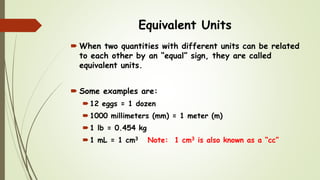
Equivalent Units
 When two quantities with different units can be related
to each other by an “equal” sign, they are called
equivalent units.
 Some examples are:
12 eggs = 1 dozen
1000 millimeters (mm) = 1 meter (m)
1 lb = 0.454 kg
1 mL = 1 cm3 Note: 1 cm3 is also known as a “cc”
Equivalent Units
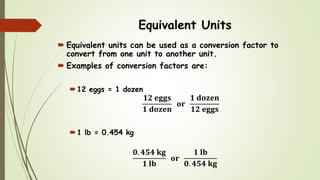
 Equivalent units can be used as a conversion factor to
convert from one unit to another unit.
 Examples of conversion factors are:
12 eggs = 1 dozen
𝟏𝟐 𝐞𝐠𝐠𝐬
𝟏 𝐝𝐨𝐳𝐞𝐧
𝐨𝐫
𝟏 𝐝𝐨𝐳𝐞𝐧
𝟏𝟐 𝐞𝐠𝐠𝐬
1 lb = 0.454 kg
𝟎. 𝟒𝟓𝟒 𝐤𝐠
𝟏 𝐥𝐛
𝐨𝐫
𝟏 𝐥𝐛
𝟎. 𝟒𝟓𝟒 𝐤𝐠
Conversion Factors
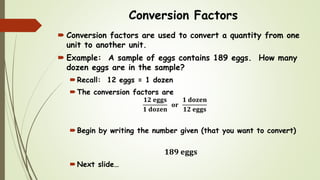
 Conversion factors are used to convert a quantity from one
unit to another unit.
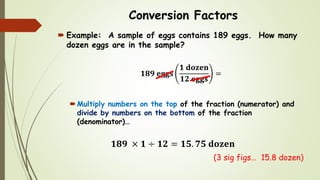
 Example: A sample of eggs contains 189 eggs. How many
dozen eggs are in the sample?
Recall: 12 eggs = 1 dozen
The conversion factors are
𝟏𝟐 𝐞𝐠𝐠𝐬
𝟏 𝐝𝐨𝐳𝐞𝐧
𝐨𝐫
𝟏 𝐝𝐨𝐳𝐞𝐧
𝟏𝟐 𝐞𝐠𝐠𝐬
Begin by writing the number given (that you want to convert)
𝟏𝟖𝟗 𝐞𝐠𝐠𝐬
Next slide…
Conversion Factors
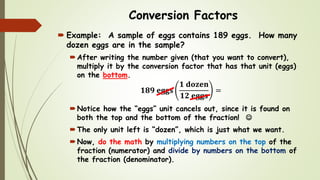
 Example: A sample of eggs contains 189 eggs. How many
dozen eggs are in the sample?
After writing the number given (that you want to convert),
multiply it by the conversion factor that has that unit (eggs)
on the bottom.
𝟏𝟖𝟗 𝐞𝐠𝐠𝐬
𝟏 𝐝𝐨𝐳𝐞𝐧
𝟏𝟐 𝐞𝐠𝐠𝐬
=
Notice how the “eggs” unit cancels out, since it is found on
both the top and the bottom of the fraction! 
The only unit left is “dozen”, which is just what we want.
Now, do the math by multiplying numbers on the top of the
fraction (numerator) and divide by numbers on the bottom of
the fraction (denominator).
Conversion Factors
 Example: A sample of eggs contains 189 eggs. How many
dozen eggs are in the sample?
𝟏𝟖𝟗 𝐞𝐠𝐠𝐬
𝟏 𝐝𝐨𝐳𝐞𝐧
𝟏𝟐 𝐞𝐠𝐠𝐬
=
Multiply numbers on the top of the fraction (numerator) and
divide by numbers on the bottom of the fraction
(denominator)…
𝟏𝟖𝟗 × 𝟏 ÷ 𝟏𝟐 = 𝟏𝟓. 𝟕𝟓 𝐝𝐨𝐳𝐞𝐧
(3 sig figs… 15.8 dozen)
Mini Quiz
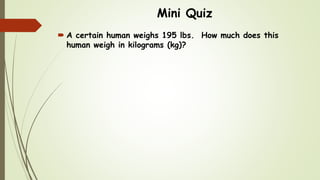
 A certain human weighs 195 lbs. How much does this
human weigh in kilograms (kg)?
Mini Quiz Solution
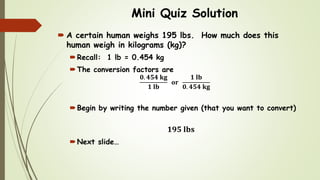
 A certain human weighs 195 lbs. How much does this
human weigh in kilograms (kg)?
Recall: 1 lb = 0.454 kg
The conversion factors are
𝟎. 𝟒𝟓𝟒 𝐤𝐠
𝟏 𝐥𝐛
𝐨𝐫
𝟏 𝐥𝐛
𝟎. 𝟒𝟓𝟒 𝐤𝐠
Begin by writing the number given (that you want to convert)
𝟏𝟗𝟓 𝐥𝐛𝐬
Next slide…
Conversion Factors
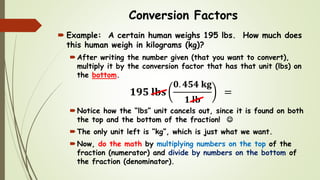
 Example: A certain human weighs 195 lbs. How much does
this human weigh in kilograms (kg)?
After writing the number given (that you want to convert),
multiply it by the conversion factor that has that unit (lbs) on
the bottom.
𝟏𝟗𝟓 𝐥𝐛𝐬
𝟎. 𝟒𝟓𝟒 𝐤𝐠
𝟏 𝐥𝐛
=
Notice how the “lbs” unit cancels out, since it is found on both
the top and the bottom of the fraction! 
The only unit left is “kg”, which is just what we want.
Now, do the math by multiplying numbers on the top of the
fraction (numerator) and divide by numbers on the bottom of
the fraction (denominator).
Conversion Factors
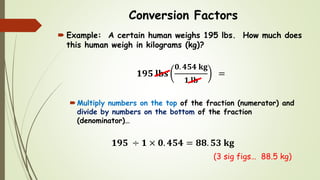
 Example: A certain human weighs 195 lbs. How much does
this human weigh in kilograms (kg)?
𝟏𝟗𝟓 𝐥𝐛𝐬
𝟎. 𝟒𝟓𝟒 𝐤𝐠
𝟏 𝐥𝐛
=
Multiply numbers on the top of the fraction (numerator) and
divide by numbers on the bottom of the fraction
(denominator)…
𝟏𝟗𝟓 ÷ 𝟏 × 𝟎. 𝟒𝟓𝟒 = 𝟖𝟖. 𝟓𝟑 𝐤𝐠
(3 sig figs… 88.5 kg)

Dimensional analysis final

  • 1.
    Dimensional Analysis This workis licensed by Shawn P. Shields-Maxwell under a Creative Commons Attribution-NonCommercial-ShareAlike 4.0 International License.
  • 2.
    Equivalent Units  Whentwo quantities with different units can be related to each other by an “equal” sign, they are called equivalent units.  Some examples are: 12 eggs = 1 dozen 1000 millimeters (mm) = 1 meter (m) 1 lb = 0.454 kg 1 mL = 1 cm3 Note: 1 cm3 is also known as a “cc”
  • 3.
    Equivalent Units  Equivalentunits can be used as a conversion factor to convert from one unit to another unit.  Examples of conversion factors are: 12 eggs = 1 dozen 𝟏𝟐 𝐞𝐠𝐠𝐬 𝟏 𝐝𝐨𝐳𝐞𝐧 𝐨𝐫 𝟏 𝐝𝐨𝐳𝐞𝐧 𝟏𝟐 𝐞𝐠𝐠𝐬 1 lb = 0.454 kg 𝟎. 𝟒𝟓𝟒 𝐤𝐠 𝟏 𝐥𝐛 𝐨𝐫 𝟏 𝐥𝐛 𝟎. 𝟒𝟓𝟒 𝐤𝐠
  • 4.
    Conversion Factors  Conversionfactors are used to convert a quantity from one unit to another unit.  Example: A sample of eggs contains 189 eggs. How many dozen eggs are in the sample? Recall: 12 eggs = 1 dozen The conversion factors are 𝟏𝟐 𝐞𝐠𝐠𝐬 𝟏 𝐝𝐨𝐳𝐞𝐧 𝐨𝐫 𝟏 𝐝𝐨𝐳𝐞𝐧 𝟏𝟐 𝐞𝐠𝐠𝐬 Begin by writing the number given (that you want to convert) 𝟏𝟖𝟗 𝐞𝐠𝐠𝐬 Next slide…
  • 5.
    Conversion Factors  Example:A sample of eggs contains 189 eggs. How many dozen eggs are in the sample? After writing the number given (that you want to convert), multiply it by the conversion factor that has that unit (eggs) on the bottom. 𝟏𝟖𝟗 𝐞𝐠𝐠𝐬 𝟏 𝐝𝐨𝐳𝐞𝐧 𝟏𝟐 𝐞𝐠𝐠𝐬 = Notice how the “eggs” unit cancels out, since it is found on both the top and the bottom of the fraction!  The only unit left is “dozen”, which is just what we want. Now, do the math by multiplying numbers on the top of the fraction (numerator) and divide by numbers on the bottom of the fraction (denominator).
  • 6.
    Conversion Factors  Example:A sample of eggs contains 189 eggs. How many dozen eggs are in the sample? 𝟏𝟖𝟗 𝐞𝐠𝐠𝐬 𝟏 𝐝𝐨𝐳𝐞𝐧 𝟏𝟐 𝐞𝐠𝐠𝐬 = Multiply numbers on the top of the fraction (numerator) and divide by numbers on the bottom of the fraction (denominator)… 𝟏𝟖𝟗 × 𝟏 ÷ 𝟏𝟐 = 𝟏𝟓. 𝟕𝟓 𝐝𝐨𝐳𝐞𝐧 (3 sig figs… 15.8 dozen)
  • 7.
    Mini Quiz  Acertain human weighs 195 lbs. How much does this human weigh in kilograms (kg)?
  • 8.
    Mini Quiz Solution A certain human weighs 195 lbs. How much does this human weigh in kilograms (kg)? Recall: 1 lb = 0.454 kg The conversion factors are 𝟎. 𝟒𝟓𝟒 𝐤𝐠 𝟏 𝐥𝐛 𝐨𝐫 𝟏 𝐥𝐛 𝟎. 𝟒𝟓𝟒 𝐤𝐠 Begin by writing the number given (that you want to convert) 𝟏𝟗𝟓 𝐥𝐛𝐬 Next slide…
  • 9.
    Conversion Factors  Example:A certain human weighs 195 lbs. How much does this human weigh in kilograms (kg)? After writing the number given (that you want to convert), multiply it by the conversion factor that has that unit (lbs) on the bottom. 𝟏𝟗𝟓 𝐥𝐛𝐬 𝟎. 𝟒𝟓𝟒 𝐤𝐠 𝟏 𝐥𝐛 = Notice how the “lbs” unit cancels out, since it is found on both the top and the bottom of the fraction!  The only unit left is “kg”, which is just what we want. Now, do the math by multiplying numbers on the top of the fraction (numerator) and divide by numbers on the bottom of the fraction (denominator).
  • 10.
    Conversion Factors  Example:A certain human weighs 195 lbs. How much does this human weigh in kilograms (kg)? 𝟏𝟗𝟓 𝐥𝐛𝐬 𝟎. 𝟒𝟓𝟒 𝐤𝐠 𝟏 𝐥𝐛 = Multiply numbers on the top of the fraction (numerator) and divide by numbers on the bottom of the fraction (denominator)… 𝟏𝟗𝟓 ÷ 𝟏 × 𝟎. 𝟒𝟓𝟒 = 𝟖𝟖. 𝟓𝟑 𝐤𝐠 (3 sig figs… 88.5 kg)