What is the difference between the
two different compounds?
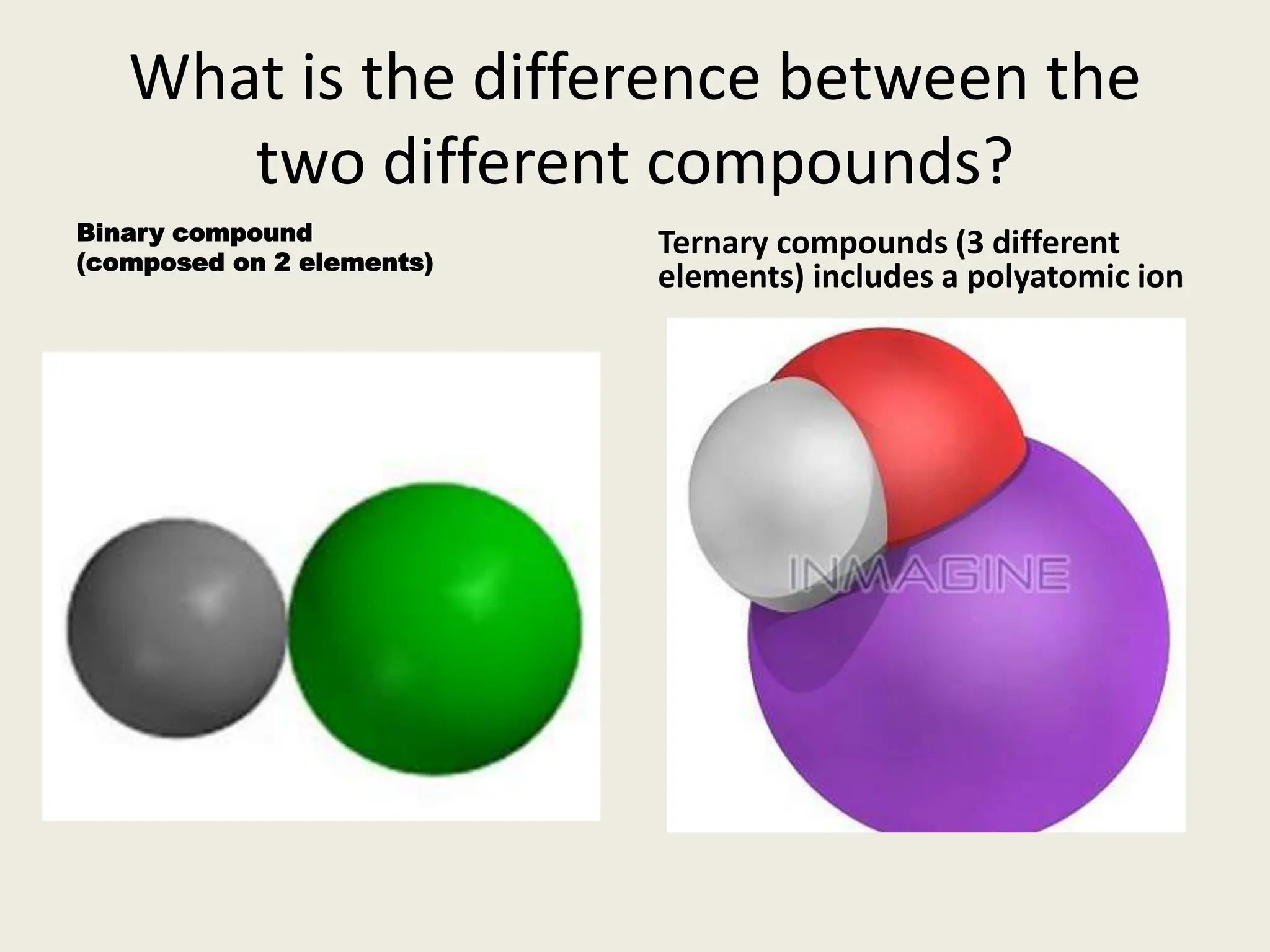
Binary compound
(composed on 2 elements)
Ternary compounds (3 different
elements) includes a polyatomic ion
Polyatomic Ions
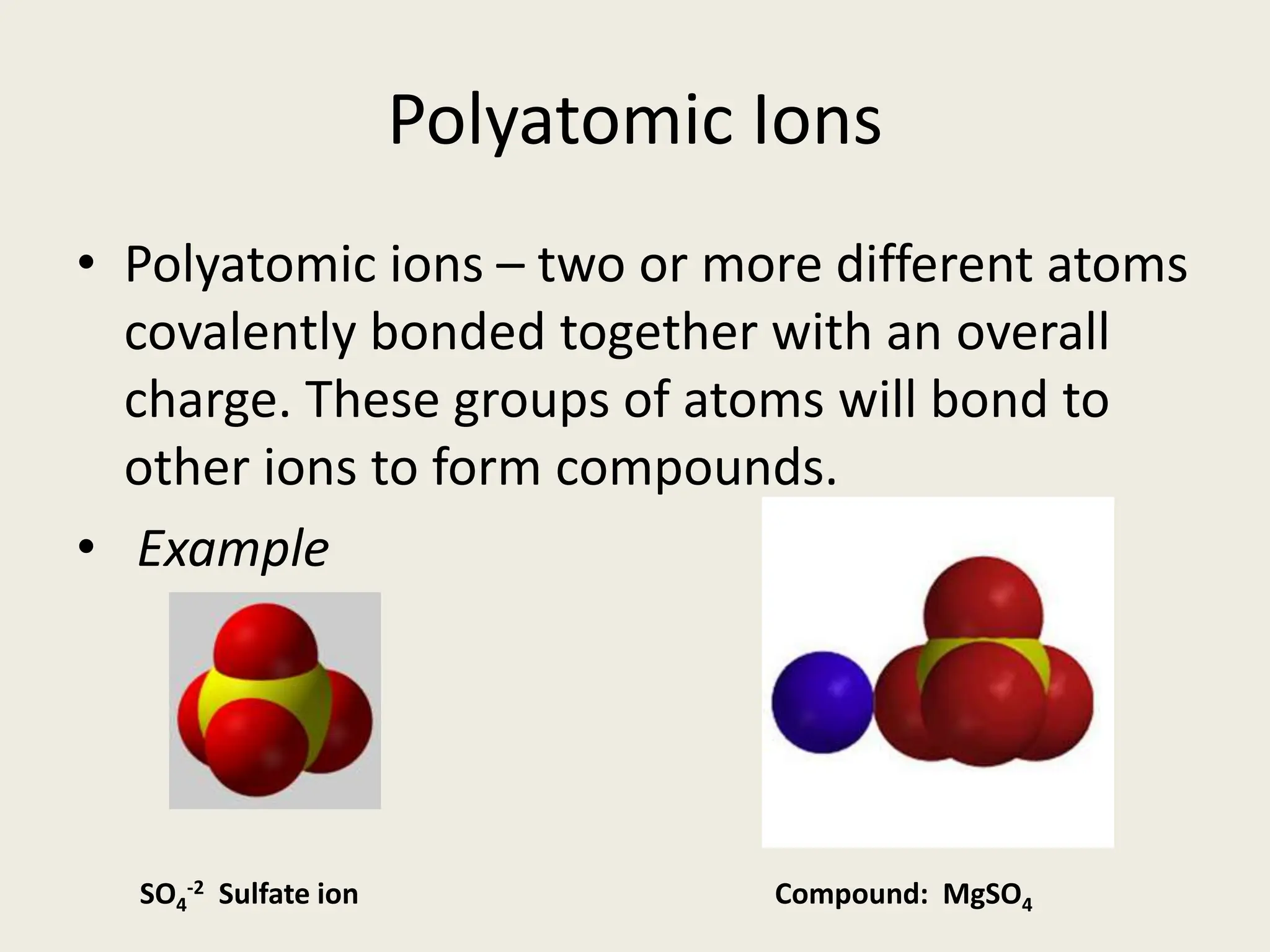
• Polyatomic ions – two or more different atoms
covalently bonded together with an overall
charge. These groups of atoms will bond to
other ions to form compounds.
• Example
SO4
-2 Sulfate ion Compound: MgSO4
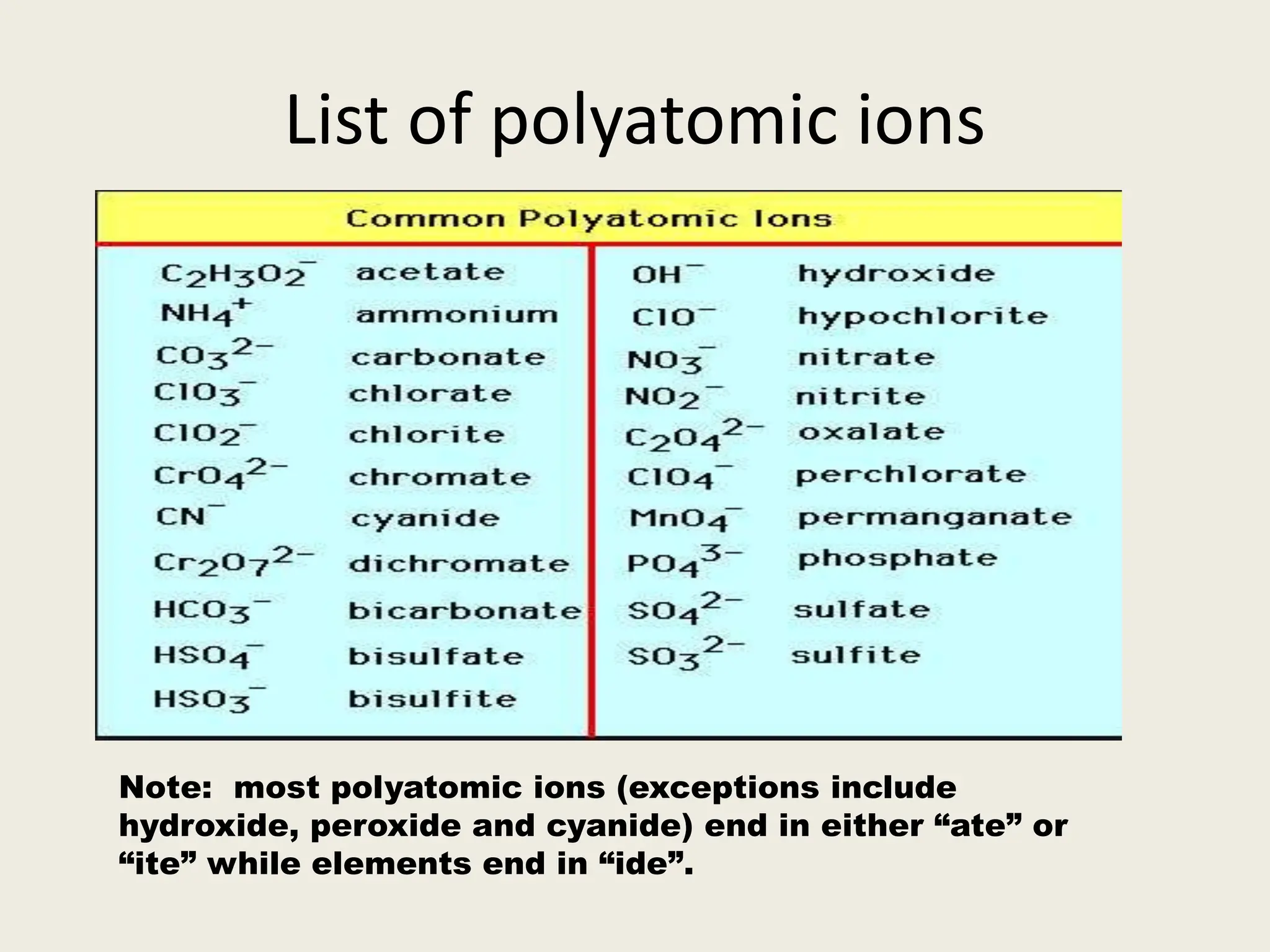
List of polyatomic ions
Note: most polyatomic ions (exceptions include
hydroxide, peroxide and cyanide) end in either “ate” or
“ite” while elements end in “ide”.
7 Polyatomic Ions to Memorize,
Name, Formula and Charge
• Name Formula and Charge
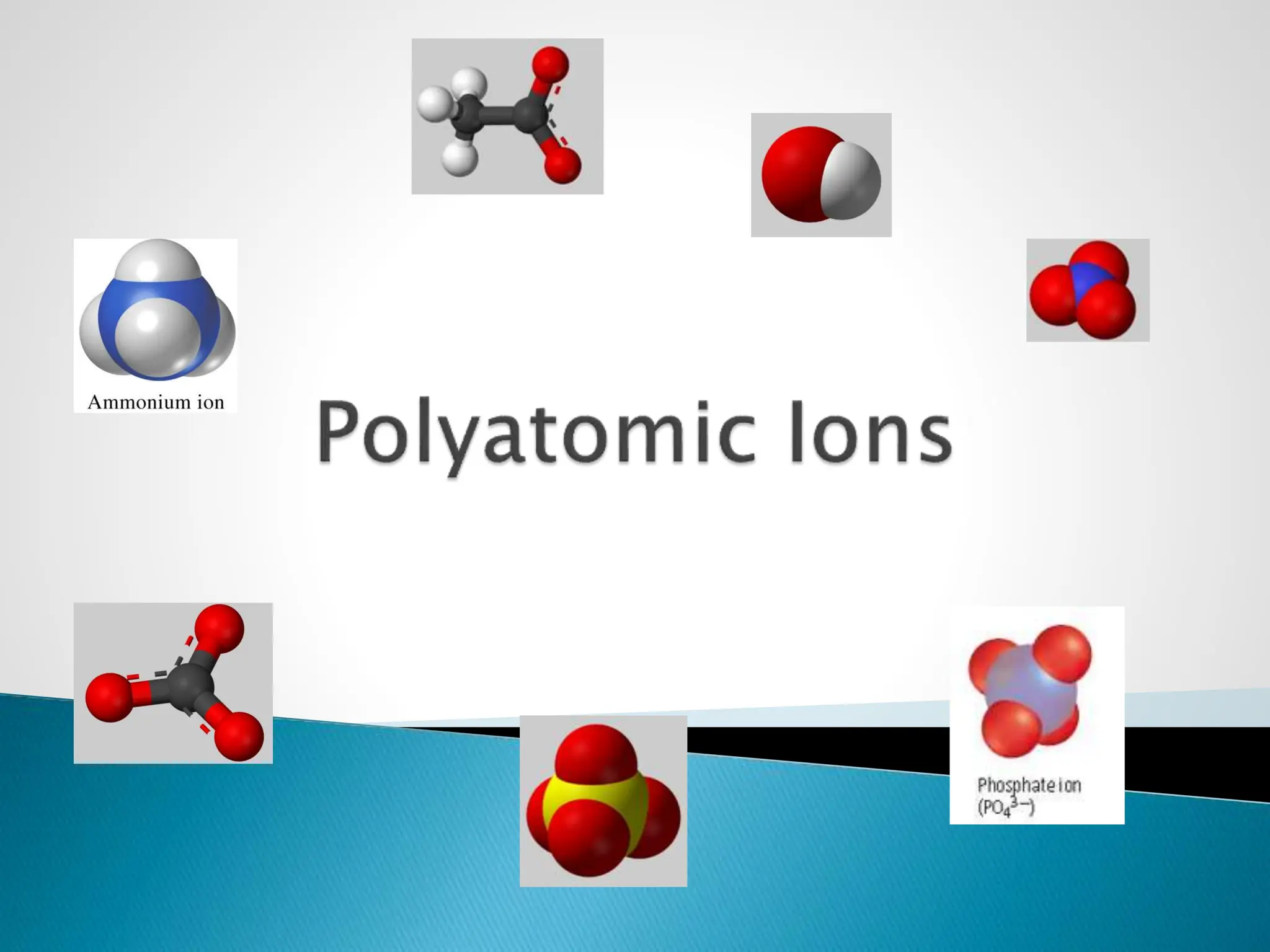
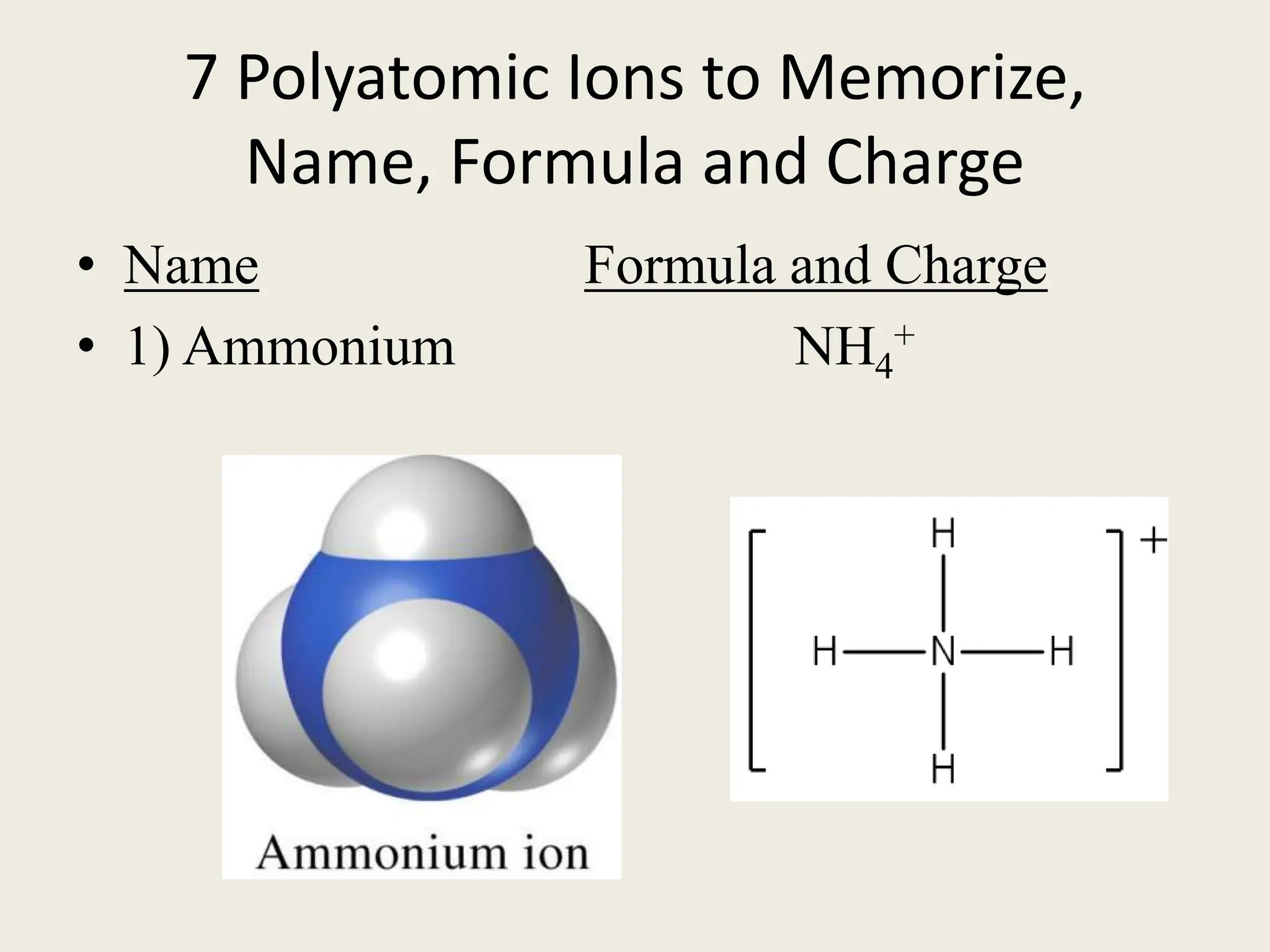
• 1) Ammonium NH4
+
7 Polyatomic Ions to Memorize,
Name, Formula and Charge
• Name Formula and Charge
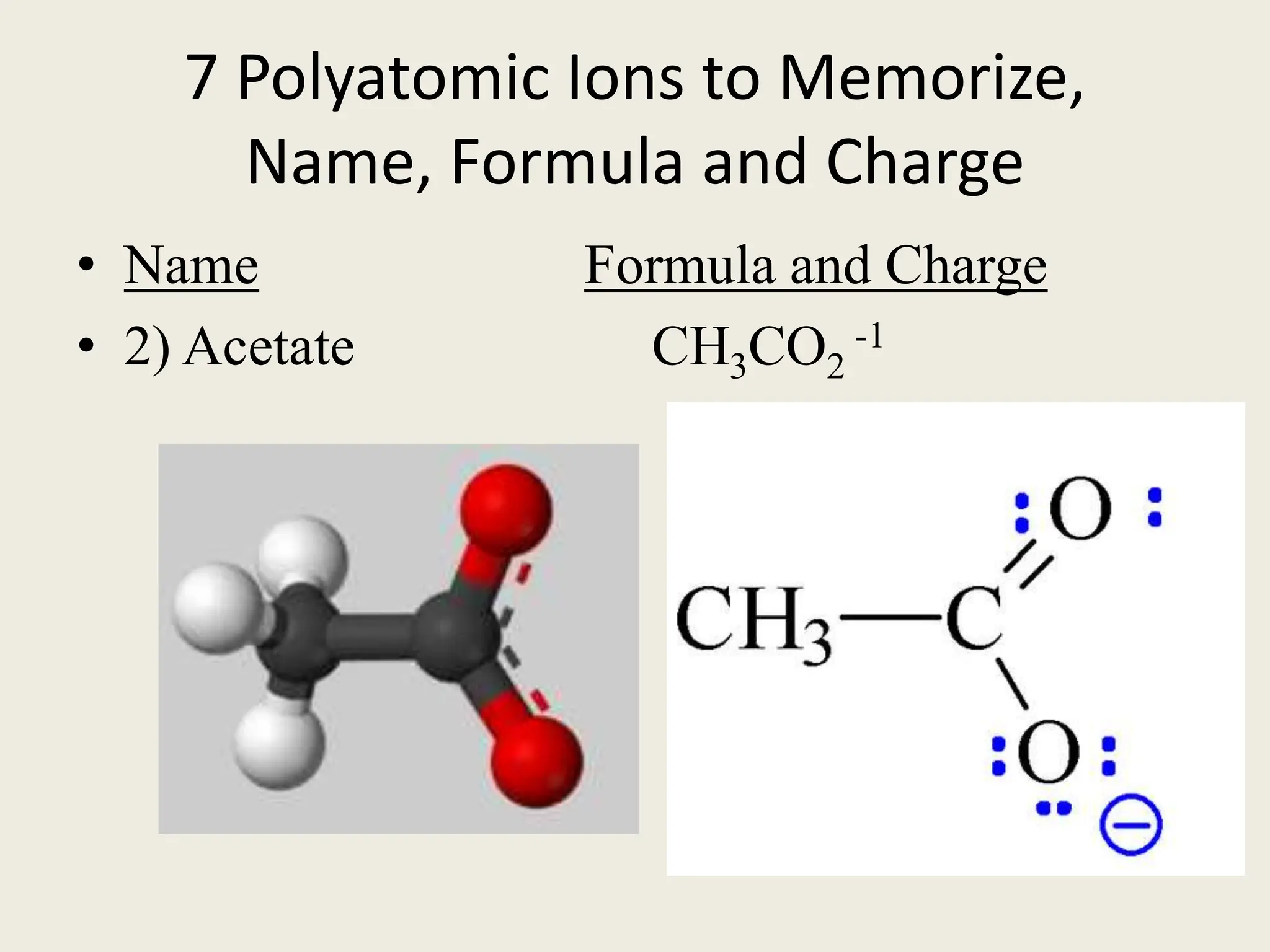
• 2) Acetate CH3CO2
-1
7 Polyatomic Ions to Memorize,
Name, Formula and Charge
• Name Formula and Charge
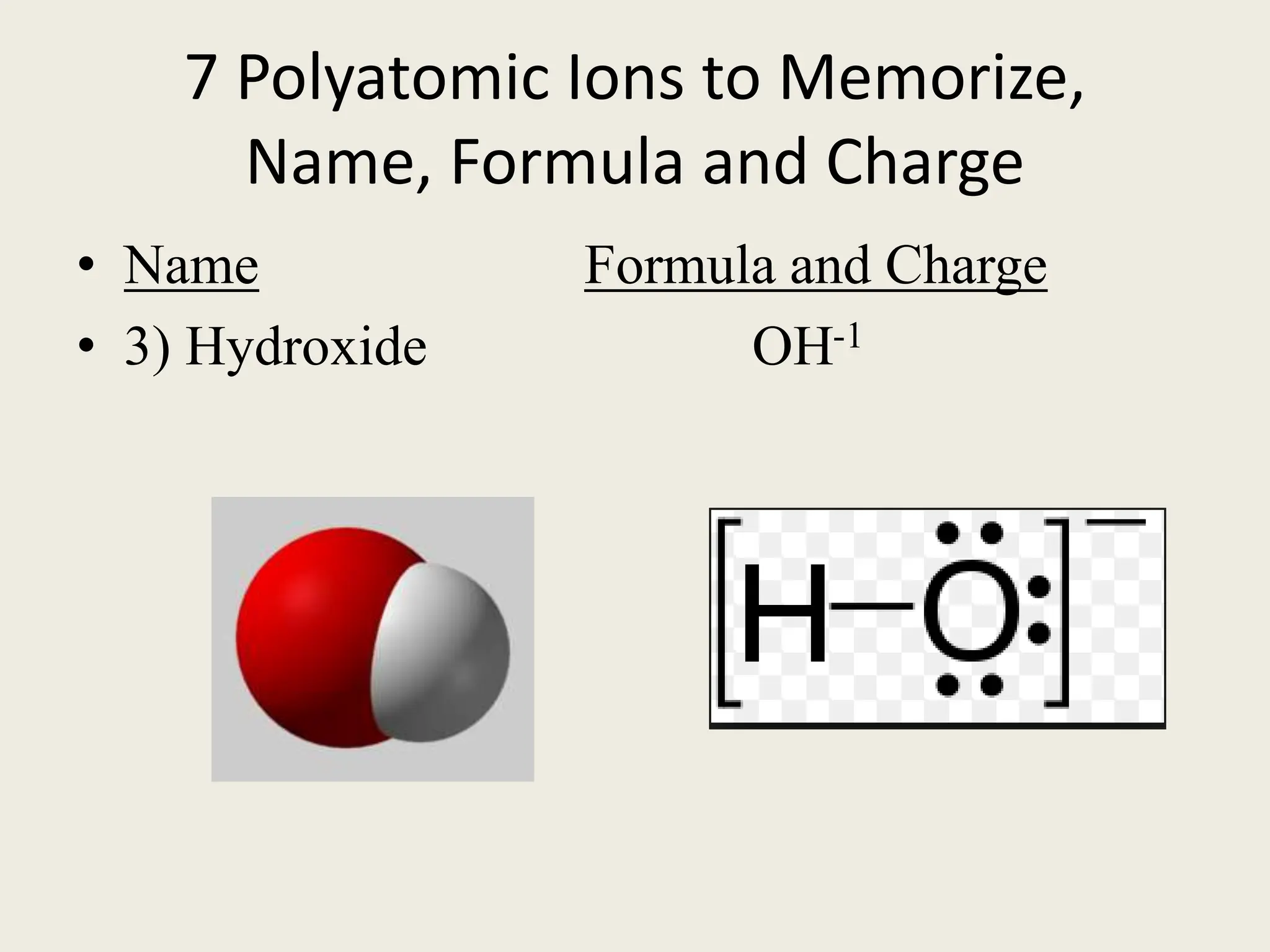
• 3) Hydroxide OH-1
7 Polyatomic Ions to Memorize,
Name, Formula and Charge
• Name Formula and Charge
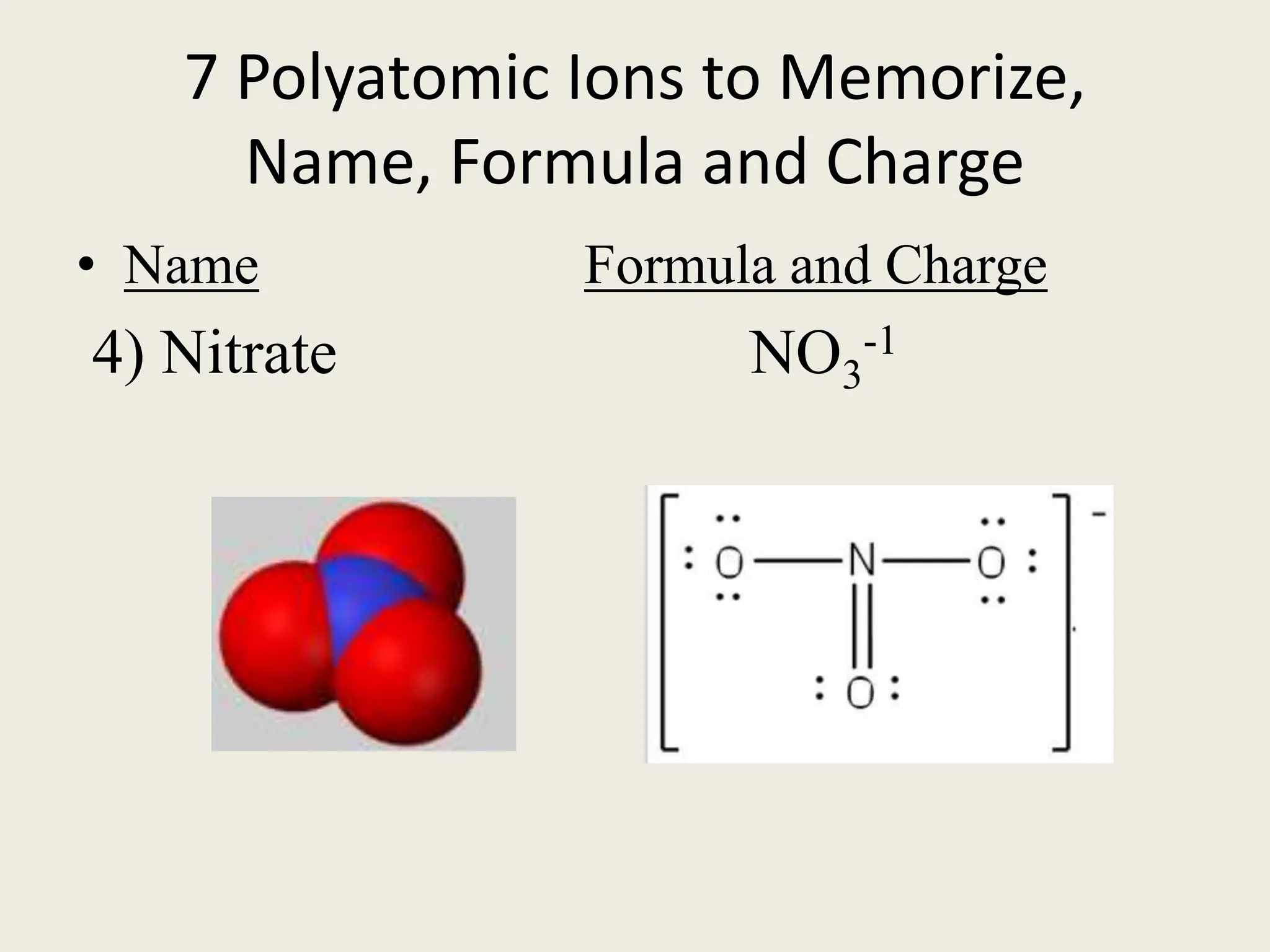
4) Nitrate NO3
-1
7 Polyatomic Ions to Memorize,
Name, Formula and Charge
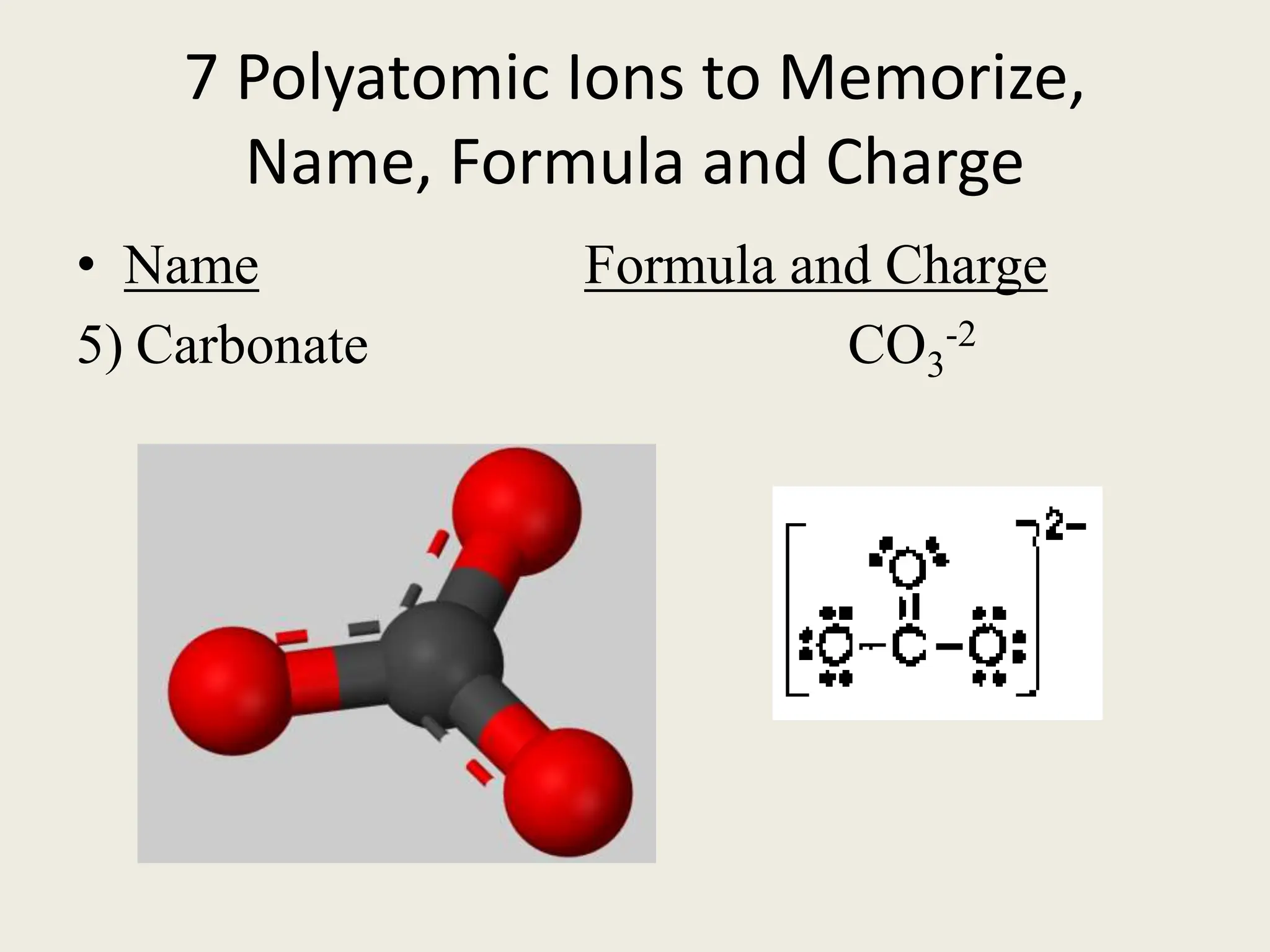
• Name Formula and Charge
5) Carbonate CO3
-2
7 Polyatomic Ions to Memorize,
Name, Formula and Charge
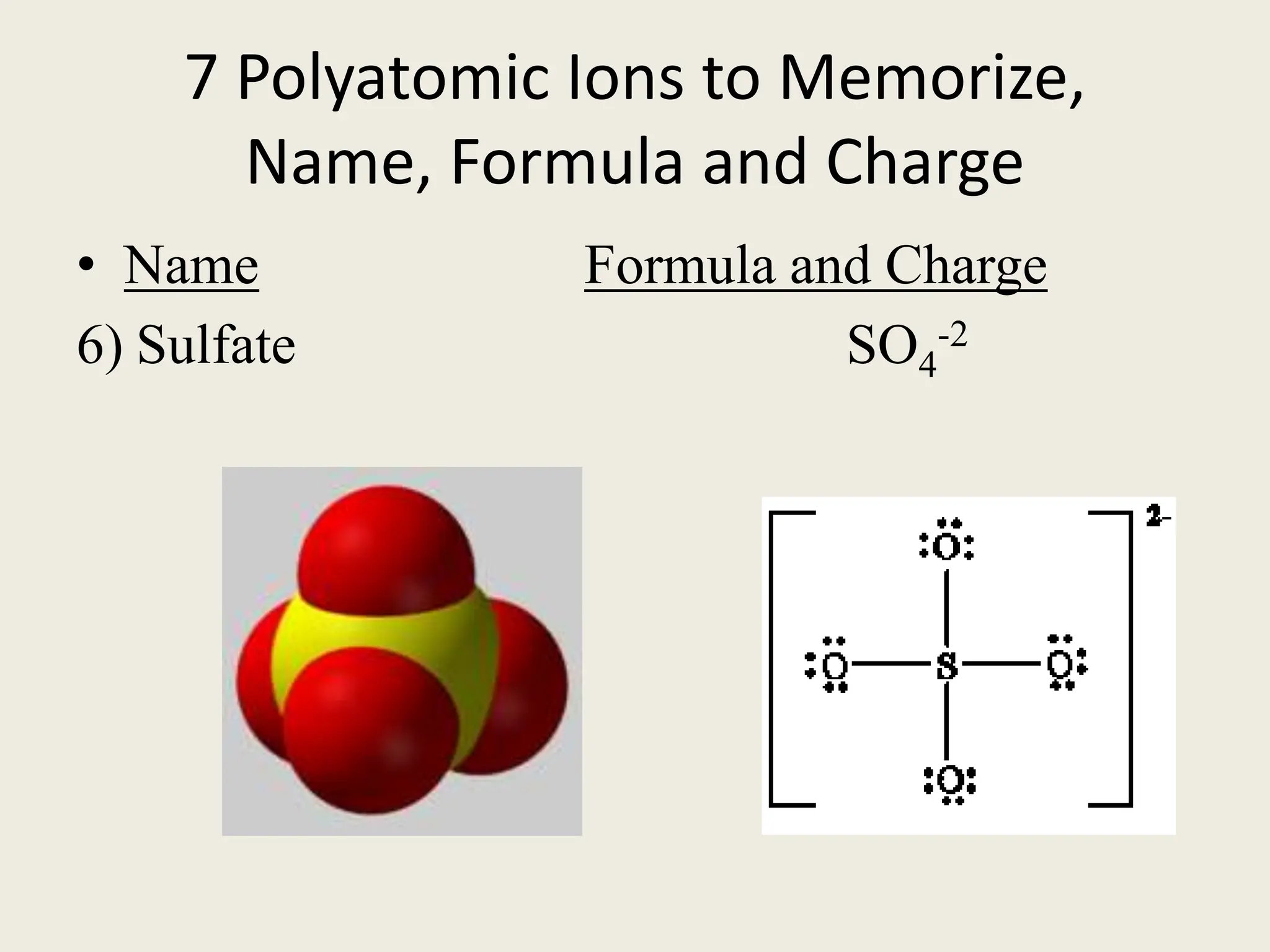
• Name Formula and Charge
6) Sulfate SO4
-2
7 Polyatomic Ions to Memorize,
Name, Formula and Charge
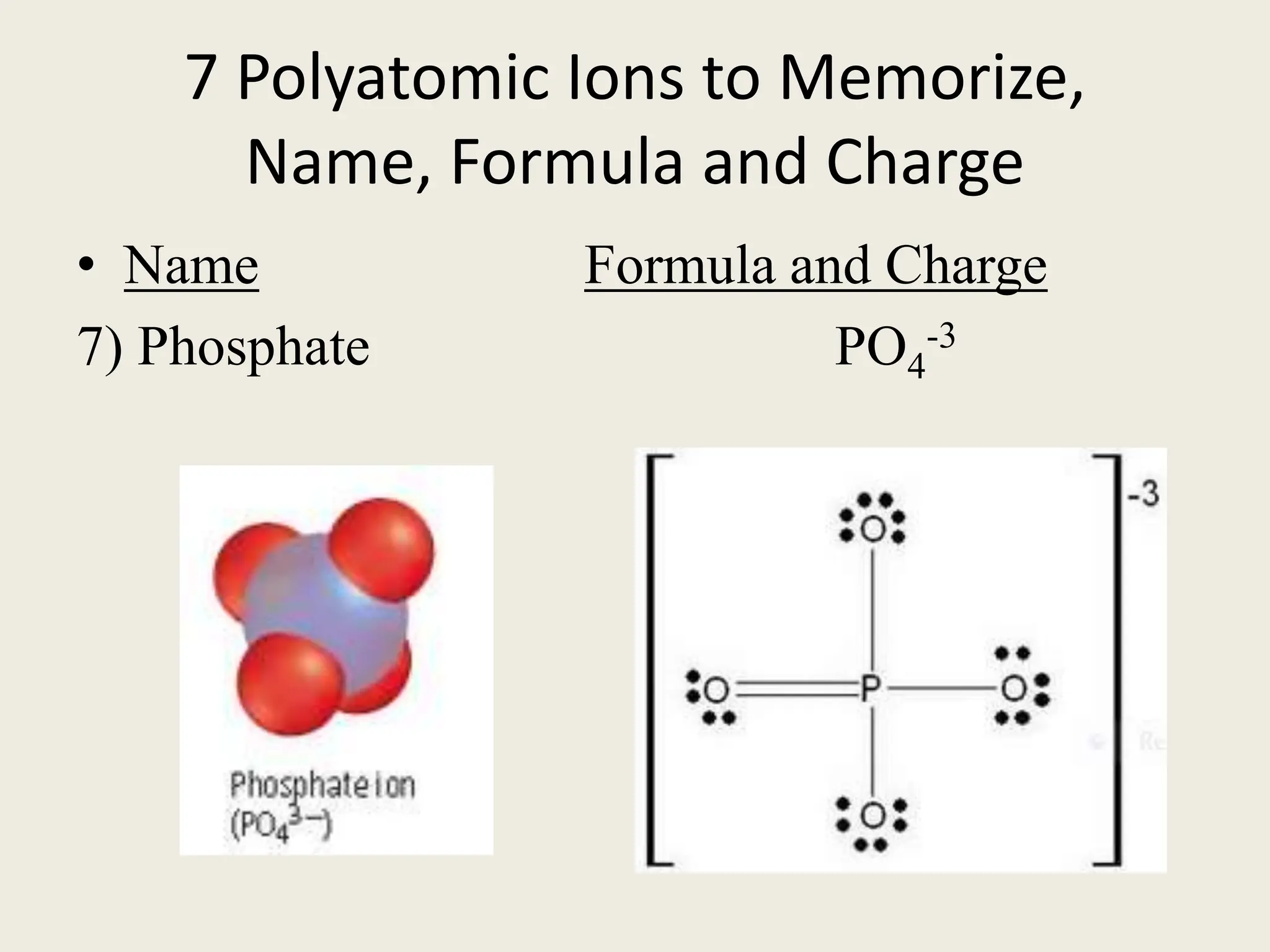
• Name Formula and Charge
7) Phosphate PO4
-3
Concept Check: How many IONS are present
in each of the following?
• (Hints for a-c each ion is enclosed in [ ];
• A) [K]+[OH]-
• B) [Na]+[CO3
-2 ] [Na]+
C) [Na]+ [PO4]-3 [Na]+
[Na]+
Ans: 2
Ans: 3
Ans: 4
Concept Check
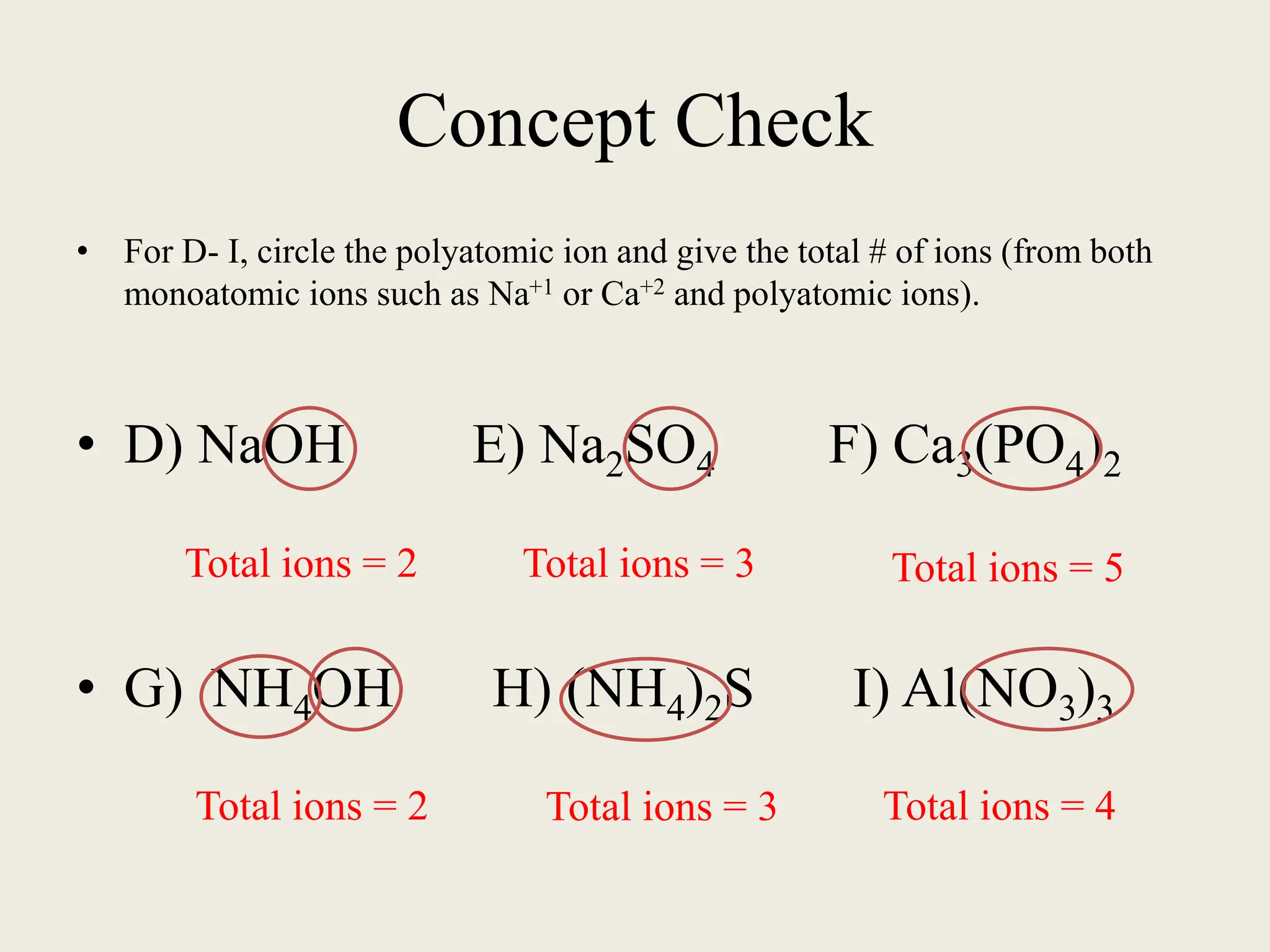
• For D- I, circle the polyatomic ion and give the total # of ions (from both
monoatomic ions such as Na+1 or Ca+2 and polyatomic ions).
• D) NaOH E) Na2SO4 F) Ca3(PO4)2
• G) NH4OH H) (NH4)2S I) Al(NO3)3
Total ions = 2 Total ions = 3 Total ions = 5
Total ions = 2 Total ions = 3 Total ions = 4
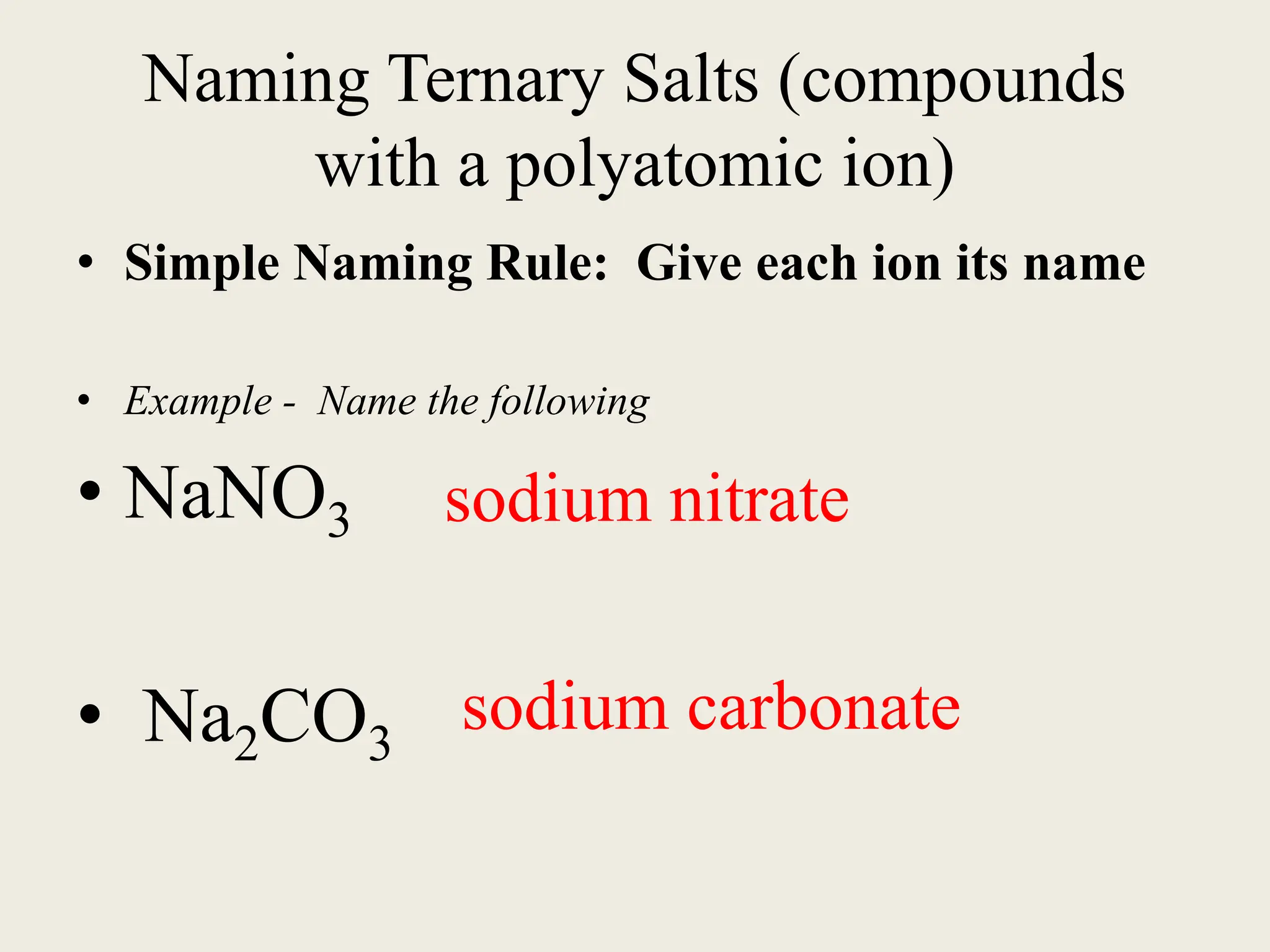
Naming Ternary Salts (compounds
with a polyatomic ion)
• Simple Naming Rule: Give each ion its name
• Example - Name the following
• NaNO3
• Na2CO3
sodium nitrate
sodium carbonate
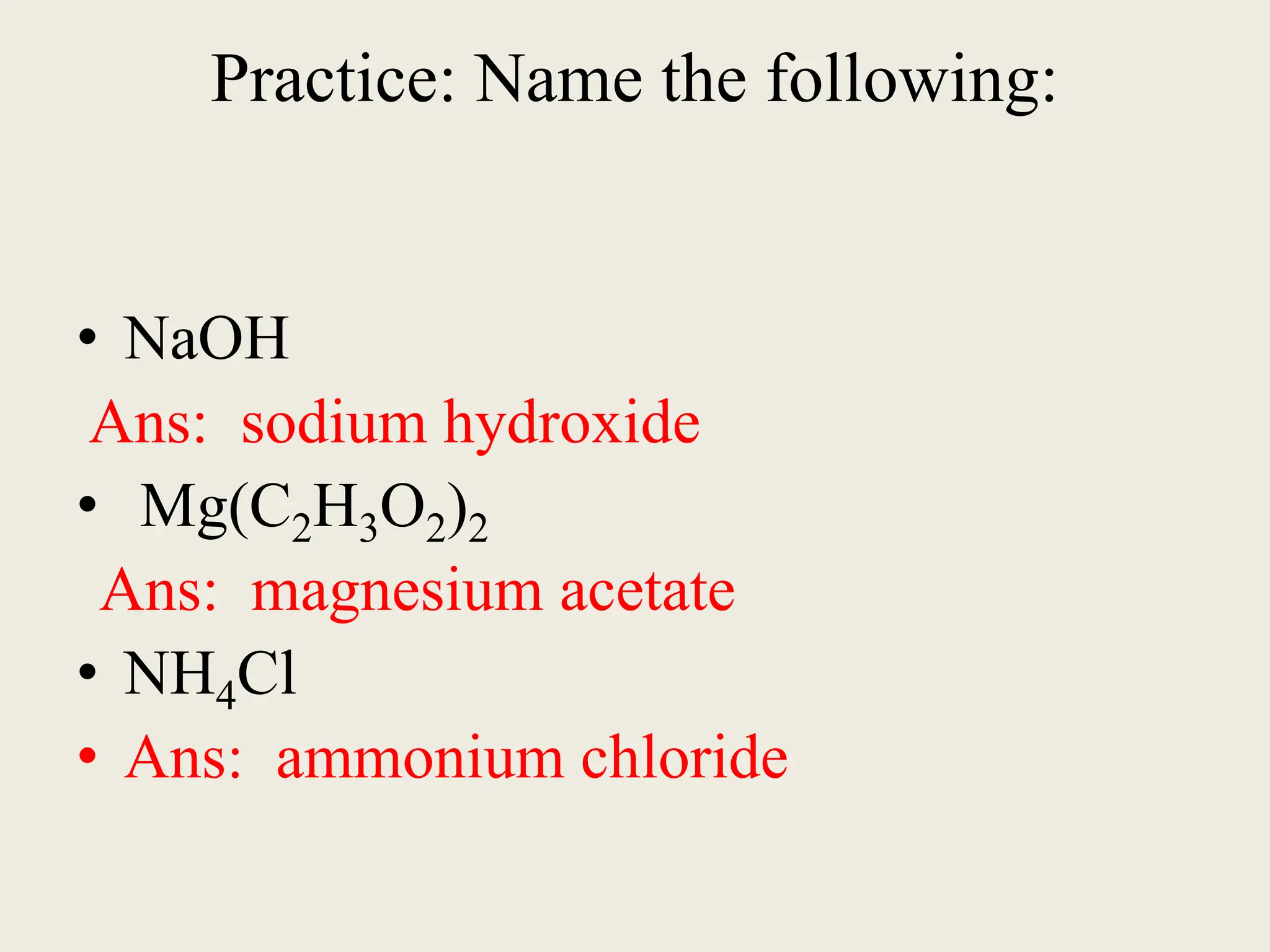
Practice: Name the following:
• NaOH
Ans: sodium hydroxide
• Mg(C2H3O2)2
Ans: magnesium acetate
• NH4Cl
• Ans: ammonium chloride
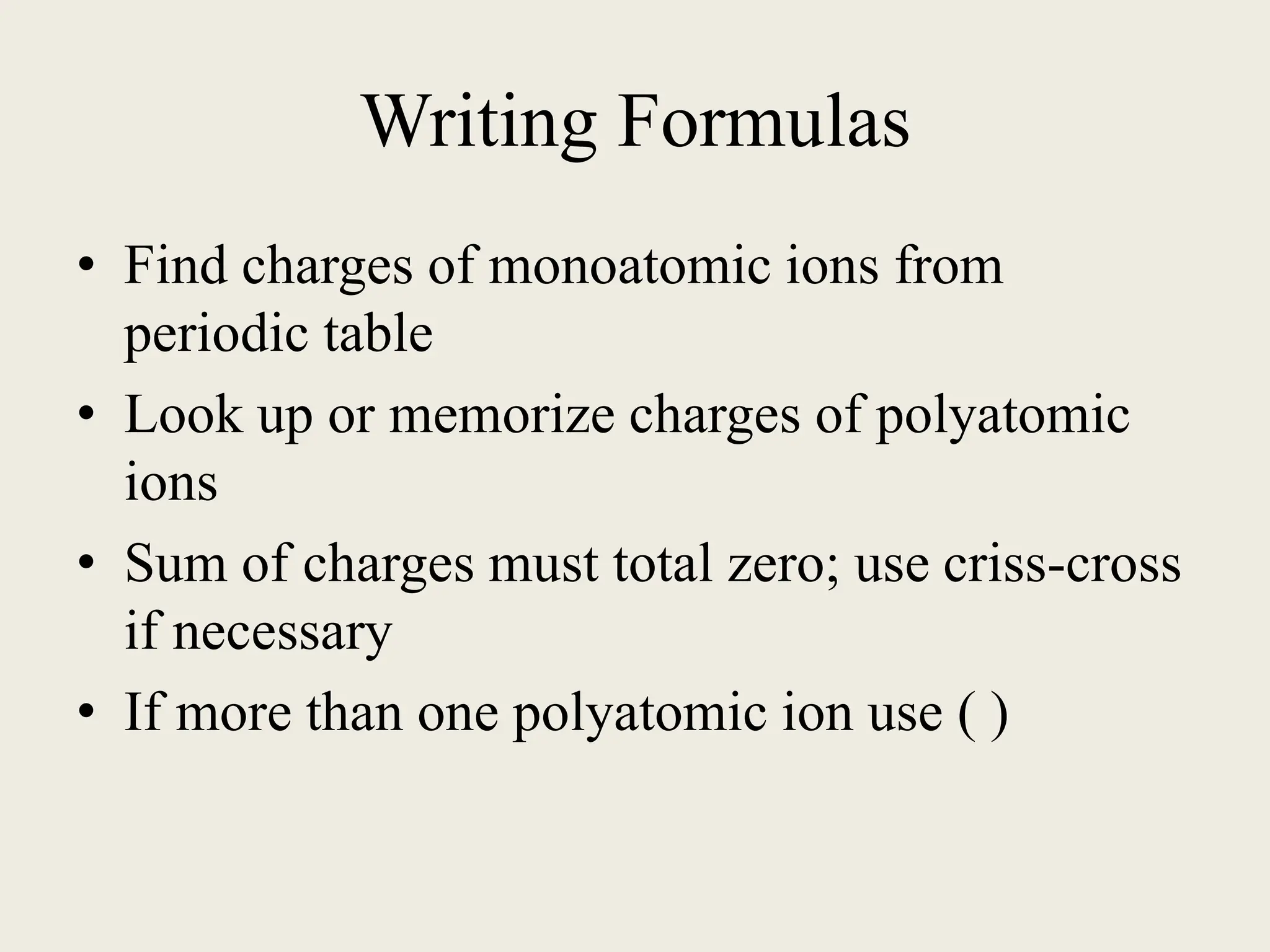
Writing Formulas
• Find charges of monoatomic ions from
periodic table
• Look up or memorize charges of polyatomic
ions
• Sum of charges must total zero; use criss-cross
if necessary
• If more than one polyatomic ion use ( )
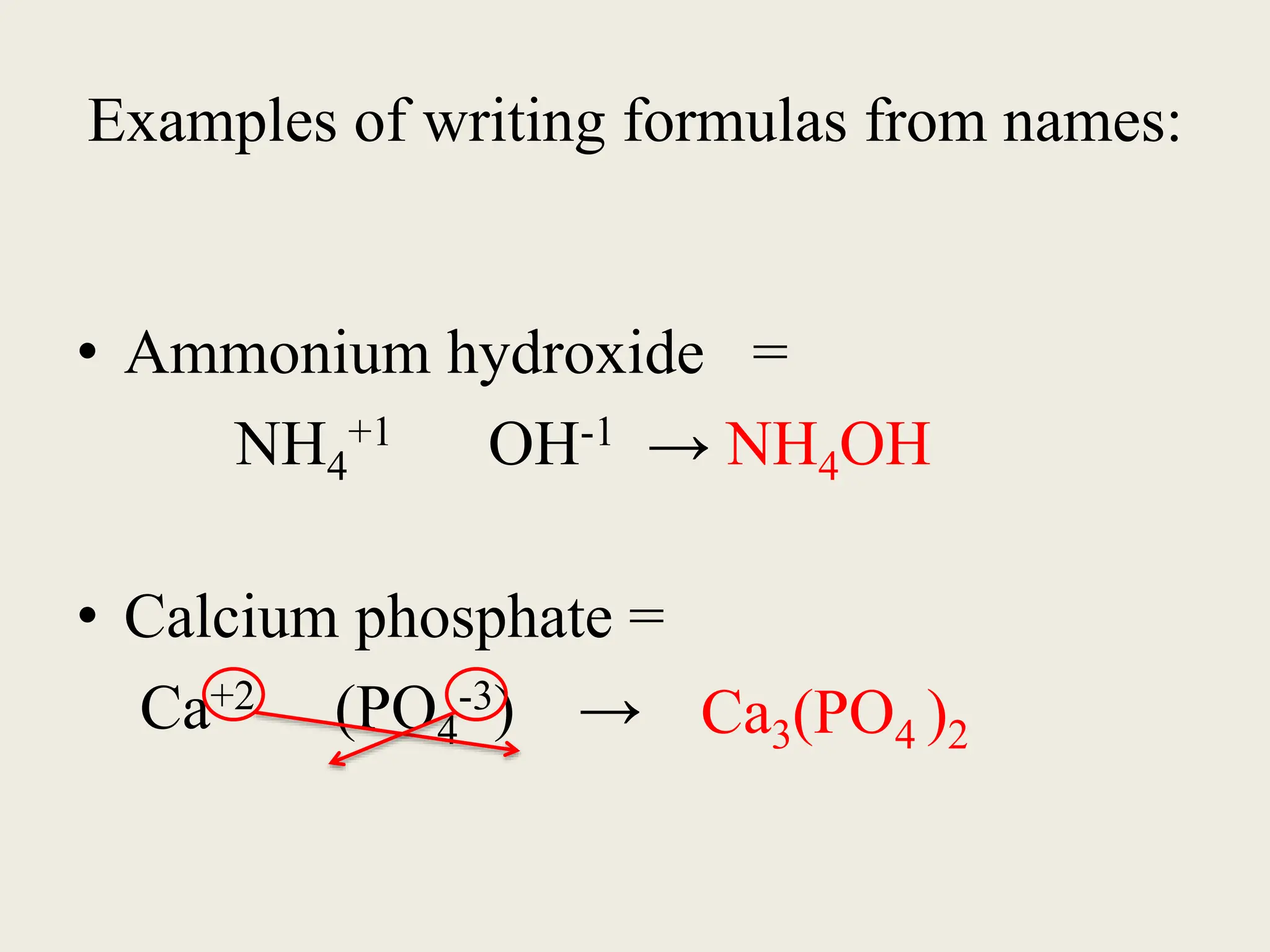
Examples of writing formulas from names:
• Ammonium hydroxide =
NH4
+1 OH-1 → NH4OH
• Calcium phosphate =
Ca+2 (PO4
-3) → Ca3(PO4 )2
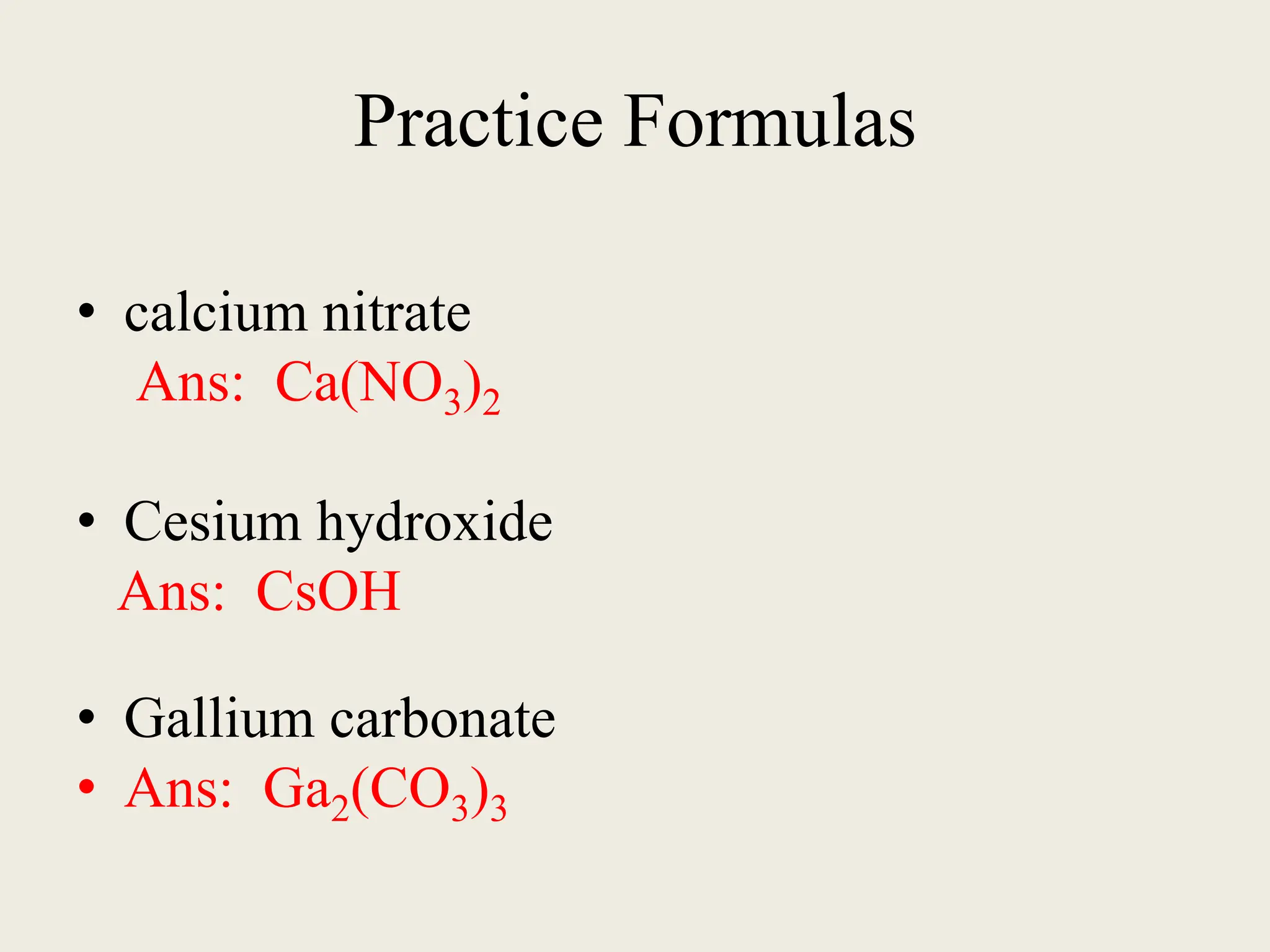
Practice Formulas
• calcium nitrate
Ans: Ca(NO3)2
• Cesium hydroxide
Ans: CsOH
• Gallium carbonate
• Ans: Ga2(CO3)3
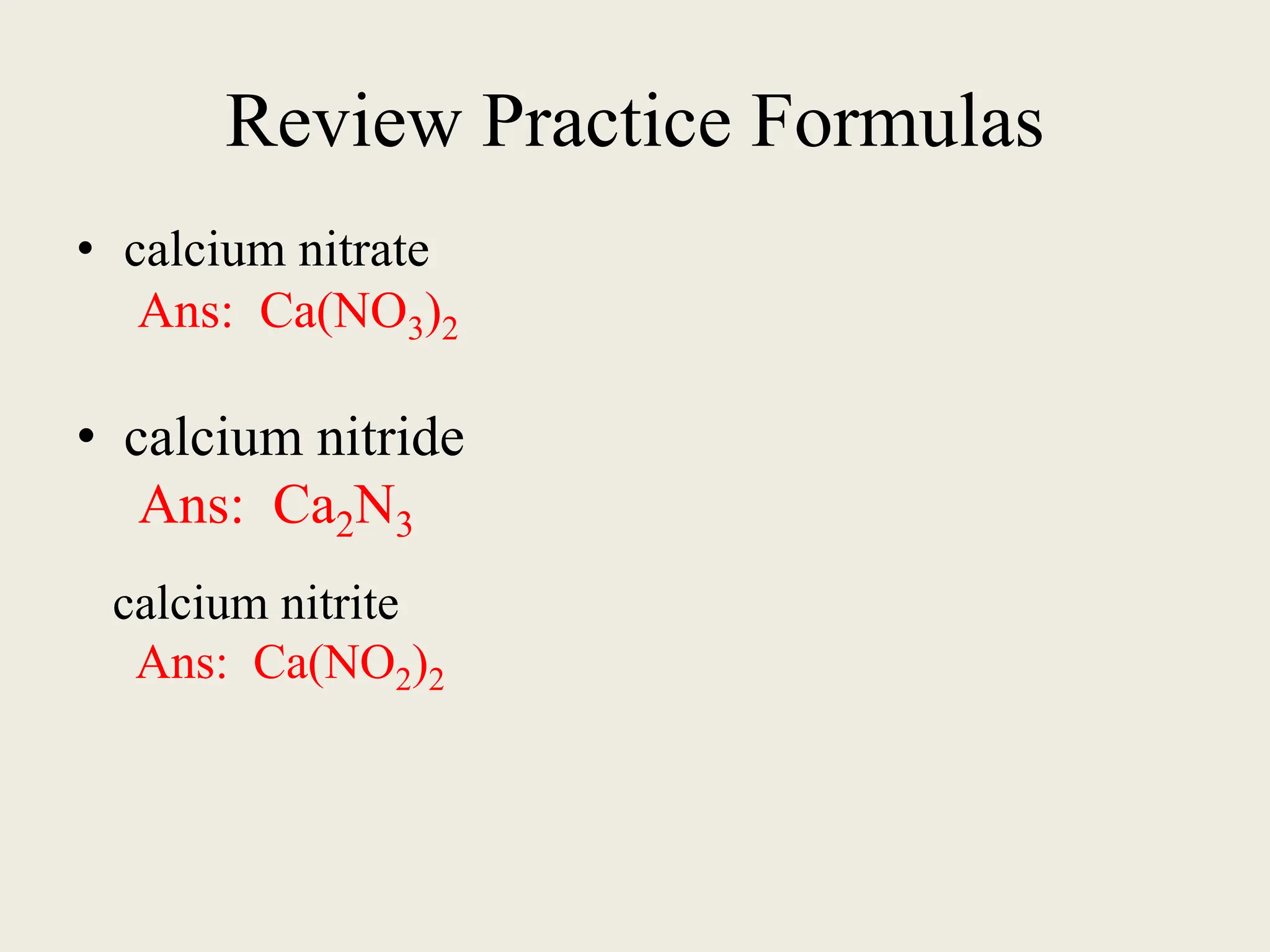
Review Practice Formulas
• calcium nitrate
Ans: Ca(NO3)2
• calcium nitride
Ans: Ca2N3
calcium nitrite
Ans: Ca(NO2)2

Polyatomic Ions - What is the difference between the two different compounds?.pptx

  • 2.
    What is thedifference between the two different compounds? Binary compound (composed on 2 elements) Ternary compounds (3 different elements) includes a polyatomic ion
  • 3.
    Polyatomic Ions • Polyatomicions – two or more different atoms covalently bonded together with an overall charge. These groups of atoms will bond to other ions to form compounds. • Example SO4 -2 Sulfate ion Compound: MgSO4
  • 4.
    List of polyatomicions Note: most polyatomic ions (exceptions include hydroxide, peroxide and cyanide) end in either “ate” or “ite” while elements end in “ide”.
  • 5.
    7 Polyatomic Ionsto Memorize, Name, Formula and Charge • Name Formula and Charge • 1) Ammonium NH4 +
  • 6.
    7 Polyatomic Ionsto Memorize, Name, Formula and Charge • Name Formula and Charge • 2) Acetate CH3CO2 -1
  • 7.
    7 Polyatomic Ionsto Memorize, Name, Formula and Charge • Name Formula and Charge • 3) Hydroxide OH-1
  • 8.
    7 Polyatomic Ionsto Memorize, Name, Formula and Charge • Name Formula and Charge 4) Nitrate NO3 -1
  • 9.
    7 Polyatomic Ionsto Memorize, Name, Formula and Charge • Name Formula and Charge 5) Carbonate CO3 -2
  • 10.
    7 Polyatomic Ionsto Memorize, Name, Formula and Charge • Name Formula and Charge 6) Sulfate SO4 -2
  • 11.
    7 Polyatomic Ionsto Memorize, Name, Formula and Charge • Name Formula and Charge 7) Phosphate PO4 -3
  • 12.
    Concept Check: Howmany IONS are present in each of the following? • (Hints for a-c each ion is enclosed in [ ]; • A) [K]+[OH]- • B) [Na]+[CO3 -2 ] [Na]+ C) [Na]+ [PO4]-3 [Na]+ [Na]+ Ans: 2 Ans: 3 Ans: 4
  • 13.
    Concept Check • ForD- I, circle the polyatomic ion and give the total # of ions (from both monoatomic ions such as Na+1 or Ca+2 and polyatomic ions). • D) NaOH E) Na2SO4 F) Ca3(PO4)2 • G) NH4OH H) (NH4)2S I) Al(NO3)3 Total ions = 2 Total ions = 3 Total ions = 5 Total ions = 2 Total ions = 3 Total ions = 4
  • 14.
    Naming Ternary Salts(compounds with a polyatomic ion) • Simple Naming Rule: Give each ion its name • Example - Name the following • NaNO3 • Na2CO3 sodium nitrate sodium carbonate
  • 15.
    Practice: Name thefollowing: • NaOH Ans: sodium hydroxide • Mg(C2H3O2)2 Ans: magnesium acetate • NH4Cl • Ans: ammonium chloride
  • 16.
    Writing Formulas • Findcharges of monoatomic ions from periodic table • Look up or memorize charges of polyatomic ions • Sum of charges must total zero; use criss-cross if necessary • If more than one polyatomic ion use ( )
  • 17.
    Examples of writingformulas from names: • Ammonium hydroxide = NH4 +1 OH-1 → NH4OH • Calcium phosphate = Ca+2 (PO4 -3) → Ca3(PO4 )2
  • 18.
    Practice Formulas • calciumnitrate Ans: Ca(NO3)2 • Cesium hydroxide Ans: CsOH • Gallium carbonate • Ans: Ga2(CO3)3
  • 19.
    Review Practice Formulas •calcium nitrate Ans: Ca(NO3)2 • calcium nitride Ans: Ca2N3 calcium nitrite Ans: Ca(NO2)2