MID-POINT LINE
PLOTTING ALGORITHM
MADE BY: DIMPY
CHUGH (1833)
DRISHTI BHALLA (1838)
INTRODUCTION
The Midpoint line algorithm is an incremental line plotting algorithm
i.e. at each step we make incremental calculations based on
preceding step to find next y value, in order to form a close
approximation to a straight line between two points.
 It chooses the pixels closest to the line with accuracy, consistency
and straightness.
 It is very simple and requires only integer data and simple
arithmetic.
 It avoids division and multiplication and thus avoid truncate
errors.
ADVANTAGES
BASISOF ALGORITHM
 Given the previous pixel P, there are two candidates for the next pixel
closest to the line, E and NE .
 If the M is above the line, choose E. If M is below the line, choose NE.
Previous pixel Choices for
current pixel
Previous pixel Choices for
current pixel
Assumptions:
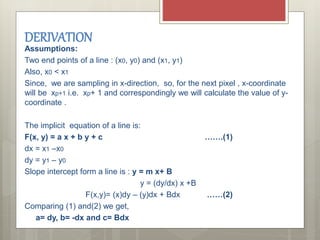
Two end points of a line : (x0, y0) and (x1, y1)
Also, x0 < x1
Since, we are sampling in x-direction, so, for the next pixel , x-coordinate
will be xp+1 i.e. xp+ 1 and correspondingly we will calculate the value of y-
coordinate .
The implicit equation of a line is:
F(x, y) = a x + b y + c …….(1)
dx = x1 –x0
dy = y1 – y0
Slope intercept form a line is : y = m x+ B
y = (dy/dx) x +B
F(x,y)= (x)dy – (y)dx + Bdx ……(2)
Comparing (1) and(2) we get,
a= dy, b= -dx and c= Bdx
DERIVATION
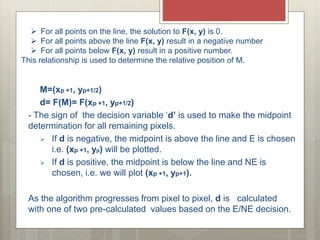
M=(xp +1, yp+1/2)
d= F(M)= F(xp +1, yp+1/2)
- The sign of the decision variable ‘d’ is used to make the midpoint
determination for all remaining pixels.
 If d is negative, the midpoint is above the line and E is chosen
i.e. (xp +1, yp) will be plotted.
 If d is positive, the midpoint is below the line and NE is
chosen, i.e. we will plot (xp +1, yp+1).
As the algorithm progresses from pixel to pixel, d is calculated
with one of two pre-calculated values based on the E/NE decision.
 For all points on the line, the solution to F(x, y) is 0.
 For all points above the line F(x, y) result in a negative number
 For all points below F(x, y) result in a positive number.
This relationship is used to determine the relative position of M.
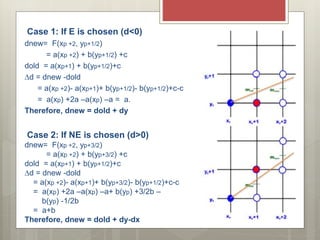
Case 1: If E is chosen (d<0)
dnew= F(xp +2, yp+1/2)
= a(xp +2) + b(yp+1/2) +c
dold = a(xp+1) + b(yp+1/2)+c
∆d = dnew -dold
= a(xp +2)- a(xp+1)+ b(yp+1/2)- b(yp+1/2)+c-c
= a(xp) +2a –a(xp) –a = a.
Therefore, dnew = dold + dy
Case 2: If NE is chosen (d>0)
dnew= F(xp +2, yp+3/2)
= a(xp +2) + b(yp+3/2) +c
dold = a(xp+1) + b(yp+1/2)+c
∆d = dnew -dold
= a(xp +2)- a(xp+1)+ b(yp+3/2)- b(yp+1/2)+c-c
= a(xp) +2a –a(xp) –a+ b(yp) +3/2b –
b(yp) -1/2b
= a+b
Therefore, dnew = dold + dy-dx
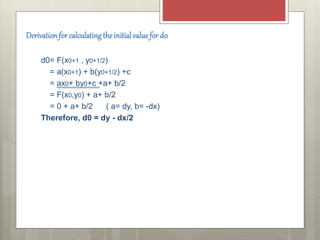
d0= F(x0+1 , y0+1/2)
= a(x0+1) + b(y0+1/2) +c
= ax0+ by0+c +a+ b/2
= F(x0,y0) + a+ b/2
= 0 + a+ b/2 ( a= dy, b= -dx)
Therefore, d0 = dy - dx/2
Derivationforcalculatingthe initial value for d0
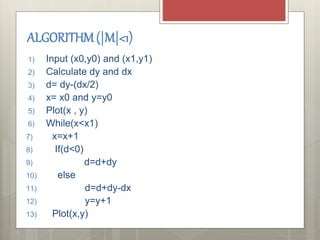
ALGORITHM(|M|<1)
1) Input (x0,y0) and (x1,y1)
2) Calculate dy and dx
3) d= dy-(dx/2)
4) x= x0 and y=y0
5) Plot(x , y)
6) While(x<x1)
7) x=x+1
8) If(d<0)
9) d=d+dy
10) else
11) d=d+dy-dx
12) y=y+1
13) Plot(x,y)
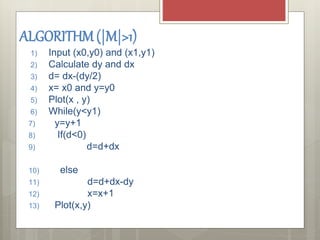
ALGORITHM (|M|>1)
1) Input (x0,y0) and (x1,y1)
2) Calculate dy and dx
3) d= dx-(dy/2)
4) x= x0 and y=y0
5) Plot(x , y)
6) While(y<y1)
7) y=y+1
8) If(d<0)
9) d=d+dx
10) else
11) d=d+dx-dy
12) x=x+1
13) Plot(x,y)
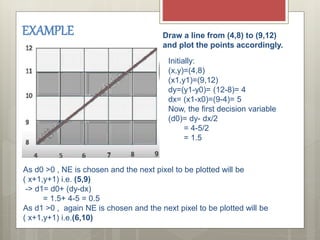
EXAMPLE Draw a line from (4,8) to (9,12)
and plot the points accordingly.
Initially:
(x,y)=(4,8)
(x1,y1)=(9,12)
dy=(y1-y0)= (12-8)= 4
dx= (x1-x0)=(9-4)= 5
Now, the first decision variable
(d0)= dy- dx/2
= 4-5/2
= 1.5
As d0 >0 , NE is chosen and the next pixel to be plotted will be
( x+1,y+1) i.e. (5,9)
-> d1= d0+ (dy-dx)
= 1.5+ 4-5 = 0.5
As d1 >0 , again NE is chosen and the next pixel to be plotted will be
( x+1,y+1) i.e.(6,10)
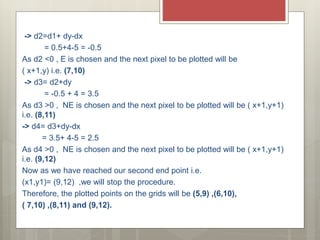
-> d2=d1+ dy-dx
= 0.5+4-5 = -0.5
As d2 <0 , E is chosen and the next pixel to be plotted will be
( x+1,y) i.e. (7,10)
-> d3= d2+dy
= -0.5 + 4 = 3.5
As d3 >0 , NE is chosen and the next pixel to be plotted will be ( x+1,y+1)
i.e. (8,11)
-> d4= d3+dy-dx
= 3.5+ 4-5 = 2.5
As d4 >0 , NE is chosen and the next pixel to be plotted will be ( x+1,y+1)
i.e. (9,12)
Now as we have reached our second end point i.e.
(x1,y1)= (9,12) ,we will stop the procedure.
Therefore, the plotted points on the grids will be (5,9) ,(6,10),
( 7,10) ,(8,11) and (9,12).
THANK YOU!

Mid point line Algorithm - Computer Graphics

  • 1.
    MID-POINT LINE PLOTTING ALGORITHM MADEBY: DIMPY CHUGH (1833) DRISHTI BHALLA (1838)
  • 2.
    INTRODUCTION The Midpoint linealgorithm is an incremental line plotting algorithm i.e. at each step we make incremental calculations based on preceding step to find next y value, in order to form a close approximation to a straight line between two points.  It chooses the pixels closest to the line with accuracy, consistency and straightness.  It is very simple and requires only integer data and simple arithmetic.  It avoids division and multiplication and thus avoid truncate errors. ADVANTAGES
  • 3.
    BASISOF ALGORITHM  Giventhe previous pixel P, there are two candidates for the next pixel closest to the line, E and NE .  If the M is above the line, choose E. If M is below the line, choose NE. Previous pixel Choices for current pixel Previous pixel Choices for current pixel
  • 4.
    Assumptions: Two end pointsof a line : (x0, y0) and (x1, y1) Also, x0 < x1 Since, we are sampling in x-direction, so, for the next pixel , x-coordinate will be xp+1 i.e. xp+ 1 and correspondingly we will calculate the value of y- coordinate . The implicit equation of a line is: F(x, y) = a x + b y + c …….(1) dx = x1 –x0 dy = y1 – y0 Slope intercept form a line is : y = m x+ B y = (dy/dx) x +B F(x,y)= (x)dy – (y)dx + Bdx ……(2) Comparing (1) and(2) we get, a= dy, b= -dx and c= Bdx DERIVATION
  • 5.
    M=(xp +1, yp+1/2) d=F(M)= F(xp +1, yp+1/2) - The sign of the decision variable ‘d’ is used to make the midpoint determination for all remaining pixels.  If d is negative, the midpoint is above the line and E is chosen i.e. (xp +1, yp) will be plotted.  If d is positive, the midpoint is below the line and NE is chosen, i.e. we will plot (xp +1, yp+1). As the algorithm progresses from pixel to pixel, d is calculated with one of two pre-calculated values based on the E/NE decision.  For all points on the line, the solution to F(x, y) is 0.  For all points above the line F(x, y) result in a negative number  For all points below F(x, y) result in a positive number. This relationship is used to determine the relative position of M.
  • 6.
    Case 1: IfE is chosen (d<0) dnew= F(xp +2, yp+1/2) = a(xp +2) + b(yp+1/2) +c dold = a(xp+1) + b(yp+1/2)+c ∆d = dnew -dold = a(xp +2)- a(xp+1)+ b(yp+1/2)- b(yp+1/2)+c-c = a(xp) +2a –a(xp) –a = a. Therefore, dnew = dold + dy Case 2: If NE is chosen (d>0) dnew= F(xp +2, yp+3/2) = a(xp +2) + b(yp+3/2) +c dold = a(xp+1) + b(yp+1/2)+c ∆d = dnew -dold = a(xp +2)- a(xp+1)+ b(yp+3/2)- b(yp+1/2)+c-c = a(xp) +2a –a(xp) –a+ b(yp) +3/2b – b(yp) -1/2b = a+b Therefore, dnew = dold + dy-dx
  • 7.
    d0= F(x0+1 ,y0+1/2) = a(x0+1) + b(y0+1/2) +c = ax0+ by0+c +a+ b/2 = F(x0,y0) + a+ b/2 = 0 + a+ b/2 ( a= dy, b= -dx) Therefore, d0 = dy - dx/2 Derivationforcalculatingthe initial value for d0
  • 8.
    ALGORITHM(|M|<1) 1) Input (x0,y0)and (x1,y1) 2) Calculate dy and dx 3) d= dy-(dx/2) 4) x= x0 and y=y0 5) Plot(x , y) 6) While(x<x1) 7) x=x+1 8) If(d<0) 9) d=d+dy 10) else 11) d=d+dy-dx 12) y=y+1 13) Plot(x,y)
  • 9.
    ALGORITHM (|M|>1) 1) Input(x0,y0) and (x1,y1) 2) Calculate dy and dx 3) d= dx-(dy/2) 4) x= x0 and y=y0 5) Plot(x , y) 6) While(y<y1) 7) y=y+1 8) If(d<0) 9) d=d+dx 10) else 11) d=d+dx-dy 12) x=x+1 13) Plot(x,y)
  • 10.
    EXAMPLE Draw aline from (4,8) to (9,12) and plot the points accordingly. Initially: (x,y)=(4,8) (x1,y1)=(9,12) dy=(y1-y0)= (12-8)= 4 dx= (x1-x0)=(9-4)= 5 Now, the first decision variable (d0)= dy- dx/2 = 4-5/2 = 1.5 As d0 >0 , NE is chosen and the next pixel to be plotted will be ( x+1,y+1) i.e. (5,9) -> d1= d0+ (dy-dx) = 1.5+ 4-5 = 0.5 As d1 >0 , again NE is chosen and the next pixel to be plotted will be ( x+1,y+1) i.e.(6,10)
  • 11.
    -> d2=d1+ dy-dx =0.5+4-5 = -0.5 As d2 <0 , E is chosen and the next pixel to be plotted will be ( x+1,y) i.e. (7,10) -> d3= d2+dy = -0.5 + 4 = 3.5 As d3 >0 , NE is chosen and the next pixel to be plotted will be ( x+1,y+1) i.e. (8,11) -> d4= d3+dy-dx = 3.5+ 4-5 = 2.5 As d4 >0 , NE is chosen and the next pixel to be plotted will be ( x+1,y+1) i.e. (9,12) Now as we have reached our second end point i.e. (x1,y1)= (9,12) ,we will stop the procedure. Therefore, the plotted points on the grids will be (5,9) ,(6,10), ( 7,10) ,(8,11) and (9,12).
  • 12.