Matrices
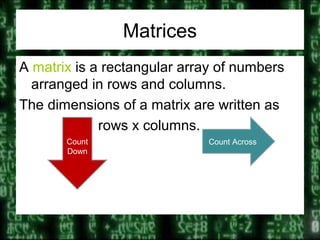
A matrix is a rectangular array of numbers
arranged in rows and columns.
The dimensions of a matrix are written as
rows x columns.
Count AcrossCount
Down
Example
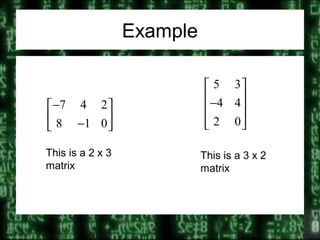
5 3
4 4
2 0
 
 − 
  
7 4 2
8 1 0
− 
 − 
This is a 2 x 3
matrix
This is a 3 x 2
matrix
Naming Matrices
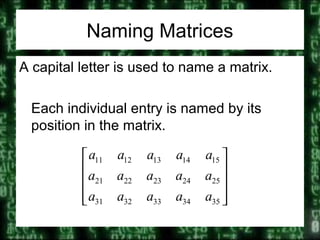
A capital letter is used to name a matrix.
Each individual entry is named by its
position in the matrix.
11 12 13 14 15
21 22 23 24 25
31 32 33 34 35
a a a a a
a a a a a
a a a a a
 
 
 
  
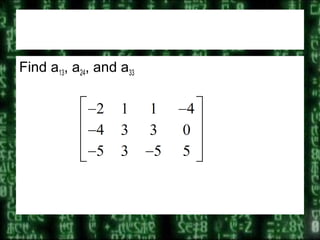
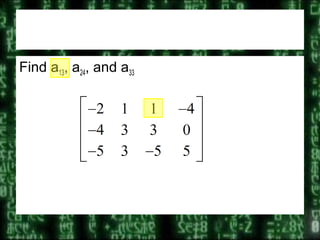
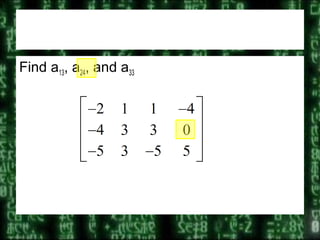
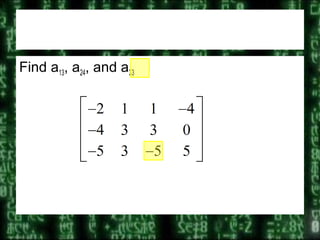
Find a13, a24, and a33
Special Matrices
A matrix with the same number of columns
and rows (2 x 2, 3 x 3, etc.) is called a
square matrix.
A matrix with all zeros is called a zero
matrix.
Equal Matrices
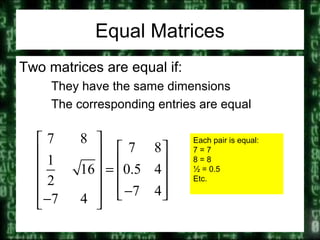
Two matrices are equal if:
They have the same dimensions
The corresponding entries are equal
7 8
7 8
1
16 0.5 4
2
7 4
7 4
 
  
   =   
 −  − 
Each pair is equal:
7 = 7
8 = 8
½ = 0.5
Etc.
Using Equal Matrices
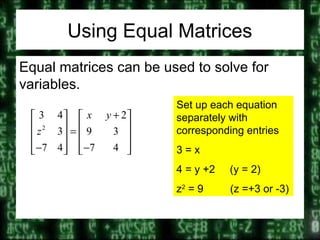
Equal matrices can be used to solve for
variables.
2
3 4 2
3 9 3
7 4 7 4
x y
z
+   
   =   
   − −   
Set up each equation
separately with
corresponding entries
3 = x
4 = y +2 (y = 2)
z2
= 9 (z =+3 or -3)
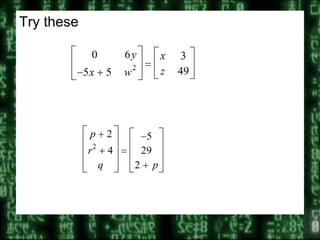
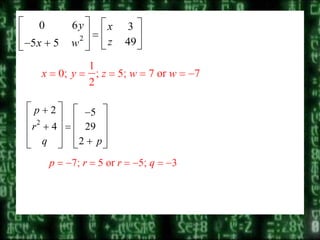
Try these
Scalar Multiplication
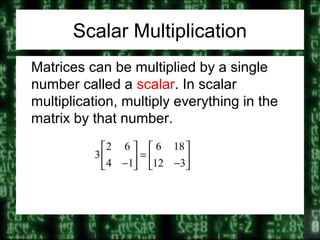
Matrices can be multiplied by a single
number called a scalar. In scalar
multiplication, multiply everything in the
matrix by that number.
2 6 6 18
3
4 1 12 3
   
=   − −   
Representing Points
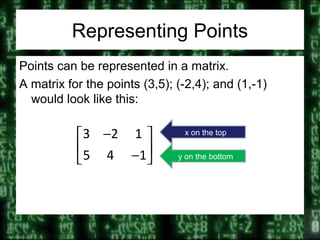
Points can be represented in a matrix.
A matrix for the points (3,5); (-2,4); and (1,-1)
would look like this:
3 2 1
5 4 1
− 
 − 
x on the top
y on the bottom
Dilation
Multiplying a matrix of points by a scalar
represents a dilation of the figure.
(Dilations make the shape bigger or
smaller)
Example
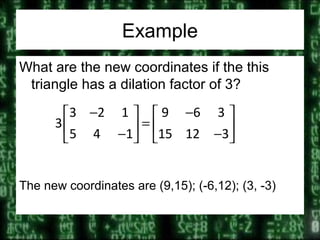
What are the new coordinates if the this
triangle has a dilation factor of 3?
The new coordinates are (9,15); (-6,12); (3, -3)
3 2 1 9 6 3
3
5 4 1 15 12 3
− −   
=   − −   

Introduction to Matrices

  • 1.
    Matrices A matrix isa rectangular array of numbers arranged in rows and columns. The dimensions of a matrix are written as rows x columns. Count AcrossCount Down
  • 2.
    Example 5 3 4 4 20    −     7 4 2 8 1 0 −   −  This is a 2 x 3 matrix This is a 3 x 2 matrix
  • 3.
    Naming Matrices A capitalletter is used to name a matrix. Each individual entry is named by its position in the matrix. 11 12 13 14 15 21 22 23 24 25 31 32 33 34 35 a a a a a a a a a a a a a a a         
  • 4.
  • 5.
  • 6.
  • 7.
  • 8.
    Special Matrices A matrixwith the same number of columns and rows (2 x 2, 3 x 3, etc.) is called a square matrix. A matrix with all zeros is called a zero matrix.
  • 9.
    Equal Matrices Two matricesare equal if: They have the same dimensions The corresponding entries are equal 7 8 7 8 1 16 0.5 4 2 7 4 7 4         =     −  −  Each pair is equal: 7 = 7 8 = 8 ½ = 0.5 Etc.
  • 10.
    Using Equal Matrices Equalmatrices can be used to solve for variables. 2 3 4 2 3 9 3 7 4 7 4 x y z +       =       − −    Set up each equation separately with corresponding entries 3 = x 4 = y +2 (y = 2) z2 = 9 (z =+3 or -3)
  • 11.
  • 13.
    Scalar Multiplication Matrices canbe multiplied by a single number called a scalar. In scalar multiplication, multiply everything in the matrix by that number. 2 6 6 18 3 4 1 12 3     =   − −   
  • 14.
    Representing Points Points canbe represented in a matrix. A matrix for the points (3,5); (-2,4); and (1,-1) would look like this: 3 2 1 5 4 1 −   −  x on the top y on the bottom
  • 15.
    Dilation Multiplying a matrixof points by a scalar represents a dilation of the figure. (Dilations make the shape bigger or smaller)
  • 16.
    Example What are thenew coordinates if the this triangle has a dilation factor of 3? The new coordinates are (9,15); (-6,12); (3, -3) 3 2 1 9 6 3 3 5 4 1 15 12 3 − −    =   − −   