Math 1
Lecturer Wala’a Abd
ul_Mageed
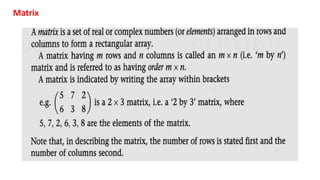
Matrix
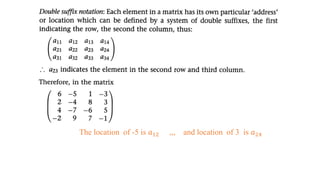
The location of -5 is 𝑎12 ,,, and location of 3 is 𝑎24
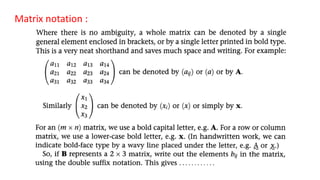
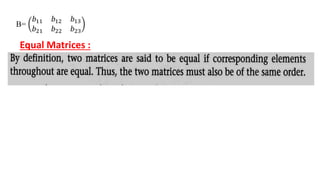
Matrix notation :
B=
𝑏11 𝑏12 𝑏13
𝑏21 𝑏22 𝑏23
Equal Matrices :
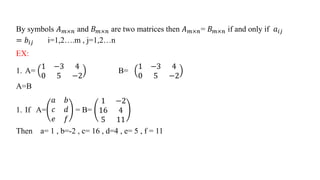
By symbols 𝐴𝑚×𝑛 and 𝐵𝑚×𝑛 are two matrices then 𝐴𝑚×𝑛= 𝐵𝑚×𝑛 if and only if 𝑎𝑖𝑗
= 𝑏𝑖𝑗 i=1,2….m , j=1,2…n
EX:
1. A=
1 −3 4
0 5 −2
B=
1 −3 4
0 5 −2
A=B
1. If A=
𝑎 𝑏
𝑐 𝑑
𝑒 𝑓
= B=
1 −2
16 4
5 11
Then a= 1 , b=-2 , c= 16 , d=4 , e= 5 , f = 11
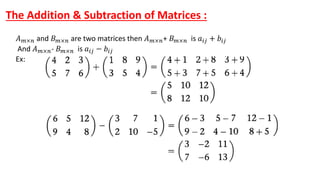
The Addition & Subtraction of Matrices :
𝐴𝑚×𝑛 and 𝐵𝑚×𝑛 are two matrices then 𝐴𝑚×𝑛+ 𝐵𝑚×𝑛 is 𝑎𝑖𝑗 + 𝑏𝑖𝑗
And 𝐴𝑚×𝑛- 𝐵𝑚×𝑛 is 𝑎𝑖𝑗 − 𝑏𝑖𝑗
Ex:
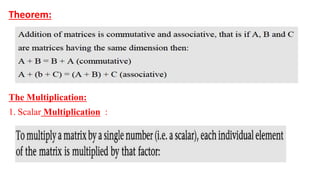
Theorem:
The Multiplication:
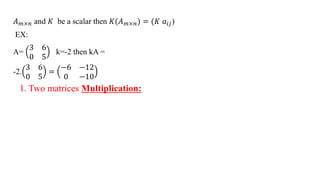
1. Scalar Multiplication :
𝐴𝑚×𝑛 and 𝐾 be a scalar then 𝐾(𝐴𝑚×𝑛) = (𝐾 𝑎𝑖𝑗)
EX:
A=
3 6
0 5
k=-2 then kA =
-2.
3 6
0 5
=
−6 −12
0 −10
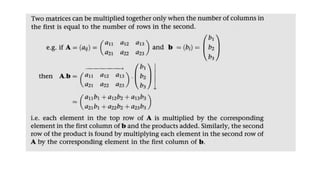
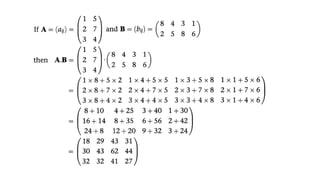
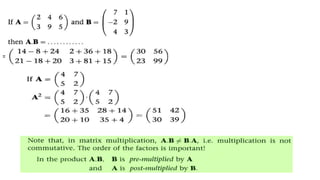
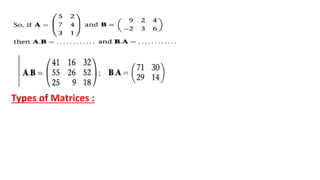
1. Two matrices Multiplication:
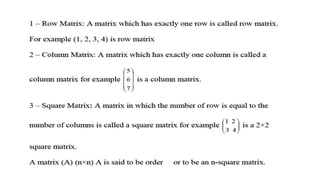
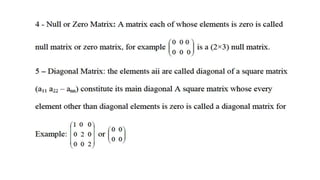
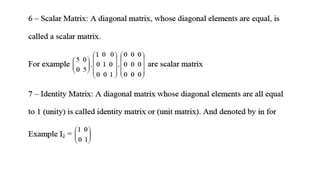
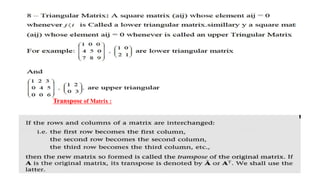
Types of Matrices :
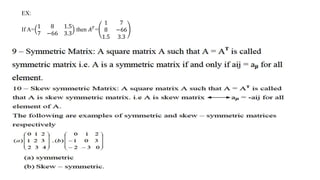
Transpose of Matrix :
EX:
If A=
1 8 1.5
7 −66 3.3
then 𝐴𝑇
=
1 7
8 −66
1.5 3.3
Determinants of Matrix
To every a square matrix that is assigned a specific number called the determinant of matrix
the determinant of a matrix A is denoted by 𝐴
If A is (1*1) matrix, A=(a) :then 𝐴 = 𝑎 = 𝑎
If A is (2*2) matrix , A=
𝑎 𝑏
𝑐 𝑑
: then 𝐴 =
𝑎 𝑏
𝑐 𝑑
=ad-bc
1f A is (3*3) matrix ,A=
𝑎11 𝑎12 𝑎13
𝑎21 𝑎22 𝑎23
𝑎31 𝑎32 𝑎33
then
𝐴 =
𝑎11 𝑎12 𝑎13
𝑎21 𝑎22 𝑎23
𝑎31 𝑎32 𝑎33
= 𝑎11
𝑎22 𝑎22
𝑎32 𝑎33
- 𝑎12
𝑎21 𝑎23
𝑎31 𝑎33
+ 𝑎13
𝑎21 𝑎22
𝑎31 𝑎32
or
𝐴 =
𝑎11 𝑎12 𝑎13
𝑎21 𝑎22 𝑎23
𝑎31 𝑎32 𝑎33
=[𝑎11𝑎22𝑎33+𝑎12𝑎23𝑎31 + 𝑎13𝑎21𝑎32] − [𝑎12𝑎21𝑎33 + 𝑎11𝑎23𝑎32
+ 𝑎13𝑎22𝑎31]
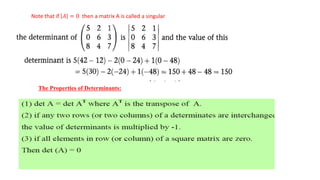
Note that if 𝐴 = 0 then a matrix A is called a singular
The Properties of Determinants:
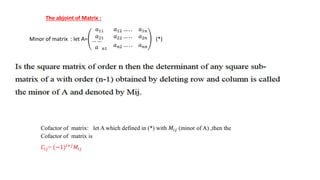
The abjoint of Matrix :
Minor of matrix : let A=
𝑎11 𝑎12 … . . 𝑎1𝑛
𝑎21 𝑎22 … . . 𝑎2𝑛
… …
𝑎 𝑛1
𝑎𝑛2 … . . 𝑎𝑛𝑛
(*)
Cofactor of matrix: let A which defined in (*) with 𝑀𝑖𝑗 (minor of A) ,then the
Cofactor of matrix is
𝐶𝑖𝑗= (−1)𝑖+𝑗
𝑀𝑖𝑗
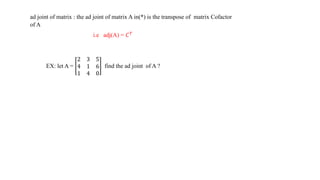
ad joint of matrix : the ad joint of matrix A in(*) is the transpose of matrix Cofactor
of A
i.e adj(A) = 𝐶𝑇
EX: let A =
2 3 5
4 1 6
1 4 0
find the ad joint of A ?
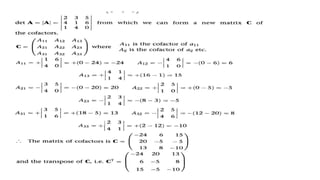
adj(A) = 𝐶𝑇
=
−24 20 13
6 −5 8
15 −5 −10
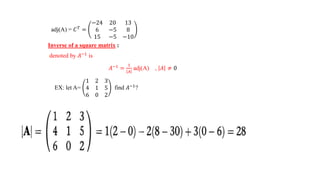
Inverse of a square matrix :
denoted by 𝐴−1
is
𝐴−1 =
1
𝐴
adj(A) , 𝐴 ≠ 0
EX: let A=
1 2 3
4 1 5
6 0 2
find 𝐴−1
?
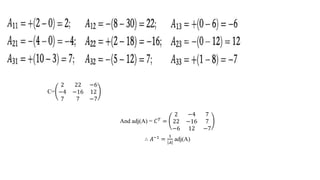
C=
2 22 −6
−4 −16 12
7 7 −7
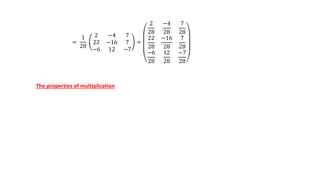
And adj(A) = 𝐶𝑇 =
2 −4 7
22 −16 7
−6 12 −7
∴ 𝐴−1
=
1
𝐴
adj(A)
=
1
28
2 −4 7
22 −16 7
−6 12 −7
=
2
28
−4
28
7
28
22
28
−16
28
7
28
−6
28
12
28
−7
28
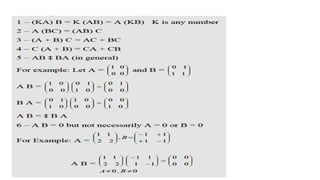
The properties of multiplication
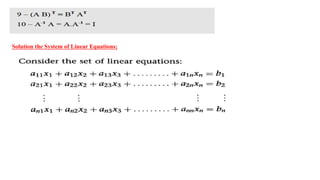
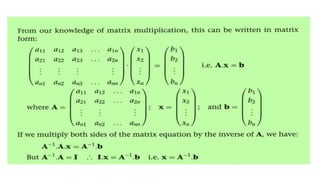
Solution the System of Linear Equations;
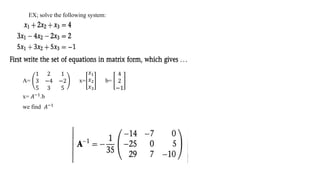
EX; solve the following system:
A=
1 2 1
3 −4 −2
5 3 5
x=
𝑥1
𝑥2
𝑥3
b=
4
2
−1
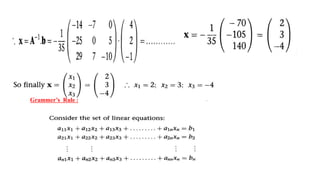
x= 𝐴−1.b
we find 𝐴−1
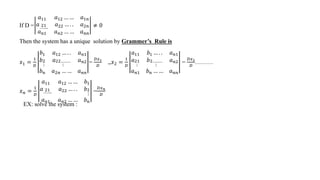
Grammer’s Rule :
If D =
𝑎11 𝑎12 … … 𝑎1𝑛
𝑎 21
……..
𝑎22 … . . 𝑎2𝑛
𝑎𝑛1 𝑎𝑛2 … … 𝑎𝑛𝑛
≠ 0
Then the system has a unique solution by Grammer’s Rule is
𝑥1 =
1
𝐷
𝑏1 𝑎12 … . . 𝑎𝑛1
𝑏2
⋮
𝑎22………
⋮
𝑎𝑛2
𝑏𝑛 𝑎2𝑛 … … 𝑎𝑛𝑛
=
𝐷𝑥1
𝐷
,,𝑥2 =
1
𝐷
𝑎11 𝑏1 … . . 𝑎𝑛1
𝑎21
⋮
𝑏2………
⋮
𝑎𝑛2
𝑎𝑛1 𝑏𝑛 … … 𝑎𝑛𝑛
=
𝐷𝑥2
𝐷
………
𝑥𝑛 =
1
𝐷
𝑎11 𝑎12 … … 𝑏1
𝑎 21
……..
𝑎22 … . . 𝑏2
⋮
𝑎𝑛1 𝑎𝑛2 … … 𝑏𝑛
=
𝐷𝑥𝑛
𝐷
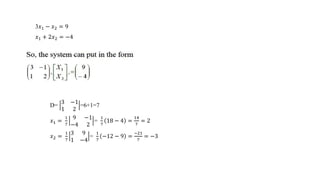
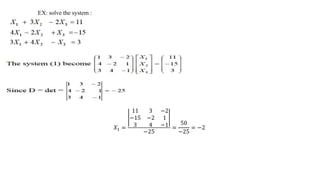
EX: solve the system :
3𝑥1 − 𝑥2 = 9
𝑥1 + 2𝑥2 = −4
D=
3 −1
1 2
=6+1=7
𝑥1 =
1
7
9 −1
−4 2
=
1
7
18 − 4 =
14
7
= 2
𝑥2 =
1
7
3 9
1 −4
=
1
7
−12 − 9 =
−21
7
= −3
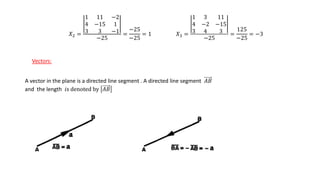
EX: solve the system :
𝑋1 =
11 3 −2
−15 −2 1
3 4 −1
−25
=
50
−25
= −2
𝑋2 =
1 11 −2
4 −15 1
3 3 −1
−25
=
−25
−25
= 1 𝑋3 =
1 3 11
4 −2 −15
3 4 3
−25
=
125
−25
= −3
Vectors:
A vector in the plane is a directed line segment . A directed line segment 𝐴𝐵
and the length 𝑖s denoted by 𝐴𝐵
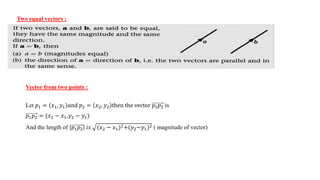
Two equal vectors :
Vector from two points :
Let 𝑝1 = 𝑥1, 𝑦1 𝑎nd 𝑝2 = 𝑥2, 𝑦2 then the vector 𝑝1𝑝2 is
𝑝1𝑝2 = (𝑥2 − 𝑥1,𝑦2 − 𝑦1)
And the length of 𝑝1𝑝2 𝑖𝑠 (𝑥2 − 𝑥1)2+(𝑦2−𝑦1)2 ( magnitude of vector)
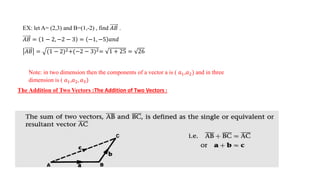
EX: let A= (2,3) and B=(1,-2) , find 𝐴𝐵 .
𝐴𝐵 = 1 − 2, −2 − 3 = −1, −5 𝑎𝑛𝑑
𝐴𝐵 = (1 − 2)2+(−2 − 3)2= 1 + 25 = 26
Note: in two dimension then the components of a vector a is ( 𝑎1,𝑎2) and in three
dimension is ( 𝑎1,𝑎2, 𝑎3)
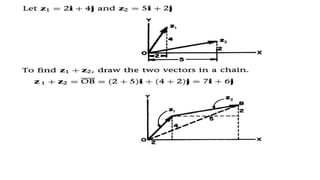
The Addition of Two Vectors :The Addition of Two Vectors :
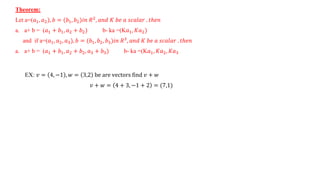
Theorem:
Let a=(𝑎1, 𝑎2), 𝑏 = (𝑏1, 𝑏2)𝑖𝑛 𝑅2
, 𝑎𝑛𝑑 𝐾 𝑏𝑒 𝑎 𝑠𝑐𝑎𝑙𝑎𝑟 . 𝑡ℎ𝑒𝑛
a. a+ b = (𝑎1 + 𝑏1, 𝑎2 + 𝑏2) b- ka =(K𝑎1, 𝐾𝑎2)
and if a=(𝑎1, 𝑎2, 𝑎3), 𝑏 = (𝑏1, 𝑏2, 𝑏3)𝑖𝑛 𝑅3
, 𝑎𝑛𝑑 𝐾 𝑏𝑒 𝑎 𝑠𝑐𝑎𝑙𝑎𝑟 . 𝑡ℎ𝑒𝑛
a. a+ b = (𝑎1 + 𝑏1, 𝑎2 + 𝑏2, 𝑎3 + 𝑏3) b- ka =(K𝑎1, 𝐾𝑎2, 𝐾𝑎3
EX: 𝑣 = 4, −1 , 𝑤 = 3,2 be are vectors find 𝑣 + 𝑤
𝑣 + 𝑤 = 4 + 3, −1 + 2 = (7,1)
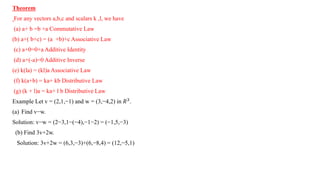
Theorem
For any vectors a,b,c and scalars k ,l, we have
(a) a+ b =b +a Commutative Law
(b) a+( b+c) = (a +b)+c Associative Law
(c) a+0=0+a Additive Identity
(d) a+(-a)=0 Additive Inverse
(e) k(la) = (kl)a Associative Law
(f) k(a+b) = ka+ kb Distributive Law
(g) (k + l)a = ka+ l b Distributive Law
Example Let v = (2,1,−1) and w = (3,−4,2) in 𝑅3.
(a) Find v−w.
Solution: v−w = (2−3,1−(−4),−1−2) = (−1,5,−3)
(b) Find 3v+2w.
Solution: 3v+2w = (6,3,−3)+(6,−8,4) = (12,−5,1)
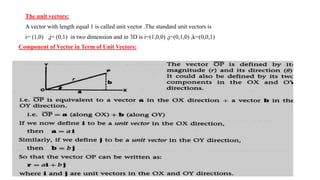
The unit vectors:
A vector with length equal 1 is called unit vector .The standard unit vectors is
i= (1,0) ,j= (0,1) in two dimension and in 3D is i=(1,0,0) ,j=(0,1,0) ,k=(0,0,1)
Component of Vector in Term of Unit Vectors:
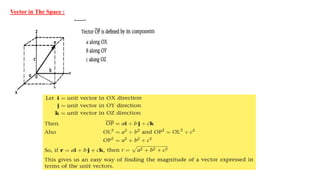
Vector in The Space :
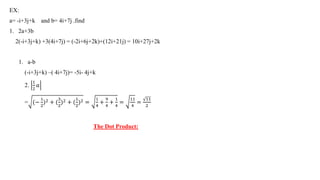
EX:
a= -i+3j+k and b= 4i+7j .find
1. 2a+3b
2(-i+3j+k) +3(4i+7j) = (-2i+6j+2k)+(12i+21j) = 10i+27j+2k
1. a-b
(-i+3j+k) –( 4i+7j)= -5i- 4j+k
2.
1
2
𝑎
= (−
1
2
)2 + (
3
2
)2 + (
1
2
)2 =
1
4
+
9
4
+
1
4
=
11
4
=
11
2
The Dot Product:
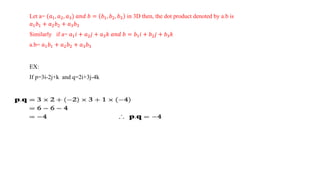
Let a= (𝑎1, 𝑎2, 𝑎3) 𝑎𝑛𝑑 𝑏 = 𝑏1, 𝑏2, 𝑏3 in 3D then, the dot product denoted by a.b is
𝑎1𝑏1 + 𝑎2𝑏2 + 𝑎3𝑏3
Similarly if a= 𝑎1𝑖 + 𝑎2𝑗 + 𝑎3𝑘 𝑎𝑛𝑑 𝑏 = 𝑏1𝑖 + 𝑏2𝑗 + 𝑏3𝑘
a.b= 𝑎1𝑏1 + 𝑎2𝑏2 + 𝑎3𝑏3
EX:
If p=3i-2j+k and q=2i+3j-4k
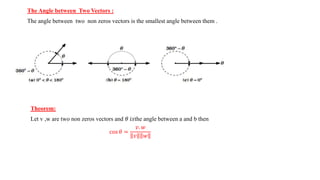
The Angle between Two Vectors :
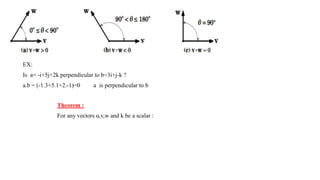
The angle between two non zeros vectors is the smallest angle between them .
Theorem:
Let v ,w are two non zeros vectors and 𝜃 𝑖𝑠the angle between a and b then
cos 𝜃 =
𝑣. 𝑤
𝑣 𝑤
EX:
Is a= -i+5j+2k perpendicular to b=3i+j-k ?
a.b = (-1.3+5.1+2.-1)=0 a is perpendicular to b
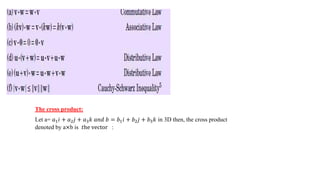
Theorem :
For any vectors u,v,w and k be a scalar :
The cross product:
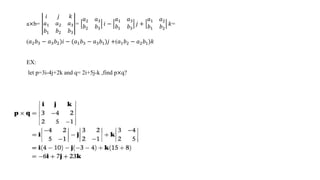
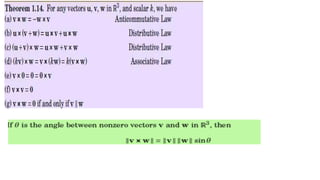
Let a= 𝑎1𝑖 + 𝑎2𝑗 + 𝑎3𝑘 𝑎𝑛𝑑 𝑏 = 𝑏1𝑖 + 𝑏2𝑗 + 𝑏3𝑘 in 3D then, the cross product
denoted by a×b is 𝑡he vector :
a×b=
𝑖 𝑗 𝑘
𝑎1 𝑎2 𝑎3
𝑏1 𝑏2 𝑏3
=
𝑎2 𝑎3
𝑏2 𝑏3
𝑖 −
𝑎1 𝑎3
𝑏1 𝑏3
𝑗 +
𝑎1 𝑎2
𝑏1 𝑏2
𝑘=
(𝑎2𝑏3 − 𝑎3𝑏2)𝑖 − (𝑎1𝑏3 − 𝑎3𝑏1)𝑗 +(𝑎1𝑏2 − 𝑎2𝑏1)𝑘
EX:
let p=3i-4j+2k and q= 2i+5j-k ,find p×q?
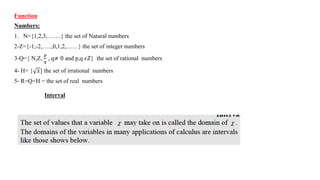
Function
Numbers:
1. N={1,2,3,…….} the set of Natural numbers
2-Z={-1,-2,…..,0,1,2,……} the set of integer numbers
3-Q={ N,Z,
𝑝
𝑞
, q≠ 0 and p,q 𝜖𝑍} the set of rational numbers
4- H= { 𝑥} the set of irrational numbers
5- R=Q+H = the set of real numbers
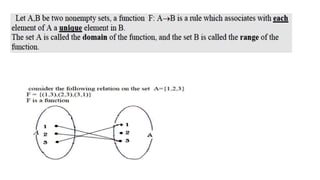
Interval
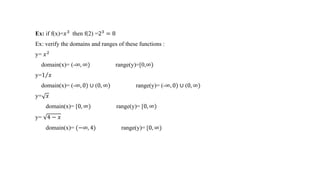
Ex: if f(x)=𝑥3
then f(2) =23
= 8
Ex: verify the domains and ranges of these functions :
y= 𝑥2
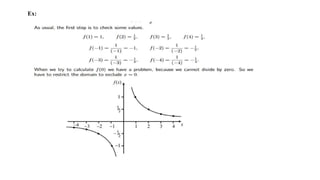
domain(x)= (-∞, ∞) range(y)=[0,∞)
y=1 𝑥
domain(x)= (-∞, 0) ∪ (0, ∞) range(y)= (-∞, 0) ∪ (0, ∞)
y= 𝑥
domain(x)= [0, ∞) range(y)= [0, ∞)
y= 4 − 𝑥
domain(x)= (−∞, 4) range(y)= [0, ∞)
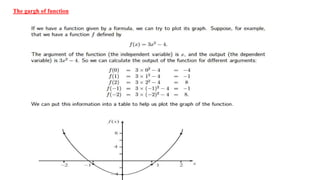
The gargh of function
Ex:
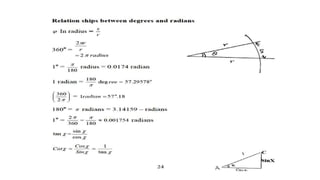
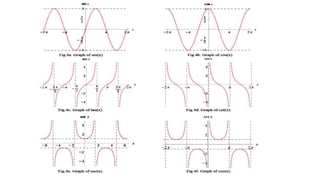
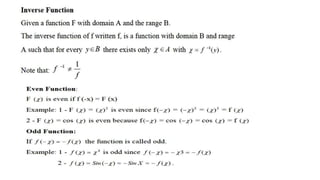
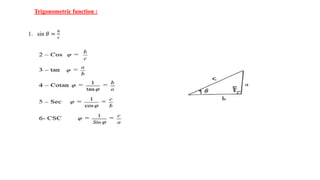
Trigonometric function :
1. sin 𝜃 =
𝑎
𝑐
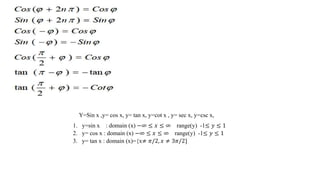
Y=Sin x ,y= cos x, y= tan x, y=cot x , y= sec x, y=csc x,
1. y=sin x : domain (x) −∞ ≤ 𝑥 ≤ ∞ range(y) -1≤ 𝑦 ≤ 1
2. y= cos x : domain (x) −∞ ≤ 𝑥 ≤ ∞ range(y) -1≤ 𝑦 ≤ 1
3. y= tan x : domain (x)={x≠ 𝜋/2, 𝑥 ≠ 3𝜋/2}
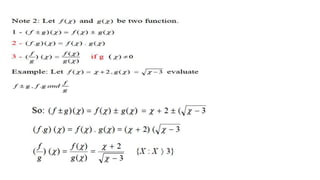
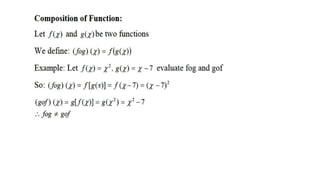
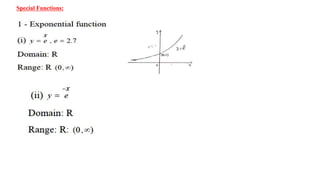
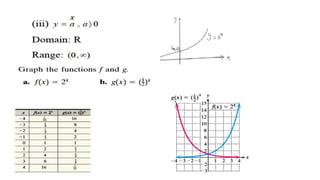
Special Functions:
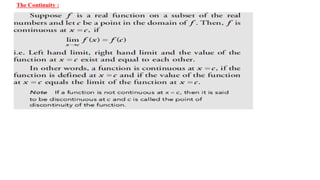
The Continuity :
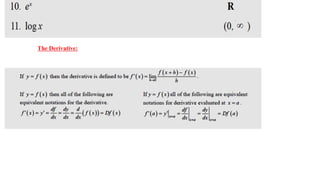
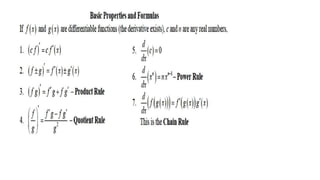
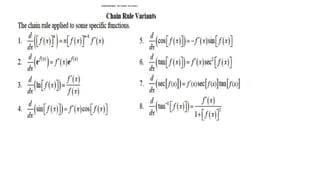
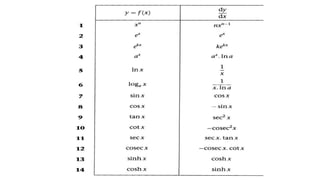
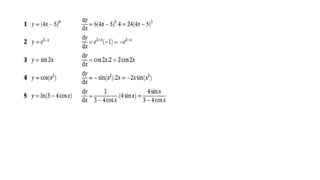
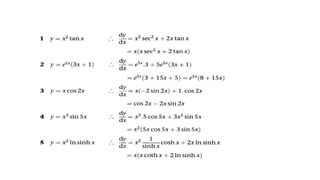
The Derivative:
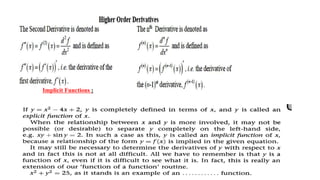
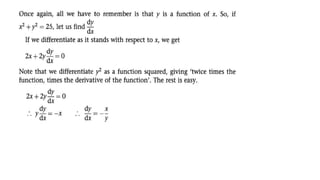
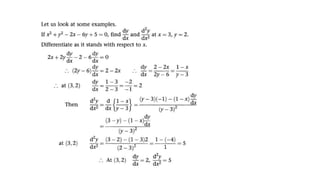
Implicit Functions :
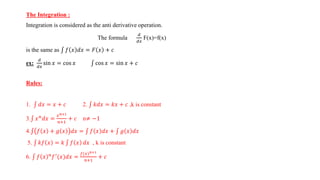
The Integration :
Integration is considered as the anti derivative operation.
The formula
𝑑
𝑑𝑥
F(x)=f(x)
is the same as 𝑓 𝑥 𝑑𝑥 = 𝐹 𝑥 + 𝑐
ex:
𝑑
𝑑𝑥
sin 𝑥 = cos 𝑥 cos 𝑥 = sin 𝑥 + 𝑐
Rules:
1. 𝑑𝑥 = 𝑥 + 𝑐 2. 𝑘𝑑𝑥 = 𝑘𝑥 + 𝑐 ,k is constant
3. 𝑥𝑛
𝑑𝑥 =
𝑥𝑛+1
𝑛+1
+ 𝑐 n≠ −1
4. 𝑓 𝑥 + 𝑔 𝑥 𝑑𝑥 = 𝑓 𝑥 𝑑𝑥 + 𝑔 𝑥 𝑑𝑥
5. 𝑘𝑓 𝑥 = 𝑘 𝑓 𝑥 𝑑𝑥 , k is constant
6. 𝑓 𝑥 𝑛
𝑓′
(𝑥)𝑑𝑥 =
𝑓(𝑥)𝑛+1
𝑛+1
+ 𝑐
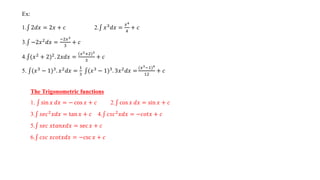
Ex:
1. 2𝑑𝑥 = 2𝑥 + 𝑐 2. 𝑥3
𝑑𝑥 =
𝑥4
4
+ 𝑐
3. −2𝑥2
𝑑𝑥 =
−2𝑥3
3
+ 𝑐
4. (𝑥2 + 2)2. 2𝑥𝑑𝑥 =
(𝑥2+2)3
3
+ 𝑐
5. (𝑥3 − 1)3. 𝑥2𝑑𝑥 =
1
3
(𝑥3 − 1)3. 3𝑥2𝑑𝑥 =
(𝑥3−1)4
12
+ 𝑐
The Trigonometric functions
1. sin 𝑥 𝑑𝑥 = − cos 𝑥 + 𝑐 2. cos 𝑥 𝑑𝑥 = sin 𝑥 + 𝑐
3. 𝑠𝑒𝑐2𝑥𝑑𝑥 = tan 𝑥 + 𝑐 4. 𝑐𝑠𝑐2𝑥𝑑𝑥 = −𝑐𝑜𝑡𝑥 + 𝑐
5. 𝑠𝑒𝑐 𝑥𝑡𝑎𝑛𝑥𝑑𝑥 = sec 𝑥 + 𝑐
6. 𝑐𝑠𝑐 𝑥𝑐𝑜𝑡𝑥𝑑𝑥 = −csc 𝑥 + 𝑐
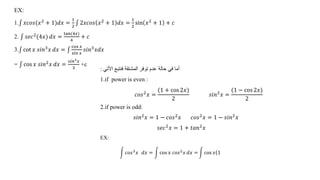
EX:
1. 𝑥𝑐𝑜𝑠(𝑥2 + 1)𝑑𝑥 =
1
2
2𝑥𝑐𝑜𝑠 𝑥2 + 1 𝑑𝑥 =
1
2
sin 𝑥2 + 1 + 𝑐
2. 𝑠𝑒𝑐2
(4𝑥) 𝑑𝑥 =
tan(4𝑥)
4
+ 𝑐
3. cot 𝑥 𝑠𝑖𝑛3𝑥 𝑑𝑥 =
cos 𝑥
sin 𝑥
𝑠𝑖𝑛3𝑥𝑑𝑥
= cos 𝑥 𝑠𝑖𝑛2
𝑥 𝑑𝑥 =
𝑠𝑖𝑛3𝑥
3
+c
‫األتي‬ ‫فنتبع‬ ‫المشتقة‬ ‫توفر‬ ‫عدم‬ ‫حالة‬ ‫في‬ ‫أما‬
:
1.if power is even :
𝑐𝑜𝑠2
𝑥 =
(1 + cos 2𝑥)
2
𝑠𝑖𝑛2
𝑥 =
(1 − cos 2𝑥)
2
2.if power is odd:
𝑠𝑖𝑛2
𝑥 = 1 − 𝑐𝑜𝑠2
𝑥 𝑐𝑜𝑠2
𝑥 = 1 − 𝑠𝑖𝑛2
𝑥
𝑠𝑒𝑐2
𝑥 = 1 + 𝑡𝑎𝑛2
𝑥
EX:
𝑐𝑜𝑠3
𝑥 𝑑𝑥 = cos 𝑥 𝑐𝑜𝑠2
𝑥 𝑑𝑥 = cos 𝑥(1
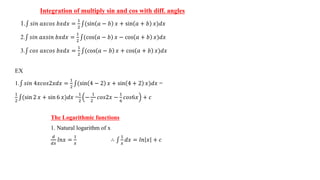
Integration of multiply sin and cos with diff. angles
1. 𝑠𝑖𝑛 𝑎𝑥𝑐𝑜𝑠 𝑏𝑥𝑑𝑥 =
1
2
(sin 𝑎 − 𝑏 𝑥 + sin 𝑎 + 𝑏 𝑥)𝑑𝑥
2. 𝑠𝑖𝑛 𝑎𝑥𝑠𝑖𝑛 𝑏𝑥𝑑𝑥 =
1
2
(cos 𝑎 − 𝑏 𝑥 − cos 𝑎 + 𝑏 𝑥)𝑑𝑥
3. 𝑐𝑜𝑠 𝑎𝑥𝑐𝑜𝑠 𝑏𝑥𝑑𝑥 =
1
2
(cos 𝑎 − 𝑏 𝑥 + cos 𝑎 + 𝑏 𝑥)𝑑𝑥
EX
1. 𝑠𝑖𝑛 4𝑥𝑐𝑜𝑠2𝑥𝑑𝑥 =
1
2
(sin 4 − 2 𝑥 + sin 4 + 2 𝑥)𝑑𝑥 =
1
2
(sin 2 𝑥 + sin 6 𝑥)𝑑𝑥 =
1
2
−
1
2
𝑐𝑜𝑠2𝑥 −
1
6
𝑐𝑜𝑠6𝑥 + 𝑐
The Logarithmic functions
1. Natural logarithm of x
𝑑
𝑑𝑥
𝑙𝑛𝑥 =
1
𝑥
∴
1
𝑥
𝑑𝑥 = 𝑙𝑛 𝑥 + 𝑐
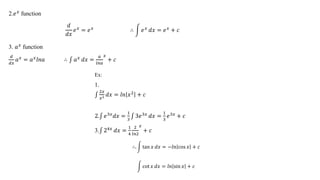
2.𝑒𝑥 function
𝑑
𝑑𝑥
𝑒𝑥
= 𝑒𝑥
∴ 𝑒𝑥
𝑑𝑥 = 𝑒𝑥
+ 𝑐
3. 𝑎𝑥
function
𝑑
𝑑𝑥
𝑎𝑥 = 𝑎𝑥𝑙𝑛𝑎 ∴ 𝑎𝑥 𝑑𝑥 =
𝑎
𝑙𝑛𝑎
𝑥
+ 𝑐
Ex:
1.
2𝑥
𝑥2 𝑑𝑥 = 𝑙𝑛 𝑥2 + 𝑐
2. 𝑒3𝑥
𝑑𝑥 =
1
3
3𝑒3𝑥
𝑑𝑥 =
1
3
𝑒3𝑥
+ 𝑐
3. 24𝑥
𝑑𝑥 =
1
4
2
𝑙𝑛2
𝑥
+ 𝑐
∴. tan 𝑥 𝑑𝑥 = −𝑙𝑛 cos 𝑥 + 𝑐
cot 𝑥 𝑑𝑥 = 𝑙𝑛 sin 𝑥 + 𝑐
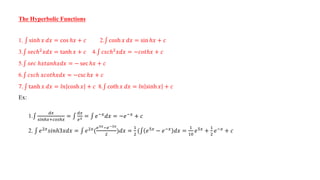
The Hyperbolic Functions
1. sinℎ 𝑥 𝑑𝑥 = cos ℎ𝑥 + 𝑐 2. cosh 𝑥 𝑑𝑥 = sin ℎ𝑥 + 𝑐
3. 𝑠𝑒𝑐ℎ2𝑥𝑑𝑥 = tanh 𝑥 + 𝑐 4. 𝑐𝑠𝑐ℎ2𝑥𝑑𝑥 = −𝑐𝑜𝑡ℎ𝑥 + 𝑐
5. 𝑠𝑒𝑐 ℎ𝑥𝑡𝑎𝑛ℎ𝑥𝑑𝑥 = − sec ℎ𝑥 + 𝑐
6. 𝑐𝑠𝑐ℎ 𝑥𝑐𝑜𝑡ℎ𝑥𝑑𝑥 = −csc ℎ𝑥 + 𝑐
7. tanh 𝑥 𝑑𝑥 = 𝑙𝑛 cosh 𝑥 + 𝑐 8. coth 𝑥 𝑑𝑥 = 𝑙𝑛 sinh 𝑥 + 𝑐
Ex:
1.
𝑑𝑥
𝑠𝑖𝑛ℎ𝑥+𝑐𝑜𝑠ℎ𝑥
=
𝑑𝑥
𝑒𝑥 = 𝑒−𝑥𝑑𝑥 = −𝑒−𝑥 + 𝑐
2. 𝑒2𝑥
𝑠𝑖𝑛ℎ3𝑥𝑑𝑥 = 𝑒2𝑥
(
𝑒3𝑥−𝑒−3𝑥
2
)𝑑𝑥 =
1
2
( 𝑒5𝑥
− 𝑒−𝑥
𝑑𝑥 =
1
10
𝑒5𝑥
+
1
2
𝑒−𝑥
+ 𝑐
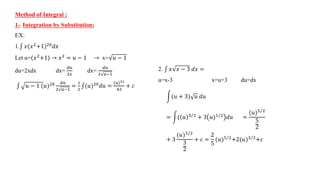
Method of Integral :
1-. Integration by Substitution:
EX:
1. 𝑥(𝑥2
+1)20
𝑑𝑥
Let u=(𝑥2
+1) → 𝑥2
= 𝑢 − 1 → x= 𝑢 − 1
du=2xdx dx=
𝑑𝑢
2𝑥
dx=
𝑑𝑢
2 𝑢−1
𝑢 − 1 (𝑢)20 𝑑𝑢
2 𝑢−1
=
1
2
(𝑢)20
𝑑𝑢 =
(𝑢)21
42
+ 𝑐
2. 𝑥 𝑥 − 3 𝑑𝑥 =
u=x-3 x=u+3 du=dx
(𝑢 + 3) 𝑢 𝑑𝑢
= ( 𝑢 3 2 + 3 𝑢)1 2 𝑑𝑢 =
(𝑢)5 2
5
2
+ 3
(𝑢)3 2
3
2
+ 𝑐 =
2
5
(𝑢)5 2+2(𝑢)3 2+𝑐
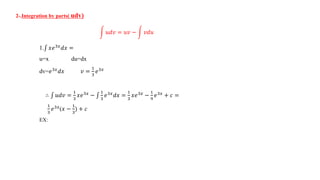
2-.Integration by parts( udv)
𝑢𝑑𝑣 = 𝑢𝑣 − 𝑣𝑑𝑢
1. 𝑥𝑒3𝑥
𝑑𝑥 =
u=x du=dx
dv=𝑒3𝑥
𝑑𝑥 𝑣 =
1
3
𝑒3𝑥
∴ 𝑢𝑑𝑣 =
1
3
𝑥𝑒3𝑥
−
1
3
𝑒3𝑥
𝑑𝑥 =
1
3
𝑥𝑒3𝑥
−
1
9
𝑒3𝑥
+ 𝑐 =
1
3
𝑒3𝑥(𝑥 −
1
3
) + 𝑐
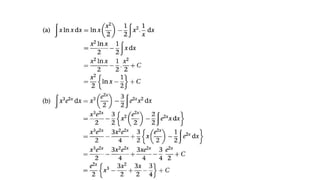
EX:
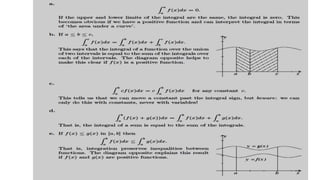
The Definite Integral :
Theorem: (Fundamental Theorem I):
𝑎
𝑏
𝑓 𝑥 𝑑𝑥 = 𝐹 𝑥 ]𝑎
𝑏 = 𝐹 𝑏 − 𝐹 𝑎 ,
𝑑
𝑑𝑥
𝐹 𝑥 = 𝑓(𝑥)
EX:
1. Find 2
3
𝑥2
𝑑𝑥 =
𝑥3
3
]2
3
=
33
3
−
23
3
=
27
3
−
8
3
=
19
3
2. 0
𝜋
sin2 𝑥 𝑑𝑥 = 0
𝜋 1
2
(1 − cos 2𝑥)𝑑𝑥 =
1
2
𝑥 −
sin 2𝑥
2
]0
𝜋
=
1
2
𝜋 −
sin 2𝜋
2
−
1
2
0
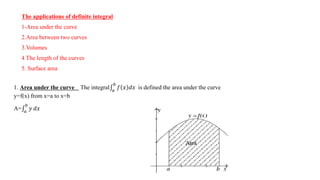
The applications of definite integral
1-Area under the curve
2.Area between two curves
3.Volumes
4 The length of the curves
5. Surface area
1. Area under the curve The integral 𝑎
𝑏
𝑓 𝑥 𝑑𝑥 is defined the area under the curve
y=f(x) from x=a to x=b
A= 𝑎
𝑏
𝑦 𝑑𝑥
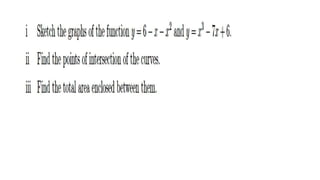
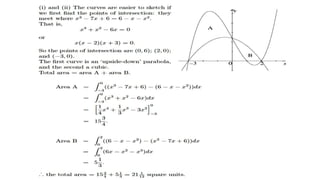
2. Area between two curves :
Case 1(No intersecting of two curves in [a,b])
If 𝑦1 = 𝑓 𝑥 , 𝑦2 = 𝑔 𝑥 then the area is defined as
𝐴𝑎
𝑏 = 𝑎
𝑏
𝑦1 − 𝑦2 𝑑𝑥
Case 2(An intersecting point exists in [a,b])
The area between two curves 𝑦1, 𝑦2 from x=a to x=b is defined as
𝐴𝑎
𝑏 =
𝑎
𝑐
𝑦2 − 𝑦1 𝑑𝑥 +
𝑐
𝑏
(𝑦1 − 𝑦2) 𝑑𝑥
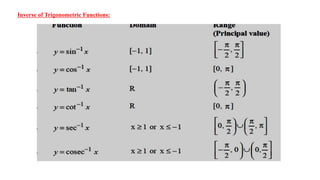
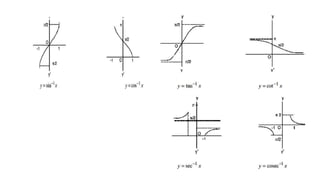
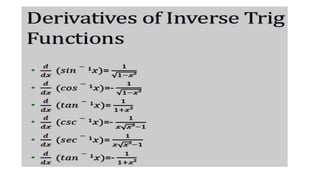
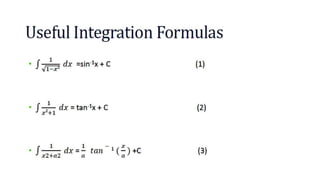
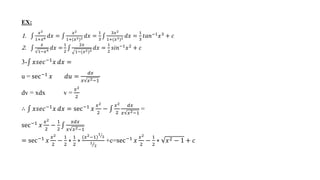
Inverse of Trigonometric Functions:
EX:
1.
𝑥2
1+𝑥6 𝑑𝑥 =
𝑥2
1+(𝑥3)2 𝑑𝑥 =
1
3
3𝑥2
1+(𝑥3)2 𝑑𝑥 =
1
3
𝑡𝑎𝑛−1
𝑥3
+ 𝑐
2.
𝑥
1−𝑥4
𝑑𝑥 =
1
2
2𝑥
1−(𝑥2)2
𝑑𝑥 =
1
2
𝑠𝑖𝑛−1𝑥2 + 𝑐
3- 𝑥𝑠𝑒𝑐−1𝑥 𝑑𝑥 =
u = sec−1 𝑥 𝑑𝑢 =
𝑑𝑥
𝑥 𝑥2−1
dv = xdx v =
𝑥2
2
∴ 𝑥𝑠𝑒𝑐−1𝑥 𝑑𝑥 = sec−1 𝑥
𝑥2
2
−
𝑥2
2
𝑑𝑥
𝑥 𝑥2−1
=
sec−1 𝑥
𝑥2
2
−
1
2
𝑥𝑑𝑥
𝑥 𝑥2−1
= sec−1 𝑥
𝑥2
2
−
1
2
∗
1
2
∗
(𝑥2−1)
1
2
1
2
+c=sec−1 𝑥
𝑥2
2
−
1
2
∗ 𝑥2 − 1 + 𝑐
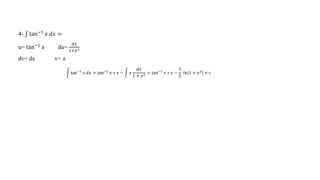
4-. tan−1 𝑥 𝑑𝑥 =
u= tan−1 𝑥 du=
𝑑𝑥
1+𝑥2
dv= dx v= 𝑥
tan−1
𝑥 𝑑𝑥 = tan−1
𝑥 ∗ 𝑥 − 𝑥
𝑑𝑥
1 + 𝑥2
= tan−1
𝑥 ∗ 𝑥 −
1
2
𝑙𝑛 1 + 𝑥2
+ 𝑐

math1مرحلة اولى -compressed.pdf

  • 1.
  • 2.
  • 3.
    The location of-5 is 𝑎12 ,,, and location of 3 is 𝑎24
  • 4.
  • 5.
    B= 𝑏11 𝑏12 𝑏13 𝑏21𝑏22 𝑏23 Equal Matrices :
  • 6.
    By symbols 𝐴𝑚×𝑛and 𝐵𝑚×𝑛 are two matrices then 𝐴𝑚×𝑛= 𝐵𝑚×𝑛 if and only if 𝑎𝑖𝑗 = 𝑏𝑖𝑗 i=1,2….m , j=1,2…n EX: 1. A= 1 −3 4 0 5 −2 B= 1 −3 4 0 5 −2 A=B 1. If A= 𝑎 𝑏 𝑐 𝑑 𝑒 𝑓 = B= 1 −2 16 4 5 11 Then a= 1 , b=-2 , c= 16 , d=4 , e= 5 , f = 11
  • 7.
    The Addition &Subtraction of Matrices : 𝐴𝑚×𝑛 and 𝐵𝑚×𝑛 are two matrices then 𝐴𝑚×𝑛+ 𝐵𝑚×𝑛 is 𝑎𝑖𝑗 + 𝑏𝑖𝑗 And 𝐴𝑚×𝑛- 𝐵𝑚×𝑛 is 𝑎𝑖𝑗 − 𝑏𝑖𝑗 Ex:
  • 8.
  • 9.
    𝐴𝑚×𝑛 and 𝐾be a scalar then 𝐾(𝐴𝑚×𝑛) = (𝐾 𝑎𝑖𝑗) EX: A= 3 6 0 5 k=-2 then kA = -2. 3 6 0 5 = −6 −12 0 −10 1. Two matrices Multiplication:
  • 13.
  • 17.
  • 18.
    EX: If A= 1 81.5 7 −66 3.3 then 𝐴𝑇 = 1 7 8 −66 1.5 3.3
  • 19.
    Determinants of Matrix Toevery a square matrix that is assigned a specific number called the determinant of matrix the determinant of a matrix A is denoted by 𝐴 If A is (1*1) matrix, A=(a) :then 𝐴 = 𝑎 = 𝑎 If A is (2*2) matrix , A= 𝑎 𝑏 𝑐 𝑑 : then 𝐴 = 𝑎 𝑏 𝑐 𝑑 =ad-bc 1f A is (3*3) matrix ,A= 𝑎11 𝑎12 𝑎13 𝑎21 𝑎22 𝑎23 𝑎31 𝑎32 𝑎33 then 𝐴 = 𝑎11 𝑎12 𝑎13 𝑎21 𝑎22 𝑎23 𝑎31 𝑎32 𝑎33 = 𝑎11 𝑎22 𝑎22 𝑎32 𝑎33 - 𝑎12 𝑎21 𝑎23 𝑎31 𝑎33 + 𝑎13 𝑎21 𝑎22 𝑎31 𝑎32 or 𝐴 = 𝑎11 𝑎12 𝑎13 𝑎21 𝑎22 𝑎23 𝑎31 𝑎32 𝑎33 =[𝑎11𝑎22𝑎33+𝑎12𝑎23𝑎31 + 𝑎13𝑎21𝑎32] − [𝑎12𝑎21𝑎33 + 𝑎11𝑎23𝑎32 + 𝑎13𝑎22𝑎31]
  • 20.
    Note that if𝐴 = 0 then a matrix A is called a singular The Properties of Determinants:
  • 21.
    The abjoint ofMatrix : Minor of matrix : let A= 𝑎11 𝑎12 … . . 𝑎1𝑛 𝑎21 𝑎22 … . . 𝑎2𝑛 … … 𝑎 𝑛1 𝑎𝑛2 … . . 𝑎𝑛𝑛 (*) Cofactor of matrix: let A which defined in (*) with 𝑀𝑖𝑗 (minor of A) ,then the Cofactor of matrix is 𝐶𝑖𝑗= (−1)𝑖+𝑗 𝑀𝑖𝑗
  • 22.
    ad joint ofmatrix : the ad joint of matrix A in(*) is the transpose of matrix Cofactor of A i.e adj(A) = 𝐶𝑇 EX: let A = 2 3 5 4 1 6 1 4 0 find the ad joint of A ?
  • 24.
    adj(A) = 𝐶𝑇 = −2420 13 6 −5 8 15 −5 −10 Inverse of a square matrix : denoted by 𝐴−1 is 𝐴−1 = 1 𝐴 adj(A) , 𝐴 ≠ 0 EX: let A= 1 2 3 4 1 5 6 0 2 find 𝐴−1 ?
  • 25.
    C= 2 22 −6 −4−16 12 7 7 −7 And adj(A) = 𝐶𝑇 = 2 −4 7 22 −16 7 −6 12 −7 ∴ 𝐴−1 = 1 𝐴 adj(A)
  • 26.
    = 1 28 2 −4 7 22−16 7 −6 12 −7 = 2 28 −4 28 7 28 22 28 −16 28 7 28 −6 28 12 28 −7 28 The properties of multiplication
  • 28.
    Solution the Systemof Linear Equations;
  • 30.
    EX; solve thefollowing system: A= 1 2 1 3 −4 −2 5 3 5 x= 𝑥1 𝑥2 𝑥3 b= 4 2 −1 x= 𝐴−1.b we find 𝐴−1
  • 31.
  • 32.
    If D = 𝑎11𝑎12 … … 𝑎1𝑛 𝑎 21 …….. 𝑎22 … . . 𝑎2𝑛 𝑎𝑛1 𝑎𝑛2 … … 𝑎𝑛𝑛 ≠ 0 Then the system has a unique solution by Grammer’s Rule is 𝑥1 = 1 𝐷 𝑏1 𝑎12 … . . 𝑎𝑛1 𝑏2 ⋮ 𝑎22……… ⋮ 𝑎𝑛2 𝑏𝑛 𝑎2𝑛 … … 𝑎𝑛𝑛 = 𝐷𝑥1 𝐷 ,,𝑥2 = 1 𝐷 𝑎11 𝑏1 … . . 𝑎𝑛1 𝑎21 ⋮ 𝑏2……… ⋮ 𝑎𝑛2 𝑎𝑛1 𝑏𝑛 … … 𝑎𝑛𝑛 = 𝐷𝑥2 𝐷 ……… 𝑥𝑛 = 1 𝐷 𝑎11 𝑎12 … … 𝑏1 𝑎 21 …….. 𝑎22 … . . 𝑏2 ⋮ 𝑎𝑛1 𝑎𝑛2 … … 𝑏𝑛 = 𝐷𝑥𝑛 𝐷 EX: solve the system :
  • 33.
    3𝑥1 − 𝑥2= 9 𝑥1 + 2𝑥2 = −4 D= 3 −1 1 2 =6+1=7 𝑥1 = 1 7 9 −1 −4 2 = 1 7 18 − 4 = 14 7 = 2 𝑥2 = 1 7 3 9 1 −4 = 1 7 −12 − 9 = −21 7 = −3
  • 34.
    EX: solve thesystem : 𝑋1 = 11 3 −2 −15 −2 1 3 4 −1 −25 = 50 −25 = −2
  • 35.
    𝑋2 = 1 11−2 4 −15 1 3 3 −1 −25 = −25 −25 = 1 𝑋3 = 1 3 11 4 −2 −15 3 4 3 −25 = 125 −25 = −3 Vectors: A vector in the plane is a directed line segment . A directed line segment 𝐴𝐵 and the length 𝑖s denoted by 𝐴𝐵
  • 36.
    Two equal vectors: Vector from two points : Let 𝑝1 = 𝑥1, 𝑦1 𝑎nd 𝑝2 = 𝑥2, 𝑦2 then the vector 𝑝1𝑝2 is 𝑝1𝑝2 = (𝑥2 − 𝑥1,𝑦2 − 𝑦1) And the length of 𝑝1𝑝2 𝑖𝑠 (𝑥2 − 𝑥1)2+(𝑦2−𝑦1)2 ( magnitude of vector)
  • 37.
    EX: let A=(2,3) and B=(1,-2) , find 𝐴𝐵 . 𝐴𝐵 = 1 − 2, −2 − 3 = −1, −5 𝑎𝑛𝑑 𝐴𝐵 = (1 − 2)2+(−2 − 3)2= 1 + 25 = 26 Note: in two dimension then the components of a vector a is ( 𝑎1,𝑎2) and in three dimension is ( 𝑎1,𝑎2, 𝑎3) The Addition of Two Vectors :The Addition of Two Vectors :
  • 38.
    Theorem: Let a=(𝑎1, 𝑎2),𝑏 = (𝑏1, 𝑏2)𝑖𝑛 𝑅2 , 𝑎𝑛𝑑 𝐾 𝑏𝑒 𝑎 𝑠𝑐𝑎𝑙𝑎𝑟 . 𝑡ℎ𝑒𝑛 a. a+ b = (𝑎1 + 𝑏1, 𝑎2 + 𝑏2) b- ka =(K𝑎1, 𝐾𝑎2) and if a=(𝑎1, 𝑎2, 𝑎3), 𝑏 = (𝑏1, 𝑏2, 𝑏3)𝑖𝑛 𝑅3 , 𝑎𝑛𝑑 𝐾 𝑏𝑒 𝑎 𝑠𝑐𝑎𝑙𝑎𝑟 . 𝑡ℎ𝑒𝑛 a. a+ b = (𝑎1 + 𝑏1, 𝑎2 + 𝑏2, 𝑎3 + 𝑏3) b- ka =(K𝑎1, 𝐾𝑎2, 𝐾𝑎3 EX: 𝑣 = 4, −1 , 𝑤 = 3,2 be are vectors find 𝑣 + 𝑤 𝑣 + 𝑤 = 4 + 3, −1 + 2 = (7,1)
  • 39.
    Theorem For any vectorsa,b,c and scalars k ,l, we have (a) a+ b =b +a Commutative Law (b) a+( b+c) = (a +b)+c Associative Law (c) a+0=0+a Additive Identity (d) a+(-a)=0 Additive Inverse (e) k(la) = (kl)a Associative Law (f) k(a+b) = ka+ kb Distributive Law (g) (k + l)a = ka+ l b Distributive Law Example Let v = (2,1,−1) and w = (3,−4,2) in 𝑅3. (a) Find v−w. Solution: v−w = (2−3,1−(−4),−1−2) = (−1,5,−3) (b) Find 3v+2w. Solution: 3v+2w = (6,3,−3)+(6,−8,4) = (12,−5,1)
  • 40.
    The unit vectors: Avector with length equal 1 is called unit vector .The standard unit vectors is i= (1,0) ,j= (0,1) in two dimension and in 3D is i=(1,0,0) ,j=(0,1,0) ,k=(0,0,1) Component of Vector in Term of Unit Vectors:
  • 42.
  • 43.
    EX: a= -i+3j+k andb= 4i+7j .find 1. 2a+3b 2(-i+3j+k) +3(4i+7j) = (-2i+6j+2k)+(12i+21j) = 10i+27j+2k 1. a-b (-i+3j+k) –( 4i+7j)= -5i- 4j+k 2. 1 2 𝑎 = (− 1 2 )2 + ( 3 2 )2 + ( 1 2 )2 = 1 4 + 9 4 + 1 4 = 11 4 = 11 2 The Dot Product:
  • 44.
    Let a= (𝑎1,𝑎2, 𝑎3) 𝑎𝑛𝑑 𝑏 = 𝑏1, 𝑏2, 𝑏3 in 3D then, the dot product denoted by a.b is 𝑎1𝑏1 + 𝑎2𝑏2 + 𝑎3𝑏3 Similarly if a= 𝑎1𝑖 + 𝑎2𝑗 + 𝑎3𝑘 𝑎𝑛𝑑 𝑏 = 𝑏1𝑖 + 𝑏2𝑗 + 𝑏3𝑘 a.b= 𝑎1𝑏1 + 𝑎2𝑏2 + 𝑎3𝑏3 EX: If p=3i-2j+k and q=2i+3j-4k
  • 45.
    The Angle betweenTwo Vectors : The angle between two non zeros vectors is the smallest angle between them . Theorem: Let v ,w are two non zeros vectors and 𝜃 𝑖𝑠the angle between a and b then cos 𝜃 = 𝑣. 𝑤 𝑣 𝑤
  • 46.
    EX: Is a= -i+5j+2kperpendicular to b=3i+j-k ? a.b = (-1.3+5.1+2.-1)=0 a is perpendicular to b Theorem : For any vectors u,v,w and k be a scalar :
  • 47.
    The cross product: Leta= 𝑎1𝑖 + 𝑎2𝑗 + 𝑎3𝑘 𝑎𝑛𝑑 𝑏 = 𝑏1𝑖 + 𝑏2𝑗 + 𝑏3𝑘 in 3D then, the cross product denoted by a×b is 𝑡he vector :
  • 48.
    a×b= 𝑖 𝑗 𝑘 𝑎1𝑎2 𝑎3 𝑏1 𝑏2 𝑏3 = 𝑎2 𝑎3 𝑏2 𝑏3 𝑖 − 𝑎1 𝑎3 𝑏1 𝑏3 𝑗 + 𝑎1 𝑎2 𝑏1 𝑏2 𝑘= (𝑎2𝑏3 − 𝑎3𝑏2)𝑖 − (𝑎1𝑏3 − 𝑎3𝑏1)𝑗 +(𝑎1𝑏2 − 𝑎2𝑏1)𝑘 EX: let p=3i-4j+2k and q= 2i+5j-k ,find p×q?
  • 50.
    Function Numbers: 1. N={1,2,3,…….} theset of Natural numbers 2-Z={-1,-2,…..,0,1,2,……} the set of integer numbers 3-Q={ N,Z, 𝑝 𝑞 , q≠ 0 and p,q 𝜖𝑍} the set of rational numbers 4- H= { 𝑥} the set of irrational numbers 5- R=Q+H = the set of real numbers Interval
  • 52.
    Ex: if f(x)=𝑥3 thenf(2) =23 = 8 Ex: verify the domains and ranges of these functions : y= 𝑥2 domain(x)= (-∞, ∞) range(y)=[0,∞) y=1 𝑥 domain(x)= (-∞, 0) ∪ (0, ∞) range(y)= (-∞, 0) ∪ (0, ∞) y= 𝑥 domain(x)= [0, ∞) range(y)= [0, ∞) y= 4 − 𝑥 domain(x)= (−∞, 4) range(y)= [0, ∞)
  • 53.
    The gargh offunction
  • 54.
  • 58.
    Trigonometric function : 1.sin 𝜃 = 𝑎 𝑐
  • 63.
    Y=Sin x ,y=cos x, y= tan x, y=cot x , y= sec x, y=csc x, 1. y=sin x : domain (x) −∞ ≤ 𝑥 ≤ ∞ range(y) -1≤ 𝑦 ≤ 1 2. y= cos x : domain (x) −∞ ≤ 𝑥 ≤ ∞ range(y) -1≤ 𝑦 ≤ 1 3. y= tan x : domain (x)={x≠ 𝜋/2, 𝑥 ≠ 3𝜋/2}
  • 66.
  • 73.
  • 75.
  • 81.
  • 84.
    The Integration : Integrationis considered as the anti derivative operation. The formula 𝑑 𝑑𝑥 F(x)=f(x) is the same as 𝑓 𝑥 𝑑𝑥 = 𝐹 𝑥 + 𝑐 ex: 𝑑 𝑑𝑥 sin 𝑥 = cos 𝑥 cos 𝑥 = sin 𝑥 + 𝑐 Rules: 1. 𝑑𝑥 = 𝑥 + 𝑐 2. 𝑘𝑑𝑥 = 𝑘𝑥 + 𝑐 ,k is constant 3. 𝑥𝑛 𝑑𝑥 = 𝑥𝑛+1 𝑛+1 + 𝑐 n≠ −1 4. 𝑓 𝑥 + 𝑔 𝑥 𝑑𝑥 = 𝑓 𝑥 𝑑𝑥 + 𝑔 𝑥 𝑑𝑥 5. 𝑘𝑓 𝑥 = 𝑘 𝑓 𝑥 𝑑𝑥 , k is constant 6. 𝑓 𝑥 𝑛 𝑓′ (𝑥)𝑑𝑥 = 𝑓(𝑥)𝑛+1 𝑛+1 + 𝑐
  • 85.
    Ex: 1. 2𝑑𝑥 =2𝑥 + 𝑐 2. 𝑥3 𝑑𝑥 = 𝑥4 4 + 𝑐 3. −2𝑥2 𝑑𝑥 = −2𝑥3 3 + 𝑐 4. (𝑥2 + 2)2. 2𝑥𝑑𝑥 = (𝑥2+2)3 3 + 𝑐 5. (𝑥3 − 1)3. 𝑥2𝑑𝑥 = 1 3 (𝑥3 − 1)3. 3𝑥2𝑑𝑥 = (𝑥3−1)4 12 + 𝑐 The Trigonometric functions 1. sin 𝑥 𝑑𝑥 = − cos 𝑥 + 𝑐 2. cos 𝑥 𝑑𝑥 = sin 𝑥 + 𝑐 3. 𝑠𝑒𝑐2𝑥𝑑𝑥 = tan 𝑥 + 𝑐 4. 𝑐𝑠𝑐2𝑥𝑑𝑥 = −𝑐𝑜𝑡𝑥 + 𝑐 5. 𝑠𝑒𝑐 𝑥𝑡𝑎𝑛𝑥𝑑𝑥 = sec 𝑥 + 𝑐 6. 𝑐𝑠𝑐 𝑥𝑐𝑜𝑡𝑥𝑑𝑥 = −csc 𝑥 + 𝑐
  • 86.
    EX: 1. 𝑥𝑐𝑜𝑠(𝑥2 +1)𝑑𝑥 = 1 2 2𝑥𝑐𝑜𝑠 𝑥2 + 1 𝑑𝑥 = 1 2 sin 𝑥2 + 1 + 𝑐 2. 𝑠𝑒𝑐2 (4𝑥) 𝑑𝑥 = tan(4𝑥) 4 + 𝑐 3. cot 𝑥 𝑠𝑖𝑛3𝑥 𝑑𝑥 = cos 𝑥 sin 𝑥 𝑠𝑖𝑛3𝑥𝑑𝑥 = cos 𝑥 𝑠𝑖𝑛2 𝑥 𝑑𝑥 = 𝑠𝑖𝑛3𝑥 3 +c ‫األتي‬ ‫فنتبع‬ ‫المشتقة‬ ‫توفر‬ ‫عدم‬ ‫حالة‬ ‫في‬ ‫أما‬ : 1.if power is even : 𝑐𝑜𝑠2 𝑥 = (1 + cos 2𝑥) 2 𝑠𝑖𝑛2 𝑥 = (1 − cos 2𝑥) 2 2.if power is odd: 𝑠𝑖𝑛2 𝑥 = 1 − 𝑐𝑜𝑠2 𝑥 𝑐𝑜𝑠2 𝑥 = 1 − 𝑠𝑖𝑛2 𝑥 𝑠𝑒𝑐2 𝑥 = 1 + 𝑡𝑎𝑛2 𝑥 EX: 𝑐𝑜𝑠3 𝑥 𝑑𝑥 = cos 𝑥 𝑐𝑜𝑠2 𝑥 𝑑𝑥 = cos 𝑥(1
  • 87.
    Integration of multiplysin and cos with diff. angles 1. 𝑠𝑖𝑛 𝑎𝑥𝑐𝑜𝑠 𝑏𝑥𝑑𝑥 = 1 2 (sin 𝑎 − 𝑏 𝑥 + sin 𝑎 + 𝑏 𝑥)𝑑𝑥 2. 𝑠𝑖𝑛 𝑎𝑥𝑠𝑖𝑛 𝑏𝑥𝑑𝑥 = 1 2 (cos 𝑎 − 𝑏 𝑥 − cos 𝑎 + 𝑏 𝑥)𝑑𝑥 3. 𝑐𝑜𝑠 𝑎𝑥𝑐𝑜𝑠 𝑏𝑥𝑑𝑥 = 1 2 (cos 𝑎 − 𝑏 𝑥 + cos 𝑎 + 𝑏 𝑥)𝑑𝑥 EX 1. 𝑠𝑖𝑛 4𝑥𝑐𝑜𝑠2𝑥𝑑𝑥 = 1 2 (sin 4 − 2 𝑥 + sin 4 + 2 𝑥)𝑑𝑥 = 1 2 (sin 2 𝑥 + sin 6 𝑥)𝑑𝑥 = 1 2 − 1 2 𝑐𝑜𝑠2𝑥 − 1 6 𝑐𝑜𝑠6𝑥 + 𝑐 The Logarithmic functions 1. Natural logarithm of x 𝑑 𝑑𝑥 𝑙𝑛𝑥 = 1 𝑥 ∴ 1 𝑥 𝑑𝑥 = 𝑙𝑛 𝑥 + 𝑐
  • 88.
    2.𝑒𝑥 function 𝑑 𝑑𝑥 𝑒𝑥 = 𝑒𝑥 ∴𝑒𝑥 𝑑𝑥 = 𝑒𝑥 + 𝑐 3. 𝑎𝑥 function 𝑑 𝑑𝑥 𝑎𝑥 = 𝑎𝑥𝑙𝑛𝑎 ∴ 𝑎𝑥 𝑑𝑥 = 𝑎 𝑙𝑛𝑎 𝑥 + 𝑐 Ex: 1. 2𝑥 𝑥2 𝑑𝑥 = 𝑙𝑛 𝑥2 + 𝑐 2. 𝑒3𝑥 𝑑𝑥 = 1 3 3𝑒3𝑥 𝑑𝑥 = 1 3 𝑒3𝑥 + 𝑐 3. 24𝑥 𝑑𝑥 = 1 4 2 𝑙𝑛2 𝑥 + 𝑐 ∴. tan 𝑥 𝑑𝑥 = −𝑙𝑛 cos 𝑥 + 𝑐 cot 𝑥 𝑑𝑥 = 𝑙𝑛 sin 𝑥 + 𝑐
  • 89.
    The Hyperbolic Functions 1.sinℎ 𝑥 𝑑𝑥 = cos ℎ𝑥 + 𝑐 2. cosh 𝑥 𝑑𝑥 = sin ℎ𝑥 + 𝑐 3. 𝑠𝑒𝑐ℎ2𝑥𝑑𝑥 = tanh 𝑥 + 𝑐 4. 𝑐𝑠𝑐ℎ2𝑥𝑑𝑥 = −𝑐𝑜𝑡ℎ𝑥 + 𝑐 5. 𝑠𝑒𝑐 ℎ𝑥𝑡𝑎𝑛ℎ𝑥𝑑𝑥 = − sec ℎ𝑥 + 𝑐 6. 𝑐𝑠𝑐ℎ 𝑥𝑐𝑜𝑡ℎ𝑥𝑑𝑥 = −csc ℎ𝑥 + 𝑐 7. tanh 𝑥 𝑑𝑥 = 𝑙𝑛 cosh 𝑥 + 𝑐 8. coth 𝑥 𝑑𝑥 = 𝑙𝑛 sinh 𝑥 + 𝑐 Ex: 1. 𝑑𝑥 𝑠𝑖𝑛ℎ𝑥+𝑐𝑜𝑠ℎ𝑥 = 𝑑𝑥 𝑒𝑥 = 𝑒−𝑥𝑑𝑥 = −𝑒−𝑥 + 𝑐 2. 𝑒2𝑥 𝑠𝑖𝑛ℎ3𝑥𝑑𝑥 = 𝑒2𝑥 ( 𝑒3𝑥−𝑒−3𝑥 2 )𝑑𝑥 = 1 2 ( 𝑒5𝑥 − 𝑒−𝑥 𝑑𝑥 = 1 10 𝑒5𝑥 + 1 2 𝑒−𝑥 + 𝑐
  • 92.
    Method of Integral: 1-. Integration by Substitution: EX: 1. 𝑥(𝑥2 +1)20 𝑑𝑥 Let u=(𝑥2 +1) → 𝑥2 = 𝑢 − 1 → x= 𝑢 − 1 du=2xdx dx= 𝑑𝑢 2𝑥 dx= 𝑑𝑢 2 𝑢−1 𝑢 − 1 (𝑢)20 𝑑𝑢 2 𝑢−1 = 1 2 (𝑢)20 𝑑𝑢 = (𝑢)21 42 + 𝑐 2. 𝑥 𝑥 − 3 𝑑𝑥 = u=x-3 x=u+3 du=dx (𝑢 + 3) 𝑢 𝑑𝑢 = ( 𝑢 3 2 + 3 𝑢)1 2 𝑑𝑢 = (𝑢)5 2 5 2 + 3 (𝑢)3 2 3 2 + 𝑐 = 2 5 (𝑢)5 2+2(𝑢)3 2+𝑐
  • 93.
    2-.Integration by parts(udv) 𝑢𝑑𝑣 = 𝑢𝑣 − 𝑣𝑑𝑢 1. 𝑥𝑒3𝑥 𝑑𝑥 = u=x du=dx dv=𝑒3𝑥 𝑑𝑥 𝑣 = 1 3 𝑒3𝑥 ∴ 𝑢𝑑𝑣 = 1 3 𝑥𝑒3𝑥 − 1 3 𝑒3𝑥 𝑑𝑥 = 1 3 𝑥𝑒3𝑥 − 1 9 𝑒3𝑥 + 𝑐 = 1 3 𝑒3𝑥(𝑥 − 1 3 ) + 𝑐 EX:
  • 95.
    The Definite Integral: Theorem: (Fundamental Theorem I): 𝑎 𝑏 𝑓 𝑥 𝑑𝑥 = 𝐹 𝑥 ]𝑎 𝑏 = 𝐹 𝑏 − 𝐹 𝑎 , 𝑑 𝑑𝑥 𝐹 𝑥 = 𝑓(𝑥) EX: 1. Find 2 3 𝑥2 𝑑𝑥 = 𝑥3 3 ]2 3 = 33 3 − 23 3 = 27 3 − 8 3 = 19 3 2. 0 𝜋 sin2 𝑥 𝑑𝑥 = 0 𝜋 1 2 (1 − cos 2𝑥)𝑑𝑥 = 1 2 𝑥 − sin 2𝑥 2 ]0 𝜋 = 1 2 𝜋 − sin 2𝜋 2 − 1 2 0
  • 98.
    The applications ofdefinite integral 1-Area under the curve 2.Area between two curves 3.Volumes 4 The length of the curves 5. Surface area 1. Area under the curve The integral 𝑎 𝑏 𝑓 𝑥 𝑑𝑥 is defined the area under the curve y=f(x) from x=a to x=b A= 𝑎 𝑏 𝑦 𝑑𝑥
  • 100.
    2. Area betweentwo curves : Case 1(No intersecting of two curves in [a,b]) If 𝑦1 = 𝑓 𝑥 , 𝑦2 = 𝑔 𝑥 then the area is defined as 𝐴𝑎 𝑏 = 𝑎 𝑏 𝑦1 − 𝑦2 𝑑𝑥 Case 2(An intersecting point exists in [a,b]) The area between two curves 𝑦1, 𝑦2 from x=a to x=b is defined as 𝐴𝑎 𝑏 = 𝑎 𝑐 𝑦2 − 𝑦1 𝑑𝑥 + 𝑐 𝑏 (𝑦1 − 𝑦2) 𝑑𝑥
  • 104.
  • 108.
    EX: 1. 𝑥2 1+𝑥6 𝑑𝑥 = 𝑥2 1+(𝑥3)2𝑑𝑥 = 1 3 3𝑥2 1+(𝑥3)2 𝑑𝑥 = 1 3 𝑡𝑎𝑛−1 𝑥3 + 𝑐 2. 𝑥 1−𝑥4 𝑑𝑥 = 1 2 2𝑥 1−(𝑥2)2 𝑑𝑥 = 1 2 𝑠𝑖𝑛−1𝑥2 + 𝑐 3- 𝑥𝑠𝑒𝑐−1𝑥 𝑑𝑥 = u = sec−1 𝑥 𝑑𝑢 = 𝑑𝑥 𝑥 𝑥2−1 dv = xdx v = 𝑥2 2 ∴ 𝑥𝑠𝑒𝑐−1𝑥 𝑑𝑥 = sec−1 𝑥 𝑥2 2 − 𝑥2 2 𝑑𝑥 𝑥 𝑥2−1 = sec−1 𝑥 𝑥2 2 − 1 2 𝑥𝑑𝑥 𝑥 𝑥2−1 = sec−1 𝑥 𝑥2 2 − 1 2 ∗ 1 2 ∗ (𝑥2−1) 1 2 1 2 +c=sec−1 𝑥 𝑥2 2 − 1 2 ∗ 𝑥2 − 1 + 𝑐
  • 109.
    4-. tan−1 𝑥𝑑𝑥 = u= tan−1 𝑥 du= 𝑑𝑥 1+𝑥2 dv= dx v= 𝑥 tan−1 𝑥 𝑑𝑥 = tan−1 𝑥 ∗ 𝑥 − 𝑥 𝑑𝑥 1 + 𝑥2 = tan−1 𝑥 ∗ 𝑥 − 1 2 𝑙𝑛 1 + 𝑥2 + 𝑐