Mathematics Fundamentals
Matrix
Matrix 
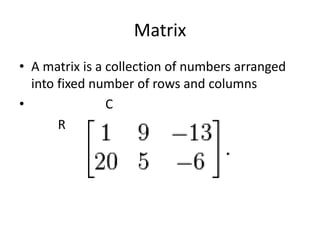
• A matrix is a collection of numbers arranged 
into fixed number of rows and columns 
• C 
R
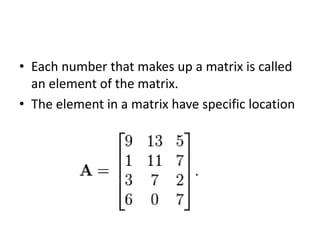
• Each number that makes up a matrix is called 
an element of the matrix. 
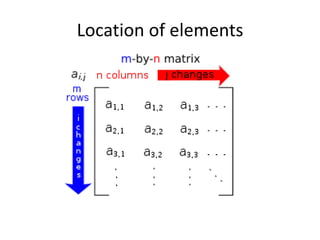
• The element in a matrix have specific location
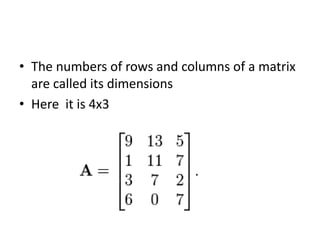
• The numbers of rows and columns of a matrix 
are called its dimensions 
• Here it is 4x3
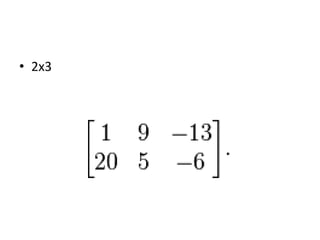
• 2x3
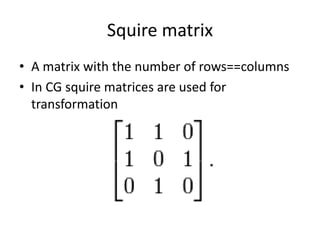
Squire matrix 
• A matrix with the number of rows==columns 
• In CG squire matrices are used for 
transformation
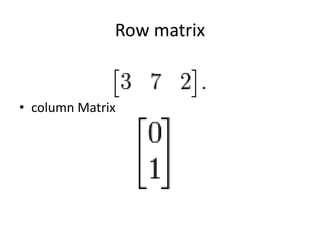
Row matrix 
• column Matrix
Notation 
• Usually a capital letter in bold face like 
• A or M 
• Sometimes as a reminder the dimensions are 
written to the right of 
• the letter as in B3x3
Location of elements
• If 2 matrices contain the same No. as 
elements; are the 2 matrices equal to each 
other???
• If 2 matrices contain the same No. as 
elements; are the 2 matrices equal to each 
other??? 
• No, to be equal, must have the same 
dimensions and must have the same values in 
the same positions.
• In other words, say that An x m = [ai j] and that 
Bp x q = [bi j] 
• Then A = B if and only if n=p, m=q, and ai j =bi j 
for all I and j in range
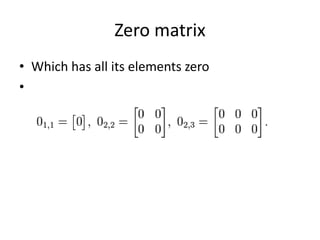
Zero matrix 
• Which has all its elements zero 
•
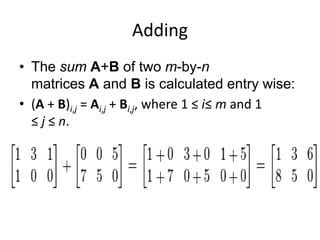
Adding 
• The sum A+B of two m-by-n 
matrices A and B is calculated entry wise: 
• (A + B)i,j = Ai,j + Bi,j, where 1 ≤ i≤ m and 1 
≤ j ≤ n.
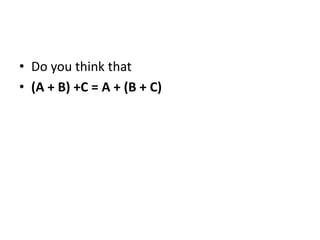
• Do you think that 
• (A + B) +C = A + (B + C)
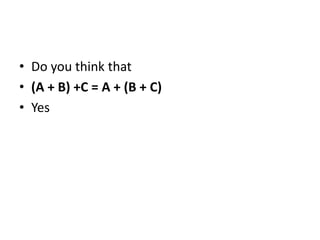
• Do you think that 
• (A + B) +C = A + (B + C) 
• Yes
Scalar multiplication 
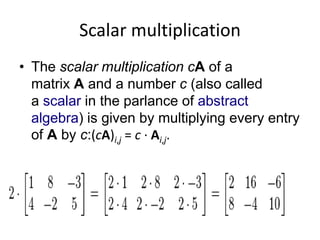
• The scalar multiplication cA of a 
matrix A and a number c (also called 
a scalar in the parlance of abstract 
algebra) is given by multiplying every entry 
of A by c:(cA)i,j = c · Ai,j.
Transpose 
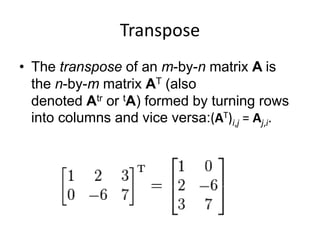
• The transpose of an m-by-n matrix A is 
the n-by-m matrix AT (also 
denoted Atr or tA) formed by turning rows 
into columns and vice versa:(AT)i,j = Aj,i.
• Familiar properties of numbers extend to these 
operations of matrices 
• for example, addition is commutative, i.e., the 
matrix sum does not depend on the order of the 
summands: A + B = B + A. 
• The transpose is compatible with addition and 
scalar multiplication, as expressed by (cA)T = c(AT) 
and 
• (A + B)T = AT + BT. 
• Finally, (AT)T = A.
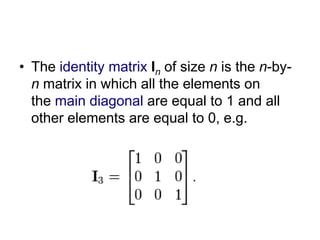
• The identity matrix In of size n is the n-by-n 
matrix in which all the elements on 
the main diagonal are equal to 1 and all 
other elements are equal to 0, e.g.
• It is called identity matrix because 
multiplication with it leaves a matrix 
unchanged: MIn = ImM = M for any m-by-n 
matrix M.
Vector 
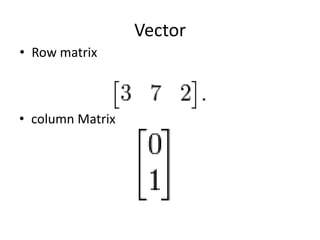
• Row matrix 
• column Matrix
Vector 
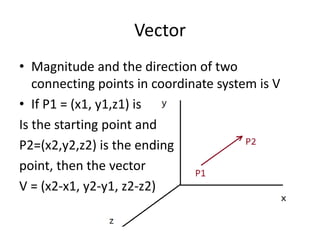
• Magnitude and the direction of two 
connecting points in coordinate system is V 
• If P1 = (x1, y1,z1) is 
Is the starting point and 
P2=(x2,y2,z2) is the ending 
point, then the vector 
V = (x2-x1, y2-y1, z2-z2)
Projection in 2D 
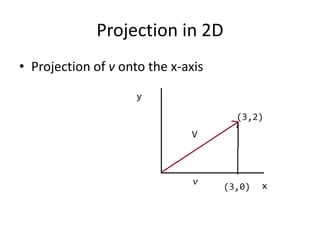
• Projection of v onto the x-axis
Projection in 3D 
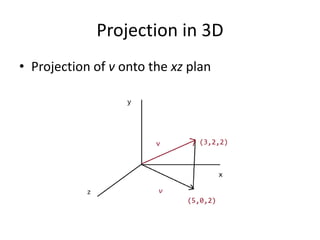
• Projection of v onto the xz plan
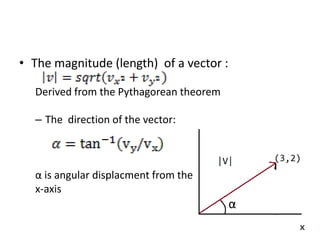
• The magnitude (length) of a vector : 
Derived from the Pythagorean theorem 
– The direction of the vector: 
α is angular displacment from the 
x-axis 
α
3D 
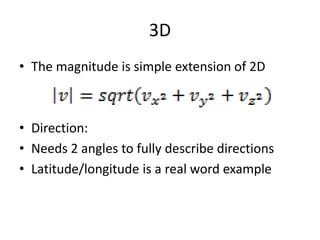
• The magnitude is simple extension of 2D 
• Direction: 
• Needs 2 angles to fully describe directions 
• Latitude/longitude is a real word example
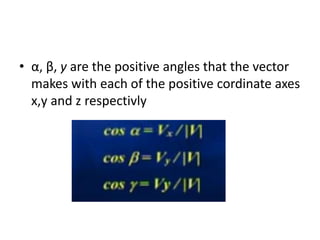
• α, β, y are the positive angles that the vector 
makes with each of the positive cordinate axes 
x,y and z respectivly
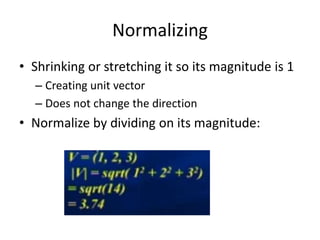
Normalizing 
• Shrinking or stretching it so its magnitude is 1 
– Creating unit vector 
– Does not change the direction 
• Normalize by dividing on its magnitude:
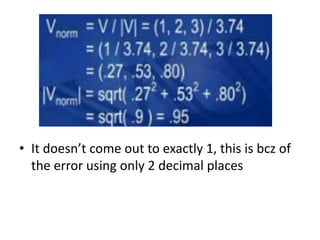
• It doesn’t come out to exactly 1, this is bcz of 
the error using only 2 decimal places

Mathematics fundamentals

  • 1.
  • 2.
  • 3.
    Matrix • Amatrix is a collection of numbers arranged into fixed number of rows and columns • C R
  • 4.
    • Each numberthat makes up a matrix is called an element of the matrix. • The element in a matrix have specific location
  • 5.
    • The numbersof rows and columns of a matrix are called its dimensions • Here it is 4x3
  • 6.
  • 7.
    Squire matrix •A matrix with the number of rows==columns • In CG squire matrices are used for transformation
  • 8.
    Row matrix •column Matrix
  • 9.
    Notation • Usuallya capital letter in bold face like • A or M • Sometimes as a reminder the dimensions are written to the right of • the letter as in B3x3
  • 10.
  • 11.
    • If 2matrices contain the same No. as elements; are the 2 matrices equal to each other???
  • 12.
    • If 2matrices contain the same No. as elements; are the 2 matrices equal to each other??? • No, to be equal, must have the same dimensions and must have the same values in the same positions.
  • 13.
    • In otherwords, say that An x m = [ai j] and that Bp x q = [bi j] • Then A = B if and only if n=p, m=q, and ai j =bi j for all I and j in range
  • 14.
    Zero matrix •Which has all its elements zero •
  • 15.
    Adding • Thesum A+B of two m-by-n matrices A and B is calculated entry wise: • (A + B)i,j = Ai,j + Bi,j, where 1 ≤ i≤ m and 1 ≤ j ≤ n.
  • 16.
    • Do youthink that • (A + B) +C = A + (B + C)
  • 17.
    • Do youthink that • (A + B) +C = A + (B + C) • Yes
  • 18.
    Scalar multiplication •The scalar multiplication cA of a matrix A and a number c (also called a scalar in the parlance of abstract algebra) is given by multiplying every entry of A by c:(cA)i,j = c · Ai,j.
  • 19.
    Transpose • Thetranspose of an m-by-n matrix A is the n-by-m matrix AT (also denoted Atr or tA) formed by turning rows into columns and vice versa:(AT)i,j = Aj,i.
  • 20.
    • Familiar propertiesof numbers extend to these operations of matrices • for example, addition is commutative, i.e., the matrix sum does not depend on the order of the summands: A + B = B + A. • The transpose is compatible with addition and scalar multiplication, as expressed by (cA)T = c(AT) and • (A + B)T = AT + BT. • Finally, (AT)T = A.
  • 21.
    • The identitymatrix In of size n is the n-by-n matrix in which all the elements on the main diagonal are equal to 1 and all other elements are equal to 0, e.g.
  • 22.
    • It iscalled identity matrix because multiplication with it leaves a matrix unchanged: MIn = ImM = M for any m-by-n matrix M.
  • 23.
    Vector • Rowmatrix • column Matrix
  • 24.
    Vector • Magnitudeand the direction of two connecting points in coordinate system is V • If P1 = (x1, y1,z1) is Is the starting point and P2=(x2,y2,z2) is the ending point, then the vector V = (x2-x1, y2-y1, z2-z2)
  • 25.
    Projection in 2D • Projection of v onto the x-axis
  • 26.
    Projection in 3D • Projection of v onto the xz plan
  • 27.
    • The magnitude(length) of a vector : Derived from the Pythagorean theorem – The direction of the vector: α is angular displacment from the x-axis α
  • 28.
    3D • Themagnitude is simple extension of 2D • Direction: • Needs 2 angles to fully describe directions • Latitude/longitude is a real word example
  • 29.
    • α, β,y are the positive angles that the vector makes with each of the positive cordinate axes x,y and z respectivly
  • 30.
    Normalizing • Shrinkingor stretching it so its magnitude is 1 – Creating unit vector – Does not change the direction • Normalize by dividing on its magnitude:
  • 31.
    • It doesn’tcome out to exactly 1, this is bcz of the error using only 2 decimal places