

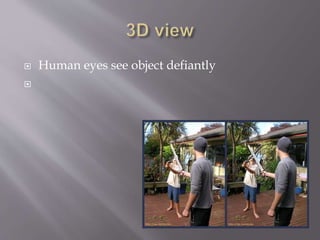


 Human eyes see object defiantly 

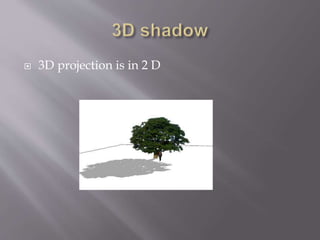
 3D projection is in 2 D
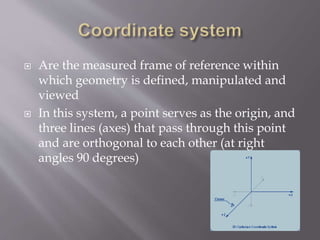
 Are the measured frame of reference within 
which geometry is defined, manipulated and 
viewed 
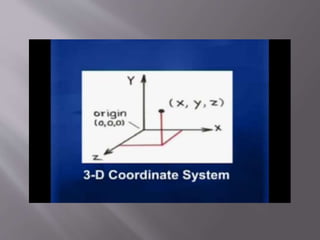
 In this system, a point serves as the origin, and 
three lines (axes) that pass through this point 
and are orthogonal to each other (at right 
angles 90 degrees)
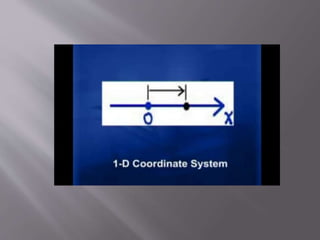
 1D coordinate system 
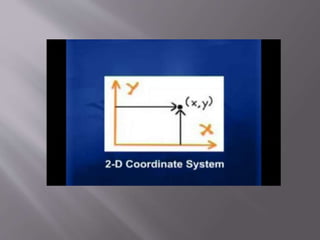
 2D coordinate system 
 3D coordinate system
 Direction and magnitude along a single axis, 
with reference to origin 
 Location are defined by a single coordinate
 We can define points, segments, lines rays 
 Can have multiple origins (frame of reference) 
and transform coordinates among them
 Direction and magnitude along two axes, with 
reference to an origin 
 Location are defined by x, y coordinate
 We can define points, segments, lines rays, 
curves, polygons (any other planar geometry) 
 Can have multiple origins (frame of reference) 
and transform coordinates among them
 3D Cartesian coordinate system 
 Direction and magnitude along three axes, with 
reference to an origin 
 Location are defined by x, y, z coordinate
 We can define points, segments, lines rays, 
curves, polygons (any other planar geometry) 
and cubes, cones, spheres, etc. (volume in 
space) 
 Can have multiple origins (frame of reference) 
and transform coordinates among them
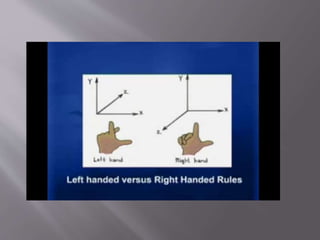
 right hand rules etc. 
 These rules determine orientation of axes and 
direction of rotations 
 Thumb = pos x 
 Index up = pos y 
 Middle out = pos z
 Most world and objects axes tend to be right 
handed 
 Left hand axes often are used for cmaeras
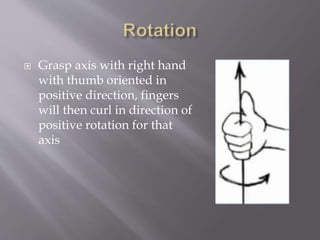
 Grasp axis with right hand 
with thumb oriented in 
positive direction, fingers 
will then curl in direction of 
positive rotation for that 
axis
 Right handed Cartesian coordinate system 
describes the relationship of the x, y, z in the 
following manner 
 X is positive to the right of the origin and 
negative to the left 
 Y is positive to the above of the origin and 
negative to the below 
 Z is positive behind the origin and negative 
beyond
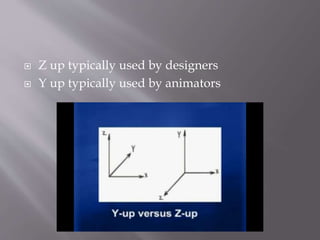
 Z up typically used by designers 
 Y up typically used by animators
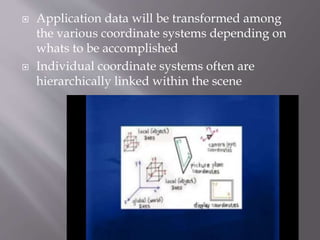
 Application data will be transformed among 
the various coordinate systems depending on 
whats to be accomplished 
 Individual coordinate systems often are 
hierarchically linked within the scene
 Use OPP to make the object of the 3d points 
 Class 3d-class 
 { public: 
 Float x; 
 Float y; 
 Float z; 
 }
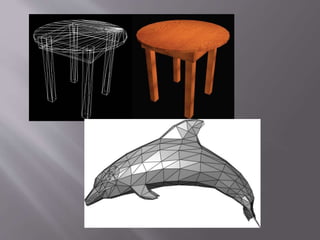
 Modeling is the process of describing an object 
or scene so that we can construct an image of it 
 Angle, location, size etc.. 
 Polygon strips or meshes 
 Meshes provide a more economical description than 
multiple individual polygons (wireframe model 
 100 individual triangles, each have 3 vertices, would 
require 100 x3 vertex definitions 
 Triangle strips require n + 2 vertex definitions, n is 
number of triangles in strip. For 100 needs 102 
unique vertex definitions
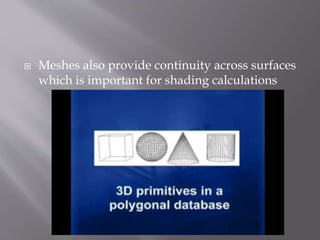
 Meshes also provide continuity across surfaces 
which is important for shading calculations
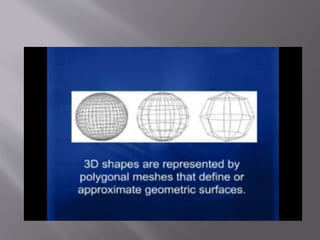
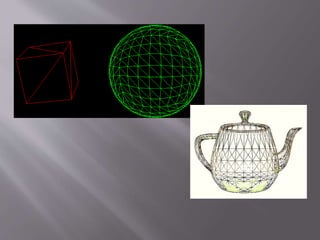
 With cured surfaces the accuracy of the 
approximation is directly proportional to the 
number of polygons used in the representation 
 More polygons yield a better approximation 
 But more polygons also exact greater 
computational overhead..
 The process of computing a 2d image using a 
combination of a 3 D database, scene 
characteristics and viewing transformations 
 Various Alog. According to the need of 
applications
 The subdivision of an entity or surface into one 
or more non-overlapping primitives 
 Typically, renderers decompose surfaces into 
triangles as part of the rendering
 The process of selecting a representative but 
finite number of values along a continuous 
function sufficient to render a reasonable 
approximations of the function for the task at 
hand
 To improve rendering efficiency when 
dynamically viewing a scene, more or less 
detailed versions of a model may be swapped 
in and out of the scene database depending on 
the importance of the object in current view
 A vector perpendicular to a surface and 
outward facing 
 SN are used to determine visibility and also in 
the calculation of shading values
3 d graphics basics

3 d graphics basics

  • 2.
     Human eyessee object defiantly 
  • 3.
  • 4.
     Are themeasured frame of reference within which geometry is defined, manipulated and viewed  In this system, a point serves as the origin, and three lines (axes) that pass through this point and are orthogonal to each other (at right angles 90 degrees)
  • 5.
     1D coordinatesystem  2D coordinate system  3D coordinate system
  • 6.
     Direction andmagnitude along a single axis, with reference to origin  Location are defined by a single coordinate
  • 7.
     We candefine points, segments, lines rays  Can have multiple origins (frame of reference) and transform coordinates among them
  • 9.
     Direction andmagnitude along two axes, with reference to an origin  Location are defined by x, y coordinate
  • 10.
     We candefine points, segments, lines rays, curves, polygons (any other planar geometry)  Can have multiple origins (frame of reference) and transform coordinates among them
  • 12.
     3D Cartesiancoordinate system  Direction and magnitude along three axes, with reference to an origin  Location are defined by x, y, z coordinate
  • 13.
     We candefine points, segments, lines rays, curves, polygons (any other planar geometry) and cubes, cones, spheres, etc. (volume in space)  Can have multiple origins (frame of reference) and transform coordinates among them
  • 15.
     right handrules etc.  These rules determine orientation of axes and direction of rotations  Thumb = pos x  Index up = pos y  Middle out = pos z
  • 16.
     Most worldand objects axes tend to be right handed  Left hand axes often are used for cmaeras
  • 18.
     Grasp axiswith right hand with thumb oriented in positive direction, fingers will then curl in direction of positive rotation for that axis
  • 19.
     Right handedCartesian coordinate system describes the relationship of the x, y, z in the following manner  X is positive to the right of the origin and negative to the left  Y is positive to the above of the origin and negative to the below  Z is positive behind the origin and negative beyond
  • 20.
     Z uptypically used by designers  Y up typically used by animators
  • 21.
     Application datawill be transformed among the various coordinate systems depending on whats to be accomplished  Individual coordinate systems often are hierarchically linked within the scene
  • 22.
     Use OPPto make the object of the 3d points  Class 3d-class  { public:  Float x;  Float y;  Float z;  }
  • 23.
     Modeling isthe process of describing an object or scene so that we can construct an image of it  Angle, location, size etc..  Polygon strips or meshes  Meshes provide a more economical description than multiple individual polygons (wireframe model  100 individual triangles, each have 3 vertices, would require 100 x3 vertex definitions  Triangle strips require n + 2 vertex definitions, n is number of triangles in strip. For 100 needs 102 unique vertex definitions
  • 24.
     Meshes alsoprovide continuity across surfaces which is important for shading calculations
  • 26.
     With curedsurfaces the accuracy of the approximation is directly proportional to the number of polygons used in the representation  More polygons yield a better approximation  But more polygons also exact greater computational overhead..
  • 27.
     The processof computing a 2d image using a combination of a 3 D database, scene characteristics and viewing transformations  Various Alog. According to the need of applications
  • 28.
     The subdivisionof an entity or surface into one or more non-overlapping primitives  Typically, renderers decompose surfaces into triangles as part of the rendering
  • 31.
     The processof selecting a representative but finite number of values along a continuous function sufficient to render a reasonable approximations of the function for the task at hand
  • 32.
     To improverendering efficiency when dynamically viewing a scene, more or less detailed versions of a model may be swapped in and out of the scene database depending on the importance of the object in current view
  • 33.
     A vectorperpendicular to a surface and outward facing  SN are used to determine visibility and also in the calculation of shading values