Trigonometry – MAT 108
Midterm Examination Review
Spring
2020
Lehman College, Department of Mathematics
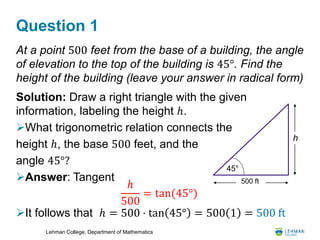
Question 1
At a point 500 feet from the base of a building, the angle
of elevation to the top of the building is 45°. Find the
height of the building (leave your answer in radical form)
Solution: Draw a right triangle with the given
information, labeling the height ℎ.
What trigonometric relation connects the
height ℎ, the base 500 feet, and the
angle 45°?
Answer: Tangent
It follows that ℎ = 500 ⋅ tan 45° = 500 1 = 500 ft
h
500 ft
45°
ℎ
500
= tan(45°)
Lehman College, Department of Mathematics
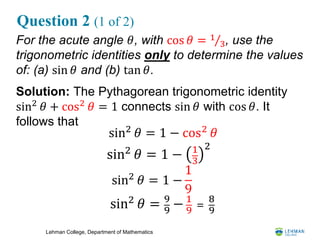
Question 2 (1 of 2)
For the acute angle 𝜃, with cos 𝜃 = 1
3, use the
trigonometric identities only to determine the values
of: (a) sin 𝜃 and (b) tan 𝜃.
Solution: The Pythagorean trigonometric identity
sin2 𝜃 + cos2 𝜃 = 1 connects sin 𝜃 with cos 𝜃. It
follows that
sin2
𝜃 = 1 − cos2
𝜃
sin2
𝜃 = 1 − 1
3
2
sin2
𝜃 = 1 −
1
9
sin2
𝜃 = 9
9
− 1
9
=
8
9
Lehman College, Department of Mathematics
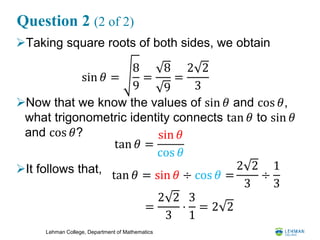
Question 2 (2 of 2)
Taking square roots of both sides, we obtain
Now that we know the values of sin 𝜃 and cos 𝜃,
what trigonometric identity connects tan 𝜃 to sin 𝜃
and cos 𝜃?
It follows that,
sin 𝜃 =
8
9
=
8
9
=
2 2
3
tan 𝜃 =
sin 𝜃
cos 𝜃
tan 𝜃 = sin 𝜃 ÷ cos 𝜃 =
2 2
3
÷
1
3
=
2 2
3
⋅
3
1
= 2 2
Lehman College, Department of Mathematics
Question 3(a)
Evaluate, without using a calculator, the sine, cosine
and tangent of: (a) 135°[5 points], and (b)
5𝜋
3
[5 points],
Solution: (a) Since 135° is greater than 90° but less
than 180° (quadrant II), its reference angle is given by:
It follows that
Note: You must use the reference angle method.
Above we used the fact that in quadrant II, sine is
positive and both cosine and tangent are negative. A
diagram may also be useful.
sin 135° = + sin 45° = 2
2
180° − 135° = 45°
cos 135° = − cos 45° = − 2
2
tan 135° = − tan 45° = −1
Lehman College, Department of Mathematics
Question 3(b)
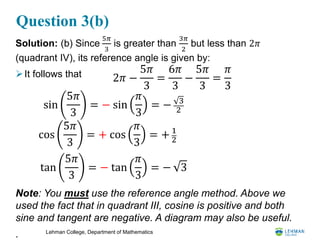
Solution: (b) Since
5𝜋
3
is greater than
3𝜋
2
but less than 2𝜋
(quadrant IV), its reference angle is given by:
It follows that
Note: You must use the reference angle method. Above we
used the fact that in quadrant III, cosine is positive and both
sine and tangent are negative. A diagram may also be useful.
.
sin
5𝜋
3
= − sin
𝜋
3
= − 3
2
cos
5𝜋
3
= + cos
𝜋
3
= + 1
2
tan
5𝜋
3
= − tan
𝜋
3
= − 3
2𝜋 −
5𝜋
3
=
6𝜋
3
−
5𝜋
3
=
𝜋
3
Lehman College, Department of Mathematics
Question 4
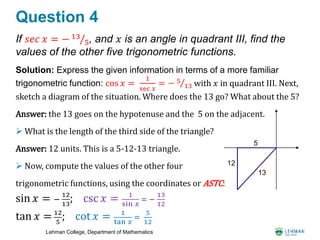
If 𝑠𝑒𝑐 𝑥 = − 13
5, and 𝑥 is an angle in quadrant III, find the
values of the other five trigonometric functions.
Solution: Express the given information in terms of a more familiar
trigonometric function: cos 𝑥 =
1
sec 𝑥
= − 5
13 with 𝑥 in quadrant III. Next,
sketch a diagram of the situation. Where does the 13 go? What about the 5?
Answer: the 13 goes on the hypotenuse and the 5 on the adjacent.
 What is the length of the third side of the triangle?
Answer: 12 units. This is a 5-12-13 triangle.
 Now, compute the values of the other four
trigonometric functions, using the coordinates or ASTC:
sin 𝑥 = −
12
13
; csc 𝑥 = 1
sin 𝑥
= −
13
12
tan 𝑥 = 12
5
; cot 𝑥 = 1
tan 𝑥
=
5
12
13
5
12
Lehman College, Department of Mathematics
Question 5
(a) Find the length of the arc of a circle of radius 3 cm that
subtends a central angle of 150°[5 points]. (b) Determine the
area of the corresponding sector [5 points] (leave all
answers in terms of 𝜋).
Solution: (a) If 𝜃 is given in degrees, then the arc length 𝑙 is
given by the formula:
So,
(a) Area of sector 𝑆 is given by the formula:
It follows that
𝑙 =
𝜃
360°
⋅ 2𝜋𝑟
𝑙 =
150°
360°
⋅ 2𝜋 3 =
5
12
⋅ 6𝜋 =
5𝜋
2
cm
𝑆 =
𝜃
360°
⋅ 𝜋𝑟2
𝑆 =
150°
360°
⋅ 𝜋 3 2
=
5
12
⋅ 9𝜋 =
15𝜋
4
cm2
Lehman College, Department of Mathematics
Question 6
(a) Find the length of the arc of a circle of radius 3 cm
that subtends a central angle of
2𝜋
5
[5 points].
(b) Determine the area of the corresponding sector
[5 points] (leave all answers in terms of 𝜋).
Solution: (a) If 𝜃 is given in radians, then the arc length
𝑙 is given by the formula:
So
(a) Area of sector 𝑆 is given by the formula:
It follows that
𝑙 = 3
2𝜋
5
=
6𝜋
5
cm
𝑙 = 𝑟𝜃
𝑆 =
1
2
⋅
2𝜋
5
3 2
=
𝜋
5
9 =
9𝜋
5
cm2
𝑆 =
1
2
𝜃𝑟2
Lehman College, Department of Mathematics
Question 7 (1 of 2)
Determine the amplitude, period and phase shift of the
function y = 3 sin(2𝑥 −
𝜋
3
). Hence or otherwise, sketch
exactly one period of the graph of y = 3 sin(2𝑥 −
𝜋
3
).
Solution: Amplitude = 3 = 3. There is no reflection
over the x-axis. To determine the period and phase
shift, let
Add
𝜋
3
to each side of the above inequality:
Divide by 2
0 ≤ 2𝑥 −
𝜋
3
≤ 2𝜋
0 +
𝜋
3
≤ 2𝑥 ≤ 2𝜋 +
𝜋
3
𝜋
3
≤ 2𝑥 ≤
7𝜋
3
𝜋
6
≤ 𝑥 ≤
7𝜋
6
Lehman College, Department of Mathematics
Question 7 (2 of 2)
It follows that the phase shift =
𝜋
6
; the period =
7𝜋
6
−
𝜋
6
= 𝜋
Graph one period of the function y = sin(𝑥)
Finally, to graph the given function, put
𝜋
6
at the
position where 0 is on the sine graph and replace 2𝜋
by
7𝜋
6
Lehman College, Department of Mathematics
Question 8
In triangle ABC, side a = 7 in, side b = 4 in, and ∠C =
60°. Find the area of the triangle (leave your answer in
radical form) [10 points].
Solution: Draw a scalene triangle ABC and label the
vertices and side lengths as given in the problem.
The formula for the area of an SAS
triangle is
For the given problem: A
B
C
𝑎 = 7 in
𝑏 = 4 in
60°
𝐴𝑟𝑒𝑎 =
1
2
(7)(4) sin 60° = 14 3
2
= 7 3 in2
𝐴𝑟𝑒𝑎 =
1
2
𝑎𝑏 sin(∠C)
Lehman College, Department of Mathematics
Question 9 (1 of 2)
In triangle ABC, side a = 2 in, ∠𝐴 = 60°, and
∠𝐵 = 45°. Find the length of side b (leave your
answer in radical form) [10 points].
Solution: Draw a scalene triangle ABC and label
the vertices and side lengths as given in the
problem.
This is an application of the Rule of Sines:
A
B
C
𝑎 = 2 in
𝑏 = ?
60°
45°
𝑏
sin(∠𝐵)
=
𝑎
sin(∠𝐴)
Lehman College, Department of Mathematics
Question 9 (2 of 2)
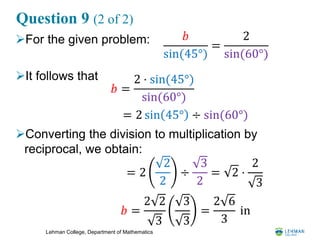
For the given problem:
It follows that
Converting the division to multiplication by
reciprocal, we obtain:
𝑏
sin(45°)
=
2
sin(60°)
𝑏 =
2 ⋅ sin(45°)
sin(60°)
= 2 sin 45° ÷ sin(60°)
𝑏 =
2 2
3
3
3
=
2 6
3
in
= 2
2
2
÷
3
2
= 2 ⋅
2
3
Lehman College, Department of Mathematics
Question 10 (1 of 2)
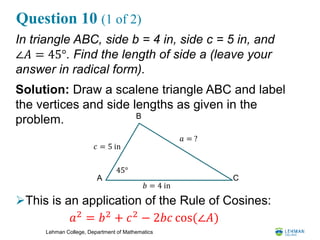
In triangle ABC, side b = 4 in, side c = 5 in, and
∠𝐴 = 45°. Find the length of side a (leave your
answer in radical form).
Solution: Draw a scalene triangle ABC and label
the vertices and side lengths as given in the
problem.
This is an application of the Rule of Cosines:
A
B
C
𝑎 = ?
𝑏 = 4 in
45°
𝑐 = 5 in
𝑎2
= 𝑏2
+ 𝑐2
− 2𝑏𝑐 cos(∠𝐴)
Lehman College, Department of Mathematics
Question 10 (2 of 2)
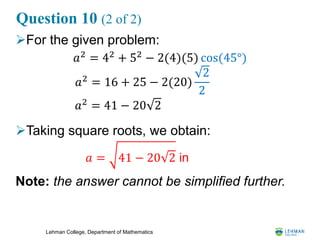
For the given problem:
Taking square roots, we obtain:
Note: the answer cannot be simplified further.
𝑎2 = 42 + 52 − 2(4)(5) cos(45°)
𝑎2 = 16 + 25 − 2(20)
2
2
𝑎2
= 41 − 20 2
𝑎 = 41 − 20 2 in

MAT-108 Trigonometry Midterm Review

  • 1.
    Trigonometry – MAT108 Midterm Examination Review Spring 2020
  • 2.
    Lehman College, Departmentof Mathematics Question 1 At a point 500 feet from the base of a building, the angle of elevation to the top of the building is 45°. Find the height of the building (leave your answer in radical form) Solution: Draw a right triangle with the given information, labeling the height ℎ. What trigonometric relation connects the height ℎ, the base 500 feet, and the angle 45°? Answer: Tangent It follows that ℎ = 500 ⋅ tan 45° = 500 1 = 500 ft h 500 ft 45° ℎ 500 = tan(45°)
  • 3.
    Lehman College, Departmentof Mathematics Question 2 (1 of 2) For the acute angle 𝜃, with cos 𝜃 = 1 3, use the trigonometric identities only to determine the values of: (a) sin 𝜃 and (b) tan 𝜃. Solution: The Pythagorean trigonometric identity sin2 𝜃 + cos2 𝜃 = 1 connects sin 𝜃 with cos 𝜃. It follows that sin2 𝜃 = 1 − cos2 𝜃 sin2 𝜃 = 1 − 1 3 2 sin2 𝜃 = 1 − 1 9 sin2 𝜃 = 9 9 − 1 9 = 8 9
  • 4.
    Lehman College, Departmentof Mathematics Question 2 (2 of 2) Taking square roots of both sides, we obtain Now that we know the values of sin 𝜃 and cos 𝜃, what trigonometric identity connects tan 𝜃 to sin 𝜃 and cos 𝜃? It follows that, sin 𝜃 = 8 9 = 8 9 = 2 2 3 tan 𝜃 = sin 𝜃 cos 𝜃 tan 𝜃 = sin 𝜃 ÷ cos 𝜃 = 2 2 3 ÷ 1 3 = 2 2 3 ⋅ 3 1 = 2 2
  • 5.
    Lehman College, Departmentof Mathematics Question 3(a) Evaluate, without using a calculator, the sine, cosine and tangent of: (a) 135°[5 points], and (b) 5𝜋 3 [5 points], Solution: (a) Since 135° is greater than 90° but less than 180° (quadrant II), its reference angle is given by: It follows that Note: You must use the reference angle method. Above we used the fact that in quadrant II, sine is positive and both cosine and tangent are negative. A diagram may also be useful. sin 135° = + sin 45° = 2 2 180° − 135° = 45° cos 135° = − cos 45° = − 2 2 tan 135° = − tan 45° = −1
  • 6.
    Lehman College, Departmentof Mathematics Question 3(b) Solution: (b) Since 5𝜋 3 is greater than 3𝜋 2 but less than 2𝜋 (quadrant IV), its reference angle is given by: It follows that Note: You must use the reference angle method. Above we used the fact that in quadrant III, cosine is positive and both sine and tangent are negative. A diagram may also be useful. . sin 5𝜋 3 = − sin 𝜋 3 = − 3 2 cos 5𝜋 3 = + cos 𝜋 3 = + 1 2 tan 5𝜋 3 = − tan 𝜋 3 = − 3 2𝜋 − 5𝜋 3 = 6𝜋 3 − 5𝜋 3 = 𝜋 3
  • 7.
    Lehman College, Departmentof Mathematics Question 4 If 𝑠𝑒𝑐 𝑥 = − 13 5, and 𝑥 is an angle in quadrant III, find the values of the other five trigonometric functions. Solution: Express the given information in terms of a more familiar trigonometric function: cos 𝑥 = 1 sec 𝑥 = − 5 13 with 𝑥 in quadrant III. Next, sketch a diagram of the situation. Where does the 13 go? What about the 5? Answer: the 13 goes on the hypotenuse and the 5 on the adjacent.  What is the length of the third side of the triangle? Answer: 12 units. This is a 5-12-13 triangle.  Now, compute the values of the other four trigonometric functions, using the coordinates or ASTC: sin 𝑥 = − 12 13 ; csc 𝑥 = 1 sin 𝑥 = − 13 12 tan 𝑥 = 12 5 ; cot 𝑥 = 1 tan 𝑥 = 5 12 13 5 12
  • 8.
    Lehman College, Departmentof Mathematics Question 5 (a) Find the length of the arc of a circle of radius 3 cm that subtends a central angle of 150°[5 points]. (b) Determine the area of the corresponding sector [5 points] (leave all answers in terms of 𝜋). Solution: (a) If 𝜃 is given in degrees, then the arc length 𝑙 is given by the formula: So, (a) Area of sector 𝑆 is given by the formula: It follows that 𝑙 = 𝜃 360° ⋅ 2𝜋𝑟 𝑙 = 150° 360° ⋅ 2𝜋 3 = 5 12 ⋅ 6𝜋 = 5𝜋 2 cm 𝑆 = 𝜃 360° ⋅ 𝜋𝑟2 𝑆 = 150° 360° ⋅ 𝜋 3 2 = 5 12 ⋅ 9𝜋 = 15𝜋 4 cm2
  • 9.
    Lehman College, Departmentof Mathematics Question 6 (a) Find the length of the arc of a circle of radius 3 cm that subtends a central angle of 2𝜋 5 [5 points]. (b) Determine the area of the corresponding sector [5 points] (leave all answers in terms of 𝜋). Solution: (a) If 𝜃 is given in radians, then the arc length 𝑙 is given by the formula: So (a) Area of sector 𝑆 is given by the formula: It follows that 𝑙 = 3 2𝜋 5 = 6𝜋 5 cm 𝑙 = 𝑟𝜃 𝑆 = 1 2 ⋅ 2𝜋 5 3 2 = 𝜋 5 9 = 9𝜋 5 cm2 𝑆 = 1 2 𝜃𝑟2
  • 10.
    Lehman College, Departmentof Mathematics Question 7 (1 of 2) Determine the amplitude, period and phase shift of the function y = 3 sin(2𝑥 − 𝜋 3 ). Hence or otherwise, sketch exactly one period of the graph of y = 3 sin(2𝑥 − 𝜋 3 ). Solution: Amplitude = 3 = 3. There is no reflection over the x-axis. To determine the period and phase shift, let Add 𝜋 3 to each side of the above inequality: Divide by 2 0 ≤ 2𝑥 − 𝜋 3 ≤ 2𝜋 0 + 𝜋 3 ≤ 2𝑥 ≤ 2𝜋 + 𝜋 3 𝜋 3 ≤ 2𝑥 ≤ 7𝜋 3 𝜋 6 ≤ 𝑥 ≤ 7𝜋 6
  • 11.
    Lehman College, Departmentof Mathematics Question 7 (2 of 2) It follows that the phase shift = 𝜋 6 ; the period = 7𝜋 6 − 𝜋 6 = 𝜋 Graph one period of the function y = sin(𝑥) Finally, to graph the given function, put 𝜋 6 at the position where 0 is on the sine graph and replace 2𝜋 by 7𝜋 6
  • 12.
    Lehman College, Departmentof Mathematics Question 8 In triangle ABC, side a = 7 in, side b = 4 in, and ∠C = 60°. Find the area of the triangle (leave your answer in radical form) [10 points]. Solution: Draw a scalene triangle ABC and label the vertices and side lengths as given in the problem. The formula for the area of an SAS triangle is For the given problem: A B C 𝑎 = 7 in 𝑏 = 4 in 60° 𝐴𝑟𝑒𝑎 = 1 2 (7)(4) sin 60° = 14 3 2 = 7 3 in2 𝐴𝑟𝑒𝑎 = 1 2 𝑎𝑏 sin(∠C)
  • 13.
    Lehman College, Departmentof Mathematics Question 9 (1 of 2) In triangle ABC, side a = 2 in, ∠𝐴 = 60°, and ∠𝐵 = 45°. Find the length of side b (leave your answer in radical form) [10 points]. Solution: Draw a scalene triangle ABC and label the vertices and side lengths as given in the problem. This is an application of the Rule of Sines: A B C 𝑎 = 2 in 𝑏 = ? 60° 45° 𝑏 sin(∠𝐵) = 𝑎 sin(∠𝐴)
  • 14.
    Lehman College, Departmentof Mathematics Question 9 (2 of 2) For the given problem: It follows that Converting the division to multiplication by reciprocal, we obtain: 𝑏 sin(45°) = 2 sin(60°) 𝑏 = 2 ⋅ sin(45°) sin(60°) = 2 sin 45° ÷ sin(60°) 𝑏 = 2 2 3 3 3 = 2 6 3 in = 2 2 2 ÷ 3 2 = 2 ⋅ 2 3
  • 15.
    Lehman College, Departmentof Mathematics Question 10 (1 of 2) In triangle ABC, side b = 4 in, side c = 5 in, and ∠𝐴 = 45°. Find the length of side a (leave your answer in radical form). Solution: Draw a scalene triangle ABC and label the vertices and side lengths as given in the problem. This is an application of the Rule of Cosines: A B C 𝑎 = ? 𝑏 = 4 in 45° 𝑐 = 5 in 𝑎2 = 𝑏2 + 𝑐2 − 2𝑏𝑐 cos(∠𝐴)
  • 16.
    Lehman College, Departmentof Mathematics Question 10 (2 of 2) For the given problem: Taking square roots, we obtain: Note: the answer cannot be simplified further. 𝑎2 = 42 + 52 − 2(4)(5) cos(45°) 𝑎2 = 16 + 25 − 2(20) 2 2 𝑎2 = 41 − 20 2 𝑎 = 41 − 20 2 in