The learner illustrates
polygons according to (a)
convexity; (b) sides; and
(c) angles. (M7GE-IIIe-2)
1. differentiate convex polygons from
concave polygons,
2. identify the different polygons; and
3. illustrate polygons.
Directions: Choose the
letter that you think best
answers the question.
1. It is a closed figure made up
of line segments that intersect
at their endpoints.

a. line
b. angle
c. polygon
d. circle
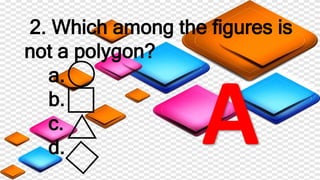
2. Which among the figures is
not a polygon?
a.
b.
c.
d.
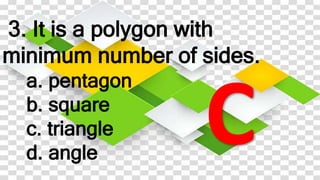
3. It is a polygon with
minimum number of sides.
a. pentagon
b. square
c. triangle
d. angle
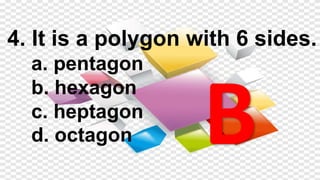
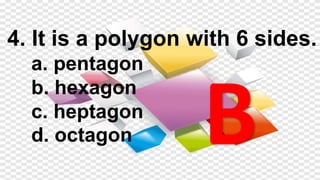
4. It is a polygon with 6 sides.
a. pentagon
b. hexagon
c. heptagon
d. octagon
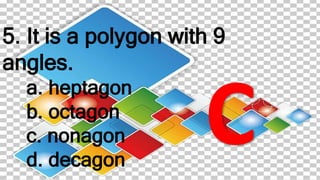
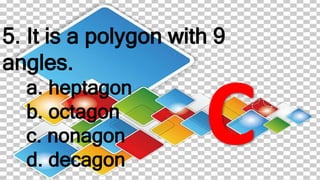
5. It is a polygon with 9
angles.
a. heptagon
b. octagon
c. nonagon
d. decagon
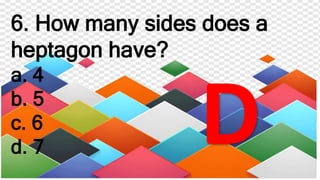
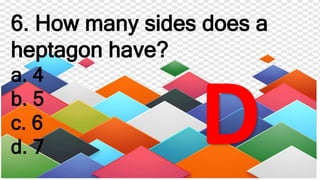
6. How many sides does a
heptagon have?
a. 4
b. 5
c. 6
d. 7
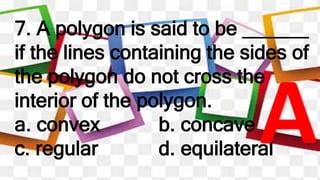
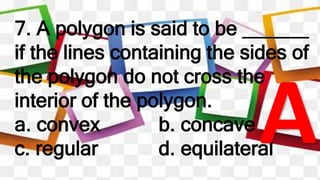
7. A polygon is said to be ______
if the lines containing the sides of
the polygon do not cross the
interior of the polygon.
a. convex b. concave
c. regular d. equilateral
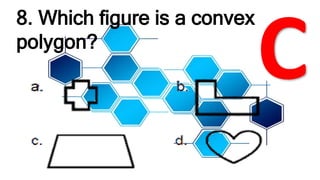
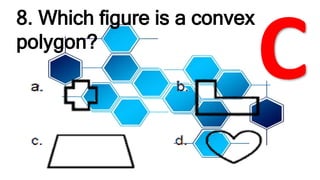
8. Which figure is a convex
polygon?
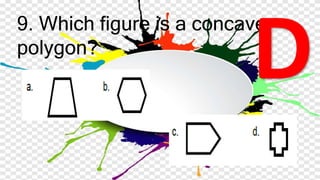
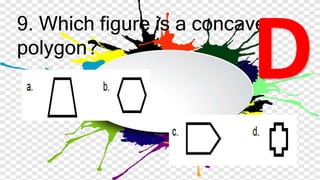
9. Which figure is a concave
polygon?
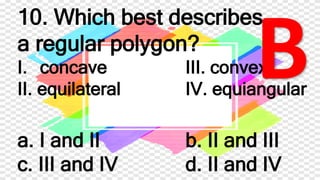
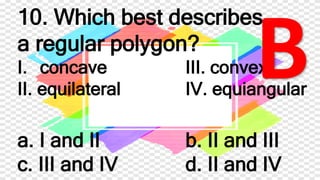
10. Which best describes
a regular polygon?
I. concave III. convex
II. equilateral IV. equiangular
a. I and II b. II and III
c. III and IV d. II and IV
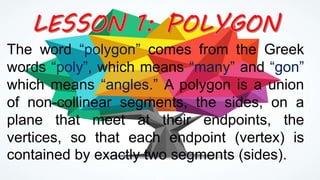
The word “polygon” comes from the Greek
words “poly”, which means “many” and “gon”
which means “angles.” A polygon is a union
of non-collinear segments, the sides, on a
plane that meet at their endpoints, the
vertices, so that each endpoint (vertex) is
contained by exactly two segments (sides).
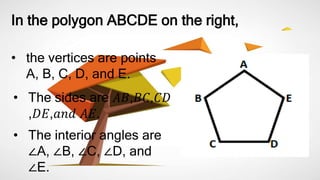
In the polygon ABCDE on the right,
• the vertices are points
A, B, C, D, and E.
• The sides are 𝐴𝐵,𝐵𝐶,𝐶𝐷
,𝐷𝐸,𝑎𝑛𝑑 𝐴𝐸.
• The interior angles are
∠A, ∠B, ∠C, ∠D, and
∠E.
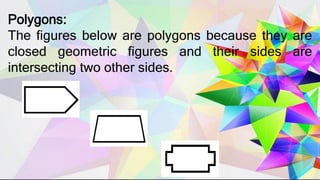
Polygons:
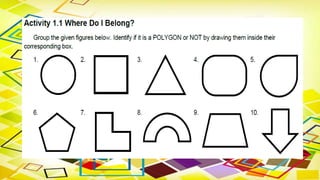
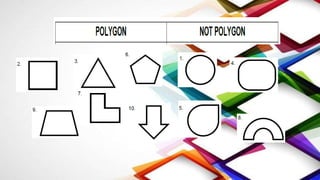
The figures below are polygons because they are
closed geometric figures and their sides are
intersecting two other sides.
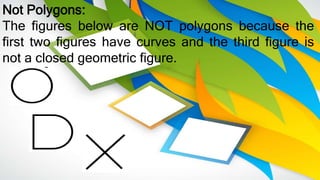
Not Polygons:
The figures below are NOT polygons because the
first two figures have curves and the third figure is
not a closed geometric figure.
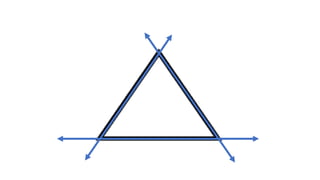
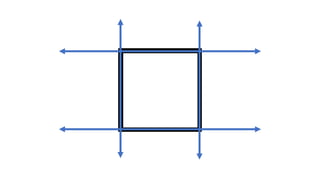
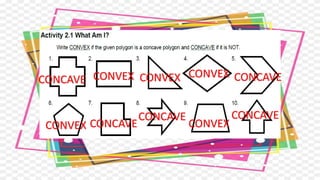
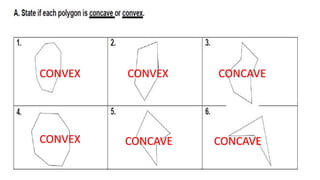
Polygons are classified as either convex
or concave. A polygon is said to be
convex if the lines containing the sides of
the polygon do not cross the interior of
the polygon. A polygon that is not
convex is called non-convex or concave
because it fails to satisfy the definition of
a convex polygon.
Illustrative Example:
Convex polygons
The given polygons below are convex
polygons because if you extend their
sides no part of it will pass inside the
polygon. Observe as well that each
interior angle measures less than
180°.
Concave polygons
The given polygons below are concave
polygons because if you extend their
sides at least one of the lines will pass
inside the polygon. Observe as well that
there is at least one interior angle that
measures greater than 180°.
CONVEX
CONCAVE
CONVEX CONVEX
CONVEX
CONVEX
CONCAVE CONCAVE
CONCAVE
CONCAVE
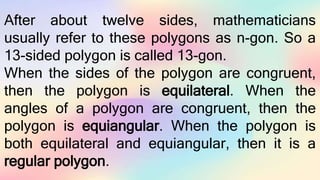
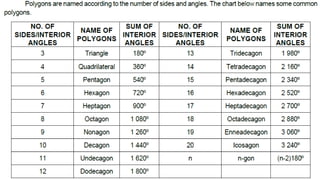
After about twelve sides, mathematicians
usually refer to these polygons as n-gon. So a
13-sided polygon is called 13-gon.
When the sides of the polygon are congruent,
then the polygon is equilateral. When the
angles of a polygon are congruent, then the
polygon is equiangular. When the polygon is
both equilateral and equiangular, then it is a
regular polygon.
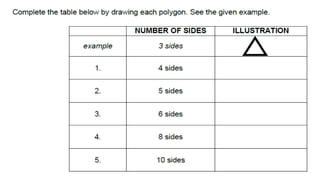
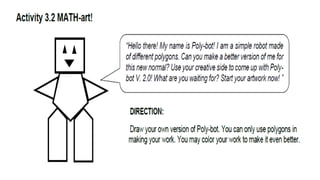
Draw Me!
CONVEX CONCAVE CONCAVE
CONCAVE
CONVEX CONVEX
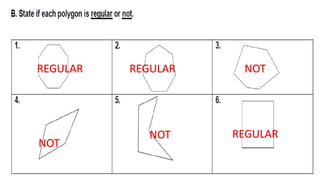
REGULAR REGULAR NOT
NOT
NOT REGULAR
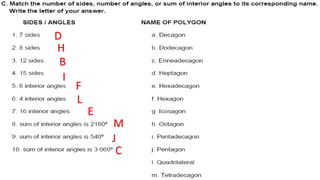
D
H
B
I
F
L
E
M
J
C
Directions: Choose the
letter that you think best
answers the question.
1. It is a closed figure made up
of line segments that intersect
at their endpoints.
a. line
b. angle
c. polygon
d. circle
2. Which among the figures is
not a polygon?
a.
b.
c.
d.
3. It is a polygon with
minimum number of sides.
a. pentagon
b. square
c. triangle
d. angle
4. It is a polygon with 6 sides.
a. pentagon
b. hexagon
c. heptagon
d. octagon
5. It is a polygon with 9
angles.
a. heptagon
b. octagon
c. nonagon
d. decagon
6. How many sides does a
heptagon have?
a. 4
b. 5
c. 6
d. 7
7. A polygon is said to be ______
if the lines containing the sides of
the polygon do not cross the
interior of the polygon.
a. convex b. concave
c. regular d. equilateral
8. Which figure is a convex
polygon?
9. Which figure is a concave
polygon?
10. Which best describes
a regular polygon?
I. concave III. convex
II. equilateral IV. equiangular
a. I and II b. II and III
c. III and IV d. II and IV
Quarter 3 Week 5 Polygons.pptx

Quarter 3 Week 5 Polygons.pptx

  • 5.
    The learner illustrates polygonsaccording to (a) convexity; (b) sides; and (c) angles. (M7GE-IIIe-2)
  • 6.
    1. differentiate convexpolygons from concave polygons, 2. identify the different polygons; and 3. illustrate polygons.
  • 7.
    Directions: Choose the letterthat you think best answers the question.
  • 8.
    1. It isa closed figure made up of line segments that intersect at their endpoints. a. line b. angle c. polygon d. circle
  • 9.
    2. Which amongthe figures is not a polygon? a. b. c. d.
  • 10.
    3. It isa polygon with minimum number of sides. a. pentagon b. square c. triangle d. angle
  • 11.
    4. It isa polygon with 6 sides. a. pentagon b. hexagon c. heptagon d. octagon
  • 12.
    5. It isa polygon with 9 angles. a. heptagon b. octagon c. nonagon d. decagon
  • 13.
    6. How manysides does a heptagon have? a. 4 b. 5 c. 6 d. 7
  • 14.
    7. A polygonis said to be ______ if the lines containing the sides of the polygon do not cross the interior of the polygon. a. convex b. concave c. regular d. equilateral
  • 15.
    8. Which figureis a convex polygon?
  • 16.
    9. Which figureis a concave polygon?
  • 17.
    10. Which bestdescribes a regular polygon? I. concave III. convex II. equilateral IV. equiangular a. I and II b. II and III c. III and IV d. II and IV
  • 19.
    The word “polygon”comes from the Greek words “poly”, which means “many” and “gon” which means “angles.” A polygon is a union of non-collinear segments, the sides, on a plane that meet at their endpoints, the vertices, so that each endpoint (vertex) is contained by exactly two segments (sides).
  • 20.
    In the polygonABCDE on the right, • the vertices are points A, B, C, D, and E. • The sides are 𝐴𝐵,𝐵𝐶,𝐶𝐷 ,𝐷𝐸,𝑎𝑛𝑑 𝐴𝐸. • The interior angles are ∠A, ∠B, ∠C, ∠D, and ∠E.
  • 21.
    Polygons: The figures beloware polygons because they are closed geometric figures and their sides are intersecting two other sides.
  • 22.
    Not Polygons: The figuresbelow are NOT polygons because the first two figures have curves and the third figure is not a closed geometric figure.
  • 28.
    Polygons are classifiedas either convex or concave. A polygon is said to be convex if the lines containing the sides of the polygon do not cross the interior of the polygon. A polygon that is not convex is called non-convex or concave because it fails to satisfy the definition of a convex polygon.
  • 29.
    Illustrative Example: Convex polygons Thegiven polygons below are convex polygons because if you extend their sides no part of it will pass inside the polygon. Observe as well that each interior angle measures less than 180°.
  • 32.
    Concave polygons The givenpolygons below are concave polygons because if you extend their sides at least one of the lines will pass inside the polygon. Observe as well that there is at least one interior angle that measures greater than 180°.
  • 36.
  • 40.
    After about twelvesides, mathematicians usually refer to these polygons as n-gon. So a 13-sided polygon is called 13-gon. When the sides of the polygon are congruent, then the polygon is equilateral. When the angles of a polygon are congruent, then the polygon is equiangular. When the polygon is both equilateral and equiangular, then it is a regular polygon.
  • 42.
  • 46.
  • 47.
  • 48.
  • 49.
    Directions: Choose the letterthat you think best answers the question.
  • 50.
    1. It isa closed figure made up of line segments that intersect at their endpoints. a. line b. angle c. polygon d. circle
  • 51.
    2. Which amongthe figures is not a polygon? a. b. c. d.
  • 52.
    3. It isa polygon with minimum number of sides. a. pentagon b. square c. triangle d. angle
  • 53.
    4. It isa polygon with 6 sides. a. pentagon b. hexagon c. heptagon d. octagon
  • 54.
    5. It isa polygon with 9 angles. a. heptagon b. octagon c. nonagon d. decagon
  • 55.
    6. How manysides does a heptagon have? a. 4 b. 5 c. 6 d. 7
  • 56.
    7. A polygonis said to be ______ if the lines containing the sides of the polygon do not cross the interior of the polygon. a. convex b. concave c. regular d. equilateral
  • 57.
    8. Which figureis a convex polygon?
  • 58.
    9. Which figureis a concave polygon?
  • 59.
    10. Which bestdescribes a regular polygon? I. concave III. convex II. equilateral IV. equiangular a. I and II b. II and III c. III and IV d. II and IV