A mathematics PowerPoint
by Eric Zhao
Trigonometry is the study and solution of
Triangles. Solving a triangle means finding
the value of each of its sides and angles. The
following terminology and tactics will be
important in the solving of triangles.
Pythagorean Theorem (a2+b2=c2).

Only for right angle triangles

Sine (sin), Cosecant (csc or sin-1)
Cosine (cos), Secant (sec or cos-1)
Tangent (tan), Cotangent (cot or tan-1)
Right/Oblique triangle
A trigonometric function is a ratio of certain parts of a triangle. The
names of these ratios are: The sine, cosine, tangent, cosecant, secant,
cotangent.
Let us look at this triangle…
Given the assigned letters to the sides and
angles, we can determine the following
trigonometric functions.

B

c

a

The Cosecant is the inversion of the
sine, the secant is the inversion of
the cosine, the cotangent is the
A
inversion of the tangent.

ө
C

b

Sinθ=

=

Cos

=

a
c
b
c

=

a
b

Tan

Side Opposite
Hypothenuse
Side Adjacent
θ= Hypothenuse
Side Opposite
θ= Side Adjacent

With this, we can find the sine of the
value of angle A by dividing side a
by side c. In order to find the angle
itself, we must take the sine of the
angle and invert it (in other words,
find the cosecant of the sine of the
angle).
Try finding the angles of the following triangle from the
side lengths using the trigonometric ratios from the
previous slide.
Click for the Answer…

B
6

α

The first step is to use the trigonometric
functions on angle A.

10

Sin θ =6/10

β
C

θ
8

A

Because all angles add up to 180,
B=90-11.537=53.1

α

The measurements have changed. Find side BA and side AC
0.559=2/BA

β
C

Csc0.6~36.9
Angle A~36.9

B
2

Sin θ =0.6

The Pythagorean theorem when
used in this triangle states
that…

0.559BA=2

BC2+AC2=AB2

Sin34=2/BA

34º

A

BA=2/0.559
BA~3.578

AC2=AB2-BC2
AC2=12.802-4=8.802
AC=8.8020.5~3
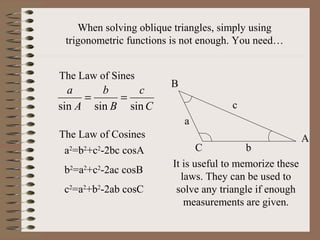
When solving oblique triangles, simply using
trigonometric functions is not enough. You need…
The Law of Sines

a
b
c
=
=
sin A sin B sin C

B
c
a

The Law of Cosines
a2=b2+c2-2bc cosA
b2=a2+c2-2ac cosB
c2=a2+b2-2ab cosC

C
b
It is useful to memorize these
laws. They can be used to
solve any triangle if enough
measurements are given.

A
When solving a triangle, you must remember to choose
the correct law to solve it with.
Whenever possible, the law of sines should be used.
Remember that at least one angle measurement must be
given in order to use the law of sines.
The law of cosines in much more difficult and time
consuming method than the law of sines and is harder to
memorize. This law, however, is the only way to solve a
triangle in which all sides but no angles are given.
Only triangles with all sides, an angle and two sides, or a
side and two angles given can be solved.
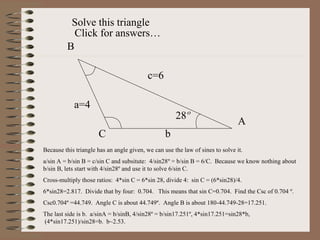
Solve this triangle
Click for answers…
B
c=6
a=4

28º
C

A

b

Because this triangle has an angle given, we can use the law of sines to solve it.
a/sin A = b/sin B = c/sin C and subsitute: 4/sin28º = b/sin B = 6/C. Because we know nothing about
b/sin B, lets start with 4/sin28º and use it to solve 6/sin C.
Cross-multiply those ratios: 4*sin C = 6*sin 28, divide 4: sin C = (6*sin28)/4.
6*sin28=2.817. Divide that by four: 0.704. This means that sin C=0.704. Find the Csc of 0.704 º.
Csc0.704º =44.749. Angle C is about 44.749º. Angle B is about 180-44.749-28=17.251.
The last side is b. a/sinA = b/sinB, 4/sin28º = b/sin17.251º, 4*sin17.251=sin28*b,
(4*sin17.251)/sin28=b. b~2.53.
Solve this triangle:
Hint: use the law of cosines
B
c=5.2
a=2.4
A

b=3.5

C

Start with the law of cosines because there are no angles given.
a2=b2+c2-2bc cosA. Substitute values. 2.42=3.52+5.22-2(3.5)(5.2) cosA,
5.76-12.25-27.04=-2(3.5)(5.2) cos A, 33.53=36.4cosA, 33.53/36.4=cos A, 0.921=cos A, A=67.07.
Now for B.
b2=a2+c2-2ac cosB, (3.5)2=(2.4)2+(5.2)2-2(2.4)(5.2) cosB, 12.25=5.76+27.04-24.96 cos B.
12.25=5.76+27.04-24.96 cos B, 12.25-5.76-27.04=-24.96 cos B. 20.54/24.96=cos B. 0.823=cos B.
B=34.61.
C=180-34.61-67.07=78.32.
Trigonometric identities are ratios
and relationships between certain
trigonometric functions.
In the following few slides, you
will learn about different
trigonometric identities that take
place in each trigonometric
function.
What is the sine of 60º? 0.866. What is the cosine of 30º?
0.866. If you look at the name of cosine, you can actually
see that it is the cofunction of the sine (co-sine). The
cotangent is the cofunction of the tangent (co-tangent), and
the cosecant is the cofunction of the secant (co-secant).
Sine60º=Cosine30º
Secant60º=Cosecant30º
tangent30º=cotangent60º
The following trigonometric identities are useful to remember.
Sin θ=1/csc θ
Cos θ=1/sec θ
Tan θ=1/cot θ
Csc θ=1/sin θ
Sec θ=1/cos θ
Tan θ=1/cot θ

(sin θ)2 + (cos θ)2=1
1+(tan θ)2=(sec θ)2
1+(cot θ)2=(csc θ)2
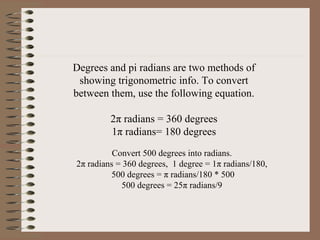
Degrees and pi radians are two methods of
showing trigonometric info. To convert
between them, use the following equation.
2π radians = 360 degrees
1π radians= 180 degrees
Convert 500 degrees into radians.
2π radians = 360 degrees, 1 degree = 1π radians/180,
500 degrees = π radians/180 * 500
500 degrees = 25π radians/9
Write out the each of the trigonometric functions (sin, cos, and tan) of the following
degrees to the hundredth place.
(In degrees mode). Note: you do not have to do all of them 

1. 45º

7. 90º

13. 47º

19. 75º

2. 38º

8. 152º

14. 442º

20. 34º

3. 22º

9. 112º

15. 123º

21. 53º

4. 18º

10. 58º

16. 53º

22. 92º

5. 95º

11. 345º

17. 41º

23. 153º

6. 63º

12. 221º

18. 22º

24. 1000º
Solve the following right triangles with the dimensions given

B
5
C
B
9
C

B
c

22

a
A

C
B

20

18

52 º

c
A

13
c

A

8º
C

12

A
Solve the following oblique triangles with the dimensions given

B
22

25
12

A

14

C

A
B

c
A

8

B

168 º 5
A
C

28 º
b

31 º
a
C
B

c
35 º
24

15
C
Find each sine, cosecant, secant, and cotangent using different
trigonometric identities to the hundredth place
(don’t just use a few identities, try all of them.).

1. 45º

7. 90º

13. 47º

19. 75º

2. 38º

8. 152º

14. 442º

20. 34º

3. 22º

9. 112º

15. 123º

21. 53º

4. 18º

10. 58º

16. 53º

22. 92º

5. 95º

11. 345º

17. 41º

23. 153º

6. 63º

12. 221º

18. 22º

24. 1000º
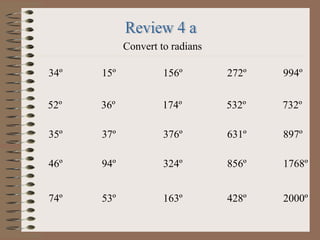
Convert to radians
34º

15º

156º

272º

994º

52º

36º

174º

532º

732º

35º

37º

376º

631º

897º

46º

94º

324º

856º

1768º

74º

53º

163º

428º

2000º
Convert to degrees
3.2π rad

6.7π rad

3.14π rad

72.45π rad

52.652π rad

3.1π rad

7.9 rad

6.48π rad

93.16π rad

435.96π rad

1.3π rad

5.4π rad

8.23π rad

25.73π rad

14.995π rad

7.4π rad

9.6π rad

5.25π rad

79.23π rad

745.153π rad
Producer
Director
Creator
Author
Basic Mathematics Second edition
MathPower Nine, chapter 6
Eric Zhao
By Haym Kruglak, John T. Moore, Ramon Mata-Toledo

Trigonometry

  • 1.
  • 2.
    Trigonometry is thestudy and solution of Triangles. Solving a triangle means finding the value of each of its sides and angles. The following terminology and tactics will be important in the solving of triangles. Pythagorean Theorem (a2+b2=c2). Only for right angle triangles Sine (sin), Cosecant (csc or sin-1) Cosine (cos), Secant (sec or cos-1) Tangent (tan), Cotangent (cot or tan-1) Right/Oblique triangle
  • 4.
    A trigonometric functionis a ratio of certain parts of a triangle. The names of these ratios are: The sine, cosine, tangent, cosecant, secant, cotangent. Let us look at this triangle… Given the assigned letters to the sides and angles, we can determine the following trigonometric functions. B c a The Cosecant is the inversion of the sine, the secant is the inversion of the cosine, the cotangent is the A inversion of the tangent. ө C b Sinθ= = Cos = a c b c = a b Tan Side Opposite Hypothenuse Side Adjacent θ= Hypothenuse Side Opposite θ= Side Adjacent With this, we can find the sine of the value of angle A by dividing side a by side c. In order to find the angle itself, we must take the sine of the angle and invert it (in other words, find the cosecant of the sine of the angle).
  • 5.
    Try finding theangles of the following triangle from the side lengths using the trigonometric ratios from the previous slide. Click for the Answer… B 6 α The first step is to use the trigonometric functions on angle A. 10 Sin θ =6/10 β C θ 8 A Because all angles add up to 180, B=90-11.537=53.1 α The measurements have changed. Find side BA and side AC 0.559=2/BA β C Csc0.6~36.9 Angle A~36.9 B 2 Sin θ =0.6 The Pythagorean theorem when used in this triangle states that… 0.559BA=2 BC2+AC2=AB2 Sin34=2/BA 34º A BA=2/0.559 BA~3.578 AC2=AB2-BC2 AC2=12.802-4=8.802 AC=8.8020.5~3
  • 7.
    When solving obliquetriangles, simply using trigonometric functions is not enough. You need… The Law of Sines a b c = = sin A sin B sin C B c a The Law of Cosines a2=b2+c2-2bc cosA b2=a2+c2-2ac cosB c2=a2+b2-2ab cosC C b It is useful to memorize these laws. They can be used to solve any triangle if enough measurements are given. A
  • 8.
    When solving atriangle, you must remember to choose the correct law to solve it with. Whenever possible, the law of sines should be used. Remember that at least one angle measurement must be given in order to use the law of sines. The law of cosines in much more difficult and time consuming method than the law of sines and is harder to memorize. This law, however, is the only way to solve a triangle in which all sides but no angles are given. Only triangles with all sides, an angle and two sides, or a side and two angles given can be solved.
  • 9.
    Solve this triangle Clickfor answers… B c=6 a=4 28º C A b Because this triangle has an angle given, we can use the law of sines to solve it. a/sin A = b/sin B = c/sin C and subsitute: 4/sin28º = b/sin B = 6/C. Because we know nothing about b/sin B, lets start with 4/sin28º and use it to solve 6/sin C. Cross-multiply those ratios: 4*sin C = 6*sin 28, divide 4: sin C = (6*sin28)/4. 6*sin28=2.817. Divide that by four: 0.704. This means that sin C=0.704. Find the Csc of 0.704 º. Csc0.704º =44.749. Angle C is about 44.749º. Angle B is about 180-44.749-28=17.251. The last side is b. a/sinA = b/sinB, 4/sin28º = b/sin17.251º, 4*sin17.251=sin28*b, (4*sin17.251)/sin28=b. b~2.53.
  • 10.
    Solve this triangle: Hint:use the law of cosines B c=5.2 a=2.4 A b=3.5 C Start with the law of cosines because there are no angles given. a2=b2+c2-2bc cosA. Substitute values. 2.42=3.52+5.22-2(3.5)(5.2) cosA, 5.76-12.25-27.04=-2(3.5)(5.2) cos A, 33.53=36.4cosA, 33.53/36.4=cos A, 0.921=cos A, A=67.07. Now for B. b2=a2+c2-2ac cosB, (3.5)2=(2.4)2+(5.2)2-2(2.4)(5.2) cosB, 12.25=5.76+27.04-24.96 cos B. 12.25=5.76+27.04-24.96 cos B, 12.25-5.76-27.04=-24.96 cos B. 20.54/24.96=cos B. 0.823=cos B. B=34.61. C=180-34.61-67.07=78.32.
  • 12.
    Trigonometric identities areratios and relationships between certain trigonometric functions. In the following few slides, you will learn about different trigonometric identities that take place in each trigonometric function.
  • 13.
    What is thesine of 60º? 0.866. What is the cosine of 30º? 0.866. If you look at the name of cosine, you can actually see that it is the cofunction of the sine (co-sine). The cotangent is the cofunction of the tangent (co-tangent), and the cosecant is the cofunction of the secant (co-secant). Sine60º=Cosine30º Secant60º=Cosecant30º tangent30º=cotangent60º
  • 14.
    The following trigonometricidentities are useful to remember. Sin θ=1/csc θ Cos θ=1/sec θ Tan θ=1/cot θ Csc θ=1/sin θ Sec θ=1/cos θ Tan θ=1/cot θ (sin θ)2 + (cos θ)2=1 1+(tan θ)2=(sec θ)2 1+(cot θ)2=(csc θ)2
  • 16.
    Degrees and piradians are two methods of showing trigonometric info. To convert between them, use the following equation. 2π radians = 360 degrees 1π radians= 180 degrees Convert 500 degrees into radians. 2π radians = 360 degrees, 1 degree = 1π radians/180, 500 degrees = π radians/180 * 500 500 degrees = 25π radians/9
  • 18.
    Write out theeach of the trigonometric functions (sin, cos, and tan) of the following degrees to the hundredth place. (In degrees mode). Note: you do not have to do all of them  1. 45º 7. 90º 13. 47º 19. 75º 2. 38º 8. 152º 14. 442º 20. 34º 3. 22º 9. 112º 15. 123º 21. 53º 4. 18º 10. 58º 16. 53º 22. 92º 5. 95º 11. 345º 17. 41º 23. 153º 6. 63º 12. 221º 18. 22º 24. 1000º
  • 19.
    Solve the followingright triangles with the dimensions given B 5 C B 9 C B c 22 a A C B 20 18 52 º c A 13 c A 8º C 12 A
  • 20.
    Solve the followingoblique triangles with the dimensions given B 22 25 12 A 14 C A B c A 8 B 168 º 5 A C 28 º b 31 º a C B c 35 º 24 15 C
  • 21.
    Find each sine,cosecant, secant, and cotangent using different trigonometric identities to the hundredth place (don’t just use a few identities, try all of them.). 1. 45º 7. 90º 13. 47º 19. 75º 2. 38º 8. 152º 14. 442º 20. 34º 3. 22º 9. 112º 15. 123º 21. 53º 4. 18º 10. 58º 16. 53º 22. 92º 5. 95º 11. 345º 17. 41º 23. 153º 6. 63º 12. 221º 18. 22º 24. 1000º
  • 22.
  • 23.
    Convert to degrees 3.2πrad 6.7π rad 3.14π rad 72.45π rad 52.652π rad 3.1π rad 7.9 rad 6.48π rad 93.16π rad 435.96π rad 1.3π rad 5.4π rad 8.23π rad 25.73π rad 14.995π rad 7.4π rad 9.6π rad 5.25π rad 79.23π rad 745.153π rad
  • 24.
    Producer Director Creator Author Basic Mathematics Secondedition MathPower Nine, chapter 6 Eric Zhao By Haym Kruglak, John T. Moore, Ramon Mata-Toledo