AS Mathematic pure 1 (trigonometry) email:racsostudenthelp@gmail.com 
5. Trigonometry 
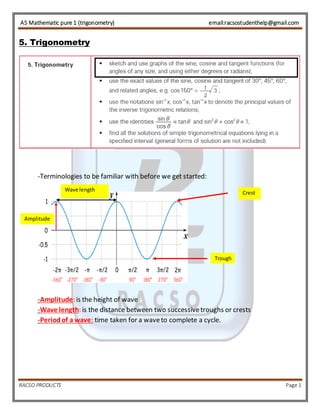
-Terminologies to be familiar with before we get started: 
Amplitude 
Wave length 
Trough 
Crest 
-Amplitude: is the height of wave 
-Wave length: is the distance between two successive troughs or crests 
-Period of a wave: time taken for a wave to complete a cycle. 
RACSO PRODUCTS Page 1
AS Mathematic pure 1 (trigonometry) email:racsostudenthelp@gmail.com 
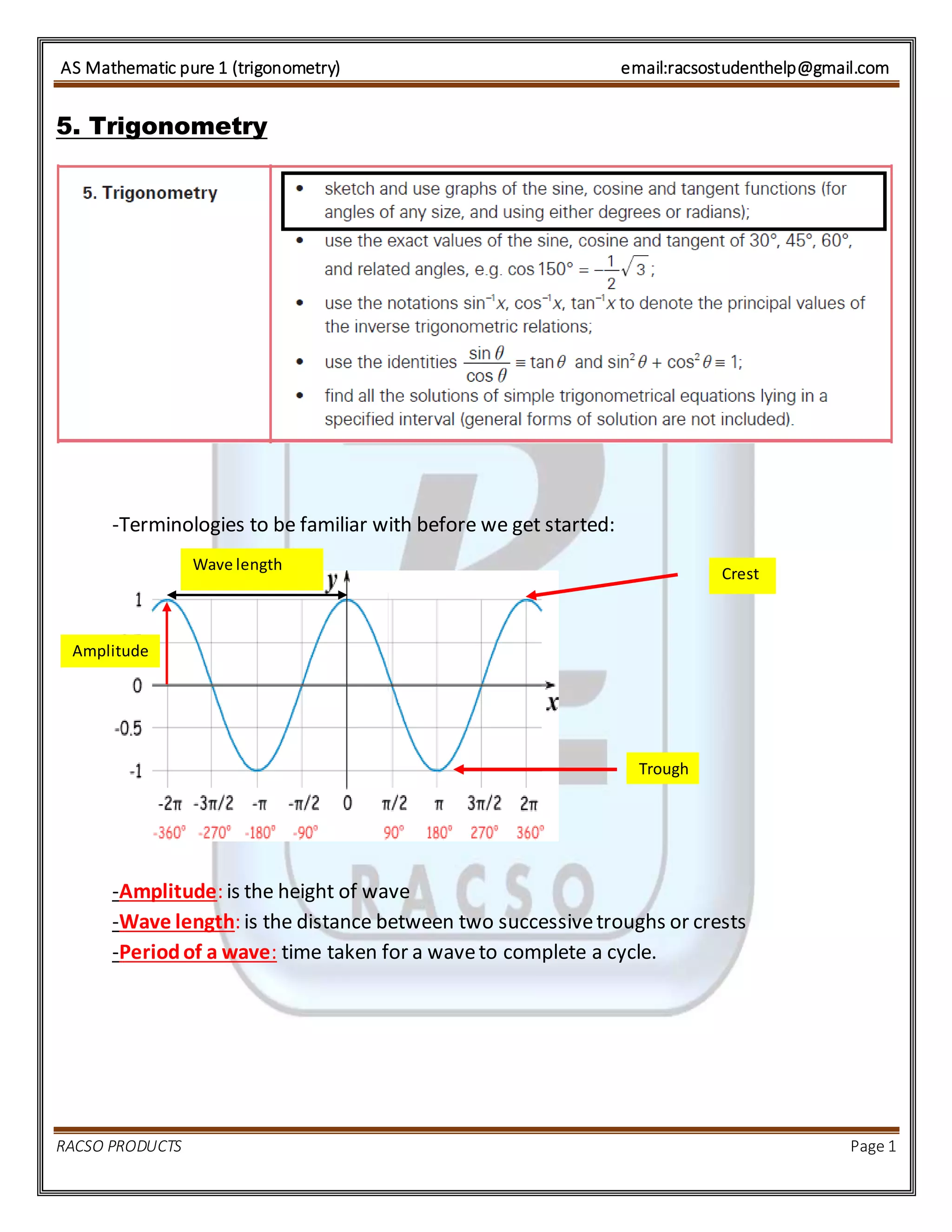
 Sine graph 
 Cosine graph 
A cosine has a period of 180o or π 
radians also. Meaning a new wave 
starts after every 180o or π radians. 
Radians 
Meanin 
g a new 
wave 
starts 
after 
every 
180o or 
π 
radians. 
n 
A sine graph has a period of 180o 
or π radians. Meaning a new 
wave starts after every 180o or π 
radians. 
Radians 
Degrees 
Degrees 
Y 
RACSO PRODUCTS Page 2
AS Mathematic pure 1 (trigonometry) email:racsostudenthelp@gmail.com 
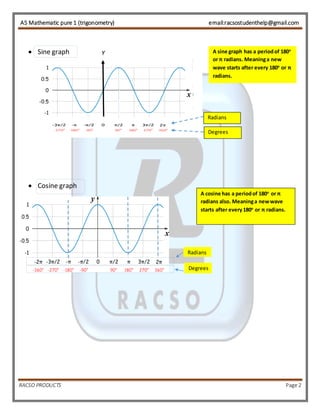
 Tangent graph 
-What does it mean by a wave completing one cycle? 
Look at the example below. 
Figure ( i) 
A tangent graph has a 
period of 90o or π/2 
radians. Meaning a new 
tangent graph starts after 
90o or π/2 every 
Radians 
Degrees 
-An easy way to remember, look at the part of 
wave circled, they look like 2 half circles (semi-circles). 
2 semi-circles make one complete 
circle. 
2 half waves= Make a waves one complete cycle 
RACSO PRODUCTS Page 3
AS Mathematic pure 1 (trigonometry) email:racsostudenthelp@gmail.com 
Figure (ii) 
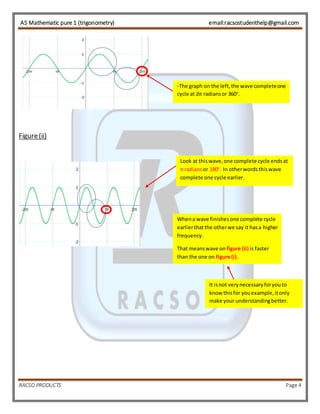
-The graph on the left, the wave complete one 
cycle at 2π radians or 360o. 
Look at this wave, one complete cycle ends at 
π radians or 180o. In other words this wave 
complete one cycle earlier. 
When a wave finishes one complete cycle 
earlier that the other we say it has a higher 
frequency. 
That means wave on figure (ii) is faster 
than the one on figure (i). 
It is not very necessary for you to 
know this for you example, it only 
make your understanding better. 
RACSO PRODUCTS Page 4
AS Mathematic pure 1 (trigonometry) email:racsostudenthelp@gmail.com 
-Transformation of a wave: 
A general equation of a wave is y = a sin bx ± d. 
From the general equation y = a sin bx ± d. on this page we changed “b” 
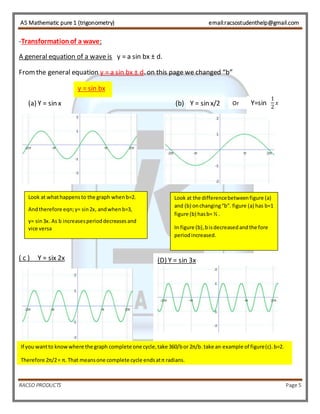
y = sin bx 
(a) Y = sin x (b) 
Look at what happens to the graph when b=2. 
And therefore eqn; y= sin 2x, and when b=3, 
y= sin 3x. As b increases period decreases and 
vice versa 
( c ) Y = six 2x 
Y=sin 
1 
2 
Y = sin x/2 Or 
푥 
Look at the difference between figure (a) 
and (b) on changing “b”. figure (a) has b=1 
figure (b) has b= ½ . 
In figure (b), b is decreased and the fore 
period increased. 
(D) Y = sin 3x 
If you want to know where the graph complete one cycle, take 360/b or 2π/b. take an example of figure (c). b=2. 
Therefore 2π/2 = π. That means one complete cycle ends at π radians. 
RACSO PRODUCTS Page 5
AS Mathematic pure 1 (trigonometry) email:racsostudenthelp@gmail.com 
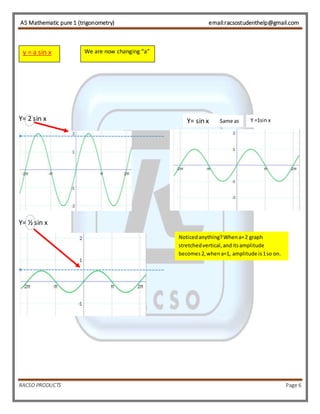
y = a sin x We are now changing “a” 
Y= 2 sin x 
Y= ½ sin x 
Y= sin x 
Same as Y =1sin x 
Noticed anything? When a= 2 graph 
stretched vertical, and its amplitude 
becomes 2, when a=1, amplitude is 1 so on. 
RACSO PRODUCTS Page 6
AS Mathematic pure 1 (trigonometry) email:racsostudenthelp@gmail.com 
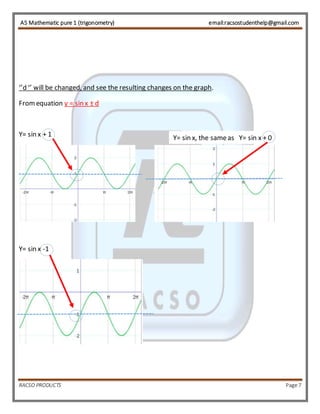
‘’d ‘’ will be changed, and see the resulting changes on the graph. 
From equation y = sin x ± d 
Y= sin x + 1 
Y= sin x -1 
Y= sin x, the same as Y= sin x + 0 
RACSO PRODUCTS Page 7
AS Mathematic pure 1 (trigonometry) email:racsostudenthelp@gmail.com 
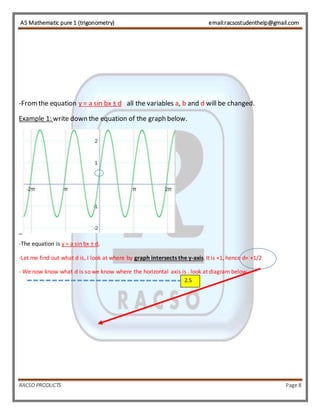
-From the equation y = a sin bx ± d all the variables a, b and d will be changed. 
Example 1: write down the equation of the graph below. 
-The equation is y = a sin bx ± d, 
-Let me find out what d is, I look at where by graph intersects the y-axis. It is +1, hence d= +1/2 
- We now know what d is so we know where the horizontal axis is . look at diagram below 
2.5 
RACSO PRODUCTS Page 8
AS Mathematic pure 1 (trigonometry) email:racsostudenthelp@gmail.com 
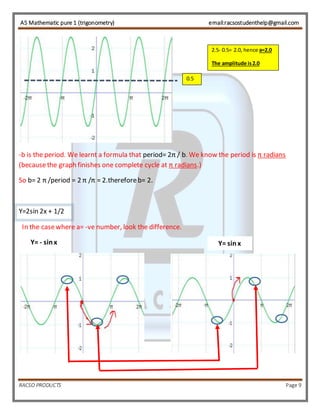
0.5 
2.5- 0.5= 2.0, hence a=2.0 
The amplitude is 2.0 
-b is the period. We learnt a formula that period= 2π / b. We know the period is π radians 
(because the graph finishes one complete cycle at π radians.) 
So b= 2 π /period = 2 π /π = 2.therefore b= 2. 
Y=2sin 2x + 1/2 
In the case where a= -ve number, look the difference. 
Y= - sin x 
Y= sin x 
RACSO PRODUCTS Page 9
AS Mathematic pure 1 (trigonometry) email:racsostudenthelp@gmail.com 
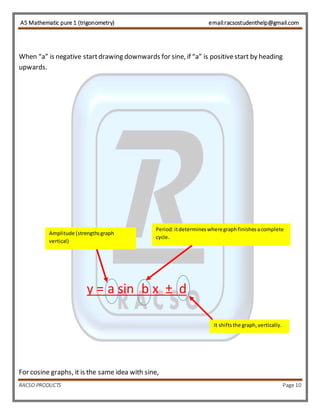
When “a” is negative start drawing downwards for sine, if “a” is positive start by heading 
upwards. 
Amplitude (strengths graph 
vertical) 
Period: it determines where graph finishes a complete 
cycle. 
y = a sin b x ± d 
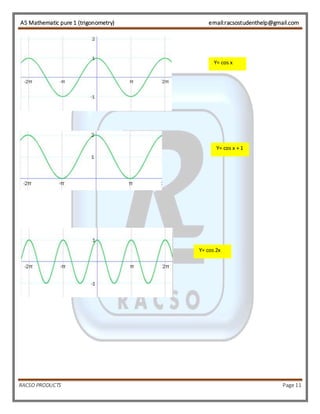
For cosine graphs, it is the same idea with sine, 
It shifts the graph, vertically. 
RACSO PRODUCTS Page 10
AS Mathematic pure 1 (trigonometry) email:racsostudenthelp@gmail.com 
Y= cos x 
Y= cos x + 1 
Y= cos 2x 
RACSO PRODUCTS Page 11
AS Mathematic pure 1 (trigonometry) email:racsostudenthelp@gmail.com 
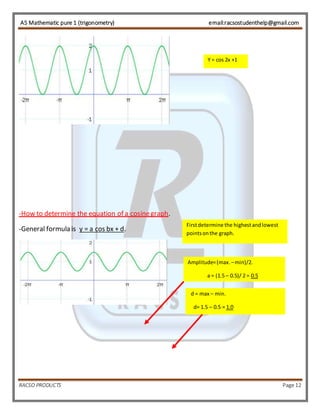
-How to determine the equation of a cosine graph. 
-General formula is y = a cos bx + d. 
Y = cos 2x +1 
First determine the highest and lowest 
points on the graph. 
Amplitude= (max. – min)/2. 
a = (1.5 – 0.5)/ 2 = 0.5 
d = max – min. 
d= 1.5 – 0.5 = 1.0 
RACSO PRODUCTS Page 12
AS Mathematic pure 1 (trigonometry) email:racsostudenthelp@gmail.com 
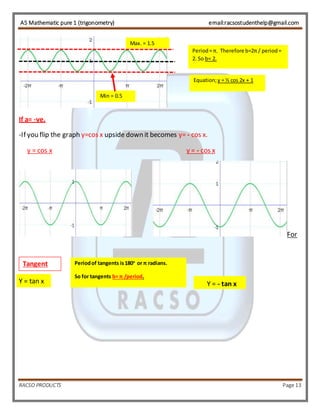
If a= -ve. 
Max. = 1.5 
Min = 0.5 
Period = π. Therefore b=2π / period = 
2. So b= 2. 
Equation; y = ½ cos 2x + 1 
-If you flip the graph y=cos x upside down it becomes y= - cos x. 
y = cos x y = - cos x 
For 
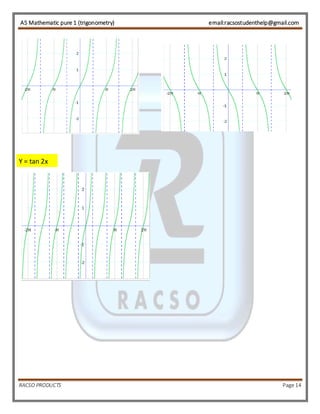
Tangent 
Y = tan x 
Period of tangents is 180o or π radians. 
So for tangents b= π /period. 
Y = - tan x 
RACSO PRODUCTS Page 13
AS Mathematic pure 1 (trigonometry) email:racsostudenthelp@gmail.com 
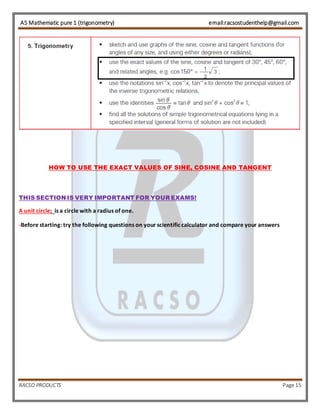
Y = tan 2x 
RACSO PRODUCTS Page 14
AS Mathematic pure 1 (trigonometry) email:racsostudenthelp@gmail.com 
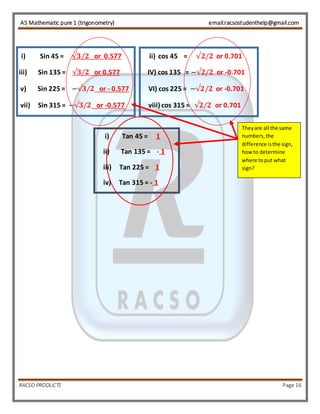
HOW TO USE THE EXACT VALUES OF SINE, COSINE AND TANGENT 
THIS SECTION IS VERY IMPORTANT FOR YOUR EXAMS! 
A unit circle: is a circle with a radius of one. 
-Before starting: try the following questions on your scientific calculator and compare your answers 
RACSO PRODUCTS Page 15
AS Mathematic pure 1 (trigonometry) email:racsostudenthelp@gmail.com 
i) Sin 45 = √ퟑ/ퟐ or 0.577 ii) cos 45 = √ퟐ/ퟐ or 0.701 
iii) Sin 135 = √ퟑ/ퟐ or 0.577 IV) cos 135 = −√ퟐ/ퟐ or -0.701 
v) Sin 225 = −√ퟑ/ퟐ or - 0.577 VI) cos 225 = −√ퟐ/ퟐ or -0.701 
vii) Sin 315 = −√ퟑ/ퟐ or -0.577 viii) cos 315 = √ퟐ/ퟐ or 0.701 
i) Tan 45 = ퟏ 
ii) Tan 135 = - ퟏ 
iii) Tan 225 = ퟏ 
iv) Tan 315 = - ퟏ 
They are all the same 
numbers, the 
difference is the sign, 
how to determine 
where to put what 
sign? 
RACSO PRODUCTS Page 16
AS Mathematic pure 1 (trigonometry) email:racsostudenthelp@gmail.com 
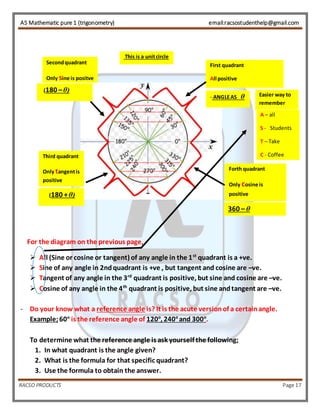
Easier way to 
remember 
Second quadrant 
Only sine is positve 
(180 – θ) 
Third quadrant 
Only tangent is 
positive 
(180 + θ) 
This is a unit circle 
For the diagram on the previous page, 
First quadrant 
All positive 
A – all 
S - Students 
T – Take 
C - Coffee 
- ANGLE AS θ 
Forth quadrant 
Only cosine is 
positive 
360 – θ 
 All (Sine or cosine or tangent) of any angle in the 1st quadrant is a +ve. 
 Sine of any angle in 2nd quadrant is +ve , but tangent and cosine are –ve. 
 Tangent of any angle in the 3rd quadrant is positive, but sine and cosine are –ve. 
 Cosine of any angle in the 4th quadrant is positive, but sine and tangent are –ve. 
- Do your know what a reference angle is? It is the acute version of a certain angle. 
Example; 60o is the reference angle of 120o, 240o and 300o. 
To determine what the reference angle is ask yourself the following; 
1. In what quadrant is the angle given? 
2. What is the formula for that specific quadrant? 
3. Use the formula to obtain the answer. 
RACSO PRODUCTS Page 17
AS Mathematic pure 1 (trigonometry) email:racsostudenthelp@gmail.com 
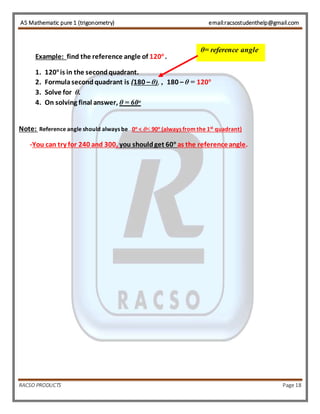
Example: find the reference angle of 120o . 
θ= reference angle 
1. 120o is in the second quadrant. 
2. Formula second quadrant is (180 – θ), , 180 – θ = 120o 
3. Solve for θ. 
4. On solving final answer, θ = 60o 
Note: Reference angle should always be 0o < θ< 90o (always from the 1st quadrant) 
-You can try for 240 and 300, you should get 60o as the reference angle. 
RACSO PRODUCTS Page 18
AS Mathematic pure 1 (trigonometry) email:racsostudenthelp@gmail.com 
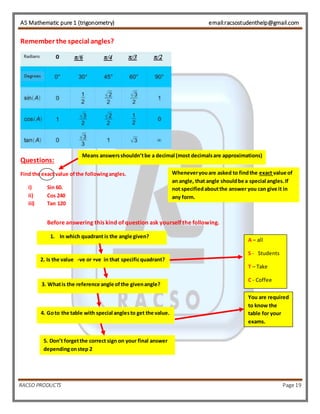
Remember the special angles? 
Questions: 
Means answers shouldn’t be a decimal (most decimals are approximations) 
Find the exact value of the following angles. 
i) Sin 60. 
ii) Cos 240 
iii) Tan 120 
Whenever you are asked to find the exact value of 
an angle, that angle should be a special angles. If 
not specified about the answer you can give it in 
any form. 
Before answering this kind of question ask yourself the following. 
1. In which quadrant is the angle given? 
2. Is the value -ve or +ve in that specific quadrant? 
A – all 
S - Students 
T – Take 
C - Coffee 
3. What is the reference angle of the given angle? 
4. Go to the table with special angles to get the value. 
5. Don’t forget the correct sign on your final answer 
depending on step 2 
You are required 
to know the 
table for your 
exams. 
RACSO PRODUCTS Page 19
AS Mathematic pure 1 (trigonometry) email:racsostudenthelp@gmail.com 
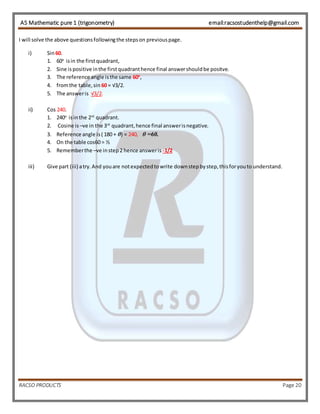
I will solve the above questions following the steps on previous page. 
i) Sin 60. 
1. 60o is in the first quadrant, 
2. Sine is positive in the first quadrant hence final answer should be positve. 
3. The reference angle is the same 60o, 
4. from the table, sin 60 = √3/2. 
5. The answer is √3/2. 
ii) Cos 240. 
1. 240o is in the 2rd quadrant. 
2. Cosine is –ve in the 3rd quadrant, hence final answer is negative. 
3. Reference angle is ( 180 + θ) = 240, θ =60. 
4. On the table cos60 = ½ 
5. Remember the –ve in step 2 hence answer is -1/2 
iii) Give part (iii) a try. And you are not expected to write down step by step, this for you to understand. 
RACSO PRODUCTS Page 20
AS Mathematic pure 1 (trigonometry) email:racsostudenthelp@gmail.com 
HOW TO FIND THE INVERSE OF A TRIGONOMETRIC RELATION. 
1. How to find inverse of trigonometric relation. 
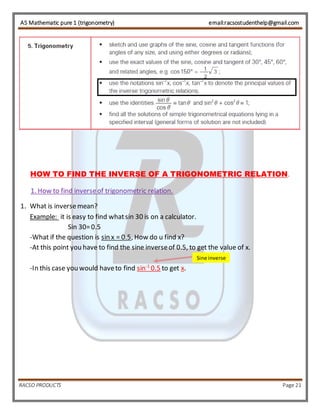
1. What is inverse mean? 
Example: it is easy to find what sin 30 is on a calculator. 
Sin 30= 0.5 
-What if the question is sin x = 0.5, How do u find x? 
-At this point you have to find the sine inverse of 0.5, to get the value of x. 
-In this case you would have to find sin-1 0.5 to get x. 
Sine inverse 
RACSO PRODUCTS Page 21
AS Mathematic pure 1 (trigonometry) email:racsostudenthelp@gmail.com 
-This is the section to master, every year a question comes from this section! 
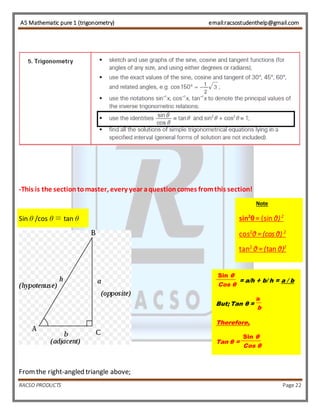
Sin θ /cos θ ≡ tan θ 
From the right-angled triangle above; 
Sin θ 
Cos θ 
Note 
sin2θ = (sin θ) 2 
cos2θ = (cos θ) 2 
tan2 θ = (tan θ)2 
= a/h ÷ b/ h = a / b 
But; Tan θ = 
a 
b 
Therefore, 
Tan θ = 
Sin θ 
Cos θ 
RACSO PRODUCTS Page 22
AS Mathematic pure 1 (trigonometry) email:racsostudenthelp@gmail.com 
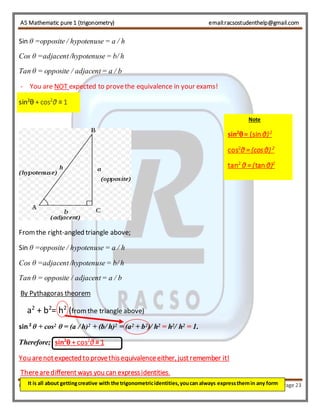
Sin θ =opposite / hypotenuse = a / h 
Cos θ =adjacent /hypotenuse = b/ h 
Tan θ = opposite / adjacent = a / b 
- You are NOT expected to prove the equivalence in your exams! 
sin2θ + cos2θ ≡ 1 
From the right-angled triangle above; 
Sin θ =opposite / hypotenuse = a / h 
Cos θ =adjacent /hypotenuse = b/ h 
Tan θ = opposite / adjacent = a / b 
By Pythagoras theorem 
a2 + b2= h2 (from the triangle above) 
sin 2 θ + cos2 θ = (a / h)2 + (b/ h)2 = (a2 + b2)/ h2 = h2/ h2 = 1. 
Therefore; sin2θ + cos2θ ≡ 1 
sin2θ = (sin θ) 2 
cos2θ = (cos θ) 2 
tan2 θ = (tan θ)2 
You are not expected to prove this equivalence either, just remember it! 
There are different ways you can express identities. 
Note 
It is all about getting creative with the trigonometric identities, you can always express them in any form 
RACSO PRODUCTS Page 23
AS Mathematic pure 1 (trigonometry) email:racsostudenthelp@gmail.com 
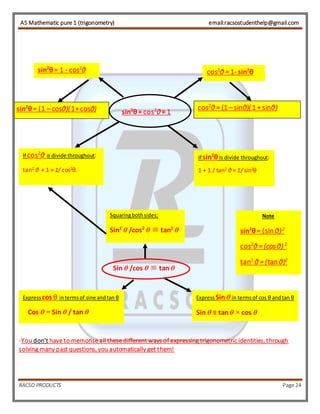
sin cos2θ = 1- sin2θ 2θ = 1 - cos2θ 
sin2θ + cos2θ ≡ 1 
Squaring both sides; 
Sin2 θ /cos2 θ ≡ tan2 θ 
Sin θ /cos θ ≡ tan θ 
cos2θ = (1 – sinθ)( 1 + sinθ) 
If sin2θ Is divide throughout: 
1 + 1 / tan2 θ = 1/ sin2θ 
sin2θ = (1 – cosθ)( 1+ cosθ) 
If cos2θ is divide throughout: 
tan2 θ + 1 = 1/ cos2θ. 
Express cos θ in terms of sine and tan θ 
Cos θ = Sin θ / tan θ 
Note 
sin2θ = (sin θ) 2 
cos2θ = (cos θ) 2 
tan2 θ = (tan θ)2 
Express Sin θ in terms of cos θ and tan θ 
Sin θ ≡ tan θ × cos θ 
-You don’t have to memorise all these different ways of expressing trigonometric identities, through 
solving many past questions, you automatically get them! 
RACSO PRODUCTS Page 24
AS Mathematic pure 1 (trigonometry) email:racsostudenthelp@gmail.com 
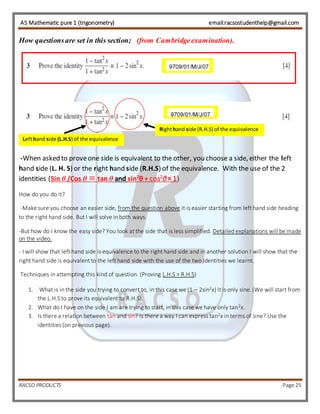
How questions are set in this section; (from Cambridge examination). 
Right hand side (R.H.S) o f the equivalence 
Left hand side (L.H.S) of the equivalence 
-When asked to prove one side is equivalent to the other, you choose a side, either the left 
hand side (L. H. S) or the right hand side (R.H.S) of the equivalence. With the use of the 2 
identities (Sin θ /Cos θ ≡ tan θ and sin2θ + cos2θ ≡ 1) 
How do you do it? 
-Make sure you choose an easier side, from the question above it is easier starting from left hand side heading 
to the right hand side. But I will solve in both ways. 
-But how do I know the easy side? You look at the side that is less simplified. Detailed explanations will be made 
on the video. 
- I will show that left hand side is equivalence to the right hand side and in another solution I will show that the 
right hand side is equivalent to the left hand side with the use of the two identities we learnt. 
Techniques in attempting this kind of question. (Proving L.H.S = R.H.S) 
1. What is in the side you trying to convert to, in this case we (1 – 2sin2x) it is only sine. (We will start from 
the L.H.S to prove its equivalent to R.H.S). 
2. What do I have on the side I am are trying to start, in this case we have only tan2x. 
3. Is there a relation between tan and sin? Is there a way I can express tan2x in terms of sine? Use the 
identities (on previous page). 
RACSO PRODUCTS Page 25
AS Mathematic pure 1 (trigonometry) email:racsostudenthelp@gmail.com 
SOLUTION OF TRIGONOMETRICALLY EQUATION LYING IN SPECIFIC 
INTERVAL 
1. Interval may be positive or negative 
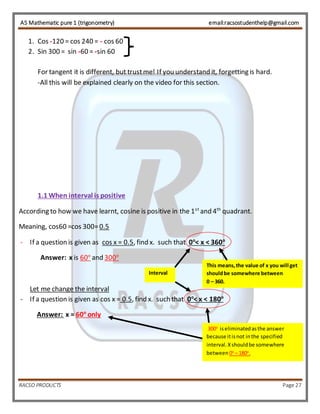
-Can you tell the difference between cos 60 and cos -60? 
This is anti-clockwise 
(60o), means you start from 0o 
going anti-clockwise 
+60 
-60 
(-60o )means you start form 0o 
clockwise. That means 
cos-60o = cos 300o 
This is clockwise 
Does this make any sense? 
RACSO PRODUCTS Page 26
AS Mathematic pure 1 (trigonometry) email:racsostudenthelp@gmail.com 
1. Cos -120 = cos 240 = - cos 60 
2. Sin 300 = sin -60 = -sin 60 
For tangent it is different, but trust me! If you understand it, forgetting is hard. 
-All this will be explained clearly on the video for this section. 
1.1 When interval is positive 
According to how we have learnt, cosine is positive in the 1st and 4th quadrant. 
Meaning, cos60 =cos 300= 0.5 
- If a question is given as cos x = 0.5, find x. such that 0o< x < 360o 
Answer: x is 60o and 300o 
Let me change the interval 
This means, the value of x you will get 
should be somewhere between 
0 – 360. 
Interval 
- If a question is given as cos x = 0.5, find x. such that 0o< x < 180o 
Answer: x = 60o only 
300o is eliminated as the answer 
because it is not in the specified 
interval. X should be somewhere 
between 0o – 180o. 
RACSO PRODUCTS Page 27
AS Mathematic pure 1 (trigonometry) email:racsostudenthelp@gmail.com 
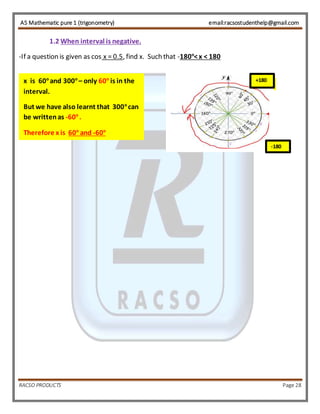
1.2 When interval is negative. 
-If a question is given as cos x = 0.5, find x. Such that -180o< x < 180 
+180 x is 60o and 300o – only 60o is in the 
interval. 
But we have also learnt that 300o can 
be written as -60o . 
Therefore x is 60o and -60o 
+180 
-180 
RACSO PRODUCTS Page 28
AS Mathematic pure 1 (trigonometry) email:racsostudenthelp@gmail.com 
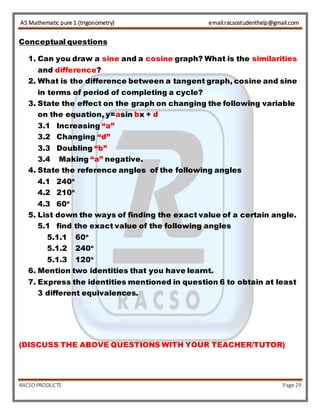
Conceptual questions 
1. Can you draw a sine and a cosine graph? What is the similarities 
and difference? 
2. What is the difference between a tangent graph, cosine and sine 
in terms of period of completing a cycle? 
3. State the effect on the graph on changing the following variable 
on the equation, y=asin bx + d 
3.1 Increasing “a” 
3.2 Changing “d” 
3.3 Doubling “b” 
3.4 Making “a” negative. 
4. State the reference angles of the following angles 
4.1 240o 
4.2 210o 
4.3 60o 
5. List down the ways of finding the exact value of a certain angle. 
5.1 find the exact value of the following angles 
5.1.1 60o 
5.1.2 240o 
5.1.3 120o 
6. Mention two identities that you have learnt. 
7. Express the identities mentioned in question 6 to obtain at least 
3 different equivalences. 
(DISCUSS THE ABOVE QUESTIONS WITH YOUR TEACHER/TUTOR) 
RACSO PRODUCTS Page 29
AS Mathematic pure 1 (trigonometry) email:racsostudenthelp@gmail.com 
RACSO PRODUCTS Page 30
AS Mathematic pure 1 (trigonometry) email:racsostudenthelp@gmail.com 
RACSO PRODUCTS Page 31
AS Mathematic pure 1 (trigonometry) email:racsostudenthelp@gmail.com 
RACSO PRODUCTS Page 32
AS Mathematic pure 1 (trigonometry) email:racsostudenthelp@gmail.com 
RACSO PRODUCTS Page 33

AS LEVEL Trigonometry (CIE) EXPLAINED WITH EXAMPLE AND DIAGRAMS

  • 1.
    AS Mathematic pure1 (trigonometry) email:racsostudenthelp@gmail.com 5. Trigonometry -Terminologies to be familiar with before we get started: Amplitude Wave length Trough Crest -Amplitude: is the height of wave -Wave length: is the distance between two successive troughs or crests -Period of a wave: time taken for a wave to complete a cycle. RACSO PRODUCTS Page 1
  • 2.
    AS Mathematic pure1 (trigonometry) email:racsostudenthelp@gmail.com  Sine graph  Cosine graph A cosine has a period of 180o or π radians also. Meaning a new wave starts after every 180o or π radians. Radians Meanin g a new wave starts after every 180o or π radians. n A sine graph has a period of 180o or π radians. Meaning a new wave starts after every 180o or π radians. Radians Degrees Degrees Y RACSO PRODUCTS Page 2
  • 3.
    AS Mathematic pure1 (trigonometry) email:racsostudenthelp@gmail.com  Tangent graph -What does it mean by a wave completing one cycle? Look at the example below. Figure ( i) A tangent graph has a period of 90o or π/2 radians. Meaning a new tangent graph starts after 90o or π/2 every Radians Degrees -An easy way to remember, look at the part of wave circled, they look like 2 half circles (semi-circles). 2 semi-circles make one complete circle. 2 half waves= Make a waves one complete cycle RACSO PRODUCTS Page 3
  • 4.
    AS Mathematic pure1 (trigonometry) email:racsostudenthelp@gmail.com Figure (ii) -The graph on the left, the wave complete one cycle at 2π radians or 360o. Look at this wave, one complete cycle ends at π radians or 180o. In other words this wave complete one cycle earlier. When a wave finishes one complete cycle earlier that the other we say it has a higher frequency. That means wave on figure (ii) is faster than the one on figure (i). It is not very necessary for you to know this for you example, it only make your understanding better. RACSO PRODUCTS Page 4
  • 5.
    AS Mathematic pure1 (trigonometry) email:racsostudenthelp@gmail.com -Transformation of a wave: A general equation of a wave is y = a sin bx ± d. From the general equation y = a sin bx ± d. on this page we changed “b” y = sin bx (a) Y = sin x (b) Look at what happens to the graph when b=2. And therefore eqn; y= sin 2x, and when b=3, y= sin 3x. As b increases period decreases and vice versa ( c ) Y = six 2x Y=sin 1 2 Y = sin x/2 Or 푥 Look at the difference between figure (a) and (b) on changing “b”. figure (a) has b=1 figure (b) has b= ½ . In figure (b), b is decreased and the fore period increased. (D) Y = sin 3x If you want to know where the graph complete one cycle, take 360/b or 2π/b. take an example of figure (c). b=2. Therefore 2π/2 = π. That means one complete cycle ends at π radians. RACSO PRODUCTS Page 5
  • 6.
    AS Mathematic pure1 (trigonometry) email:racsostudenthelp@gmail.com y = a sin x We are now changing “a” Y= 2 sin x Y= ½ sin x Y= sin x Same as Y =1sin x Noticed anything? When a= 2 graph stretched vertical, and its amplitude becomes 2, when a=1, amplitude is 1 so on. RACSO PRODUCTS Page 6
  • 7.
    AS Mathematic pure1 (trigonometry) email:racsostudenthelp@gmail.com ‘’d ‘’ will be changed, and see the resulting changes on the graph. From equation y = sin x ± d Y= sin x + 1 Y= sin x -1 Y= sin x, the same as Y= sin x + 0 RACSO PRODUCTS Page 7
  • 8.
    AS Mathematic pure1 (trigonometry) email:racsostudenthelp@gmail.com -From the equation y = a sin bx ± d all the variables a, b and d will be changed. Example 1: write down the equation of the graph below. -The equation is y = a sin bx ± d, -Let me find out what d is, I look at where by graph intersects the y-axis. It is +1, hence d= +1/2 - We now know what d is so we know where the horizontal axis is . look at diagram below 2.5 RACSO PRODUCTS Page 8
  • 9.
    AS Mathematic pure1 (trigonometry) email:racsostudenthelp@gmail.com 0.5 2.5- 0.5= 2.0, hence a=2.0 The amplitude is 2.0 -b is the period. We learnt a formula that period= 2π / b. We know the period is π radians (because the graph finishes one complete cycle at π radians.) So b= 2 π /period = 2 π /π = 2.therefore b= 2. Y=2sin 2x + 1/2 In the case where a= -ve number, look the difference. Y= - sin x Y= sin x RACSO PRODUCTS Page 9
  • 10.
    AS Mathematic pure1 (trigonometry) email:racsostudenthelp@gmail.com When “a” is negative start drawing downwards for sine, if “a” is positive start by heading upwards. Amplitude (strengths graph vertical) Period: it determines where graph finishes a complete cycle. y = a sin b x ± d For cosine graphs, it is the same idea with sine, It shifts the graph, vertically. RACSO PRODUCTS Page 10
  • 11.
    AS Mathematic pure1 (trigonometry) email:racsostudenthelp@gmail.com Y= cos x Y= cos x + 1 Y= cos 2x RACSO PRODUCTS Page 11
  • 12.
    AS Mathematic pure1 (trigonometry) email:racsostudenthelp@gmail.com -How to determine the equation of a cosine graph. -General formula is y = a cos bx + d. Y = cos 2x +1 First determine the highest and lowest points on the graph. Amplitude= (max. – min)/2. a = (1.5 – 0.5)/ 2 = 0.5 d = max – min. d= 1.5 – 0.5 = 1.0 RACSO PRODUCTS Page 12
  • 13.
    AS Mathematic pure1 (trigonometry) email:racsostudenthelp@gmail.com If a= -ve. Max. = 1.5 Min = 0.5 Period = π. Therefore b=2π / period = 2. So b= 2. Equation; y = ½ cos 2x + 1 -If you flip the graph y=cos x upside down it becomes y= - cos x. y = cos x y = - cos x For Tangent Y = tan x Period of tangents is 180o or π radians. So for tangents b= π /period. Y = - tan x RACSO PRODUCTS Page 13
  • 14.
    AS Mathematic pure1 (trigonometry) email:racsostudenthelp@gmail.com Y = tan 2x RACSO PRODUCTS Page 14
  • 15.
    AS Mathematic pure1 (trigonometry) email:racsostudenthelp@gmail.com HOW TO USE THE EXACT VALUES OF SINE, COSINE AND TANGENT THIS SECTION IS VERY IMPORTANT FOR YOUR EXAMS! A unit circle: is a circle with a radius of one. -Before starting: try the following questions on your scientific calculator and compare your answers RACSO PRODUCTS Page 15
  • 16.
    AS Mathematic pure1 (trigonometry) email:racsostudenthelp@gmail.com i) Sin 45 = √ퟑ/ퟐ or 0.577 ii) cos 45 = √ퟐ/ퟐ or 0.701 iii) Sin 135 = √ퟑ/ퟐ or 0.577 IV) cos 135 = −√ퟐ/ퟐ or -0.701 v) Sin 225 = −√ퟑ/ퟐ or - 0.577 VI) cos 225 = −√ퟐ/ퟐ or -0.701 vii) Sin 315 = −√ퟑ/ퟐ or -0.577 viii) cos 315 = √ퟐ/ퟐ or 0.701 i) Tan 45 = ퟏ ii) Tan 135 = - ퟏ iii) Tan 225 = ퟏ iv) Tan 315 = - ퟏ They are all the same numbers, the difference is the sign, how to determine where to put what sign? RACSO PRODUCTS Page 16
  • 17.
    AS Mathematic pure1 (trigonometry) email:racsostudenthelp@gmail.com Easier way to remember Second quadrant Only sine is positve (180 – θ) Third quadrant Only tangent is positive (180 + θ) This is a unit circle For the diagram on the previous page, First quadrant All positive A – all S - Students T – Take C - Coffee - ANGLE AS θ Forth quadrant Only cosine is positive 360 – θ  All (Sine or cosine or tangent) of any angle in the 1st quadrant is a +ve.  Sine of any angle in 2nd quadrant is +ve , but tangent and cosine are –ve.  Tangent of any angle in the 3rd quadrant is positive, but sine and cosine are –ve.  Cosine of any angle in the 4th quadrant is positive, but sine and tangent are –ve. - Do your know what a reference angle is? It is the acute version of a certain angle. Example; 60o is the reference angle of 120o, 240o and 300o. To determine what the reference angle is ask yourself the following; 1. In what quadrant is the angle given? 2. What is the formula for that specific quadrant? 3. Use the formula to obtain the answer. RACSO PRODUCTS Page 17
  • 18.
    AS Mathematic pure1 (trigonometry) email:racsostudenthelp@gmail.com Example: find the reference angle of 120o . θ= reference angle 1. 120o is in the second quadrant. 2. Formula second quadrant is (180 – θ), , 180 – θ = 120o 3. Solve for θ. 4. On solving final answer, θ = 60o Note: Reference angle should always be 0o < θ< 90o (always from the 1st quadrant) -You can try for 240 and 300, you should get 60o as the reference angle. RACSO PRODUCTS Page 18
  • 19.
    AS Mathematic pure1 (trigonometry) email:racsostudenthelp@gmail.com Remember the special angles? Questions: Means answers shouldn’t be a decimal (most decimals are approximations) Find the exact value of the following angles. i) Sin 60. ii) Cos 240 iii) Tan 120 Whenever you are asked to find the exact value of an angle, that angle should be a special angles. If not specified about the answer you can give it in any form. Before answering this kind of question ask yourself the following. 1. In which quadrant is the angle given? 2. Is the value -ve or +ve in that specific quadrant? A – all S - Students T – Take C - Coffee 3. What is the reference angle of the given angle? 4. Go to the table with special angles to get the value. 5. Don’t forget the correct sign on your final answer depending on step 2 You are required to know the table for your exams. RACSO PRODUCTS Page 19
  • 20.
    AS Mathematic pure1 (trigonometry) email:racsostudenthelp@gmail.com I will solve the above questions following the steps on previous page. i) Sin 60. 1. 60o is in the first quadrant, 2. Sine is positive in the first quadrant hence final answer should be positve. 3. The reference angle is the same 60o, 4. from the table, sin 60 = √3/2. 5. The answer is √3/2. ii) Cos 240. 1. 240o is in the 2rd quadrant. 2. Cosine is –ve in the 3rd quadrant, hence final answer is negative. 3. Reference angle is ( 180 + θ) = 240, θ =60. 4. On the table cos60 = ½ 5. Remember the –ve in step 2 hence answer is -1/2 iii) Give part (iii) a try. And you are not expected to write down step by step, this for you to understand. RACSO PRODUCTS Page 20
  • 21.
    AS Mathematic pure1 (trigonometry) email:racsostudenthelp@gmail.com HOW TO FIND THE INVERSE OF A TRIGONOMETRIC RELATION. 1. How to find inverse of trigonometric relation. 1. What is inverse mean? Example: it is easy to find what sin 30 is on a calculator. Sin 30= 0.5 -What if the question is sin x = 0.5, How do u find x? -At this point you have to find the sine inverse of 0.5, to get the value of x. -In this case you would have to find sin-1 0.5 to get x. Sine inverse RACSO PRODUCTS Page 21
  • 22.
    AS Mathematic pure1 (trigonometry) email:racsostudenthelp@gmail.com -This is the section to master, every year a question comes from this section! Sin θ /cos θ ≡ tan θ From the right-angled triangle above; Sin θ Cos θ Note sin2θ = (sin θ) 2 cos2θ = (cos θ) 2 tan2 θ = (tan θ)2 = a/h ÷ b/ h = a / b But; Tan θ = a b Therefore, Tan θ = Sin θ Cos θ RACSO PRODUCTS Page 22
  • 23.
    AS Mathematic pure1 (trigonometry) email:racsostudenthelp@gmail.com Sin θ =opposite / hypotenuse = a / h Cos θ =adjacent /hypotenuse = b/ h Tan θ = opposite / adjacent = a / b - You are NOT expected to prove the equivalence in your exams! sin2θ + cos2θ ≡ 1 From the right-angled triangle above; Sin θ =opposite / hypotenuse = a / h Cos θ =adjacent /hypotenuse = b/ h Tan θ = opposite / adjacent = a / b By Pythagoras theorem a2 + b2= h2 (from the triangle above) sin 2 θ + cos2 θ = (a / h)2 + (b/ h)2 = (a2 + b2)/ h2 = h2/ h2 = 1. Therefore; sin2θ + cos2θ ≡ 1 sin2θ = (sin θ) 2 cos2θ = (cos θ) 2 tan2 θ = (tan θ)2 You are not expected to prove this equivalence either, just remember it! There are different ways you can express identities. Note It is all about getting creative with the trigonometric identities, you can always express them in any form RACSO PRODUCTS Page 23
  • 24.
    AS Mathematic pure1 (trigonometry) email:racsostudenthelp@gmail.com sin cos2θ = 1- sin2θ 2θ = 1 - cos2θ sin2θ + cos2θ ≡ 1 Squaring both sides; Sin2 θ /cos2 θ ≡ tan2 θ Sin θ /cos θ ≡ tan θ cos2θ = (1 – sinθ)( 1 + sinθ) If sin2θ Is divide throughout: 1 + 1 / tan2 θ = 1/ sin2θ sin2θ = (1 – cosθ)( 1+ cosθ) If cos2θ is divide throughout: tan2 θ + 1 = 1/ cos2θ. Express cos θ in terms of sine and tan θ Cos θ = Sin θ / tan θ Note sin2θ = (sin θ) 2 cos2θ = (cos θ) 2 tan2 θ = (tan θ)2 Express Sin θ in terms of cos θ and tan θ Sin θ ≡ tan θ × cos θ -You don’t have to memorise all these different ways of expressing trigonometric identities, through solving many past questions, you automatically get them! RACSO PRODUCTS Page 24
  • 25.
    AS Mathematic pure1 (trigonometry) email:racsostudenthelp@gmail.com How questions are set in this section; (from Cambridge examination). Right hand side (R.H.S) o f the equivalence Left hand side (L.H.S) of the equivalence -When asked to prove one side is equivalent to the other, you choose a side, either the left hand side (L. H. S) or the right hand side (R.H.S) of the equivalence. With the use of the 2 identities (Sin θ /Cos θ ≡ tan θ and sin2θ + cos2θ ≡ 1) How do you do it? -Make sure you choose an easier side, from the question above it is easier starting from left hand side heading to the right hand side. But I will solve in both ways. -But how do I know the easy side? You look at the side that is less simplified. Detailed explanations will be made on the video. - I will show that left hand side is equivalence to the right hand side and in another solution I will show that the right hand side is equivalent to the left hand side with the use of the two identities we learnt. Techniques in attempting this kind of question. (Proving L.H.S = R.H.S) 1. What is in the side you trying to convert to, in this case we (1 – 2sin2x) it is only sine. (We will start from the L.H.S to prove its equivalent to R.H.S). 2. What do I have on the side I am are trying to start, in this case we have only tan2x. 3. Is there a relation between tan and sin? Is there a way I can express tan2x in terms of sine? Use the identities (on previous page). RACSO PRODUCTS Page 25
  • 26.
    AS Mathematic pure1 (trigonometry) email:racsostudenthelp@gmail.com SOLUTION OF TRIGONOMETRICALLY EQUATION LYING IN SPECIFIC INTERVAL 1. Interval may be positive or negative -Can you tell the difference between cos 60 and cos -60? This is anti-clockwise (60o), means you start from 0o going anti-clockwise +60 -60 (-60o )means you start form 0o clockwise. That means cos-60o = cos 300o This is clockwise Does this make any sense? RACSO PRODUCTS Page 26
  • 27.
    AS Mathematic pure1 (trigonometry) email:racsostudenthelp@gmail.com 1. Cos -120 = cos 240 = - cos 60 2. Sin 300 = sin -60 = -sin 60 For tangent it is different, but trust me! If you understand it, forgetting is hard. -All this will be explained clearly on the video for this section. 1.1 When interval is positive According to how we have learnt, cosine is positive in the 1st and 4th quadrant. Meaning, cos60 =cos 300= 0.5 - If a question is given as cos x = 0.5, find x. such that 0o< x < 360o Answer: x is 60o and 300o Let me change the interval This means, the value of x you will get should be somewhere between 0 – 360. Interval - If a question is given as cos x = 0.5, find x. such that 0o< x < 180o Answer: x = 60o only 300o is eliminated as the answer because it is not in the specified interval. X should be somewhere between 0o – 180o. RACSO PRODUCTS Page 27
  • 28.
    AS Mathematic pure1 (trigonometry) email:racsostudenthelp@gmail.com 1.2 When interval is negative. -If a question is given as cos x = 0.5, find x. Such that -180o< x < 180 +180 x is 60o and 300o – only 60o is in the interval. But we have also learnt that 300o can be written as -60o . Therefore x is 60o and -60o +180 -180 RACSO PRODUCTS Page 28
  • 29.
    AS Mathematic pure1 (trigonometry) email:racsostudenthelp@gmail.com Conceptual questions 1. Can you draw a sine and a cosine graph? What is the similarities and difference? 2. What is the difference between a tangent graph, cosine and sine in terms of period of completing a cycle? 3. State the effect on the graph on changing the following variable on the equation, y=asin bx + d 3.1 Increasing “a” 3.2 Changing “d” 3.3 Doubling “b” 3.4 Making “a” negative. 4. State the reference angles of the following angles 4.1 240o 4.2 210o 4.3 60o 5. List down the ways of finding the exact value of a certain angle. 5.1 find the exact value of the following angles 5.1.1 60o 5.1.2 240o 5.1.3 120o 6. Mention two identities that you have learnt. 7. Express the identities mentioned in question 6 to obtain at least 3 different equivalences. (DISCUSS THE ABOVE QUESTIONS WITH YOUR TEACHER/TUTOR) RACSO PRODUCTS Page 29
  • 30.
    AS Mathematic pure1 (trigonometry) email:racsostudenthelp@gmail.com RACSO PRODUCTS Page 30
  • 31.
    AS Mathematic pure1 (trigonometry) email:racsostudenthelp@gmail.com RACSO PRODUCTS Page 31
  • 32.
    AS Mathematic pure1 (trigonometry) email:racsostudenthelp@gmail.com RACSO PRODUCTS Page 32
  • 33.
    AS Mathematic pure1 (trigonometry) email:racsostudenthelp@gmail.com RACSO PRODUCTS Page 33