







Mathematics 7
3rd Quarter: Geometry
Circle and
Its Parts
MR. CARLO JUSTINO J. LUNA
Malabanias Integrated School
Angeles City
CONTENT STANDARD
The learner demonstrates
understanding of key
concepts of geometry of
shapes and sizes, and
geometric relationships.
PERFORMANCE STANDARD
The learner is able to create
models of plane figures and
formulate and solve
accurately authentic
problems involving sides and
angles of a polygon.
LEARNING
COMPETENCY
The learner
illustrates a circle
and the terms
related to it:
radius, diameter,
center, arc,
chord, tangent,
secant, central
angle, and
inscribed angle.
M7GE-IIIg-1
ACTIVITY
Directions:
1. Draw a point
somewhere in
the middle of a
sheet of paper.
ACTIVITY
Directions:
2. Now, using a
ruler, mark 20
other points
that are 5 cm
from the first
point.
ACTIVITY
Directions:
3. Compare
your work with
that of your
seatmates.
What shape do
you recognize?
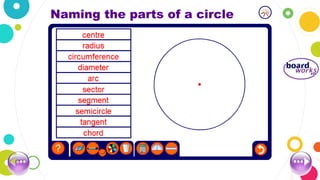
Naming the parts of a circle
Drag and
drop the
words on
the
illustration.
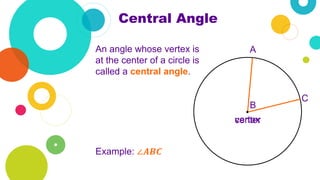
Central Angle
An angle whose vertex is
at the center of a circle is
called a central angle.
Example: ∠𝑨𝑩𝑪
vertex
A
B
C
center
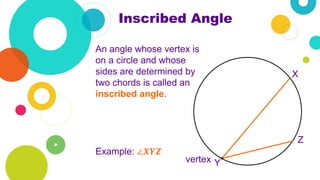
Inscribed Angle
An angle whose vertex is
on a circle and whose
sides are determined by
two chords is called an
inscribed angle.
Example: ∠𝑿𝒀𝒁
vertex
X
Y
Z
ACTIVITY
A. Determine whether each statement
is true or false.
1. Two radii always have the same
length.
2. Two chords always have the same
length.
3. All chords are diameters.
4. All diameters are chords.
5. All chords intersect at one point.
6. A radius is not a chord.
7. All diameters intersect at one point
ACTIVITY
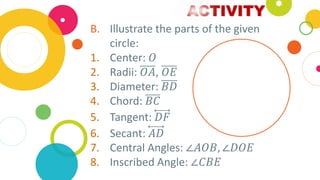
B. Illustrate the parts of the given
circle:
1. Center: 𝑂
2. Radii: 𝑂𝐴, 𝑂𝐸
3. Diameter: 𝐵𝐷
4. Chord: 𝐵𝐶
5. Tangent: 𝐷𝐹
6. Secant: 𝐴𝐷
7. Central Angles: ∠𝐴𝑂𝐵, ∠𝐷𝑂𝐸
8. Inscribed Angle: ∠𝐶𝐵𝐸
ADDITIONAL ACTIVITIES
Using a compass, draw a circle whose radius is 5cm.
1. What is the length of the diameter of the circle?
2. How many sectors of 90° will fit inside the circle?
3. Draw five radii inside your circle that are equally spaced out
around the circumference. Join up the ends of the radii to
create a shape inside your circle.
4. What is the name of the shape that you have created inside
your circle?
5. How long are the chords that are joining the radii together?
6. How big is the angle of each sector?
7. If you did the same as above with sectors of 45°, what
shape would you create inside your circle?
THANKS!
MR. CARLO JUSTINO J. LUNA
Malabanias Integrated School
Angeles City
Credits
Special thanks to all the people who
made and released these awesome
resources for free:
◎Presentation template by
SlidesCarnival
◎Naming Activity by BoardWorks
◎Shockwave Flash by Teachade

Circle and Its Part - Math 7 (3rd Quarter)

  • 1.
    Mathematics 7 3rd Quarter:Geometry Circle and Its Parts MR. CARLO JUSTINO J. LUNA Malabanias Integrated School Angeles City
  • 2.
    CONTENT STANDARD The learnerdemonstrates understanding of key concepts of geometry of shapes and sizes, and geometric relationships.
  • 3.
    PERFORMANCE STANDARD The learneris able to create models of plane figures and formulate and solve accurately authentic problems involving sides and angles of a polygon.
  • 4.
    LEARNING COMPETENCY The learner illustrates acircle and the terms related to it: radius, diameter, center, arc, chord, tangent, secant, central angle, and inscribed angle. M7GE-IIIg-1
  • 5.
    ACTIVITY Directions: 1. Draw apoint somewhere in the middle of a sheet of paper.
  • 6.
    ACTIVITY Directions: 2. Now, usinga ruler, mark 20 other points that are 5 cm from the first point.
  • 7.
    ACTIVITY Directions: 3. Compare your workwith that of your seatmates. What shape do you recognize?
  • 9.
    Naming the partsof a circle
  • 10.
    Drag and drop the wordson the illustration.
  • 11.
    Central Angle An anglewhose vertex is at the center of a circle is called a central angle. Example: ∠𝑨𝑩𝑪 vertex A B C center
  • 12.
    Inscribed Angle An anglewhose vertex is on a circle and whose sides are determined by two chords is called an inscribed angle. Example: ∠𝑿𝒀𝒁 vertex X Y Z
  • 13.
    ACTIVITY A. Determine whethereach statement is true or false. 1. Two radii always have the same length. 2. Two chords always have the same length. 3. All chords are diameters. 4. All diameters are chords. 5. All chords intersect at one point. 6. A radius is not a chord. 7. All diameters intersect at one point
  • 14.
    ACTIVITY B. Illustrate theparts of the given circle: 1. Center: 𝑂 2. Radii: 𝑂𝐴, 𝑂𝐸 3. Diameter: 𝐵𝐷 4. Chord: 𝐵𝐶 5. Tangent: 𝐷𝐹 6. Secant: 𝐴𝐷 7. Central Angles: ∠𝐴𝑂𝐵, ∠𝐷𝑂𝐸 8. Inscribed Angle: ∠𝐶𝐵𝐸
  • 15.
    ADDITIONAL ACTIVITIES Using acompass, draw a circle whose radius is 5cm. 1. What is the length of the diameter of the circle? 2. How many sectors of 90° will fit inside the circle? 3. Draw five radii inside your circle that are equally spaced out around the circumference. Join up the ends of the radii to create a shape inside your circle. 4. What is the name of the shape that you have created inside your circle? 5. How long are the chords that are joining the radii together? 6. How big is the angle of each sector? 7. If you did the same as above with sectors of 45°, what shape would you create inside your circle?
  • 16.
    THANKS! MR. CARLO JUSTINOJ. LUNA Malabanias Integrated School Angeles City
  • 17.
    Credits Special thanks toall the people who made and released these awesome resources for free: ◎Presentation template by SlidesCarnival ◎Naming Activity by BoardWorks ◎Shockwave Flash by Teachade