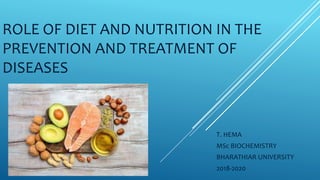



ROLE OF DIET AND NUTRITION IN THE
PREVENTION AND TREATMENT OF
DISEASES
T. HEMA
MSc BIOCHEMISTRY
BHARATHIAR UNIVERSITY
2018-2020
WHAT IS DIET?
 Diet refer to the food and drink a person consumes daily and the mental and
physical circumstances connected to eating.
ACCORDING TO WHO,
 An unhealthy diet is one of the major risk factors for a range of chronic
diseases, including cardiovascular diseases, cancer, diabetes and other
conditions linked to obesity.
 Specific recommendations for a healthy diet include: eating more fruit,
vegetables, legumes, nuts and grains; cutting down on salt, sugar and fats.
 It is also advisable to choose unsaturated fats, instead of saturated fats and
towards the elimination of trans-fatty acids.
 Improving dietary habits is a societal, not just an individual problem.
 Therefore it demands a population-based, multi sectoral, multi-disciplinary, and
culturally relevant approach.
WHAT IS NUTRITION?
 Nutrition involves more than simply eating a “good” diet—it is about nourishment on
every level.
 It involves relationships with family, friends, nature (the environment), our bodies, our
community, and the world.
ACCORDIND TO WHO
 Nutrition is the intake of food, considered in relation to the body’s dietary needs.
 Good nutrition – an adequate, well balanced diet combined with regular physical
activity – is a cornerstone of good health.
 Poor nutrition can lead to reduced immunity, increased susceptibility to disease,
impaired physical and mental development, and reduced productivity.
DIET AND NUTRITION
 The Council on Food and Nutrition of the American Medical Association defines nutrition as "the
science of food; the nutrients and the substances therein; their action, interaction, and balance in
relation to health and disease; and the process by which the organism (i.e. body) ingests, digest,
absorbs, transports, utilizes, and excretes food substances.
 The purpose of our diet is to consume foods that provide the six essential nutrients:
 carbohydrates,
 protein,
 fat,
 vitamins,
 minerals, and
 water.
 The correct amount and variety of food provides the correct amount of nutrients for health and weight
management.
DIETARY REFERENCE INTAKES
 Research to determine the appropriate amount of nutrients for health began in the 1940s because
men were being rejected from the military during World War II due to the effects of poor nutrition
on their health. The first Food and Nutrition Board was formed to evaluate the nutritional intakes
of large populations.
 The latest and most comprehensive nutrition recommendations are contained in the so-called
Dietary Reference Intakes (DRIs). DRIs were created in 1997 and have changed the way that diets
are evaluated.
 The primary goal of these guidelines was to not only prevent nutrient deficiencies but also reduce
the risk of chronic diseases such as cancer, cardiovascular disease, diabetes, and osteoporosis.
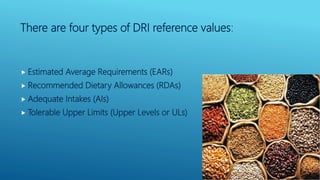
 Estimated Average Requirements (EARs)
 Recommended Dietary Allowances (RDAs)
 Adequate Intakes (AIs)
 Tolerable Upper Limits (Upper Levels or ULs)
There are four types of DRI reference values:
DIETARY GUIDELINES
The key recommendations are:
 Adequate nutrients within calorie needs
 Weight management
 Physical activity
 Food groups to encourage
 Alcoholic beverages
THE FOOD GUIDE PYRAMID
 Food can be divided into food groups according to its calorie and nutrient
content. This means that you can consume any food within a food group and
get a similar amount of nutrients.
 Food guides have been categorizing foods into food groups since 1916 and
have undergone many changes:
 1916 Caroline Hunt buying guide: five food groups were milk and meat;
cereals; vegetables and fruits; fats and fat foods; and sugars and sugary
foods
 1930's H.K. Stiebeling buying guide: 12 food groups were milk; lean meat,
poultry and fish; dry mature beans, peas, and nuts; eggs; flours and cereals;
leafy green and yellow vegetables; potatoes and sweet potatoes; other
vegetables and fruit; tomatoes and citrus; butter; other fats; and sugars
 1940's Basic Seven foundation diet: seven food groups were milk and milk products;
meat, poultry, fish, eggs, dried beans, peas and nuts; bread, flour, and cereals; leafy
green and yellow vegetables; potatoes and other fruit and vegetables; citrus, tomato,
cabbage, and salad greens; and butter-fortified margarine
 1956-1970's Basic Four foundation diet: milk group; meat group; bread and cereal;
and vegetable-fruit group
 1979 Hassle-Free foundation diet: five food groups were milk-cheese group; meat,
poultry, fish, and beans group; bread-cereal group; vegetable-fruit group; and fats,
sweets, and alcohol group
 1984 to present Food Guide Pyramid: six food groups were milk, yogurt, and cheese;
meat, poultry, fish, eggs, dry beans, and nuts; breads, cereals, rice, and pasta;
vegetables; fruit; and fats, oils, and sweets
FOOD LABELS
 serving size
 calories
 calories from fat
 total fat
 saturated fat
 monounsaturated fat
 polyunsaturated fat
 trans fat
 cholesterol
 sodium
 total carbohydrates
 dietary fiber
 sugars
 protein
 Vitamins and
 minerals
The food label, or nutrition facts label, is your best source of information for what you are feeding your
body. Before you can use it, you have to know how to read it, so let's "digest" the food label.
The most important thing to read on the food label is the very first line. The serving size that is
listed is what all of the rest of the information is based upon.
CALORIES
Our sources of calories comes from three of the essential nutrients:
carbohydrates, protein, and fat. Each of these nutrients has a set
number of calories:
1 gram of carbohydrates = 4 calories
1 gram of protein = 4 calories
1 gram of fat = 9 calories
1 gram of alcohol = 7 calories
 Adults and children should get 45%-65% of their calories from
carbohydrates.
 Adults and children should get 10%-35% of their calories from
protein.
 Adults should get 20%-35% of their calories from fat.
 Infants and younger children should get 25%-40% of calories
from fat.
 Fat is the most concentrated source of calories in the diet,
providing 9 calories per gram
 The fat that we consume is primarily in the source
of triglycerides. This means that there are three fatty
acids combined with a glycerol backbone. These fatty acids
are
 monounsaturated: olive oil, olives, peanut oil, canola oil,
avocado, and nuts;
 polyunsaturated: safflower oil, sunflower oil, corn oil, fish,
flaxseeds, and walnuts; and
 saturated: butter, lard, red meat, poultry skin, whole milk,
coconut oil, and palm oil.
 olive oil: 15% saturated fat, 10% polyunsaturated fat, and
75% monounsaturated fat;
 flaxseed oil: 9% saturated fat, 73% polyunsaturated fat, and
18% monounsaturated fat.
Dietary fat is a necessary nutrient in our diet. Many
people have turned to fat-free products, assuming
that they are healthier, but this is not always the
case.
Fat-free products are often high in sugar.
Vitamins are needed in small quantities to perform invaluable functions
Minerals are another component in a healthy diet. There are two
categories of minerals: major minerals and trace minerals.
The difference between each of these is the amount that is needed
each day.
The major minerals are calcium, phosphorus, magnesium, sodium,
potassium, chloride, and sulfur.
The trace minerals are iodine, iron, zinc, selenium, fluoride, chromium,
and copper.
DIET, NUTRITION AND THE
PREVENTION OF CHRONIC DISEASES
 Obesity: the imbalance between declining energy
expenditure due to physical inactivity and high energy
in the diet (excess calories whether from sugar, starches
or fat) is the main determinant of the obesity epidemic.
 Increasing physical activity, plus reducing intakes of
foods high in fat and foods and drinks high in sugars,
can prevent unhealthy weight gain.
 Taking these simple goals to concrete action requires
major social and environmental changes in order to
effectively promote and support healthier choices at
the individual level.
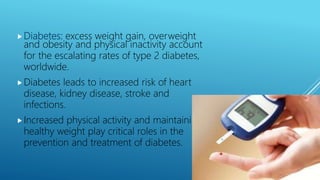
Diabetes: excess weight gain, overweight
and obesity and physical inactivity account
for the escalating rates of type 2 diabetes,
worldwide.
Diabetes leads to increased risk of heart
disease, kidney disease, stroke and
infections.
Increased physical activity and maintaining
healthy weight play critical roles in the
prevention and treatment of diabetes.
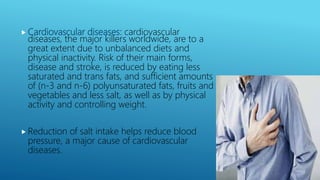
 Cardiovascular diseases: cardiovascular
diseases, the major killers worldwide, are to a
great extent due to unbalanced diets and
physical inactivity. Risk of their main forms,
disease and stroke, is reduced by eating less
saturated and trans fats, and sufficient amounts
of (n-3 and n-6) polyunsaturated fats, fruits and
vegetables and less salt, as well as by physical
activity and controlling weight.
 Reduction of salt intake helps reduce blood
pressure, a major cause of cardiovascular
diseases.
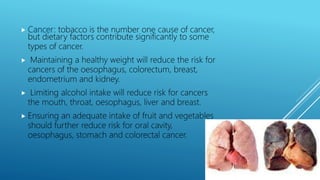
 Cancer: tobacco is the number one cause of cancer,
but dietary factors contribute significantly to some
types of cancer.
 Maintaining a healthy weight will reduce the risk for
cancers of the oesophagus, colorectum, breast,
endometrium and kidney.
 Limiting alcohol intake will reduce risk for cancers
the mouth, throat, oesophagus, liver and breast.
 Ensuring an adequate intake of fruit and vegetables
should further reduce risk for oral cavity,
oesophagus, stomach and colorectal cancer.
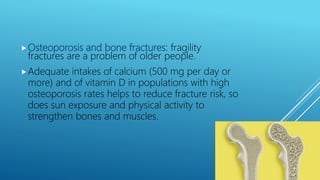
Osteoporosis and bone fractures: fragility
fractures are a problem of older people.
Adequate intakes of calcium (500 mg per day or
more) and of vitamin D in populations with high
osteoporosis rates helps to reduce fracture risk, so
does sun exposure and physical activity to
strengthen bones and muscles.
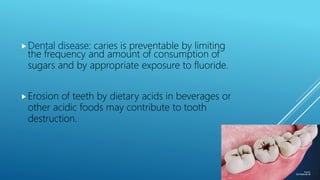
Dental disease: caries is preventable by limiting
the frequency and amount of consumption of
sugars and by appropriate exposure to fluoride.
Erosion of teeth by dietary acids in beverages or
other acidic foods may contribute to tooth
destruction.
THANK YOU

Diet and Nutrition

  • 1.
    ROLE OF DIETAND NUTRITION IN THE PREVENTION AND TREATMENT OF DISEASES T. HEMA MSc BIOCHEMISTRY BHARATHIAR UNIVERSITY 2018-2020
  • 2.
    WHAT IS DIET? Diet refer to the food and drink a person consumes daily and the mental and physical circumstances connected to eating. ACCORDING TO WHO,  An unhealthy diet is one of the major risk factors for a range of chronic diseases, including cardiovascular diseases, cancer, diabetes and other conditions linked to obesity.  Specific recommendations for a healthy diet include: eating more fruit, vegetables, legumes, nuts and grains; cutting down on salt, sugar and fats.  It is also advisable to choose unsaturated fats, instead of saturated fats and towards the elimination of trans-fatty acids.
  • 3.
     Improving dietaryhabits is a societal, not just an individual problem.  Therefore it demands a population-based, multi sectoral, multi-disciplinary, and culturally relevant approach.
  • 4.
    WHAT IS NUTRITION? Nutrition involves more than simply eating a “good” diet—it is about nourishment on every level.  It involves relationships with family, friends, nature (the environment), our bodies, our community, and the world. ACCORDIND TO WHO  Nutrition is the intake of food, considered in relation to the body’s dietary needs.  Good nutrition – an adequate, well balanced diet combined with regular physical activity – is a cornerstone of good health.  Poor nutrition can lead to reduced immunity, increased susceptibility to disease, impaired physical and mental development, and reduced productivity.
  • 5.
    DIET AND NUTRITION The Council on Food and Nutrition of the American Medical Association defines nutrition as "the science of food; the nutrients and the substances therein; their action, interaction, and balance in relation to health and disease; and the process by which the organism (i.e. body) ingests, digest, absorbs, transports, utilizes, and excretes food substances.  The purpose of our diet is to consume foods that provide the six essential nutrients:  carbohydrates,  protein,  fat,  vitamins,  minerals, and  water.  The correct amount and variety of food provides the correct amount of nutrients for health and weight management.
  • 6.
    DIETARY REFERENCE INTAKES Research to determine the appropriate amount of nutrients for health began in the 1940s because men were being rejected from the military during World War II due to the effects of poor nutrition on their health. The first Food and Nutrition Board was formed to evaluate the nutritional intakes of large populations.  The latest and most comprehensive nutrition recommendations are contained in the so-called Dietary Reference Intakes (DRIs). DRIs were created in 1997 and have changed the way that diets are evaluated.  The primary goal of these guidelines was to not only prevent nutrient deficiencies but also reduce the risk of chronic diseases such as cancer, cardiovascular disease, diabetes, and osteoporosis.
  • 7.
     Estimated AverageRequirements (EARs)  Recommended Dietary Allowances (RDAs)  Adequate Intakes (AIs)  Tolerable Upper Limits (Upper Levels or ULs) There are four types of DRI reference values:
  • 8.
    DIETARY GUIDELINES The keyrecommendations are:  Adequate nutrients within calorie needs  Weight management  Physical activity  Food groups to encourage  Alcoholic beverages
  • 9.
    THE FOOD GUIDEPYRAMID  Food can be divided into food groups according to its calorie and nutrient content. This means that you can consume any food within a food group and get a similar amount of nutrients.  Food guides have been categorizing foods into food groups since 1916 and have undergone many changes:  1916 Caroline Hunt buying guide: five food groups were milk and meat; cereals; vegetables and fruits; fats and fat foods; and sugars and sugary foods  1930's H.K. Stiebeling buying guide: 12 food groups were milk; lean meat, poultry and fish; dry mature beans, peas, and nuts; eggs; flours and cereals; leafy green and yellow vegetables; potatoes and sweet potatoes; other vegetables and fruit; tomatoes and citrus; butter; other fats; and sugars
  • 10.
     1940's BasicSeven foundation diet: seven food groups were milk and milk products; meat, poultry, fish, eggs, dried beans, peas and nuts; bread, flour, and cereals; leafy green and yellow vegetables; potatoes and other fruit and vegetables; citrus, tomato, cabbage, and salad greens; and butter-fortified margarine  1956-1970's Basic Four foundation diet: milk group; meat group; bread and cereal; and vegetable-fruit group  1979 Hassle-Free foundation diet: five food groups were milk-cheese group; meat, poultry, fish, and beans group; bread-cereal group; vegetable-fruit group; and fats, sweets, and alcohol group  1984 to present Food Guide Pyramid: six food groups were milk, yogurt, and cheese; meat, poultry, fish, eggs, dry beans, and nuts; breads, cereals, rice, and pasta; vegetables; fruit; and fats, oils, and sweets
  • 11.
    FOOD LABELS  servingsize  calories  calories from fat  total fat  saturated fat  monounsaturated fat  polyunsaturated fat  trans fat  cholesterol  sodium  total carbohydrates  dietary fiber  sugars  protein  Vitamins and  minerals The food label, or nutrition facts label, is your best source of information for what you are feeding your body. Before you can use it, you have to know how to read it, so let's "digest" the food label. The most important thing to read on the food label is the very first line. The serving size that is listed is what all of the rest of the information is based upon.
  • 12.
    CALORIES Our sources ofcalories comes from three of the essential nutrients: carbohydrates, protein, and fat. Each of these nutrients has a set number of calories: 1 gram of carbohydrates = 4 calories 1 gram of protein = 4 calories 1 gram of fat = 9 calories 1 gram of alcohol = 7 calories
  • 13.
     Adults andchildren should get 45%-65% of their calories from carbohydrates.  Adults and children should get 10%-35% of their calories from protein.  Adults should get 20%-35% of their calories from fat.  Infants and younger children should get 25%-40% of calories from fat.
  • 14.
     Fat isthe most concentrated source of calories in the diet, providing 9 calories per gram  The fat that we consume is primarily in the source of triglycerides. This means that there are three fatty acids combined with a glycerol backbone. These fatty acids are  monounsaturated: olive oil, olives, peanut oil, canola oil, avocado, and nuts;  polyunsaturated: safflower oil, sunflower oil, corn oil, fish, flaxseeds, and walnuts; and  saturated: butter, lard, red meat, poultry skin, whole milk, coconut oil, and palm oil.  olive oil: 15% saturated fat, 10% polyunsaturated fat, and 75% monounsaturated fat;  flaxseed oil: 9% saturated fat, 73% polyunsaturated fat, and 18% monounsaturated fat.
  • 15.
    Dietary fat isa necessary nutrient in our diet. Many people have turned to fat-free products, assuming that they are healthier, but this is not always the case. Fat-free products are often high in sugar.
  • 16.
    Vitamins are neededin small quantities to perform invaluable functions Minerals are another component in a healthy diet. There are two categories of minerals: major minerals and trace minerals. The difference between each of these is the amount that is needed each day. The major minerals are calcium, phosphorus, magnesium, sodium, potassium, chloride, and sulfur. The trace minerals are iodine, iron, zinc, selenium, fluoride, chromium, and copper.
  • 17.
    DIET, NUTRITION ANDTHE PREVENTION OF CHRONIC DISEASES  Obesity: the imbalance between declining energy expenditure due to physical inactivity and high energy in the diet (excess calories whether from sugar, starches or fat) is the main determinant of the obesity epidemic.  Increasing physical activity, plus reducing intakes of foods high in fat and foods and drinks high in sugars, can prevent unhealthy weight gain.  Taking these simple goals to concrete action requires major social and environmental changes in order to effectively promote and support healthier choices at the individual level.
  • 18.
    Diabetes: excess weightgain, overweight and obesity and physical inactivity account for the escalating rates of type 2 diabetes, worldwide. Diabetes leads to increased risk of heart disease, kidney disease, stroke and infections. Increased physical activity and maintaining healthy weight play critical roles in the prevention and treatment of diabetes.
  • 19.
     Cardiovascular diseases:cardiovascular diseases, the major killers worldwide, are to a great extent due to unbalanced diets and physical inactivity. Risk of their main forms, disease and stroke, is reduced by eating less saturated and trans fats, and sufficient amounts of (n-3 and n-6) polyunsaturated fats, fruits and vegetables and less salt, as well as by physical activity and controlling weight.  Reduction of salt intake helps reduce blood pressure, a major cause of cardiovascular diseases.
  • 20.
     Cancer: tobaccois the number one cause of cancer, but dietary factors contribute significantly to some types of cancer.  Maintaining a healthy weight will reduce the risk for cancers of the oesophagus, colorectum, breast, endometrium and kidney.  Limiting alcohol intake will reduce risk for cancers the mouth, throat, oesophagus, liver and breast.  Ensuring an adequate intake of fruit and vegetables should further reduce risk for oral cavity, oesophagus, stomach and colorectal cancer.
  • 21.
    Osteoporosis and bonefractures: fragility fractures are a problem of older people. Adequate intakes of calcium (500 mg per day or more) and of vitamin D in populations with high osteoporosis rates helps to reduce fracture risk, so does sun exposure and physical activity to strengthen bones and muscles.
  • 22.
    Dental disease: cariesis preventable by limiting the frequency and amount of consumption of sugars and by appropriate exposure to fluoride. Erosion of teeth by dietary acids in beverages or other acidic foods may contribute to tooth destruction.
  • 23.