
Presented by
S.Navya PravaliKA
 OBJECTIVES.
 WHY MISSION TO MASS.
 RESEARCHES ON MASS.
 LAUNCH AND ORBIT.
 MISSION PLAN.
 PHASES OF MASS.
 PSLV.
 SPACE CRAFTS.
 PAYLOADS.
 MASS ORBITORY.
 COMMUNICATION IN MANGALYAAN.
 NEXT ORBIT MISSION.
 TRACKING.
 CONCLUSION.
 Design and realisation of a Mars orbiter with a
capability to perform Earth bound maneuvers,
cruise phase of 300 days, Mars orbit insertion /
capture, and on-orbit phase around Mars.
 Deep space communication, navigation, mission
planning and management.
 Incorporate autonomous features to handle
contingency situations.
 The secondary objectives are scientific, and include
the study of Mars surface features, morphology,
mineralogy and the Martian atmosphere.
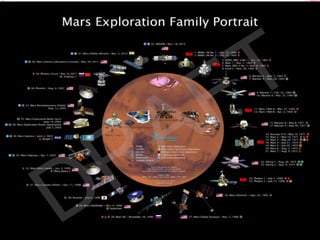
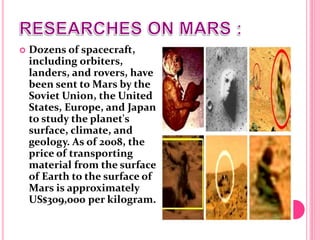
 Dozens of spacecraft,
including orbiters,
landers, and rovers, have
been sent to Mars by the
Soviet Union, the United
States, Europe, and Japan
to study the planet's
surface, climate, and
geology. As of 2008, the
price of transporting
material from the surface
of Earth to the surface of
Mars is approximately
US$309,000 per kilogram.
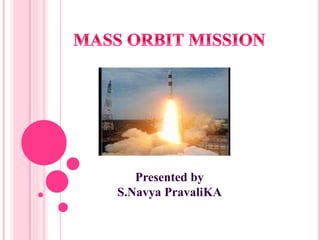
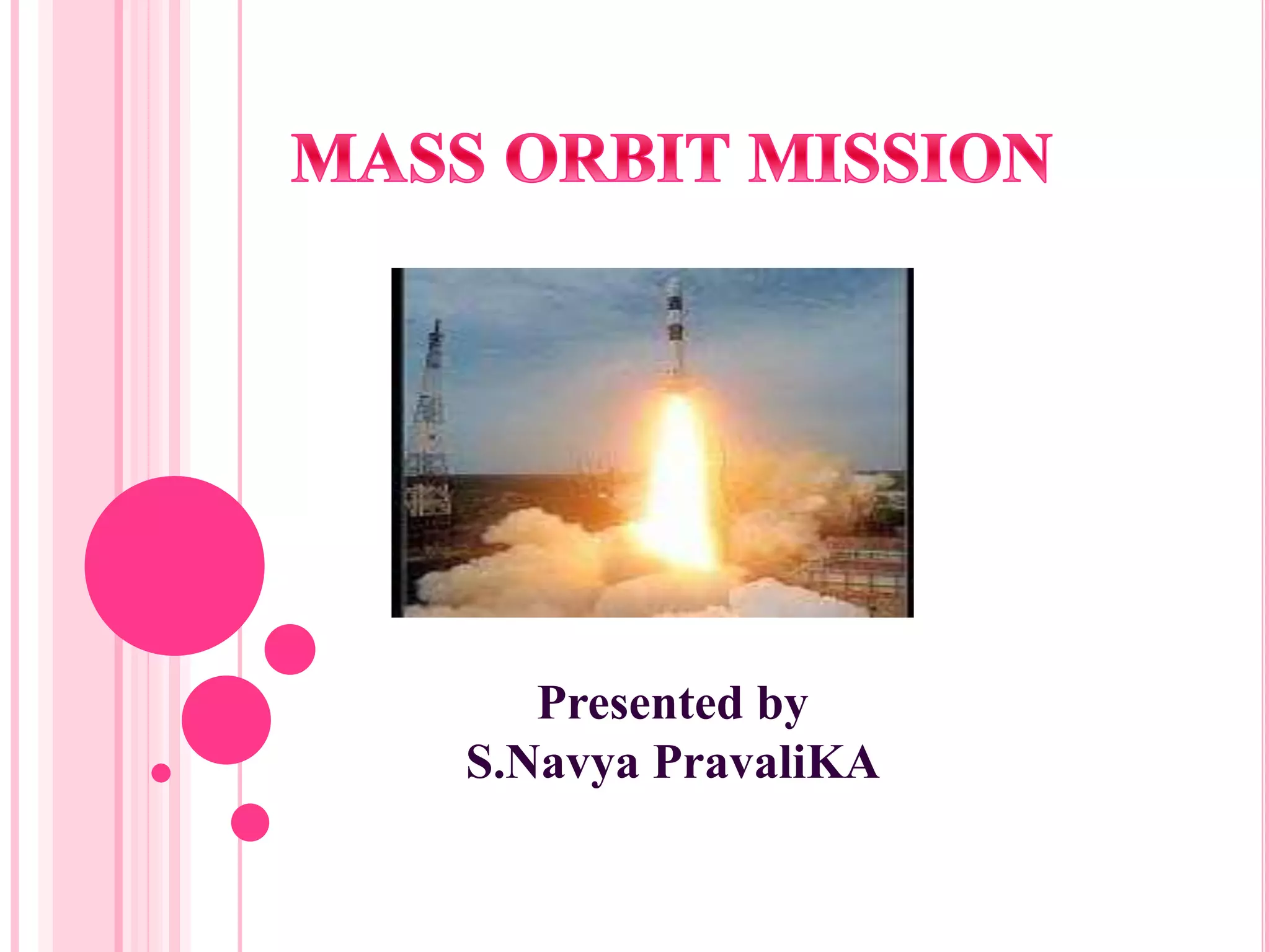
 launch will place from sriharikota and the Mars
Orbiter will be placed into Earth orbit, then six
engine firings will raise that orbit to one with an
apogee of 215,000 km and a perigee of 600 km,
where it will remain for about 25 days.
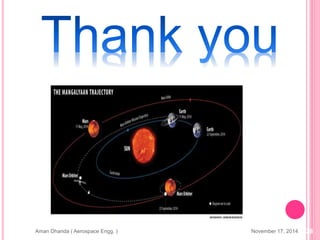
 A final firing in 30 November 2013 will send
MOM onto an interplanetary trajectory.
 Mars orbit insertion is planned for 21 September
2014 and would allow the spacecraft to enter a
highly elliptical orbit of 372 km x 80,000 km
around Mars.
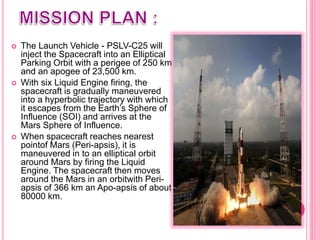
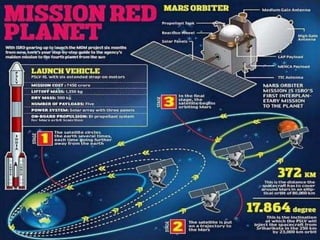
 The Launch Vehicle - PSLV-C25 will
inject the Spacecraft into an Elliptical
Parking Orbit with a perigee of 250 km
and an apogee of 23,500 km.
 With six Liquid Engine firing, the
spacecraft is gradually maneuvered
into a hyperbolic trajectory with which
it escapes from the Earth’s Sphere of
Influence (SOI) and arrives at the
Mars Sphere of Influence.
 When spacecraft reaches nearest
pointof Mars (Peri-apsis), it is
maneuvered in to an elliptical orbit
around Mars by firing the Liquid
Engine. The spacecraft then moves
around the Mars in an orbitwith Peri-
apsis of 366 km an Apo-apsis of about
80000 km.
:
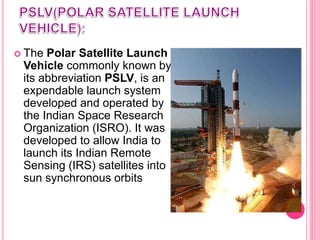
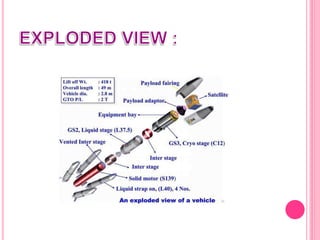
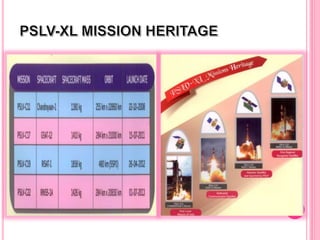
 The Polar Satellite Launch
Vehicle commonly known by
its abbreviation PSLV, is an
expendable launch system
developed and operated by
the Indian Space Research
Organization (ISRO). It was
developed to allow India to
launch its Indian Remote
Sensing (IRS) satellites into
sun synchronous orbits
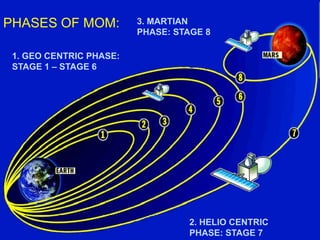
PHASES OF MOM:
1. GEO CENTRIC PHASE:
STAGE 1 – STAGE 6
2. HELIO CENTRIC
PHASE: STAGE 7
3. MARTIAN
PHASE: STAGE 8
1. Geo Centric Phase
The spacecraft is injected into an
Elliptic Parking Orbit by the
launcher. With six main engine
burns, the spacecraft is gradually
maneuvered into a departure
hyperbolic trajectory with which it
escapes from the Earth’s Sphere
of Influence (SOI) with Earth’s
orbital velocity + V boost.
2. Helio Centric Phase
The spacecraft leaves Earth
in a direction tangential to
Earth’s orbit and encounters
Mars tangentially to its orbit.
The flight path is roughly one
half of an ellipse around sun.
3. Martian Phase
The spacecraft arrives at
the Mars Sphere of
Influence (around 573473
km from the surface of
Mars) in a hyperbolic
trajectory. At the time the
spacecraft reaches the
closest approach to Mars
(Periapsis)
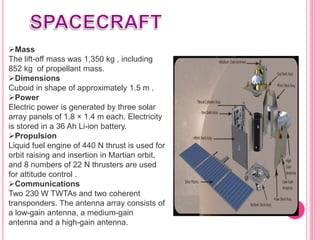
Mass
The lift-off mass was 1,350 kg , including
852 kg of propellant mass.
Dimensions
Cuboid in shape of approximately 1.5 m .
Power
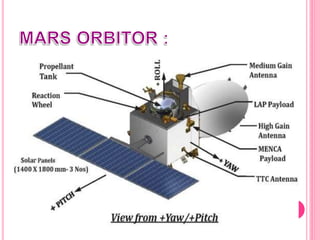
Electric power is generated by three solar
array panels of 1.8 × 1.4 m each. Electricity
is stored in a 36 Ah Li-ion battery.
Propulsion
Liquid fuel engine of 440 N thrust is used for
orbit raising and insertion in Martian orbit,
and 8 numbers of 22 N thrusters are used
for attitude control .
Communications
Two 230 W TWTAs and two coherent
transponders. The antenna array consists of
a low-gain antenna, a medium-gain
antenna and a high-gain antenna.
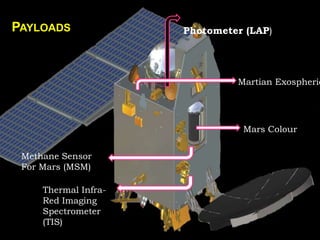
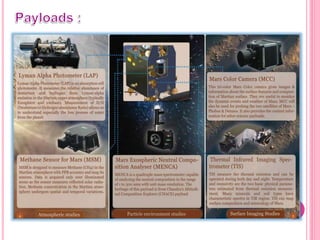
PAYLOADS
Lyman Alpha
Photometer (LAP)
Martian Exospheric
Neutral
Composition
Explorer (MENCA)
Mars Colour
Camera (MCC)
Methane Sensor
For Mars (MSM)
Thermal Infra-
Red Imaging
Spectrometer
(TIS)
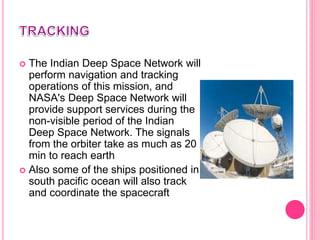
 The Indian Deep Space Network will
perform navigation and tracking
operations of this mission, and
NASA's Deep Space Network will
provide support services during the
non-visible period of the Indian
Deep Space Network. The signals
from the orbiter take as much as 20
min to reach earth
 Also some of the ships positioned in
south pacific ocean will also track
and coordinate the spacecraft
 The government of India approved the project on 3
August 2012,after the Indian Space Research
Organization completed 1.25 billion (US$19 million)
of required studies for the orbiter. The total project
cost may be up to 4.54 billion (US$69 million).
SUMMARY
November 17, 2014Aman Dhanda ( Aerospace Engg. ) 23
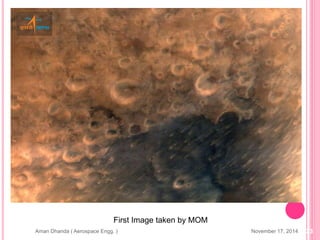
First Image taken by MOM
 Communications with Mangalyaan to get blocked for 15 days in
June
 India's Mangalyaan mission will face a crucial period in June
when the sun will block out all communications with the ground
for 15 days, former Indian Space Research Organisation (ISRO)
chief Dr K Radhakrishnan has said. Dr Radhakrishnan made the
remarks at the Indian Science Congress and said, "If we could
regain control over the craft after that period, that would be one
more major achievement."
 According to a Times of India report, that this will be longest
break in communication with Mangalyaan, since the Mars Orbiter
was launched in November 2013. During the blackout phase the
orbiter will be "in an autonomous mode."
 The TOI report quoted MoM project director Subbiah Arunan as
saying that the blackout would be from 8 to 22 June because the
Sun will come between Earth and Mars. Arunan also said that in
May 2016, the Earth would come between Mars and Sun, leading
to another loss of communications for about a fortnight.
o The second mission to Mars could be between 2018-
2020, but may not be similar to the Orbiter Mission
launched last year, ISRO chief K Radhakrishnan said on
Wednesday.
 "MOM is not an end, but a beginining of our next
scientific mission. The next mission to Mars may happen
between 2018 to 2020. It may necessarily not be an
Orbiter Mission like MOM. We need to get feedback
from the scientific community on what kind of project
would this be," he said.
 The ISRO chief was speaking at a book launch of
'Reaching for the stars: India's journey to Mars and
Beyond' authored by eminient science journalist Pallava
Bagla and Subhadra Menon.
HERE ARE REASONS WHY INDIA’S MARS
ORBITER MISSION (MOM) IS JUST AMAZING :
 The Mangalyaan mission cost India $73 million (~Rs.450 crores) which is
even cheaper than an eight lane bridge in Mumbai which cost $340
million.
 It is less than the budget of film “Gravity” which was about $105 million
and about one-tenth of what the US has spent on MAVEN, making it
undoubtedly the most cost-effective inter-planetary space mission to
have ever been undertaken anywhere in the world!
 In real terms, when distributed over the population of 1.2 billion, every
Indian has contributed Rs.4 per towards the mission.
 Mangalyaan will observe the environment of Mars and look for various
elements like methane (marsh gas), which is a possible indicator of life. It
will also look for Deuterium-Hydroden ratio and other neutral constants.
 The orbiter weighs 1,350-kg, which is even less than the weight of an
average sports utility vehicle
 The manufacturing of Mangalyaan took 15 months while NASA took five
years to complete MAVEN.
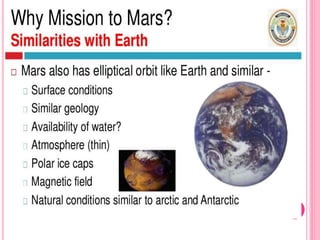
 Certain features on Mars are similar to the
features of Earth.
 The features on Earth are known to have been
caused by the existence of water in those locations.
 Most scientists now believe that these features
on Mars are evidence that water has existed on
Mars in the past & may, in fact, still exist below the
surface today.
November 17, 2014Aman Dhanda ( Aerospace Engg. ) 28
MASS ORBIT MISSION PRESENT AND FUTURE

MASS ORBIT MISSION PRESENT AND FUTURE

  • 1.
  • 3.
     OBJECTIVES.  WHYMISSION TO MASS.  RESEARCHES ON MASS.  LAUNCH AND ORBIT.  MISSION PLAN.  PHASES OF MASS.  PSLV.  SPACE CRAFTS.  PAYLOADS.  MASS ORBITORY.  COMMUNICATION IN MANGALYAAN.  NEXT ORBIT MISSION.  TRACKING.  CONCLUSION.
  • 4.
     Design andrealisation of a Mars orbiter with a capability to perform Earth bound maneuvers, cruise phase of 300 days, Mars orbit insertion / capture, and on-orbit phase around Mars.  Deep space communication, navigation, mission planning and management.  Incorporate autonomous features to handle contingency situations.  The secondary objectives are scientific, and include the study of Mars surface features, morphology, mineralogy and the Martian atmosphere.
  • 6.
     Dozens ofspacecraft, including orbiters, landers, and rovers, have been sent to Mars by the Soviet Union, the United States, Europe, and Japan to study the planet's surface, climate, and geology. As of 2008, the price of transporting material from the surface of Earth to the surface of Mars is approximately US$309,000 per kilogram.
  • 7.
     launch willplace from sriharikota and the Mars Orbiter will be placed into Earth orbit, then six engine firings will raise that orbit to one with an apogee of 215,000 km and a perigee of 600 km, where it will remain for about 25 days.  A final firing in 30 November 2013 will send MOM onto an interplanetary trajectory.  Mars orbit insertion is planned for 21 September 2014 and would allow the spacecraft to enter a highly elliptical orbit of 372 km x 80,000 km around Mars.
  • 8.
     The LaunchVehicle - PSLV-C25 will inject the Spacecraft into an Elliptical Parking Orbit with a perigee of 250 km and an apogee of 23,500 km.  With six Liquid Engine firing, the spacecraft is gradually maneuvered into a hyperbolic trajectory with which it escapes from the Earth’s Sphere of Influence (SOI) and arrives at the Mars Sphere of Influence.  When spacecraft reaches nearest pointof Mars (Peri-apsis), it is maneuvered in to an elliptical orbit around Mars by firing the Liquid Engine. The spacecraft then moves around the Mars in an orbitwith Peri- apsis of 366 km an Apo-apsis of about 80000 km.
  • 9.
  • 10.
     The PolarSatellite Launch Vehicle commonly known by its abbreviation PSLV, is an expendable launch system developed and operated by the Indian Space Research Organization (ISRO). It was developed to allow India to launch its Indian Remote Sensing (IRS) satellites into sun synchronous orbits
  • 14.
    PHASES OF MOM: 1.GEO CENTRIC PHASE: STAGE 1 – STAGE 6 2. HELIO CENTRIC PHASE: STAGE 7 3. MARTIAN PHASE: STAGE 8
  • 15.
    1. Geo CentricPhase The spacecraft is injected into an Elliptic Parking Orbit by the launcher. With six main engine burns, the spacecraft is gradually maneuvered into a departure hyperbolic trajectory with which it escapes from the Earth’s Sphere of Influence (SOI) with Earth’s orbital velocity + V boost. 2. Helio Centric Phase The spacecraft leaves Earth in a direction tangential to Earth’s orbit and encounters Mars tangentially to its orbit. The flight path is roughly one half of an ellipse around sun. 3. Martian Phase The spacecraft arrives at the Mars Sphere of Influence (around 573473 km from the surface of Mars) in a hyperbolic trajectory. At the time the spacecraft reaches the closest approach to Mars (Periapsis)
  • 16.
    Mass The lift-off masswas 1,350 kg , including 852 kg of propellant mass. Dimensions Cuboid in shape of approximately 1.5 m . Power Electric power is generated by three solar array panels of 1.8 × 1.4 m each. Electricity is stored in a 36 Ah Li-ion battery. Propulsion Liquid fuel engine of 440 N thrust is used for orbit raising and insertion in Martian orbit, and 8 numbers of 22 N thrusters are used for attitude control . Communications Two 230 W TWTAs and two coherent transponders. The antenna array consists of a low-gain antenna, a medium-gain antenna and a high-gain antenna.
  • 17.
    PAYLOADS Lyman Alpha Photometer (LAP) MartianExospheric Neutral Composition Explorer (MENCA) Mars Colour Camera (MCC) Methane Sensor For Mars (MSM) Thermal Infra- Red Imaging Spectrometer (TIS)
  • 20.
     The IndianDeep Space Network will perform navigation and tracking operations of this mission, and NASA's Deep Space Network will provide support services during the non-visible period of the Indian Deep Space Network. The signals from the orbiter take as much as 20 min to reach earth  Also some of the ships positioned in south pacific ocean will also track and coordinate the spacecraft
  • 21.
     The governmentof India approved the project on 3 August 2012,after the Indian Space Research Organization completed 1.25 billion (US$19 million) of required studies for the orbiter. The total project cost may be up to 4.54 billion (US$69 million).
  • 22.
  • 23.
    November 17, 2014AmanDhanda ( Aerospace Engg. ) 23 First Image taken by MOM
  • 24.
     Communications withMangalyaan to get blocked for 15 days in June  India's Mangalyaan mission will face a crucial period in June when the sun will block out all communications with the ground for 15 days, former Indian Space Research Organisation (ISRO) chief Dr K Radhakrishnan has said. Dr Radhakrishnan made the remarks at the Indian Science Congress and said, "If we could regain control over the craft after that period, that would be one more major achievement."  According to a Times of India report, that this will be longest break in communication with Mangalyaan, since the Mars Orbiter was launched in November 2013. During the blackout phase the orbiter will be "in an autonomous mode."  The TOI report quoted MoM project director Subbiah Arunan as saying that the blackout would be from 8 to 22 June because the Sun will come between Earth and Mars. Arunan also said that in May 2016, the Earth would come between Mars and Sun, leading to another loss of communications for about a fortnight.
  • 25.
    o The secondmission to Mars could be between 2018- 2020, but may not be similar to the Orbiter Mission launched last year, ISRO chief K Radhakrishnan said on Wednesday.  "MOM is not an end, but a beginining of our next scientific mission. The next mission to Mars may happen between 2018 to 2020. It may necessarily not be an Orbiter Mission like MOM. We need to get feedback from the scientific community on what kind of project would this be," he said.  The ISRO chief was speaking at a book launch of 'Reaching for the stars: India's journey to Mars and Beyond' authored by eminient science journalist Pallava Bagla and Subhadra Menon.
  • 26.
    HERE ARE REASONSWHY INDIA’S MARS ORBITER MISSION (MOM) IS JUST AMAZING :  The Mangalyaan mission cost India $73 million (~Rs.450 crores) which is even cheaper than an eight lane bridge in Mumbai which cost $340 million.  It is less than the budget of film “Gravity” which was about $105 million and about one-tenth of what the US has spent on MAVEN, making it undoubtedly the most cost-effective inter-planetary space mission to have ever been undertaken anywhere in the world!  In real terms, when distributed over the population of 1.2 billion, every Indian has contributed Rs.4 per towards the mission.  Mangalyaan will observe the environment of Mars and look for various elements like methane (marsh gas), which is a possible indicator of life. It will also look for Deuterium-Hydroden ratio and other neutral constants.  The orbiter weighs 1,350-kg, which is even less than the weight of an average sports utility vehicle  The manufacturing of Mangalyaan took 15 months while NASA took five years to complete MAVEN.
  • 27.
     Certain featureson Mars are similar to the features of Earth.  The features on Earth are known to have been caused by the existence of water in those locations.  Most scientists now believe that these features on Mars are evidence that water has existed on Mars in the past & may, in fact, still exist below the surface today.
  • 28.
    November 17, 2014AmanDhanda ( Aerospace Engg. ) 28