1RS & GIS DIVISION, DEPT. OF CIVIL ENGG, NIT
Prepared by
Pramod M Khombare
(Source : ISRO) (Source : space.com)
 Introduction.
 Mission Objectives.
 Mission Profile.
 Earth-Mars Trajectory.
 Getting into Martian Orbit.
 References.
RS & GIS DIVISION, DEPT. OF CIVIL ENGG, NIT WARANGAL
2
RS & GIS DIVISION, DEPT. OF CIVIL ENGG, NIT WARANGAL 3
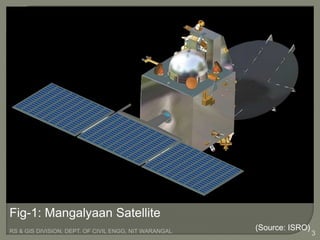
Fig-1: Mangalyaan Satellite
(Source: ISRO)
 India’s first Interplanetary Mission by ISRO in its entire history of
44 years.
 Launched at Satish Dhawan Space Centre, Sriharikota,Andhra
Pradesh.
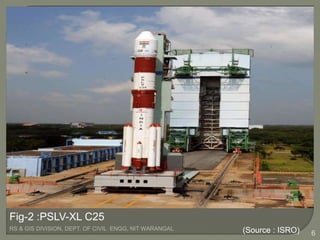
 By using Polar Satellite Launch Vehicle, C25 on 5 November 2013.
 ISRO is the 4th Space Agency in the world after NASA, RFSA and
ESA.
 Mangalyaan mission cost ~450 crores.
 Mars is about 670 million kilometers from the earth.
RS & GIS DIVISION, DEPT. OF CIVIL ENGG, NIT WARANGAL
4
 Cost - ~Rs.6.7 per kilometer.
 The orbiter weighs-1,350-kg.
 Spacecraft is cuboid in shape ~1.5 m across.
 Constructed of an aluminium and composite fibre reinforced plastic
sandwich construction.
 Electricity is generated by 3 solar array panels of 1.8 m × 1.4 m
each.
 Maximum power generation is 840 watts in Mars orbit.
 Manufacturing duration-15 months.
 Flyby time is 6 months.
RS & GIS DIVISION, DEPT. OF CIVIL ENGG, NIT WARANGAL
5
RS & GIS DIVISION, DEPT. OF CIVIL ENGG, NIT WARANGAL
6
Fig-2 :PSLV-XL C25
(Source : ISRO)
A. Technological Objectives:
 Design and realisation of a Mars orbiter with a capability to
survive and perform Earth bound manoeuvres, cruise phase of
300 days, Mars orbit insertion / capture, and on-orbit phase
around Mars.
 Deep space communication, navigation, mission planning and
management.
 Incorporate autonomous features to handle contingency
situations.
RS & GIS DIVISION, DEPT. OF CIVIL ENGG, NIT WARANGAL
7
B. Scientific Objectives:
 Exploration of Mars surface features, morphology, mineralogy
and Martian atmosphere by indigenous scientific instruments.
RS & GIS DIVISION, DEPT. OF CIVIL ENGG, NIT WARANGAL
8
RS & GIS DIVISION, DEPT. OF CIVIL ENGG, NIT WARANGAL
9
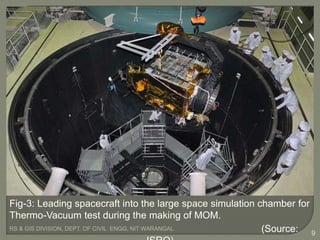
(Source:
Fig-3: Leading spacecraft into the large space simulation chamber for
Thermo-Vacuum test during the making of MOM.
The mission consists of following three phases:
1. Geo Centric Phase:
 The spacecraft is injected into an Elliptic Parking Orbit by the launcher.
 6 engine burns makes spacecraft to escape from earth’s Sphere of
Influence(SOI).
 Then spacecraft fallow hyperbolic trajectory.
 The SOI of earth ends at 918347 km from the surface of the earth.
 ISRO has used a method of travel called a Hohmann Transfer Orbit – or a
Minimum Energy Transfer Orbit.
 To send a spacecraft from Earth to Mars with the least amount of fuel
possible.
RS & GIS DIVISION, DEPT. OF CIVIL ENGG, NIT WARANGAL
10
RS & GIS DIVISION, DEPT. OF CIVIL ENGG, NIT WARANGAL
11
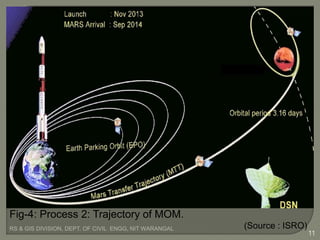
(Source : ISRO)
Fig-4: Process 2: Trajectory of MOM.
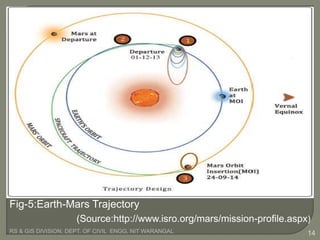
 The spacecraft leaves Earth in a direction tangential to Earth’s orbit
encounters Mars tangentially to its orbit.
 The flight path is roughly one half of an ellipse around sun.
 It will intersect the orbit of Mars at the exact moment when Mars is there
too.
 This trajectory becomes possible with certain allowances when the
relative position of Earth, Mars and Sun form an angle of approximately
44o.
 This arrangement recur periodically at intervals of about 780 days.
 Minimum energy opportunities for Earth-Mars occur in November 2013,
January 2016, May2018 etc.
RS & GIS DIVISION, DEPT. OF CIVIL ENGG, NIT WARANGAL
12
 The spacecraft arrives at the Mars Sphere of Influence in a hyperbolic
trajectory.
 Mars Sphere of Influence is around 573473 km from the surface.
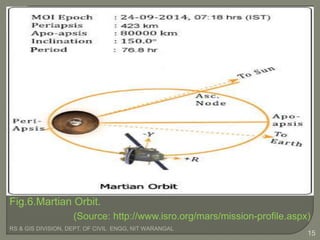
 At the time the spacecraft reaches the Periapsis of Mars, it is captured
into planned orbit around mars is called the Mars Orbit Insertion (MOI)
manoeuvre.
RS & GIS DIVISION, DEPT. OF CIVIL ENGG, NIT WARANGAL
13
RS & GIS DIVISION, DEPT. OF CIVIL ENGG, NIT WARANGAL 14
(Source:http://www.isro.org/mars/mission-profile.aspx)
Fig-5:Earth-Mars Trajectory
RS & GIS DIVISION, DEPT. OF CIVIL ENGG, NIT WARANGAL
15
(Source: http://www.isro.org/mars/mission-profile.aspx)
Fig.6.Martian Orbit.
RS & GIS DIVISION, DEPT. OF CIVIL ENGG, NIT WARANGAL
16
(Courtsey : Doordarshan)
Video-1 : Process 1:Launching of Satellite.
MOM has greeted the RED PLANET on 24 September 2014.
RS & GIS DIVISION, DEPT. OF CIVIL ENGG, NIT WARANGAL
17
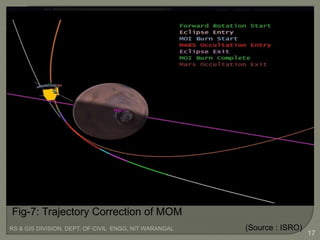
Fig-7: Trajectory Correction of MOM
(Source : ISRO)
RS & GIS DIVISION, DEPT. OF CIVIL ENGG, NIT WARANGAL
18
(Source: ISRO)
Video-2: Process 2: Trajectory Correction of MOM. The main
test engine had a perfect burn for 4 seconds.
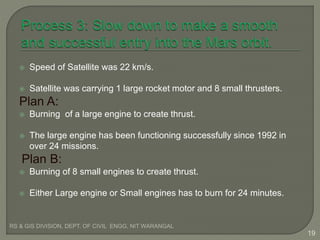
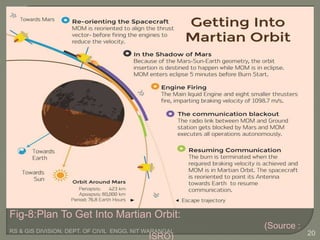
 Speed of Satellite was 22 km/s.
 Satellite was carrying 1 large rocket motor and 8 small thrusters.
Plan A:
 Burning of a large engine to create thrust.
 The large engine has been functioning successfully since 1992 in
over 24 missions.
Plan B:
 Burning of 8 small engines to create thrust.
 Either Large engine or Small engines has to burn for 24 minutes.
RS & GIS DIVISION, DEPT. OF CIVIL ENGG, NIT WARANGAL
19
RS & GIS DIVISION, DEPT. OF CIVIL ENGG, NIT WARANGAL 20
(Source :
ISRO)
Fig-8:Plan To Get Into Martian Orbit:
RS & GIS DIVISION, DEPT. OF CIVIL ENGG, NIT WARANGAL 21
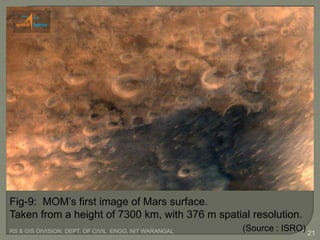
Fig-9: MOM’s first image of Mars surface.
Taken from a height of 7300 km, with 376 m spatial resolution.
(Source : ISRO)
RS & GIS DIVISION, DEPT. OF CIVIL ENGG, NIT WARANGAL
22
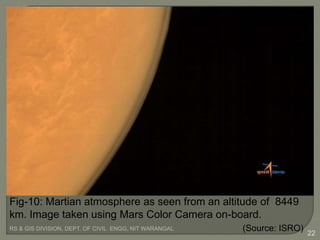
Fig-10: Martian atmosphere as seen from an altitude of 8449
km. Image taken using Mars Color Camera on-board.
(Source: ISRO)
RS & GIS DIVISION, DEPT. OF CIVIL ENGG, NIT WARANGAL
23
THANK YOU
India makes a mark in Mars
 http://www.isro.org/mars/home.aspx
 http://www.space.com/27242-india-mars-
mission-arrival.html
 "Mars Orbiter Spacecraft completes Engine
Test, fine-tunes its Course". Spaceflight 101. 22
September 2014. Retrieved 2014-09-24.
 http://www.isro.org/pslv-c25/mission.aspx
 http://en.wikipedia.org/wiki/Mars_Orbiter_Mission
RS & GIS DIVISION, DEPT. OF CIVIL ENGG, NIT WARANGAL
24

Mars orbiter mission

  • 1.
    1RS & GISDIVISION, DEPT. OF CIVIL ENGG, NIT Prepared by Pramod M Khombare (Source : ISRO) (Source : space.com)
  • 2.
     Introduction.  MissionObjectives.  Mission Profile.  Earth-Mars Trajectory.  Getting into Martian Orbit.  References. RS & GIS DIVISION, DEPT. OF CIVIL ENGG, NIT WARANGAL 2
  • 3.
    RS & GISDIVISION, DEPT. OF CIVIL ENGG, NIT WARANGAL 3 Fig-1: Mangalyaan Satellite (Source: ISRO)
  • 4.
     India’s firstInterplanetary Mission by ISRO in its entire history of 44 years.  Launched at Satish Dhawan Space Centre, Sriharikota,Andhra Pradesh.  By using Polar Satellite Launch Vehicle, C25 on 5 November 2013.  ISRO is the 4th Space Agency in the world after NASA, RFSA and ESA.  Mangalyaan mission cost ~450 crores.  Mars is about 670 million kilometers from the earth. RS & GIS DIVISION, DEPT. OF CIVIL ENGG, NIT WARANGAL 4
  • 5.
     Cost -~Rs.6.7 per kilometer.  The orbiter weighs-1,350-kg.  Spacecraft is cuboid in shape ~1.5 m across.  Constructed of an aluminium and composite fibre reinforced plastic sandwich construction.  Electricity is generated by 3 solar array panels of 1.8 m × 1.4 m each.  Maximum power generation is 840 watts in Mars orbit.  Manufacturing duration-15 months.  Flyby time is 6 months. RS & GIS DIVISION, DEPT. OF CIVIL ENGG, NIT WARANGAL 5
  • 6.
    RS & GISDIVISION, DEPT. OF CIVIL ENGG, NIT WARANGAL 6 Fig-2 :PSLV-XL C25 (Source : ISRO)
  • 7.
    A. Technological Objectives: Design and realisation of a Mars orbiter with a capability to survive and perform Earth bound manoeuvres, cruise phase of 300 days, Mars orbit insertion / capture, and on-orbit phase around Mars.  Deep space communication, navigation, mission planning and management.  Incorporate autonomous features to handle contingency situations. RS & GIS DIVISION, DEPT. OF CIVIL ENGG, NIT WARANGAL 7
  • 8.
    B. Scientific Objectives: Exploration of Mars surface features, morphology, mineralogy and Martian atmosphere by indigenous scientific instruments. RS & GIS DIVISION, DEPT. OF CIVIL ENGG, NIT WARANGAL 8
  • 9.
    RS & GISDIVISION, DEPT. OF CIVIL ENGG, NIT WARANGAL 9 (Source: Fig-3: Leading spacecraft into the large space simulation chamber for Thermo-Vacuum test during the making of MOM.
  • 10.
    The mission consistsof following three phases: 1. Geo Centric Phase:  The spacecraft is injected into an Elliptic Parking Orbit by the launcher.  6 engine burns makes spacecraft to escape from earth’s Sphere of Influence(SOI).  Then spacecraft fallow hyperbolic trajectory.  The SOI of earth ends at 918347 km from the surface of the earth.  ISRO has used a method of travel called a Hohmann Transfer Orbit – or a Minimum Energy Transfer Orbit.  To send a spacecraft from Earth to Mars with the least amount of fuel possible. RS & GIS DIVISION, DEPT. OF CIVIL ENGG, NIT WARANGAL 10
  • 11.
    RS & GISDIVISION, DEPT. OF CIVIL ENGG, NIT WARANGAL 11 (Source : ISRO) Fig-4: Process 2: Trajectory of MOM.
  • 12.
     The spacecraftleaves Earth in a direction tangential to Earth’s orbit encounters Mars tangentially to its orbit.  The flight path is roughly one half of an ellipse around sun.  It will intersect the orbit of Mars at the exact moment when Mars is there too.  This trajectory becomes possible with certain allowances when the relative position of Earth, Mars and Sun form an angle of approximately 44o.  This arrangement recur periodically at intervals of about 780 days.  Minimum energy opportunities for Earth-Mars occur in November 2013, January 2016, May2018 etc. RS & GIS DIVISION, DEPT. OF CIVIL ENGG, NIT WARANGAL 12
  • 13.
     The spacecraftarrives at the Mars Sphere of Influence in a hyperbolic trajectory.  Mars Sphere of Influence is around 573473 km from the surface.  At the time the spacecraft reaches the Periapsis of Mars, it is captured into planned orbit around mars is called the Mars Orbit Insertion (MOI) manoeuvre. RS & GIS DIVISION, DEPT. OF CIVIL ENGG, NIT WARANGAL 13
  • 14.
    RS & GISDIVISION, DEPT. OF CIVIL ENGG, NIT WARANGAL 14 (Source:http://www.isro.org/mars/mission-profile.aspx) Fig-5:Earth-Mars Trajectory
  • 15.
    RS & GISDIVISION, DEPT. OF CIVIL ENGG, NIT WARANGAL 15 (Source: http://www.isro.org/mars/mission-profile.aspx) Fig.6.Martian Orbit.
  • 16.
    RS & GISDIVISION, DEPT. OF CIVIL ENGG, NIT WARANGAL 16 (Courtsey : Doordarshan) Video-1 : Process 1:Launching of Satellite. MOM has greeted the RED PLANET on 24 September 2014.
  • 17.
    RS & GISDIVISION, DEPT. OF CIVIL ENGG, NIT WARANGAL 17 Fig-7: Trajectory Correction of MOM (Source : ISRO)
  • 18.
    RS & GISDIVISION, DEPT. OF CIVIL ENGG, NIT WARANGAL 18 (Source: ISRO) Video-2: Process 2: Trajectory Correction of MOM. The main test engine had a perfect burn for 4 seconds.
  • 19.
     Speed ofSatellite was 22 km/s.  Satellite was carrying 1 large rocket motor and 8 small thrusters. Plan A:  Burning of a large engine to create thrust.  The large engine has been functioning successfully since 1992 in over 24 missions. Plan B:  Burning of 8 small engines to create thrust.  Either Large engine or Small engines has to burn for 24 minutes. RS & GIS DIVISION, DEPT. OF CIVIL ENGG, NIT WARANGAL 19
  • 20.
    RS & GISDIVISION, DEPT. OF CIVIL ENGG, NIT WARANGAL 20 (Source : ISRO) Fig-8:Plan To Get Into Martian Orbit:
  • 21.
    RS & GISDIVISION, DEPT. OF CIVIL ENGG, NIT WARANGAL 21 Fig-9: MOM’s first image of Mars surface. Taken from a height of 7300 km, with 376 m spatial resolution. (Source : ISRO)
  • 22.
    RS & GISDIVISION, DEPT. OF CIVIL ENGG, NIT WARANGAL 22 Fig-10: Martian atmosphere as seen from an altitude of 8449 km. Image taken using Mars Color Camera on-board. (Source: ISRO)
  • 23.
    RS & GISDIVISION, DEPT. OF CIVIL ENGG, NIT WARANGAL 23 THANK YOU India makes a mark in Mars
  • 24.
     http://www.isro.org/mars/home.aspx  http://www.space.com/27242-india-mars- mission-arrival.html "Mars Orbiter Spacecraft completes Engine Test, fine-tunes its Course". Spaceflight 101. 22 September 2014. Retrieved 2014-09-24.  http://www.isro.org/pslv-c25/mission.aspx  http://en.wikipedia.org/wiki/Mars_Orbiter_Mission RS & GIS DIVISION, DEPT. OF CIVIL ENGG, NIT WARANGAL 24