



By
Prof. Amit Raikar
A. G. Patil Institute of Technology, Solapur
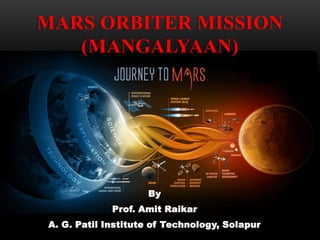
MARS ORBITER MISSION
(MANGALYAAN)
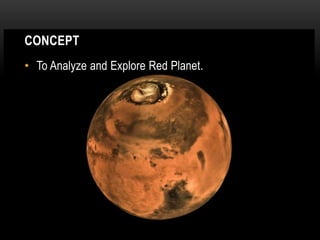
CONCEPT
• To Analyze and Explore Red Planet.
MISSION OBJECTIVE
• The main objectives are to develop the technologies required for designing, planning,
management and operations of an interplanetary mission.
Primary Objective
• Orbit manoeuvres to transfer the spacecraft
• Navigation in all phases
• Maintain the spacecraft in all phases of the mission
• Meeting power, communications, thermal and payload operation requirements
• Incorporate autonomous features
Scientific Objective
• Exploration of Mars surface
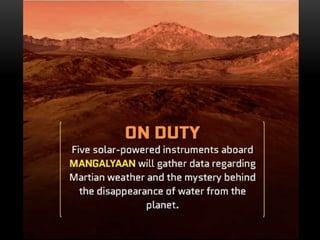
• Study the constituents of methane in the Martian atmosphere
• Study the upper atmosphere of Mars.
WHAT IS MANGALYAAN IS ACTUALLY GOING TO
DO???
• To find Methane in atmosphere
• To study morphology, topography and mineralogy
• To observe dynamic changes in the atmosphere, effects of solar wind and
radiation
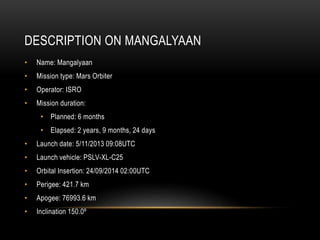
DESCRIPTION ON MANGALYAAN
• Name: Mangalyaan
• Mission type: Mars Orbiter
• Operator: ISRO
• Mission duration:
• Planned: 6 months
• Elapsed: 2 years, 9 months, 24 days
• Launch date: 5/11/2013 09:08UTC
• Launch vehicle: PSLV-XL-C25
• Orbital Insertion: 24/09/2014 02:00UTC
• Perigee: 421.7 km
• Apogee: 76993.6 km
• Inclination 150.0º
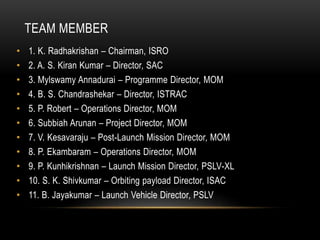
• 1. K. Radhakrishan – Chairman, ISRO
• 2. A. S. Kiran Kumar – Director, SAC
• 3. Mylswamy Annadurai – Programme Director, MOM
• 4. B. S. Chandrashekar – Director, ISTRAC
• 5. P. Robert – Operations Director, MOM
• 6. Subbiah Arunan – Project Director, MOM
• 7. V. Kesavaraju – Post-Launch Mission Director, MOM
• 8. P. Ekambaram – Operations Director, MOM
• 9. P. Kunhikrishnan – Launch Mission Director, PSLV-XL
• 10. S. K. Shivkumar – Orbiting payload Director, ISAC
• 11. B. Jayakumar – Launch Vehicle Director, PSLV
TEAM MEMBER
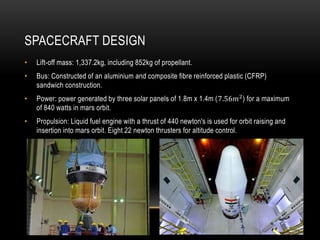
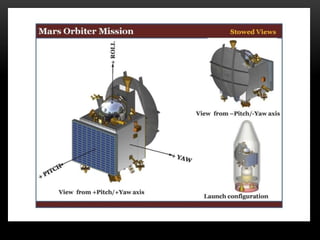
SPACECRAFT DESIGN
• Lift-off mass: 1,337.2kg, including 852kg of propellant.
• Bus: Constructed of an aluminium and composite fibre reinforced plastic (CFRP)
sandwich construction.
• Power: power generated by three solar panels of 1.8m x 1.4m (7.56𝑚2
) for a maximum
of 840 watts in mars orbit.
• Propulsion: Liquid fuel engine with a thrust of 440 newton's is used for orbit raising and
insertion into mars orbit. Eight 22 newton thrusters for altitude control.
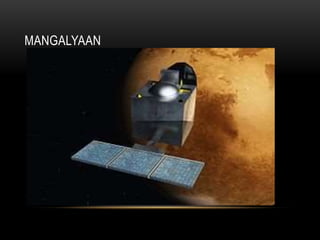
MANGALYAAN
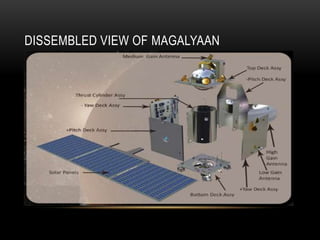
DISSEMBLED VIEW OF MAGALYAAN
PAYLOAD
Scientific instruments
LAP Lyman-Alpha Photometer 1.97 kg (4.3 lb)
MSM Methane Sensor for Mars 2.94 kg (6.5 lb)
MENCA
Mars Exospheric Neutral
Composition Analyser
3.56 kg (7.8 lb)
TIS
Thermal Infrared Imaging
Spectrometer
3.20 kg (7.1 lb)
MCC Mars Colour Camera 1.27 kg (2.8 lb)
• The Lyman Alpha Photometer (LAP) will measure the ratio of
deuterium to hydrogen, which will help to explain how Mars has
lost its water over time.
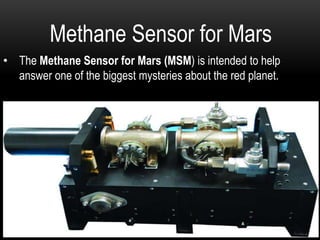
Methane Sensor for Mars
• The Methane Sensor for Mars (MSM) is intended to help
answer one of the biggest mysteries about the red planet.
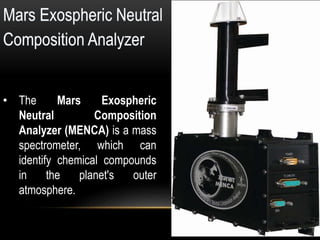
• The Mars Exospheric
Neutral Composition
Analyzer (MENCA) is a mass
spectrometer, which can
identify chemical compounds
in the planet's outer
atmosphere.
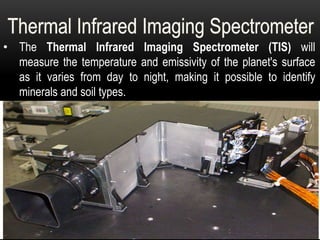
• The Thermal Infrared Imaging Spectrometer (TIS) will
measure the temperature and emissivity of the planet's surface
as it varies from day to night, making it possible to identify
minerals and soil types.
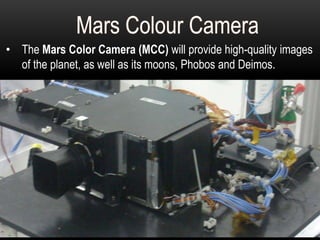
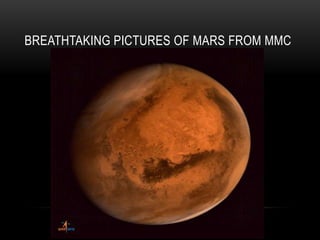
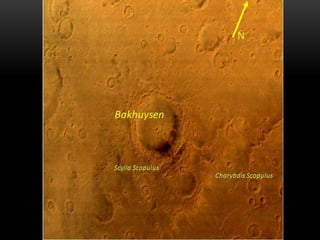
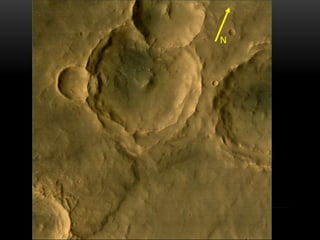
• The Mars Color Camera (MCC) will provide high-quality images
of the planet, as well as its moons, Phobos and Deimos.
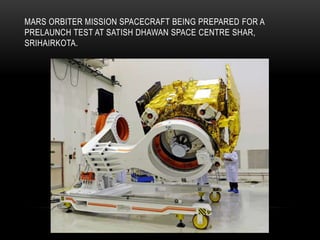
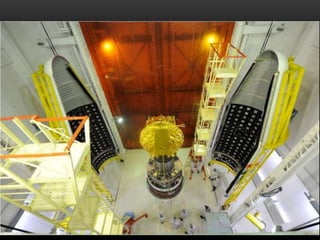
MARS ORBITER MISSION SPACECRAFT BEING PREPARED FOR A
PRELAUNCH TEST AT SATISH DHAWAN SPACE CENTRE SHAR,
SRIHAIRKOTA.
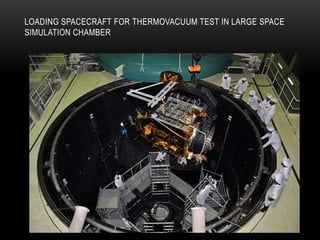
LOADING SPACECRAFT FOR THERMOVACUUM TEST IN LARGE SPACE
SIMULATION CHAMBER
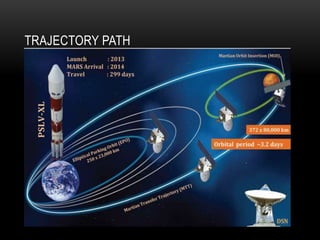
TRAJECTORY PATH
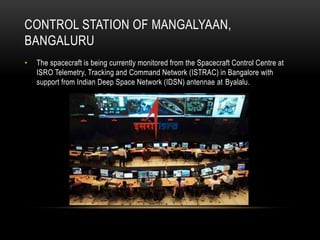
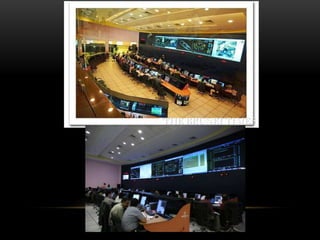
CONTROL STATION OF MANGALYAAN,
BANGALURU
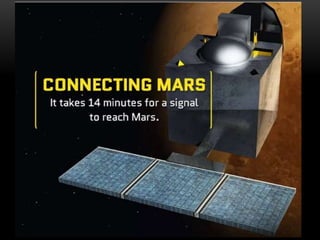
• The spacecraft is being currently monitored from the Spacecraft Control Centre at
ISRO Telemetry, Tracking and Command Network (ISTRAC) in Bangalore with
support from Indian Deep Space Network (IDSN) antennae at Byalalu.
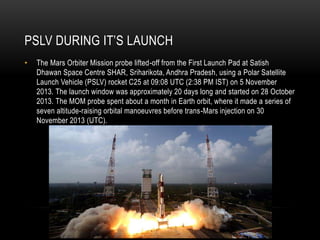
PSLV DURING IT’S LAUNCH
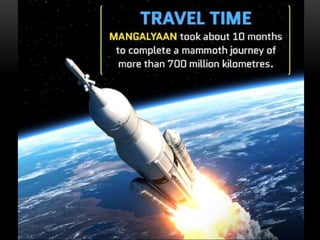
• The Mars Orbiter Mission probe lifted-off from the First Launch Pad at Satish
Dhawan Space Centre SHAR, Sriharikota, Andhra Pradesh, using a Polar Satellite
Launch Vehicle (PSLV) rocket C25 at 09:08 UTC (2:38 PM IST) on 5 November
2013. The launch window was approximately 20 days long and started on 28 October
2013. The MOM probe spent about a month in Earth orbit, where it made a series of
seven altitude-raising orbital manoeuvres before trans-Mars injection on 30
November 2013 (UTC).
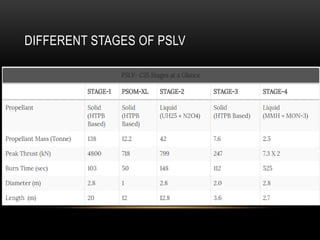
DIFFERENT STAGES OF PSLV
MISSION CONSIST OF THREE STAGES
• Stage 1: Geo Centric phase
departure hyperbolic trajectory & escapes the Sphere of
Influence(SOI) of Earth on 5th Dec,2013. “Minimum Energy Transfer
Orbit”
• Stage 2:Hello centric phase
The Spacecraft leaves in a direction tangential to Earth Orbit &
encountered Mars tangentially to its orbit.
• Stage 3:Martian phase
The spacecraft is scheduled to arrive at the Mars Sphere of
Influence(around 573473 km from the surface of Mars) in a hyperbolic
trajectory on 22th Sep,2014
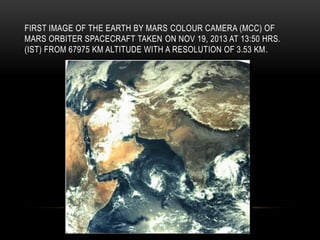
FIRST IMAGE OF THE EARTH BY MARS COLOUR CAMERA (MCC) OF
MARS ORBITER SPACECRAFT TAKEN ON NOV 19, 2013 AT 13:50 HRS.
(IST) FROM 67975 KM ALTITUDE WITH A RESOLUTION OF 3.53 KM.
TELEMETRY AND COMMAND
• ISRO Telemetry Tracking and Command Network (ISTRAC) will be providing
support of the TTC ground stations, communications network between ground
stations and control center.
• The ground segment systems form an integrated system supporting both
launch phase, and orbital phase of the mission.
LAUNCH PHASE
• The launch vehicle is tracked during its flight from lift-off till spacecraft
separation by a network of ground stations
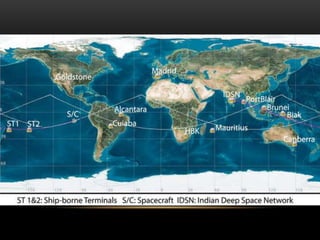
• The ground stations at Sriharikota, Port Blair, Brunei provide continuous
tracking of the PSLV-C25 from liftoff till burnout of third stage of PSLV-C25.
• Two ships carrying Ship Borne Terminals (SBT) are being deployed at
suitable locations in the South Pacific Ocean, to support the tracking of the
launch vehicle from PS4 ignition till spacecraft separation.
CONTROL PHASE
• After satellite separation from the launch vehicle, the Spacecraft operations
are controlled from the Spacecraft Control Centre in Bangalore.
• To ensure the required coverage for carrying out the mission operations, the
ground stations of ISTRAC at Bangalore, Mauritius, Brunei, and Biak are
being supplemented by Alcantara and Cuiaba TTC stations of INPE, Brazil,
Hartebeestoek TTC station of SANSA and the DSN network of JPL, NASA.
BUDGET OF MOM
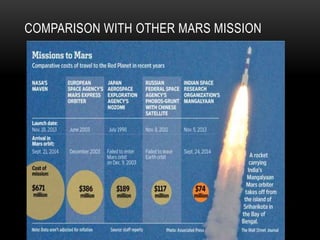
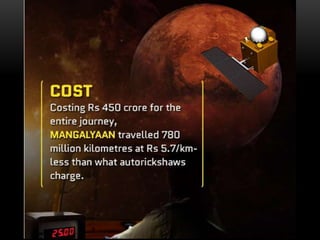
• The total cost of project is 450crores Rupees or 74million
dollars.
• It is one of the cheapest mission for mars.
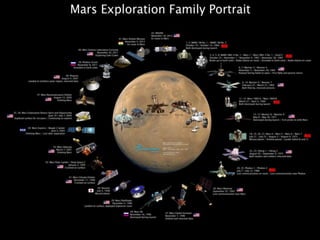
COMPARISON WITH OTHER MARS MISSION
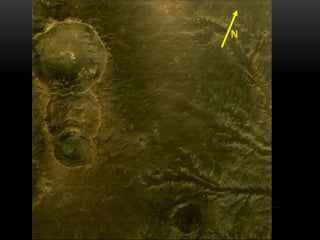
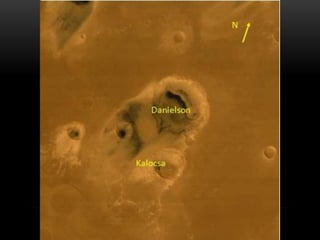
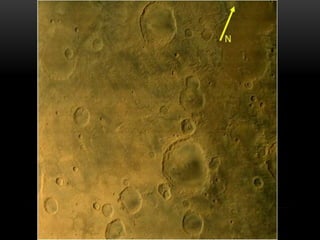
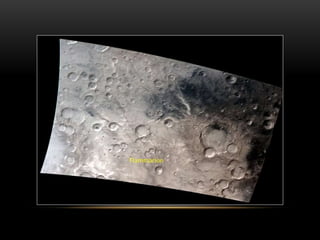
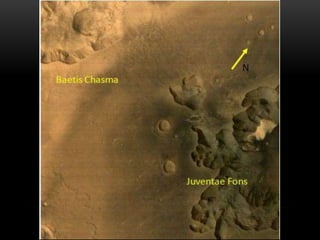
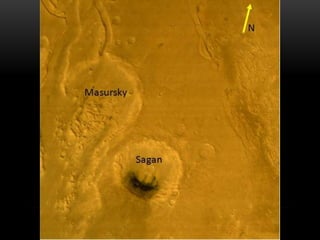
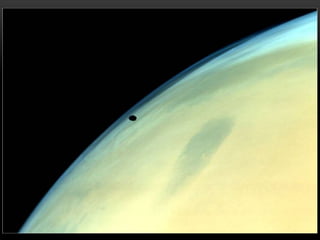
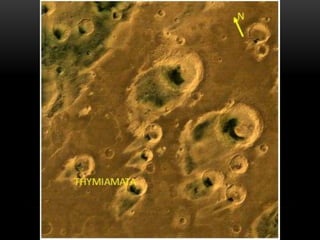
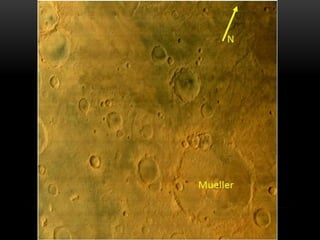
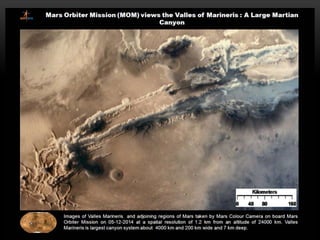
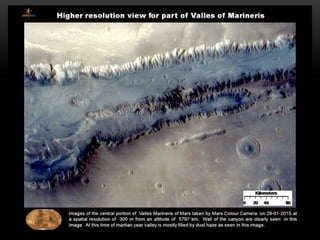
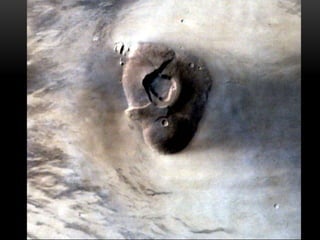
BREATHTAKING PICTURES OF MARS FROM MMC
ADVANTAGES
THANK YOU

Mars orbiter mission (Mangalyaan)

  • 1.
    By Prof. Amit Raikar A.G. Patil Institute of Technology, Solapur MARS ORBITER MISSION (MANGALYAAN)
  • 2.
    CONCEPT • To Analyzeand Explore Red Planet.
  • 3.
    MISSION OBJECTIVE • Themain objectives are to develop the technologies required for designing, planning, management and operations of an interplanetary mission. Primary Objective • Orbit manoeuvres to transfer the spacecraft • Navigation in all phases • Maintain the spacecraft in all phases of the mission • Meeting power, communications, thermal and payload operation requirements • Incorporate autonomous features Scientific Objective • Exploration of Mars surface • Study the constituents of methane in the Martian atmosphere • Study the upper atmosphere of Mars.
  • 4.
    WHAT IS MANGALYAANIS ACTUALLY GOING TO DO??? • To find Methane in atmosphere • To study morphology, topography and mineralogy • To observe dynamic changes in the atmosphere, effects of solar wind and radiation
  • 5.
    DESCRIPTION ON MANGALYAAN •Name: Mangalyaan • Mission type: Mars Orbiter • Operator: ISRO • Mission duration: • Planned: 6 months • Elapsed: 2 years, 9 months, 24 days • Launch date: 5/11/2013 09:08UTC • Launch vehicle: PSLV-XL-C25 • Orbital Insertion: 24/09/2014 02:00UTC • Perigee: 421.7 km • Apogee: 76993.6 km • Inclination 150.0º
  • 6.
    • 1. K.Radhakrishan – Chairman, ISRO • 2. A. S. Kiran Kumar – Director, SAC • 3. Mylswamy Annadurai – Programme Director, MOM • 4. B. S. Chandrashekar – Director, ISTRAC • 5. P. Robert – Operations Director, MOM • 6. Subbiah Arunan – Project Director, MOM • 7. V. Kesavaraju – Post-Launch Mission Director, MOM • 8. P. Ekambaram – Operations Director, MOM • 9. P. Kunhikrishnan – Launch Mission Director, PSLV-XL • 10. S. K. Shivkumar – Orbiting payload Director, ISAC • 11. B. Jayakumar – Launch Vehicle Director, PSLV TEAM MEMBER
  • 7.
    SPACECRAFT DESIGN • Lift-offmass: 1,337.2kg, including 852kg of propellant. • Bus: Constructed of an aluminium and composite fibre reinforced plastic (CFRP) sandwich construction. • Power: power generated by three solar panels of 1.8m x 1.4m (7.56𝑚2 ) for a maximum of 840 watts in mars orbit. • Propulsion: Liquid fuel engine with a thrust of 440 newton's is used for orbit raising and insertion into mars orbit. Eight 22 newton thrusters for altitude control.
  • 8.
  • 10.
  • 11.
    PAYLOAD Scientific instruments LAP Lyman-AlphaPhotometer 1.97 kg (4.3 lb) MSM Methane Sensor for Mars 2.94 kg (6.5 lb) MENCA Mars Exospheric Neutral Composition Analyser 3.56 kg (7.8 lb) TIS Thermal Infrared Imaging Spectrometer 3.20 kg (7.1 lb) MCC Mars Colour Camera 1.27 kg (2.8 lb)
  • 13.
    • The LymanAlpha Photometer (LAP) will measure the ratio of deuterium to hydrogen, which will help to explain how Mars has lost its water over time.
  • 14.
    Methane Sensor forMars • The Methane Sensor for Mars (MSM) is intended to help answer one of the biggest mysteries about the red planet.
  • 15.
    • The MarsExospheric Neutral Composition Analyzer (MENCA) is a mass spectrometer, which can identify chemical compounds in the planet's outer atmosphere.
  • 16.
    • The ThermalInfrared Imaging Spectrometer (TIS) will measure the temperature and emissivity of the planet's surface as it varies from day to night, making it possible to identify minerals and soil types.
  • 17.
    • The MarsColor Camera (MCC) will provide high-quality images of the planet, as well as its moons, Phobos and Deimos.
  • 18.
    MARS ORBITER MISSIONSPACECRAFT BEING PREPARED FOR A PRELAUNCH TEST AT SATISH DHAWAN SPACE CENTRE SHAR, SRIHAIRKOTA.
  • 19.
    LOADING SPACECRAFT FORTHERMOVACUUM TEST IN LARGE SPACE SIMULATION CHAMBER
  • 21.
  • 23.
    CONTROL STATION OFMANGALYAAN, BANGALURU • The spacecraft is being currently monitored from the Spacecraft Control Centre at ISRO Telemetry, Tracking and Command Network (ISTRAC) in Bangalore with support from Indian Deep Space Network (IDSN) antennae at Byalalu.
  • 24.
    PSLV DURING IT’SLAUNCH • The Mars Orbiter Mission probe lifted-off from the First Launch Pad at Satish Dhawan Space Centre SHAR, Sriharikota, Andhra Pradesh, using a Polar Satellite Launch Vehicle (PSLV) rocket C25 at 09:08 UTC (2:38 PM IST) on 5 November 2013. The launch window was approximately 20 days long and started on 28 October 2013. The MOM probe spent about a month in Earth orbit, where it made a series of seven altitude-raising orbital manoeuvres before trans-Mars injection on 30 November 2013 (UTC).
  • 25.
  • 26.
    MISSION CONSIST OFTHREE STAGES • Stage 1: Geo Centric phase departure hyperbolic trajectory & escapes the Sphere of Influence(SOI) of Earth on 5th Dec,2013. “Minimum Energy Transfer Orbit” • Stage 2:Hello centric phase The Spacecraft leaves in a direction tangential to Earth Orbit & encountered Mars tangentially to its orbit. • Stage 3:Martian phase The spacecraft is scheduled to arrive at the Mars Sphere of Influence(around 573473 km from the surface of Mars) in a hyperbolic trajectory on 22th Sep,2014
  • 27.
    FIRST IMAGE OFTHE EARTH BY MARS COLOUR CAMERA (MCC) OF MARS ORBITER SPACECRAFT TAKEN ON NOV 19, 2013 AT 13:50 HRS. (IST) FROM 67975 KM ALTITUDE WITH A RESOLUTION OF 3.53 KM.
  • 28.
    TELEMETRY AND COMMAND •ISRO Telemetry Tracking and Command Network (ISTRAC) will be providing support of the TTC ground stations, communications network between ground stations and control center. • The ground segment systems form an integrated system supporting both launch phase, and orbital phase of the mission.
  • 30.
    LAUNCH PHASE • Thelaunch vehicle is tracked during its flight from lift-off till spacecraft separation by a network of ground stations • The ground stations at Sriharikota, Port Blair, Brunei provide continuous tracking of the PSLV-C25 from liftoff till burnout of third stage of PSLV-C25. • Two ships carrying Ship Borne Terminals (SBT) are being deployed at suitable locations in the South Pacific Ocean, to support the tracking of the launch vehicle from PS4 ignition till spacecraft separation.
  • 31.
    CONTROL PHASE • Aftersatellite separation from the launch vehicle, the Spacecraft operations are controlled from the Spacecraft Control Centre in Bangalore. • To ensure the required coverage for carrying out the mission operations, the ground stations of ISTRAC at Bangalore, Mauritius, Brunei, and Biak are being supplemented by Alcantara and Cuiaba TTC stations of INPE, Brazil, Hartebeestoek TTC station of SANSA and the DSN network of JPL, NASA.
  • 33.
    BUDGET OF MOM •The total cost of project is 450crores Rupees or 74million dollars. • It is one of the cheapest mission for mars.
  • 34.
  • 36.
  • 52.
  • 60.