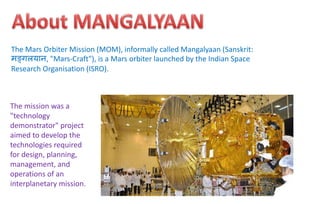
The Mars Orbiter Mission (MOM), informally called Mangalyaan (Sanskrit:
मङ्गलयान, "Mars-Craft"), is a Mars orbiter launched by the Indian Space
Research Organisation (ISRO).
The mission was a
"technology
demonstrator" project
aimed to develop the
technologies required
for design, planning,
management, and
operations of an
interplanetary mission.
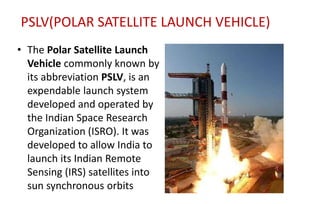
PSLV(POLAR SATELLITE LAUNCH VEHICLE)
• The Polar Satellite Launch
Vehicle commonly known by
its abbreviation PSLV, is an
expendable launch system
developed and operated by
the Indian Space Research
Organization (ISRO). It was
developed to allow India to
launch its Indian Remote
Sensing (IRS) satellites into
sun synchronous orbits
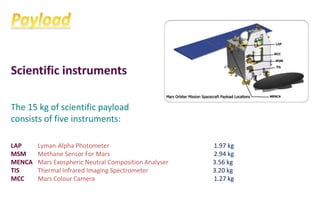
LAP Lyman-Alpha Photometer 1.97 kg
MSM Methane Sensor For Mars 2.94 kg
MENCA Mars Exospheric Neutral Composition Analyser 3.56 kg
TIS Thermal Infrared Imaging Spectrometer 3.20 kg
MCC Mars Colour Camera 1.27 kg
The 15 kg of scientific payload
consists of five instruments:
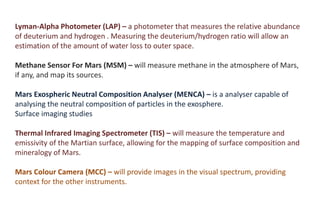
Lyman-Alpha Photometer (LAP) – a photometer that measures the relative abundance
of deuterium and hydrogen . Measuring the deuterium/hydrogen ratio will allow an
estimation of the amount of water loss to outer space.
Methane Sensor For Mars (MSM) – will measure methane in the atmosphere of Mars,
if any, and map its sources.
Mars Exospheric Neutral Composition Analyser (MENCA) – is a analyser capable of
analysing the neutral composition of particles in the exosphere.
Surface imaging studies
Thermal Infrared Imaging Spectrometer (TIS) – will measure the temperature and
emissivity of the Martian surface, allowing for the mapping of surface composition and
mineralogy of Mars.
Mars Colour Camera (MCC) – will provide images in the visual spectrum, providing
context for the other instruments.
LAUNCH AND ORBIT
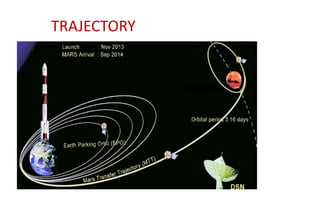
• launch will place from sriharikota and the Mars
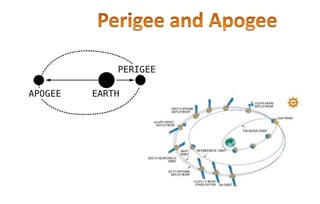
Orbiter will be placed into Earth orbit, then six engine
firings will raise that orbit to one with an apogee of
215,000 km and a perigee of 600 km, where it will
remain for about 25 days.
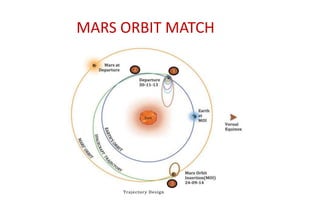
• A final firing in 30 November 2013 will send MOM
onto an interplanetary trajectory.
• Mars orbit insertion is planned for 21 September
2014 and would allow the spacecraft to enter a highly
elliptical orbit of 372 km x 80,000 km around Mars.
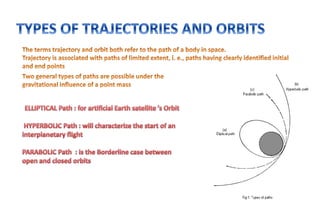
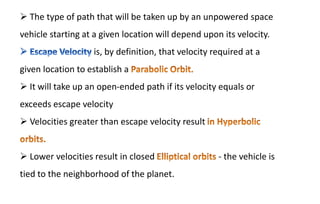
 The type of path that will be taken up by an unpowered space
vehicle starting at a given location will depend upon its velocity.
is, by definition, that velocity required at a
given location to establish a
 It will take up an open-ended path if its velocity equals or
exceeds escape velocity
 Velocities greater than escape velocity result
 Lower velocities result in closed - the vehicle is
tied to the neighborhood of the planet.
MARS ORBIT MATCH
TRAJECTORY

M.O.M

  • 4.
    The Mars OrbiterMission (MOM), informally called Mangalyaan (Sanskrit: मङ्गलयान, "Mars-Craft"), is a Mars orbiter launched by the Indian Space Research Organisation (ISRO). The mission was a "technology demonstrator" project aimed to develop the technologies required for design, planning, management, and operations of an interplanetary mission.
  • 5.
    PSLV(POLAR SATELLITE LAUNCHVEHICLE) • The Polar Satellite Launch Vehicle commonly known by its abbreviation PSLV, is an expendable launch system developed and operated by the Indian Space Research Organization (ISRO). It was developed to allow India to launch its Indian Remote Sensing (IRS) satellites into sun synchronous orbits
  • 6.
    LAP Lyman-Alpha Photometer1.97 kg MSM Methane Sensor For Mars 2.94 kg MENCA Mars Exospheric Neutral Composition Analyser 3.56 kg TIS Thermal Infrared Imaging Spectrometer 3.20 kg MCC Mars Colour Camera 1.27 kg The 15 kg of scientific payload consists of five instruments:
  • 7.
    Lyman-Alpha Photometer (LAP)– a photometer that measures the relative abundance of deuterium and hydrogen . Measuring the deuterium/hydrogen ratio will allow an estimation of the amount of water loss to outer space. Methane Sensor For Mars (MSM) – will measure methane in the atmosphere of Mars, if any, and map its sources. Mars Exospheric Neutral Composition Analyser (MENCA) – is a analyser capable of analysing the neutral composition of particles in the exosphere. Surface imaging studies Thermal Infrared Imaging Spectrometer (TIS) – will measure the temperature and emissivity of the Martian surface, allowing for the mapping of surface composition and mineralogy of Mars. Mars Colour Camera (MCC) – will provide images in the visual spectrum, providing context for the other instruments.
  • 8.
    LAUNCH AND ORBIT •launch will place from sriharikota and the Mars Orbiter will be placed into Earth orbit, then six engine firings will raise that orbit to one with an apogee of 215,000 km and a perigee of 600 km, where it will remain for about 25 days. • A final firing in 30 November 2013 will send MOM onto an interplanetary trajectory. • Mars orbit insertion is planned for 21 September 2014 and would allow the spacecraft to enter a highly elliptical orbit of 372 km x 80,000 km around Mars.
  • 10.
     The typeof path that will be taken up by an unpowered space vehicle starting at a given location will depend upon its velocity. is, by definition, that velocity required at a given location to establish a  It will take up an open-ended path if its velocity equals or exceeds escape velocity  Velocities greater than escape velocity result  Lower velocities result in closed - the vehicle is tied to the neighborhood of the planet.
  • 12.
  • 13.