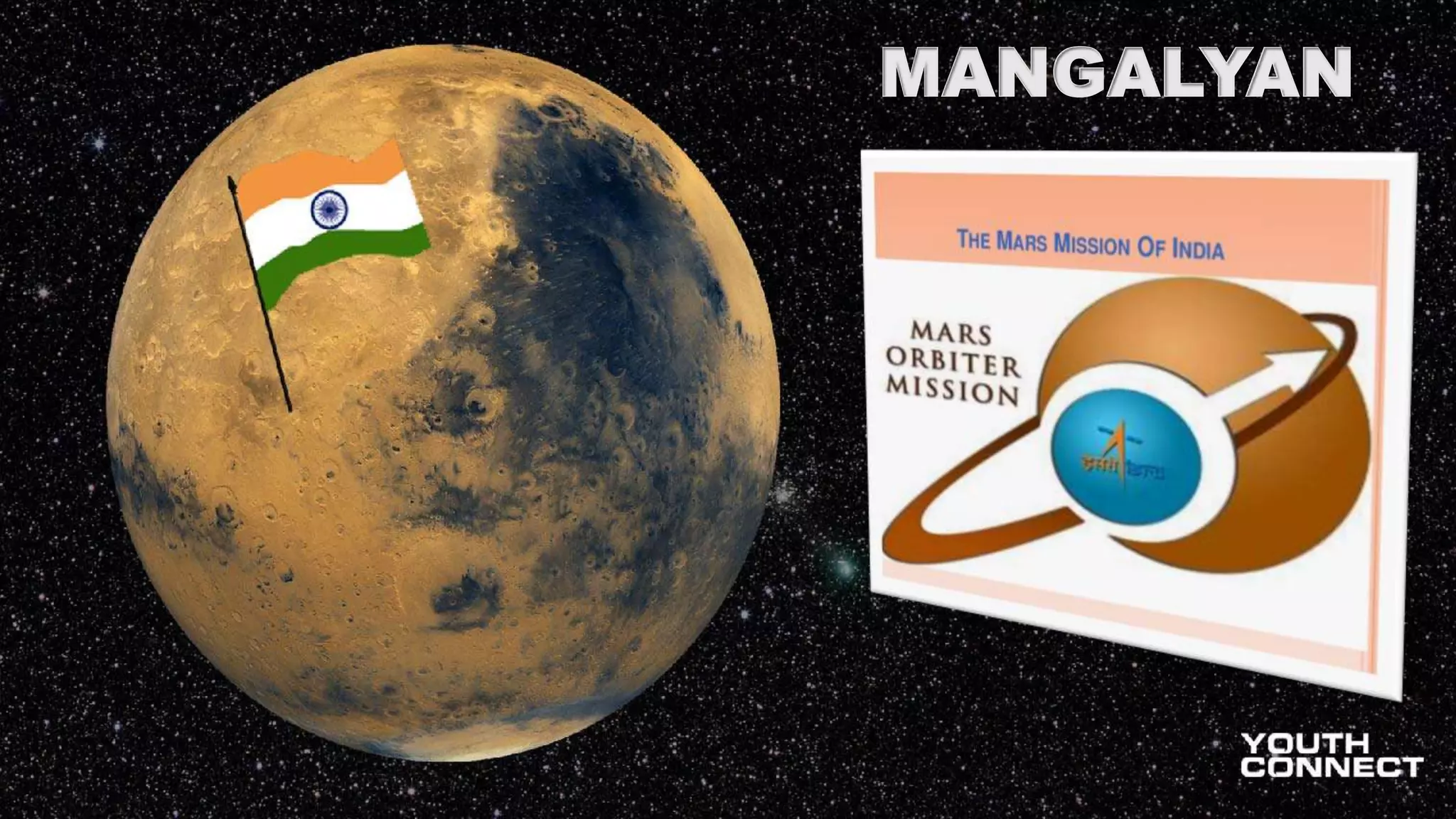
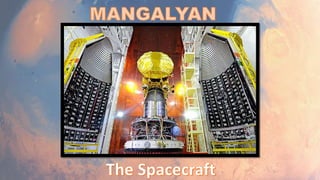
MANGALYAN
• The Mars Orbiter Mission (MOM), informally
called Mangalyaan is a Mars orbiter launched into
Earth orbit on 5 November 2013 by the Indian
Space Research Organisation (ISRO).
• It entered into mars orbit on 24 September 2014.
• The mission is a "technology demonstrator"
project aiming to develop the technologies
required for design, planning, management, and
operations of an interplanetary mission
• Following are the major objectives of the mission:
Technological Objectives:
• Design and realisation of a Mars orbiter with a capability to survive and perform
Earth bound manoeuvres, cruise phase of 300 days, Mars orbit insertion / capture, and
on-orbit phase around Mars.
1.Deep space communication, navigation, mission planning and management.
2.Incorporate autonomous features to handle contingency situations.
Scientific Objectives:
Exploration of Mars surface features, mineralogy and Martian atmosphere by
indigenous scientific instruments
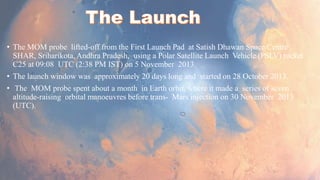
• The MOM probe lifted-off from the First Launch Pad at Satish Dhawan Space Centre
SHAR, Sriharikota, Andhra Pradesh, using a Polar Satellite Launch Vehicle (PSLV) rocket
C25 at 09:08 UTC (2:38 PM IST) on 5 November 2013.
• The launch window was approximately 20 days long and started on 28 October 2013.
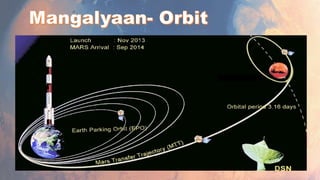
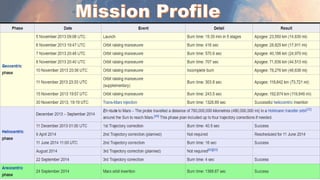
• The MOM probe spent about a month in Earth orbit, where it made a series of seven
altitude-raising orbital manoeuvres before trans- Mars injection on 30 November 2013
(UTC).
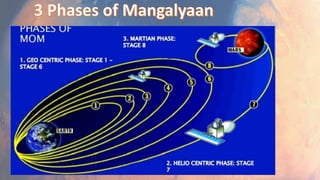
1.Geo Centric Phase
The spacecraft is injected into an Elliptic Parking Orbit by the launcher. With
six main engine burns, the spacecraft is gradually maneuvered into a
departure hyperbolic trajectory with which it escapes from the Earth’s
Sphere of Influence (SOI) with Earth’s orbital velocity .
The SOI of earth ends at 918347 km from the surface of the earth beyond
which the perturbing force on the orbiter is mainly due to the Sun.
One primary concern is how to get the spacecraft to Mars, on the least
amount of fuel. ISRO uses a method of travel called a Hohmann Transfer
Orbit – or a Minimum Energy Transfer Orbit – to send a spacecraft from
Earth to Mars with the least amount of fuel possible.
2.Helio Centric Phase
• The spacecraft leaves Earth in a direction tangential to Earth’s orbit and encounters Mars
tangentially to its orbit. The flight path is roughly one half of an ellipse around sun. Eventually
it will intersect the orbit of Mars at the exact moment when Mars is there too. This trajectory
becomes possible with certain allowances when the relative position of Earth, Mars and Sun
form an angle of approximately 44o. Such an arrangement recur periodically at intervals of
about 780 days. Minimum energy opportunities for Earth-Mars occur in November 2013,
January 2016, May2018 etc.
3.Martian Phase
• The spacecraft arrives at the Mars Sphere of Influence (around 573473 km from the surface
of Mars) in a hyperbolic trajectory. At the time the spacecraft reaches the closest approach to
Mars , it is captured into planned orbit around mars by imparting ∆V retro which is called the
Mars Orbit Insertion (MOI) manoeuvre.
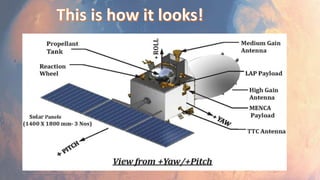
• Mass: The lift-off mass was 1,350 kg (2,980 lb), including 852 kg (1,878 lb)
of propellant mass.
• Dimension: Cuboid in shape of approximately 1.5 m (4 feet 11 inches
• Bus: The spacecraft's bus is a modified I-1 K structure and propulsion
hardware configurations similar to Chandrayaan 1, India's lunar orbiter with
specific improvements and upgrades needed for a Mars mission. The satellite
structure is of aluminium and composite fibre reinforced plastic (CFRP)
sandwich construction.
• Power: Electric power is generated by three solar array panels of 1.8 m × 1.4
m (5 ft. 11 in× 4 ft. 7 in) each for a maximum of 840 W generation in Martian
orbit. Electricity is stored in a 36 Ah Li-ion battery.
• Propulsion: Liquid fuel engine of 440 N thrust is used for orbit raising and
insertion in Martian orbit. The orbiter also has eight 22 N thrusters for attitude
control or orientation
Communication:
• Two 230 W TWTAs and two coherent transponders.
• The antenna array consists of a low-gain antenna, a medium-gain antenna and a
high-gain antenna. The High- gain antenna system is based on a single 2.2-metre
reflector illuminated by a feed at S-band.
• Telemetry and Command:
• The ISRO Telemetry, Tracking and Command Network performed navigation and
tracking operations for the launch with ground stations at Sriharikota, Port
Blair, Brunei and Biak in Indonesia, and after the spacecraft's apogee became
more than 100,000 km, an 18 m (59 ft) and a 32 m (105 ft) diameter antenna of
the Indian Deep Space Network were utilised.
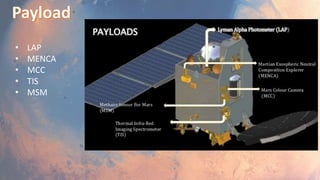
• LAP
• MENCA
• MCC
• TIS
• MSM
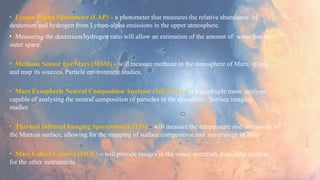
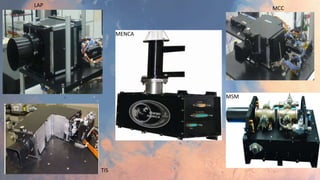
• Lyman-Alpha Photometer (LAP) – a photometer that measures the relative abundance of
deuterium and hydrogen from Lyman-alpha emissions in the upper atmosphere.
• Measuring the deuterium/hydrogen ratio will allow an estimation of the amount of water loss to
outer space.
• Methane Sensor For Mars (MSM) – will measure methane in the atmosphere of Mars, if any,
and map its sources. Particle environment studies.
• Mars Exospheric Neutral Composition Analyser (MENCA) – is a quadruple mass analyser
capable of analysing the neutral composition of particles in the exosphere. Surface imaging
studies
• Thermal Infrared Imaging Spectrometer (TIS) – will measure the temperature and emissivity of
the Martian surface, allowing for the mapping of surface composition and mineralogy of Mars.
• Mars Colour Camera (MCC) – will provide images in the visual spectrum, providing context
for the other instruments.
LAP
MSM
MENCA
TIS
MCC
MCC
TIS
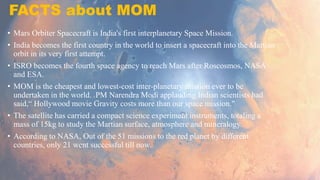
FACTS about MOM
• Mars Orbiter Spacecraft is India's first interplanetary Space Mission.
• India becomes the first country in the world to insert a spacecraft into the Martian
orbit in its very first attempt.
• ISRO becomes the fourth space agency to reach Mars after Roscosmos, NASA
and ESA.
• MOM is the cheapest and lowest-cost inter-planetary mission ever to be
undertaken in the world. PM Narendra Modi applauding Indian scientists had
said,“ Hollywood movie Gravity costs more than our space mission."
• The satellite has carried a compact science experiment instruments, totaling a
mass of 15kg to study the Martian surface, atmosphere and mineralogy.
• According to NASA, Out of the 51 missions to the red planet by different
countries, only 21 went successful till now.
Mom

Mom

  • 1.
  • 3.
    • The MarsOrbiter Mission (MOM), informally called Mangalyaan is a Mars orbiter launched into Earth orbit on 5 November 2013 by the Indian Space Research Organisation (ISRO). • It entered into mars orbit on 24 September 2014. • The mission is a "technology demonstrator" project aiming to develop the technologies required for design, planning, management, and operations of an interplanetary mission
  • 4.
    • Following arethe major objectives of the mission: Technological Objectives: • Design and realisation of a Mars orbiter with a capability to survive and perform Earth bound manoeuvres, cruise phase of 300 days, Mars orbit insertion / capture, and on-orbit phase around Mars. 1.Deep space communication, navigation, mission planning and management. 2.Incorporate autonomous features to handle contingency situations. Scientific Objectives: Exploration of Mars surface features, mineralogy and Martian atmosphere by indigenous scientific instruments
  • 5.
    • The MOMprobe lifted-off from the First Launch Pad at Satish Dhawan Space Centre SHAR, Sriharikota, Andhra Pradesh, using a Polar Satellite Launch Vehicle (PSLV) rocket C25 at 09:08 UTC (2:38 PM IST) on 5 November 2013. • The launch window was approximately 20 days long and started on 28 October 2013. • The MOM probe spent about a month in Earth orbit, where it made a series of seven altitude-raising orbital manoeuvres before trans- Mars injection on 30 November 2013 (UTC).
  • 9.
    1.Geo Centric Phase Thespacecraft is injected into an Elliptic Parking Orbit by the launcher. With six main engine burns, the spacecraft is gradually maneuvered into a departure hyperbolic trajectory with which it escapes from the Earth’s Sphere of Influence (SOI) with Earth’s orbital velocity . The SOI of earth ends at 918347 km from the surface of the earth beyond which the perturbing force on the orbiter is mainly due to the Sun. One primary concern is how to get the spacecraft to Mars, on the least amount of fuel. ISRO uses a method of travel called a Hohmann Transfer Orbit – or a Minimum Energy Transfer Orbit – to send a spacecraft from Earth to Mars with the least amount of fuel possible.
  • 10.
    2.Helio Centric Phase •The spacecraft leaves Earth in a direction tangential to Earth’s orbit and encounters Mars tangentially to its orbit. The flight path is roughly one half of an ellipse around sun. Eventually it will intersect the orbit of Mars at the exact moment when Mars is there too. This trajectory becomes possible with certain allowances when the relative position of Earth, Mars and Sun form an angle of approximately 44o. Such an arrangement recur periodically at intervals of about 780 days. Minimum energy opportunities for Earth-Mars occur in November 2013, January 2016, May2018 etc. 3.Martian Phase • The spacecraft arrives at the Mars Sphere of Influence (around 573473 km from the surface of Mars) in a hyperbolic trajectory. At the time the spacecraft reaches the closest approach to Mars , it is captured into planned orbit around mars by imparting ∆V retro which is called the Mars Orbit Insertion (MOI) manoeuvre.
  • 11.
    • Mass: Thelift-off mass was 1,350 kg (2,980 lb), including 852 kg (1,878 lb) of propellant mass. • Dimension: Cuboid in shape of approximately 1.5 m (4 feet 11 inches • Bus: The spacecraft's bus is a modified I-1 K structure and propulsion hardware configurations similar to Chandrayaan 1, India's lunar orbiter with specific improvements and upgrades needed for a Mars mission. The satellite structure is of aluminium and composite fibre reinforced plastic (CFRP) sandwich construction. • Power: Electric power is generated by three solar array panels of 1.8 m × 1.4 m (5 ft. 11 in× 4 ft. 7 in) each for a maximum of 840 W generation in Martian orbit. Electricity is stored in a 36 Ah Li-ion battery. • Propulsion: Liquid fuel engine of 440 N thrust is used for orbit raising and insertion in Martian orbit. The orbiter also has eight 22 N thrusters for attitude control or orientation
  • 12.
    Communication: • Two 230W TWTAs and two coherent transponders. • The antenna array consists of a low-gain antenna, a medium-gain antenna and a high-gain antenna. The High- gain antenna system is based on a single 2.2-metre reflector illuminated by a feed at S-band. • Telemetry and Command: • The ISRO Telemetry, Tracking and Command Network performed navigation and tracking operations for the launch with ground stations at Sriharikota, Port Blair, Brunei and Biak in Indonesia, and after the spacecraft's apogee became more than 100,000 km, an 18 m (59 ft) and a 32 m (105 ft) diameter antenna of the Indian Deep Space Network were utilised.
  • 14.
    • LAP • MENCA •MCC • TIS • MSM
  • 15.
    • Lyman-Alpha Photometer(LAP) – a photometer that measures the relative abundance of deuterium and hydrogen from Lyman-alpha emissions in the upper atmosphere. • Measuring the deuterium/hydrogen ratio will allow an estimation of the amount of water loss to outer space. • Methane Sensor For Mars (MSM) – will measure methane in the atmosphere of Mars, if any, and map its sources. Particle environment studies. • Mars Exospheric Neutral Composition Analyser (MENCA) – is a quadruple mass analyser capable of analysing the neutral composition of particles in the exosphere. Surface imaging studies • Thermal Infrared Imaging Spectrometer (TIS) – will measure the temperature and emissivity of the Martian surface, allowing for the mapping of surface composition and mineralogy of Mars. • Mars Colour Camera (MCC) – will provide images in the visual spectrum, providing context for the other instruments.
  • 16.
  • 17.
    FACTS about MOM •Mars Orbiter Spacecraft is India's first interplanetary Space Mission. • India becomes the first country in the world to insert a spacecraft into the Martian orbit in its very first attempt. • ISRO becomes the fourth space agency to reach Mars after Roscosmos, NASA and ESA. • MOM is the cheapest and lowest-cost inter-planetary mission ever to be undertaken in the world. PM Narendra Modi applauding Indian scientists had said,“ Hollywood movie Gravity costs more than our space mission." • The satellite has carried a compact science experiment instruments, totaling a mass of 15kg to study the Martian surface, atmosphere and mineralogy. • According to NASA, Out of the 51 missions to the red planet by different countries, only 21 went successful till now.