AIAA SPACE 2013 Conference
By
Prasad Sundararajan
Indian Mars Orbiter (“Mangalyaan”) Mission
Indian Space Program
 Earth Observation (IRS, INSAT, IRNSS)
 Space Science & Planetary Exploration
Chandrayaan-I
 India’s first deep space mission
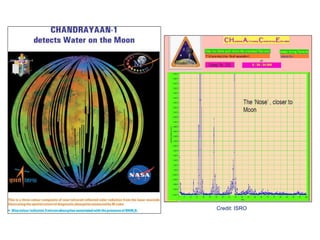
 Discoveries of the mission
Indian Mars Orbiter (“Mangalyaan”) Mission
 India’s first interplanetary mission to the Red Planet
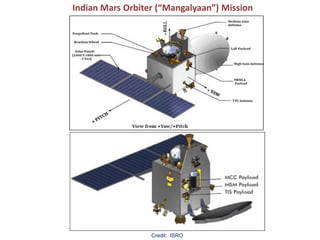
 Mars Orbiter Spacecraft
 Navigation & Communication
 Science Objectives & Payloads
Future Missions
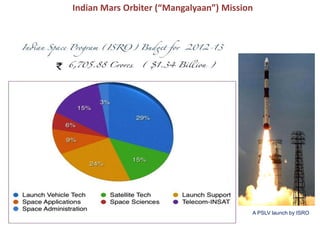
Indian Mars Orbiter (“Mangalyaan”) Mission
A PSLV launch by ISRO
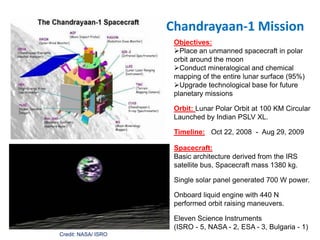
Chandrayaan-1 Mission
Objectives:
Place an unmanned spacecraft in polar
orbit around the moon
Conduct mineralogical and chemical
mapping of the entire lunar surface (95%)
Upgrade technological base for future
planetary missions
Orbit: Lunar Polar Orbit at 100 KM Circular
Launched by Indian PSLV XL.
Timeline: Oct 22, 2008 - Aug 29, 2009
Spacecraft:
Basic architecture derived from the IRS
satellite bus, Spacecraft mass 1380 kg.
Single solar panel generated 700 W power.
Onboard liquid engine with 440 N
performed orbit raising maneuvers.
Eleven Science Instruments
(ISRO - 5, NASA - 2, ESA - 3, Bulgaria - 1)
Credit: NASA/ ISRO
Credit: ISRO
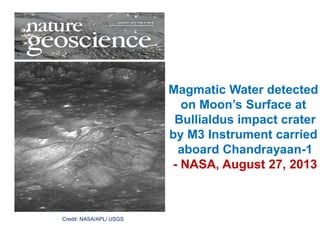
Credit: NASA/APL/ USGS
Magmatic Water detected
on Moon’s Surface at
Bullialdus impact crater
by M3 Instrument carried
aboard Chandrayaan-1
- NASA, August 27, 2013
Indian Mars Orbiter (“Mangalyaan”) Mission
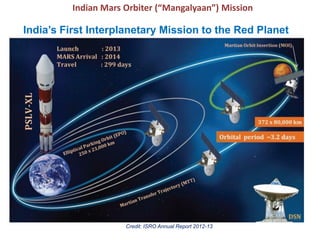
Credit: ISRO Annual Report 2012-13
India’s First Interplanetary Mission to the Red Planet
Indian Mars Orbiter (“Mangalyaan”) Mission
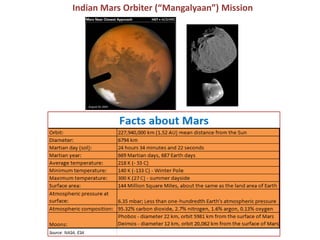
Credit: ISRO
Indian Mars Orbiter (“Mangalyaan”) Mission
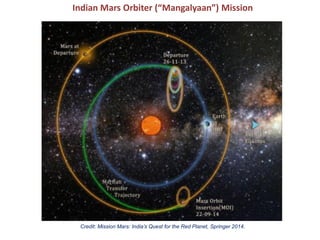
Credit: Mission Mars: India’s Quest for the Red Planet, Springer 2014.
Indian Mars Orbiter (“Mangalyaan”) Mission
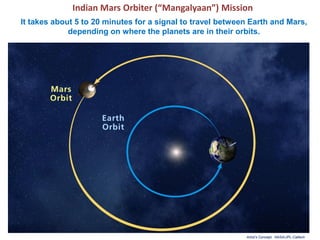
Artist’s Concept. NASA/JPL-Caltech
It takes about 5 to 20 minutes for a signal to travel between Earth and Mars,
depending on where the planets are in their orbits.
Indian Mars Orbiter (“Mangalyaan”) Mission
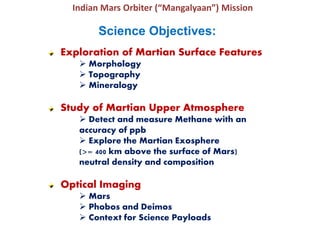
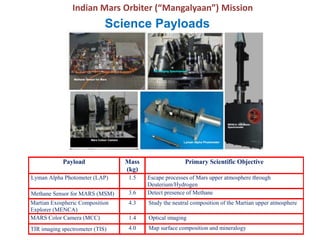
Science Objectives:
Exploration of Martian Surface Features
 Morphology
 Topography
 Mineralogy
Study of Martian Upper Atmosphere
 Detect and measure Methane with an
accuracy of ppb
 Explore the Martian Exosphere
(>= 400 km above the surface of Mars)
neutral density and composition
Optical Imaging
 Mars
 Phobos and Deimos
 Context for Science Payloads
Indian Mars Orbiter (“Mangalyaan”) Mission
Payload Mass
(kg)
Primary Scientific Objective
Lyman Alpha Photometer (LAP) 1.5 Escape processes of Mars upper atmosphere through
Deuterium/Hydrogen
Methane Sensor for MARS (MSM) 3.6 Detect presence of Methane
Martian Exospheric Composition
Explorer (MENCA)
4.3 Study the neutral composition of the Martian upper atmosphere
MARS Color Camera (MCC) 1.4 Optical imaging
TIR imaging spectrometer (TIS) 4.0 Map surface composition and mineralogy
Science Payloads
Indian Mars Orbiter (“Mangalyaan”) Mission
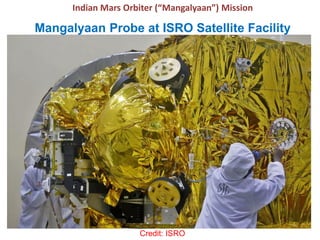
Mangalyaan Probe at ISRO Satellite Facility
Credit: ISRO

Mangalyaan - India's First Interplanetary Mission to Mars

  • 1.
    AIAA SPACE 2013Conference By Prasad Sundararajan Indian Mars Orbiter (“Mangalyaan”) Mission
  • 2.
    Indian Space Program Earth Observation (IRS, INSAT, IRNSS)  Space Science & Planetary Exploration Chandrayaan-I  India’s first deep space mission  Discoveries of the mission Indian Mars Orbiter (“Mangalyaan”) Mission  India’s first interplanetary mission to the Red Planet  Mars Orbiter Spacecraft  Navigation & Communication  Science Objectives & Payloads Future Missions Indian Mars Orbiter (“Mangalyaan”) Mission
  • 3.
    Indian Mars Orbiter(“Mangalyaan”) Mission A PSLV launch by ISRO
  • 4.
    Chandrayaan-1 Mission Objectives: Place anunmanned spacecraft in polar orbit around the moon Conduct mineralogical and chemical mapping of the entire lunar surface (95%) Upgrade technological base for future planetary missions Orbit: Lunar Polar Orbit at 100 KM Circular Launched by Indian PSLV XL. Timeline: Oct 22, 2008 - Aug 29, 2009 Spacecraft: Basic architecture derived from the IRS satellite bus, Spacecraft mass 1380 kg. Single solar panel generated 700 W power. Onboard liquid engine with 440 N performed orbit raising maneuvers. Eleven Science Instruments (ISRO - 5, NASA - 2, ESA - 3, Bulgaria - 1) Credit: NASA/ ISRO
  • 5.
  • 6.
    Credit: NASA/APL/ USGS MagmaticWater detected on Moon’s Surface at Bullialdus impact crater by M3 Instrument carried aboard Chandrayaan-1 - NASA, August 27, 2013
  • 7.
    Indian Mars Orbiter(“Mangalyaan”) Mission
  • 8.
    Indian Mars Orbiter(“Mangalyaan”) Mission Credit: ISRO Annual Report 2012-13 India’s First Interplanetary Mission to the Red Planet
  • 9.
    Indian Mars Orbiter(“Mangalyaan”) Mission Credit: ISRO
  • 10.
    Indian Mars Orbiter(“Mangalyaan”) Mission Credit: Mission Mars: India’s Quest for the Red Planet, Springer 2014.
  • 11.
    Indian Mars Orbiter(“Mangalyaan”) Mission Artist’s Concept. NASA/JPL-Caltech It takes about 5 to 20 minutes for a signal to travel between Earth and Mars, depending on where the planets are in their orbits.
  • 12.
    Indian Mars Orbiter(“Mangalyaan”) Mission Science Objectives: Exploration of Martian Surface Features  Morphology  Topography  Mineralogy Study of Martian Upper Atmosphere  Detect and measure Methane with an accuracy of ppb  Explore the Martian Exosphere (>= 400 km above the surface of Mars) neutral density and composition Optical Imaging  Mars  Phobos and Deimos  Context for Science Payloads
  • 13.
    Indian Mars Orbiter(“Mangalyaan”) Mission Payload Mass (kg) Primary Scientific Objective Lyman Alpha Photometer (LAP) 1.5 Escape processes of Mars upper atmosphere through Deuterium/Hydrogen Methane Sensor for MARS (MSM) 3.6 Detect presence of Methane Martian Exospheric Composition Explorer (MENCA) 4.3 Study the neutral composition of the Martian upper atmosphere MARS Color Camera (MCC) 1.4 Optical imaging TIR imaging spectrometer (TIS) 4.0 Map surface composition and mineralogy Science Payloads
  • 14.
    Indian Mars Orbiter(“Mangalyaan”) Mission Mangalyaan Probe at ISRO Satellite Facility Credit: ISRO