MARKET
INTEGRATION
Presented by:
SAKTHIVEL .R
2014010016
Market integration
 Integration shows the relationship of firms in a
market. The extent of integration influences the market
conduct of the firms and consequently their marketing
efficiency.
 Markets differ in the extent of integration and,
therefore, there is a variation in their degree of
efficiency.
 Market integration is a process which refers to the
expansion of firms by consolidating additional
marketing functions and activities under a single
management.
Types of market integration
There are three basic kind of market Integration:
 Horizontal Integration
 Vertical Integration
 Conglomeration
Horizontal Integration
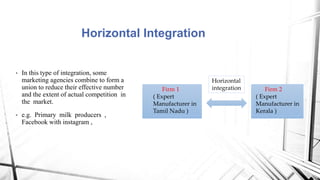
• In this type of integration, some
marketing agencies combine to form a
union to reduce their effective number
and the extent of actual competition in
the market.
• e.g. Primary milk producers ,
Facebook with instagram ,
Firm 1
( Expert
Manufacturer in
Tamil Nadu )
Firm 2
( Expert
Manufacturer in
Kerala )
Horizontal
integration
Example for horizontal integration
 One of the clearest examples of horizontal integration is
Facebook’s acquisition of Instagram in 2012 for a reported
$1 billion.
 Both Facebook and Instagram operated in the same
industry and were in similar production stages in regard to
their photo-sharing services.
 Facebook looking to strengthen its position in the social
media and social sharing space, saw the acquisition of
Instagram as an opportunity to grow its market share,
increase its product line, reduce competition and access
potential new markets.
 All of these things came to pass , resulting in a high level of
synergy
Vertical Integration
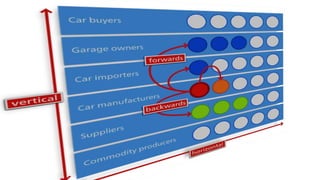
 Vertical integration occurs when a firm performs more than one activity in the
sequence of the marketing process.
 It is linking together of two or more functions in the marketing process with in a
single firm or under a single ownership.
 For e.g. if a firm assumes wholesale as well as retailing, it is a vertical
integration or rice processor under taking retailing.
1. Forward Integration : takes activities close to the consumption function
Eg. wholesaler assuming the function of retailing
2. Backward Integration : combination of sources of supply. Eg. processing firm
assumes the function of assembling/purchasing
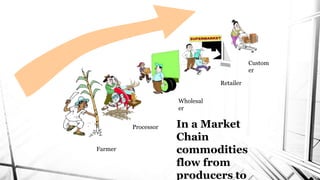
Farmer
Processor
Wholesal
er
Retailer
Custom
er
In a Market
Chain
commodities
flow from
producers to
Example for forward vertical integration company
 Canadian communications giant Rogers is an example of
forward integration.
 The company established Rogers TV, a subsidiary company
that operates local television channels.
 The Rogers TV channels show programs such as cooking and
talk shows, which are produced by Rogers-managed television
studios.
 These provide Rogers with an opportunity to advertise and sell
its digital products using an electronic version of a retail store.
Example for backward vertical integration
company
 Amazon.com backward vertically integrated when it
became not only a bookseller but a book publisher.
 As a bookseller, Amazon.com buys books from various
suppliers, such as publishing companies.
 By becoming a publisher itself, it has integrated into its
business the role of supplier and can sell books that its
own publishing company publishes.
Conglomeration
 A combination of agencies or activities not directly related to each other may
operate under a unified management.
 Eg : conglomeration are Hindustan Unilever Ltd. (processed vegetables and
soaps), Delhi Cloth and General Mills (Cloth and Vanaspati).
 What : involved in a number of different and frequently unrelated activities
 How : Most of the business firms have some degree of vertical integration,
horizontal integration and conglomerate character
 Whom : firm which buys and sells the grains is also engaged in selling of
fertilizers, insecticides and pesticides, feed
 Why : meeting the multiple needs of their customers, most of whom are
farmers spreading the risk and helps in expanding the activities to additional
markets
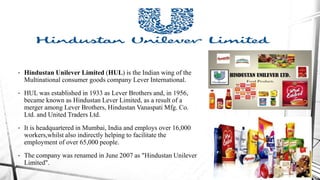
• Hindustan Unilever Limited (HUL) is the Indian wing of the
Multinational consumer goods company Lever International.
• HUL was established in 1933 as Lever Brothers and, in 1956,
became known as Hindustan Lever Limited, as a result of a
merger among Lever Brothers, Hindustan Vanaspati Mfg. Co.
Ltd. and United Traders Ltd.
• It is headquartered in Mumbai, India and employs over 16,000
workers,whilst also indirectly helping to facilitate the
employment of over 65,000 people.
• The company was renamed in June 2007 as "Hindustan Unilever
Limited".
Market integration

Market integration

  • 1.
  • 2.
    Market integration  Integrationshows the relationship of firms in a market. The extent of integration influences the market conduct of the firms and consequently their marketing efficiency.  Markets differ in the extent of integration and, therefore, there is a variation in their degree of efficiency.  Market integration is a process which refers to the expansion of firms by consolidating additional marketing functions and activities under a single management.
  • 3.
    Types of marketintegration There are three basic kind of market Integration:  Horizontal Integration  Vertical Integration  Conglomeration
  • 4.
    Horizontal Integration • Inthis type of integration, some marketing agencies combine to form a union to reduce their effective number and the extent of actual competition in the market. • e.g. Primary milk producers , Facebook with instagram , Firm 1 ( Expert Manufacturer in Tamil Nadu ) Firm 2 ( Expert Manufacturer in Kerala ) Horizontal integration
  • 5.
    Example for horizontalintegration  One of the clearest examples of horizontal integration is Facebook’s acquisition of Instagram in 2012 for a reported $1 billion.  Both Facebook and Instagram operated in the same industry and were in similar production stages in regard to their photo-sharing services.  Facebook looking to strengthen its position in the social media and social sharing space, saw the acquisition of Instagram as an opportunity to grow its market share, increase its product line, reduce competition and access potential new markets.  All of these things came to pass , resulting in a high level of synergy
  • 6.
    Vertical Integration  Verticalintegration occurs when a firm performs more than one activity in the sequence of the marketing process.  It is linking together of two or more functions in the marketing process with in a single firm or under a single ownership.  For e.g. if a firm assumes wholesale as well as retailing, it is a vertical integration or rice processor under taking retailing. 1. Forward Integration : takes activities close to the consumption function Eg. wholesaler assuming the function of retailing 2. Backward Integration : combination of sources of supply. Eg. processing firm assumes the function of assembling/purchasing
  • 7.
  • 9.
    Example for forwardvertical integration company  Canadian communications giant Rogers is an example of forward integration.  The company established Rogers TV, a subsidiary company that operates local television channels.  The Rogers TV channels show programs such as cooking and talk shows, which are produced by Rogers-managed television studios.  These provide Rogers with an opportunity to advertise and sell its digital products using an electronic version of a retail store.
  • 10.
    Example for backwardvertical integration company  Amazon.com backward vertically integrated when it became not only a bookseller but a book publisher.  As a bookseller, Amazon.com buys books from various suppliers, such as publishing companies.  By becoming a publisher itself, it has integrated into its business the role of supplier and can sell books that its own publishing company publishes.
  • 11.
    Conglomeration  A combinationof agencies or activities not directly related to each other may operate under a unified management.  Eg : conglomeration are Hindustan Unilever Ltd. (processed vegetables and soaps), Delhi Cloth and General Mills (Cloth and Vanaspati).  What : involved in a number of different and frequently unrelated activities  How : Most of the business firms have some degree of vertical integration, horizontal integration and conglomerate character  Whom : firm which buys and sells the grains is also engaged in selling of fertilizers, insecticides and pesticides, feed  Why : meeting the multiple needs of their customers, most of whom are farmers spreading the risk and helps in expanding the activities to additional markets
  • 12.
    • Hindustan UnileverLimited (HUL) is the Indian wing of the Multinational consumer goods company Lever International. • HUL was established in 1933 as Lever Brothers and, in 1956, became known as Hindustan Lever Limited, as a result of a merger among Lever Brothers, Hindustan Vanaspati Mfg. Co. Ltd. and United Traders Ltd. • It is headquartered in Mumbai, India and employs over 16,000 workers,whilst also indirectly helping to facilitate the employment of over 65,000 people. • The company was renamed in June 2007 as "Hindustan Unilever Limited".