Elements of Market Structure
 Diversification:
If a firm produces different product which is not substitute for the existing
product is called diversification
Diversification may be(Penrose)
1. Technological Base
2. Market Areas
3. Productive activities.
Process of Diversification
 Output expansion without change in technological change and market base.
 Output expansion with change in technological change and without change
market base.
 Output expansion without change in technological change and change in market
base.
 Output expansion with change in both technology and market base.
Forms of Diversification Strategy
 New product or product line
 New market for new opportunities, boost profits, increase sales revenue and
expand market share.
 New Technology/Production Process
 New Ideas/ Innovation
Diversification Strategy( Product/ Market Expansion)
1. Market Penetration- a company tries to increase an existing product's share in an
existing market.
2. Market Development- a company introduces an existing product in a new market.
3. Product Development-companies introduce new products in an existing market
4. Product Diversification- companies introduce new products to new markets.
Types of Diversification Strategies
 Concentric diversification -This method introduces closely related products to the
existing market. Similar products are added to the current product line.( Eg: Fuel
vehicle shifted to Electric vehicle)
 Horizontal diversification-Introducing new but unrelated offerings to the company's
product mix (Complementary goods- Eg:-Kalyan-Jewelleries and Textiles)
 Conglomerate diversification-A business focuses on a completely different product
line in this strategy( Disney Products-Movies, Live shows, Parks, Merchandise
products, Toys etc.)
 Lateral Diversification:
When a firm produces different goods which diverge from the
same process or source in terms of materials for the same process
or market; ie by-products form.
Leather tanning firm have lateral diversification when it
produces boots, shoes, garments etc.
 Vertical Diversification:
The process of manufacturing or distribution which
procedes or succeeds those in which the firm is already
engaged.
It may be backward Integration and Forward Integration
 Backward Integration is seen where firms starts
manufacturing products previously purchased from others
inorder to use them in making its original product line.
Eg: A milk product company have its own dairy farm.
 Forward Integration occurs when a firms move to the final market
for its product and carries out a function which was previously
undertaken by its customers.
Eg: A flour mill may start making its own bakeries.
 Diagonal Diversification: Provision within same organization
of auxilliary goods and services required for the several main
processes or lines of production of the organization.
Eg: Firms may have its own power house to generate electricity or
machine tool making units- things are required for running almost every
processing activity.
Motives for Diversification
1. Production Expansion.
2. Market Expansion
3.Better utilization of resources.
4. Market Complementarity.
5. Reduce Competition
6. Maintain rate of growth.
7. Security to the firm
8. Efficiency of the firm.
9. Economies in marketing
10. Eliminating middlemen
11. Cost advantage.
12. Profitability.
13. Stability
14. Market power.
Integration
• The process where business combine to enhance their competitiveness,
efficiency or market share.
• It is a form of diversification or merging.
Types of Integration
Horizontal integration: Acquiring a company that does related business on a
similar supply chain level.(Eg: Oil Companies Merging-Oil and Natural Gas
Corporation with Indian Oil Corporation, Bharat Petroleum Corporation and
HPCL)
Vertical integration: Acquiring a company in the same industry but at an
earlier stage of production.(Integration among intermediate products-
Multiple stages of supply chain; Eg: Apple, Amazon and Tesla etc.)
Forward integration: Expanding into new areas related to supply,
distribution, or competition.
Backward integration: Acquiring a supplier of the existing business.
Conglomeration: Combining businesses in unrelated industries.
Benefits of Integration
Reduced competition
Expanded customer base
Cost reduction
Increased market share
Revenue growth
Improved efficiencies
Greater product and service differentiation
Access to new markets
Increased market power
 Merging & Acquisition
• Merging implies a process in which the combination of two
businesses of about equal strength takesplace( Eg:Vodafone and Idea)
• In acquisition,the purchase of one company by another—typically a
bigger one buying a smaller one.(Tata Steel’s Acquisition of Corus-
Europ’s second largest steel company)
Stategies of M&A
 Horizontal combinations, which bring together competitors in the
same industry.
 Vertical combinations, which extend supply chains.
 Conglomerates, which involve unrelated businesses owned by a
single holding company.
Motives for Merging and Acqusition
1. Increase in profitability.
2. Stability in earnings
3. Stock market gains cosidering the difference in the earning- price ratio or market price
for their shares.
4. Valuation discrepancies when buying and selling of company’s share.
5. Efficiency motive.
6. Market power motive related to pricing and output.
7. Growth Motive.
Measurement approaches to Diversification, Integration and
Merger
 Measure of diversification:
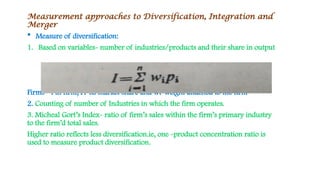
1. Based on variables- number of industries/products and their share in output
Firms- ‘i’th firm; Pi-its market share and wi-weight attached to the firm
2. Counting of number of Industries in which the firm operates.
3. Micheal Gort’s Index- ratio of firm’s sales within the firm’s primary industry
to the firm’d total sales.
Higher ratio reflects less diversification.ie, one -product concentration ratio is
used to measure product diversification.
• 4 Berry’s Index: Applied HHI of concentration to measure product
divrsification..ie, ratio of firm’s output/sales in the Ith industry to firm’s total
output in N industries.
• 5 Entrop Index: shows both inter- industry and intra- industry diversification.
• 6. Utton’s measure: based on cumulative diversification curve for the firm.
shows cumulative employment share of the firmin different industries against rank
ordering of the industries in decreasing importance starting with the primary
industry in which the firm operates.
7. Gravity Index: ( Caves, Honeycutt and Zimmerman): Takes in to account the
number of industries in which a firm operates, the quantitative importance to the
firm of each industry measured interms of output porportion of the industry and the
distance or difference between the products interms of technologicak charactoristics
or market homogeneity.
2. Measurement of Vertical Integration
1. Ratio of value-added to sales:
2. Ratio of Inventory values/ stock of product to sales.
3. Degree of dependence on inputs and output markets- Forward and
backward vertical integration.
3.Measurement of Merging
1. Count the number of mergers taking place during a year or
specified period.
2. Take the percentage of employment of acquired firms in total
employment of the concerned industry or entire manufacturing
sectoral employment, which takecare of conglomerate merger.
Thank You.

vnd.openxmlformats-officedocument.presentationml.presentation&rendition=1.pptx

  • 1.
    Elements of MarketStructure  Diversification: If a firm produces different product which is not substitute for the existing product is called diversification Diversification may be(Penrose) 1. Technological Base 2. Market Areas 3. Productive activities.
  • 2.
    Process of Diversification Output expansion without change in technological change and market base.  Output expansion with change in technological change and without change market base.  Output expansion without change in technological change and change in market base.  Output expansion with change in both technology and market base. Forms of Diversification Strategy  New product or product line  New market for new opportunities, boost profits, increase sales revenue and expand market share.  New Technology/Production Process  New Ideas/ Innovation
  • 3.
    Diversification Strategy( Product/Market Expansion) 1. Market Penetration- a company tries to increase an existing product's share in an existing market. 2. Market Development- a company introduces an existing product in a new market. 3. Product Development-companies introduce new products in an existing market 4. Product Diversification- companies introduce new products to new markets. Types of Diversification Strategies  Concentric diversification -This method introduces closely related products to the existing market. Similar products are added to the current product line.( Eg: Fuel vehicle shifted to Electric vehicle)  Horizontal diversification-Introducing new but unrelated offerings to the company's product mix (Complementary goods- Eg:-Kalyan-Jewelleries and Textiles)  Conglomerate diversification-A business focuses on a completely different product line in this strategy( Disney Products-Movies, Live shows, Parks, Merchandise products, Toys etc.)
  • 4.
     Lateral Diversification: Whena firm produces different goods which diverge from the same process or source in terms of materials for the same process or market; ie by-products form. Leather tanning firm have lateral diversification when it produces boots, shoes, garments etc.  Vertical Diversification: The process of manufacturing or distribution which procedes or succeeds those in which the firm is already engaged. It may be backward Integration and Forward Integration  Backward Integration is seen where firms starts manufacturing products previously purchased from others inorder to use them in making its original product line. Eg: A milk product company have its own dairy farm.
  • 5.
     Forward Integrationoccurs when a firms move to the final market for its product and carries out a function which was previously undertaken by its customers. Eg: A flour mill may start making its own bakeries.  Diagonal Diversification: Provision within same organization of auxilliary goods and services required for the several main processes or lines of production of the organization. Eg: Firms may have its own power house to generate electricity or machine tool making units- things are required for running almost every processing activity. Motives for Diversification 1. Production Expansion. 2. Market Expansion 3.Better utilization of resources.
  • 6.
    4. Market Complementarity. 5.Reduce Competition 6. Maintain rate of growth. 7. Security to the firm 8. Efficiency of the firm. 9. Economies in marketing 10. Eliminating middlemen 11. Cost advantage. 12. Profitability. 13. Stability 14. Market power.
  • 7.
    Integration • The processwhere business combine to enhance their competitiveness, efficiency or market share. • It is a form of diversification or merging. Types of Integration Horizontal integration: Acquiring a company that does related business on a similar supply chain level.(Eg: Oil Companies Merging-Oil and Natural Gas Corporation with Indian Oil Corporation, Bharat Petroleum Corporation and HPCL) Vertical integration: Acquiring a company in the same industry but at an earlier stage of production.(Integration among intermediate products- Multiple stages of supply chain; Eg: Apple, Amazon and Tesla etc.) Forward integration: Expanding into new areas related to supply, distribution, or competition. Backward integration: Acquiring a supplier of the existing business. Conglomeration: Combining businesses in unrelated industries.
  • 8.
    Benefits of Integration Reducedcompetition Expanded customer base Cost reduction Increased market share Revenue growth Improved efficiencies Greater product and service differentiation Access to new markets Increased market power
  • 9.
     Merging &Acquisition • Merging implies a process in which the combination of two businesses of about equal strength takesplace( Eg:Vodafone and Idea) • In acquisition,the purchase of one company by another—typically a bigger one buying a smaller one.(Tata Steel’s Acquisition of Corus- Europ’s second largest steel company) Stategies of M&A  Horizontal combinations, which bring together competitors in the same industry.  Vertical combinations, which extend supply chains.  Conglomerates, which involve unrelated businesses owned by a single holding company.
  • 10.
    Motives for Mergingand Acqusition 1. Increase in profitability. 2. Stability in earnings 3. Stock market gains cosidering the difference in the earning- price ratio or market price for their shares. 4. Valuation discrepancies when buying and selling of company’s share. 5. Efficiency motive. 6. Market power motive related to pricing and output. 7. Growth Motive.
  • 11.
    Measurement approaches toDiversification, Integration and Merger  Measure of diversification: 1. Based on variables- number of industries/products and their share in output Firms- ‘i’th firm; Pi-its market share and wi-weight attached to the firm 2. Counting of number of Industries in which the firm operates. 3. Micheal Gort’s Index- ratio of firm’s sales within the firm’s primary industry to the firm’d total sales. Higher ratio reflects less diversification.ie, one -product concentration ratio is used to measure product diversification.
  • 12.
    • 4 Berry’sIndex: Applied HHI of concentration to measure product divrsification..ie, ratio of firm’s output/sales in the Ith industry to firm’s total output in N industries. • 5 Entrop Index: shows both inter- industry and intra- industry diversification. • 6. Utton’s measure: based on cumulative diversification curve for the firm. shows cumulative employment share of the firmin different industries against rank ordering of the industries in decreasing importance starting with the primary industry in which the firm operates. 7. Gravity Index: ( Caves, Honeycutt and Zimmerman): Takes in to account the number of industries in which a firm operates, the quantitative importance to the firm of each industry measured interms of output porportion of the industry and the distance or difference between the products interms of technologicak charactoristics or market homogeneity.
  • 13.
    2. Measurement ofVertical Integration 1. Ratio of value-added to sales: 2. Ratio of Inventory values/ stock of product to sales. 3. Degree of dependence on inputs and output markets- Forward and backward vertical integration. 3.Measurement of Merging 1. Count the number of mergers taking place during a year or specified period. 2. Take the percentage of employment of acquired firms in total employment of the concerned industry or entire manufacturing sectoral employment, which takecare of conglomerate merger.
  • 14.