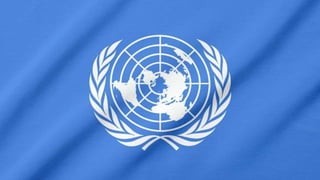
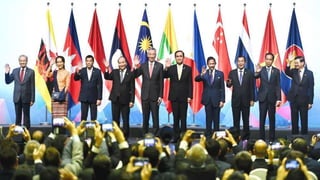
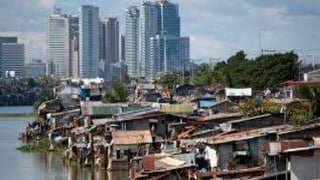
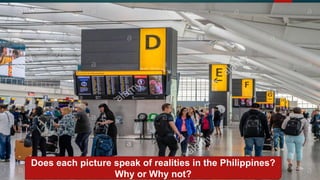
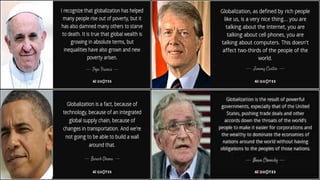
Does each picture speak of realities in the Philippines?
Why or Why not?
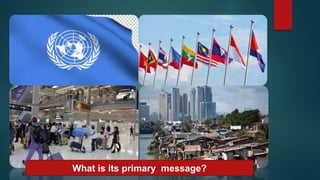
What is its primary message?
G L O B A L I Z A T I ON
GROUP ACTIVITY
Divide the class into 3 Group.
Present the picture.
List all the terms, definition, and meaning of
the world BY MAKKING YOUR OWN
CONCEPTUAL MAP THAT SHOWS THE
MEANING OF GLOBALIZATION.
GLOBALIZATION
Globalization refers to the existence
of free exchange of goods, services,
culture and even people, between
and among countries. (Theodore
Levitt-Globalization Markets)
GLOBALIZATION
As a contested concept-ā€Since its earliest appearance
in the 1960s, the term ā€˜globalization’ has been used in
both popular and academic literature to describe a
process, a condition, a system, a force and an age.
Given that these competing labels have very different
meanings, their indiscriminate usage is often obscure
and invites confusion.ā€- Manfred Steger
ECONOMIC
GLOBALIZATION
Closer integration of national economies through trade
and financial flows as well as cross-border migration of
people. As national economies ā€˜open up’ and lower
their external barriers, they become more exposed-
and more vulnerable-to global forces and influences.-
ā€The United Nations Conference on Trade and
Developemnt.
This definition also covers what the European
Union (EU) calls as the ā€œfour freedomā€
-free movement of goods or products,
-free movement of services
-free movement of capital or investment
-free movement of persons.
Free movement of goods
or products
Facilitated by liberalization or the
abolition of tax on imported good
Liberation-process or policy of removal or reduction of restrictions or
barriers on the free trade between nation.
Free movement of capital or
investment
Implemented through deregulation or the
lifting of strict banking and financial
regulations aimed at encouraging investors
to invest more and retain their ability to pull
out their investments at any time with ease.
Deregulation- loosening or lifting of government
regulations. Usually to favor private corporations’
flexibility or operations and profitability.
Free movement of
persons
Achieved through the loosening or
abolition of visa restrictions and barriers
to migration.
UNCTAD’s- GLOBALIZATION further
clarifies that it is simultaneously and
partly a process, a condition, a system,
a force and an age, an era that has a
beginning and a prospective end.
GLOBALIZATION
 Thomas Friedman ā€œThe Lexus and the olive Treeā€-considers it
as both an era and a system- ā€œis not static, but a dynamic
ongoing process: globalization involves the inexorable
integration of markets, nation-states, and technologies to a
degree never witnessed before-in a way that is enabling
individuals, corporations, and nation-states to reach around the
world farther, faster, deeper, and cheaper than ever before,
and in a way that is… also producing a powerful backlash from
those brutalized or left behind by this new system.
GLOBALIZATION
 British Broadcasting Corporation (BCC)
 ā€œthe process by which the world is becoming
increasingly interconnected as a result of massively
increased trade and cultural exchange [which] has
increased the production of goods and services
[and] has been taking place for hundred of years,
but has speeded up enormously over the last half-
century.ā€
Distinction between Internationalization
and Globalization
 Leslie Sklair- reveals that ā€œ much of the globalization
literature is confused because not all those who use the
term dis……
 Argues that Globalization is broader and more complicated
than internationalization.
INTERNATIONALIZATION
 Refers to processes and systems that pertain to
relationships between nation-states.
GLOBALIZATION
 Encompasses processes and systems related to
ā€œglobal social relationsā€-or interactions between
international and/or transnational entities.
INTERNATIONALIZATION
 The cultural ties and economic trade between the
members of the Association of Southeast Asian
Nation or the members of EU (European Unions).
GLOBALIZATION
 Interactions between entities such as the ASEAN
and the EU.
MERIAM WEBSTER
INTERNATIONAL- of, relating to, or affecting two or
more nation.
-active, known, or reaching beyond
national boundaries.
-Multinational
GLOBAL- of, relating or involving the entire world-
Worldwide, Universal
Philosophies and Ideologies
of/on/against Globalization
SIX CORE CLAIMS
 Globalization is about the liberation and global integration markets.
 Globalization in inevitable and irreversible;
 Nobody is in charge of globalization;
 Globalization benefits everyone (…in the long run)
 Globalization furthers the spread of democracy in the world;
 Globalization requires war on terror.
GLOBALIZATION- as a system, is currently led and promoted by ideologues and policymakers
who subscribe to the capitalist and neoliberal ideologies.
CAPITALISM- is the dominant economic framework and system in many parts of the world
today.
>people tend to buy stocks of profitable companies.
>government of the Third World countries allow mining corporations to operate even in places
where the ecosystem is vulnerable.
NEOLIBERALISM- build on the profit motive by asserting that for capitalism to thrive, markets
should be free from government intervention, claiming that ā€œFree markets and free trade will set
free the creative potential and the entrepreneurial spirit which is built into the spontaneous order
of any human society, and thereby lead to more individual liberty and well-being, and a more
efficient allocation of resources.
Critics
Anti-globalization- wants an end to what it
considers as a highly imbalanced system of
globalization that favors the First World over the
Third World, corporations over citizens and
communities, and profit-seeking over
environmental sustainability.
 Alter-globalization-favors ā€œalteringā€ or ā€œchangingā€ the
current system of globalization to make it more humane,
more pro-environment, and more grassroots-driven rather
than staying as a top-down imposition.
 ā€œ the directing motive, the end and aim of capitalist
production, is to extract the greatest possible amount of
surplus-value, and consequently to exploit labour-power
to the greatest possible extent.ā€
RESOLUTION For or Against
Globalization (Activity)
ā€œGLOBALIZATIONā€
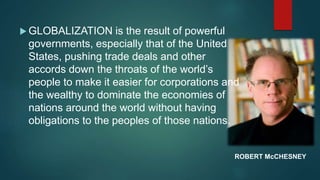
 GLOBALIZATION is the result of powerful
governments, especially that of the United
States, pushing trade deals and other
accords down the throats of the world’s
people to make it easier for corporations and
the wealthy to dominate the economies of
nations around the world without having
obligations to the peoples of those nations.
ROBERT McCHESNEY
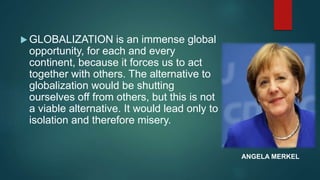
 GLOBALIZATION is an immense global
opportunity, for each and every
continent, because it forces us to act
together with others. The alternative to
globalization would be shutting
ourselves off from others, but this is not
a viable alternative. It would lead only to
isolation and therefore misery.
ANGELA MERKEL
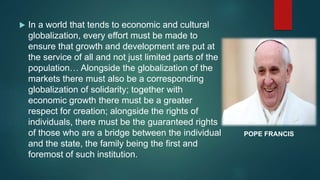
 In a world that tends to economic and cultural
globalization, every effort must be made to
ensure that growth and development are put at
the service of all and not just limited parts of the
population… Alongside the globalization of the
markets there must also be a corresponding
globalization of solidarity; together with
economic growth there must be a greater
respect for creation; alongside the rights of
individuals, there must be the guaranteed rights
of those who are a bridge between the individual
and the state, the family being the first and
foremost of such institution.
POPE FRANCIS
Contemporary world
Contemporary world

Contemporary world

  • 5.
    Does each picturespeak of realities in the Philippines? Why or Why not?
  • 6.
    What is itsprimary message?
  • 7.
    G L OB A L I Z A T I ON
  • 8.
    GROUP ACTIVITY Divide theclass into 3 Group. Present the picture. List all the terms, definition, and meaning of the world BY MAKKING YOUR OWN CONCEPTUAL MAP THAT SHOWS THE MEANING OF GLOBALIZATION.
  • 10.
    GLOBALIZATION Globalization refers tothe existence of free exchange of goods, services, culture and even people, between and among countries. (Theodore Levitt-Globalization Markets)
  • 11.
    GLOBALIZATION As a contestedconcept-ā€Since its earliest appearance in the 1960s, the term ā€˜globalization’ has been used in both popular and academic literature to describe a process, a condition, a system, a force and an age. Given that these competing labels have very different meanings, their indiscriminate usage is often obscure and invites confusion.ā€- Manfred Steger
  • 12.
    ECONOMIC GLOBALIZATION Closer integration ofnational economies through trade and financial flows as well as cross-border migration of people. As national economies ā€˜open up’ and lower their external barriers, they become more exposed- and more vulnerable-to global forces and influences.- ā€The United Nations Conference on Trade and Developemnt.
  • 13.
    This definition alsocovers what the European Union (EU) calls as the ā€œfour freedomā€ -free movement of goods or products, -free movement of services -free movement of capital or investment -free movement of persons.
  • 14.
    Free movement ofgoods or products Facilitated by liberalization or the abolition of tax on imported good Liberation-process or policy of removal or reduction of restrictions or barriers on the free trade between nation.
  • 15.
    Free movement ofcapital or investment Implemented through deregulation or the lifting of strict banking and financial regulations aimed at encouraging investors to invest more and retain their ability to pull out their investments at any time with ease. Deregulation- loosening or lifting of government regulations. Usually to favor private corporations’ flexibility or operations and profitability.
  • 16.
    Free movement of persons Achievedthrough the loosening or abolition of visa restrictions and barriers to migration.
  • 17.
    UNCTAD’s- GLOBALIZATION further clarifiesthat it is simultaneously and partly a process, a condition, a system, a force and an age, an era that has a beginning and a prospective end.
  • 18.
    GLOBALIZATION  Thomas Friedmanā€œThe Lexus and the olive Treeā€-considers it as both an era and a system- ā€œis not static, but a dynamic ongoing process: globalization involves the inexorable integration of markets, nation-states, and technologies to a degree never witnessed before-in a way that is enabling individuals, corporations, and nation-states to reach around the world farther, faster, deeper, and cheaper than ever before, and in a way that is… also producing a powerful backlash from those brutalized or left behind by this new system.
  • 19.
    GLOBALIZATION  British BroadcastingCorporation (BCC)  ā€œthe process by which the world is becoming increasingly interconnected as a result of massively increased trade and cultural exchange [which] has increased the production of goods and services [and] has been taking place for hundred of years, but has speeded up enormously over the last half- century.ā€
  • 20.
    Distinction between Internationalization andGlobalization  Leslie Sklair- reveals that ā€œ much of the globalization literature is confused because not all those who use the term dis……  Argues that Globalization is broader and more complicated than internationalization.
  • 21.
    INTERNATIONALIZATION  Refers toprocesses and systems that pertain to relationships between nation-states. GLOBALIZATION  Encompasses processes and systems related to ā€œglobal social relationsā€-or interactions between international and/or transnational entities.
  • 22.
    INTERNATIONALIZATION  The culturalties and economic trade between the members of the Association of Southeast Asian Nation or the members of EU (European Unions). GLOBALIZATION  Interactions between entities such as the ASEAN and the EU.
  • 23.
    MERIAM WEBSTER INTERNATIONAL- of,relating to, or affecting two or more nation. -active, known, or reaching beyond national boundaries. -Multinational GLOBAL- of, relating or involving the entire world- Worldwide, Universal
  • 24.
    Philosophies and Ideologies of/on/againstGlobalization SIX CORE CLAIMS  Globalization is about the liberation and global integration markets.  Globalization in inevitable and irreversible;  Nobody is in charge of globalization;  Globalization benefits everyone (…in the long run)  Globalization furthers the spread of democracy in the world;  Globalization requires war on terror.
  • 25.
    GLOBALIZATION- as asystem, is currently led and promoted by ideologues and policymakers who subscribe to the capitalist and neoliberal ideologies. CAPITALISM- is the dominant economic framework and system in many parts of the world today. >people tend to buy stocks of profitable companies. >government of the Third World countries allow mining corporations to operate even in places where the ecosystem is vulnerable. NEOLIBERALISM- build on the profit motive by asserting that for capitalism to thrive, markets should be free from government intervention, claiming that ā€œFree markets and free trade will set free the creative potential and the entrepreneurial spirit which is built into the spontaneous order of any human society, and thereby lead to more individual liberty and well-being, and a more efficient allocation of resources.
  • 26.
    Critics Anti-globalization- wants anend to what it considers as a highly imbalanced system of globalization that favors the First World over the Third World, corporations over citizens and communities, and profit-seeking over environmental sustainability.
  • 27.
     Alter-globalization-favors ā€œalteringā€or ā€œchangingā€ the current system of globalization to make it more humane, more pro-environment, and more grassroots-driven rather than staying as a top-down imposition.  ā€œ the directing motive, the end and aim of capitalist production, is to extract the greatest possible amount of surplus-value, and consequently to exploit labour-power to the greatest possible extent.ā€
  • 28.
    RESOLUTION For orAgainst Globalization (Activity)
  • 29.
  • 30.
     GLOBALIZATION isthe result of powerful governments, especially that of the United States, pushing trade deals and other accords down the throats of the world’s people to make it easier for corporations and the wealthy to dominate the economies of nations around the world without having obligations to the peoples of those nations. ROBERT McCHESNEY
  • 31.
     GLOBALIZATION isan immense global opportunity, for each and every continent, because it forces us to act together with others. The alternative to globalization would be shutting ourselves off from others, but this is not a viable alternative. It would lead only to isolation and therefore misery. ANGELA MERKEL
  • 32.
     In aworld that tends to economic and cultural globalization, every effort must be made to ensure that growth and development are put at the service of all and not just limited parts of the population… Alongside the globalization of the markets there must also be a corresponding globalization of solidarity; together with economic growth there must be a greater respect for creation; alongside the rights of individuals, there must be the guaranteed rights of those who are a bridge between the individual and the state, the family being the first and foremost of such institution. POPE FRANCIS