











-ZMSH
What is
Globalization?
Globalization is the
word used to describe
the growing
interdependence of the
world’s economies,
cultures, and
populations, brought
about by cross-border
trade in goods and
services, technology,
and flows of investment,
people, and information.
Homogeneity
Refers to the increasing of
sameness in the world as
cultural inputs, economic
factors, and political
orientations of societies. To
create common practice and
similar forms of government.
Heterogeneity
Pertains to the creation of
various cultural practices,
new economies, and political
groups because of the
interaction of elements from
different societies in the
world.
Heterogeneity in culture
is associated with
cultural hybridization.
When the world is growing closer,
new and more proficient linkages are
being created among people from
various cultures.
Cultural Hybridization
“GLOCALIZATION”
by Roland Robertson in
1992. As global forces
interact with local factors r a
specific are, the “glocal” is
being produced
“Glocalization”
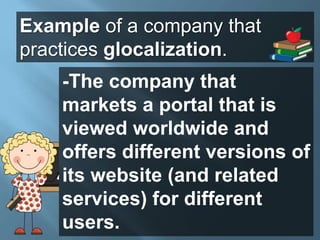
Example of a company that
practices glocalization.
-The company that
markets a portal that is
viewed worldwide and
offers different versions of
its website (and related
services) for different
users.
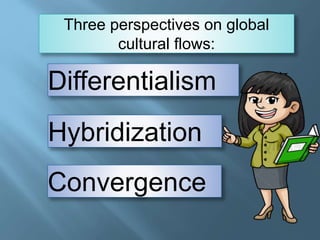
Three perspectives on global
cultural flows:
Differentialism
Hybridization
Convergence
Cultural Differentialism
emphasizes the fact that
cultures are essentially
different and are only
superficially affected by
global flows.
Cultural Hybridization
Approach emphasizes
the integration of local
and global culture.
“Glocal”
Cultural Convergence
Increasing similarities
between cultures, which
is not limited to beliefs,
consumer brands, and
media.
Group yourselves into three (3).
Basing on what the students understands:
First Group will give at least 5 positive impacts
of Globalization.
Second Group will differentiate the
globalization and Glocalization
The third group will provide 5 companies as
an example of Globalization and why are they
called globalized company?
True or False.
Write True if the statement is correct otherwise, False.
1. Globalization refers to the reliance of the world’s needs of
goods, services, information and manpower of countries to one
another.
2. Glocalization was coined by Mr. Robert Atkinson in 1992.
3. The Shopee online selling website can be accessed by Filipinos
as well as in other countries such as China and India without the
users having difficulty in understanding the language. The
statement is an example of Glocalization.
4. The ability to travel and experience other places and cultures is
an example of Glocalization.
5. Homogeneity is referring to the differences in cultures and
society in the world. (False)
Define/explain the
meaning of the given
questions.
-ZMSH

Globalization theories - Contemporary World

  • 1.
  • 2.
  • 3.
    Globalization is the wordused to describe the growing interdependence of the world’s economies, cultures, and populations, brought about by cross-border trade in goods and services, technology, and flows of investment, people, and information.
  • 5.
    Homogeneity Refers to theincreasing of sameness in the world as cultural inputs, economic factors, and political orientations of societies. To create common practice and similar forms of government.
  • 8.
    Heterogeneity Pertains to thecreation of various cultural practices, new economies, and political groups because of the interaction of elements from different societies in the world.
  • 9.
    Heterogeneity in culture isassociated with cultural hybridization. When the world is growing closer, new and more proficient linkages are being created among people from various cultures.
  • 10.
  • 11.
    by Roland Robertsonin 1992. As global forces interact with local factors r a specific are, the “glocal” is being produced “Glocalization”
  • 12.
    Example of acompany that practices glocalization. -The company that markets a portal that is viewed worldwide and offers different versions of its website (and related services) for different users.
  • 14.
    Three perspectives onglobal cultural flows: Differentialism Hybridization Convergence
  • 15.
    Cultural Differentialism emphasizes thefact that cultures are essentially different and are only superficially affected by global flows.
  • 16.
    Cultural Hybridization Approach emphasizes theintegration of local and global culture. “Glocal”
  • 17.
    Cultural Convergence Increasing similarities betweencultures, which is not limited to beliefs, consumer brands, and media.
  • 20.
    Group yourselves intothree (3). Basing on what the students understands: First Group will give at least 5 positive impacts of Globalization. Second Group will differentiate the globalization and Glocalization The third group will provide 5 companies as an example of Globalization and why are they called globalized company?
  • 22.
    True or False. WriteTrue if the statement is correct otherwise, False. 1. Globalization refers to the reliance of the world’s needs of goods, services, information and manpower of countries to one another. 2. Glocalization was coined by Mr. Robert Atkinson in 1992. 3. The Shopee online selling website can be accessed by Filipinos as well as in other countries such as China and India without the users having difficulty in understanding the language. The statement is an example of Glocalization. 4. The ability to travel and experience other places and cultures is an example of Glocalization. 5. Homogeneity is referring to the differences in cultures and society in the world. (False)
  • 24.
    Define/explain the meaning ofthe given questions.
  • 25.