Strategic Management
Module 2 – MG University
Prepared By
Kindly restrict the use of slides for personal purpose.
Please seek permission to reproduce the same in public forms and presentations.
Manu Melwin Joy
Assistant Professor
Ilahia School of Management Studies
Kerala, India.
Phone – 9744551114
Mail – manu_melwinjoy@yahoo.com
Contents
• Business level strategies.
– Cost leadership, Differentiation, Focus.
• Corporate level strategies.
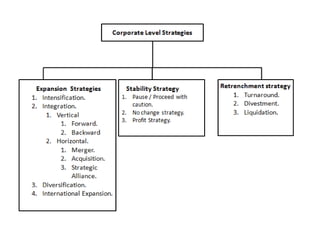
– Stability strategies.
– Expansion strategies – Intensification, Integration,
International expansion.
– Diversification stratégies, Merger, Acquisitions,
Strategic alliance.
– Turnaround strategies
Corporate Level Strategies
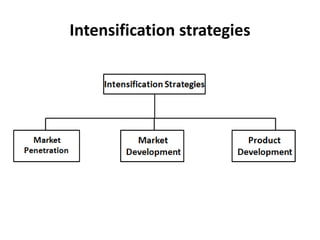
Intensification strategies
Market penetration
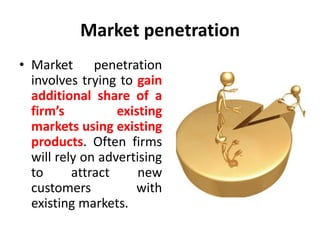
• Market penetration
involves trying to gain
additional share of a
firm’s existing
markets using existing
products. Often firms
will rely on advertising
to attract new
customers with
existing markets.
Examples of Market penetration
• Nike features famous
athletes in print and
television ads
designed to take
market share within
the athletic shoes
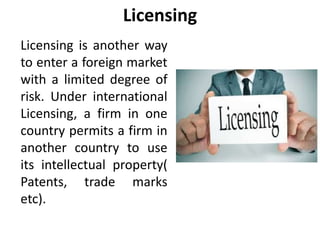
business from Adidas
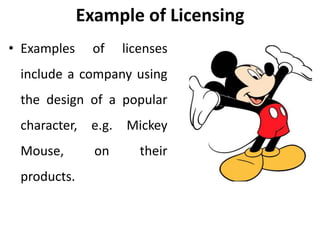
and other rivals.
Examples of Market penetration
• McDonald’s has pursued
market penetration in recent
years by using Latino themes
within some of its
advertising. The firm also
maintains a Spanish-
language website at
http://www.meencanta.com
; the website’s name is the
Spanish translation of
McDonald’s slogan “I’m
lovin’ it.” McDonald’s hopes
to gain more Latino
customers through initiatives
such as this website.
Market Development
• Market development
involves taking existing
products and trying to
sell them within new
markets.
Examples of Market Development
• One way to reach a new market is
to enter a new retail channel.
Starbucks has stepped beyond
selling coffee beans only in its
stores and now sells beans in
grocery stores. This enables
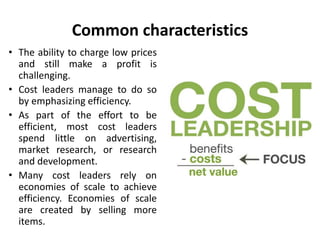
Starbucks to reach consumers that
do not visit its coffeehouses.
Examples of Market Development
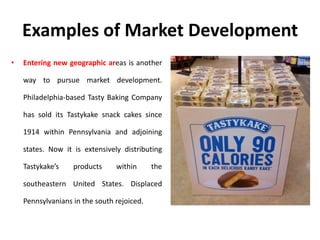
• Entering new geographic areas is another
way to pursue market development.
Philadelphia-based Tasty Baking Company
has sold its Tastykake snack cakes since
1914 within Pennsylvania and adjoining
states. Now it is extensively distributing
Tastykake’s products within the
southeastern United States. Displaced
Pennsylvanians in the south rejoiced.
Product Development
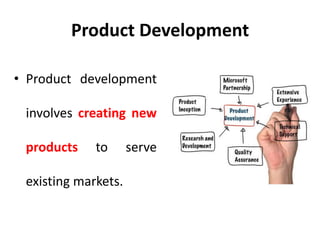
• Product development
involves creating new
products to serve
existing markets.
Examples of Product Development
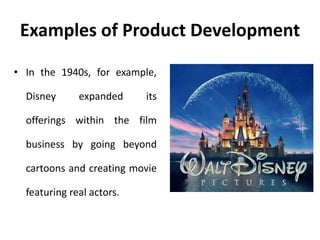
• In the 1940s, for example,
Disney expanded its
offerings within the film
business by going beyond
cartoons and creating movie
featuring real actors.
Examples of Product Development
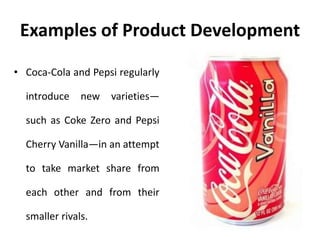
• Coca-Cola and Pepsi regularly
introduce new varieties—
such as Coke Zero and Pepsi
Cherry Vanilla—in an attempt
to take market share from
each other and from their
smaller rivals.
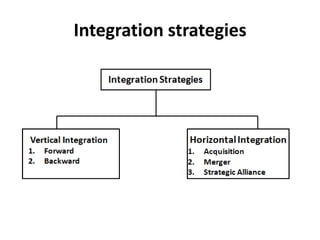
Integration strategies
Vertical Integration
• When pursuing a vertical
integration strategy, a
firm gets involved in new
portions of the value
chain. This approach can
be very attractive when a
firm’s suppliers or buyers
have too much power
over the firm and are
becoming increasingly
profitable at the firm’s
expense.
Examples of Vertical Integration
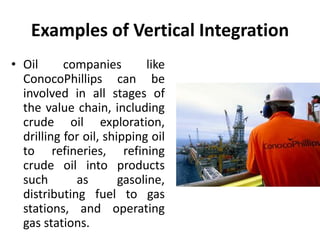
• Oil companies like
ConocoPhillips can be
involved in all stages of
the value chain, including
crude oil exploration,
drilling for oil, shipping oil
to refineries, refining
crude oil into products
such as gasoline,
distributing fuel to gas
stations, and operating
gas stations.
Forward Integration
• When pursuing a vertical
integration strategy, a
firm gets involved in new
portions of the value
chain. This approach can
be very attractive when a
firm’s suppliers or buyers
have too much power
over the firm and are
becoming increasingly
profitable at the firm’s
expense.
Examples of Forward Integration
• Disney has pursued
forward vertical
integration by operating
more than three hundred
retail stores that sell
merchandise based on
Disney’s characters and
movies. This allows
Disney to capture profits
that would otherwise be
enjoyed by another store.
Backward Integration
• When pursuing a vertical
integration strategy, a
firm gets involved in new
portions of the value
chain. This approach can
be very attractive when a
firm’s suppliers or buyers
have too much power
over the firm and are
becoming increasingly
profitable at the firm’s
expense.
Examples of Backward Integration
• Ford Motor Company
created subsidiaries that
provided key inputs to
vehicles such as rubber,
glass, and metal. This
approach ensured that
Ford would not be hurt by
suppliers holding out for
higher prices or providing
materials of inferior
quality.
Horizontal Integration
• It is a type of
integration strategies
pursued by a company
in order to strengthen
its position in the
industry. A corporate
that implements this
type of strategy usually
mergers or acquires
another company that
is in the same
production stage.
Example of Horizontal Integration
• One example of
horizontal integration
is what happened
between the
infamous Daimler
Benz and Chrysler
merger (car
developing,
manufacturing and
retailing).
Acquisition
• An acquisition takes
place when one
company purchases
another company.
Generally, the
acquired company is
smaller than the firm
that purchases it.
Examples of Acquisition
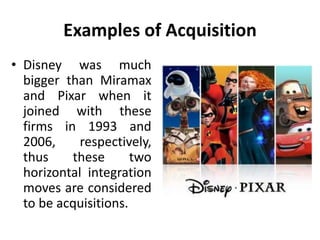
• Disney was much
bigger than Miramax
and Pixar when it
joined with these
firms in 1993 and
2006, respectively,
thus these two
horizontal integration
moves are considered
to be acquisitions.
Merger
• A merger is a combination
of two or more
organizations in which one
acquires the assets and
liabilities of the other in
exchange for shares or
cash or both the
organization are dissolved
and the assets and
liabilities are combined
and new stock is issued.
Examples of Merger
• Big oil got even bigger in
1999, when Exxon and
Mobil signed a $81
billion agreement to
merge and form Exxon
Mobil. ExxonMobil
remains the strongest
leader in the oil market,
with a huge hold on the
international market and
dramatic earnings.
Strategic Alliance
• A strategic alliance is a
cooperative arrangement
between two or more
organizations that does
not involve the creation
of a new entity.
Examples of Strategic Alliance
• In June 2011,Twitter
announced the formation
of a strategic alliance with
Yahoo! Japan. The alliance
involves relevant Tweets
appearing within various
functions offered by
Yahoo! Japan.
Diversification strategies
• Firms using diversification
strategies enter entirely new
industries. While vertical
integration involves a firm
moving into a new part of a
value chain that it is already is
within, diversification
requires moving into new
value chains.
Examples of Diversification strategies
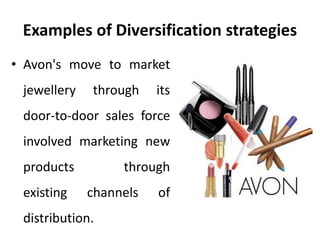
• Avon's move to market
jewellery through its
door-to-door sales force
involved marketing new
products through
existing channels of
distribution.
Diversification strategies
Concentric Diversification
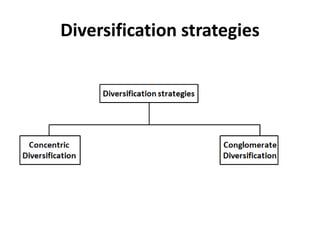
• When an organization takes up
an activity in such a manner
that is related to the existing
business definition of one or
more of firms businesses, either
in terms of customer groups,
customer’s functions or
alternative technologies, it is
called concentric diversification.
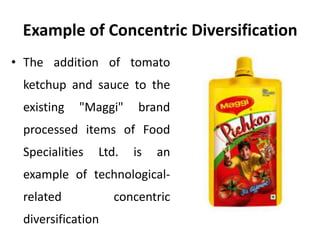
Example of Concentric Diversification
• The addition of tomato
ketchup and sauce to the
existing "Maggi" brand
processed items of Food
Specialities Ltd. is an
example of technological-
related concentric
diversification
Conglomerate Diversification
• When an organization adopts a
strategy which requires taking of
those activities which are
unrelated to the existing
businesses definition of one or
more of its businesses either in
terms of their respective customer
groups, customer functions or
alternative technologies, it is called
conglomerate diversification.
Examples of Conglomerate Diversification
• Example of Indian company
which have adopted apart
of growth and expansion
through conglomerate
diversification the classic
examples is of ITC, a
cigarette company
diversifying into the hotel
industry.
International Expansion
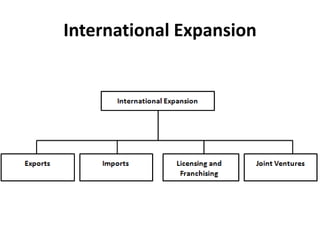
Export
• Exporting is an effective
entry strategy for
companies that are just
beginning to enter a
new foreign market. It’s
a low-cost, low-risk
option compared to the
other strategies.
Imports
• Importing is the
flipside of exporting.
Importing refers to
buying goods and
services from foreign
sources and bringing
them back into the
home country.
Licensing
Licensing is another way
to enter a foreign market
with a limited degree of
risk. Under international
Licensing, a firm in one
country permits a firm in
another country to use
its intellectual property(
Patents, trade marks
etc).
Example of Licensing
• Examples of licenses
include a company using
the design of a popular
character, e.g. Mickey
Mouse, on their
products.
Franchising
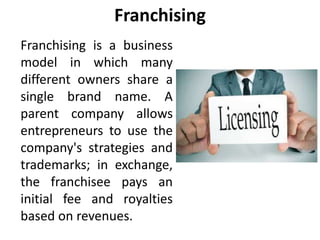
Franchising is a business
model in which many
different owners share a
single brand name. A
parent company allows
entrepreneurs to use the
company's strategies and
trademarks; in exchange,
the franchisee pays an
initial fee and royalties
based on revenues.
Example of Franchise
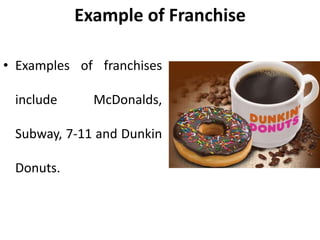
• Examples of franchises
include McDonalds,
Subway, 7-11 and Dunkin
Donuts.
Joint Ventures
An equity joint venture is
a contractual, strategic
partnership between two
or more separate
business entities to
pursue a business
opportunity together.
Example of Joint Ventures
Sony-Ericsson is a joint
venture by the Japanese
consumer electronics
company Sony Corporation
and the Swedish
telecommunications
company Ericsson to make
mobile phones.
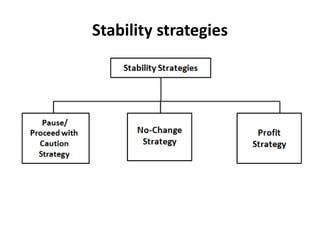
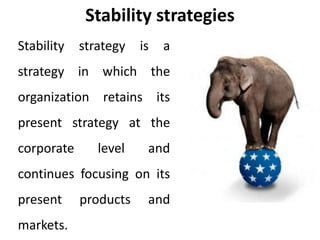
Stability strategies
Stability strategy is a
strategy in which the
organization retains its
present strategy at the
corporate level and
continues focusing on its
present products and
markets.
Examples of Stability strategies
Steel Authority of India has
adopted stability strategy
because of over capacity in
steel sector. Instead it has
concentrated on increasing
operational efficiency of its
various plants rather than
going for expansion. Others
industries are ‘heavy
commercial vehicle’, ‘coal
industry’.
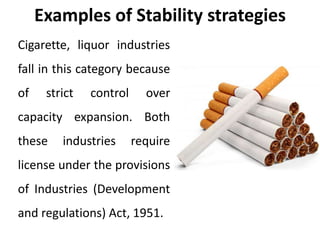
Examples of Stability strategies
Cigarette, liquor industries
fall in this category because
of strict control over
capacity expansion. Both
these industries require
license under the provisions
of Industries (Development
and regulations) Act, 1951.
Pause/ Proceed with Caution Strategy
It is employed by the firm
that wish to test the ground
before moving ahead with a
full fledged grand strategy,
or by firms that have an
intense pace of expansion
and wish to rest for a while
before moving ahead
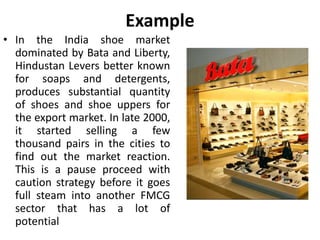
Example
• In the India shoe market
dominated by Bata and Liberty,
Hindustan Levers better known
for soaps and detergents,
produces substantial quantity
of shoes and shoe uppers for
the export market. In late 2000,
it started selling a few
thousand pairs in the cities to
find out the market reaction.
This is a pause proceed with
caution strategy before it goes
full steam into another FMCG
sector that has a lot of
potential
No-Change Strategy
It is a conscious decision to
do nothing new. The firm
will continue with its
present business definition.
When a firm has a stable
internal and external
environment the firm will
continue with its present
strategy.
Profit Strategy
• A profit strategy is one that
capitalizes on a situation in which
old and obsolete product or
technology is being replaced by a
new one. This type of strategy does
not require new investment, so it is
not a growth strategy. Firms
adopting this strategy decide to
follow the same technology, at least
partially, while transiting into new
technological domains.
Examples of Profit Strategy
• Sylvania, RCA, and GE are
among the firms that
followed this strategy. They
decided to stay in the
vacuum tube market until
the “end of the game.”
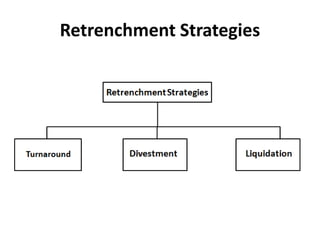
Retrenchment Strategies
Retrenchment strategy
• A retrenchment grand strategy is
followed when an organization
aims at a contraction of its
activities through substantial
reduction or the elimination of
the scope of one or more of its
businesses in terms of their
respective customer groups,
customer functions, or alternative
technologies either singly or
jointly in order to improve its
overall performance.
Examples of Retrenchment strategy
• General Motors of the
United States stopped
producing a number of
"makes" of automobile. GM
decided that it needed to
retrench by concentrating
on just a few "makes." It
hoped this would help it
return to profitability.
Turnaround strategies
• Turn around strategies derives
their name from the action
involved that is reversing a
negative trend. There are
certain conditions or indicators
which point out that a
turnaround is needed for an
organization to survive. An
organization which faces one or
more of these issues is referred
to as a ‘sick’ company.
Turnaround strategies
• There are three ways in which
turnarounds can be managed
– The existing chief executive and
management team handles the
entire turnaround strategy with
the advisory support of a
external consultant.
– In another case the existing
team withdraws temporarily
and an executive consultant or
turnaround specialist is
employed to do the job.
– The last method involves the
replacement of the existing
team specially the chief
executive, or merging the sick
organization with a healthy one.
Examples of Turnaround strategies
• Xerox revealed a
Turnaround Programme in
December 2000, which
included cutting $1 billion in
costs, and raising up to $4
billion through the sale of
assets, exiting non-core
businesses and lay-offs.
Subsequently, in August
2001, Mulcahy was made
CEO. Xerox continued to
report losses in 2001, but it
returned to profit in 2002
and continued to report
profits in 2003.
Divestment strategy
• A divestment strategy
involves the sale or
liquidation of a portion of
business, or a major
division.
Divestment strategy
• TATA group is a highly diversified entity
with a range of businesses under its
fold. They identified their non – core
businesses for divestment. TOMCO
was divested and sold to Hindustan
Levers as soaps and a detergent was
not considered a core business for the
Tatas.
Liquidation Strategy
• A retrenchment strategy
which is considered the most
extreme and unattractive is
the liquidation strategy,
which involves closing down
a firm and selling its assets. It
is considered as the last
resort because it leads to
serious consequences such
as loss of employment for
workers and other
employees, termination of
opportunities where a firm
could pursue any future
activities and the stigma of
failure.
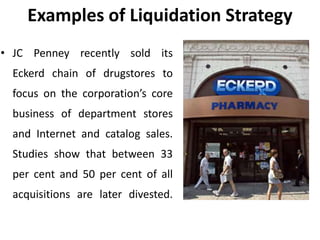
Examples of Liquidation Strategy
• JC Penney recently sold its
Eckerd chain of drugstores to
focus on the corporation’s core
business of department stores
and Internet and catalog sales.
Studies show that between 33
per cent and 50 per cent of all
acquisitions are later divested.
Business Level Strategies
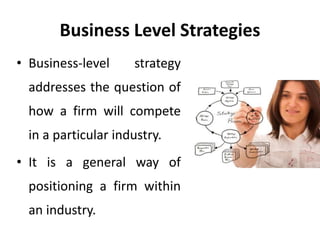
• Business-level strategy
addresses the question of
how a firm will compete
in a particular industry.
• It is a general way of
positioning a firm within
an industry.
Business Level Strategies
Competitive dimensions
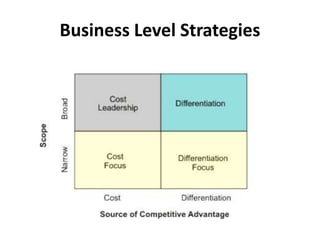
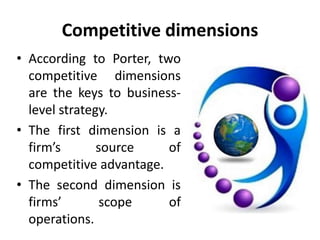
• According to Porter, two
competitive dimensions
are the keys to business-
level strategy.
• The first dimension is a
firm’s source of
competitive advantage.
• The second dimension is
firms’ scope of
operations.
Cost Leadership
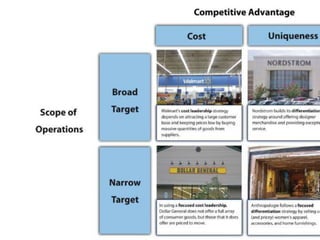
• Perhaps the most famous
cost leader is Walmart,
which has used a cost
leadership strategy to
become the largest
company in the world.
• The firm’s advertising
slogans such as “Always
Low Prices” and “Save
Money. Live Better”
communicate Walmart’s
emphasis on price slashing
to potential customers.
Common characteristics
• The ability to charge low prices
and still make a profit is
challenging.
• Cost leaders manage to do so
by emphasizing efficiency.
• As part of the effort to be
efficient, most cost leaders
spend little on advertising,
market research, or research
and development.
• Many cost leaders rely on
economies of scale to achieve
efficiency. Economies of scale
are created by selling more
items.
Examples of Cost leadership
• McDonald's - McDonald's
has been extremely
successful with this
strategy by offering basic
fast-food meals at low
prices. They are able to
keep prices low through a
division of labor that allows
it to hire and train
inexperienced employees
rather than trained cooks.
Examples of Cost leadership
• Ikea -The Swedish
furniture retailer Ikea
revolutionized the
furniture industry by
offering cheap but stylish
furniture. Ikea is able to
keep its prices low by
sourcing its products in
low-wage countries and
by offering a very basic
level of service.
Examples of Cost leadership
• Southwest Airlines -
Southwest attempts to
offer the lowest prices
possible by being more
efficient than traditional
airlines. They minimize
the time that their planes
spend on the tarmac in
order to keep them flying
and to keep profits up.
Differentiation
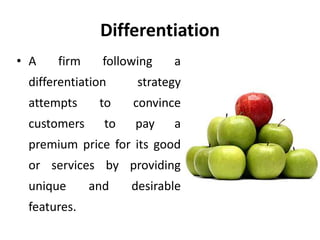
• A firm following a
differentiation strategy
attempts to convince
customers to pay a
premium price for its good
or services by providing
unique and desirable
features.
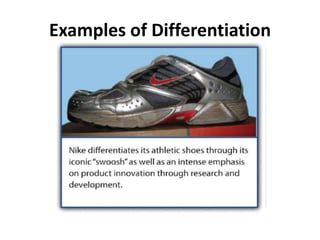
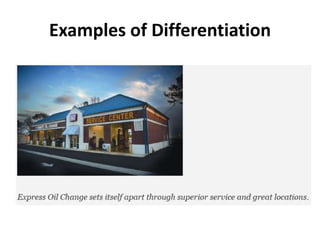
Examples of Differentiation
• Apple - Steve Jobs said
this about the difference
between Dell and Apple:
Apple and Dell are the
only ones in this industry
making money. They
make it by being Wal-
Mart. We make it by
innovation.
Examples of Differentiation
Focused cost leadership strategy
• A focused cost leadership strategy
requires competing based on
price to target a narrow market.
• A firm that follows this strategy
does not necessarily charge the
lowest prices in the industry.
Instead, it charges low prices
relative to other firms that
compete within the target
market.
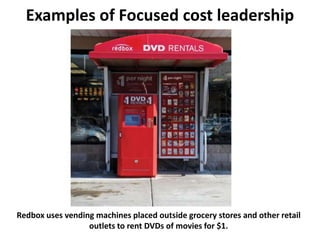
Examples of Focused cost leadership
Redbox uses vending machines placed outside grocery stores and other retail
outlets to rent DVDs of movies for $1.
Focused Differentiation strategy
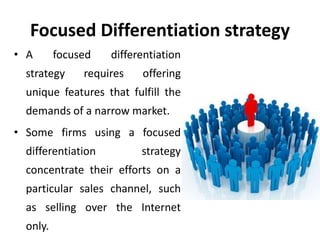
• A focused differentiation
strategy requires offering
unique features that fulfill the
demands of a narrow market.
• Some firms using a focused
differentiation strategy
concentrate their efforts on a
particular sales channel, such
as selling over the Internet
only.
Examples of Focused Differentiation
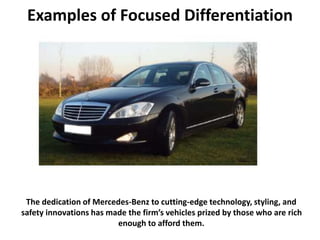
The dedication of Mercedes-Benz to cutting-edge technology, styling, and
safety innovations has made the firm’s vehicles prized by those who are rich
enough to afford them.
Strategic Management - Module 2 – MG University  - Manu Melwin Joy

Strategic Management - Module 2 – MG University - Manu Melwin Joy

  • 1.
  • 2.
    Prepared By Kindly restrictthe use of slides for personal purpose. Please seek permission to reproduce the same in public forms and presentations. Manu Melwin Joy Assistant Professor Ilahia School of Management Studies Kerala, India. Phone – 9744551114 Mail – manu_melwinjoy@yahoo.com
  • 3.
    Contents • Business levelstrategies. – Cost leadership, Differentiation, Focus. • Corporate level strategies. – Stability strategies. – Expansion strategies – Intensification, Integration, International expansion. – Diversification stratégies, Merger, Acquisitions, Strategic alliance. – Turnaround strategies
  • 4.
  • 6.
  • 7.
    Market penetration • Marketpenetration involves trying to gain additional share of a firm’s existing markets using existing products. Often firms will rely on advertising to attract new customers with existing markets.
  • 8.
    Examples of Marketpenetration • Nike features famous athletes in print and television ads designed to take market share within the athletic shoes business from Adidas and other rivals.
  • 9.
    Examples of Marketpenetration • McDonald’s has pursued market penetration in recent years by using Latino themes within some of its advertising. The firm also maintains a Spanish- language website at http://www.meencanta.com ; the website’s name is the Spanish translation of McDonald’s slogan “I’m lovin’ it.” McDonald’s hopes to gain more Latino customers through initiatives such as this website.
  • 10.
    Market Development • Marketdevelopment involves taking existing products and trying to sell them within new markets.
  • 11.
    Examples of MarketDevelopment • One way to reach a new market is to enter a new retail channel. Starbucks has stepped beyond selling coffee beans only in its stores and now sells beans in grocery stores. This enables Starbucks to reach consumers that do not visit its coffeehouses.
  • 12.
    Examples of MarketDevelopment • Entering new geographic areas is another way to pursue market development. Philadelphia-based Tasty Baking Company has sold its Tastykake snack cakes since 1914 within Pennsylvania and adjoining states. Now it is extensively distributing Tastykake’s products within the southeastern United States. Displaced Pennsylvanians in the south rejoiced.
  • 13.
    Product Development • Productdevelopment involves creating new products to serve existing markets.
  • 14.
    Examples of ProductDevelopment • In the 1940s, for example, Disney expanded its offerings within the film business by going beyond cartoons and creating movie featuring real actors.
  • 15.
    Examples of ProductDevelopment • Coca-Cola and Pepsi regularly introduce new varieties— such as Coke Zero and Pepsi Cherry Vanilla—in an attempt to take market share from each other and from their smaller rivals.
  • 16.
  • 17.
    Vertical Integration • Whenpursuing a vertical integration strategy, a firm gets involved in new portions of the value chain. This approach can be very attractive when a firm’s suppliers or buyers have too much power over the firm and are becoming increasingly profitable at the firm’s expense.
  • 18.
    Examples of VerticalIntegration • Oil companies like ConocoPhillips can be involved in all stages of the value chain, including crude oil exploration, drilling for oil, shipping oil to refineries, refining crude oil into products such as gasoline, distributing fuel to gas stations, and operating gas stations.
  • 19.
    Forward Integration • Whenpursuing a vertical integration strategy, a firm gets involved in new portions of the value chain. This approach can be very attractive when a firm’s suppliers or buyers have too much power over the firm and are becoming increasingly profitable at the firm’s expense.
  • 20.
    Examples of ForwardIntegration • Disney has pursued forward vertical integration by operating more than three hundred retail stores that sell merchandise based on Disney’s characters and movies. This allows Disney to capture profits that would otherwise be enjoyed by another store.
  • 21.
    Backward Integration • Whenpursuing a vertical integration strategy, a firm gets involved in new portions of the value chain. This approach can be very attractive when a firm’s suppliers or buyers have too much power over the firm and are becoming increasingly profitable at the firm’s expense.
  • 22.
    Examples of BackwardIntegration • Ford Motor Company created subsidiaries that provided key inputs to vehicles such as rubber, glass, and metal. This approach ensured that Ford would not be hurt by suppliers holding out for higher prices or providing materials of inferior quality.
  • 23.
    Horizontal Integration • Itis a type of integration strategies pursued by a company in order to strengthen its position in the industry. A corporate that implements this type of strategy usually mergers or acquires another company that is in the same production stage.
  • 24.
    Example of HorizontalIntegration • One example of horizontal integration is what happened between the infamous Daimler Benz and Chrysler merger (car developing, manufacturing and retailing).
  • 25.
    Acquisition • An acquisitiontakes place when one company purchases another company. Generally, the acquired company is smaller than the firm that purchases it.
  • 26.
    Examples of Acquisition •Disney was much bigger than Miramax and Pixar when it joined with these firms in 1993 and 2006, respectively, thus these two horizontal integration moves are considered to be acquisitions.
  • 27.
    Merger • A mergeris a combination of two or more organizations in which one acquires the assets and liabilities of the other in exchange for shares or cash or both the organization are dissolved and the assets and liabilities are combined and new stock is issued.
  • 28.
    Examples of Merger •Big oil got even bigger in 1999, when Exxon and Mobil signed a $81 billion agreement to merge and form Exxon Mobil. ExxonMobil remains the strongest leader in the oil market, with a huge hold on the international market and dramatic earnings.
  • 29.
    Strategic Alliance • Astrategic alliance is a cooperative arrangement between two or more organizations that does not involve the creation of a new entity.
  • 30.
    Examples of StrategicAlliance • In June 2011,Twitter announced the formation of a strategic alliance with Yahoo! Japan. The alliance involves relevant Tweets appearing within various functions offered by Yahoo! Japan.
  • 31.
    Diversification strategies • Firmsusing diversification strategies enter entirely new industries. While vertical integration involves a firm moving into a new part of a value chain that it is already is within, diversification requires moving into new value chains.
  • 32.
    Examples of Diversificationstrategies • Avon's move to market jewellery through its door-to-door sales force involved marketing new products through existing channels of distribution.
  • 33.
  • 34.
    Concentric Diversification • Whenan organization takes up an activity in such a manner that is related to the existing business definition of one or more of firms businesses, either in terms of customer groups, customer’s functions or alternative technologies, it is called concentric diversification.
  • 35.
    Example of ConcentricDiversification • The addition of tomato ketchup and sauce to the existing "Maggi" brand processed items of Food Specialities Ltd. is an example of technological- related concentric diversification
  • 36.
    Conglomerate Diversification • Whenan organization adopts a strategy which requires taking of those activities which are unrelated to the existing businesses definition of one or more of its businesses either in terms of their respective customer groups, customer functions or alternative technologies, it is called conglomerate diversification.
  • 37.
    Examples of ConglomerateDiversification • Example of Indian company which have adopted apart of growth and expansion through conglomerate diversification the classic examples is of ITC, a cigarette company diversifying into the hotel industry.
  • 38.
  • 39.
    Export • Exporting isan effective entry strategy for companies that are just beginning to enter a new foreign market. It’s a low-cost, low-risk option compared to the other strategies.
  • 40.
    Imports • Importing isthe flipside of exporting. Importing refers to buying goods and services from foreign sources and bringing them back into the home country.
  • 41.
    Licensing Licensing is anotherway to enter a foreign market with a limited degree of risk. Under international Licensing, a firm in one country permits a firm in another country to use its intellectual property( Patents, trade marks etc).
  • 42.
    Example of Licensing •Examples of licenses include a company using the design of a popular character, e.g. Mickey Mouse, on their products.
  • 43.
    Franchising Franchising is abusiness model in which many different owners share a single brand name. A parent company allows entrepreneurs to use the company's strategies and trademarks; in exchange, the franchisee pays an initial fee and royalties based on revenues.
  • 44.
    Example of Franchise •Examples of franchises include McDonalds, Subway, 7-11 and Dunkin Donuts.
  • 45.
    Joint Ventures An equityjoint venture is a contractual, strategic partnership between two or more separate business entities to pursue a business opportunity together.
  • 46.
    Example of JointVentures Sony-Ericsson is a joint venture by the Japanese consumer electronics company Sony Corporation and the Swedish telecommunications company Ericsson to make mobile phones.
  • 47.
  • 48.
    Stability strategies Stability strategyis a strategy in which the organization retains its present strategy at the corporate level and continues focusing on its present products and markets.
  • 49.
    Examples of Stabilitystrategies Steel Authority of India has adopted stability strategy because of over capacity in steel sector. Instead it has concentrated on increasing operational efficiency of its various plants rather than going for expansion. Others industries are ‘heavy commercial vehicle’, ‘coal industry’.
  • 50.
    Examples of Stabilitystrategies Cigarette, liquor industries fall in this category because of strict control over capacity expansion. Both these industries require license under the provisions of Industries (Development and regulations) Act, 1951.
  • 51.
    Pause/ Proceed withCaution Strategy It is employed by the firm that wish to test the ground before moving ahead with a full fledged grand strategy, or by firms that have an intense pace of expansion and wish to rest for a while before moving ahead
  • 52.
    Example • In theIndia shoe market dominated by Bata and Liberty, Hindustan Levers better known for soaps and detergents, produces substantial quantity of shoes and shoe uppers for the export market. In late 2000, it started selling a few thousand pairs in the cities to find out the market reaction. This is a pause proceed with caution strategy before it goes full steam into another FMCG sector that has a lot of potential
  • 53.
    No-Change Strategy It isa conscious decision to do nothing new. The firm will continue with its present business definition. When a firm has a stable internal and external environment the firm will continue with its present strategy.
  • 54.
    Profit Strategy • Aprofit strategy is one that capitalizes on a situation in which old and obsolete product or technology is being replaced by a new one. This type of strategy does not require new investment, so it is not a growth strategy. Firms adopting this strategy decide to follow the same technology, at least partially, while transiting into new technological domains.
  • 55.
    Examples of ProfitStrategy • Sylvania, RCA, and GE are among the firms that followed this strategy. They decided to stay in the vacuum tube market until the “end of the game.”
  • 56.
  • 57.
    Retrenchment strategy • Aretrenchment grand strategy is followed when an organization aims at a contraction of its activities through substantial reduction or the elimination of the scope of one or more of its businesses in terms of their respective customer groups, customer functions, or alternative technologies either singly or jointly in order to improve its overall performance.
  • 58.
    Examples of Retrenchmentstrategy • General Motors of the United States stopped producing a number of "makes" of automobile. GM decided that it needed to retrench by concentrating on just a few "makes." It hoped this would help it return to profitability.
  • 59.
    Turnaround strategies • Turnaround strategies derives their name from the action involved that is reversing a negative trend. There are certain conditions or indicators which point out that a turnaround is needed for an organization to survive. An organization which faces one or more of these issues is referred to as a ‘sick’ company.
  • 60.
    Turnaround strategies • Thereare three ways in which turnarounds can be managed – The existing chief executive and management team handles the entire turnaround strategy with the advisory support of a external consultant. – In another case the existing team withdraws temporarily and an executive consultant or turnaround specialist is employed to do the job. – The last method involves the replacement of the existing team specially the chief executive, or merging the sick organization with a healthy one.
  • 61.
    Examples of Turnaroundstrategies • Xerox revealed a Turnaround Programme in December 2000, which included cutting $1 billion in costs, and raising up to $4 billion through the sale of assets, exiting non-core businesses and lay-offs. Subsequently, in August 2001, Mulcahy was made CEO. Xerox continued to report losses in 2001, but it returned to profit in 2002 and continued to report profits in 2003.
  • 62.
    Divestment strategy • Adivestment strategy involves the sale or liquidation of a portion of business, or a major division.
  • 63.
    Divestment strategy • TATAgroup is a highly diversified entity with a range of businesses under its fold. They identified their non – core businesses for divestment. TOMCO was divested and sold to Hindustan Levers as soaps and a detergent was not considered a core business for the Tatas.
  • 64.
    Liquidation Strategy • Aretrenchment strategy which is considered the most extreme and unattractive is the liquidation strategy, which involves closing down a firm and selling its assets. It is considered as the last resort because it leads to serious consequences such as loss of employment for workers and other employees, termination of opportunities where a firm could pursue any future activities and the stigma of failure.
  • 65.
    Examples of LiquidationStrategy • JC Penney recently sold its Eckerd chain of drugstores to focus on the corporation’s core business of department stores and Internet and catalog sales. Studies show that between 33 per cent and 50 per cent of all acquisitions are later divested.
  • 66.
  • 67.
    Business Level Strategies •Business-level strategy addresses the question of how a firm will compete in a particular industry. • It is a general way of positioning a firm within an industry.
  • 68.
  • 70.
    Competitive dimensions • Accordingto Porter, two competitive dimensions are the keys to business- level strategy. • The first dimension is a firm’s source of competitive advantage. • The second dimension is firms’ scope of operations.
  • 71.
    Cost Leadership • Perhapsthe most famous cost leader is Walmart, which has used a cost leadership strategy to become the largest company in the world. • The firm’s advertising slogans such as “Always Low Prices” and “Save Money. Live Better” communicate Walmart’s emphasis on price slashing to potential customers.
  • 72.
    Common characteristics • Theability to charge low prices and still make a profit is challenging. • Cost leaders manage to do so by emphasizing efficiency. • As part of the effort to be efficient, most cost leaders spend little on advertising, market research, or research and development. • Many cost leaders rely on economies of scale to achieve efficiency. Economies of scale are created by selling more items.
  • 73.
    Examples of Costleadership • McDonald's - McDonald's has been extremely successful with this strategy by offering basic fast-food meals at low prices. They are able to keep prices low through a division of labor that allows it to hire and train inexperienced employees rather than trained cooks.
  • 74.
    Examples of Costleadership • Ikea -The Swedish furniture retailer Ikea revolutionized the furniture industry by offering cheap but stylish furniture. Ikea is able to keep its prices low by sourcing its products in low-wage countries and by offering a very basic level of service.
  • 75.
    Examples of Costleadership • Southwest Airlines - Southwest attempts to offer the lowest prices possible by being more efficient than traditional airlines. They minimize the time that their planes spend on the tarmac in order to keep them flying and to keep profits up.
  • 76.
    Differentiation • A firmfollowing a differentiation strategy attempts to convince customers to pay a premium price for its good or services by providing unique and desirable features.
  • 77.
    Examples of Differentiation •Apple - Steve Jobs said this about the difference between Dell and Apple: Apple and Dell are the only ones in this industry making money. They make it by being Wal- Mart. We make it by innovation.
  • 78.
  • 79.
  • 80.
  • 81.
    Focused cost leadershipstrategy • A focused cost leadership strategy requires competing based on price to target a narrow market. • A firm that follows this strategy does not necessarily charge the lowest prices in the industry. Instead, it charges low prices relative to other firms that compete within the target market.
  • 82.
    Examples of Focusedcost leadership Redbox uses vending machines placed outside grocery stores and other retail outlets to rent DVDs of movies for $1.
  • 83.
    Focused Differentiation strategy •A focused differentiation strategy requires offering unique features that fulfill the demands of a narrow market. • Some firms using a focused differentiation strategy concentrate their efforts on a particular sales channel, such as selling over the Internet only.
  • 84.
    Examples of FocusedDifferentiation The dedication of Mercedes-Benz to cutting-edge technology, styling, and safety innovations has made the firm’s vehicles prized by those who are rich enough to afford them.