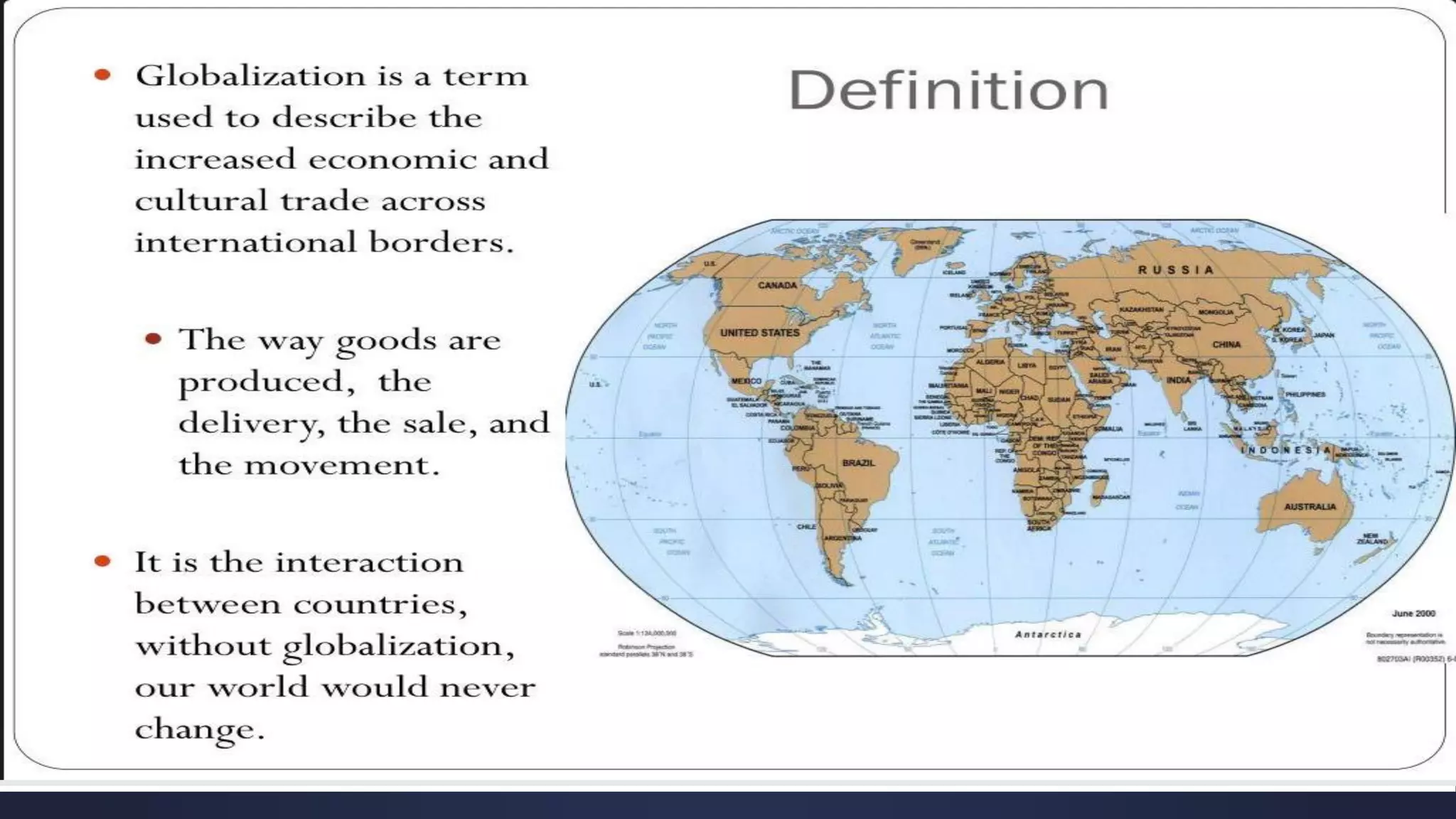
GLOBALIZATION
Globalization is a process of interaction and
integration among the people, companies, and
governments of different nations, a process driven by
international trade and investment and aided by
information technology.
This process has effects on the environment, on
culture, on political systems. on economic
development and prosperity, and on human physical
well-being in societies around the world
("Globalization 101," n.d.).
SIX CORE CLAIMS OF GLOBALISM
1. Globalization is about the liberalization and global
integration of markets;
2. Globalization is inevitable and irreversible;
3. Nobody is in charge of globalization;
4. Globalization benefits everyone (i.e., in the long run);
5. Globalization furthers the spread of democracy in the
world; and
6. Globalization requires a global war on terror.
GLOBALIZATION IN ECONOMICS
• Multinational corporations operate on a global scale, with satellite offices
and branches in numerous locations.
• Outsourcing can add to the economic development of a struggling
country, bringing much needed jobs.
• Some automobiles use parts from other countries, as in a car being
assembled in the Philippines with the parts coming from Japan, Germany,
or Korea. The Free World Trade Organization supervises world trade.
• A dress with design inspired by the culture of Africa, made in South
Korea, and sold in New York.
• A bag made in China, sold in America, and brought to the Philippines as
souvenir to expectant relatives.
GLOBALIZATION INTHE BLENDING OF CULTURES
• Greek culture spread across Africa, Europe and Asia
through Alexander the Great. This is the reason there
are cities named for Alexander in Africa, Egypt and
Turkey.
• The Silk Road was a trade route between China and the
Mediterranean Sea area and it allowed the exchange of
not only goods, but culture and knowledge. Christian
missionaries from Europe added to the globalization of
Christianity.
GLOBALIZATION INTHE BLENDING OF CULTURES
• Colonization all over the world was a major cause of
globalization.
• Improved travel facilitated the growth of globalization, as
people moved for a better job, a better life, or fled from danger
or oppression.
• Food is one factor of globalization. One can find people eating
sushi in Peru or Indian food in Europe.
• Satellite television allows shows from one country to be
broadcast in many others, adding to cultural globalization.
GLOBALIZATION INTECHNOLOGY
• The Internet is a major contributor to globalization, not
only technologically but in other areas as well, like in
cultural exchanges of the arts.
• Global news networks, like CNN, contribute to the
spread of knowledge. Cells phones connect people all
over the world like never before. Around 60 percent of
all people in the world use cell phones.
GLOBALIZATION INTECHNOLOGY
• The Internet is a major contributor to globalization, not
only technologically but in other areas as well, like in
cultural exchanges of the arts.
• Global news networks, like CNN, contribute to the
spread of knowledge. Cells phones connect people all
over the world like never before. Around 60 percent of
all people in the world use cell phones.
THE STRUCTURES OF GLOBALIZATION
GLOBAL ECONOMY
▪The Global Economy
▪Key Players/Actors in Globalization
▪Modern World-System
▪Global Economic Integration
The Global Economy
Economic Globalization (Mohan 2009)
▪ refers to the free movement of goods, capital,
services, technology and information.
▪ it results to an increasing economic integration and
interdependence of national, regional, and local
economics around the world by strengthening the
cross-border movement of goods, technologies and
capita
Key Players/Actors in Globalization
International Organization
▪ Promotes voluntary cooperation and
coordination between or among members
(McCornick 1999)
▪ categorized either Intergovernmental or
Supranational organizations
Key Players/Actors in Globalization
Intergovernmental Organizations (IGO)
▪ composed of nation-states that promote
voluntarily cooperation and coordination among its
members.
Supranational Organizations
▪ Member states either global or regional, they
surrender their power in specific areas to the higher
organization
▪ this is an entity where member states formed for
mutual benefit and in pursuit of shared goals
Key Players/Actors in Globalization
International Non-governmental Organizations
▪ tries to help in alleviating the problems
as hunger, disease, illiteracy and inequalities.
Key Players/Actors in Globalization
Large Manufacturing Corporation
▪ consist of multinationals and transnationals
▪ these corporations sells goods and
manufactured products
Key Players/Actors in Globalization
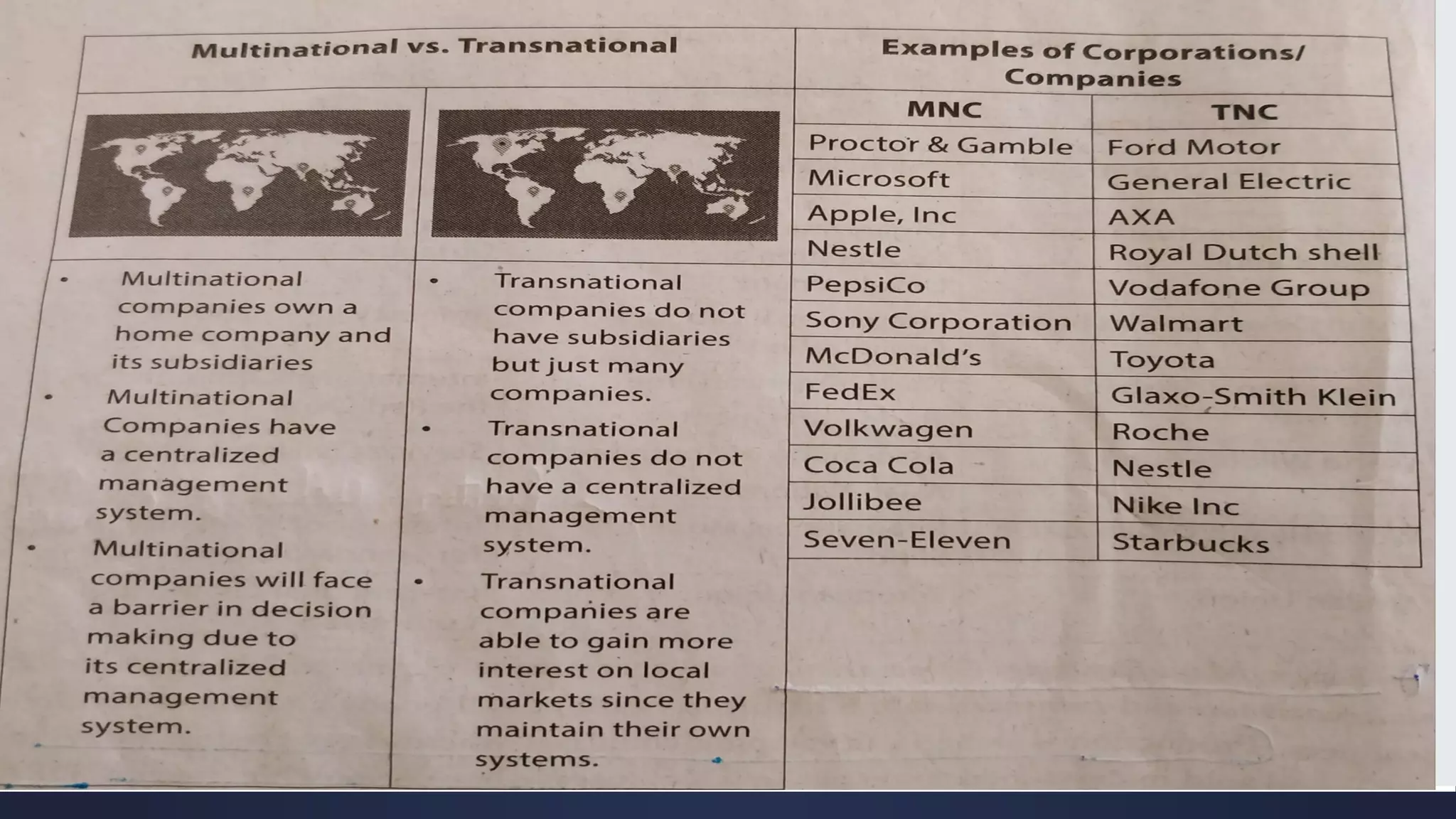
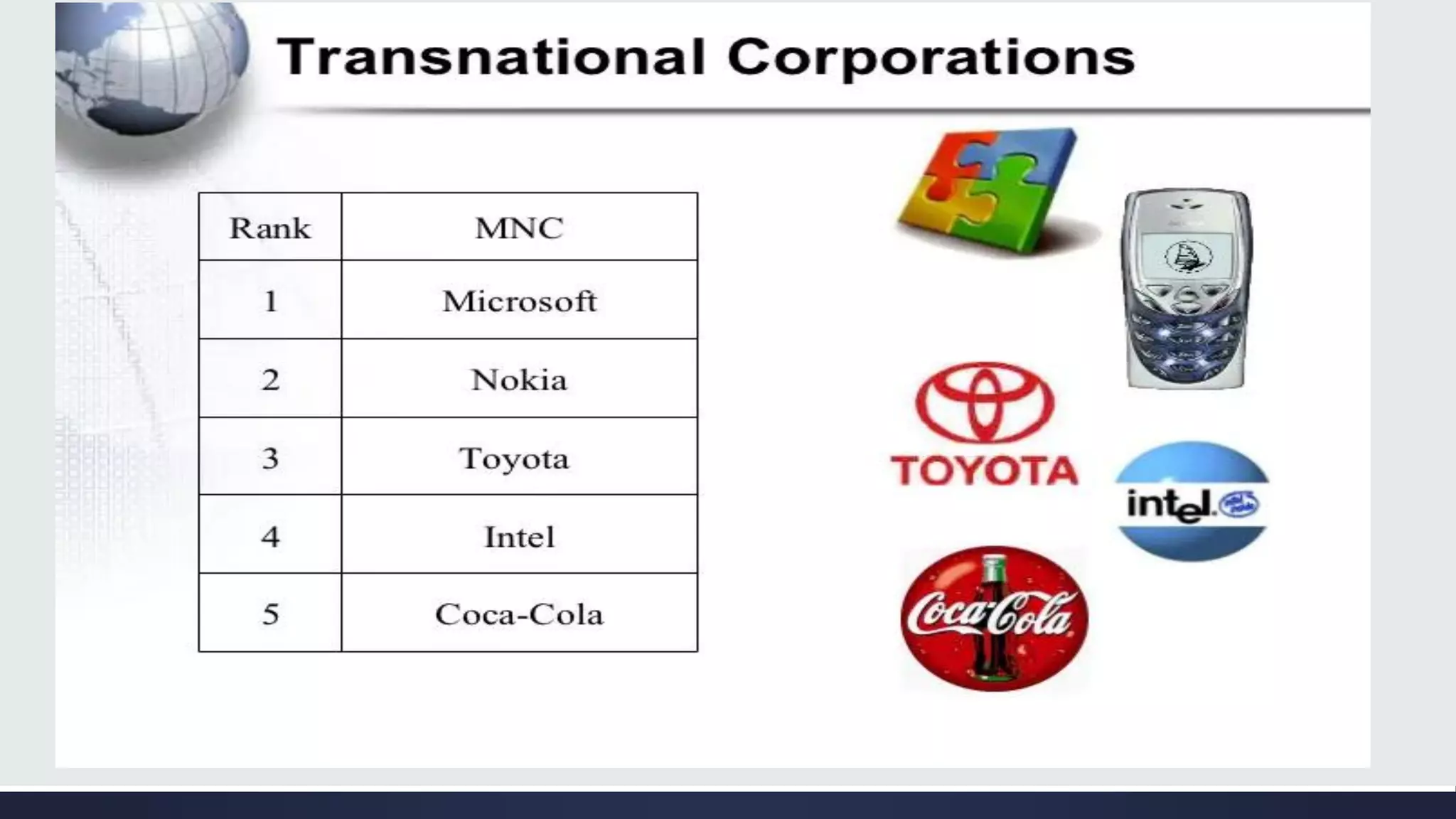
Multinational Corporation (MNC)
▪ known as global corporation
▪ entity that owns and controls production of
goods or services in one or more countries
aside from their home country.
▪ Ex. Procter and Game, Apple Inc, Nestle,
Jollibee, Microsoft, Coca Cola and etc.
Key Players/Actors in Globalization
Transnational Corporation (TNC)
▪ commercial enterprise that operates
substantial facilities that does business in
more than one country.
• Ex. Ford Motor, AXA,Vodafone Group,
Walmart, Starbucks,Toyota and etc
Key Players/Actors in Globalization
Transnational Corporation (TNC)
▪ commercial enterprise that operates
substantial facilities that does business in
more than one country.
• Ex. Ford Motor, AXA,Vodafone Group,
Walmart, Starbucks,Toyota and etc
Key Players/Actors in Globalization
Media
▪ Media are the communication outlets or tools
used to store and deliver information or data.
▪ The term refers to components of the mass
media communications industry, such as print
media, publishing, the news media,
photography, cinema, broadcasting (radio and
television), and advertising.
Key Players/Actors in Globalization
Multilateral Development Banks
▪ Multilateral development banks are
international financial institutions owned by
countries.
▪ These institutions provide loans, grants,
guarantee, private equity and technical
assistance to public and private sector
projects in developing countries
Key Players/Actors in Globalization
Nation-States
▪ Nation-states refer to a certain form of state
that derives its political legitimacy from
serving as a sovereign entity for a nation
within its sovereign territorial space.
ModernWorld-System
ModernWorld-System
▪ a social system that has boundaries, structures,
member groups, rules of legitimation and
coherence (ImmanuelWallerstein 1974)
ModernWorld-System
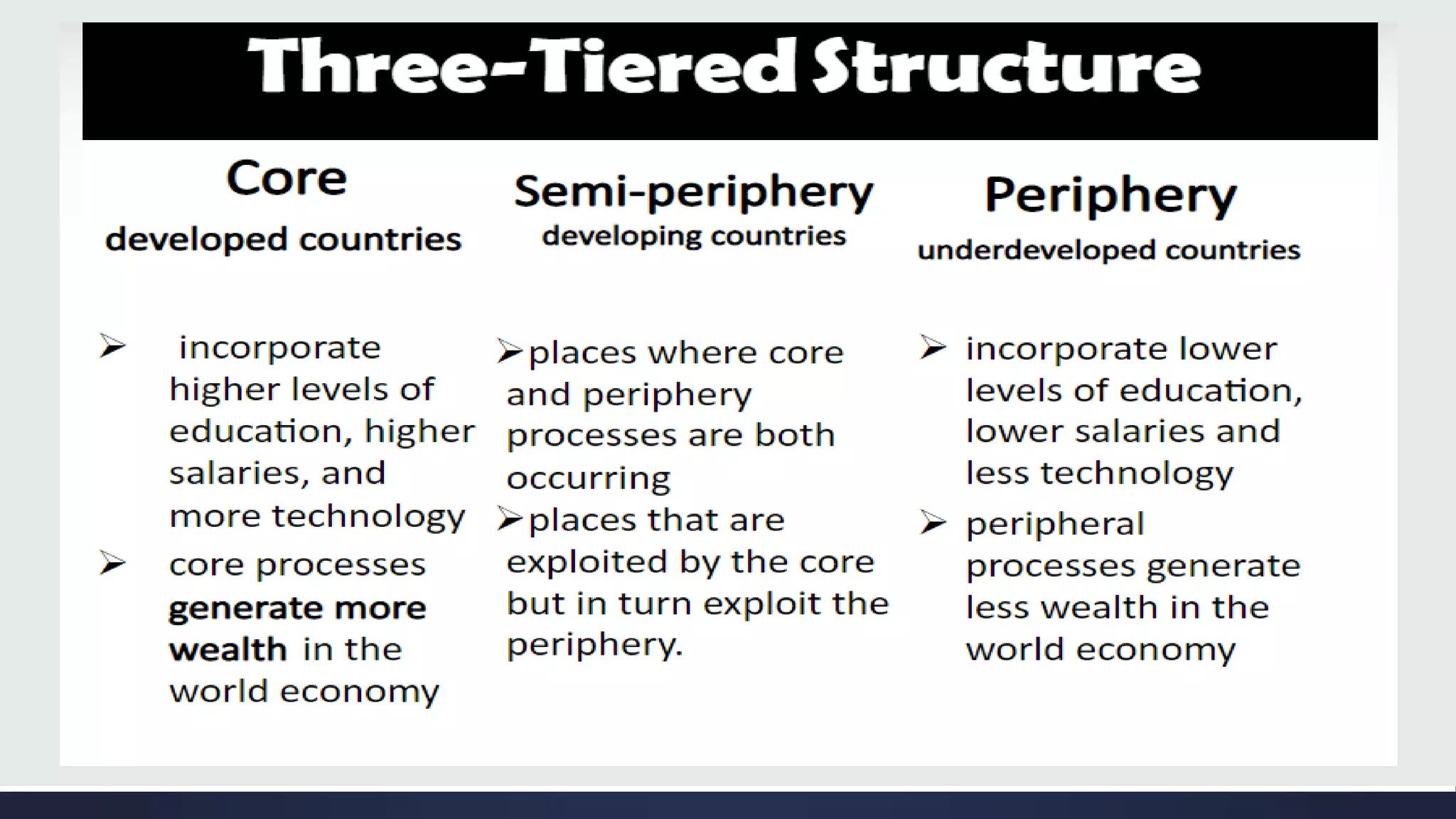
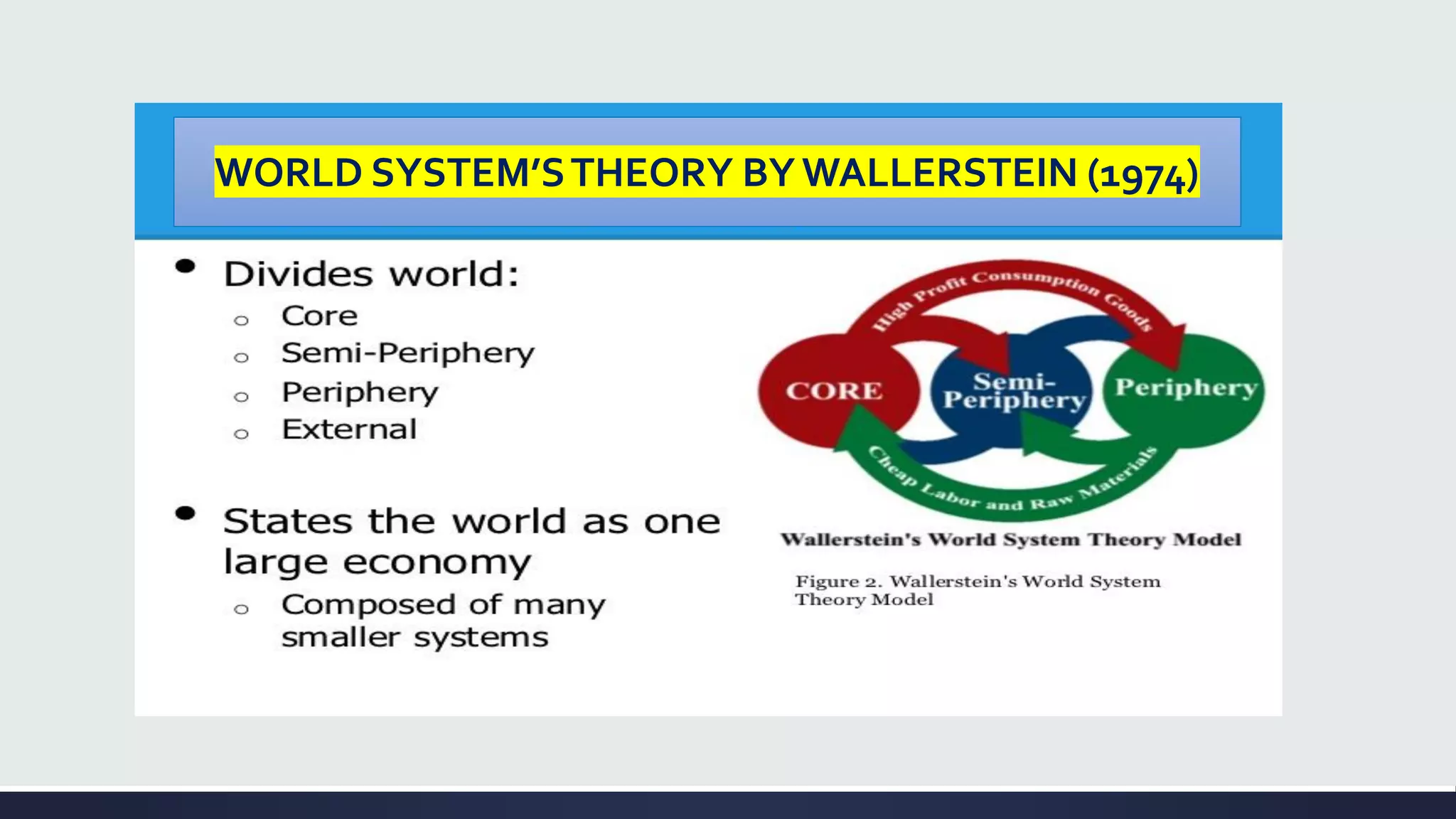
WORLD SYSTEM’STHEORY BYWALLERSTEIN (1974)
ModernWorld-System
The world-systems theory, developed by
sociologist ImmanuelWallerstein, is an approach
to world history and social change that suggests
there is a world economic system in which some
countries benefit while others are exploited.
What Is Economic Integration
▪ Economic integration is an arrangement among
nations that typically includes the reduction or
elimination of trade barriers and the
coordination of monetary and fiscal policies.
▪ Economic integration aims to reduce costs for
both consumers and producers and to increase
trade between the countries involved in the
agreement.
Add a SlideTitle
- 6
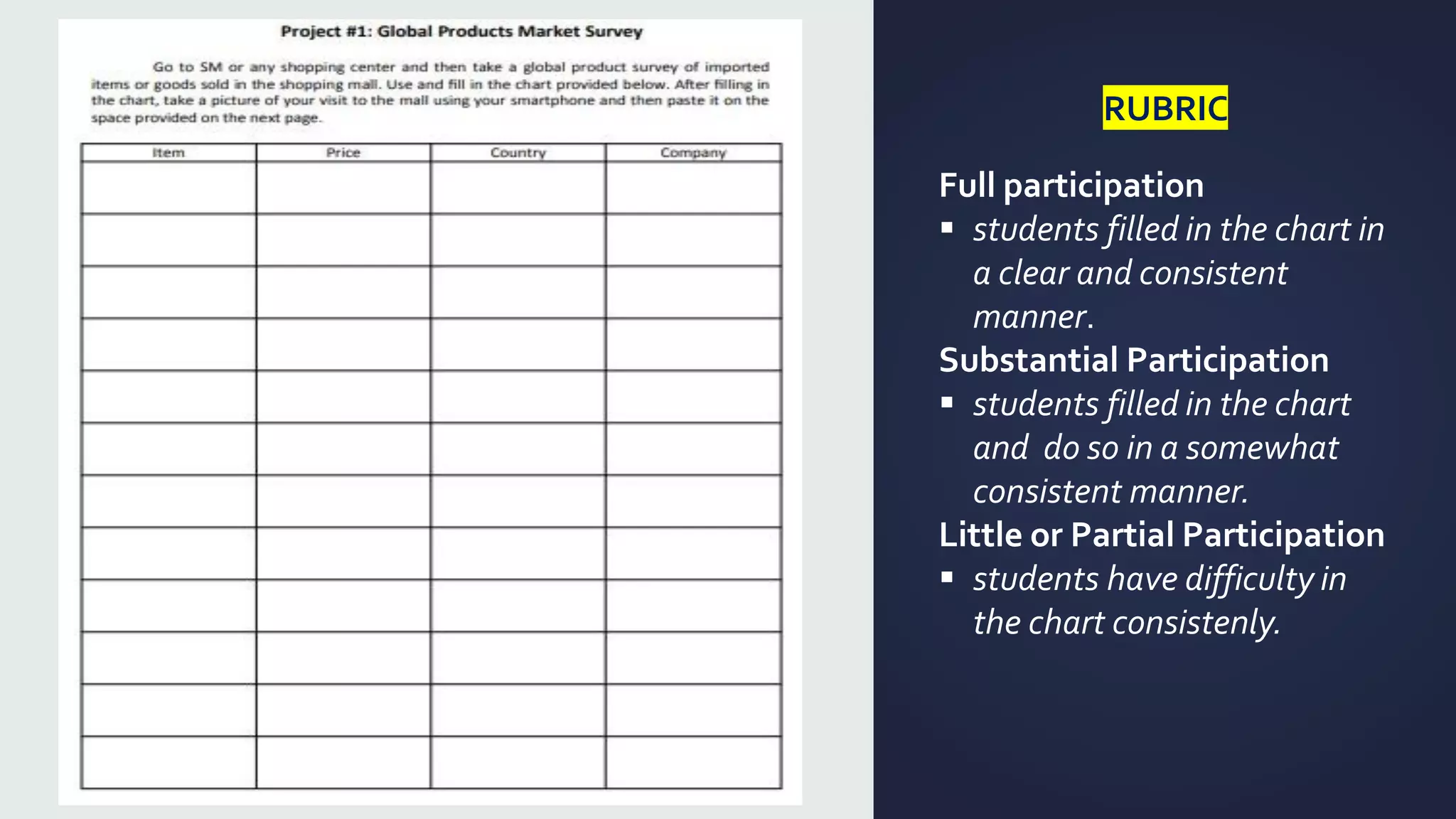
RUBRIC
Full participation
▪ students filled in the chart in
a clear and consistent
manner.
Substantial Participation
▪ students filled in the chart
and do so in a somewhat
consistent manner.
Little or Partial Participation
▪ students have difficulty in
the chart consistenly.

THE STRUCTURES OF GLOBALIZATION.pdf

  • 2.
    GLOBALIZATION Globalization is aprocess of interaction and integration among the people, companies, and governments of different nations, a process driven by international trade and investment and aided by information technology. This process has effects on the environment, on culture, on political systems. on economic development and prosperity, and on human physical well-being in societies around the world ("Globalization 101," n.d.).
  • 3.
    SIX CORE CLAIMSOF GLOBALISM 1. Globalization is about the liberalization and global integration of markets; 2. Globalization is inevitable and irreversible; 3. Nobody is in charge of globalization; 4. Globalization benefits everyone (i.e., in the long run); 5. Globalization furthers the spread of democracy in the world; and 6. Globalization requires a global war on terror.
  • 4.
    GLOBALIZATION IN ECONOMICS •Multinational corporations operate on a global scale, with satellite offices and branches in numerous locations. • Outsourcing can add to the economic development of a struggling country, bringing much needed jobs. • Some automobiles use parts from other countries, as in a car being assembled in the Philippines with the parts coming from Japan, Germany, or Korea. The Free World Trade Organization supervises world trade. • A dress with design inspired by the culture of Africa, made in South Korea, and sold in New York. • A bag made in China, sold in America, and brought to the Philippines as souvenir to expectant relatives.
  • 5.
    GLOBALIZATION INTHE BLENDINGOF CULTURES • Greek culture spread across Africa, Europe and Asia through Alexander the Great. This is the reason there are cities named for Alexander in Africa, Egypt and Turkey. • The Silk Road was a trade route between China and the Mediterranean Sea area and it allowed the exchange of not only goods, but culture and knowledge. Christian missionaries from Europe added to the globalization of Christianity.
  • 6.
    GLOBALIZATION INTHE BLENDINGOF CULTURES • Colonization all over the world was a major cause of globalization. • Improved travel facilitated the growth of globalization, as people moved for a better job, a better life, or fled from danger or oppression. • Food is one factor of globalization. One can find people eating sushi in Peru or Indian food in Europe. • Satellite television allows shows from one country to be broadcast in many others, adding to cultural globalization.
  • 7.
    GLOBALIZATION INTECHNOLOGY • TheInternet is a major contributor to globalization, not only technologically but in other areas as well, like in cultural exchanges of the arts. • Global news networks, like CNN, contribute to the spread of knowledge. Cells phones connect people all over the world like never before. Around 60 percent of all people in the world use cell phones.
  • 8.
    GLOBALIZATION INTECHNOLOGY • TheInternet is a major contributor to globalization, not only technologically but in other areas as well, like in cultural exchanges of the arts. • Global news networks, like CNN, contribute to the spread of knowledge. Cells phones connect people all over the world like never before. Around 60 percent of all people in the world use cell phones.
  • 9.
    THE STRUCTURES OFGLOBALIZATION
  • 10.
    GLOBAL ECONOMY ▪The GlobalEconomy ▪Key Players/Actors in Globalization ▪Modern World-System ▪Global Economic Integration
  • 11.
    The Global Economy EconomicGlobalization (Mohan 2009) ▪ refers to the free movement of goods, capital, services, technology and information. ▪ it results to an increasing economic integration and interdependence of national, regional, and local economics around the world by strengthening the cross-border movement of goods, technologies and capita
  • 12.
    Key Players/Actors inGlobalization International Organization ▪ Promotes voluntary cooperation and coordination between or among members (McCornick 1999) ▪ categorized either Intergovernmental or Supranational organizations
  • 13.
    Key Players/Actors inGlobalization Intergovernmental Organizations (IGO) ▪ composed of nation-states that promote voluntarily cooperation and coordination among its members. Supranational Organizations ▪ Member states either global or regional, they surrender their power in specific areas to the higher organization ▪ this is an entity where member states formed for mutual benefit and in pursuit of shared goals
  • 14.
    Key Players/Actors inGlobalization International Non-governmental Organizations ▪ tries to help in alleviating the problems as hunger, disease, illiteracy and inequalities.
  • 15.
    Key Players/Actors inGlobalization Large Manufacturing Corporation ▪ consist of multinationals and transnationals ▪ these corporations sells goods and manufactured products
  • 16.
    Key Players/Actors inGlobalization Multinational Corporation (MNC) ▪ known as global corporation ▪ entity that owns and controls production of goods or services in one or more countries aside from their home country. ▪ Ex. Procter and Game, Apple Inc, Nestle, Jollibee, Microsoft, Coca Cola and etc.
  • 17.
    Key Players/Actors inGlobalization Transnational Corporation (TNC) ▪ commercial enterprise that operates substantial facilities that does business in more than one country. • Ex. Ford Motor, AXA,Vodafone Group, Walmart, Starbucks,Toyota and etc
  • 19.
    Key Players/Actors inGlobalization Transnational Corporation (TNC) ▪ commercial enterprise that operates substantial facilities that does business in more than one country. • Ex. Ford Motor, AXA,Vodafone Group, Walmart, Starbucks,Toyota and etc
  • 20.
    Key Players/Actors inGlobalization Media ▪ Media are the communication outlets or tools used to store and deliver information or data. ▪ The term refers to components of the mass media communications industry, such as print media, publishing, the news media, photography, cinema, broadcasting (radio and television), and advertising.
  • 21.
    Key Players/Actors inGlobalization Multilateral Development Banks ▪ Multilateral development banks are international financial institutions owned by countries. ▪ These institutions provide loans, grants, guarantee, private equity and technical assistance to public and private sector projects in developing countries
  • 22.
    Key Players/Actors inGlobalization Nation-States ▪ Nation-states refer to a certain form of state that derives its political legitimacy from serving as a sovereign entity for a nation within its sovereign territorial space.
  • 23.
    ModernWorld-System ModernWorld-System ▪ a socialsystem that has boundaries, structures, member groups, rules of legitimation and coherence (ImmanuelWallerstein 1974)
  • 24.
  • 25.
  • 26.
    ModernWorld-System The world-systems theory,developed by sociologist ImmanuelWallerstein, is an approach to world history and social change that suggests there is a world economic system in which some countries benefit while others are exploited.
  • 27.
    What Is EconomicIntegration ▪ Economic integration is an arrangement among nations that typically includes the reduction or elimination of trade barriers and the coordination of monetary and fiscal policies. ▪ Economic integration aims to reduce costs for both consumers and producers and to increase trade between the countries involved in the agreement.
  • 28.
  • 29.
    RUBRIC Full participation ▪ studentsfilled in the chart in a clear and consistent manner. Substantial Participation ▪ students filled in the chart and do so in a somewhat consistent manner. Little or Partial Participation ▪ students have difficulty in the chart consistenly.