Disclaimer:
•Any views or opinions presented in this video are
personal and belong solely to the content creator
and do not represent of those people,
institutions, or organizations that the content
creator may or may not be associated with in
professional or personal capacity, unless
explicitly stated. Any views or opinions are not
intended to malign any religion, ethnic group,
club, organization, company, or individual.
The Globalization of
Religion
Sir Malit
Religion is perhaps the most difficult subject to study from
an objective point of view. Some people are deeply
committed to their own religious beliefs and are not
interested in examining alternative view that they believe
are “weird” threatening, or utterly ridiculous. Others do not
believe in supernatural beings and are skeptical of
sociology’s concern with matters that appear to be beyond
the realms of science.
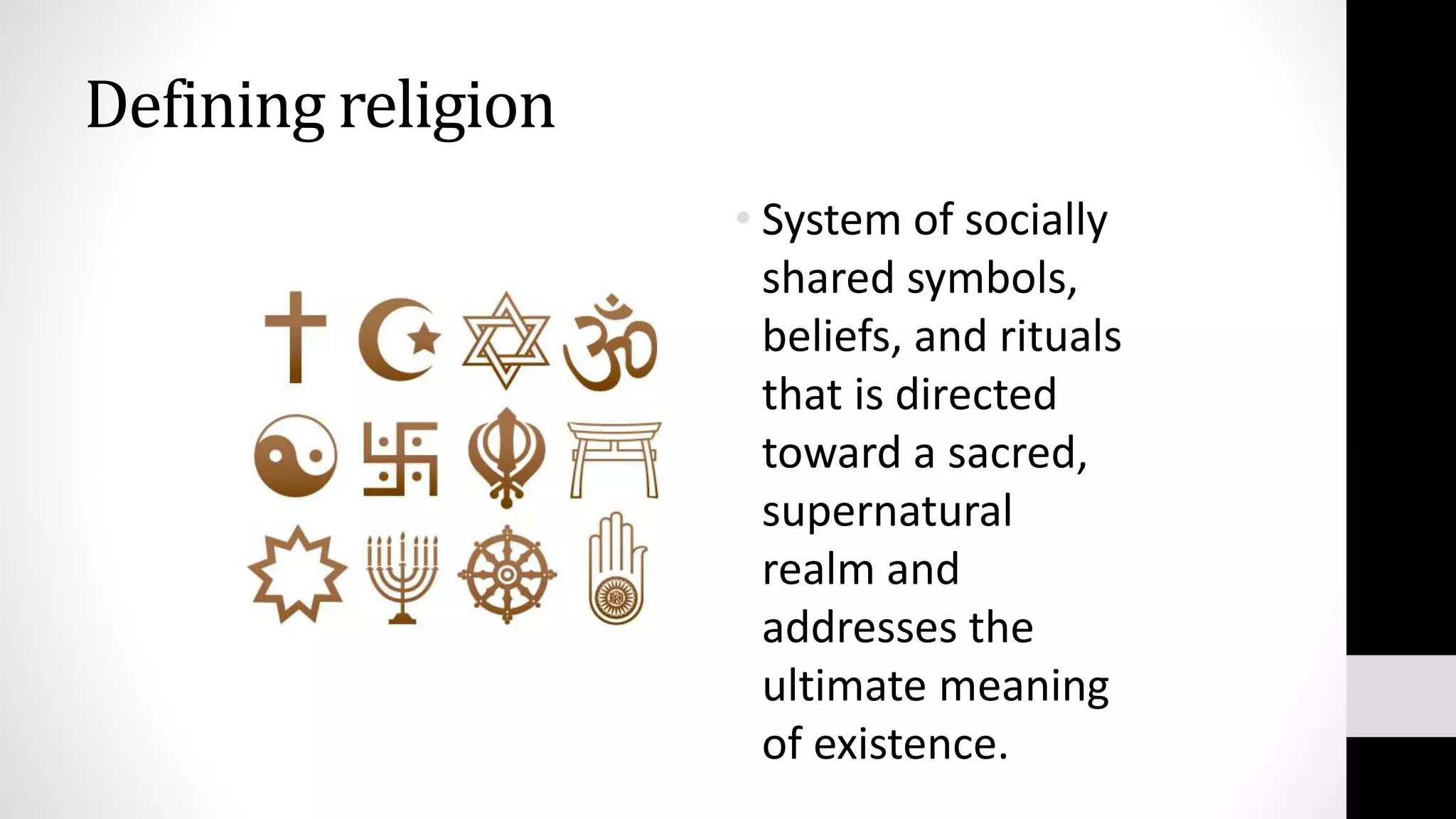
Defining religion
• System of socially
shared symbols,
beliefs, and rituals
that is directed
toward a sacred,
supernatural
realm and
addresses the
ultimate meaning
of existence.
VARIETIES OF RELIGION
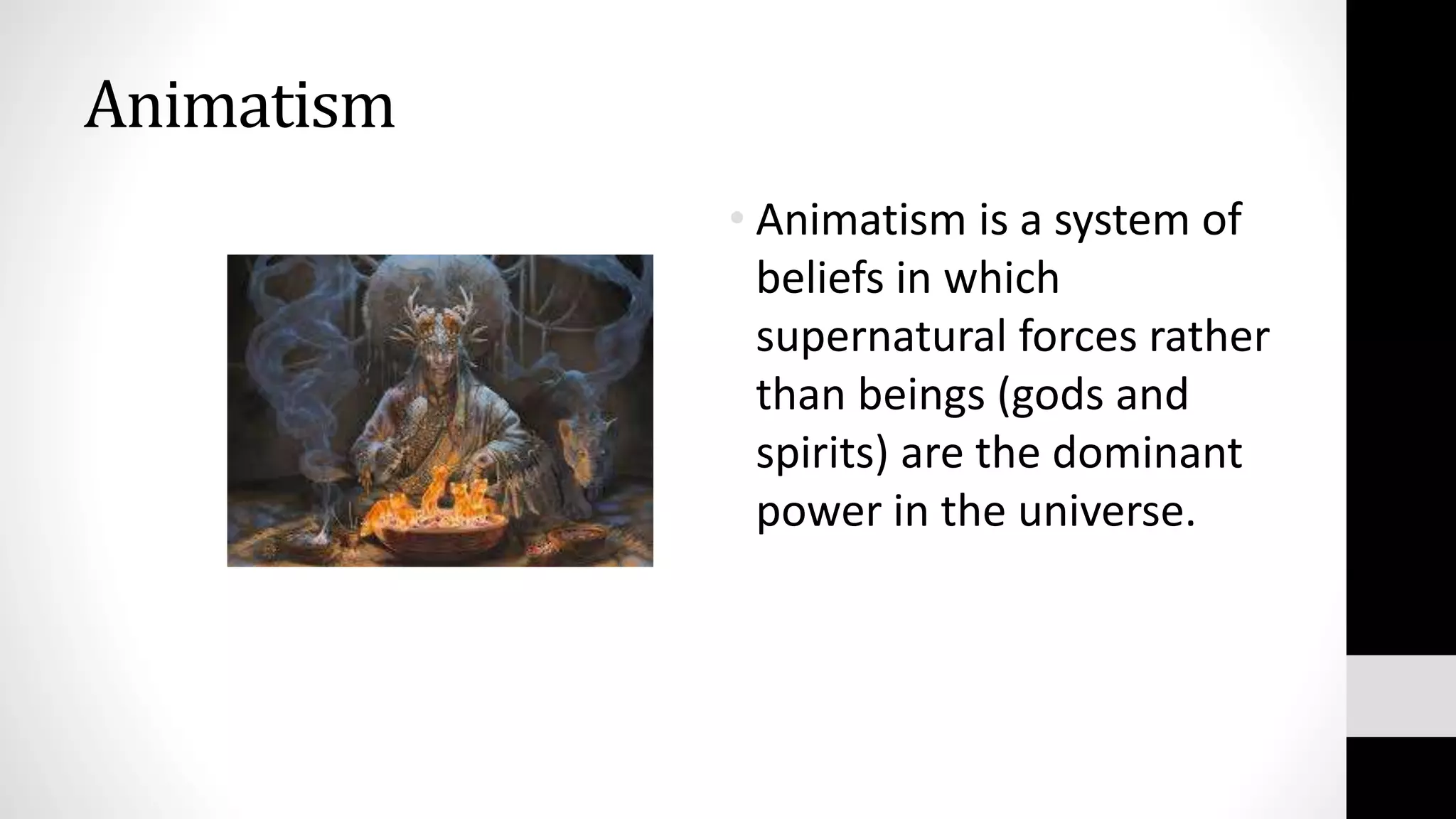
Animatism
• Animatism is a system of
beliefs in which
supernatural forces rather
than beings (gods and
spirits) are the dominant
power in the universe.
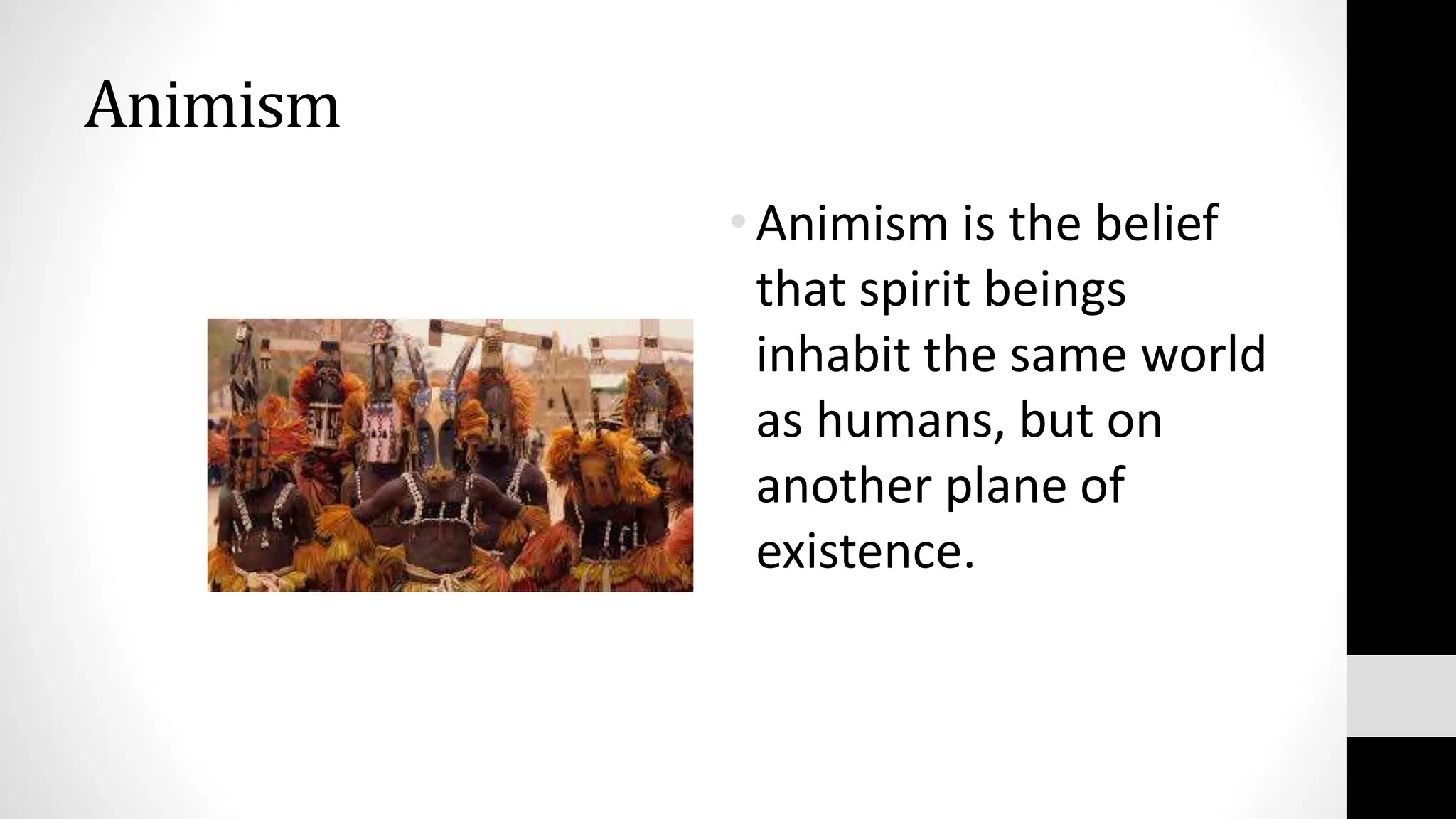
Animism
•Animism is the belief
that spirit beings
inhabit the same world
as humans, but on
another plane of
existence.
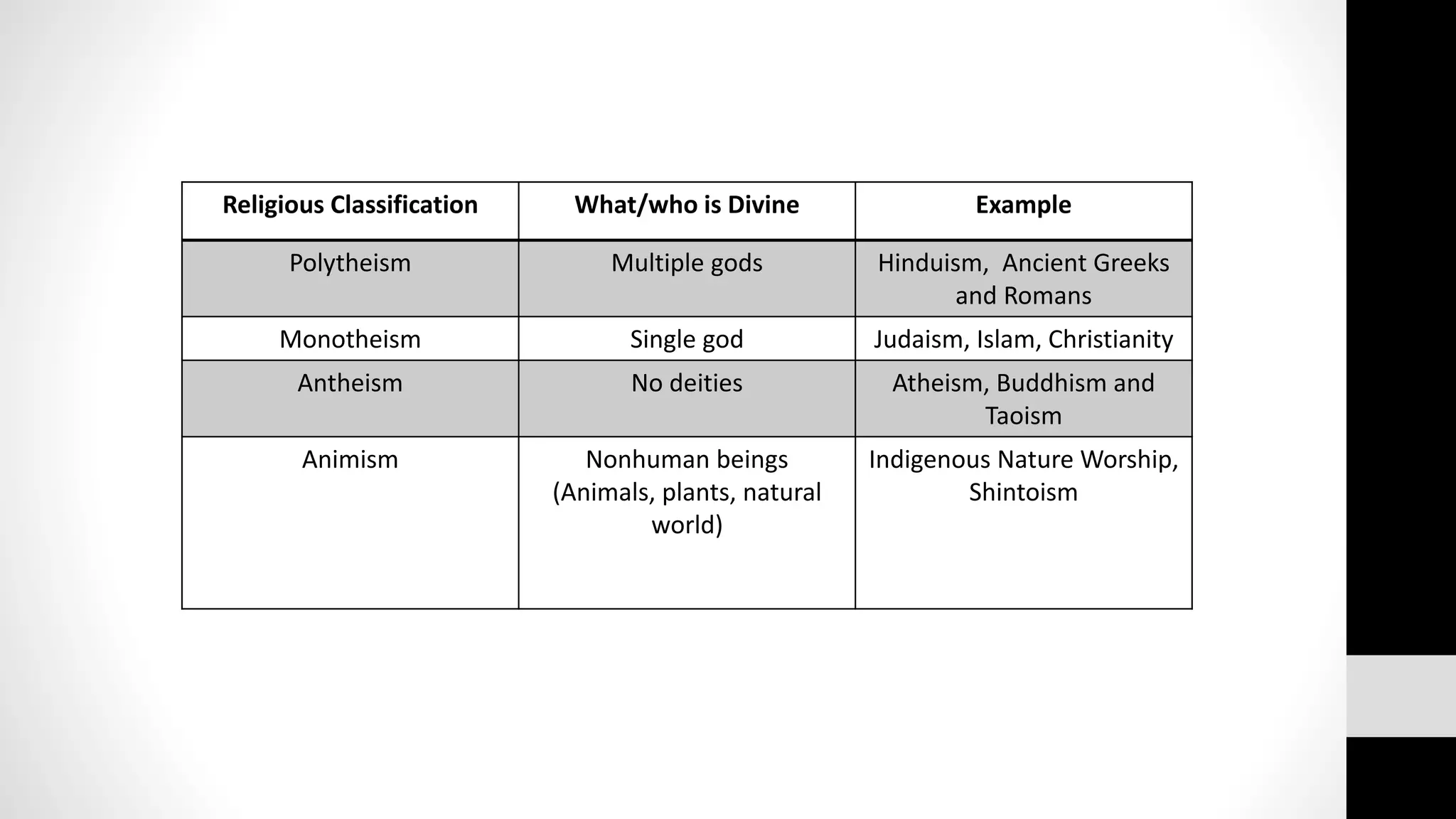
Religious Classification What/who is Divine Example
Polytheism Multiple gods Hinduism, Ancient Greeks
and Romans
Monotheism Single god Judaism, Islam, Christianity
Antheism No deities Atheism, Buddhism and
Taoism
Animism Nonhuman beings
(Animals, plants, natural
world)
Indigenous Nature Worship,
Shintoism
Social organizations of religion
• The idea of religious visionaries can capture the public
imagination and inspire change, even social revolution.
But in the long run, the relative influence of any religion
depends on religious communities that are organized to
promote religious ideals and objectives. Sociologist
classify religious organizations into four ideal types-
ecclesia, denomination, sect, and cult.
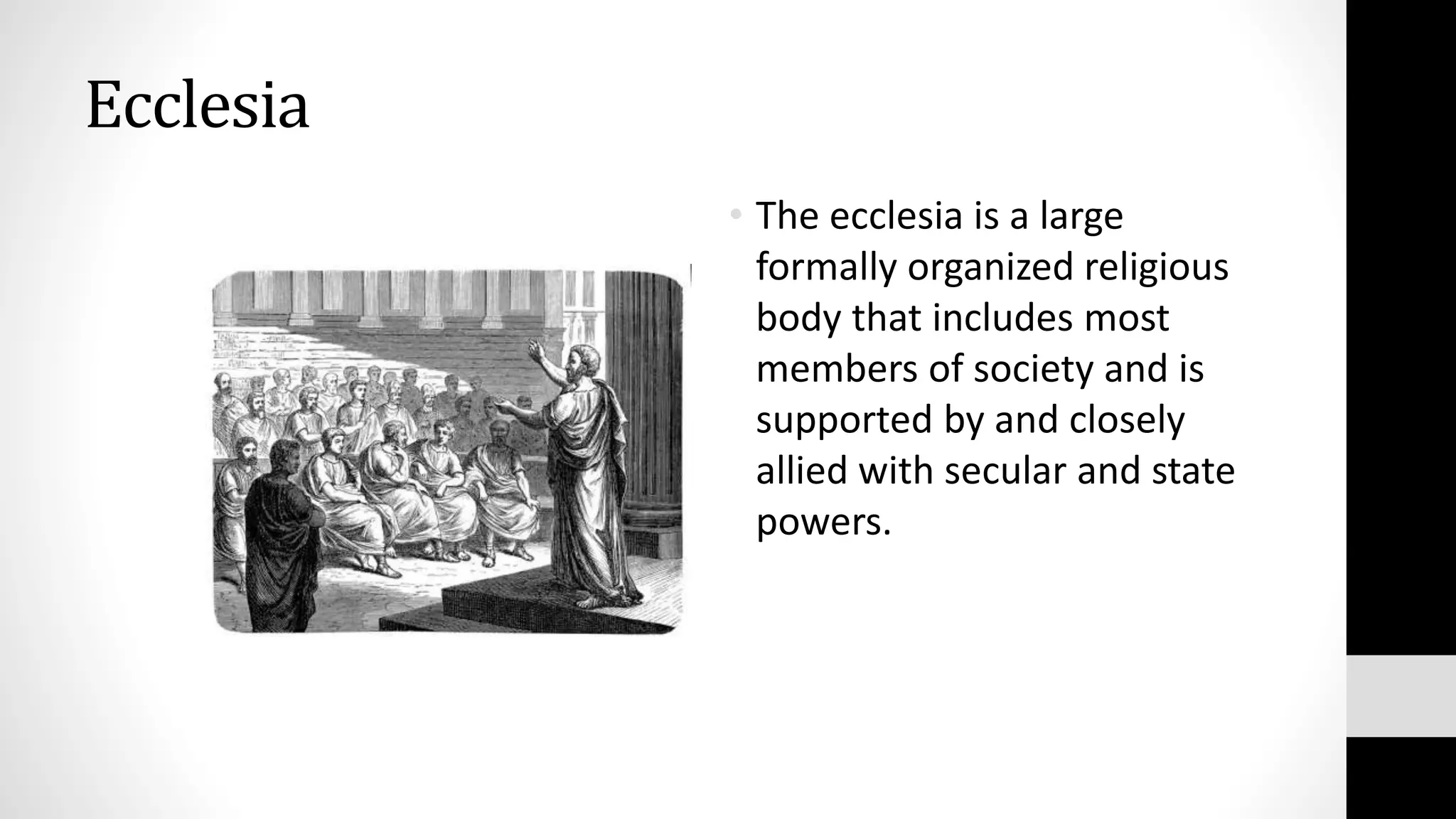
Ecclesia
• The ecclesia is a large
formally organized religious
body that includes most
members of society and is
supported by and closely
allied with secular and state
powers.
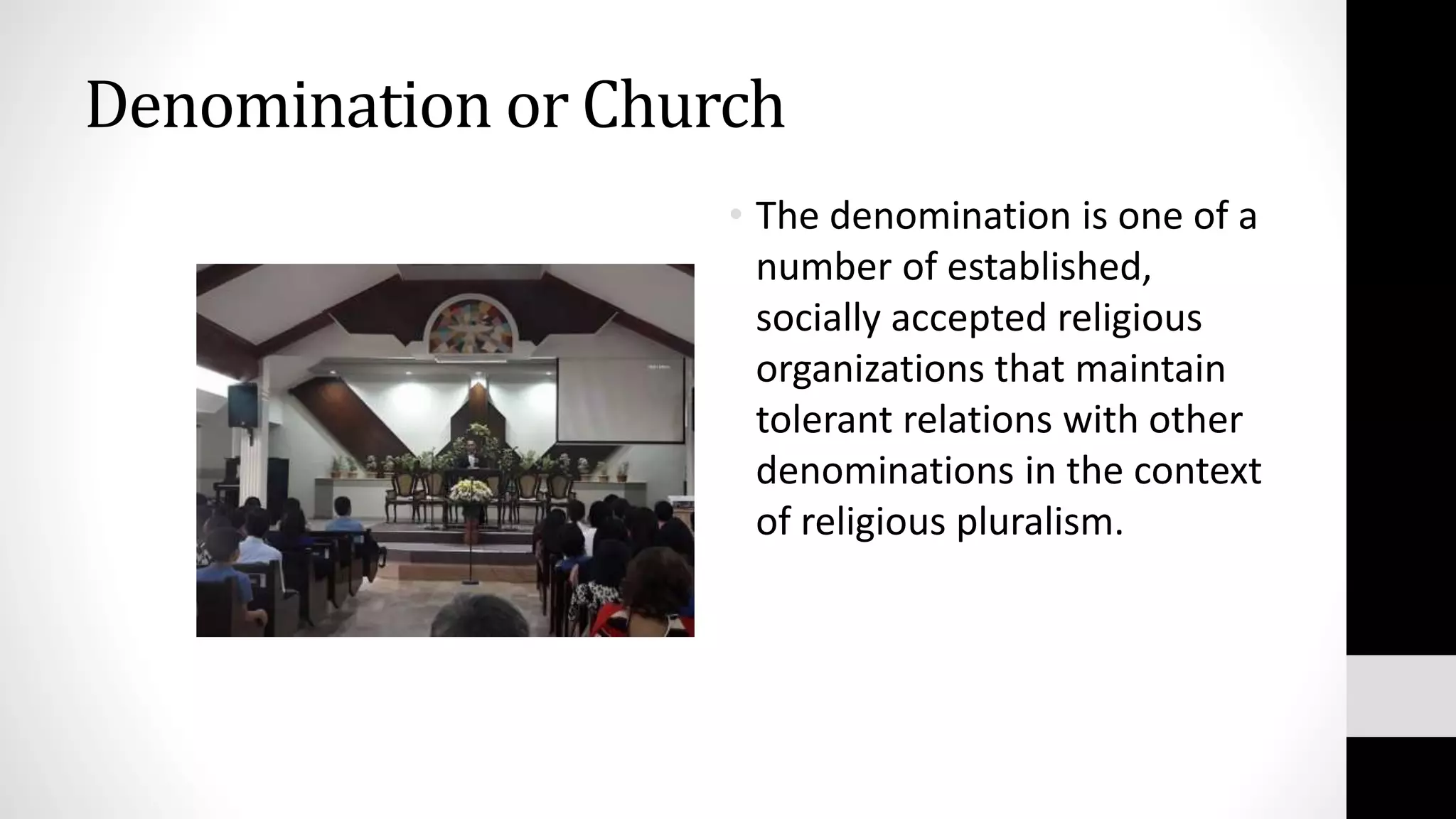
Denomination or Church
• The denomination is one of a
number of established,
socially accepted religious
organizations that maintain
tolerant relations with other
denominations in the context
of religious pluralism.
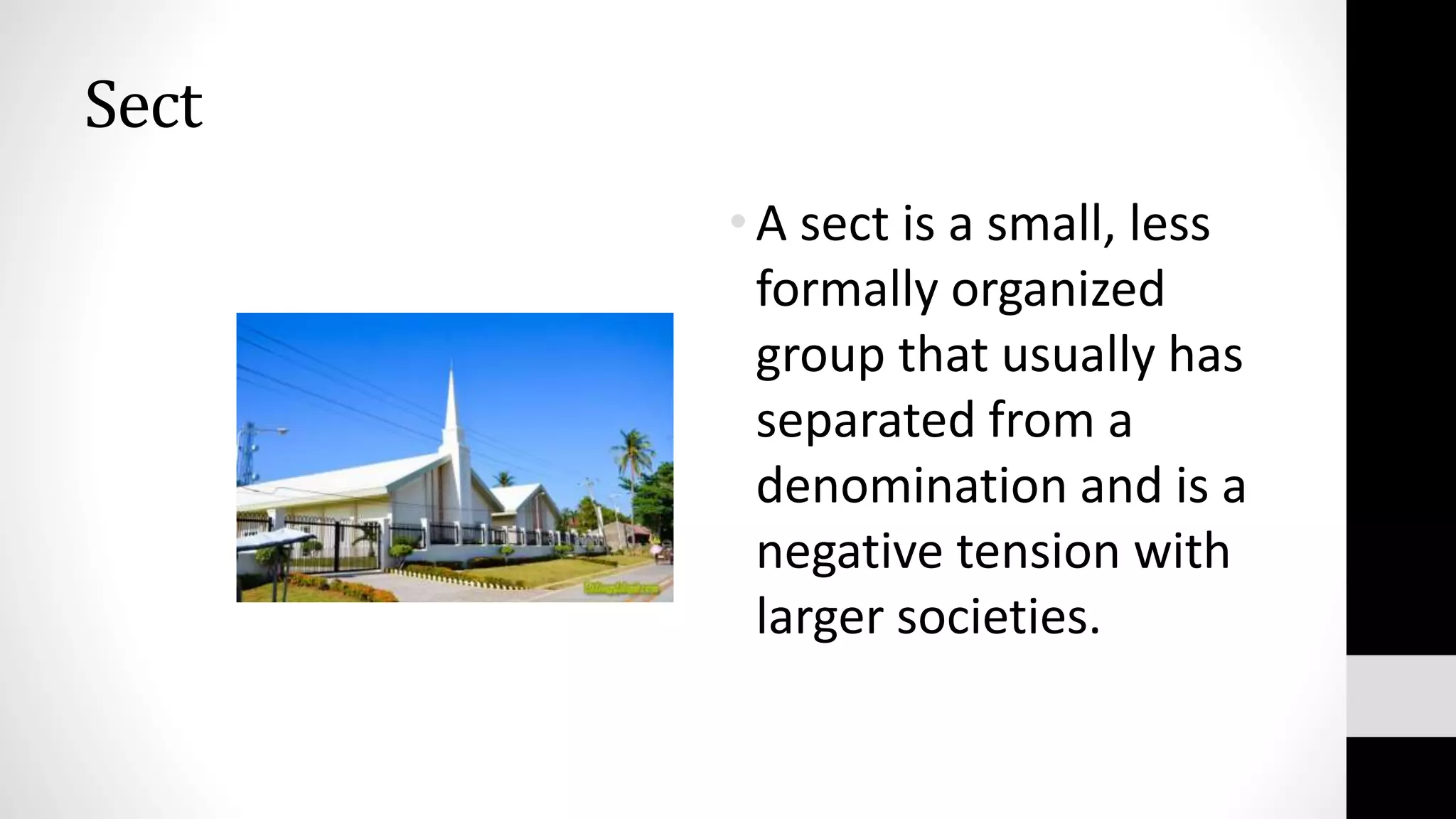
Sect
•A sect is a small, less
formally organized
group that usually has
separated from a
denomination and is a
negative tension with
larger societies.
New Religious Movement
•A new religious movement (cult) is a
loosely organized and transient religious
organization that includes religious beliefs
and practices that are considered novel
and at odds with a society’s religious
tradition.
Some cults
Church of Flying Spaghetti Monster Church of Scientology
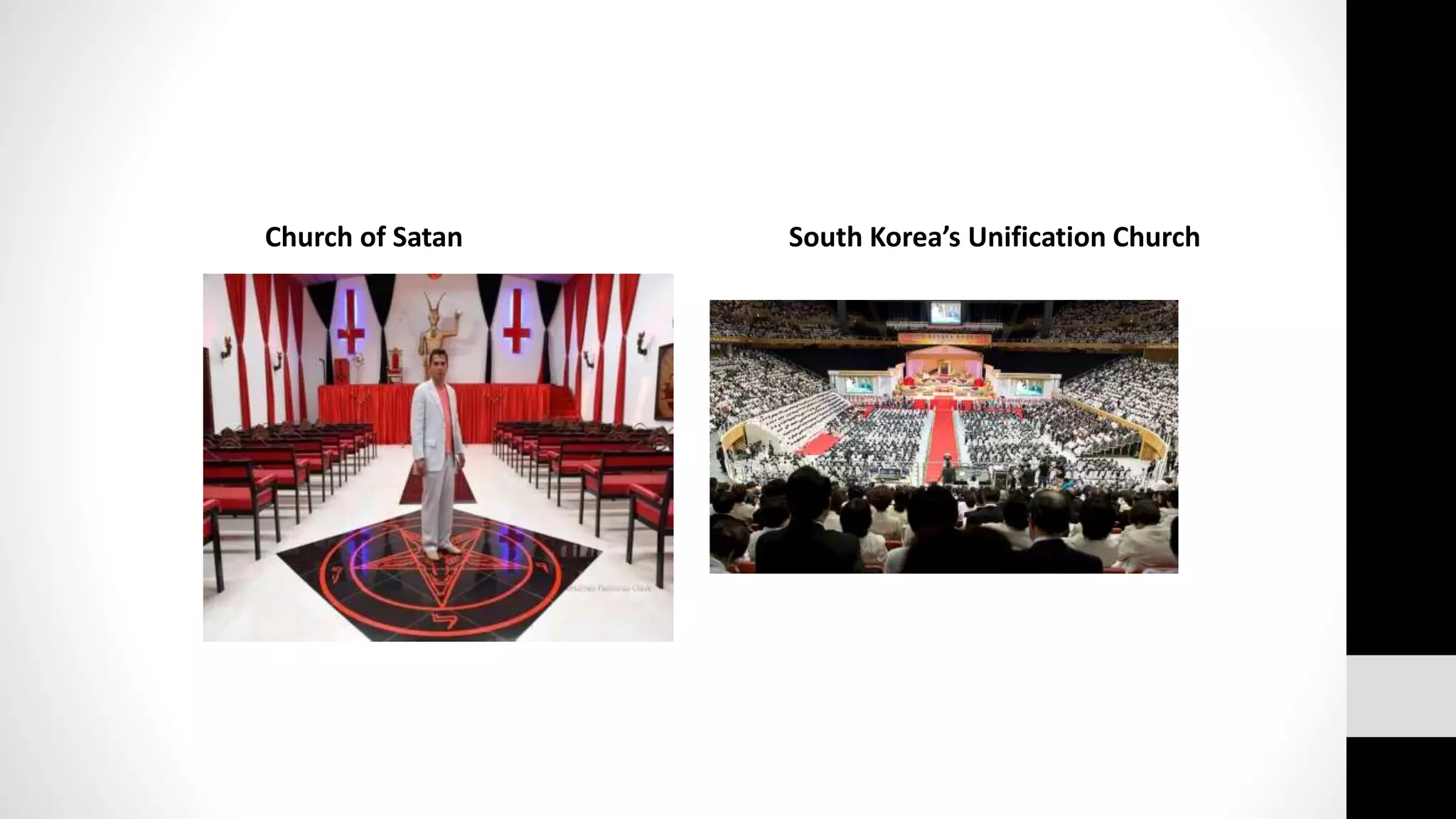
Church of Satan South Korea’s Unification Church
Kingdom of Jesus Christ
(Philippines)
RELIGION AND SOCIETY
Religion and Functionalism
1. Religion can promote social solidarity through
common symbols, belief, norms, and collective
rituals.
2. It may provide also provide individuals and groups
with emotional comfort and support, morale and
motivation, and a sense of individual and group
identity.
3. All societies through religion require collectively
and rituals for their cohesion and survival.
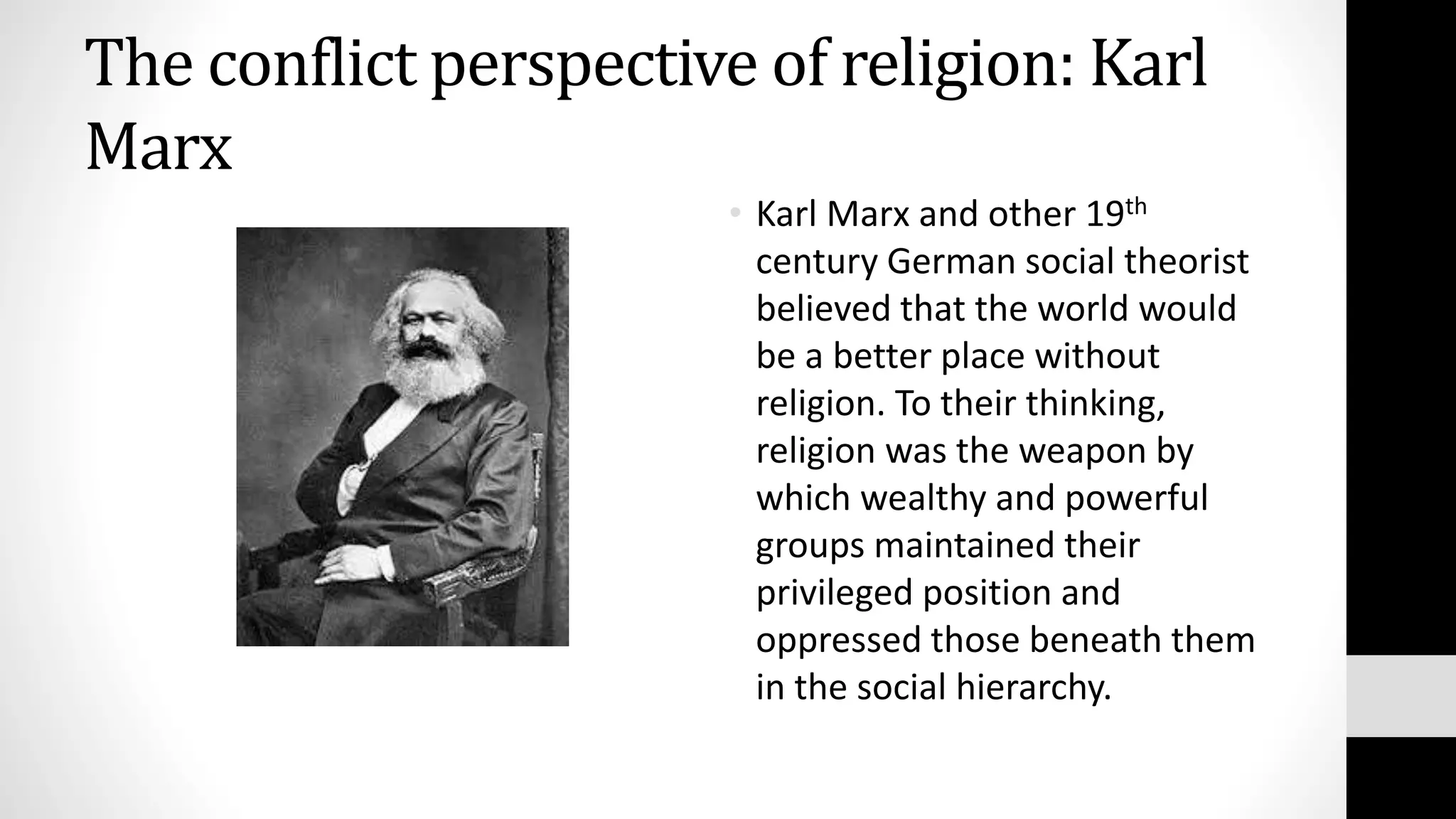
The conflict perspective of religion: Karl
Marx
• Karl Marx and other 19th
century German social theorist
believed that the world would
be a better place without
religion. To their thinking,
religion was the weapon by
which wealthy and powerful
groups maintained their
privileged position and
oppressed those beneath them
in the social hierarchy.
KarlMarx
“Religion is the sigh of the
oppressed creature, the sentiment
of a heartless world, and the soul of
soulless conditions. It is the opium
of the people.”
Religion and Social Change: Max Weber
• Max weber’s comprehensive
study of religions worldwide
revealed that while some
were fact highly conservative,
others- in particular,
Protestants and Puritanism in
Western Europe and America-
inspired major social and
economic movements.
Secularization and Religious Movements
•Rodney Stark (1990, p. 201) argued that during the
past century, only one social science thesis had
near universal acceptance: the secularization thesis,
which maintains that the global spread of
modernization and of more rational and pragmatic
approaches to life inevitably leads to the decline of
small-scale societies that are based on traditional
and religious worldviews.
Trivia Time
• Did you know that Desmond
Doss (who was once awarded
with the congressional Medal of
Honor for rescuing at least 75
men on the Hacksaw Ridge in
the Battle of Okinawa and was
known to be a conscientious
objector) is a Seventh-day
Adventist. He refused to bear
arms and did not allow himself
to go out on Saturday.

The globalization of religion

  • 1.
    Disclaimer: •Any views oropinions presented in this video are personal and belong solely to the content creator and do not represent of those people, institutions, or organizations that the content creator may or may not be associated with in professional or personal capacity, unless explicitly stated. Any views or opinions are not intended to malign any religion, ethnic group, club, organization, company, or individual.
  • 2.
  • 3.
    Religion is perhapsthe most difficult subject to study from an objective point of view. Some people are deeply committed to their own religious beliefs and are not interested in examining alternative view that they believe are “weird” threatening, or utterly ridiculous. Others do not believe in supernatural beings and are skeptical of sociology’s concern with matters that appear to be beyond the realms of science.
  • 4.
    Defining religion • Systemof socially shared symbols, beliefs, and rituals that is directed toward a sacred, supernatural realm and addresses the ultimate meaning of existence.
  • 5.
  • 6.
    Animatism • Animatism isa system of beliefs in which supernatural forces rather than beings (gods and spirits) are the dominant power in the universe.
  • 7.
    Animism •Animism is thebelief that spirit beings inhabit the same world as humans, but on another plane of existence.
  • 10.
    Religious Classification What/whois Divine Example Polytheism Multiple gods Hinduism, Ancient Greeks and Romans Monotheism Single god Judaism, Islam, Christianity Antheism No deities Atheism, Buddhism and Taoism Animism Nonhuman beings (Animals, plants, natural world) Indigenous Nature Worship, Shintoism
  • 11.
    Social organizations ofreligion • The idea of religious visionaries can capture the public imagination and inspire change, even social revolution. But in the long run, the relative influence of any religion depends on religious communities that are organized to promote religious ideals and objectives. Sociologist classify religious organizations into four ideal types- ecclesia, denomination, sect, and cult.
  • 12.
    Ecclesia • The ecclesiais a large formally organized religious body that includes most members of society and is supported by and closely allied with secular and state powers.
  • 13.
    Denomination or Church •The denomination is one of a number of established, socially accepted religious organizations that maintain tolerant relations with other denominations in the context of religious pluralism.
  • 14.
    Sect •A sect isa small, less formally organized group that usually has separated from a denomination and is a negative tension with larger societies.
  • 15.
    New Religious Movement •Anew religious movement (cult) is a loosely organized and transient religious organization that includes religious beliefs and practices that are considered novel and at odds with a society’s religious tradition.
  • 16.
    Some cults Church ofFlying Spaghetti Monster Church of Scientology
  • 17.
    Church of SatanSouth Korea’s Unification Church
  • 18.
    Kingdom of JesusChrist (Philippines)
  • 19.
  • 20.
    Religion and Functionalism 1.Religion can promote social solidarity through common symbols, belief, norms, and collective rituals. 2. It may provide also provide individuals and groups with emotional comfort and support, morale and motivation, and a sense of individual and group identity. 3. All societies through religion require collectively and rituals for their cohesion and survival.
  • 21.
    The conflict perspectiveof religion: Karl Marx • Karl Marx and other 19th century German social theorist believed that the world would be a better place without religion. To their thinking, religion was the weapon by which wealthy and powerful groups maintained their privileged position and oppressed those beneath them in the social hierarchy.
  • 22.
    KarlMarx “Religion is thesigh of the oppressed creature, the sentiment of a heartless world, and the soul of soulless conditions. It is the opium of the people.”
  • 23.
    Religion and SocialChange: Max Weber • Max weber’s comprehensive study of religions worldwide revealed that while some were fact highly conservative, others- in particular, Protestants and Puritanism in Western Europe and America- inspired major social and economic movements.
  • 24.
    Secularization and ReligiousMovements •Rodney Stark (1990, p. 201) argued that during the past century, only one social science thesis had near universal acceptance: the secularization thesis, which maintains that the global spread of modernization and of more rational and pragmatic approaches to life inevitably leads to the decline of small-scale societies that are based on traditional and religious worldviews.
  • 25.
    Trivia Time • Didyou know that Desmond Doss (who was once awarded with the congressional Medal of Honor for rescuing at least 75 men on the Hacksaw Ridge in the Battle of Okinawa and was known to be a conscientious objector) is a Seventh-day Adventist. He refused to bear arms and did not allow himself to go out on Saturday.