



MARKET EQUILIBRIUM
         AND
APPLICATION OF DEMAND
  AND SUPPLY THEORY
MARKET EQUILIBRIUM
• Equilibrium is the unique price and
quantity established at the intersection
of the supply and the demand curves.
• Only at equilibrium does quantity
demanded equal quantity supplied.

                                      2
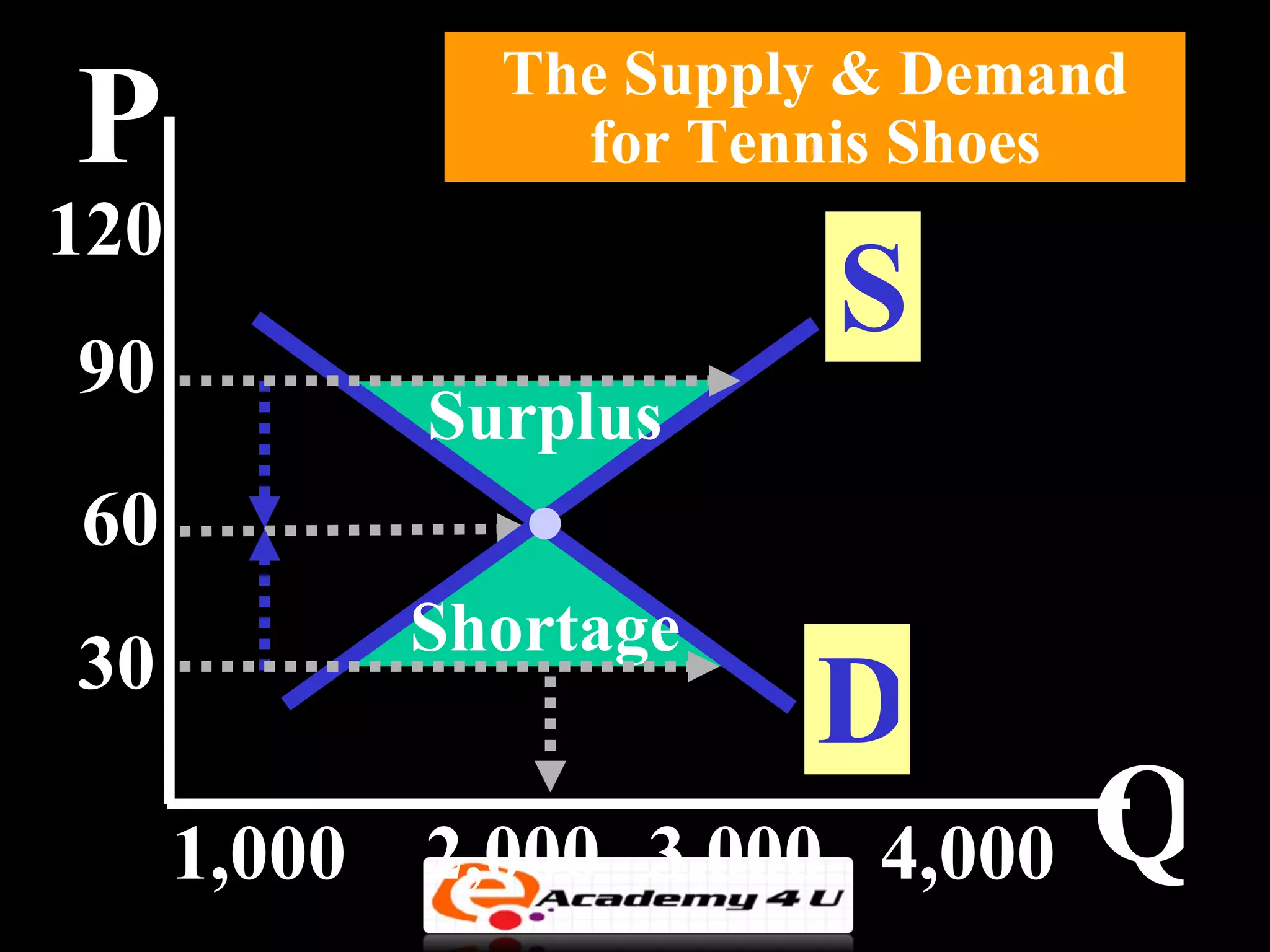
P               The Supply & Demand
                  for Tennis Shoes
120
90
                          S
              Surplus
60
              Shortage
30
                         D
      1,000   2,000 3,000 4,000   Q
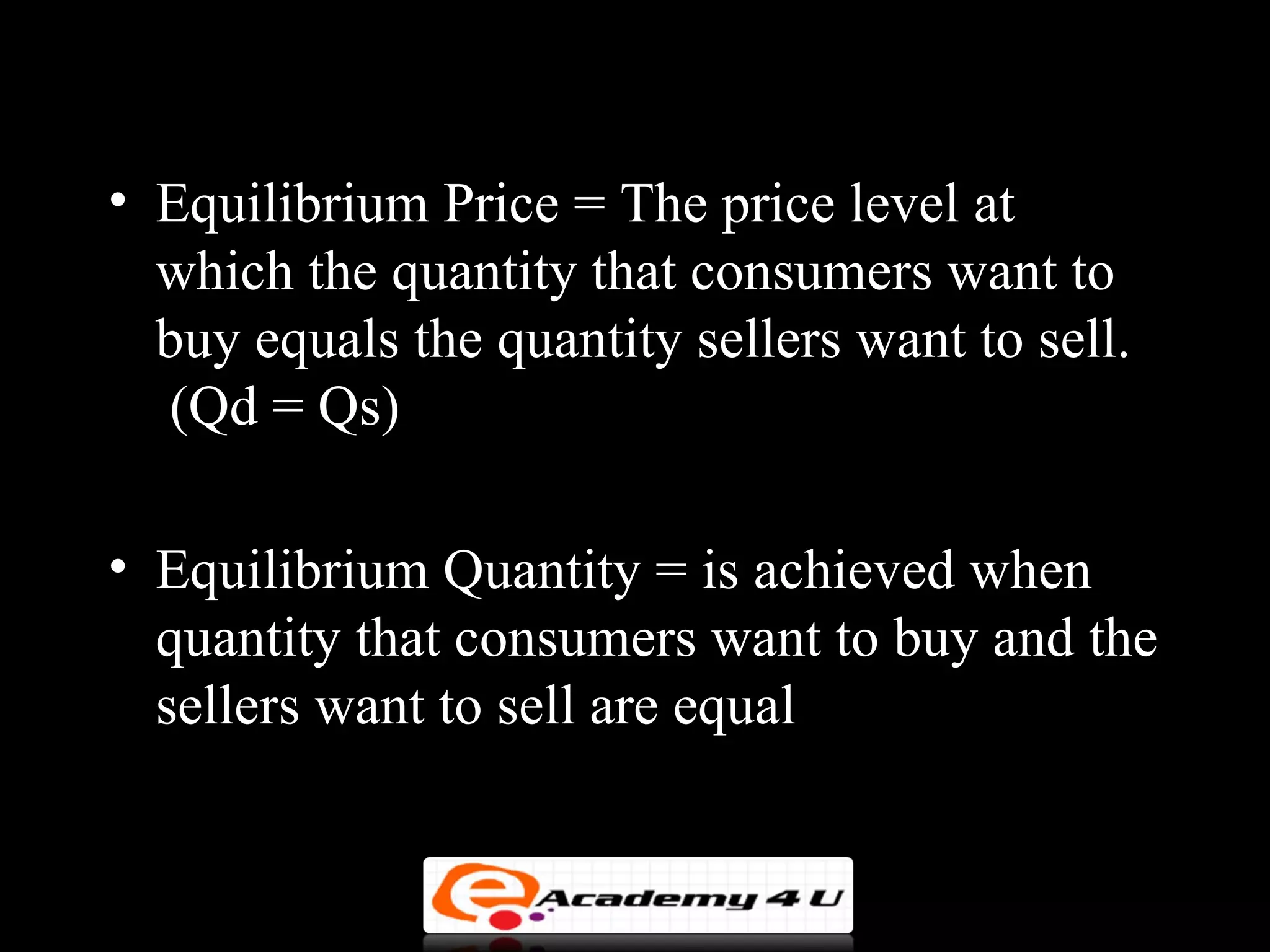
• Equilibrium Price = The price level at
  which the quantity that consumers want to
  buy equals the quantity sellers want to sell.
  (Qd = Qs)

• Equilibrium Quantity = is achieved when
  quantity that consumers want to buy and the
  sellers want to sell are equal
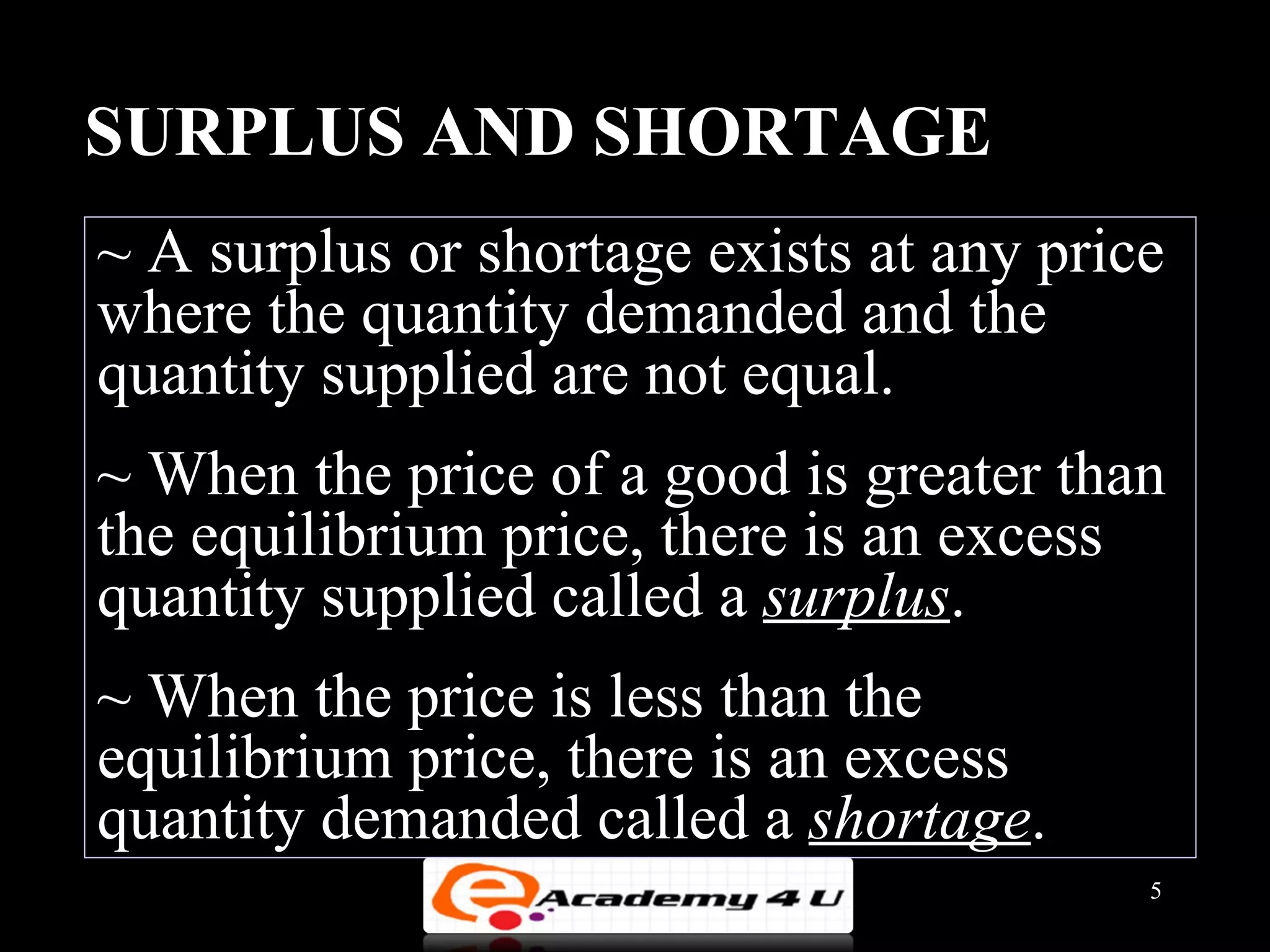
SURPLUS AND SHORTAGE
~ A surplus or shortage exists at any price
where the quantity demanded and the
quantity supplied are not equal.
~ When the price of a good is greater than
the equilibrium price, there is an excess
quantity supplied called a surplus.
~ When the price is less than the
equilibrium price, there is an excess
quantity demanded called a shortage.
                                          5
What can cause a shift in
   a Demand Curve?
1. Number of buyers in the market
2. Tastes and preferences
3. Income
4. Expectations of consumers
5. Prices of related goods
6. Seasonal factors
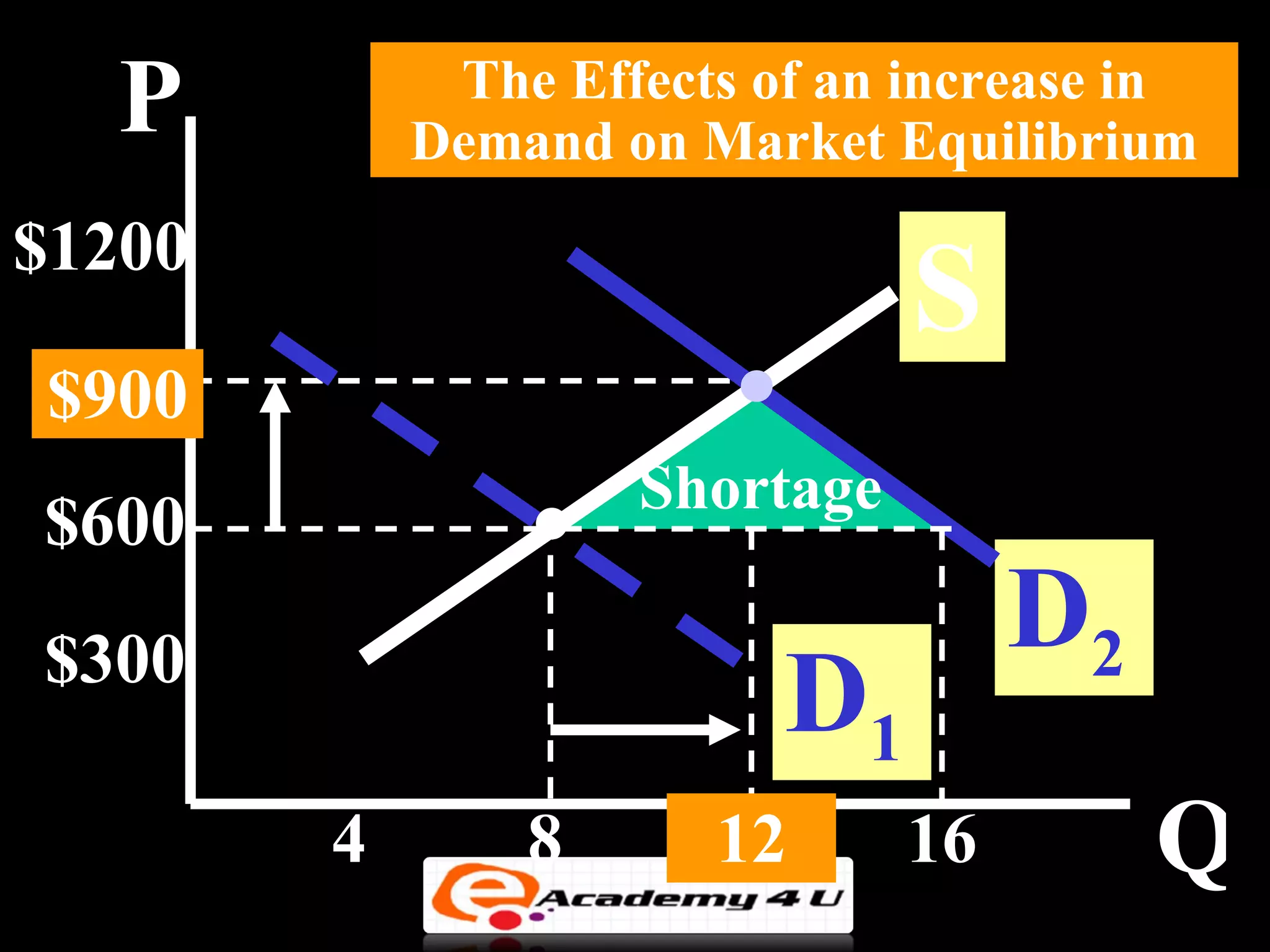
P          The Effects of an increase in
            Demand on Market Equilibrium
$1200
                               S
$900
                    Shortage
$600
$300
                                    D2
                          D1
        4       8      12      16        Q
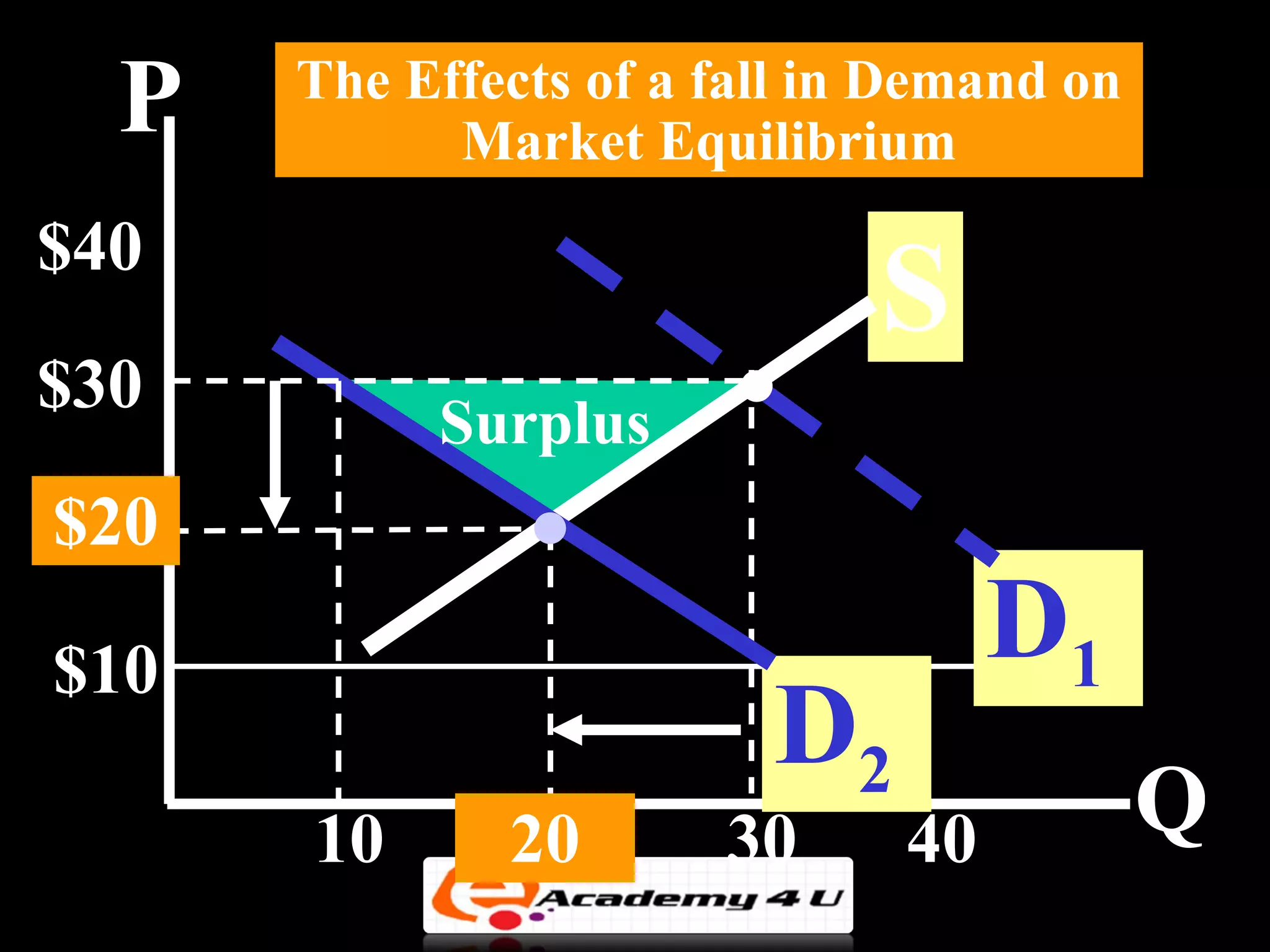
P   The Effects of a fall in Demand on
            Market Equilibrium
$40
                              S
$30
           Surplus
$20

$10
                                    D1
                         D2
      10      20       30      40          Q
What can cause a shift in
     a Supply Curve?
1. Number of sellers in the market
2. Technology
3. Resource prices
4. Taxes and subsidies
5. Expectations of producers
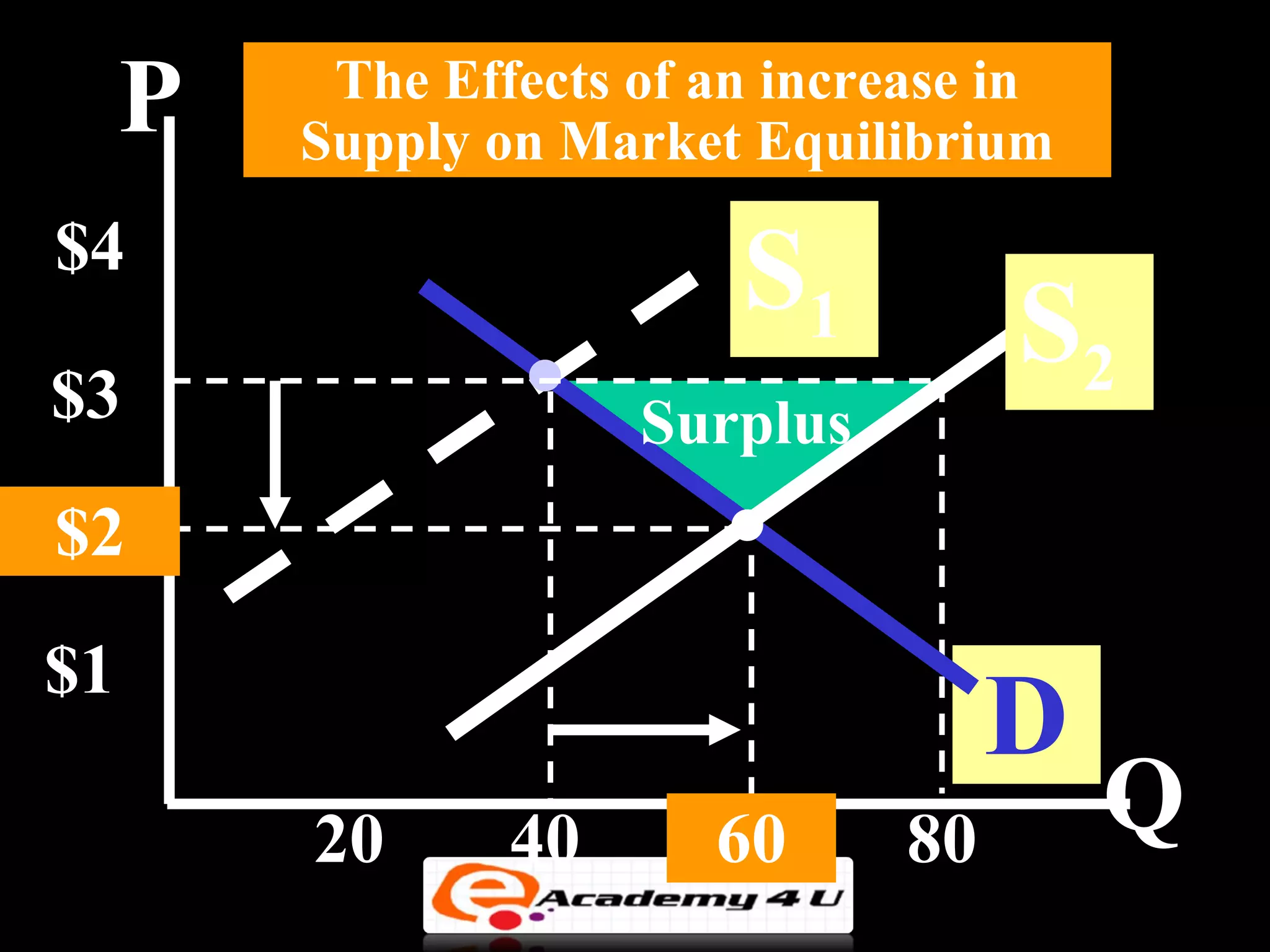
P    The Effects of an increase in
         Supply on Market Equilibrium
$4
                          S1          S2
$3                    Surplus
$2
$1
                                      D
         20      40      60      80       Q
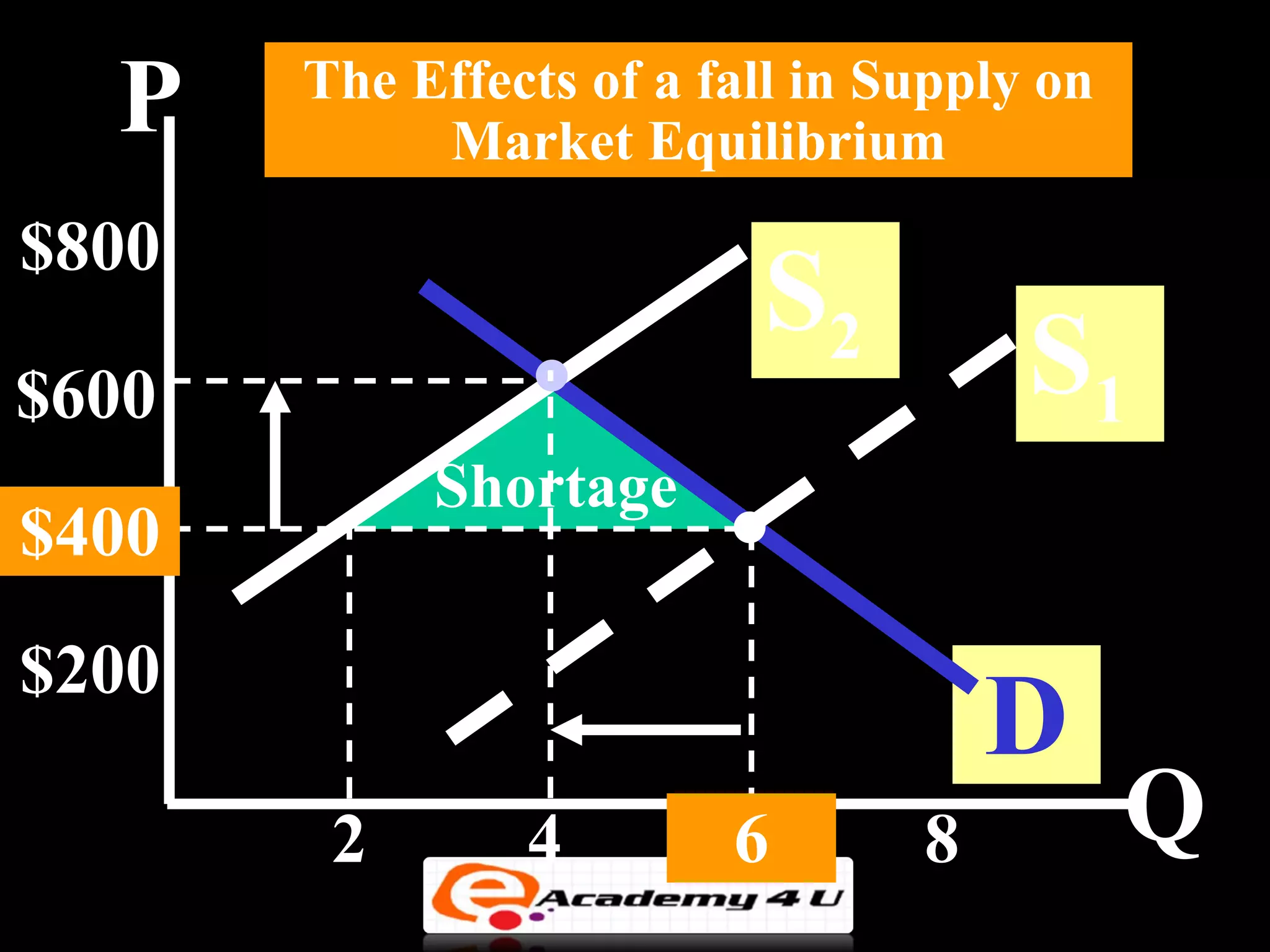
P    The Effects of a fall in Supply on
            Market Equilibrium
$800
                          S2
$600                                  S1
            Shortage
$400
$200
                                     D
        2       4        6       8          Q
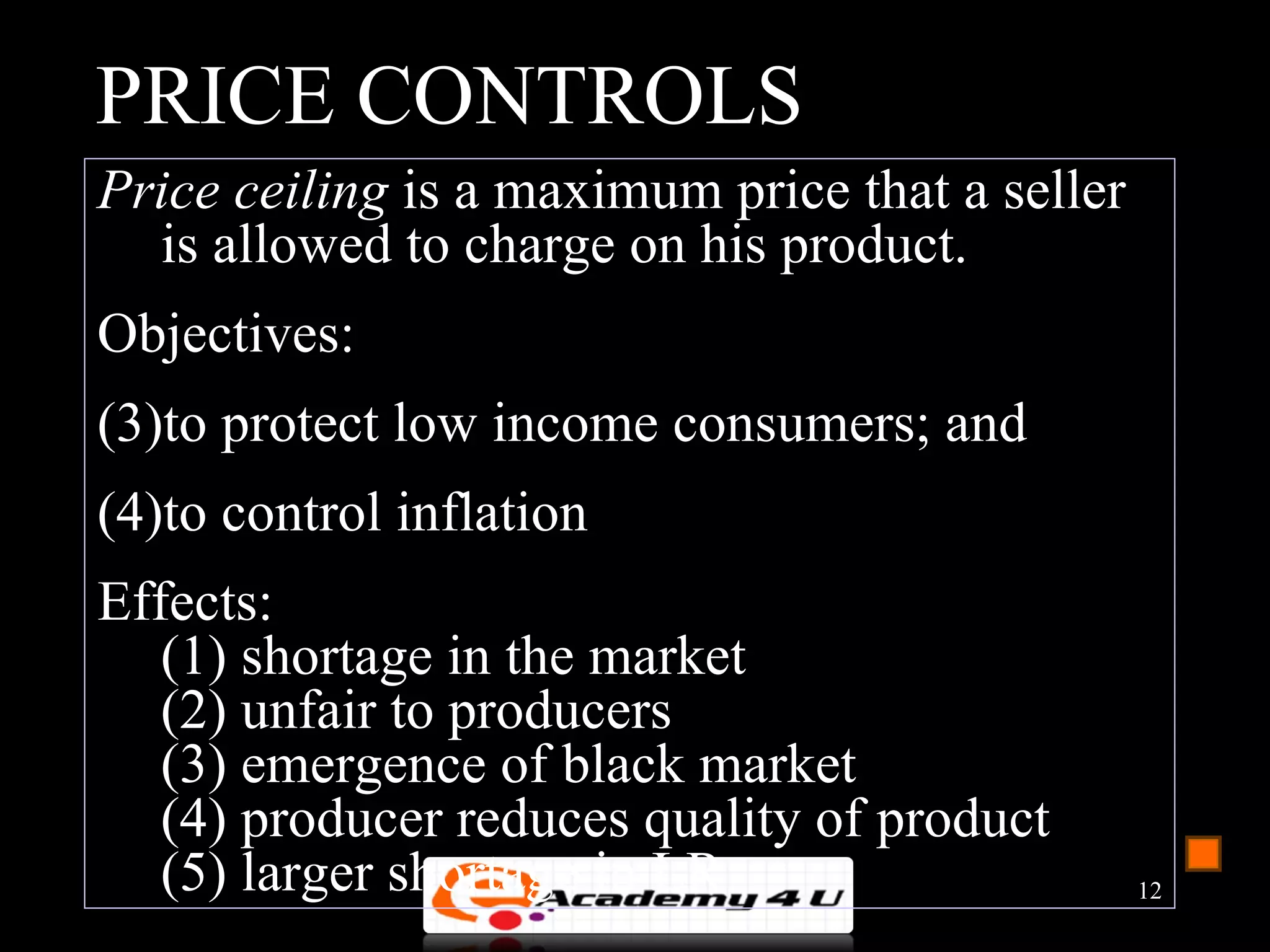
PRICE CONTROLS
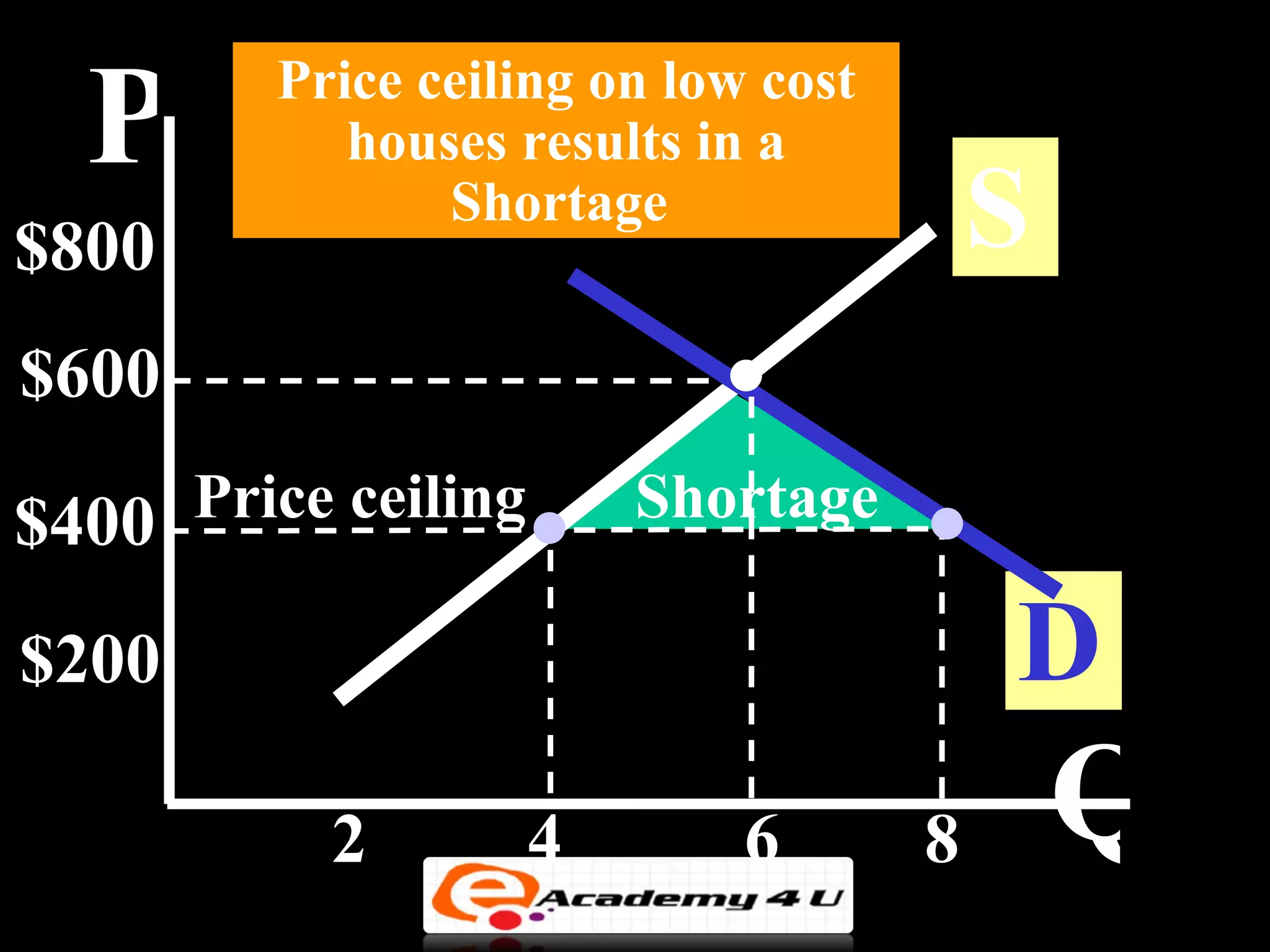
Price ceiling is a maximum price that a seller
  is allowed to charge on his product.
Objectives:
(3)to protect low income consumers; and
(4)to control inflation
Effects:
   (1) shortage in the market
   (2) unfair to producers
   (3) emergence of black market
   (4) producer reduces quality of product
   (5) larger shortage in LR                     12
P      Price ceiling on low cost
            houses results in a
$800
                Shortage                 S
$600

$400 Price ceiling       Shortage

$200                                     D
           2         4       6       8       Q
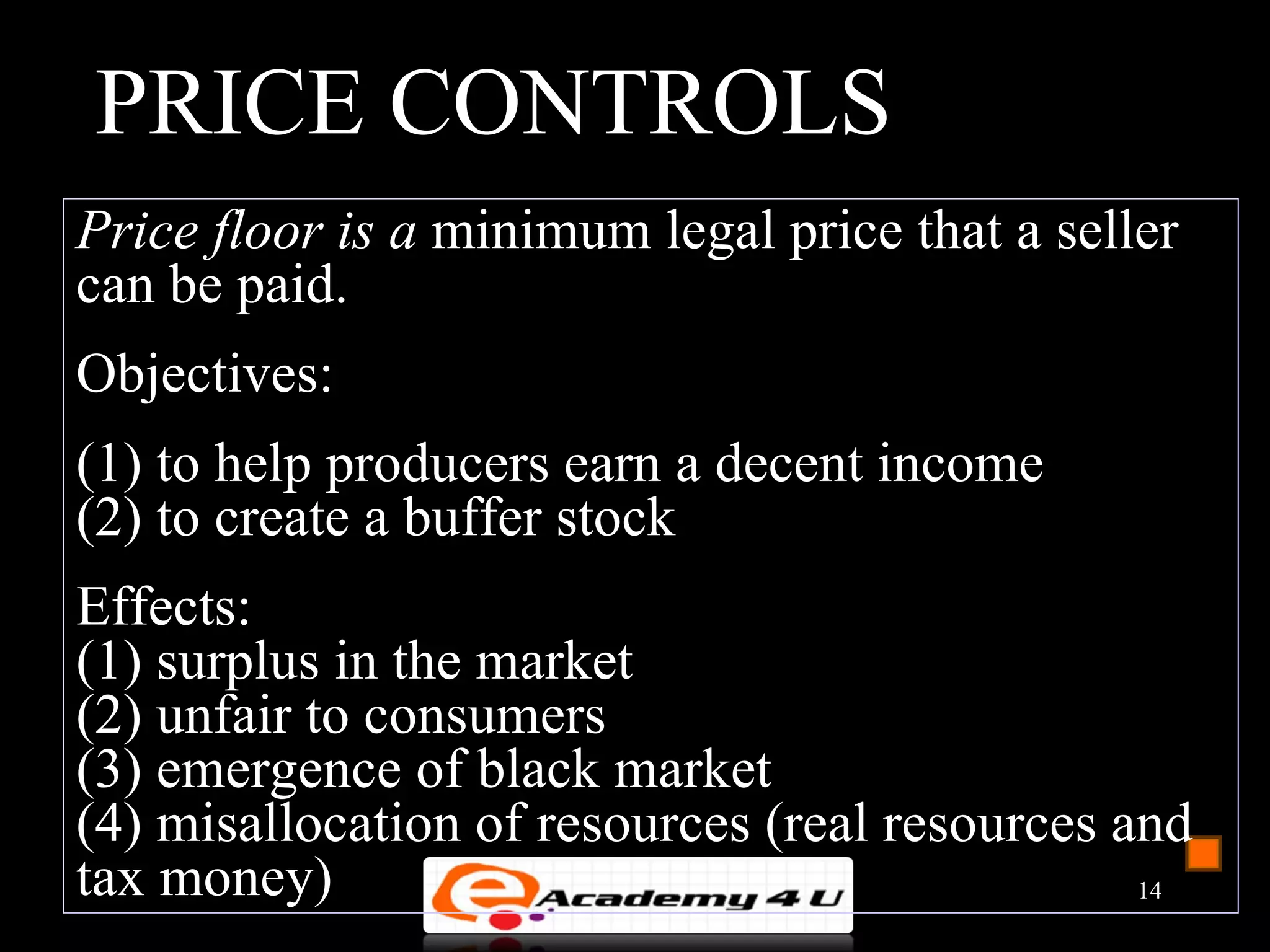
PRICE CONTROLS
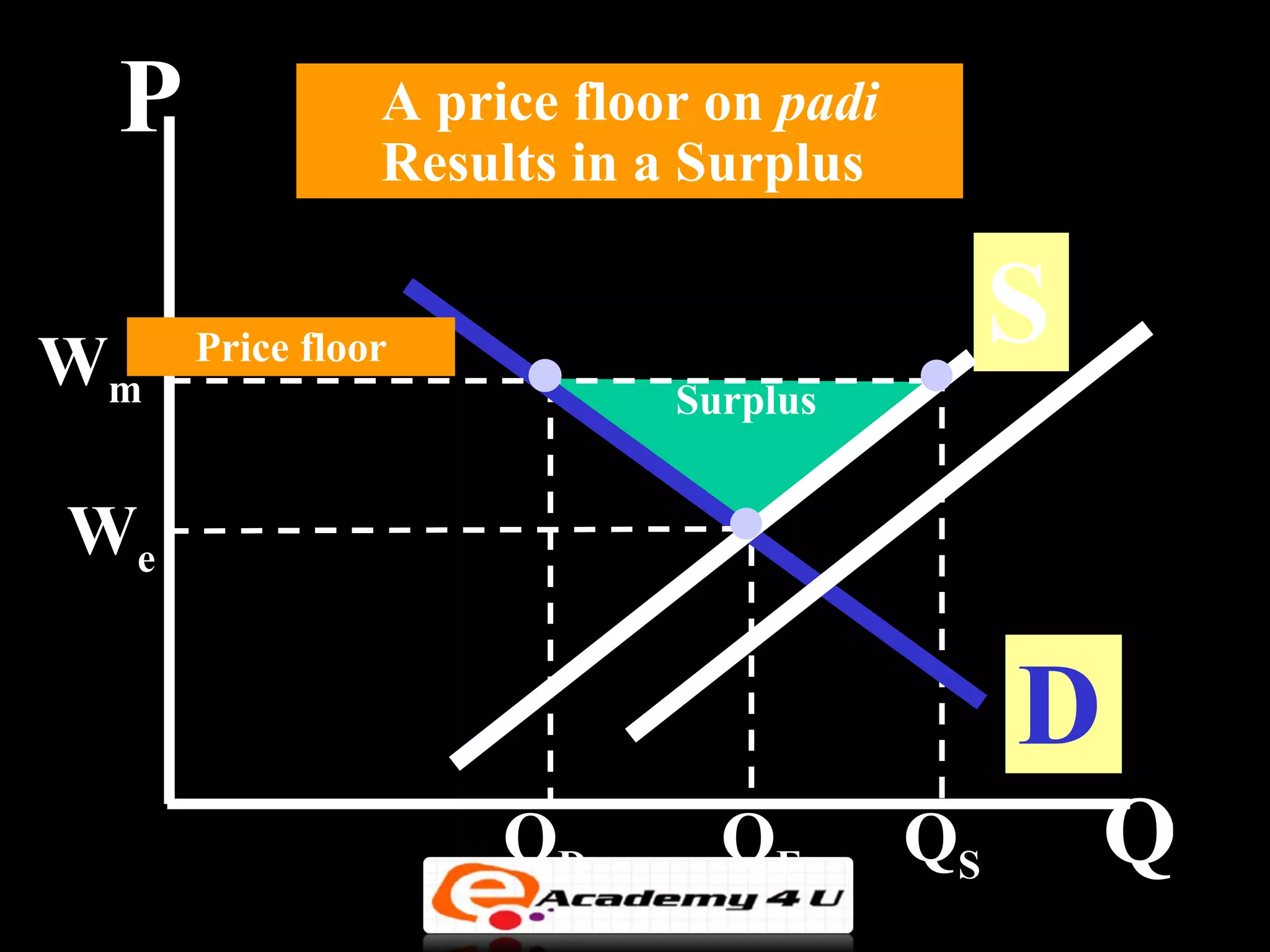
Price floor is a minimum legal price that a seller
can be paid.
Objectives:
(1) to help producers earn a decent income
(2) to create a buffer stock
Effects:
(1) surplus in the market
(2) unfair to consumers
(3) emergence of black market
(4) misallocation of resources (real resources and
tax money)                                      14
P             A price floor on padi
               Results in a Surplus


Wm   Price floor                            S
                           Surplus


We

                                            D
                    QD       QE        QS       Q
PRICE ELASTICITY OF DEMAND

• Price elasticity of demand is a
measure of the responsiveness of the
quantity demanded to a change in price.
• Specifically, price elasticity of
demand is the ratio of the percentage
change in quantity demanded to the
percentage change in price.
                                        16
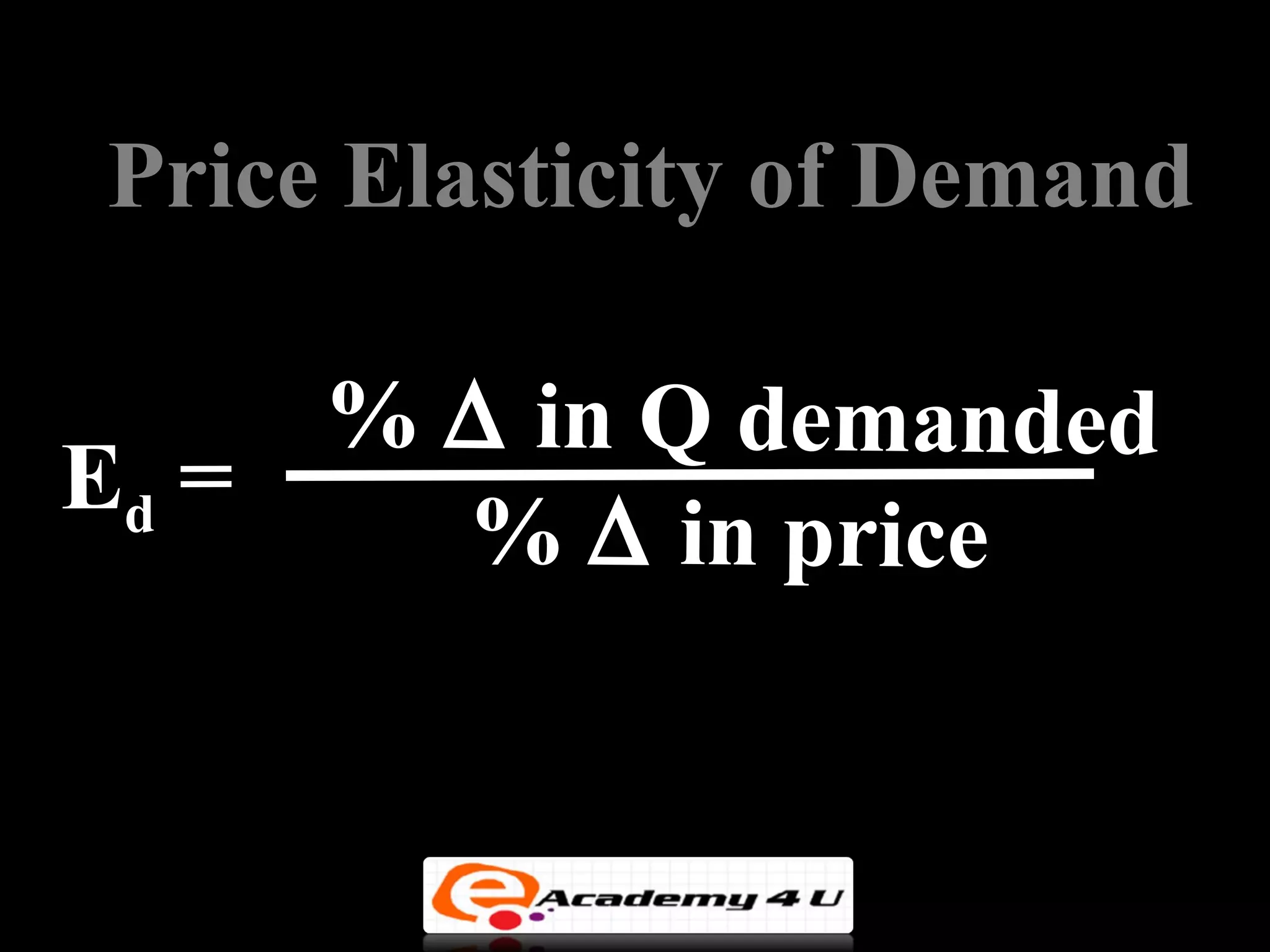
Price Elasticity of Demand

     % ∆ in Q demanded
Ed =
       % ∆ in price
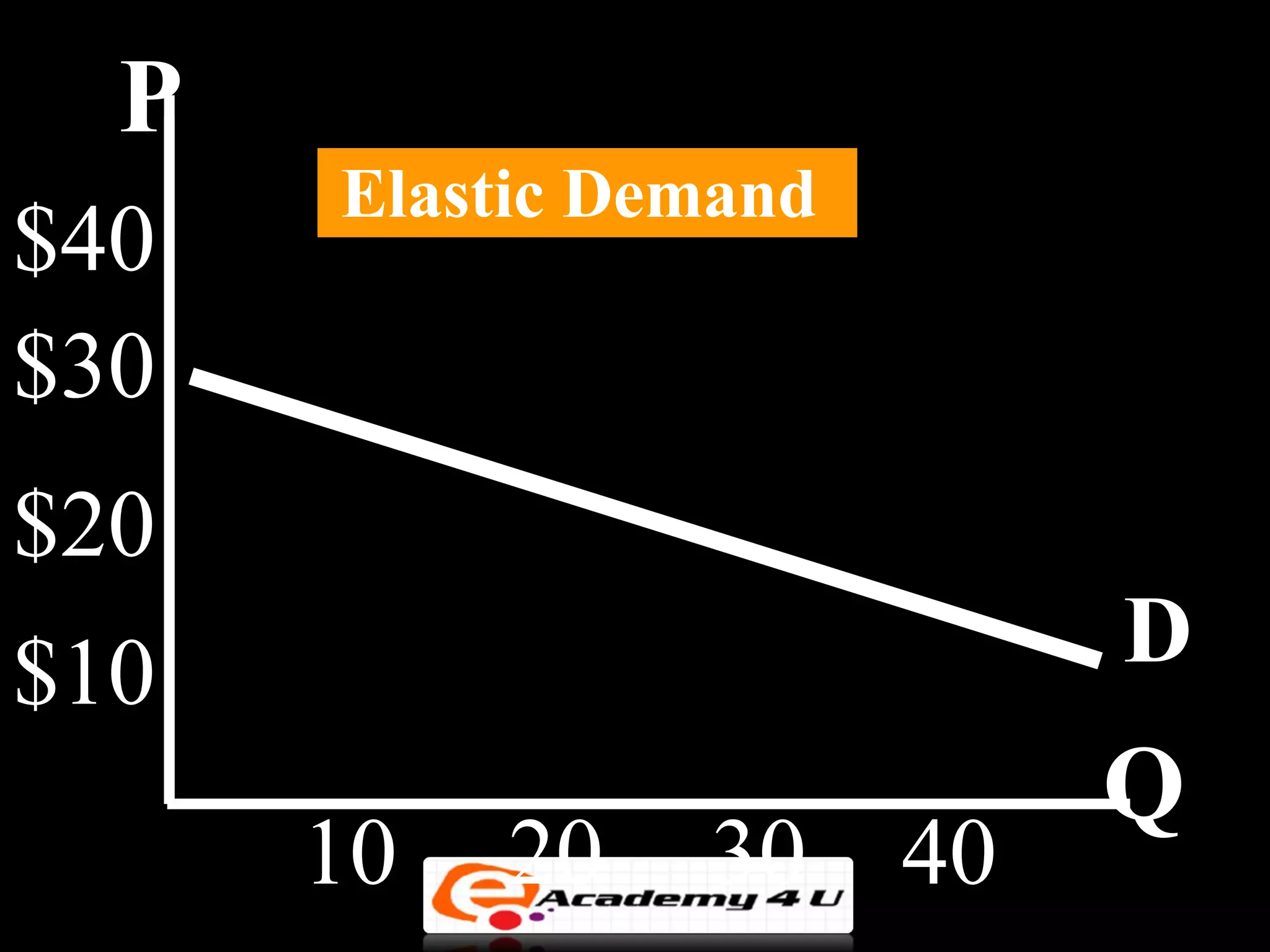
• Elastic demand is a change of more
than one percent in quantity demanded
in response to a one percent change in
price.
• Demand is elastic when the elasticity
coefficient is greater than one and total
revenue (price time quantity) varies
inversely with the direction of the price
change.

                                      18
P
      Elastic Demand
$40
$30
$20
$10                         D
                            Q
      10   20   30     40
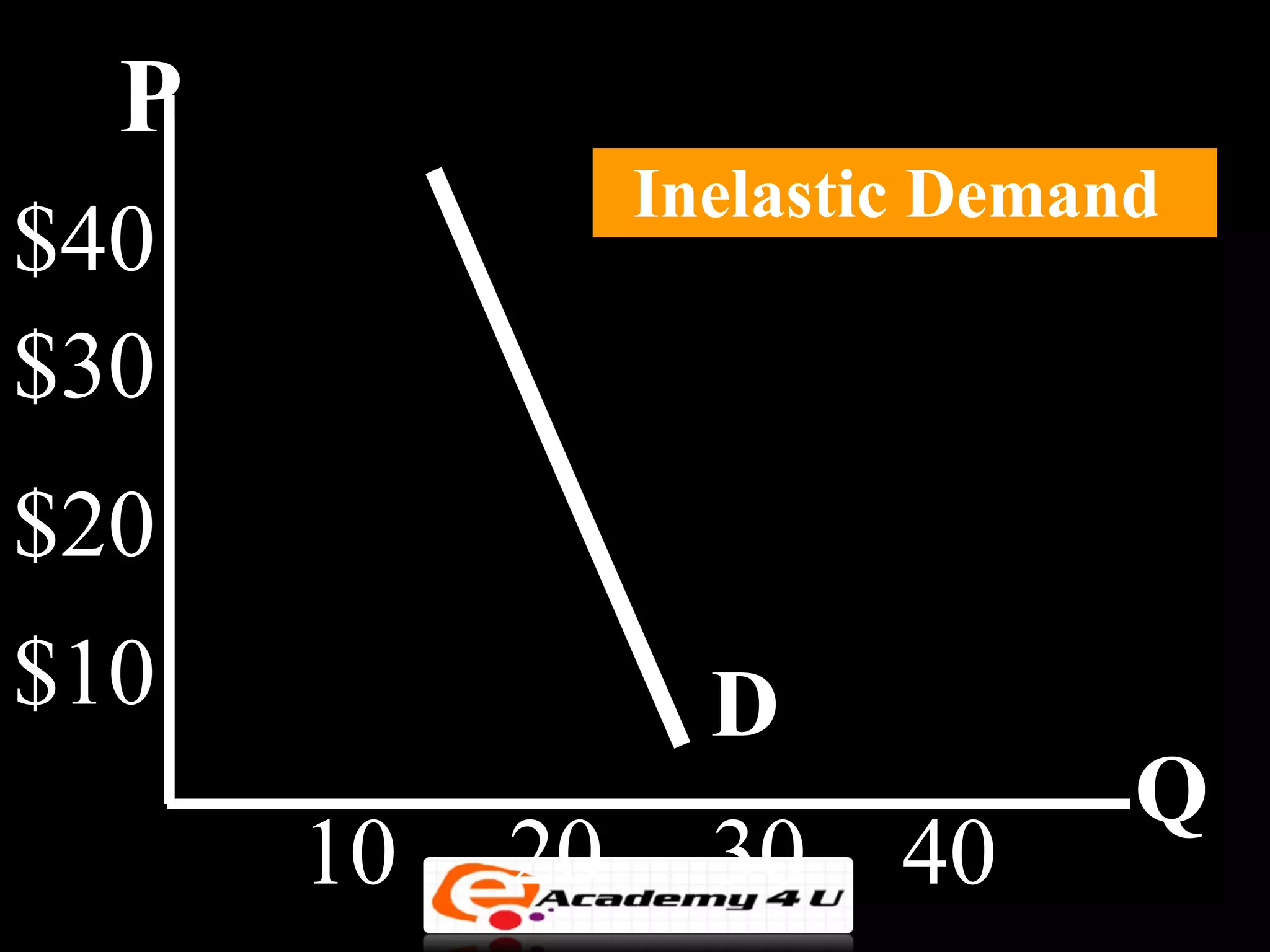
• Inelastic demand is a change of less
than one percent in quantity
demanded in response to a one
percent change in price.
• Demand is inelastic when the
elasticity coefficient is less than one
and total revenue varies directly with
the direction of the price change.


                                     20
P
                Inelastic Demand
$40
$30
$20
$10               D
                               Q
      10   20     30    40
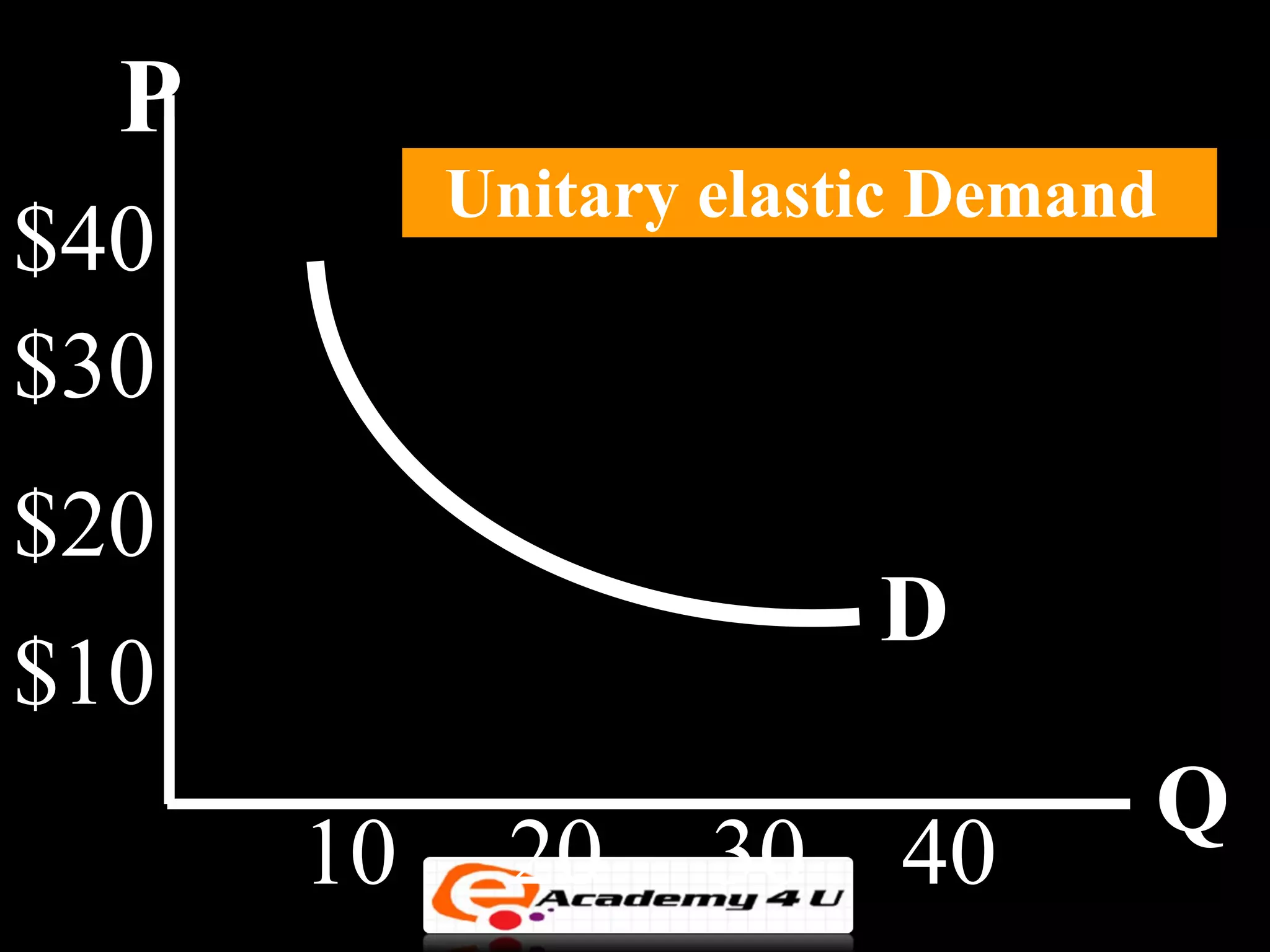
• Unitary elastic demand is a one
percent change in quantity demanded in
response to a one percent change in
price.
• Demand is unitary elastic when the
elasticity coefficient equals one and
total revenue remains constant as the
price changes.


                                        22
P
           Unitary elastic Demand
$40
$30
$20
                        D
$10
                                Q
      10    20     30    40
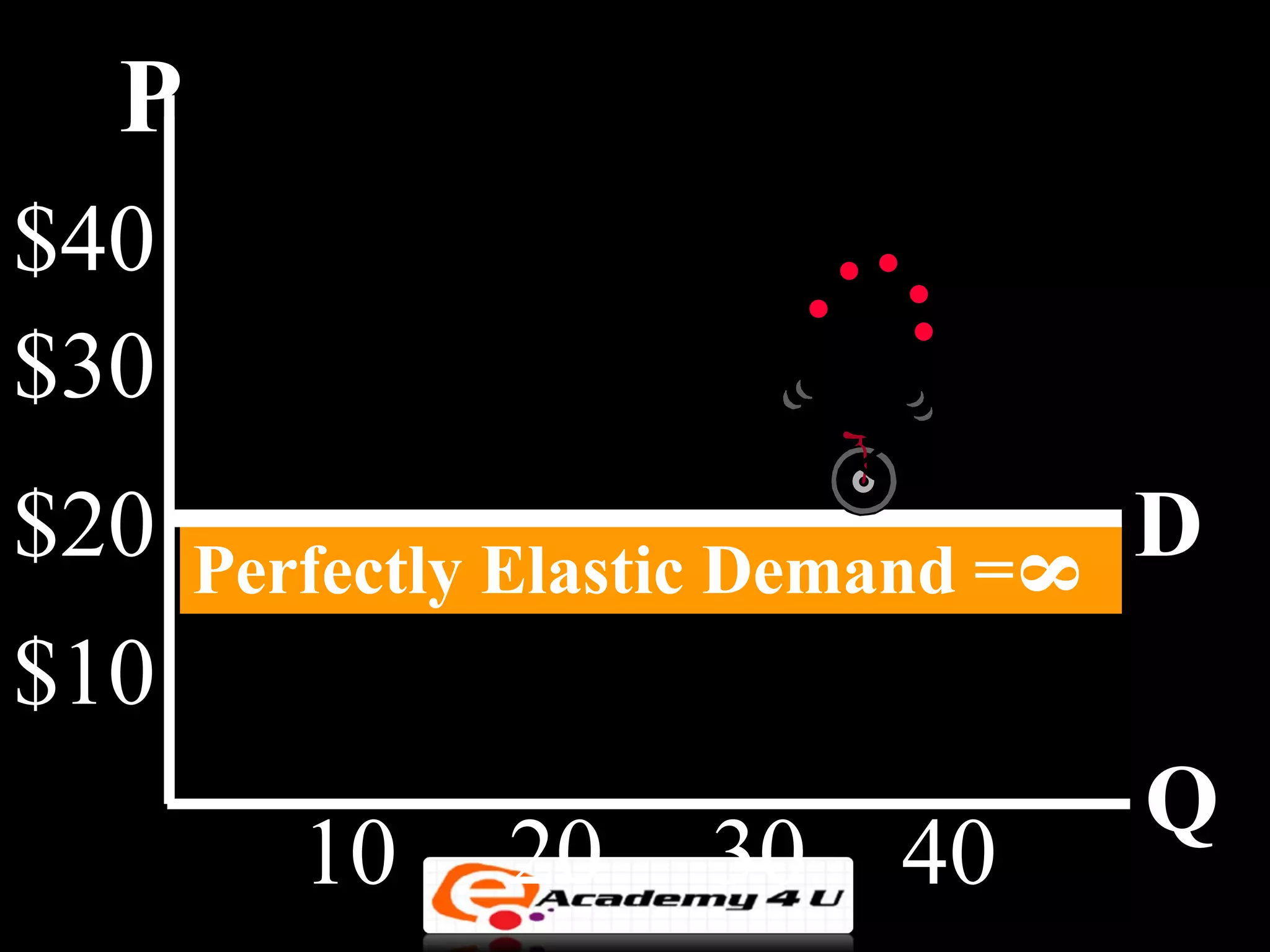
• Perfectly elastic demand is a
decline in quantity demanded to
zero for even the slightest rise or
fall in price.
• This is an extreme case in which
the demand curve is horizontal and
the elasticity coefficient equals
infinity.
                                      24
P
$40
$30
$20   Perfectly Elastic Demand =
                                     D


                                 8
$10
                                     Q
         10    20     30    40
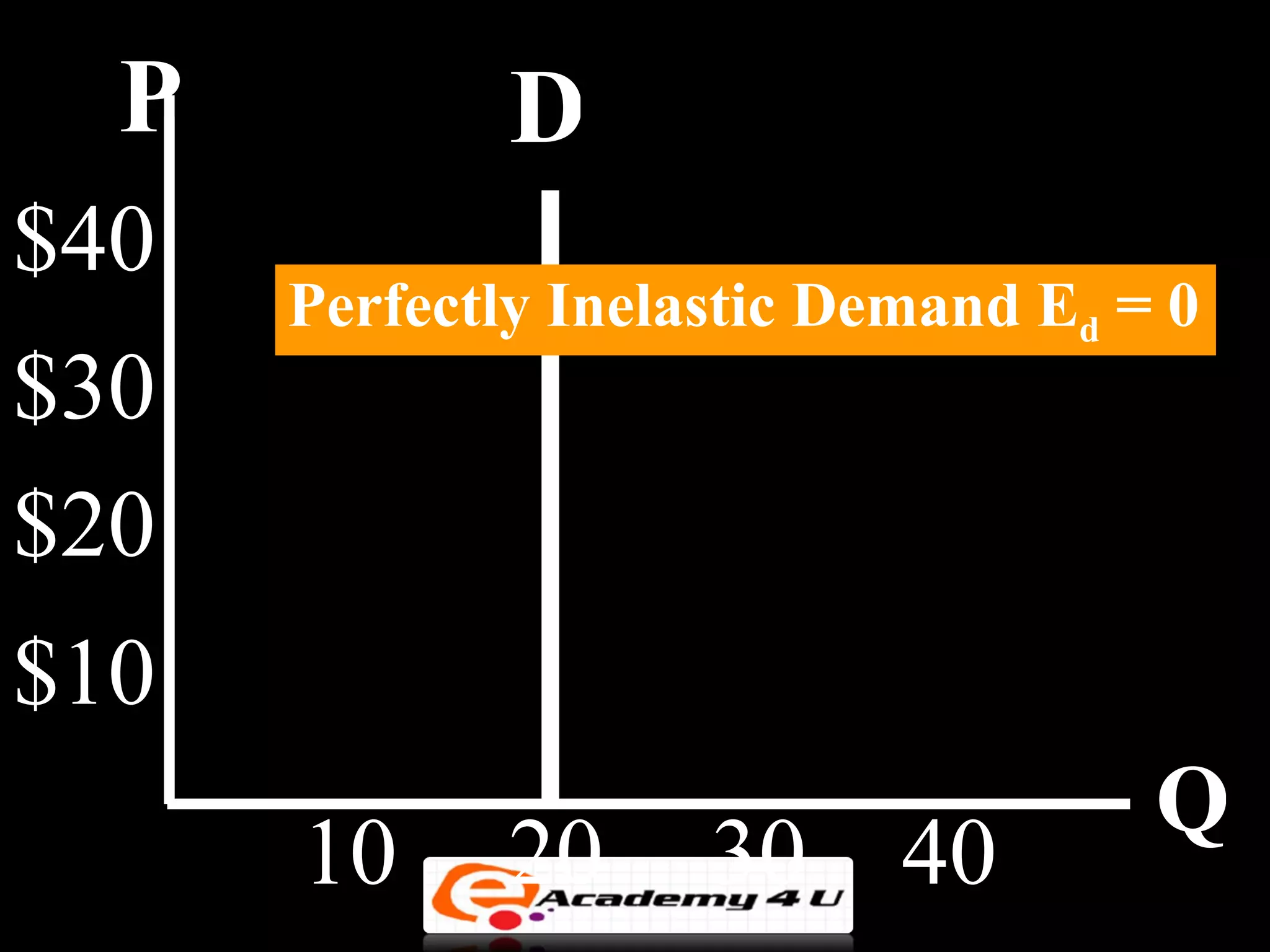
• Perfectly inelastic demand is no
change in quantity demanded in
response to price changes.
• This is an extreme case in which the
the demand curve is vertical and the
elasticity coefficient equals zero.


                                     26
P           D
$40
      Perfectly Inelastic Demand Ed = 0
$30
$20
$10
                                     Q
      10     20      30     40
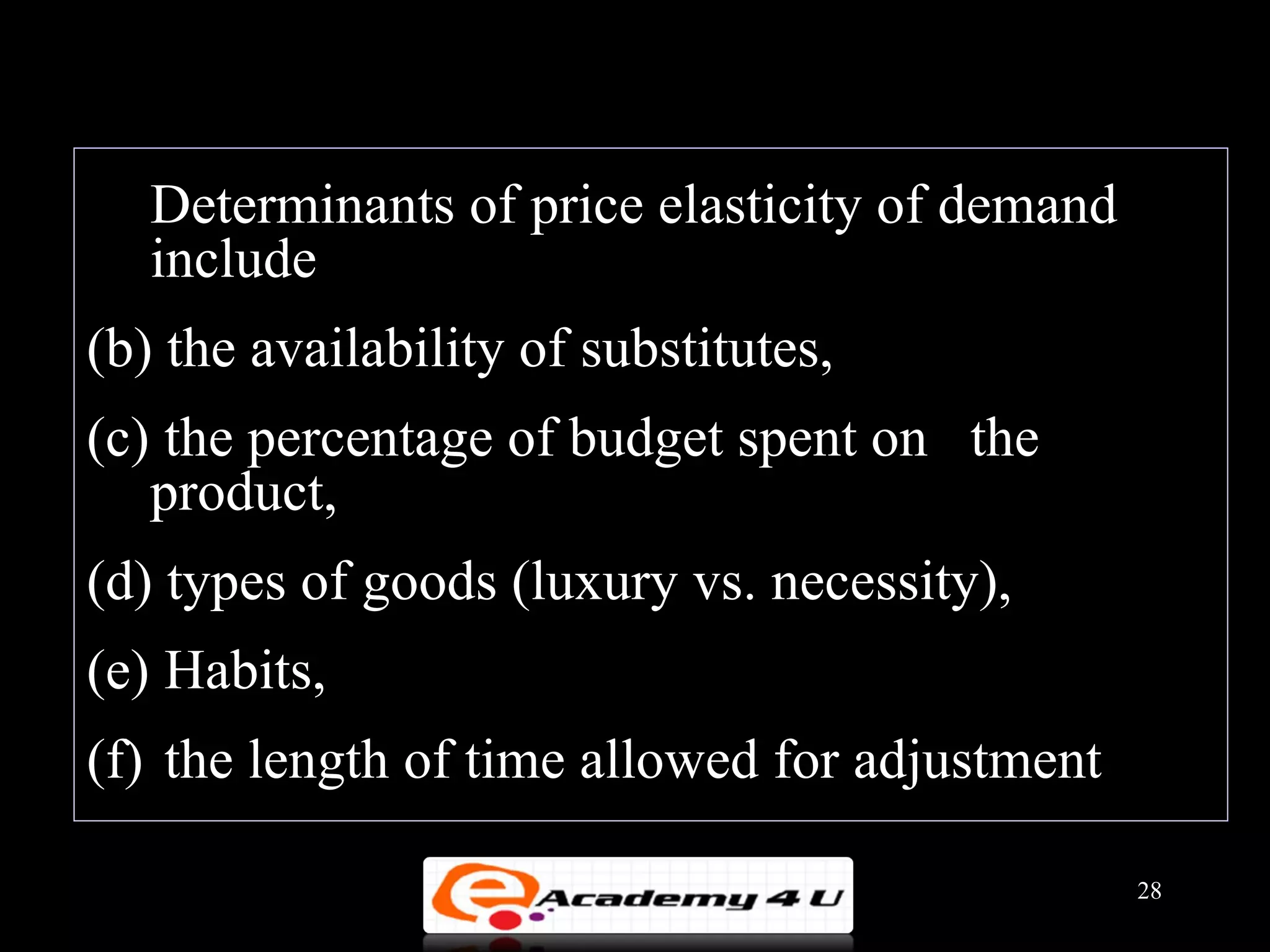
Determinants of price elasticity of demand
   include
(b) the availability of substitutes,
(c) the percentage of budget spent on the
   product,
(d) types of goods (luxury vs. necessity),
(e) Habits,
(f) the length of time allowed for adjustment

                                                28
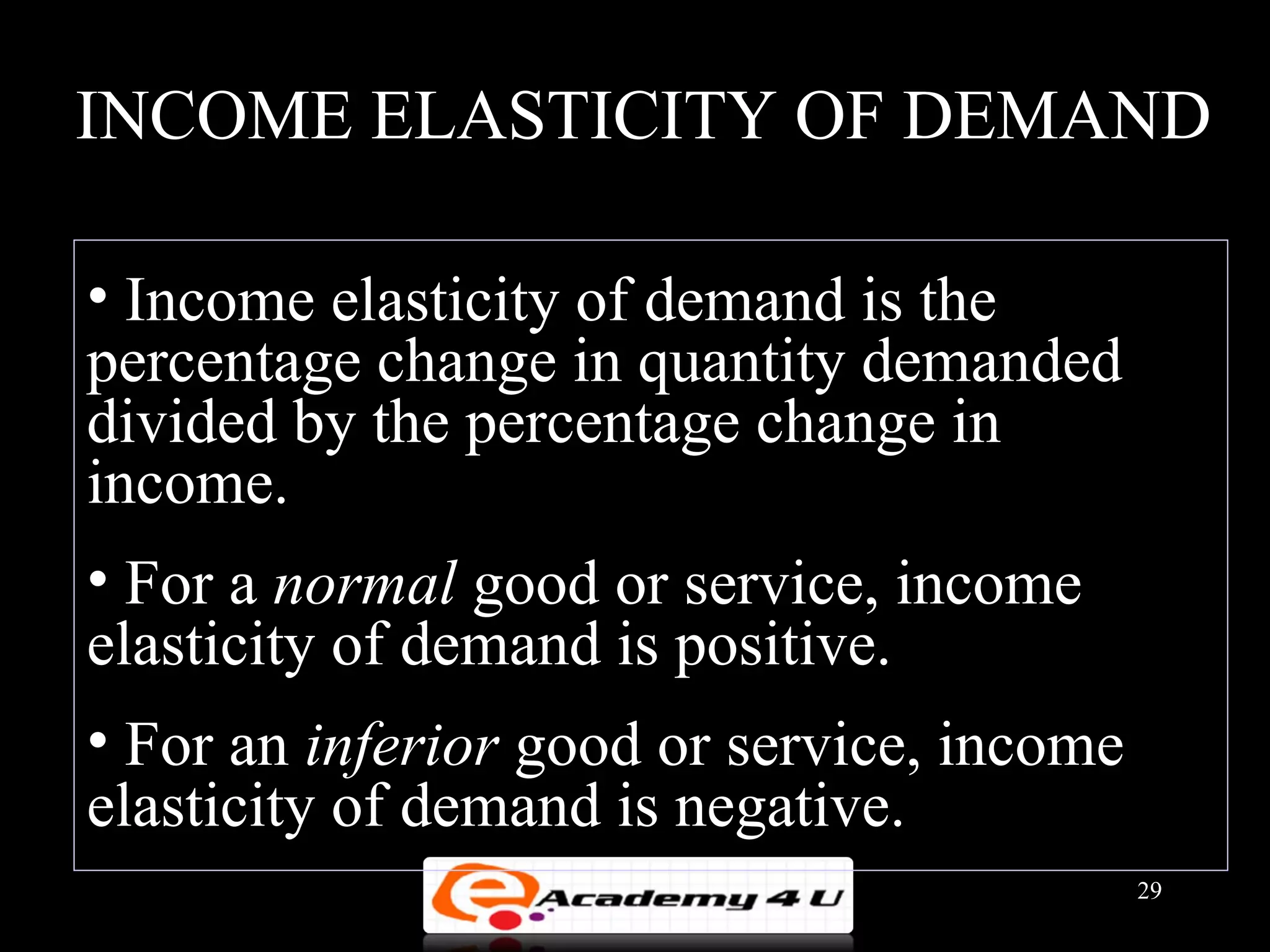
INCOME ELASTICITY OF DEMAND

• Income elasticity of demand is the
percentage change in quantity demanded
divided by the percentage change in
income.
• For a normal good or service, income
elasticity of demand is positive.
• For an inferior good or service, income
elasticity of demand is negative.
                                            29
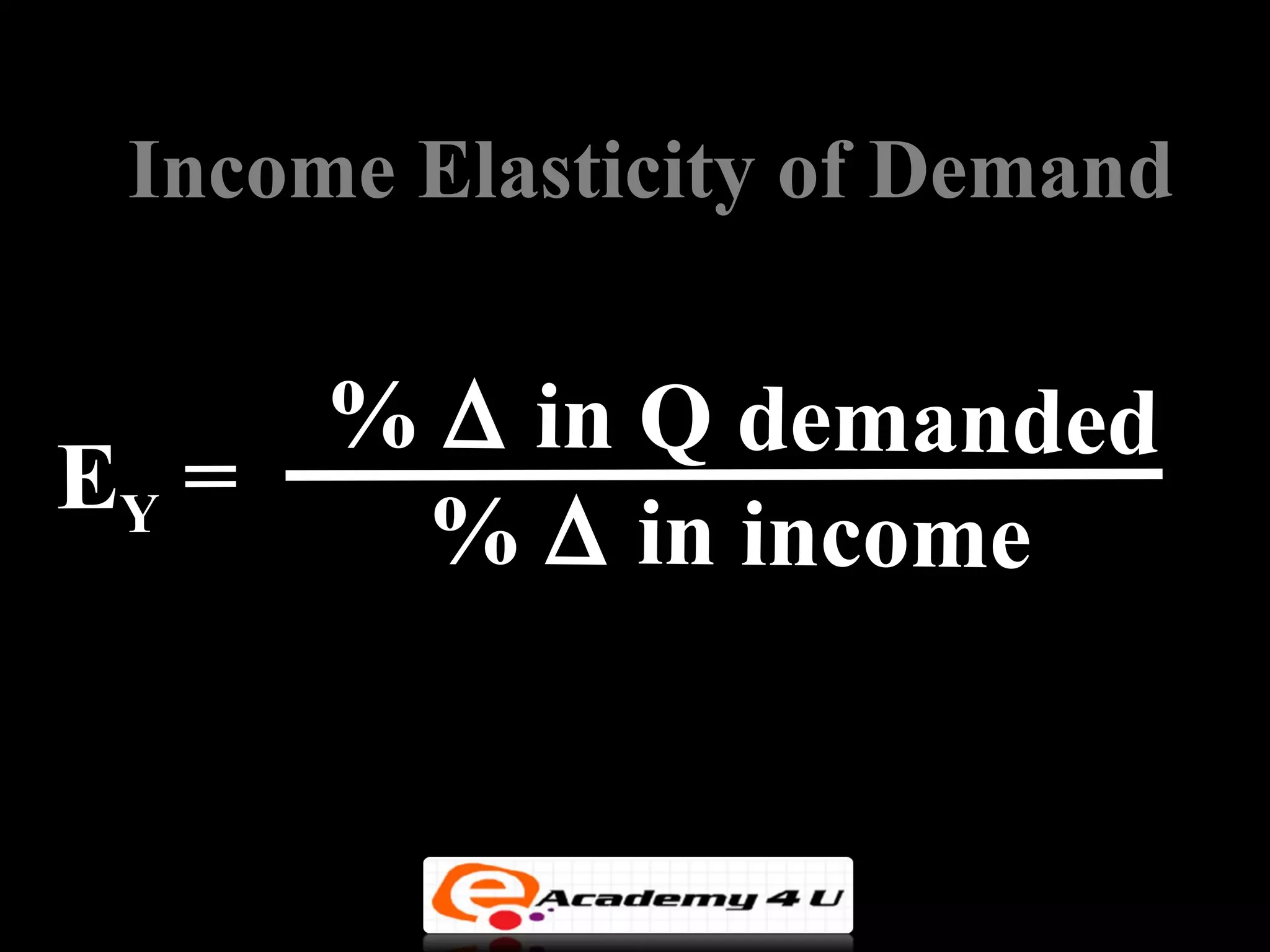
Income Elasticity of Demand

     % ∆ in Q demanded
EY =
      % ∆ in income
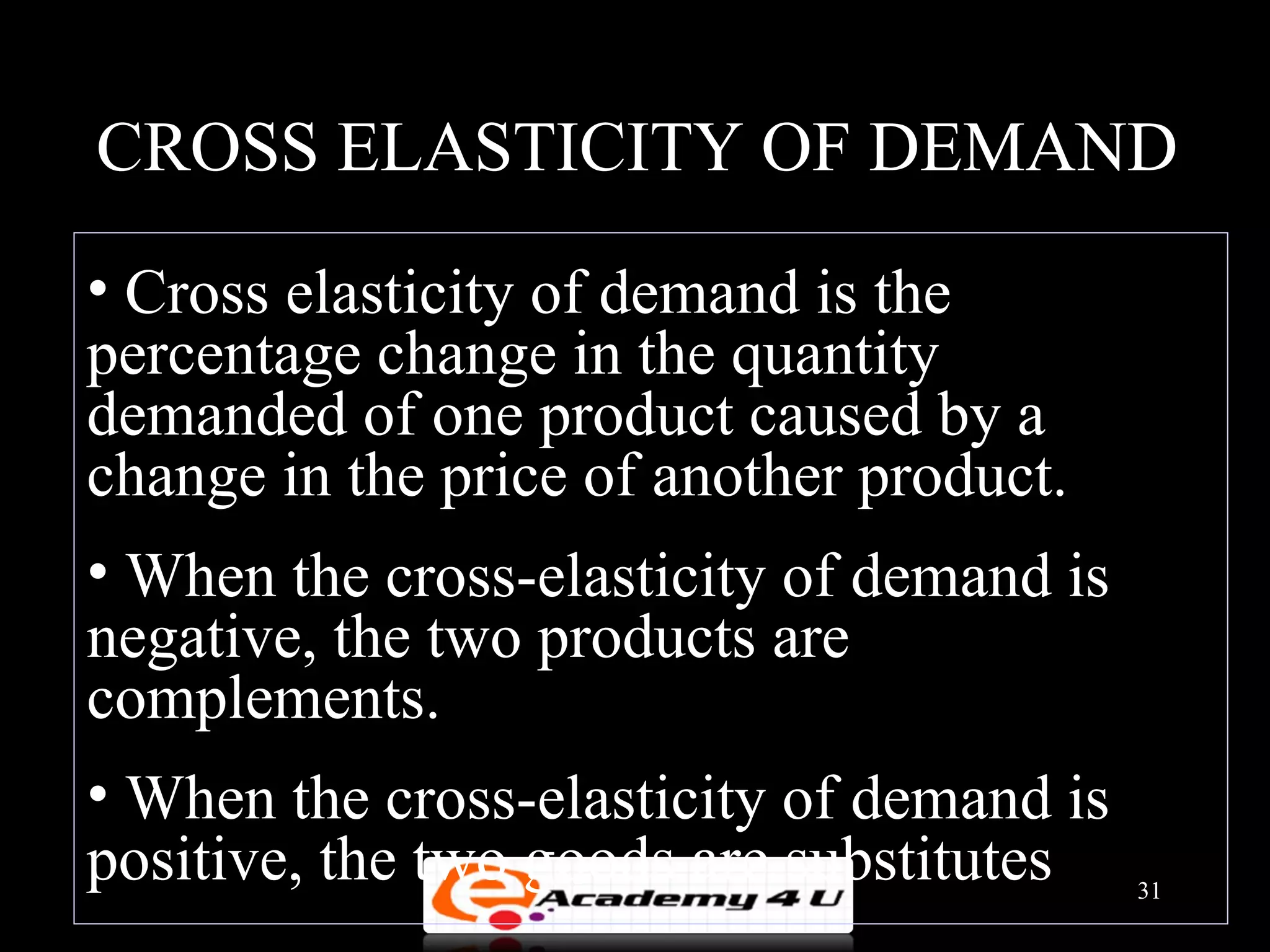
CROSS ELASTICITY OF DEMAND
• Cross elasticity of demand is the
percentage change in the quantity
demanded of one product caused by a
change in the price of another product.
• When the cross-elasticity of demand is
negative, the two products are
complements.
• When the cross-elasticity of demand is
positive, the two goods are substitutes    31
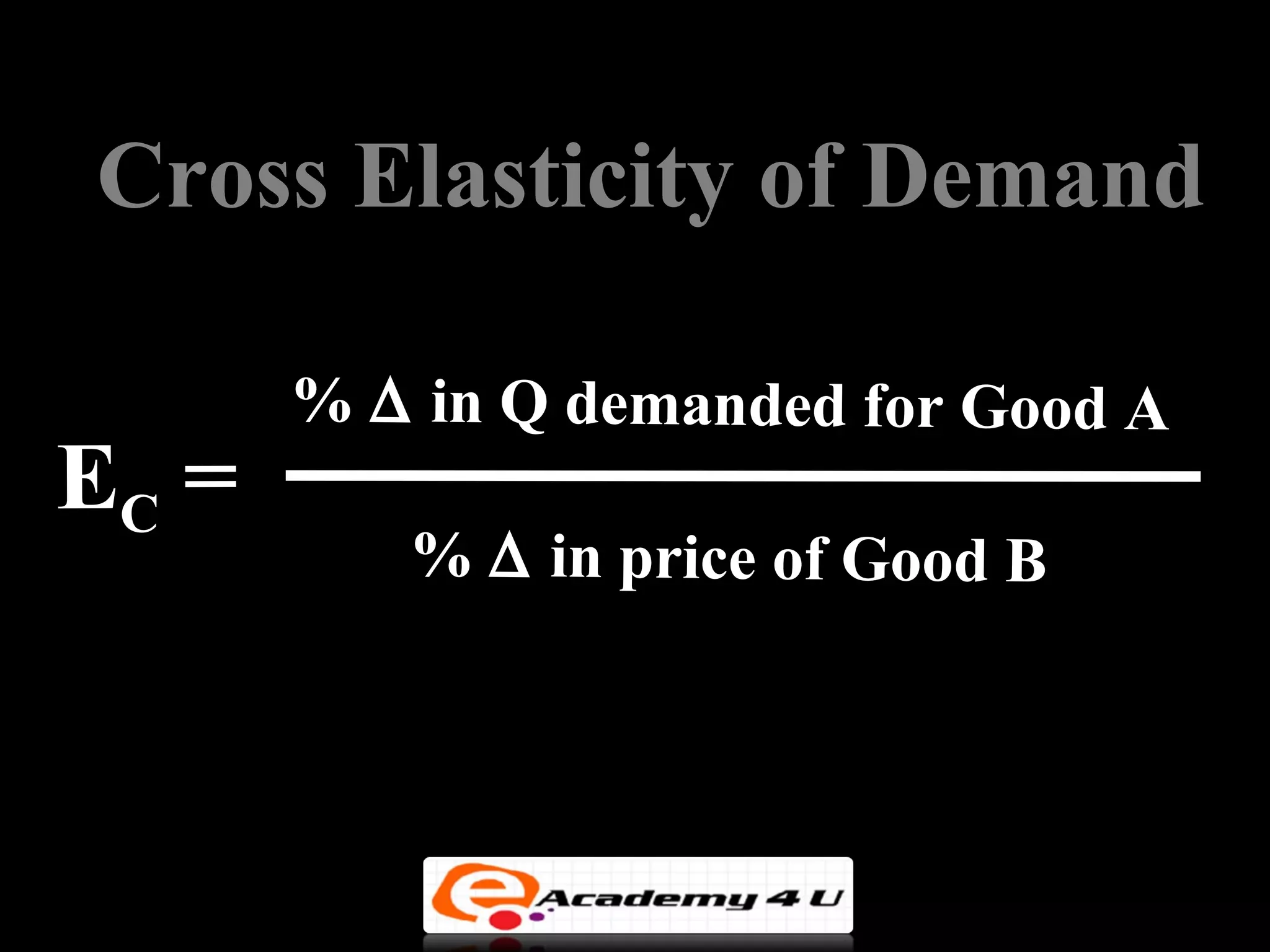
Cross Elasticity of Demand

       % ∆ in Q demanded for Good A
EC =
          % ∆ in price of Good B
PRICE ELASTICITY OF SUPPLY

• Price elasticity of supply is a
measure of the responsiveness of the
quantity demanded to a change in
price.
• Price elasticity of supply is the ratio
of the percentage change in quantity
supplied to the percentage change in
price.                                 33
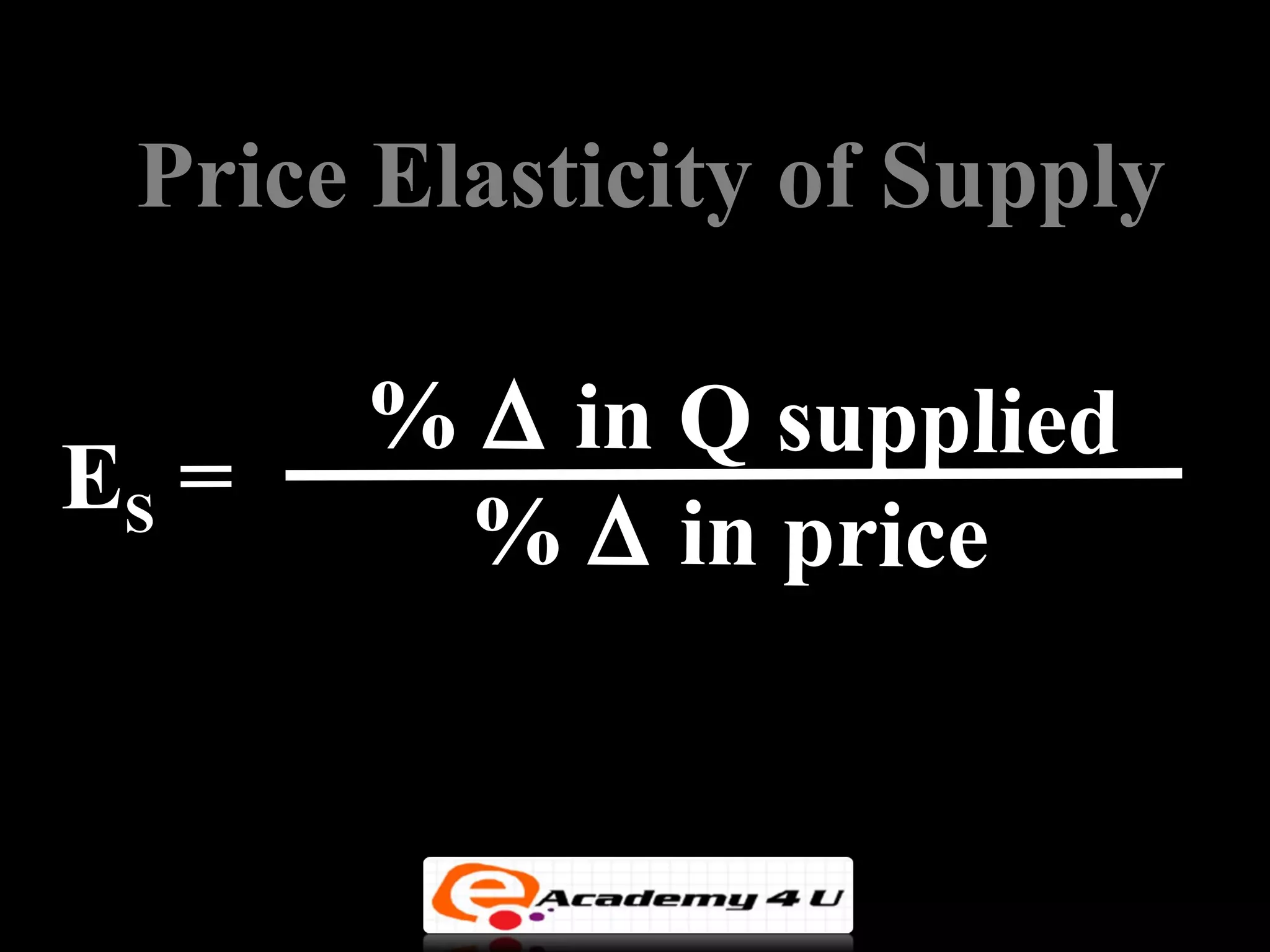
Price Elasticity of Supply

       % ∆ in Q supplied
ES =
        % ∆ in price
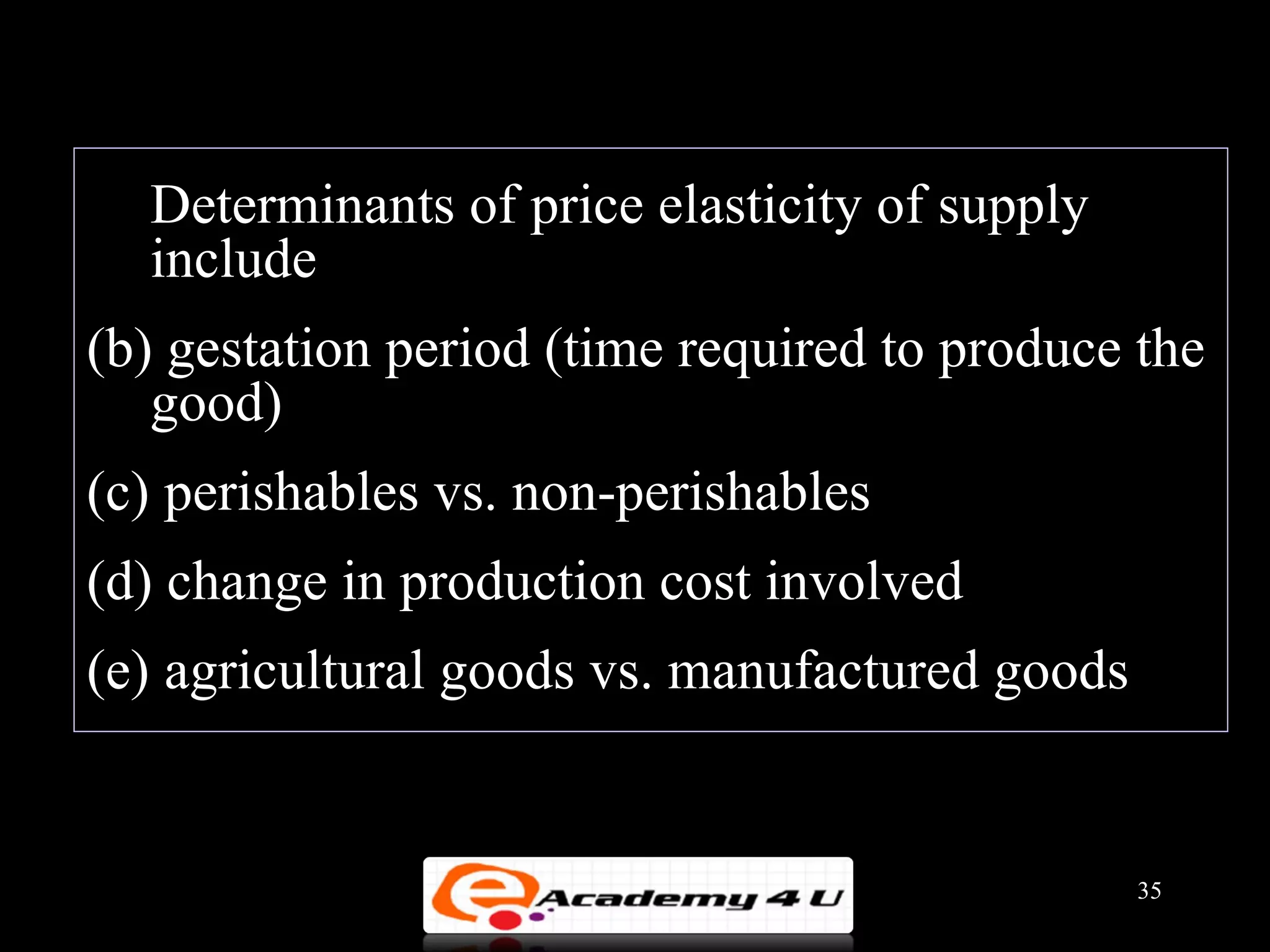
Determinants of price elasticity of supply
  include
(b) gestation period (time required to produce the
   good)
(c) perishables vs. non-perishables
(d) change in production cost involved
(e) agricultural goods vs. manufactured goods


                                                35
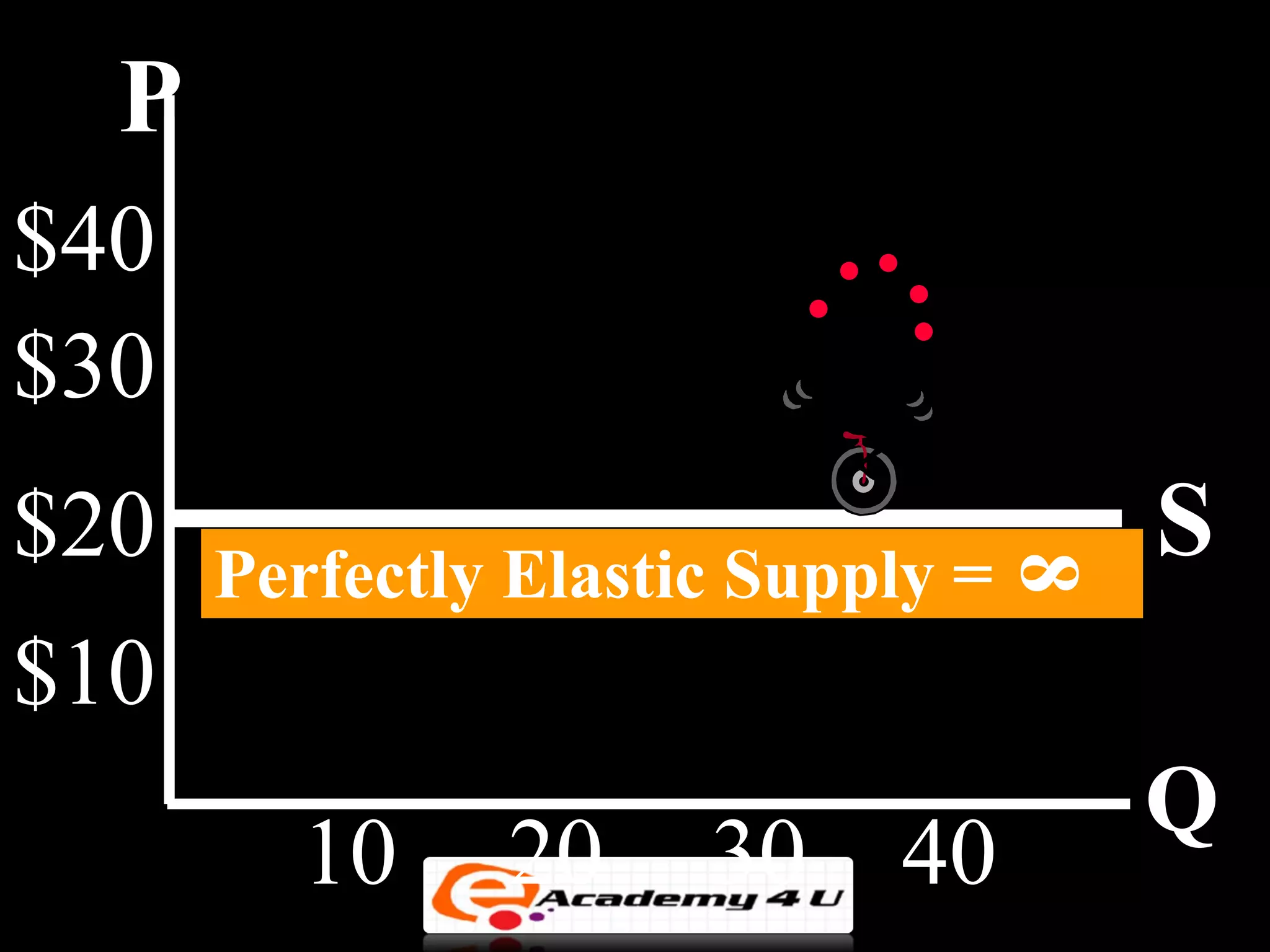
P
$40
$30
$20   Perfectly Elastic Supply =
                                       S


                                   8
$10
                                       Q
        10     20     30    40
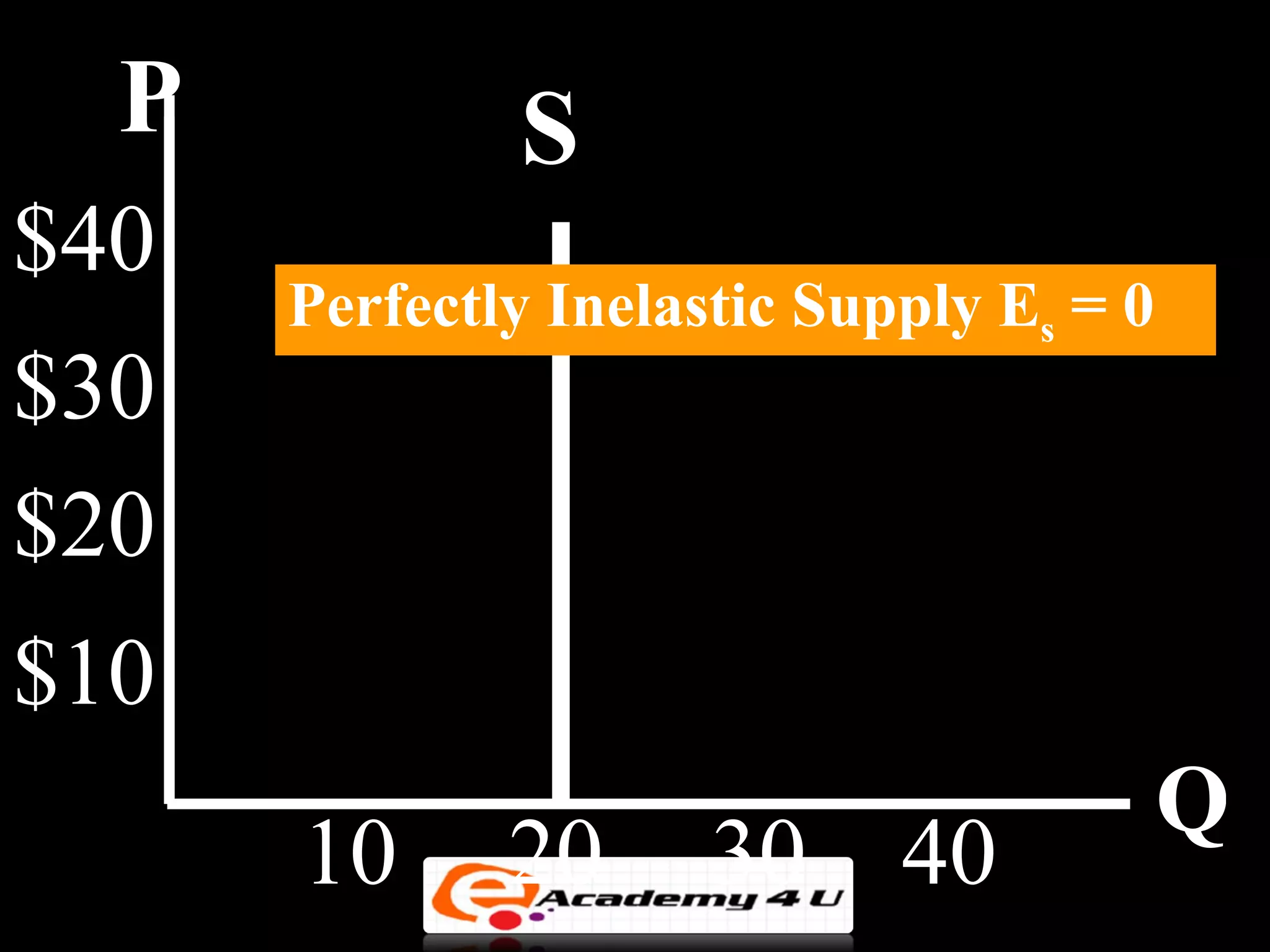
P           S
$40
      Perfectly Inelastic Supply Es = 0
$30
$20
$10
                                          Q
      10      20      30     40
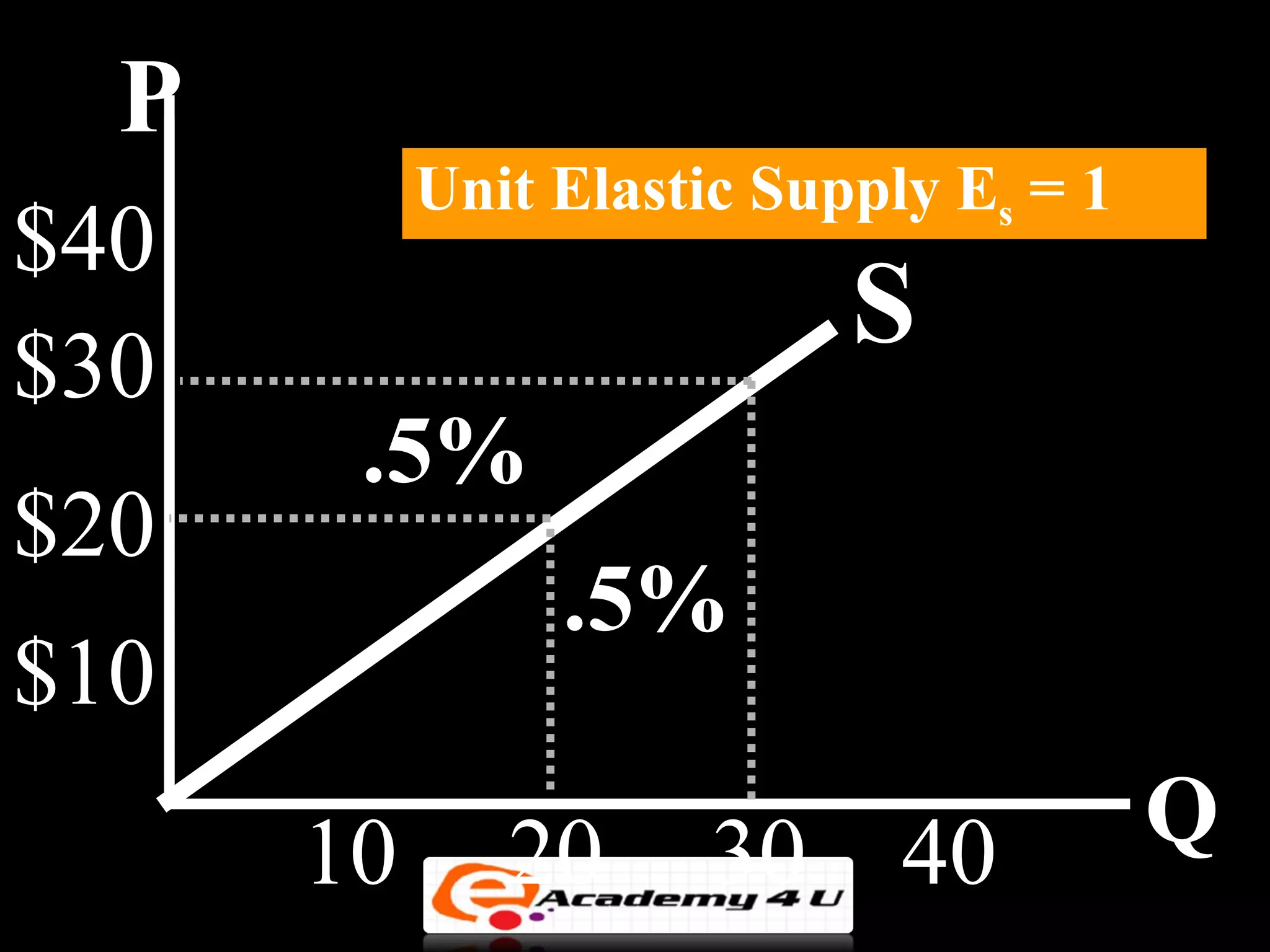
P
           Unit Elastic Supply Es = 1
$40
$30
                           S
       .5%
$20
                .5%
$10
      10      20      30     40         Q
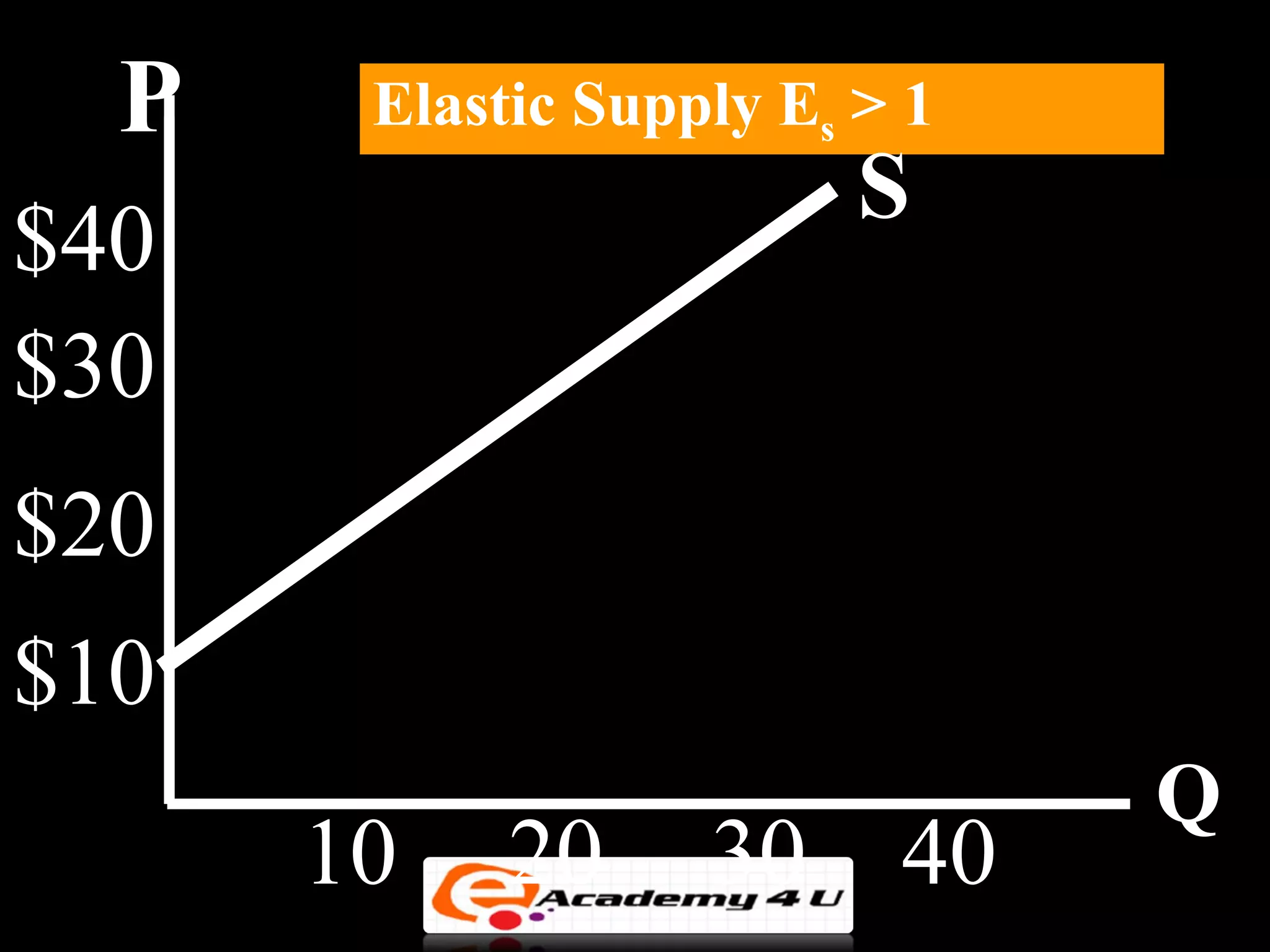
P    Elastic Supply Es > 1
                         S
$40
$30
$20
$10
                               Q
      10    20     30     40
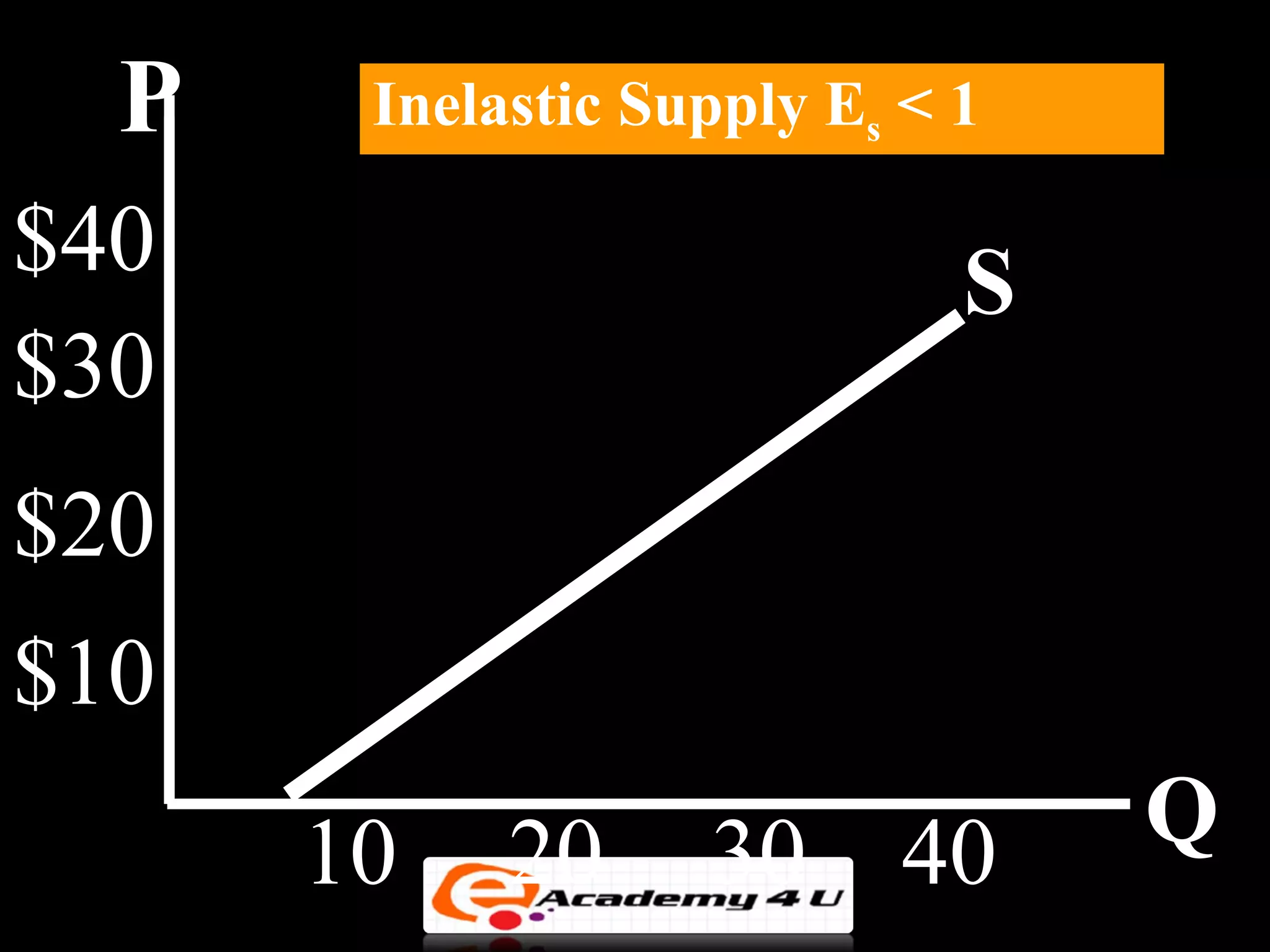
P    Inelastic Supply Es < 1

$40                          S
$30
$20
$10
      10    20     30      40    Q

Market equilibrium and application of demand and supply theory

  • 1.
    MARKET EQUILIBRIUM AND APPLICATION OF DEMAND AND SUPPLY THEORY
  • 2.
    MARKET EQUILIBRIUM • Equilibriumis the unique price and quantity established at the intersection of the supply and the demand curves. • Only at equilibrium does quantity demanded equal quantity supplied. 2
  • 3.
    P The Supply & Demand for Tennis Shoes 120 90 S Surplus 60 Shortage 30 D 1,000 2,000 3,000 4,000 Q
  • 4.
    • Equilibrium Price= The price level at which the quantity that consumers want to buy equals the quantity sellers want to sell. (Qd = Qs) • Equilibrium Quantity = is achieved when quantity that consumers want to buy and the sellers want to sell are equal
  • 5.
    SURPLUS AND SHORTAGE ~A surplus or shortage exists at any price where the quantity demanded and the quantity supplied are not equal. ~ When the price of a good is greater than the equilibrium price, there is an excess quantity supplied called a surplus. ~ When the price is less than the equilibrium price, there is an excess quantity demanded called a shortage. 5
  • 6.
    What can causea shift in a Demand Curve? 1. Number of buyers in the market 2. Tastes and preferences 3. Income 4. Expectations of consumers 5. Prices of related goods 6. Seasonal factors
  • 7.
    P The Effects of an increase in Demand on Market Equilibrium $1200 S $900 Shortage $600 $300 D2 D1 4 8 12 16 Q
  • 8.
    P The Effects of a fall in Demand on Market Equilibrium $40 S $30 Surplus $20 $10 D1 D2 10 20 30 40 Q
  • 9.
    What can causea shift in a Supply Curve? 1. Number of sellers in the market 2. Technology 3. Resource prices 4. Taxes and subsidies 5. Expectations of producers
  • 10.
    P The Effects of an increase in Supply on Market Equilibrium $4 S1 S2 $3 Surplus $2 $1 D 20 40 60 80 Q
  • 11.
    P The Effects of a fall in Supply on Market Equilibrium $800 S2 $600 S1 Shortage $400 $200 D 2 4 6 8 Q
  • 12.
    PRICE CONTROLS Price ceilingis a maximum price that a seller is allowed to charge on his product. Objectives: (3)to protect low income consumers; and (4)to control inflation Effects: (1) shortage in the market (2) unfair to producers (3) emergence of black market (4) producer reduces quality of product (5) larger shortage in LR 12
  • 13.
    P Price ceiling on low cost houses results in a $800 Shortage S $600 $400 Price ceiling Shortage $200 D 2 4 6 8 Q
  • 14.
    PRICE CONTROLS Price flooris a minimum legal price that a seller can be paid. Objectives: (1) to help producers earn a decent income (2) to create a buffer stock Effects: (1) surplus in the market (2) unfair to consumers (3) emergence of black market (4) misallocation of resources (real resources and tax money) 14
  • 15.
    P A price floor on padi Results in a Surplus Wm Price floor S Surplus We D QD QE QS Q
  • 16.
    PRICE ELASTICITY OFDEMAND • Price elasticity of demand is a measure of the responsiveness of the quantity demanded to a change in price. • Specifically, price elasticity of demand is the ratio of the percentage change in quantity demanded to the percentage change in price. 16
  • 17.
    Price Elasticity ofDemand % ∆ in Q demanded Ed = % ∆ in price
  • 18.
    • Elastic demandis a change of more than one percent in quantity demanded in response to a one percent change in price. • Demand is elastic when the elasticity coefficient is greater than one and total revenue (price time quantity) varies inversely with the direction of the price change. 18
  • 19.
    P Elastic Demand $40 $30 $20 $10 D Q 10 20 30 40
  • 20.
    • Inelastic demandis a change of less than one percent in quantity demanded in response to a one percent change in price. • Demand is inelastic when the elasticity coefficient is less than one and total revenue varies directly with the direction of the price change. 20
  • 21.
    P Inelastic Demand $40 $30 $20 $10 D Q 10 20 30 40
  • 22.
    • Unitary elasticdemand is a one percent change in quantity demanded in response to a one percent change in price. • Demand is unitary elastic when the elasticity coefficient equals one and total revenue remains constant as the price changes. 22
  • 23.
    P Unitary elastic Demand $40 $30 $20 D $10 Q 10 20 30 40
  • 24.
    • Perfectly elasticdemand is a decline in quantity demanded to zero for even the slightest rise or fall in price. • This is an extreme case in which the demand curve is horizontal and the elasticity coefficient equals infinity. 24
  • 25.
    P $40 $30 $20 Perfectly Elastic Demand = D 8 $10 Q 10 20 30 40
  • 26.
    • Perfectly inelasticdemand is no change in quantity demanded in response to price changes. • This is an extreme case in which the the demand curve is vertical and the elasticity coefficient equals zero. 26
  • 27.
    P D $40 Perfectly Inelastic Demand Ed = 0 $30 $20 $10 Q 10 20 30 40
  • 28.
    Determinants of priceelasticity of demand include (b) the availability of substitutes, (c) the percentage of budget spent on the product, (d) types of goods (luxury vs. necessity), (e) Habits, (f) the length of time allowed for adjustment 28
  • 29.
    INCOME ELASTICITY OFDEMAND • Income elasticity of demand is the percentage change in quantity demanded divided by the percentage change in income. • For a normal good or service, income elasticity of demand is positive. • For an inferior good or service, income elasticity of demand is negative. 29
  • 30.
    Income Elasticity ofDemand % ∆ in Q demanded EY = % ∆ in income
  • 31.
    CROSS ELASTICITY OFDEMAND • Cross elasticity of demand is the percentage change in the quantity demanded of one product caused by a change in the price of another product. • When the cross-elasticity of demand is negative, the two products are complements. • When the cross-elasticity of demand is positive, the two goods are substitutes 31
  • 32.
    Cross Elasticity ofDemand % ∆ in Q demanded for Good A EC = % ∆ in price of Good B
  • 33.
    PRICE ELASTICITY OFSUPPLY • Price elasticity of supply is a measure of the responsiveness of the quantity demanded to a change in price. • Price elasticity of supply is the ratio of the percentage change in quantity supplied to the percentage change in price. 33
  • 34.
    Price Elasticity ofSupply % ∆ in Q supplied ES = % ∆ in price
  • 35.
    Determinants of priceelasticity of supply include (b) gestation period (time required to produce the good) (c) perishables vs. non-perishables (d) change in production cost involved (e) agricultural goods vs. manufactured goods 35
  • 36.
    P $40 $30 $20 Perfectly Elastic Supply = S 8 $10 Q 10 20 30 40
  • 37.
    P S $40 Perfectly Inelastic Supply Es = 0 $30 $20 $10 Q 10 20 30 40
  • 38.
    P Unit Elastic Supply Es = 1 $40 $30 S .5% $20 .5% $10 10 20 30 40 Q
  • 39.
    P Elastic Supply Es > 1 S $40 $30 $20 $10 Q 10 20 30 40
  • 40.
    P Inelastic Supply Es < 1 $40 S $30 $20 $10 10 20 30 40 Q