Harcourt, Inc. items and derived items copyright © 2001 by Harcourt, Inc.
Externalities
Chapter 10
Copyright © 2001 by Harcourt, Inc.
All rights reserved. Requests for permission to make copies of any part of the
work should be mailed to:
Permissions Department, Harcourt College Publishers,
6277 Sea Harbor Drive, Orlando, Florida 32887-6777.
Harcourt, Inc. items and derived items copyright © 2001 by Harcourt, Inc.
Market Failures: Externalities
When a market outcome affects
parties other than the buyers and
sellers in the market, side-effects are
created called externalities.
Externalities cause markets to be
inefficient, and thus fail to maximize
total surplus.
Harcourt, Inc. items and derived items copyright © 2001 by Harcourt, Inc.
An externality arises...
. . . when a person engages in an
activity that influences the well-
being of a bystander and yet neither
pays nor receives any compensation
for that effect.
Harcourt, Inc. items and derived items copyright © 2001 by Harcourt, Inc.
Market Failures: Externalities
When the impact on the bystander is
adverse, the externality is called a
negative externality.
When the impact on the bystander is
beneficial, the externality is called a
positive externality.
Harcourt, Inc. items and derived items copyright © 2001 by Harcourt, Inc.
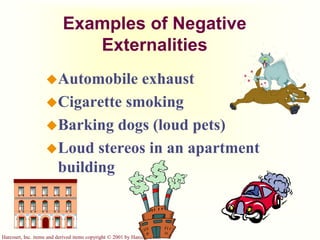
Automobile exhaust
Cigarette smoking
Barking dogs (loud pets)
Loud stereos in an apartment
building
Examples of Negative
Externalities
Harcourt, Inc. items and derived items copyright © 2001 by Harcourt, Inc.
Immunizations
Restored historic buildings
Research into new technologies
Examples of Positive
Externalities
Harcourt, Inc. items and derived items copyright © 2001 by Harcourt, Inc.
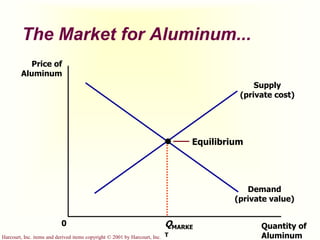
The Market for Aluminum...
Quantity of
Aluminum
0
Price of
Aluminum
QMARKE
T
Demand
(private value)
Supply
(private cost)
Equilibrium
Harcourt, Inc. items and derived items copyright © 2001 by Harcourt, Inc.
QMARKE
T
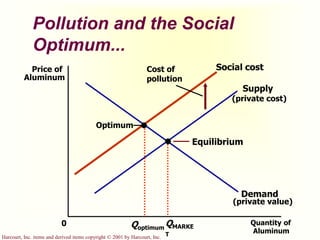
Pollution and the Social
Optimum...
Quantity of
Aluminum
0
Price of
Aluminum
Demand
(private value)
Supply
(private cost)
Social cost
Qoptimum
Cost of
pollution
Equilibrium
Optimum
Harcourt, Inc. items and derived items copyright © 2001 by Harcourt, Inc.
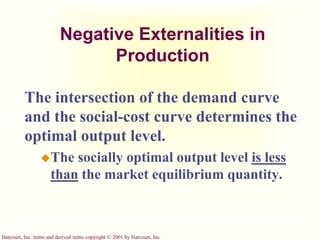
Negative Externalities in
Production
The intersection of the demand curve
and the social-cost curve determines the
optimal output level.
The socially optimal output level is less
than the market equilibrium quantity.
Harcourt, Inc. items and derived items copyright © 2001 by Harcourt, Inc.
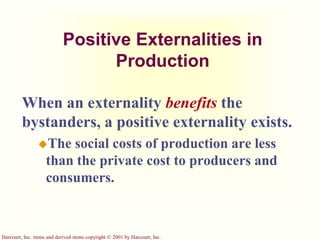
Positive Externalities in
Production
When an externality benefits the
bystanders, a positive externality exists.
The social costs of production are less
than the private cost to producers and
consumers.
Harcourt, Inc. items and derived items copyright © 2001 by Harcourt, Inc.
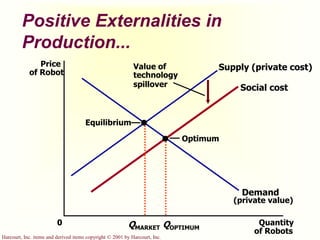
Positive Externalities in
Production...
Quantity
of Robots
0
Price
of Robot
QOPTIMUM
Demand
(private value)
Supply (private cost)
Social cost
QMARKET
Value of
technology
spillover
Equilibrium
Optimum
Harcourt, Inc. items and derived items copyright © 2001 by Harcourt, Inc.
Positive Externalities in
Production
The intersection of the demand curve and
the social-cost curve determines the optimal
output level.
 The optimal output level is more than the
equilibrium quantity.
 The market produces a smaller quantity than
is socially desirable.
 The social costs of production are less than
the private cost to producers and consumers.
Harcourt, Inc. items and derived items copyright © 2001 by Harcourt, Inc.
Internalizing Production
Externalities
Taxes are the primary tools used
to internalize negative
externalities.
Subsidies are the primary tools
used to internalize positive
externalities.
Harcourt, Inc. items and derived items copyright © 2001 by Harcourt, Inc.
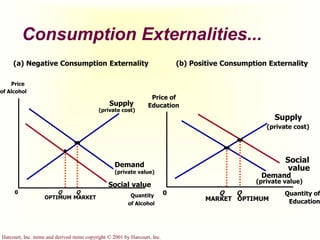
Consumption Externalities...
Quantity of
Education
0
Price of
Education
Q
MARKET
Demand
(private value)
Social
value
Q
OPTIMUM
(b) Positive Consumption Externality
Supply
(private cost)
Quantity
of Alcohol
0
Price
of Alcohol
Q
MARKET
Demand
(private value)
Supply
(private cost)
Social value
Q
OPTIMUM
(a) Negative Consumption Externality
Harcourt, Inc. items and derived items copyright © 2001 by Harcourt, Inc.
Externalities and Market
Inefficiency
 Negative externalities in production or
consumption lead markets to produce a
larger quantity than is socially
desirable.
 Positive externalities in production or
consumption lead markets to produce a
larger quantity than is socially
desirable.
Harcourt, Inc. items and derived items copyright © 2001 by Harcourt, Inc.
Private Solutions to
Externalities
Government action is not
always needed to solve the
problem of externalities.
Harcourt, Inc. items and derived items copyright © 2001 by Harcourt, Inc.
The Coase Theorem
The Coase Theorem states that if private
parties can bargain without cost over the
allocation of resources, then the private
market will always solve the problem of
externalities on its own and allocate
resources efficiently.
Harcourt, Inc. items and derived items copyright © 2001 by Harcourt, Inc.
Why Private Solutions
Do Not Always Work
Sometimes the private solution
approach fails because transaction
costs can be so high that private
agreement is not possible.
Harcourt, Inc. items and derived items copyright © 2001 by Harcourt, Inc.
Public Policy Toward
Externalities
When externalities are significant and
private solutions are not found,
government may attempt to solve the
problem through . . .
command-and-control policies.
market-based policies.

Externalities

  • 1.
    Harcourt, Inc. itemsand derived items copyright © 2001 by Harcourt, Inc. Externalities Chapter 10 Copyright © 2001 by Harcourt, Inc. All rights reserved. Requests for permission to make copies of any part of the work should be mailed to: Permissions Department, Harcourt College Publishers, 6277 Sea Harbor Drive, Orlando, Florida 32887-6777.
  • 2.
    Harcourt, Inc. itemsand derived items copyright © 2001 by Harcourt, Inc. Market Failures: Externalities When a market outcome affects parties other than the buyers and sellers in the market, side-effects are created called externalities. Externalities cause markets to be inefficient, and thus fail to maximize total surplus.
  • 3.
    Harcourt, Inc. itemsand derived items copyright © 2001 by Harcourt, Inc. An externality arises... . . . when a person engages in an activity that influences the well- being of a bystander and yet neither pays nor receives any compensation for that effect.
  • 4.
    Harcourt, Inc. itemsand derived items copyright © 2001 by Harcourt, Inc. Market Failures: Externalities When the impact on the bystander is adverse, the externality is called a negative externality. When the impact on the bystander is beneficial, the externality is called a positive externality.
  • 5.
    Harcourt, Inc. itemsand derived items copyright © 2001 by Harcourt, Inc. Automobile exhaust Cigarette smoking Barking dogs (loud pets) Loud stereos in an apartment building Examples of Negative Externalities
  • 6.
    Harcourt, Inc. itemsand derived items copyright © 2001 by Harcourt, Inc. Immunizations Restored historic buildings Research into new technologies Examples of Positive Externalities
  • 7.
    Harcourt, Inc. itemsand derived items copyright © 2001 by Harcourt, Inc. The Market for Aluminum... Quantity of Aluminum 0 Price of Aluminum QMARKE T Demand (private value) Supply (private cost) Equilibrium
  • 8.
    Harcourt, Inc. itemsand derived items copyright © 2001 by Harcourt, Inc. QMARKE T Pollution and the Social Optimum... Quantity of Aluminum 0 Price of Aluminum Demand (private value) Supply (private cost) Social cost Qoptimum Cost of pollution Equilibrium Optimum
  • 9.
    Harcourt, Inc. itemsand derived items copyright © 2001 by Harcourt, Inc. Negative Externalities in Production The intersection of the demand curve and the social-cost curve determines the optimal output level. The socially optimal output level is less than the market equilibrium quantity.
  • 10.
    Harcourt, Inc. itemsand derived items copyright © 2001 by Harcourt, Inc. Positive Externalities in Production When an externality benefits the bystanders, a positive externality exists. The social costs of production are less than the private cost to producers and consumers.
  • 11.
    Harcourt, Inc. itemsand derived items copyright © 2001 by Harcourt, Inc. Positive Externalities in Production... Quantity of Robots 0 Price of Robot QOPTIMUM Demand (private value) Supply (private cost) Social cost QMARKET Value of technology spillover Equilibrium Optimum
  • 12.
    Harcourt, Inc. itemsand derived items copyright © 2001 by Harcourt, Inc. Positive Externalities in Production The intersection of the demand curve and the social-cost curve determines the optimal output level.  The optimal output level is more than the equilibrium quantity.  The market produces a smaller quantity than is socially desirable.  The social costs of production are less than the private cost to producers and consumers.
  • 13.
    Harcourt, Inc. itemsand derived items copyright © 2001 by Harcourt, Inc. Internalizing Production Externalities Taxes are the primary tools used to internalize negative externalities. Subsidies are the primary tools used to internalize positive externalities.
  • 14.
    Harcourt, Inc. itemsand derived items copyright © 2001 by Harcourt, Inc. Consumption Externalities... Quantity of Education 0 Price of Education Q MARKET Demand (private value) Social value Q OPTIMUM (b) Positive Consumption Externality Supply (private cost) Quantity of Alcohol 0 Price of Alcohol Q MARKET Demand (private value) Supply (private cost) Social value Q OPTIMUM (a) Negative Consumption Externality
  • 15.
    Harcourt, Inc. itemsand derived items copyright © 2001 by Harcourt, Inc. Externalities and Market Inefficiency  Negative externalities in production or consumption lead markets to produce a larger quantity than is socially desirable.  Positive externalities in production or consumption lead markets to produce a larger quantity than is socially desirable.
  • 16.
    Harcourt, Inc. itemsand derived items copyright © 2001 by Harcourt, Inc. Private Solutions to Externalities Government action is not always needed to solve the problem of externalities.
  • 17.
    Harcourt, Inc. itemsand derived items copyright © 2001 by Harcourt, Inc. The Coase Theorem The Coase Theorem states that if private parties can bargain without cost over the allocation of resources, then the private market will always solve the problem of externalities on its own and allocate resources efficiently.
  • 18.
    Harcourt, Inc. itemsand derived items copyright © 2001 by Harcourt, Inc. Why Private Solutions Do Not Always Work Sometimes the private solution approach fails because transaction costs can be so high that private agreement is not possible.
  • 19.
    Harcourt, Inc. itemsand derived items copyright © 2001 by Harcourt, Inc. Public Policy Toward Externalities When externalities are significant and private solutions are not found, government may attempt to solve the problem through . . . command-and-control policies. market-based policies.