Xolisa S Mbobo
University of Johannesburg

Economics for
Grade 11
Learners
1-1
ECONOMIC CONCEPTS AND SYSTEMS
Economic concepts
1-2
Lecture Plan


What is Economics?



Scarcity



Basic economic problems



What are resources



Production possibility analysis


The circular flow of economic activity



The interaction of the economic participants



Economic model of income and consumption



Economic policies
1-3
What is Economics?


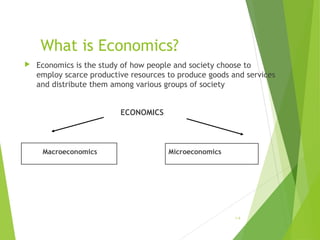
Economics is the study of how people and society choose to
employ scarce productive resources to produce goods and services
and distribute them among various groups of society
ECONOMICS

Macroeconomics

Microeconomics

1-4
Microeconomics vs. Macroeconomics


Microeconomics = the study of individual, consumers, firms and
industries




It focuses on:






(‘Micro’ = the ancient Greek word for ‘small’)

The pricing and production decisions of industrial firms
Consumer behaviour and
The output and state of single industries

Macroeconomics is concerned with how the economy functions as a
whole (e.g. total income)


(‘Macro’ is the Greek word for ‘large’)

1-5
Scarcity


Every economy is endowed with what we call
resources, which are inputs used in the production of
goods and services for consumption to satisfy our needs
and wants



The basic economic problem of any society is the
relative scarcity of resources in relation to the
unlimited needs and wants of consumers

1-6
Resources


Resources = All inputs that can be combined in many different ways
to produce goods and services of various types to help satisfy
people’s unlimited needs and wants



Often referred to as the factors of production



Resources include land, capital, labour and enterprise

1-7
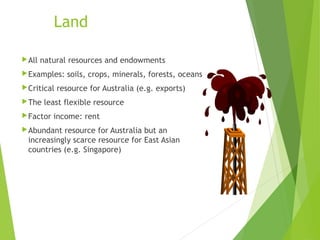
Land
 All

natural resources and endowments

 Examples:
 Critical
 The

soils, crops, minerals, forests, oceans

resource for Australia (e.g. exports)

least flexible resource

 Factor

income: rent

 Abundant

resource for Australia but an
increasingly scarce resource for East Asian
countries (e.g. Singapore)

1-8
Capital


Any good or service used to produce
others (i.e. intermediate goods)


e.g. factories, tools, machinery and
equipment

Most abundant factor for industrial
countries (e.g. United States, Japan)
 Factor income: interest
 Note: Expenditure on capital
is
Investment


1-9
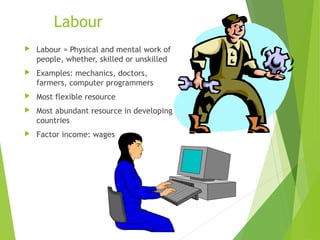
Labour


Labour = Physical and mental work of
people, whether, skilled or unskilled



Examples: mechanics, doctors,
farmers, computer programmers



Most flexible resource



Most abundant resource in developing
countries



Factor income: wages

1-10
Enterprise


Management (e.g. ownership, control
and/or coordination) of the other three
factors of production (entrepreneurship)



Covers the various organisational skills
of ‘entrepreneurs’



Example: business managers



Factor income: profit

1-11
Characteristics of Resources


Scarce





Have alternative uses
Limited, finite

Quantity of resources


Physical amount of resources available



Affected by resource endowment and population



Australia’s cropland is 463 000 sq. km, while Indonesia’s cropland is
324 000 sq. km



Australia’s labour force is around 9–10 million people, while Indonesia’s
workforce is over 90 million people

(cont.)
1-12
Characteristics of Resources
(cont.)


Quality of resources



Affected by technology, education and training of workforce



Land productivity (yield/ha)





Productivity of resources

Labour productivity (production per person)

We achieve economic growth by increasing the quantity and/or
quality of resources

1-13
Consumer Needs and Wants


Needs: those things necessary to human survival e.g. food, shelter



Wants: goods/services desired by the consumer e.g. hi-fi, travel,
luxury cars



Characteristics:


unlimited



recurrent



complementary



NEED

changeable
WANT

1-14
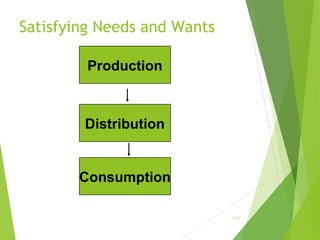
Satisfying Needs and Wants
Production

Distribution

Consumption
1-15
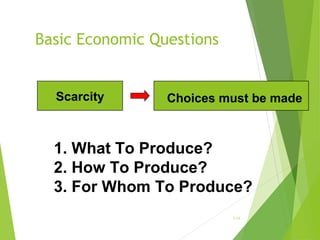
Basic Economic Questions

Scarcity

Choices must be made

1. What To Produce?
2. How To Produce?
3. For Whom To Produce?
1-16
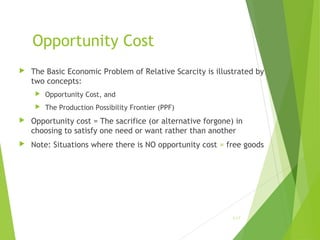
Opportunity Cost


The Basic Economic Problem of Relative Scarcity is illustrated by
two concepts:


Opportunity Cost, and



The Production Possibility Frontier (PPF)



Opportunity cost = The sacrifice (or alternative forgone) in
choosing to satisfy one need or want rather than another



Note: Situations where there is NO opportunity cost = free goods

1-17
Production Possibility Frontier (PPF)
Theory


A simplified economic model which portrays scarcity, choice and
opportunity cost

The Static Production Possibility Frontier


Analyses the economy at a fixed point in time



Is based on the following assumptions:


There is a fixed quantity of resources



The economy only produces two products



Resources can be used interchangeably



All resources within the economy are used



Resources are used at maximum efficiency

1-18
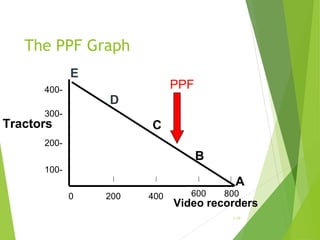
The PPF Graph
E
400-

PPF
D

300-

Tractors

C

200-

B
100-

A
0

200

400

600

800

Video recorders
1-19
Maximum Output Levels


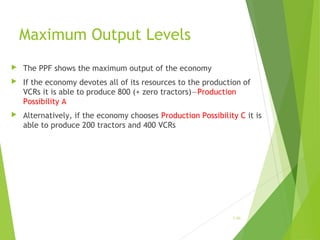
The PPF shows the maximum output of the economy



If the economy devotes all of its resources to the production of
VCRs it is able to produce 800 (+ zero tractors)—Production
Possibility A



Alternatively, if the economy chooses Production Possibility C it is
able to produce 200 tractors and 400 VCRs

1-20
Opportunity Costs


The PPF shows that to produce more of one product means
producing less of another



Opportunity costs of production can be measured e.g. if the
economy moves from point C to D (along the PPF) it will produce an
extra 100 tractors BUT 200 VCRs must be sacrificed



Hence the opportunity cost is 200 VCRs

1-21
Points Outside the Static PPF


Points outside the PPF (e.g. X) are not possible using existing
technology and resources

A
.X
PPF
B

1-22
Points Inside the Static PPF
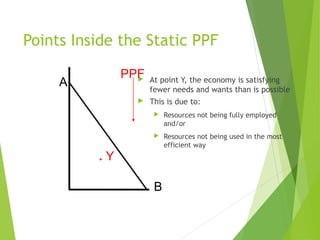
PPF


A



At point Y, the economy is satisfying
fewer needs and wants than is possible
This is due to:


Resources not being fully employed
and/or



Resources not being used in the most
efficient way

.Y
B
1-23
The Dynamic PPF Model


This model differs from the static PPF in that it
incorporates changes over time



It demonstrates the effect of changes in the quantity
and quality of productive resources e.g. new resource
discoveries, improvements in technology



Changes in the quantity and/or quality of resources will
SHIFT the PPF

1-24
Dynamic PPF
A



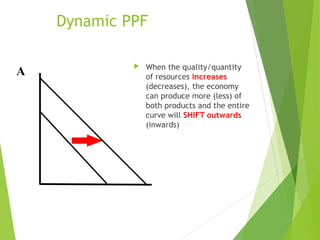
When the quality/quantity
of resources increases
(decreases), the economy
can produce more (less) of
both products and the entire
curve will SHIFT outwards
(inwards)

1-25
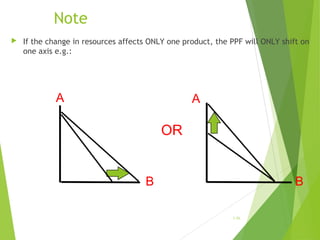
Note


If the change in resources affects ONLY one product, the PPF will ONLY shift on
one axis e.g.:

A

A

OR

B

B
1-26
The Significance of PPF Shifts


Increased maximum output levels enable:
1.
2.



higher levels of consumption
greater satisfaction of consumer needs and wants

Improvements in the quality of resources results in the more
efficient use of scarce resources

1-27
Basic Economic Activities
 Production
 The

use of economic resources in the creation of goods and
services for the satisfaction of human wants.

 Consumption
 The

using up of goods and services by consumer purchasing
or in the production of other goods.

 Employment
 The

use of economic resources in production; engagement
in activity

 Income
 The

Generation

production of maximum amount an individual can
spend during a period without being any worse off.
Two Economic Units


Household




The basic consuming unit.



The basic producing unit.

Firm
Stock and Flow Variables
 Flow
A

quantity measured over a particular period of time.

 Stock
A

quantity measured as of a given point in time.

The concepts of stock and flow measurements
are essential in understanding the economic
variables of wealth and income.
 Wealth
 Anything

of valued owned. It is a stock since it is what is
owned at a particular time.

 Income
 The

rate at which we earn money. It is a flow since income
that is saved, increases the stock of wealth.
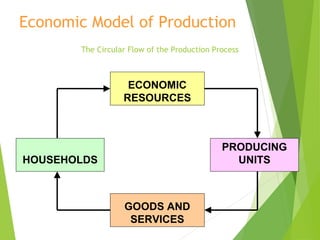
Economic Model of Production
The Circular Flow of the Production Process

ECONOMIC
RESOURCES

PRODUCING
UNITS

HOUSEHOLDS

GOODS AND
SERVICES
Circular Flow of Goods Among Production Units
RAW
MATERIALS
RAW MATERIAL
FIRM

INTERMEDIATE
GOOD FIRM

CONSUMERS
INTERMEDIAT
E GOODS

FINAL GOODS

FINAL GOOD FIRM
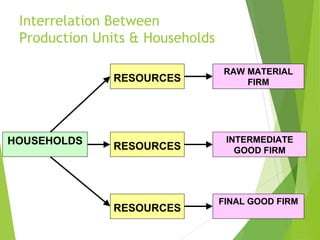
Interrelation Between
Production Units & Households
RESOURCES

HOUSEHOLDS

RAW MATERIAL
FIRM

RESOURCES

INTERMEDIATE
GOOD FIRM

RESOURCES

FINAL GOOD FIRM
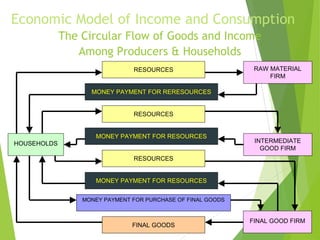
Economic Model of Income and Consumption
The Circular Flow of Goods and Income
Among Producers & Households
RESOURCES

RAW MATERIAL
FIRM

MONEY PAYMENT FOR RERESOURCES
RESOURCES
MONEY PAYMENT FOR RESOURCES
HOUSEHOLDS

INTERMEDIATE
GOOD FIRM

RESOURCES
MONEY PAYMENT FOR RESOURCES
MONEY PAYMENT FOR PURCHASE OF FINAL GOODS

FINAL GOODS

FINAL GOOD FIRM
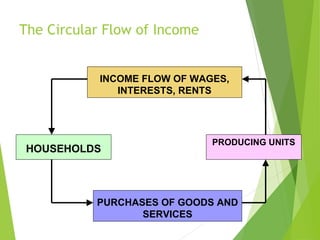
The Circular Flow of Income
INCOME FLOW OF WAGES,
INTERESTS, RENTS

HOUSEHOLDS

PRODUCING UNITS

PURCHASES OF GOODS AND
SERVICES
Circular Flow of Income Among Production
Units
MONEY PAYMENTS
FOR RAW MATERIALS
INTERMEDIATE
GOOD FIRM

RAW MATERIALS FIRM

MONEY PAYMENTS FOR
INTERMEDIATE GOODS

FINAL GOOD
FIRM
MONEY PAYMENTS
FOR FINAL GOODS

HOUSEHOLDS
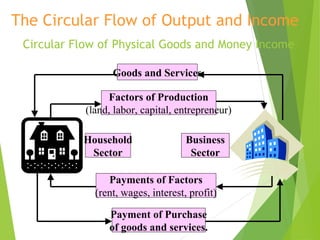
The Circular Flow of Output and Income
Circular Flow of Physical Goods and Money Income
Goods and Services
Factors of Production
(land, labor, capital, entrepreneur)
Household
Sector

Business
Sector

Payments of Factors
(rent, wages, interest, profit)
Payment of Purchase
of goods and services.
The Circular Flow of
Goods & Income of Households & Firms
with the Government & Foreign Countries
GOVERNMENT Purchase of Goods
Wages, Transfer Payments
& Services
Taxes
Taxes
Economic Resources
Purchase of Goods & Services
HOUSEHOLDS
PRODUCING UNITS
Income Payments of Wages, Rent,
Dividends, & Interests
Goods & Services
Money Payments for
Money Payments for
Imports
Exports
FOREIGN COUNTRIES
Implications of the
Circular Flow of Economic Activity
1.

The goods, resources, and money payments
will flow as long as households continue to
consume, and as long as firms continue to
produce.

2.

That since goods and resources flow in
exchange for payments, the rate of
payments flow will in the end be the same.
Money is the inducing factor, and the pillar
of the price system. Without it, there is no
price system.
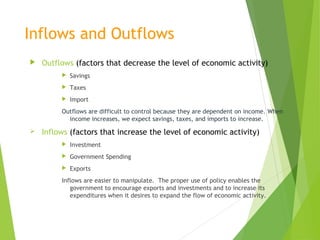
Inflows and Outflows


Outflows (factors that decrease the level of economic activity)


Savings



Taxes



Import

Outflows are difficult to control because they are dependent on income. When
income increases, we expect savings, taxes, and imports to increase.



Inflows (factors that increase the level of economic activity)


Investment



Government Spending



Exports

Inflows are easier to manipulate. The proper use of policy enables the
government to encourage exports and investments and to increase its
expenditures when it desires to expand the flow of economic activity.
Fiscal and Monetary policy


Fiscal- the utilization of certain governmental activities
and actions in the development and stabilization of the
economy.



Monetary- this pertains to the amount of money
circulation or the money supply in our country.
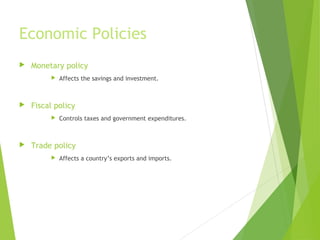
Economic Policies


Monetary policy




Fiscal policy




Affects the savings and investment.

Controls taxes and government expenditures.

Trade policy


Affects a country’s exports and imports.
Elements of Fiscal Policy


Taxation- means of obtaining revenue/s from
government, as a means of transferring resources from
private to public sector.



Expenditure-means the amount of the expenses of the
government to finance the goods and services they
provide.



Debt management- how government manage the debts
in the country in various forms.
Public Finance


Income- it is the financial resources that the
government get from taxes and other revenues.



Outgo- is the government’s expenditure of funds to
finance the goods and services.
Public Finance
5 step process


the formulation of fiscal policy.



The generation of revenue from taxation and other
sources.



The expenditure of funds through the national budget.



Public borrowings



accountability
References
This presentation is a mashup of 3 different sources. They are:

Cristabol M. Pagoso, Rosemary P. Dinio, and George. A Villasis .
(2011). The circular flow of economic activity
http://www.slideshare.net/dienshMBA/dmydocspatricelourdescollegepowerpointsecon1theci
Accessed date: 05 March 2014
Faizan Chaudhry. (2011) Economic concepts and systems
http://www.slideshare.net/HUKKAM/ch01-ppt-7484908
Accessed date: 05 March 2014
April Van Diwata. (2013)
http://www.slideshare.net/FairywithBraces/fiscal-and-monetary-policy
Accessed date: 05 March 2014

1-46

Economics concepts for grade 11 learners

  • 1.
    Xolisa S Mbobo Universityof Johannesburg Economics for Grade 11 Learners 1-1
  • 2.
    ECONOMIC CONCEPTS ANDSYSTEMS Economic concepts 1-2
  • 3.
    Lecture Plan  What isEconomics?  Scarcity  Basic economic problems  What are resources  Production possibility analysis  The circular flow of economic activity  The interaction of the economic participants  Economic model of income and consumption  Economic policies 1-3
  • 4.
    What is Economics?  Economicsis the study of how people and society choose to employ scarce productive resources to produce goods and services and distribute them among various groups of society ECONOMICS Macroeconomics Microeconomics 1-4
  • 5.
    Microeconomics vs. Macroeconomics  Microeconomics= the study of individual, consumers, firms and industries   It focuses on:     (‘Micro’ = the ancient Greek word for ‘small’) The pricing and production decisions of industrial firms Consumer behaviour and The output and state of single industries Macroeconomics is concerned with how the economy functions as a whole (e.g. total income)  (‘Macro’ is the Greek word for ‘large’) 1-5
  • 6.
    Scarcity  Every economy isendowed with what we call resources, which are inputs used in the production of goods and services for consumption to satisfy our needs and wants  The basic economic problem of any society is the relative scarcity of resources in relation to the unlimited needs and wants of consumers 1-6
  • 7.
    Resources  Resources = Allinputs that can be combined in many different ways to produce goods and services of various types to help satisfy people’s unlimited needs and wants  Often referred to as the factors of production  Resources include land, capital, labour and enterprise 1-7
  • 8.
    Land  All natural resourcesand endowments  Examples:  Critical  The soils, crops, minerals, forests, oceans resource for Australia (e.g. exports) least flexible resource  Factor income: rent  Abundant resource for Australia but an increasingly scarce resource for East Asian countries (e.g. Singapore) 1-8
  • 9.
    Capital  Any good orservice used to produce others (i.e. intermediate goods)  e.g. factories, tools, machinery and equipment Most abundant factor for industrial countries (e.g. United States, Japan)  Factor income: interest  Note: Expenditure on capital is Investment  1-9
  • 10.
    Labour  Labour = Physicaland mental work of people, whether, skilled or unskilled  Examples: mechanics, doctors, farmers, computer programmers  Most flexible resource  Most abundant resource in developing countries  Factor income: wages 1-10
  • 11.
    Enterprise  Management (e.g. ownership,control and/or coordination) of the other three factors of production (entrepreneurship)  Covers the various organisational skills of ‘entrepreneurs’  Example: business managers  Factor income: profit 1-11
  • 12.
    Characteristics of Resources  Scarce    Havealternative uses Limited, finite Quantity of resources  Physical amount of resources available  Affected by resource endowment and population  Australia’s cropland is 463 000 sq. km, while Indonesia’s cropland is 324 000 sq. km  Australia’s labour force is around 9–10 million people, while Indonesia’s workforce is over 90 million people (cont.) 1-12
  • 13.
    Characteristics of Resources (cont.)  Qualityof resources   Affected by technology, education and training of workforce  Land productivity (yield/ha)   Productivity of resources Labour productivity (production per person) We achieve economic growth by increasing the quantity and/or quality of resources 1-13
  • 14.
    Consumer Needs andWants  Needs: those things necessary to human survival e.g. food, shelter  Wants: goods/services desired by the consumer e.g. hi-fi, travel, luxury cars  Characteristics:  unlimited  recurrent  complementary  NEED changeable WANT 1-14
  • 15.
    Satisfying Needs andWants Production Distribution Consumption 1-15
  • 16.
    Basic Economic Questions Scarcity Choicesmust be made 1. What To Produce? 2. How To Produce? 3. For Whom To Produce? 1-16
  • 17.
    Opportunity Cost  The BasicEconomic Problem of Relative Scarcity is illustrated by two concepts:  Opportunity Cost, and  The Production Possibility Frontier (PPF)  Opportunity cost = The sacrifice (or alternative forgone) in choosing to satisfy one need or want rather than another  Note: Situations where there is NO opportunity cost = free goods 1-17
  • 18.
    Production Possibility Frontier(PPF) Theory  A simplified economic model which portrays scarcity, choice and opportunity cost The Static Production Possibility Frontier  Analyses the economy at a fixed point in time  Is based on the following assumptions:  There is a fixed quantity of resources  The economy only produces two products  Resources can be used interchangeably  All resources within the economy are used  Resources are used at maximum efficiency 1-18
  • 19.
  • 20.
    Maximum Output Levels  ThePPF shows the maximum output of the economy  If the economy devotes all of its resources to the production of VCRs it is able to produce 800 (+ zero tractors)—Production Possibility A  Alternatively, if the economy chooses Production Possibility C it is able to produce 200 tractors and 400 VCRs 1-20
  • 21.
    Opportunity Costs  The PPFshows that to produce more of one product means producing less of another  Opportunity costs of production can be measured e.g. if the economy moves from point C to D (along the PPF) it will produce an extra 100 tractors BUT 200 VCRs must be sacrificed  Hence the opportunity cost is 200 VCRs 1-21
  • 22.
    Points Outside theStatic PPF  Points outside the PPF (e.g. X) are not possible using existing technology and resources A .X PPF B 1-22
  • 23.
    Points Inside theStatic PPF PPF  A  At point Y, the economy is satisfying fewer needs and wants than is possible This is due to:  Resources not being fully employed and/or  Resources not being used in the most efficient way .Y B 1-23
  • 24.
    The Dynamic PPFModel  This model differs from the static PPF in that it incorporates changes over time  It demonstrates the effect of changes in the quantity and quality of productive resources e.g. new resource discoveries, improvements in technology  Changes in the quantity and/or quality of resources will SHIFT the PPF 1-24
  • 25.
    Dynamic PPF A  When thequality/quantity of resources increases (decreases), the economy can produce more (less) of both products and the entire curve will SHIFT outwards (inwards) 1-25
  • 26.
    Note  If the changein resources affects ONLY one product, the PPF will ONLY shift on one axis e.g.: A A OR B B 1-26
  • 27.
    The Significance ofPPF Shifts  Increased maximum output levels enable: 1. 2.  higher levels of consumption greater satisfaction of consumer needs and wants Improvements in the quality of resources results in the more efficient use of scarce resources 1-27
  • 28.
    Basic Economic Activities Production  The use of economic resources in the creation of goods and services for the satisfaction of human wants.  Consumption  The using up of goods and services by consumer purchasing or in the production of other goods.  Employment  The use of economic resources in production; engagement in activity  Income  The Generation production of maximum amount an individual can spend during a period without being any worse off.
  • 29.
    Two Economic Units  Household   Thebasic consuming unit.  The basic producing unit. Firm
  • 30.
    Stock and FlowVariables  Flow A quantity measured over a particular period of time.  Stock A quantity measured as of a given point in time. The concepts of stock and flow measurements are essential in understanding the economic variables of wealth and income.  Wealth  Anything of valued owned. It is a stock since it is what is owned at a particular time.  Income  The rate at which we earn money. It is a flow since income that is saved, increases the stock of wealth.
  • 31.
    Economic Model ofProduction The Circular Flow of the Production Process ECONOMIC RESOURCES PRODUCING UNITS HOUSEHOLDS GOODS AND SERVICES
  • 32.
    Circular Flow ofGoods Among Production Units RAW MATERIALS RAW MATERIAL FIRM INTERMEDIATE GOOD FIRM CONSUMERS INTERMEDIAT E GOODS FINAL GOODS FINAL GOOD FIRM
  • 33.
    Interrelation Between Production Units& Households RESOURCES HOUSEHOLDS RAW MATERIAL FIRM RESOURCES INTERMEDIATE GOOD FIRM RESOURCES FINAL GOOD FIRM
  • 34.
    Economic Model ofIncome and Consumption The Circular Flow of Goods and Income Among Producers & Households RESOURCES RAW MATERIAL FIRM MONEY PAYMENT FOR RERESOURCES RESOURCES MONEY PAYMENT FOR RESOURCES HOUSEHOLDS INTERMEDIATE GOOD FIRM RESOURCES MONEY PAYMENT FOR RESOURCES MONEY PAYMENT FOR PURCHASE OF FINAL GOODS FINAL GOODS FINAL GOOD FIRM
  • 35.
    The Circular Flowof Income INCOME FLOW OF WAGES, INTERESTS, RENTS HOUSEHOLDS PRODUCING UNITS PURCHASES OF GOODS AND SERVICES
  • 36.
    Circular Flow ofIncome Among Production Units MONEY PAYMENTS FOR RAW MATERIALS INTERMEDIATE GOOD FIRM RAW MATERIALS FIRM MONEY PAYMENTS FOR INTERMEDIATE GOODS FINAL GOOD FIRM MONEY PAYMENTS FOR FINAL GOODS HOUSEHOLDS
  • 37.
    The Circular Flowof Output and Income Circular Flow of Physical Goods and Money Income Goods and Services Factors of Production (land, labor, capital, entrepreneur) Household Sector Business Sector Payments of Factors (rent, wages, interest, profit) Payment of Purchase of goods and services.
  • 38.
    The Circular Flowof Goods & Income of Households & Firms with the Government & Foreign Countries GOVERNMENT Purchase of Goods Wages, Transfer Payments & Services Taxes Taxes Economic Resources Purchase of Goods & Services HOUSEHOLDS PRODUCING UNITS Income Payments of Wages, Rent, Dividends, & Interests Goods & Services Money Payments for Money Payments for Imports Exports FOREIGN COUNTRIES
  • 39.
    Implications of the CircularFlow of Economic Activity 1. The goods, resources, and money payments will flow as long as households continue to consume, and as long as firms continue to produce. 2. That since goods and resources flow in exchange for payments, the rate of payments flow will in the end be the same. Money is the inducing factor, and the pillar of the price system. Without it, there is no price system.
  • 40.
    Inflows and Outflows  Outflows(factors that decrease the level of economic activity)  Savings  Taxes  Import Outflows are difficult to control because they are dependent on income. When income increases, we expect savings, taxes, and imports to increase.  Inflows (factors that increase the level of economic activity)  Investment  Government Spending  Exports Inflows are easier to manipulate. The proper use of policy enables the government to encourage exports and investments and to increase its expenditures when it desires to expand the flow of economic activity.
  • 41.
    Fiscal and Monetarypolicy  Fiscal- the utilization of certain governmental activities and actions in the development and stabilization of the economy.  Monetary- this pertains to the amount of money circulation or the money supply in our country.
  • 42.
    Economic Policies  Monetary policy   Fiscalpolicy   Affects the savings and investment. Controls taxes and government expenditures. Trade policy  Affects a country’s exports and imports.
  • 43.
    Elements of FiscalPolicy  Taxation- means of obtaining revenue/s from government, as a means of transferring resources from private to public sector.  Expenditure-means the amount of the expenses of the government to finance the goods and services they provide.  Debt management- how government manage the debts in the country in various forms.
  • 44.
    Public Finance  Income- itis the financial resources that the government get from taxes and other revenues.  Outgo- is the government’s expenditure of funds to finance the goods and services.
  • 45.
    Public Finance 5 stepprocess  the formulation of fiscal policy.  The generation of revenue from taxation and other sources.  The expenditure of funds through the national budget.  Public borrowings  accountability
  • 46.
    References This presentation isa mashup of 3 different sources. They are: Cristabol M. Pagoso, Rosemary P. Dinio, and George. A Villasis . (2011). The circular flow of economic activity http://www.slideshare.net/dienshMBA/dmydocspatricelourdescollegepowerpointsecon1theci Accessed date: 05 March 2014 Faizan Chaudhry. (2011) Economic concepts and systems http://www.slideshare.net/HUKKAM/ch01-ppt-7484908 Accessed date: 05 March 2014 April Van Diwata. (2013) http://www.slideshare.net/FairywithBraces/fiscal-and-monetary-policy Accessed date: 05 March 2014 1-46

Editor's Notes

  • #13 The Quantity of productive resources refers to the physical amount of resources available. It is affected by: resource endowment and population. The Quality of productive resources refers to the productivity of resources and is affected by: Technology, education and training of workforce. By increasing the quantity and/or quality of resources we achieve ECONOMIC GROWTH.
  • #14 The Quantity of productive resources refers to the physical amount of resources available. It is affected by: resource endowment and population. The Quality of productive resources refers to the productivity of resources and is affected by: Technology, education and training of workforce. By increasing the quantity and/or quality of resources we achieve ECONOMIC GROWTH.