Demand and Supply 
1. Demand Schedule and Demand 
Curve 
2. Supply Schedule and the Supply 
Curve 
3. Elasticity of demand and supply
 Demand - Total quantity customers are 
willing and able to purchase. 
 A demand function is a behavior function for 
consumers. 
 A supply function is a behavior function for 
producers. 
We describe market behavior using these two 
functions.
Direct Demand and Derived 
Demand 
 Direct Demand-for consumption goods 
Goods and services that satisfy consumer 
desires. 
 Derived Demand-These are sometimes 
called intermediate goods. 
For example, demand for steel (an 
intermediate good) is derived from the 
demand for final goods (e.g., automobiles).
 Quantity Demanded – amount of a good 
that the consumer is willing to buy and able to 
buy at a given price over a period of time. 
 Law of Demand :All other things remaining 
unchanged, the quantity demanded of a good 
increases when its price decreases and vice 
versa. 
 This relationship can be shown by a demand 
schedule, a demand curve or a demand 
function.
Demand Schedule 
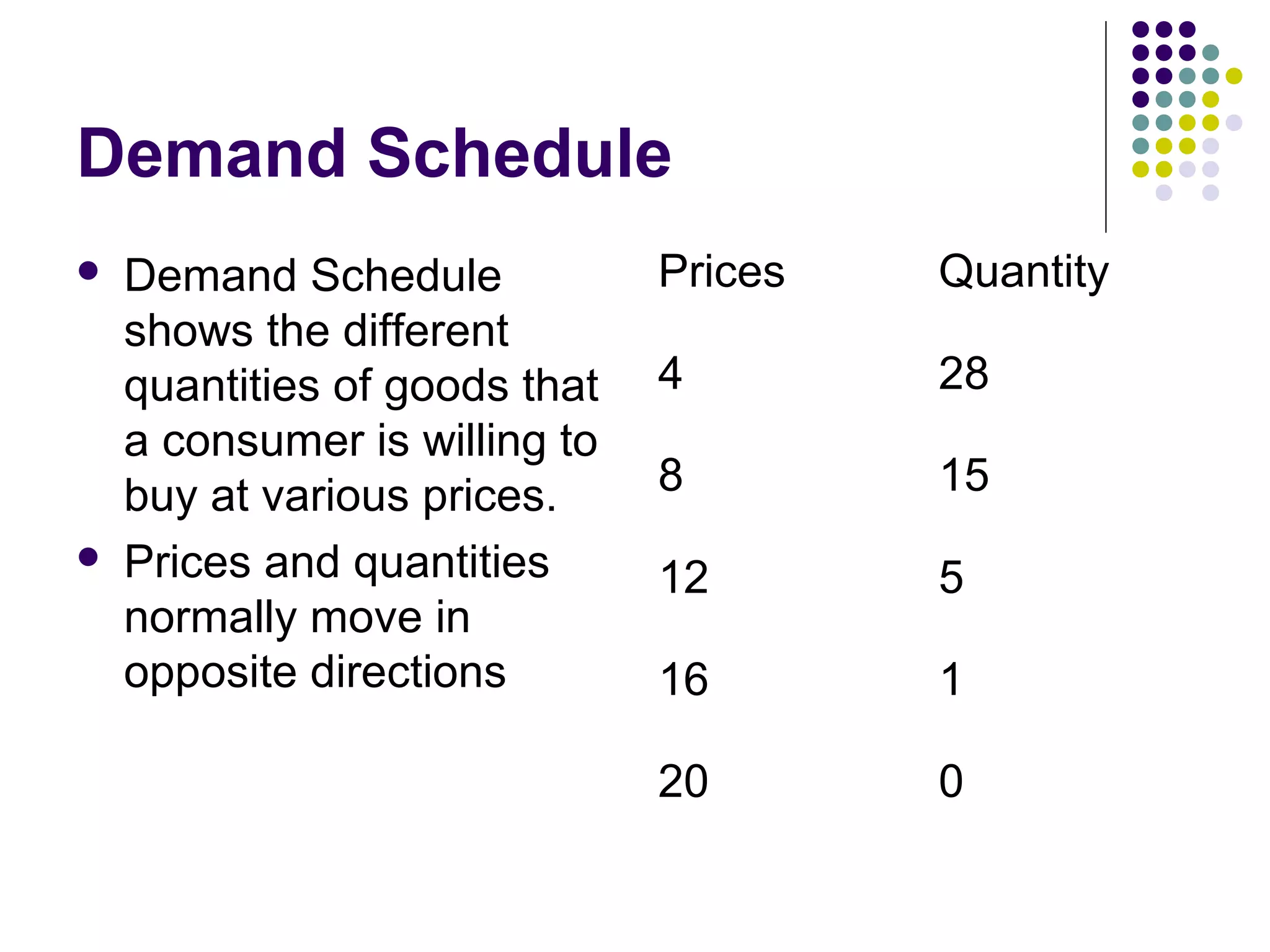
 Demand Schedule 
shows the different 
quantities of goods that 
a consumer is willing to 
buy at various prices. 
 Prices and quantities 
normally move in 
opposite directions 
Prices Quantity 
4 28 
8 15 
12 5 
16 1 
20 0
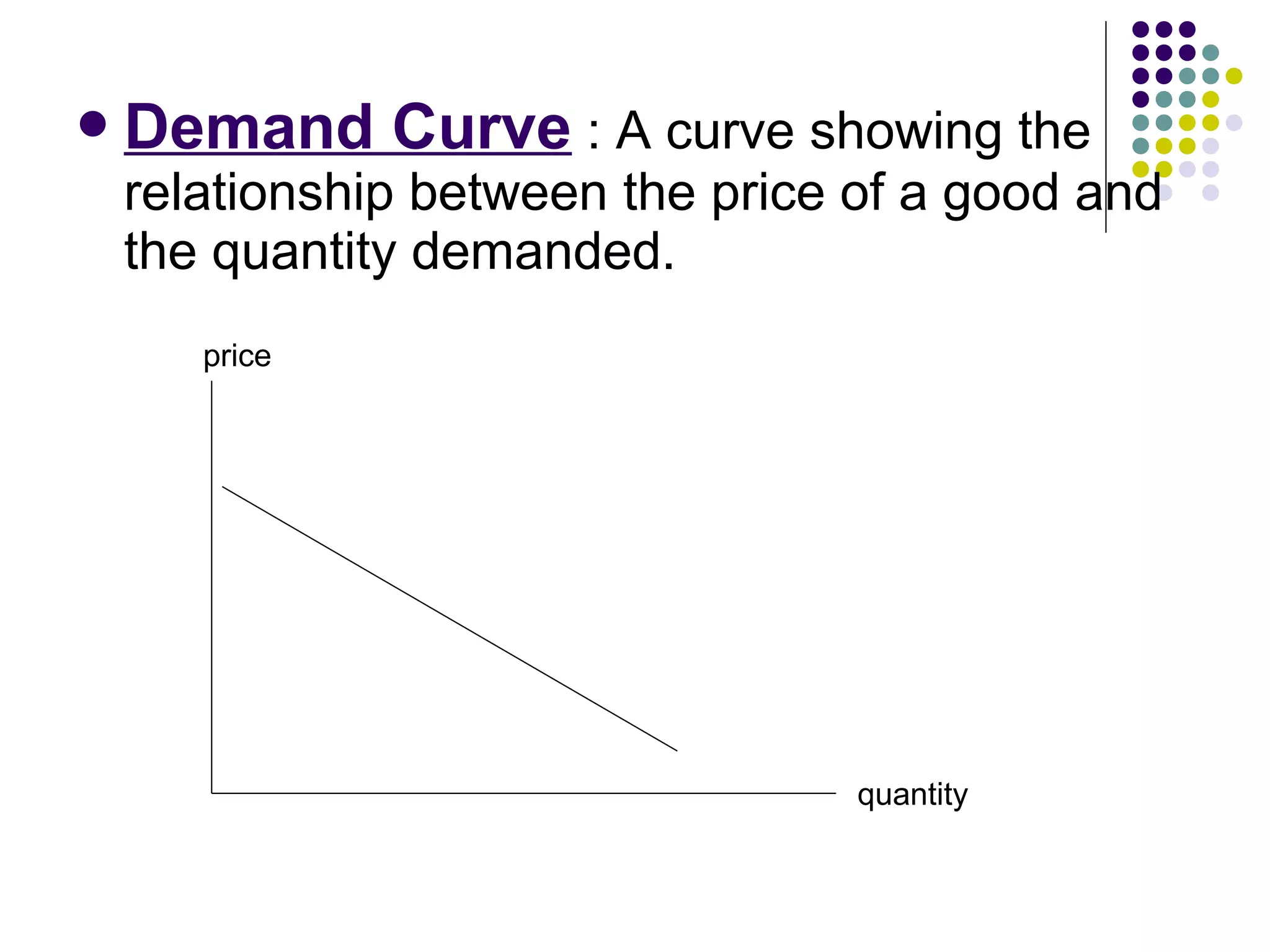
Demand Curve : A curve showing the 
relationship between the price of a good and 
the quantity demanded. 
price 
quantity
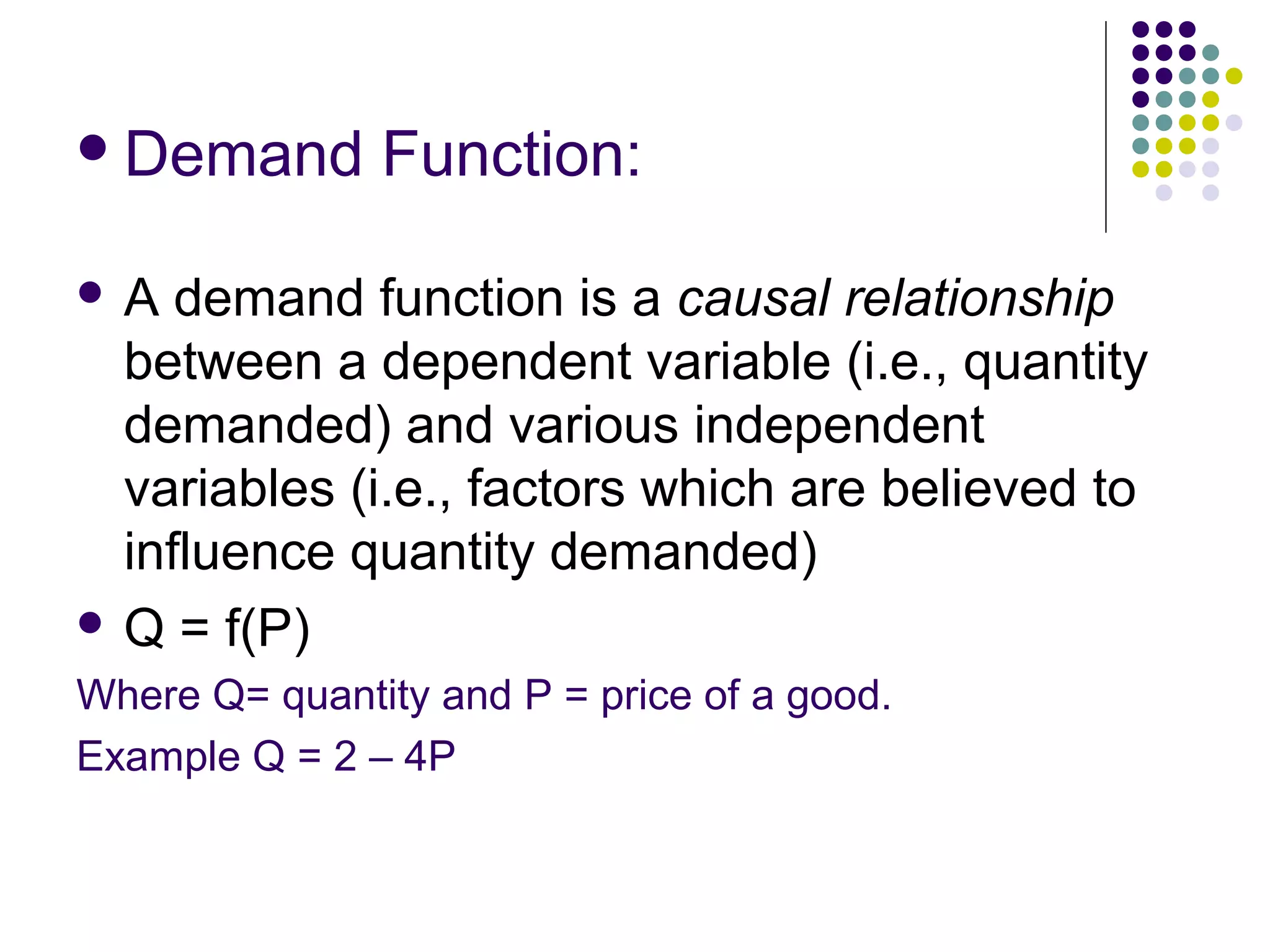
Demand Function: 
 A demand function is a causal relationship 
between a dependent variable (i.e., quantity 
demanded) and various independent 
variables (i.e., factors which are believed to 
influence quantity demanded) 
 Q = f(P) 
Where Q= quantity and P = price of a good. 
Example Q = 2 – 4P
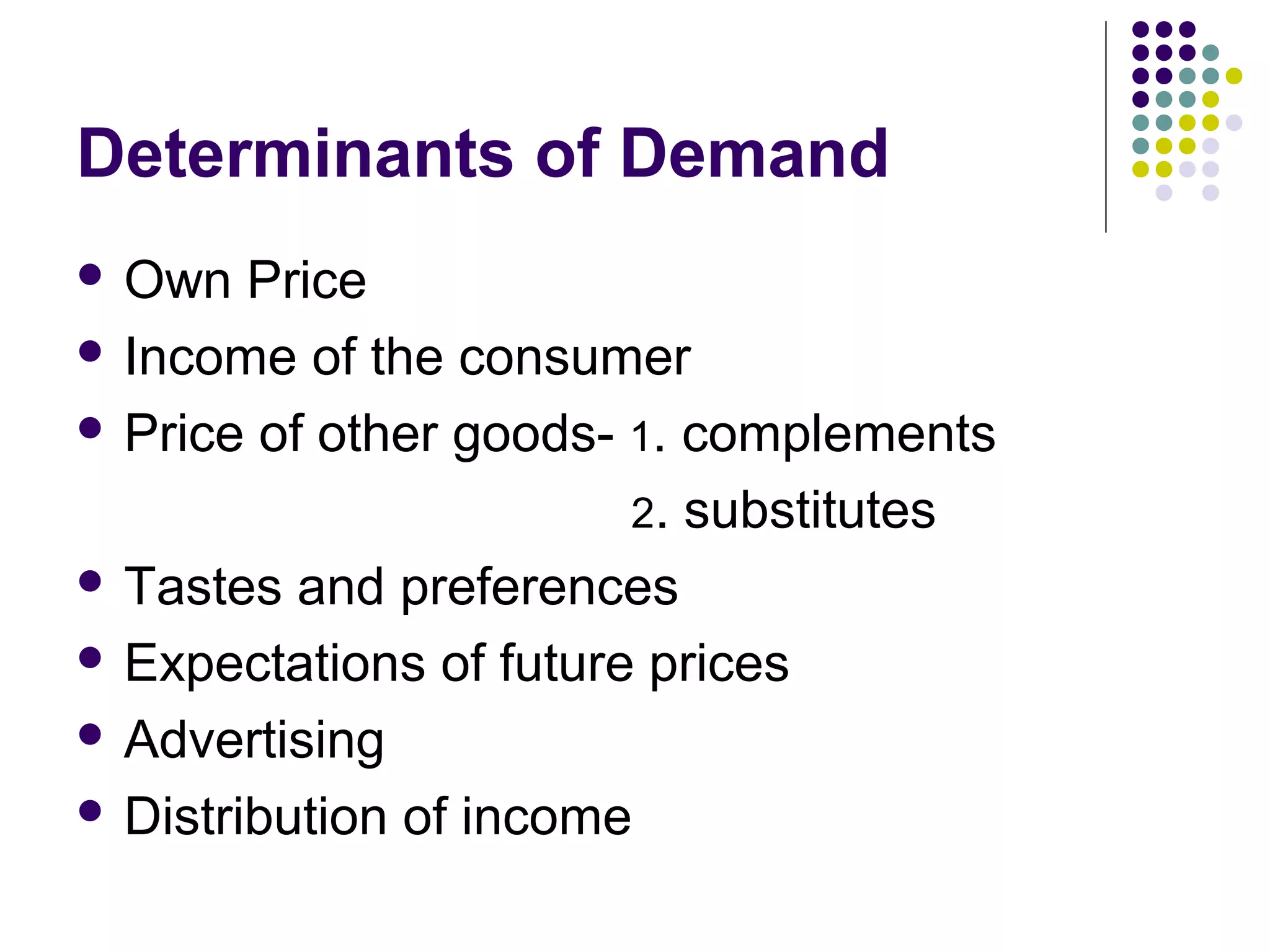
Determinants of Demand 
 Own Price 
 Income of the consumer 
 Price of other goods- 1. complements 
2. substitutes 
 Tastes and preferences 
 Expectations of future prices 
 Advertising 
 Distribution of income
Types of goods 
 Complementary goods are a pair of goods 
consumed together. As the price of one goes 
up the demand for the other falls. 
Example- car and petrol 
 Substitute goods are alternatives to each 
other. As the price of one goes up the 
demand for the other also goes up. 
Example – pepsi and coke
 Normal goods are those goods whose 
demand goes up when the consumer’s 
income increases. 
 Inferior goods are those goods whose 
demand falls when the consumer’s income 
increases. 
Example : autotravel, kerosene 
 Giffen goods are those goods whose demand 
moves in same direction as price 
 Snob or Veblen goods are those goods 
whose demand falls when price falls
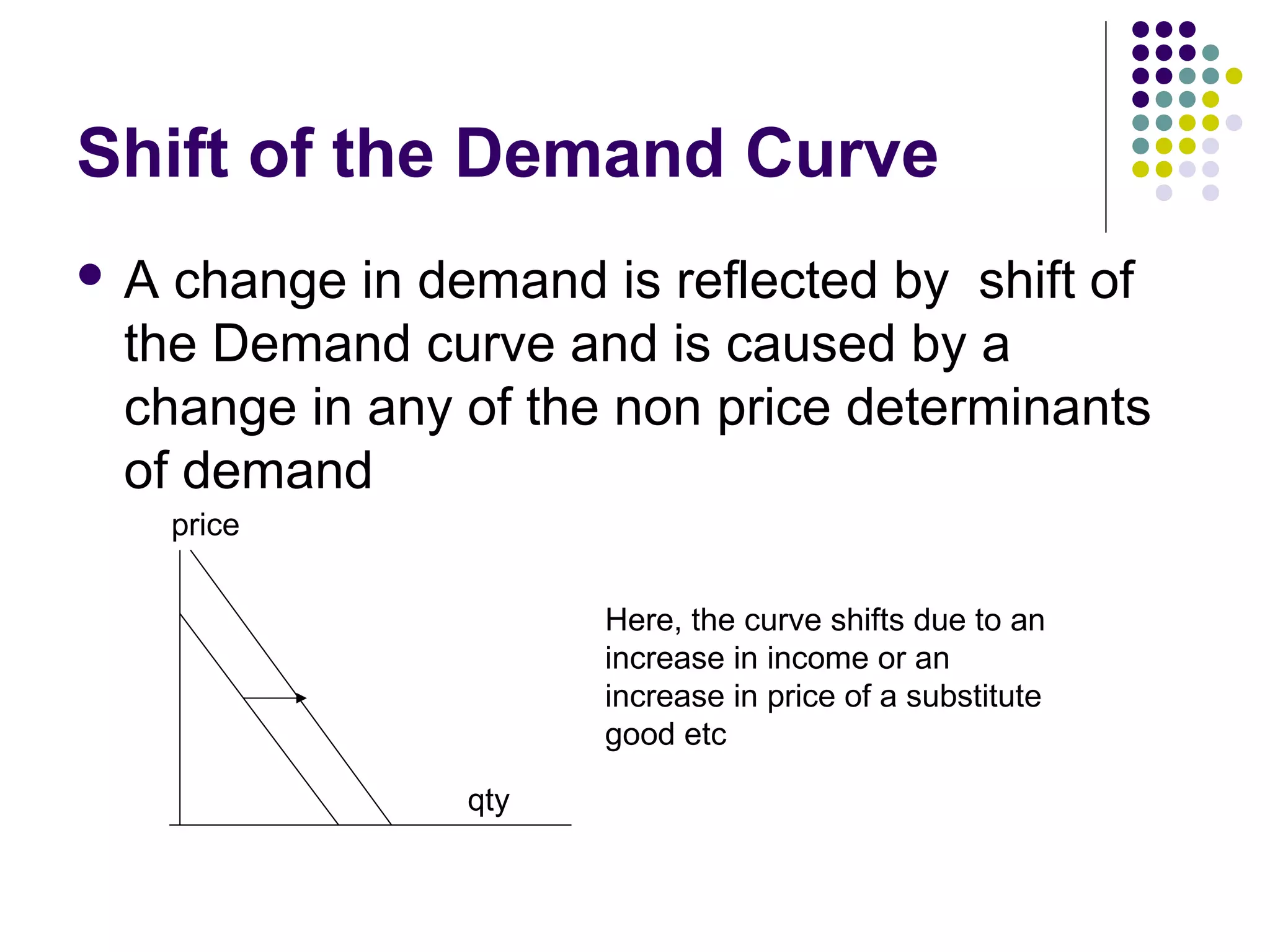
Shift of the Demand Curve 
 A change in demand is reflected by shift of 
the Demand curve and is caused by a 
change in any of the non price determinants 
of demand 
price 
qty 
Here, the curve shifts due to an 
increase in income or an 
increase in price of a substitute 
good etc
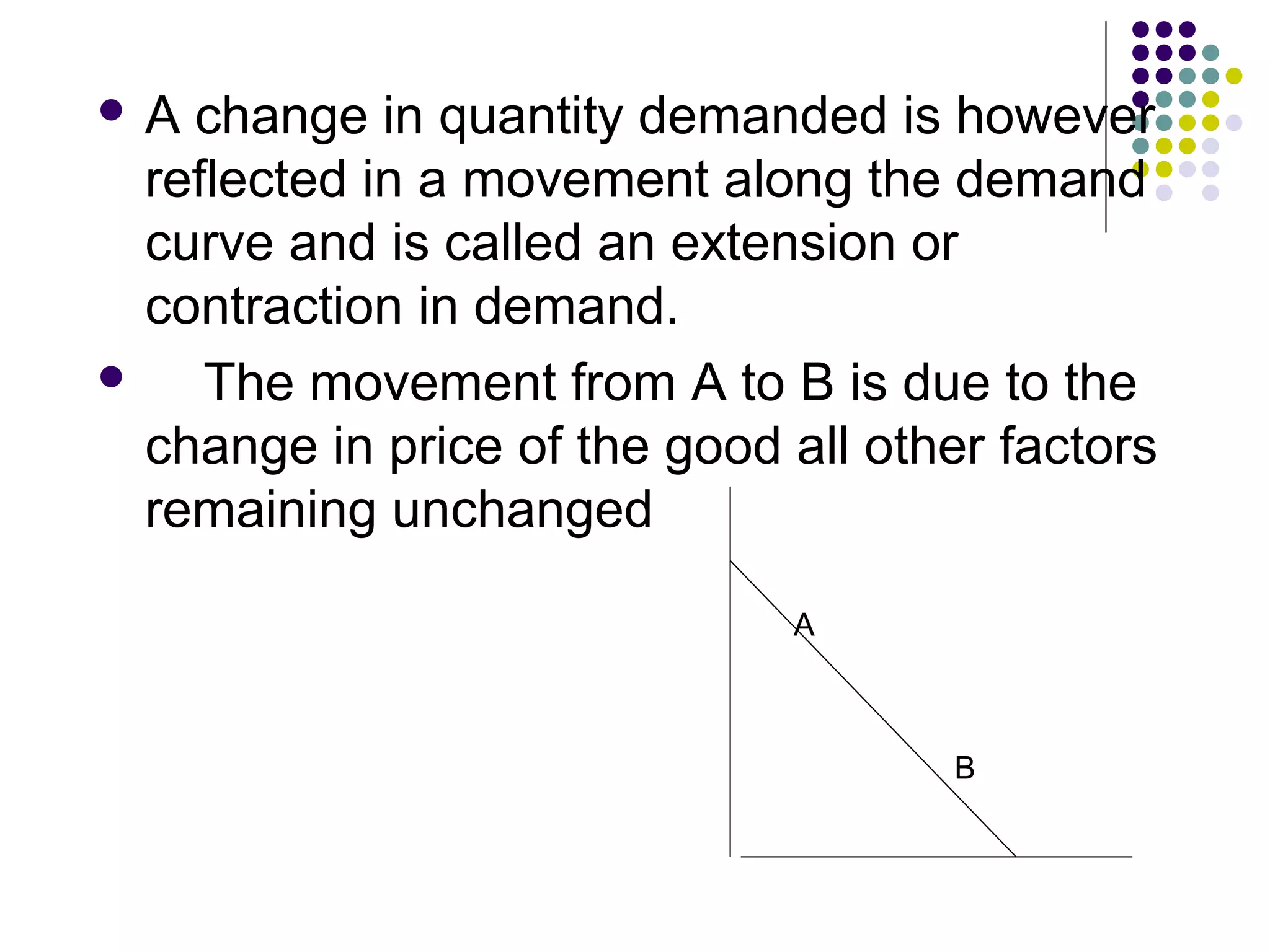
 A change in quantity demanded is however 
reflected in a movement along the demand 
curve and is called an extension or 
contraction in demand. 
 The movement from A to B is due to the 
change in price of the good all other factors 
remaining unchanged 
A 
B
Supply 
 The quantity supplied is the number of units 
that sellers want to sell over a specified 
period of time at a particular price. 
 Law of Supply states that all other factors 
remaining unchanged the supply of a good 
increases as its price increases. This can be 
shown by a supply schedule, a supply curve 
or a supply function.
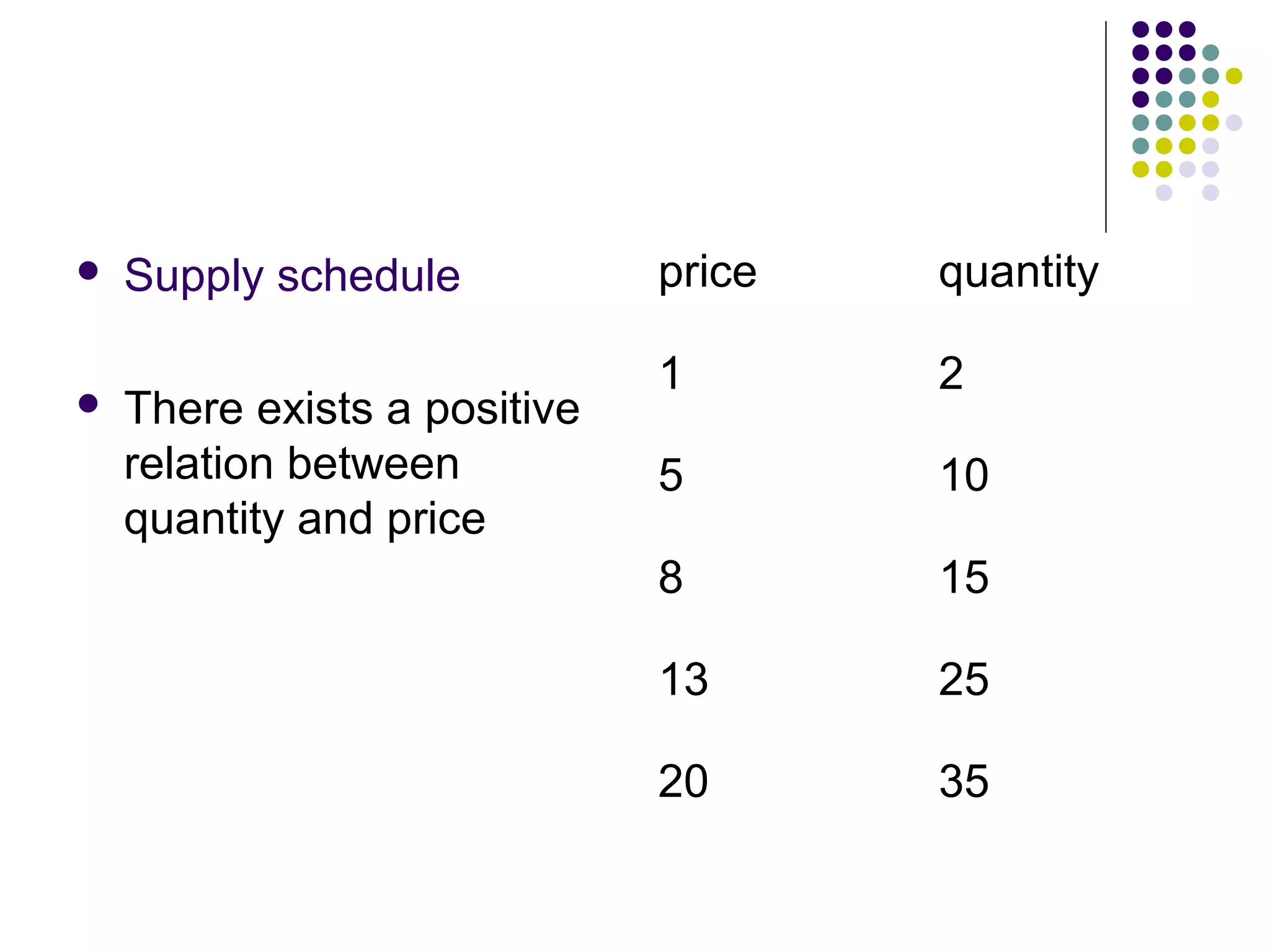
 Supply schedule 
 There exists a positive 
relation between 
quantity and price 
price quantity 
1 2 
5 10 
8 15 
13 25 
20 35
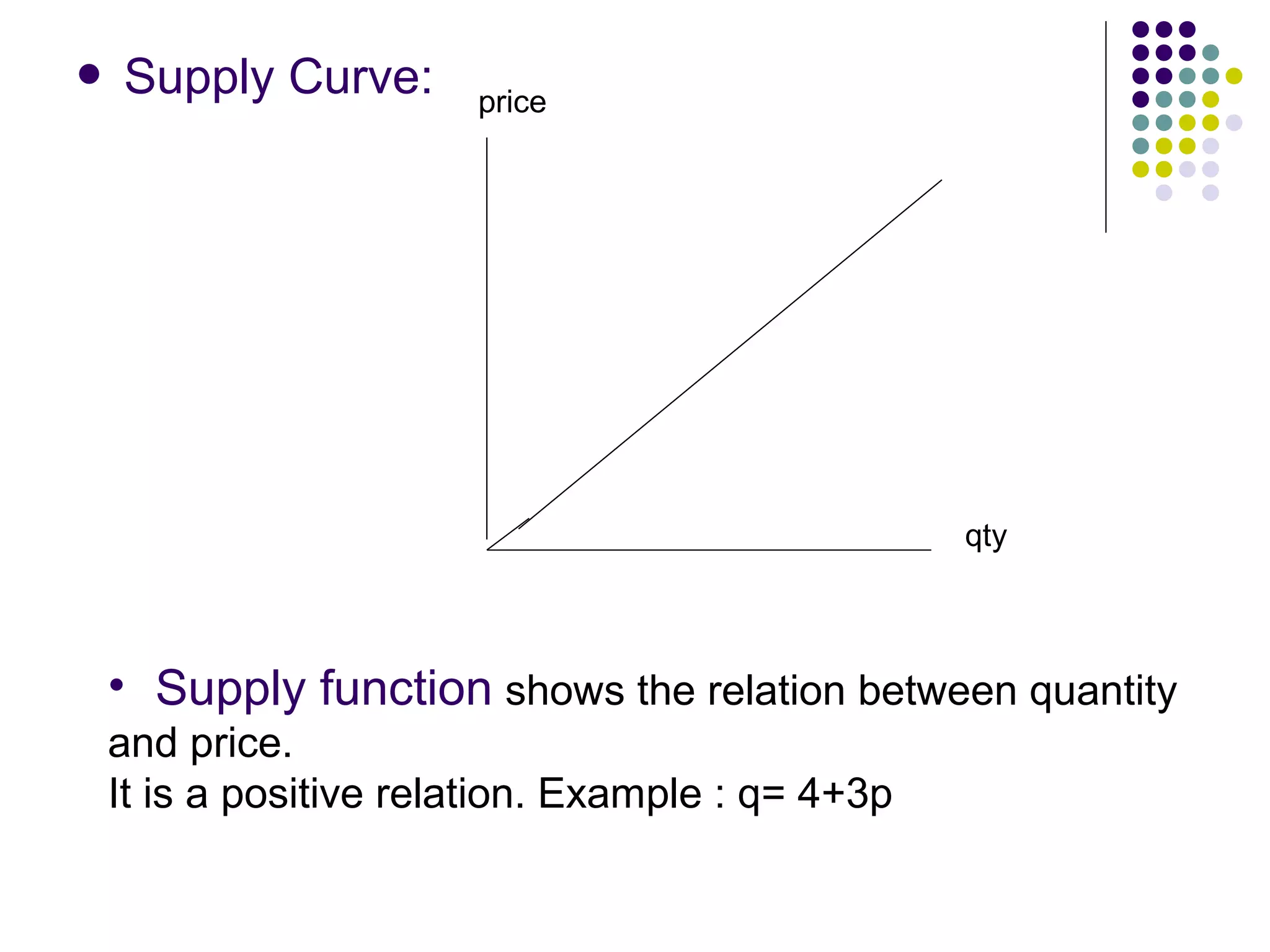
 Supply Curve: 
qty 
price 
• Supply function shows the relation between quantity 
and price. 
It is a positive relation. Example : q= 4+3p
Determinants Of Supply 
 Price 
 Cost of production 
 Technological progress 
 Prices of related outputs 
 Govt policy 
All factors other than price cause a shift of the 
supply curve and is called a change in supply
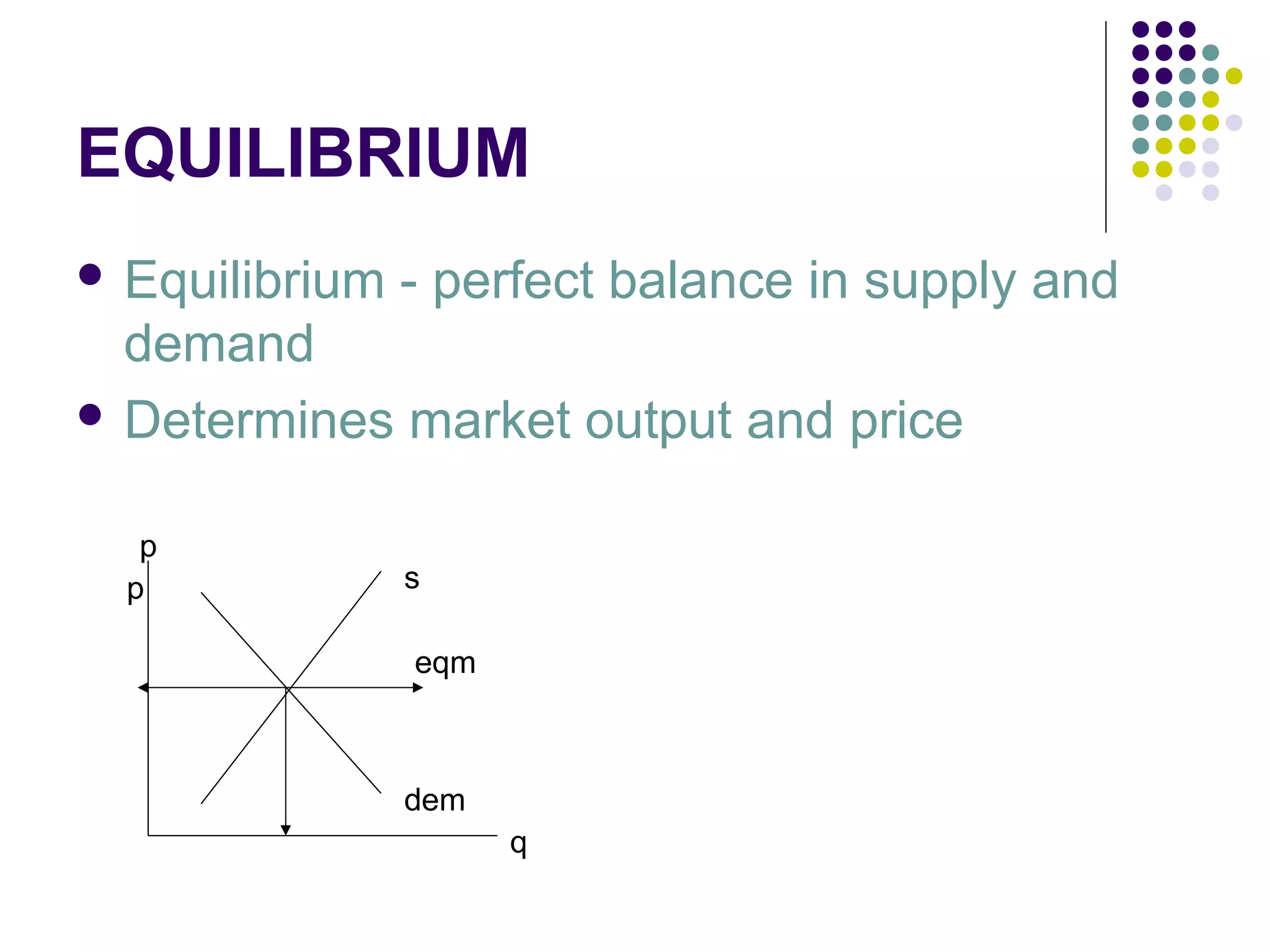
EQUILIBRIUM 
 Equilibrium - perfect balance in supply and 
demand 
 Determines market output and price 
eqm 
p 
q 
s 
dem 
p
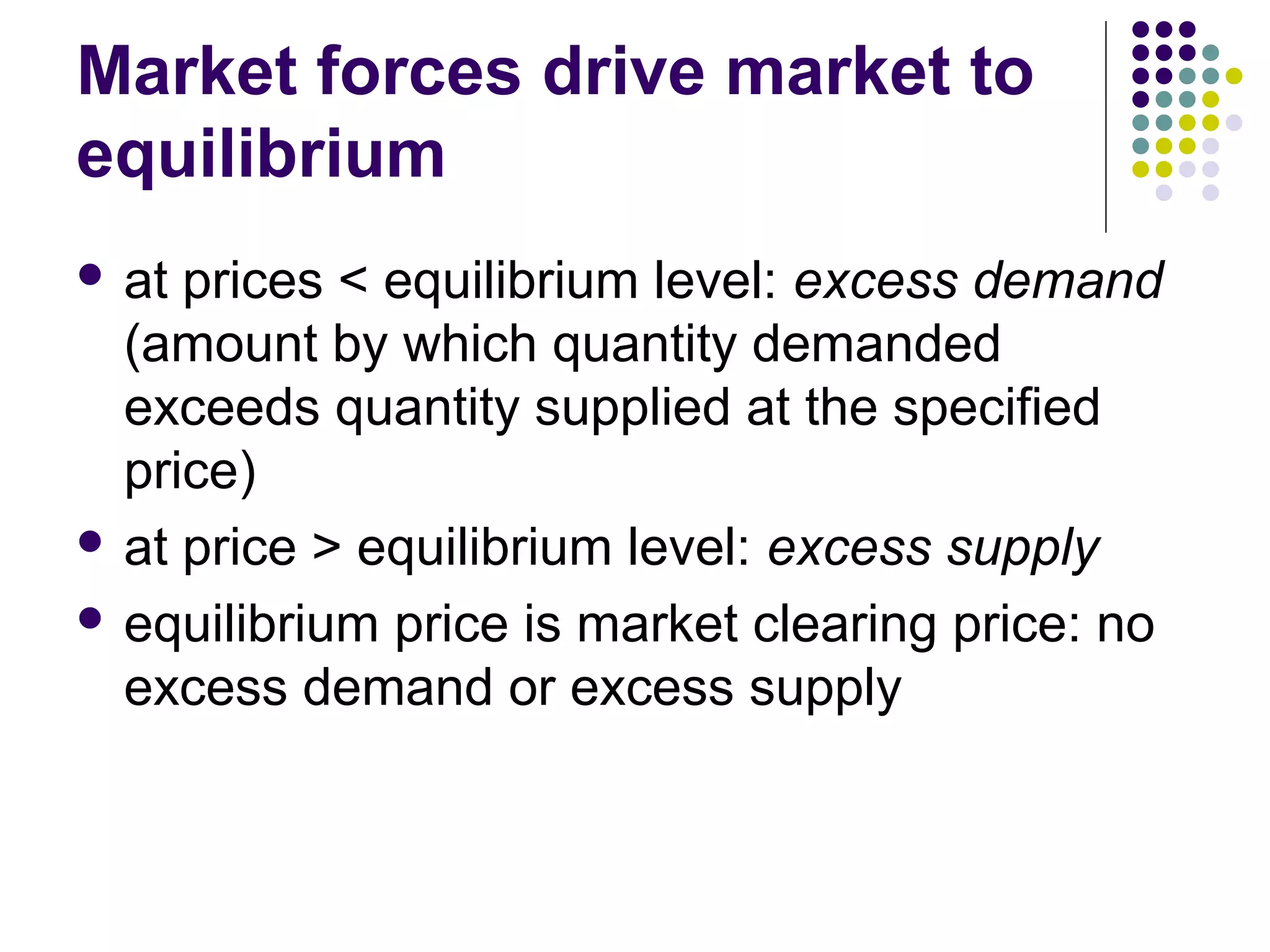
Market forces drive market to 
equilibrium 
 at prices < equilibrium level: excess demand 
(amount by which quantity demanded 
exceeds quantity supplied at the specified 
price) 
 at price > equilibrium level: excess supply 
 equilibrium price is market clearing price: no 
excess demand or excess supply
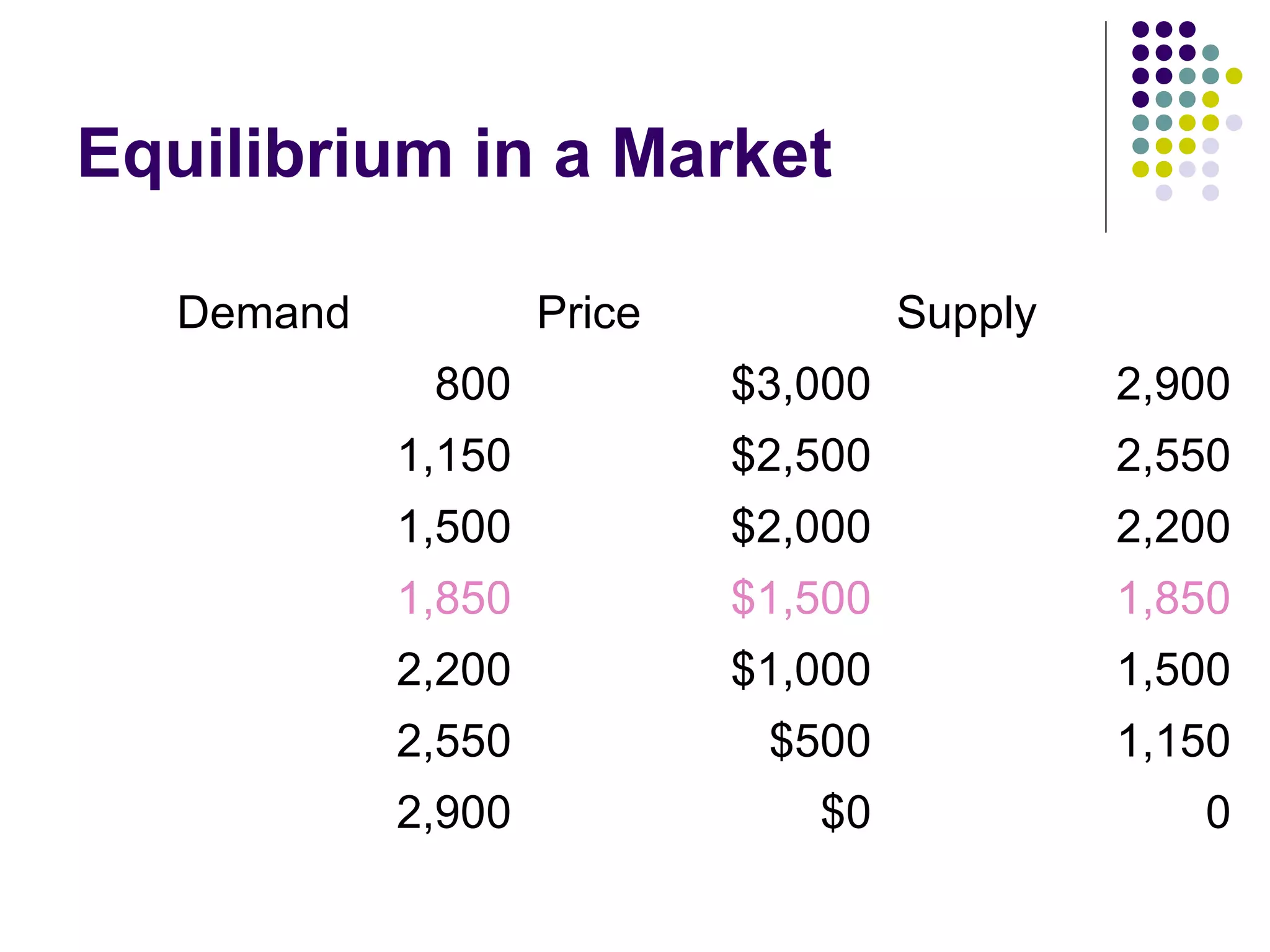
Equilibrium in a Market 
Demand Price Supply 
800 $3,000 2,900 
1,150 $2,500 2,550 
1,500 $2,000 2,200 
1,850 $1,500 1,850 
2,200 $1,000 1,500 
2,550 $500 1,150 
2,900 $0 0
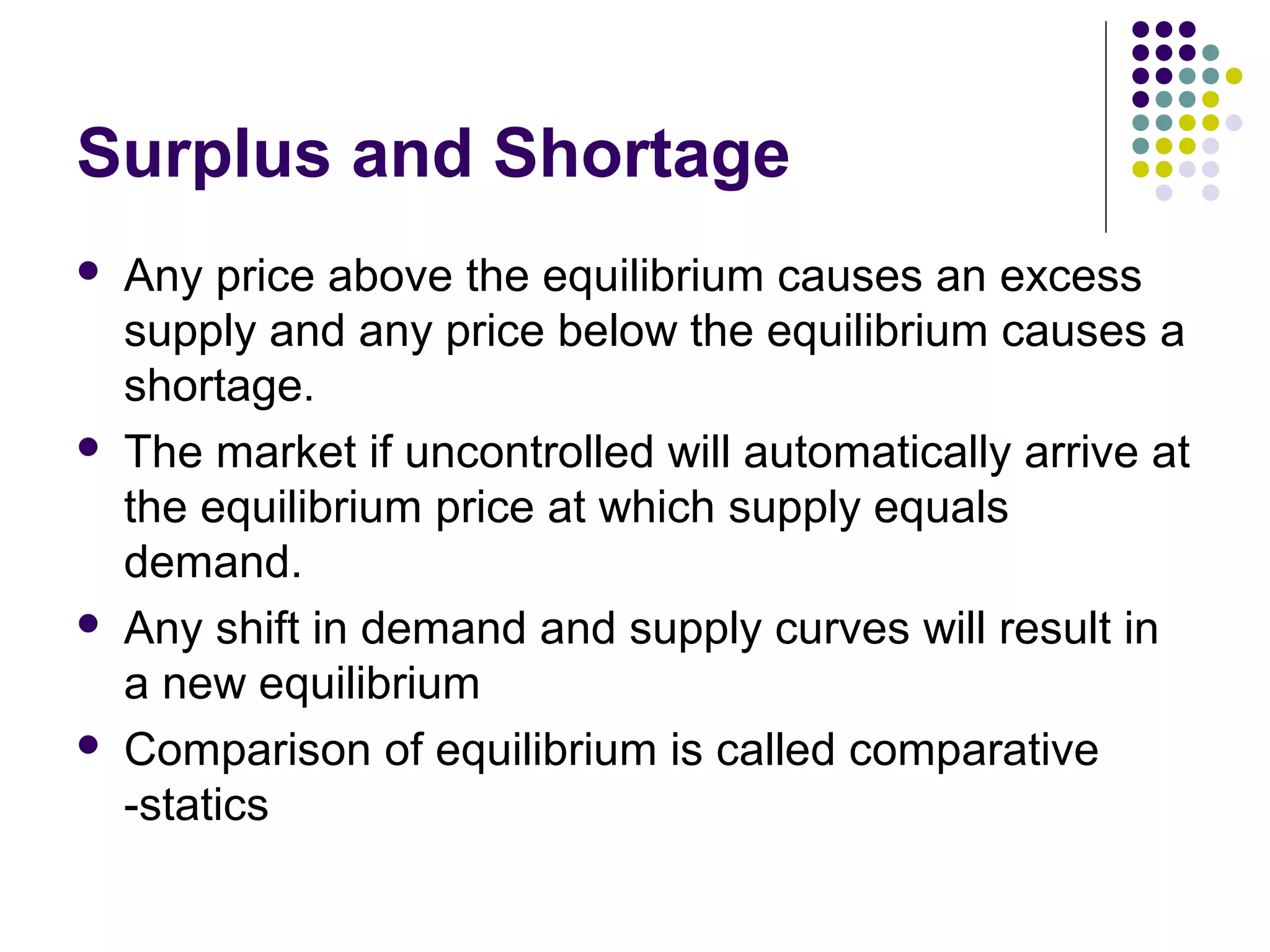
Surplus and Shortage 
 Any price above the equilibrium causes an excess 
supply and any price below the equilibrium causes a 
shortage. 
 The market if uncontrolled will automatically arrive at 
the equilibrium price at which supply equals 
demand. 
 Any shift in demand and supply curves will result in 
a new equilibrium 
 Comparison of equilibrium is called comparative 
-statics
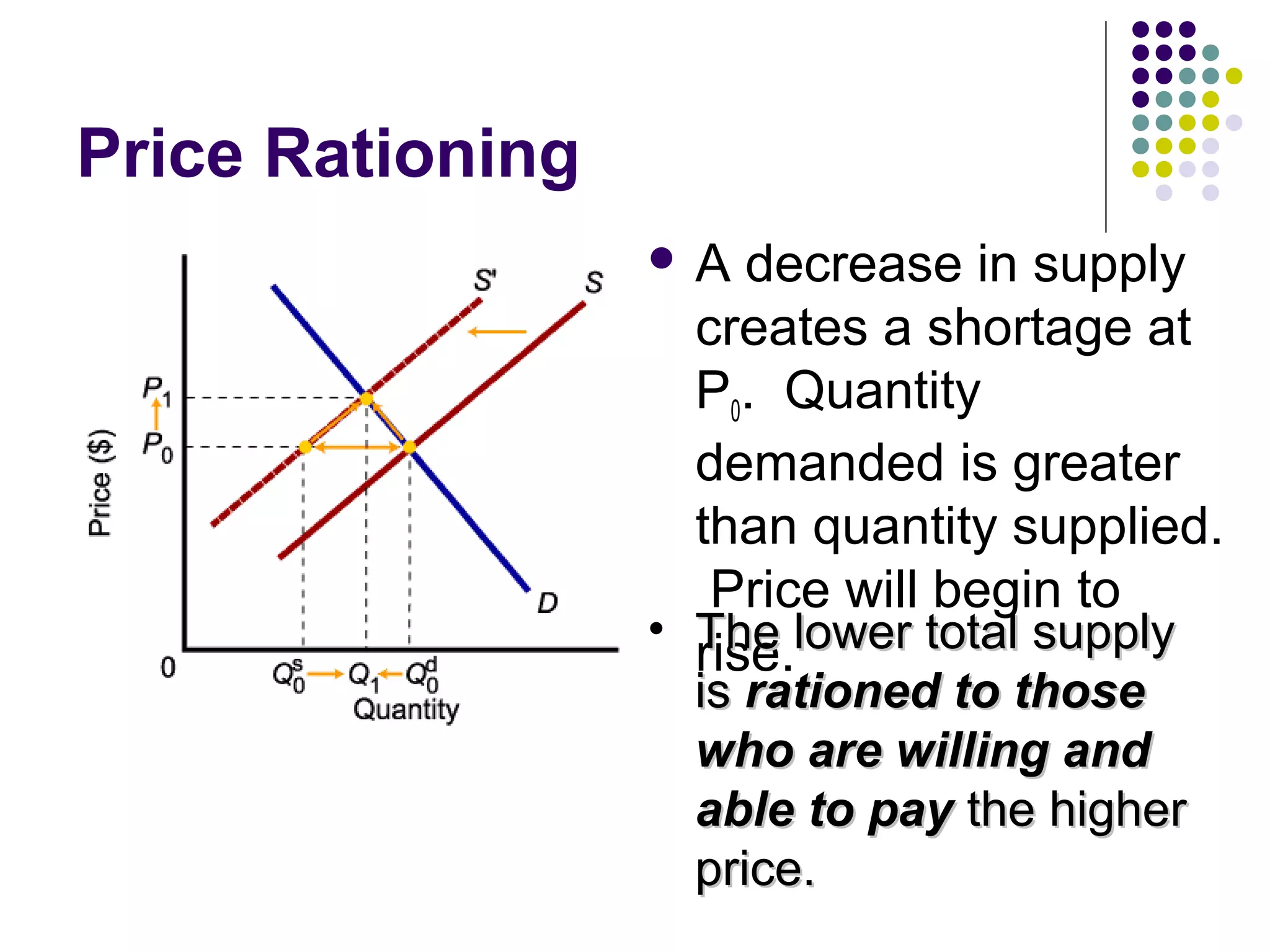
Price Rationing 
 A decrease in supply 
creates a shortage at 
P0. Quantity 
demanded is greater 
than quantity supplied. 
Price will begin to 
• TrTishheee . lloowweerr ttoottaall ssuuppppllyy 
iiss rraattiioonneedd ttoo tthhoossee 
wwhhoo aarree wwiilllliinngg aanndd 
aabbllee ttoo ppaayy tthhee hhiigghheerr 
pprriiccee..
Alternative Price- Control 
Mechanisms 
• A pprriiccee cceeiilliinngg is a maximum price 
that sellers may charge for a good, 
usually set by government. 
• Example: rent control 
• AA pprriiccee fflloooorr iiss aa pprriiccee aabboovvee 
eeqquuiilliibbrriiuumm pprriiccee tthhaatt tthhee bbuuyyeerrss hhaavvee 
ttoo ppaayy.. 
• EExxaammppllee :: aaggrriiccuullttuurraall ssuuppppoorrtt pprriiccee,, 
mmiinniimmuumm wwaaggeess
Elasticity 
 Elasticity: A measure of the 
responsiveness of one variable to changes 
in another variable; the percentage change 
in one variable that arises due to a given 
percentage change in another variable. 
 By converting each of these changes into 
percentages, the elasticity measure does 
not depend on the units in which we 
measure the variables.
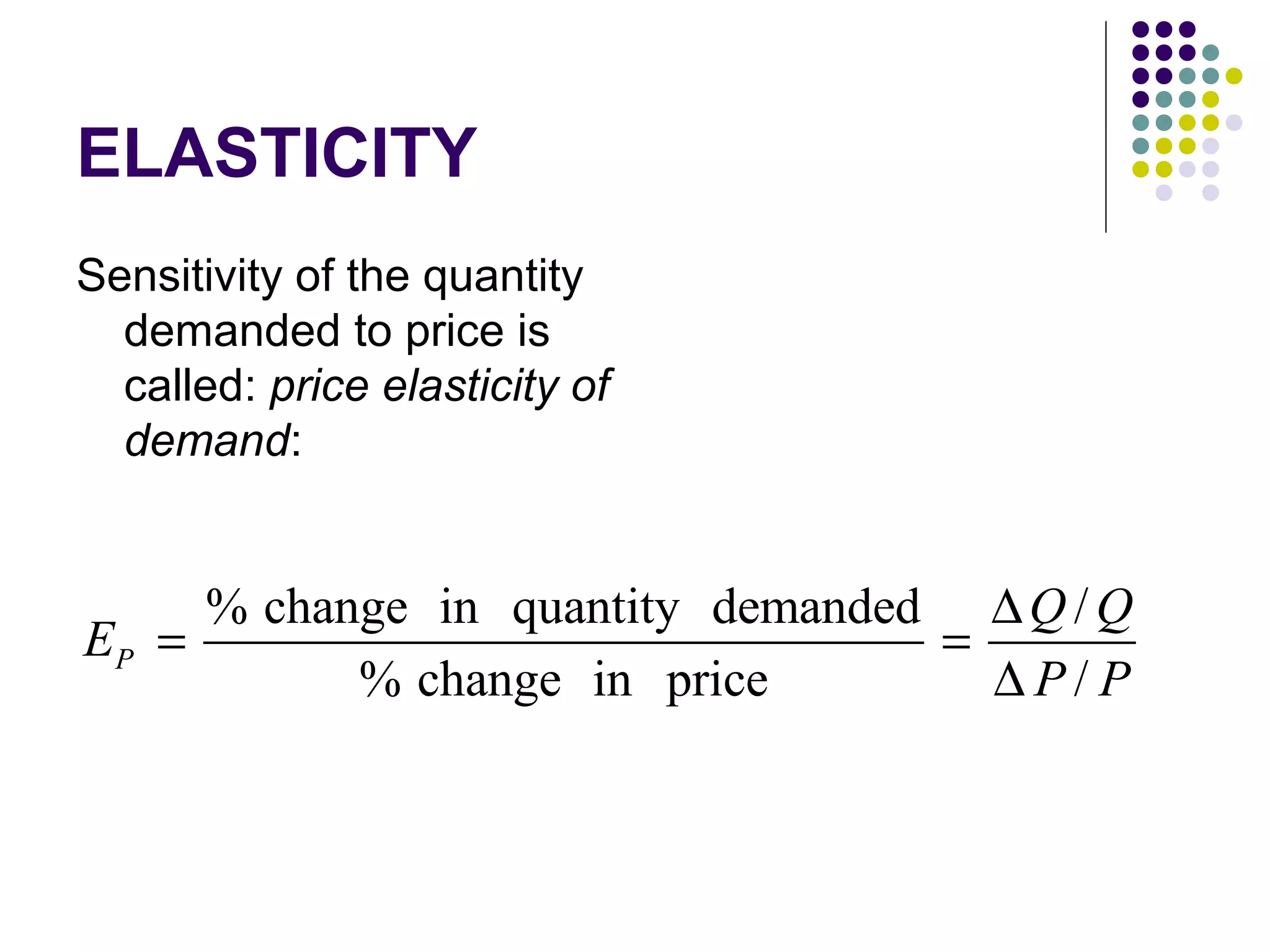
ELASTICITY 
Sensitivity of the quantity 
demanded to price is 
called: price elasticity of 
demand: 
E % change in quantity demanded Q / 
Q 
P % change in price / 
P P 
= = D 
D
Arc Elasticity 
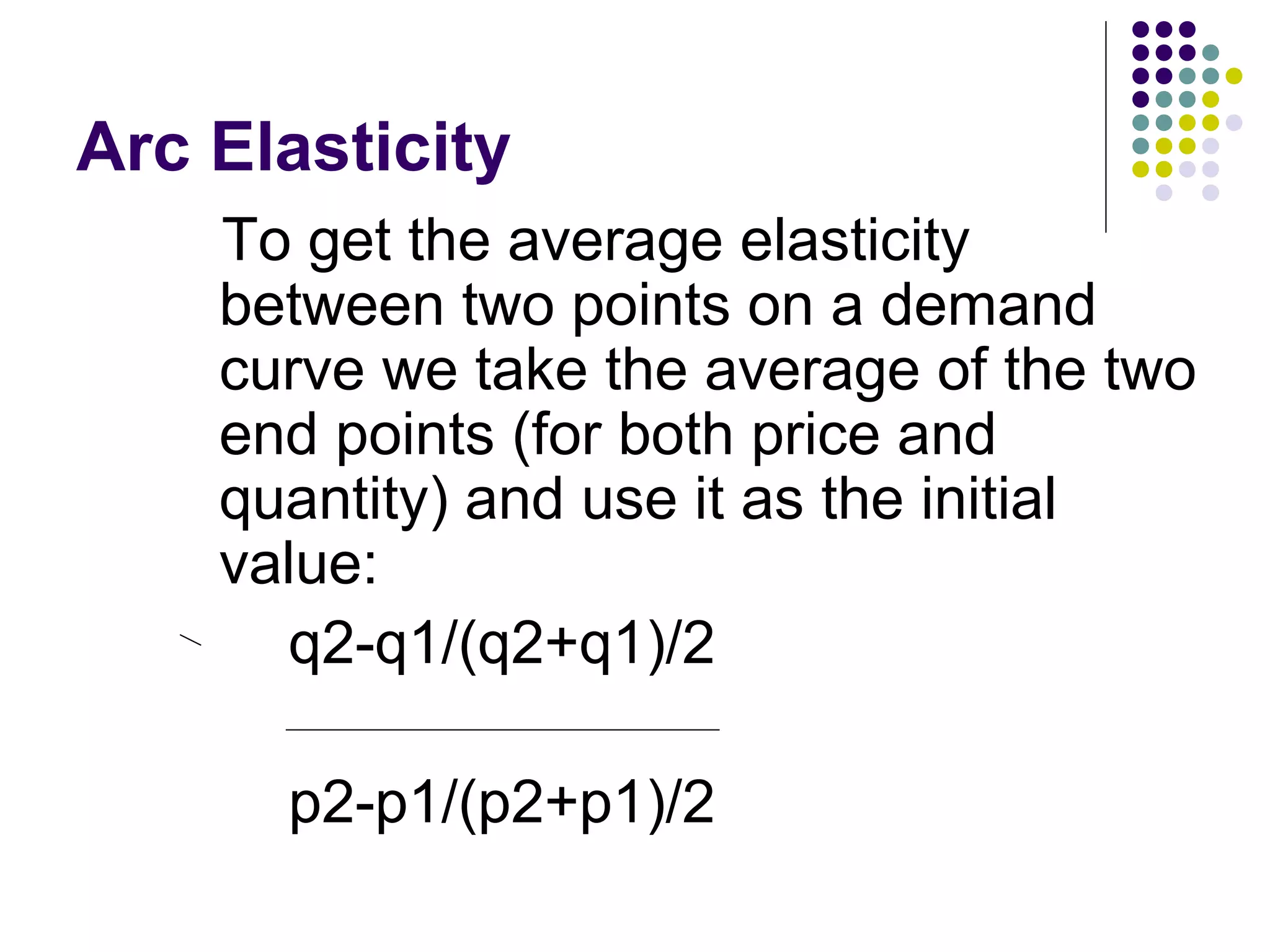
To get the average elasticity 
between two points on a demand 
curve we take the average of the two 
end points (for both price and 
quantity) and use it as the initial 
value: 
q2-q1/(q2+q1)/2 
p2-p1/(p2+p1)/2
Own Price Elasticity of 
Demand 
 Own price elasticity: A measure of the 
responsiveness of the quantity demanded of a 
good to a change in the price of that good; the 
percentage change in quantity demanded 
divided by the percentage change in the price 
of the good. 
 Elastic demand: Demand is elastic if the 
absolute value of the own price elasticity is 
greater than 1.
Types of elasticities 
 elastic: the quantity demanded changes more 
than in proportion to a change in price 
 inelastic: the quantity demanded changes 
less than in proportion to a change in price
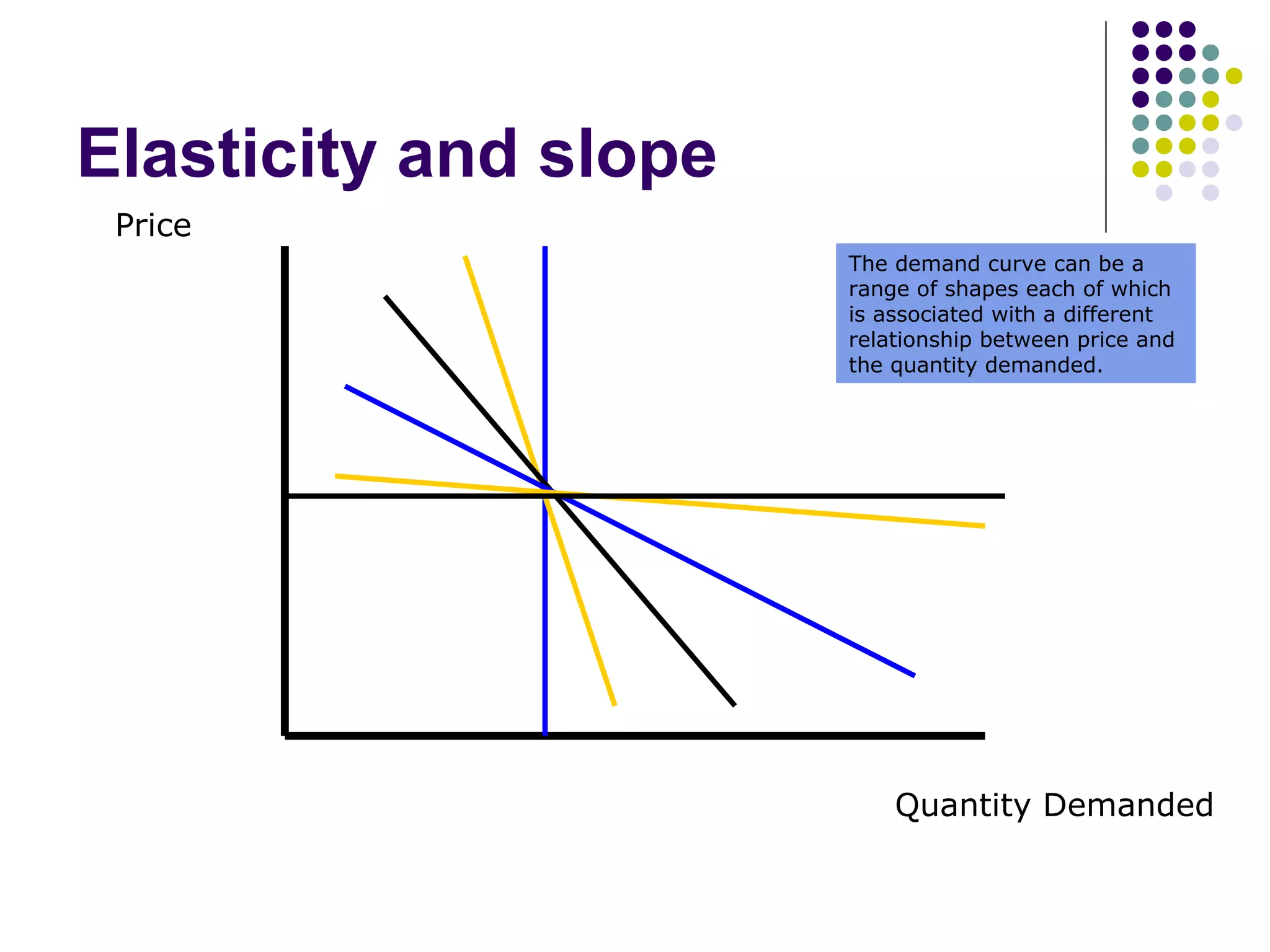
Elasticity and slope 
Price 
The demand curve can be a 
range of shapes each of which 
is associated with a different 
relationship between price and 
the quantity demanded. 
Quantity Demanded
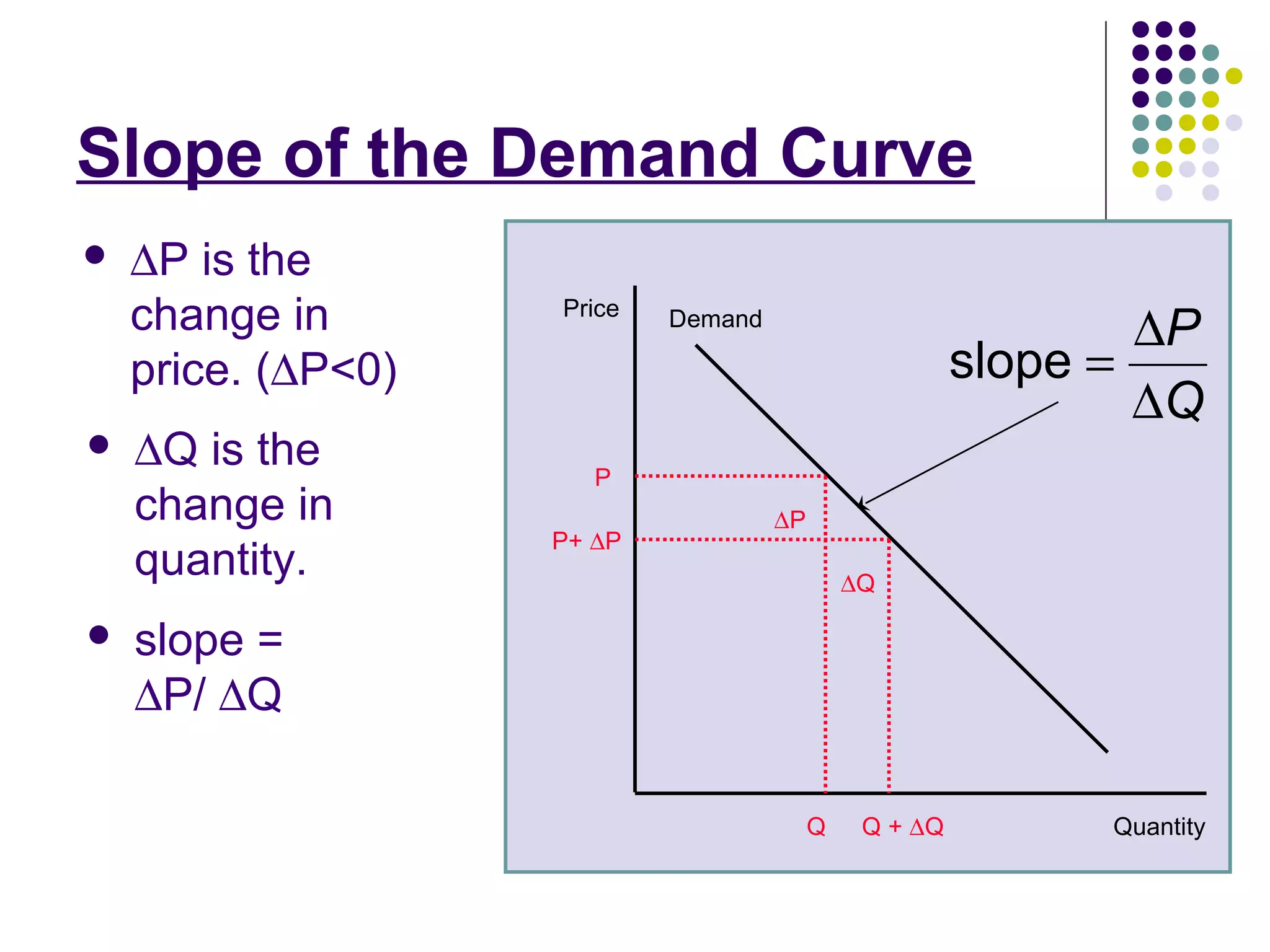
Slope of the Demand Curve 
 DP is the 
change in 
Price 
price. (DP<0) 
P 
D 
slope = D 
Quantity 
Demand 
DQ 
Q Q + DQ 
P 
P+ DP 
DP 
 DQ is the 
change in 
quantity. 
 slope = 
DP/ DQ 
Q
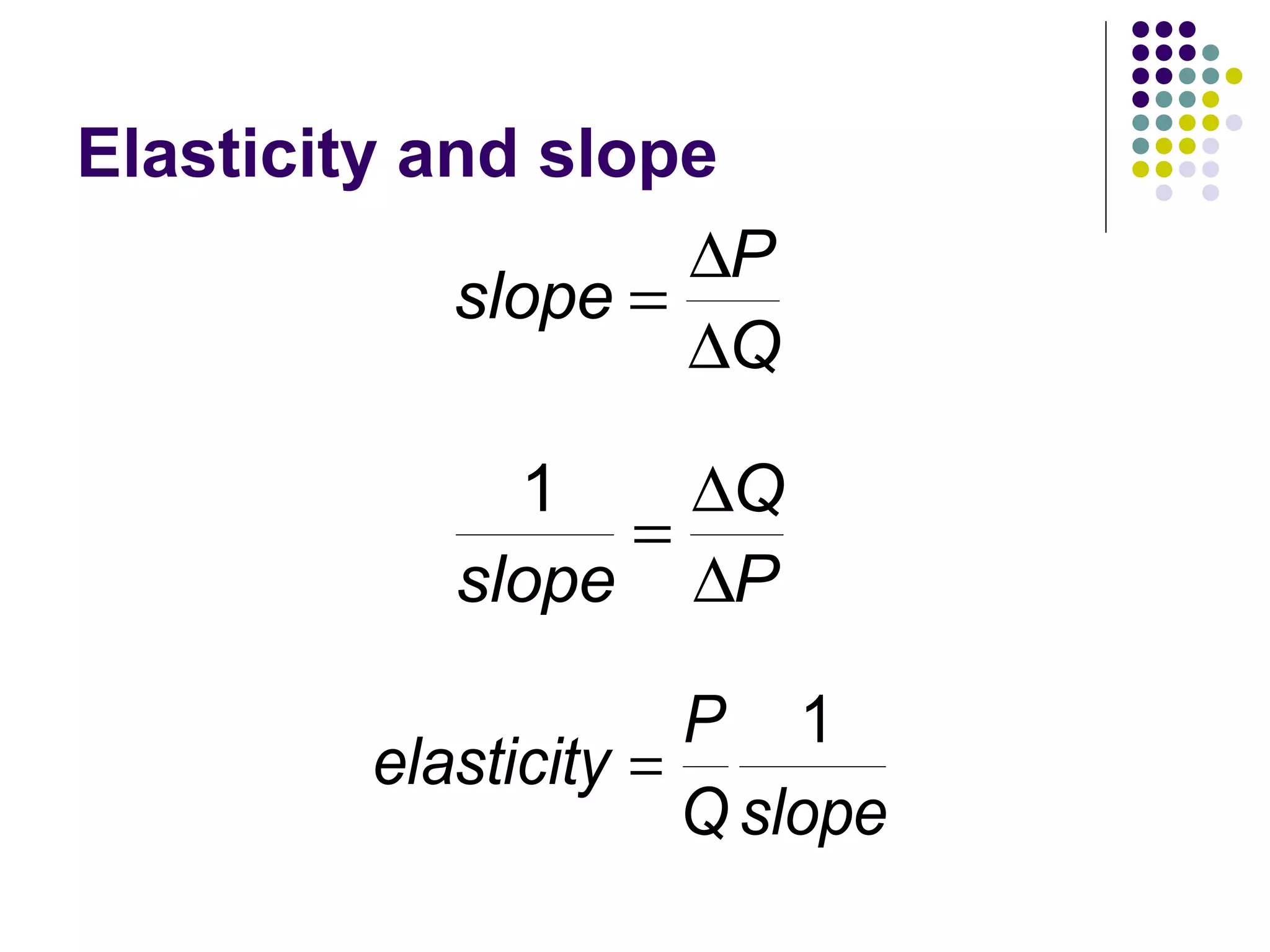
Elasticity and slope 
slope P 
= D 
D 
Q 
1 
slope 
Q 
P 
= D 
D 
= 1 
elasticity P 
Qslope
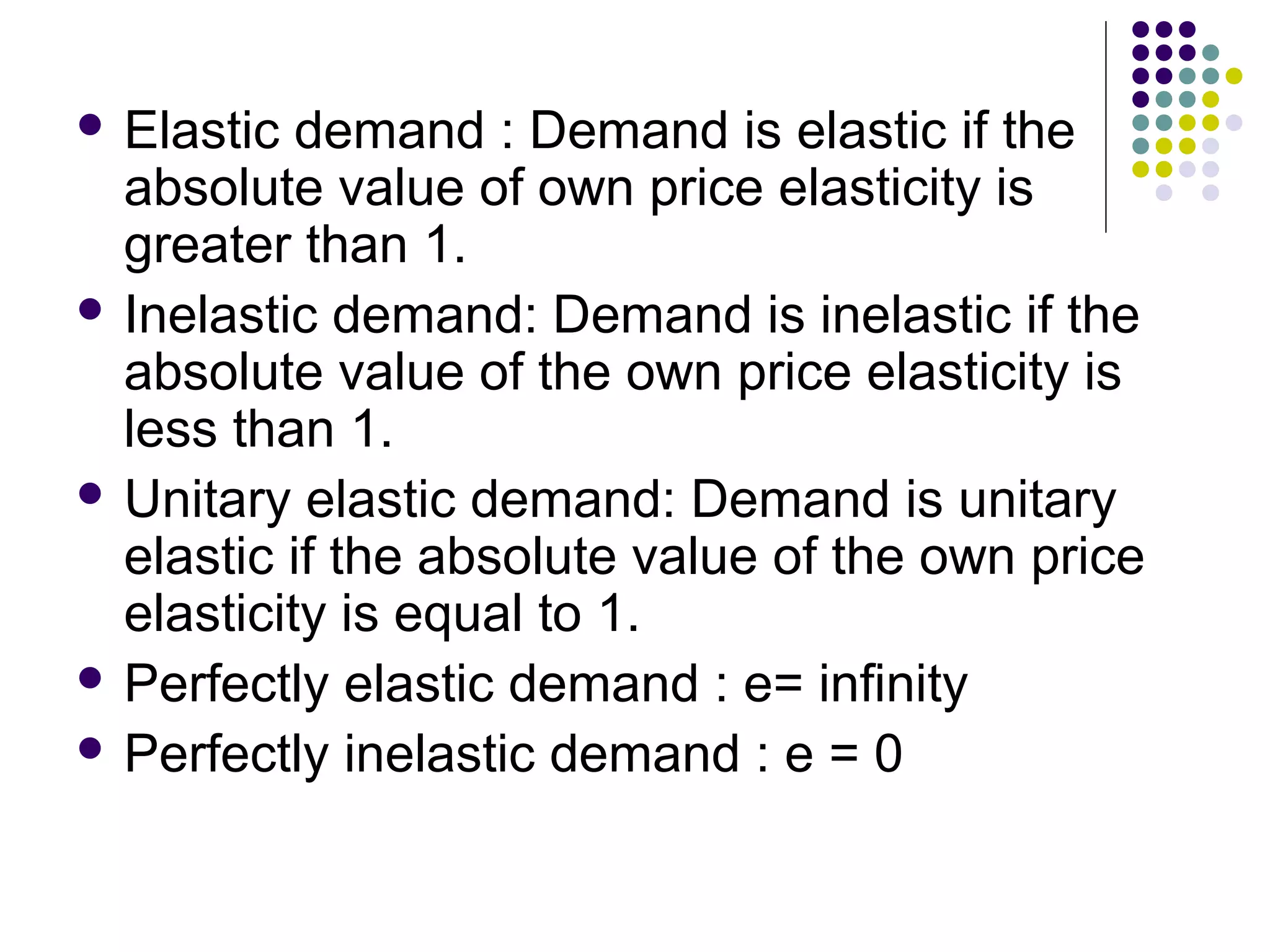
 Elastic demand : Demand is elastic if the 
absolute value of own price elasticity is 
greater than 1. 
 Inelastic demand: Demand is inelastic if the 
absolute value of the own price elasticity is 
less than 1. 
 Unitary elastic demand: Demand is unitary 
elastic if the absolute value of the own price 
elasticity is equal to 1. 
 Perfectly elastic demand : e= infinity 
 Perfectly inelastic demand : e = 0
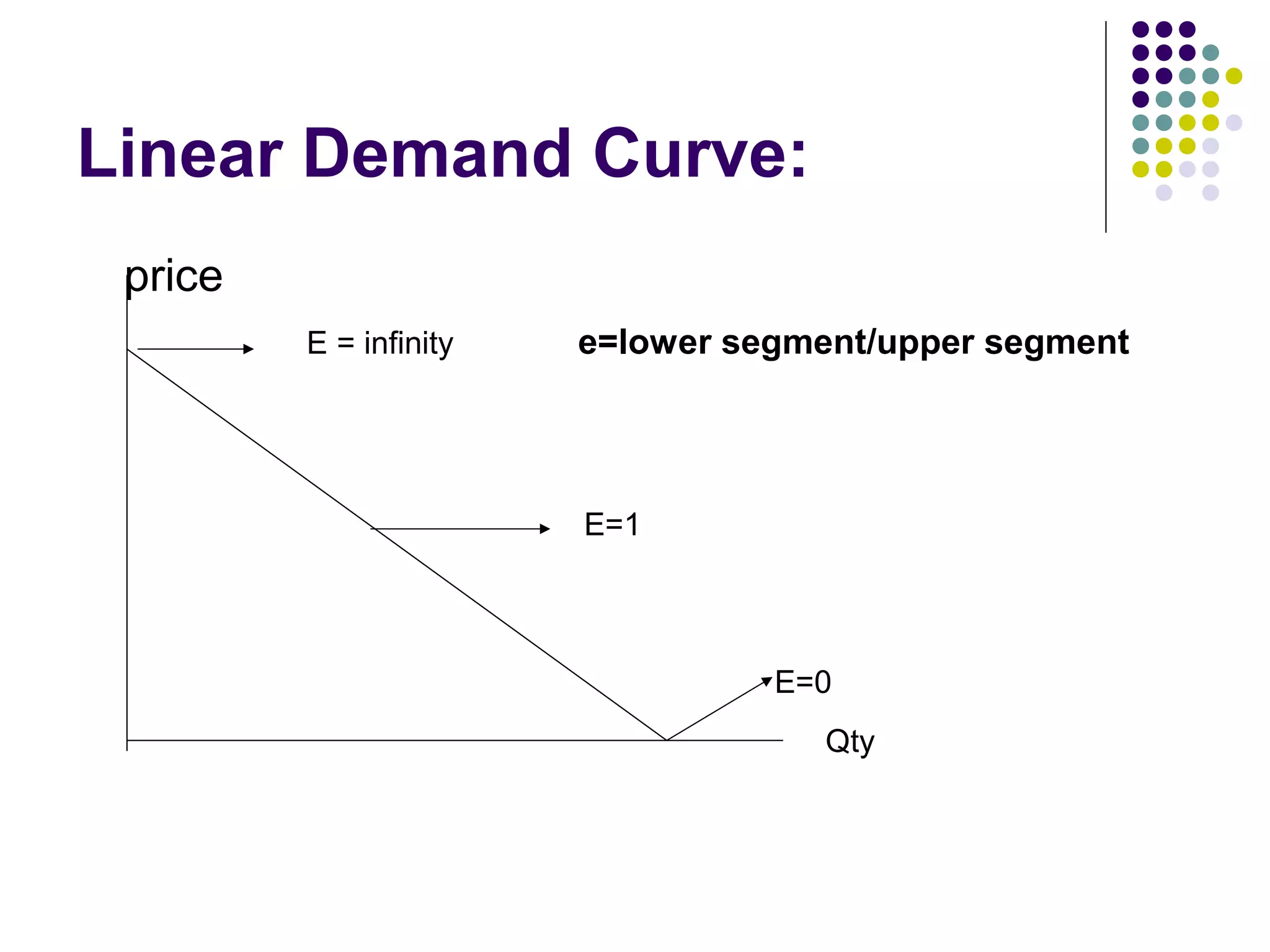
Linear Demand Curve: 
price 
E = infinity e=lower segment/upper segment 
E=0 
Qty 
E=1
Determinants of Elasticity 
 Number and closeness of substitutes – 
the greater the number of substitutes, 
the more elastic 
 The proportion of income taken up by the product – the smaller 
the proportion the more inelastic 
 Price of the product- lower the price, lower the elasticity 
 Luxury or Necessity - for example, 
addictive drugs 
 Time period – the longer the time under consideration the more 
elastic a good is likely to be
Cross-Price Elasticity 
 Cross-price elasticity: A measure of the 
responsiveness of the demand for a good to 
changes in the price of a related good; the 
percentage change in the quantity demanded 
of one good divided by the percentage change 
in the price of a related good. 
 The cross-price elasticity is positive whenever 
goods are substitutes. 
 The cross-price elasticity is negative whenever 
goods are complements.
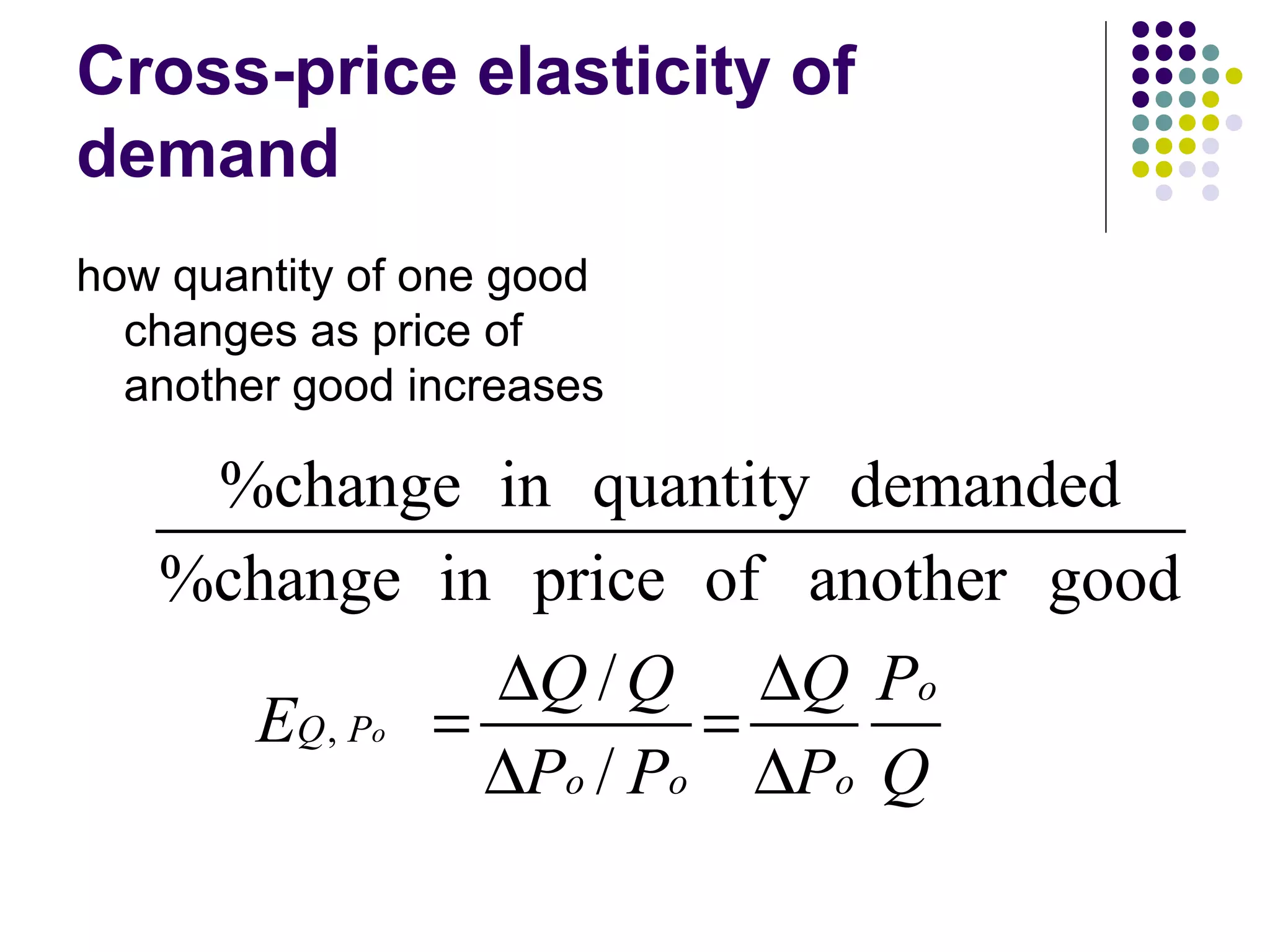
Cross-price elasticity of 
demand 
how quantity of one good 
changes as price of 
another good increases 
%change in quantity demanded 
%change in price of another good 
E Q Q Q P 
, 
= D = D 
D D 
/ 
/ o 
o 
Q P 
P o P o P o 
Q
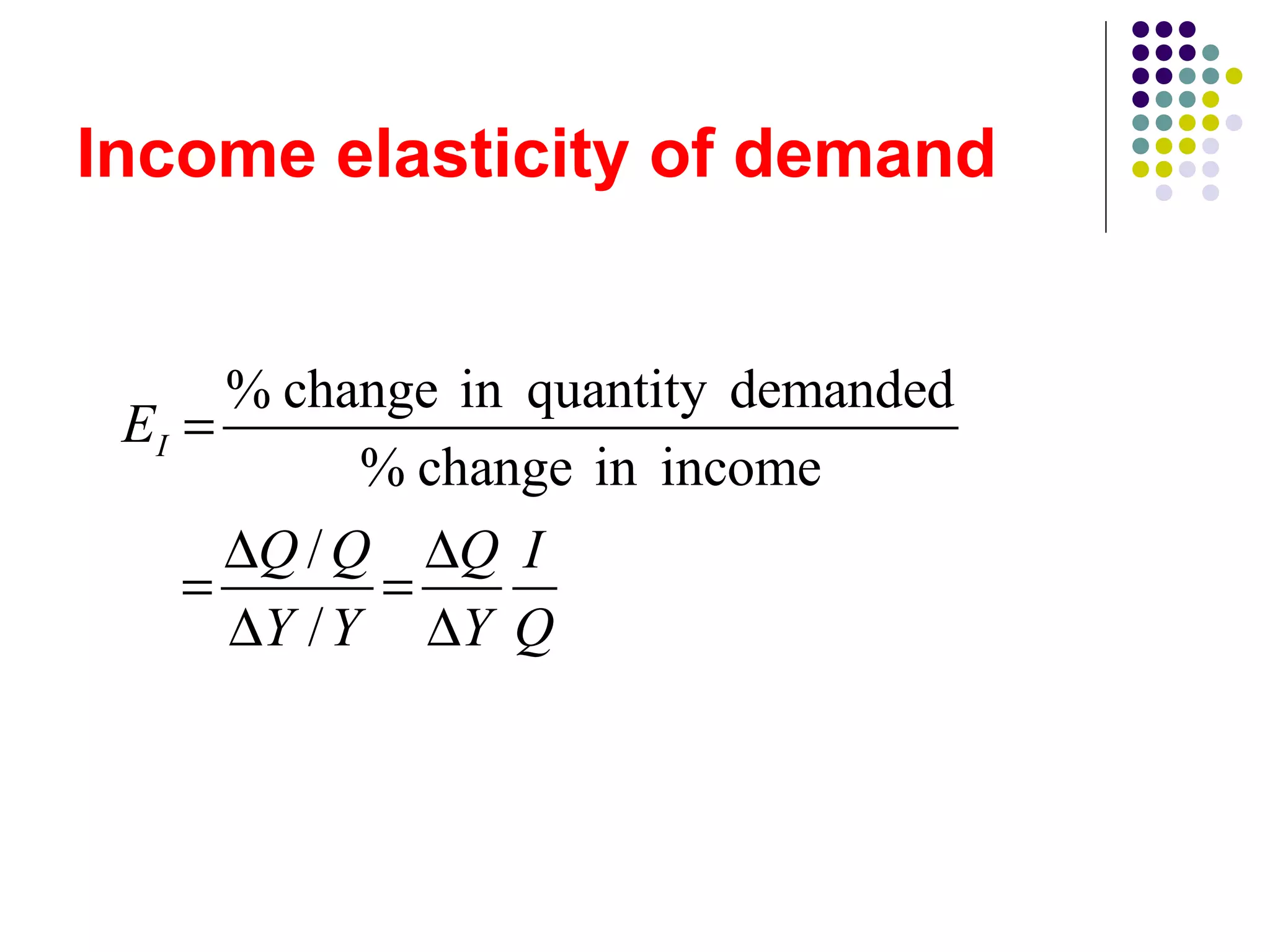
Income elasticity of demand 
% change in quantity demanded 
% change in income 
/ 
/ 
I E 
Q Q Q I 
Y Y Y Q 
= 
= D = D 
D D
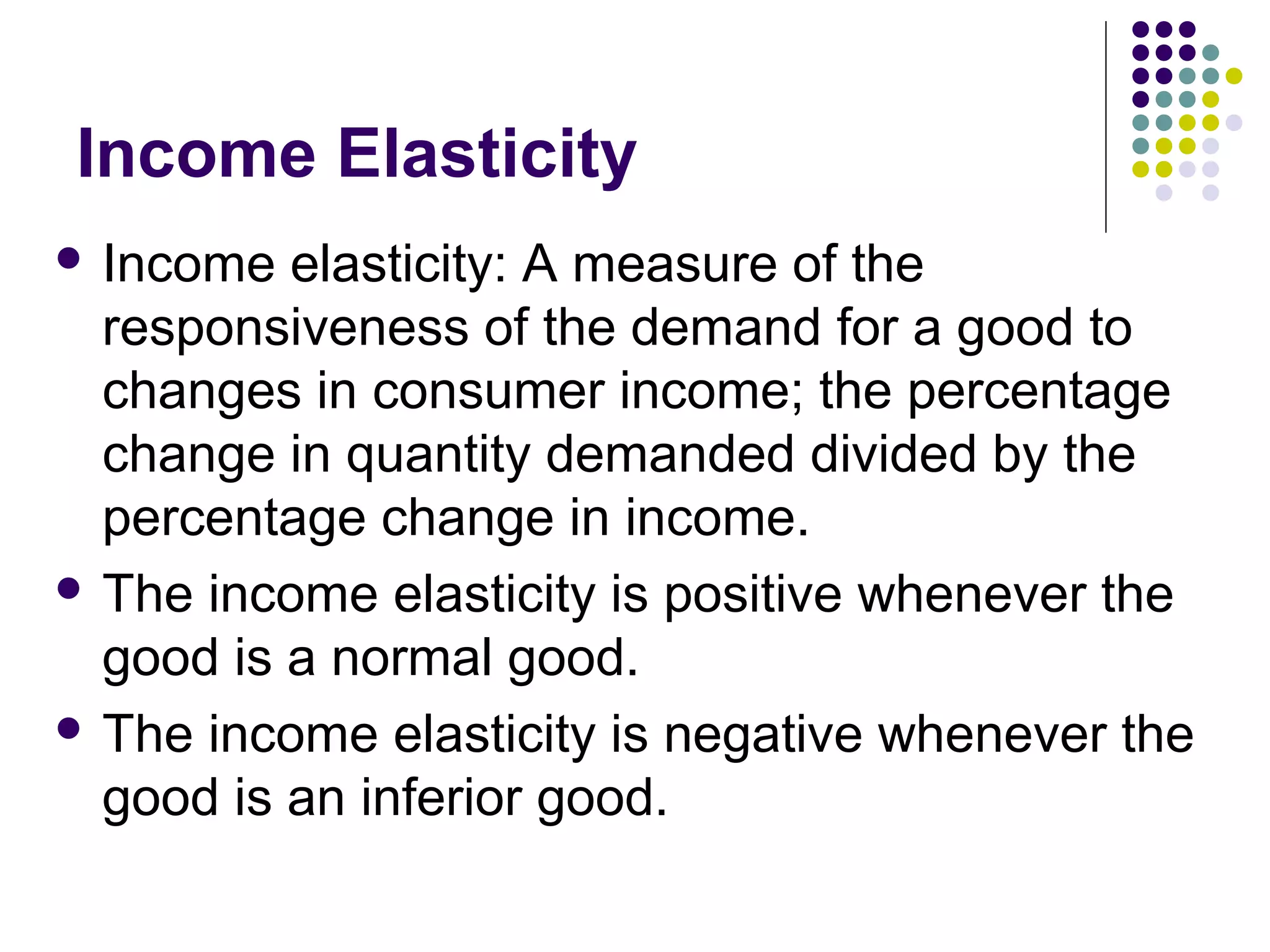
Income Elasticity 
 Income elasticity: A measure of the 
responsiveness of the demand for a good to 
changes in consumer income; the percentage 
change in quantity demanded divided by the 
percentage change in income. 
 The income elasticity is positive whenever the 
good is a normal good. 
 The income elasticity is negative whenever the 
good is an inferior good.
Factors affecting Income elasticity: 
 Nature of the good: 
 inferior goods have negative income elasticity 
 Normal goods have positive income elasticity 
 Luxury goods have income elasticity greater 
than one 
 Necessary goods have income elasticity less 
than one
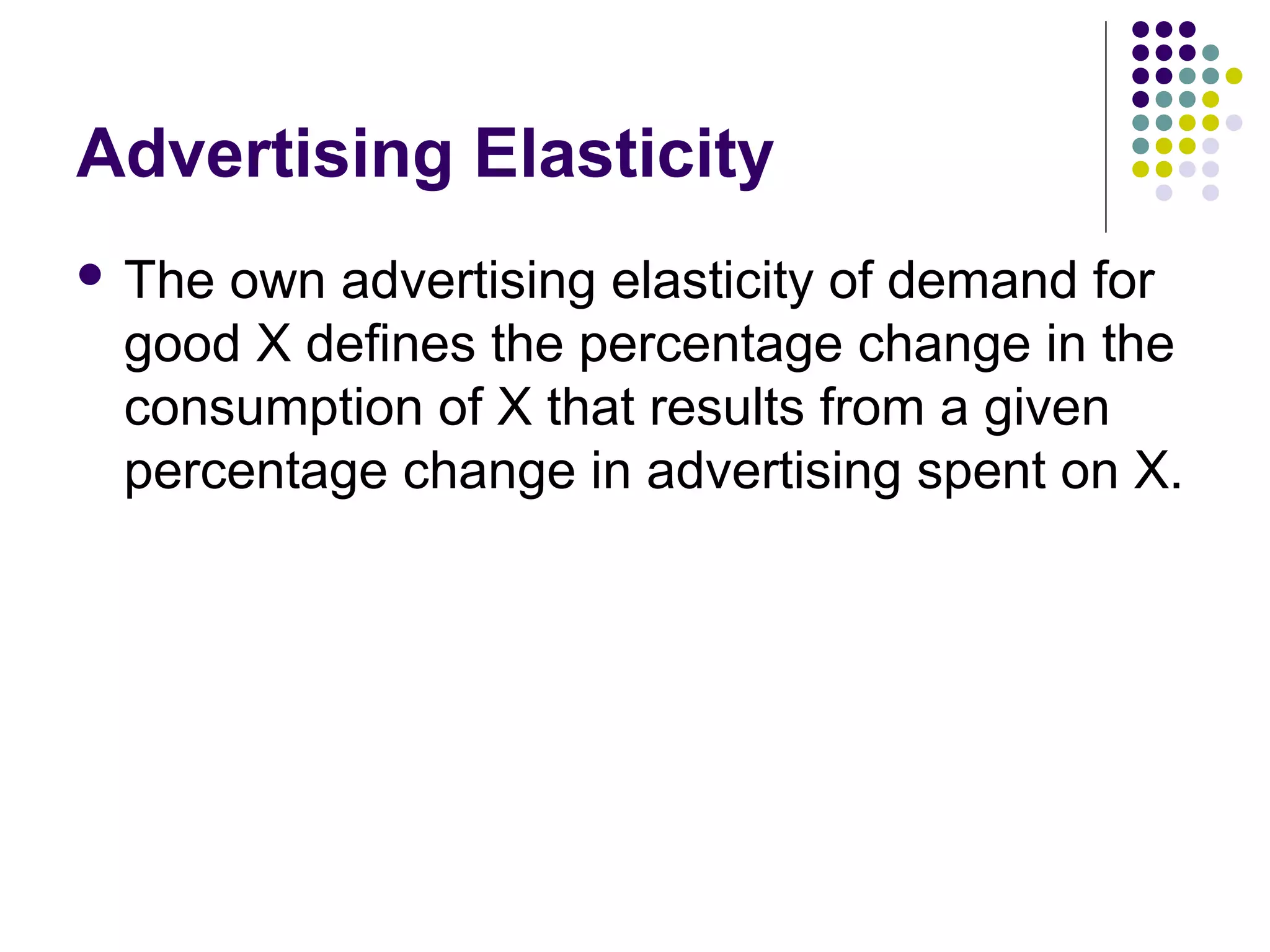
Advertising Elasticity 
 The own advertising elasticity of demand for 
good X defines the percentage change in the 
consumption of X that results from a given 
percentage change in advertising spent on X.
Elasticity and Total Revenue 
 If demand is elastic, an increase (decrease) 
in price will lead to a decrease (increase) in 
total revenue. 
 If demand is inelastic, an increase (decrease) 
in price will lead to an increase (decrease) in 
total revenue. 
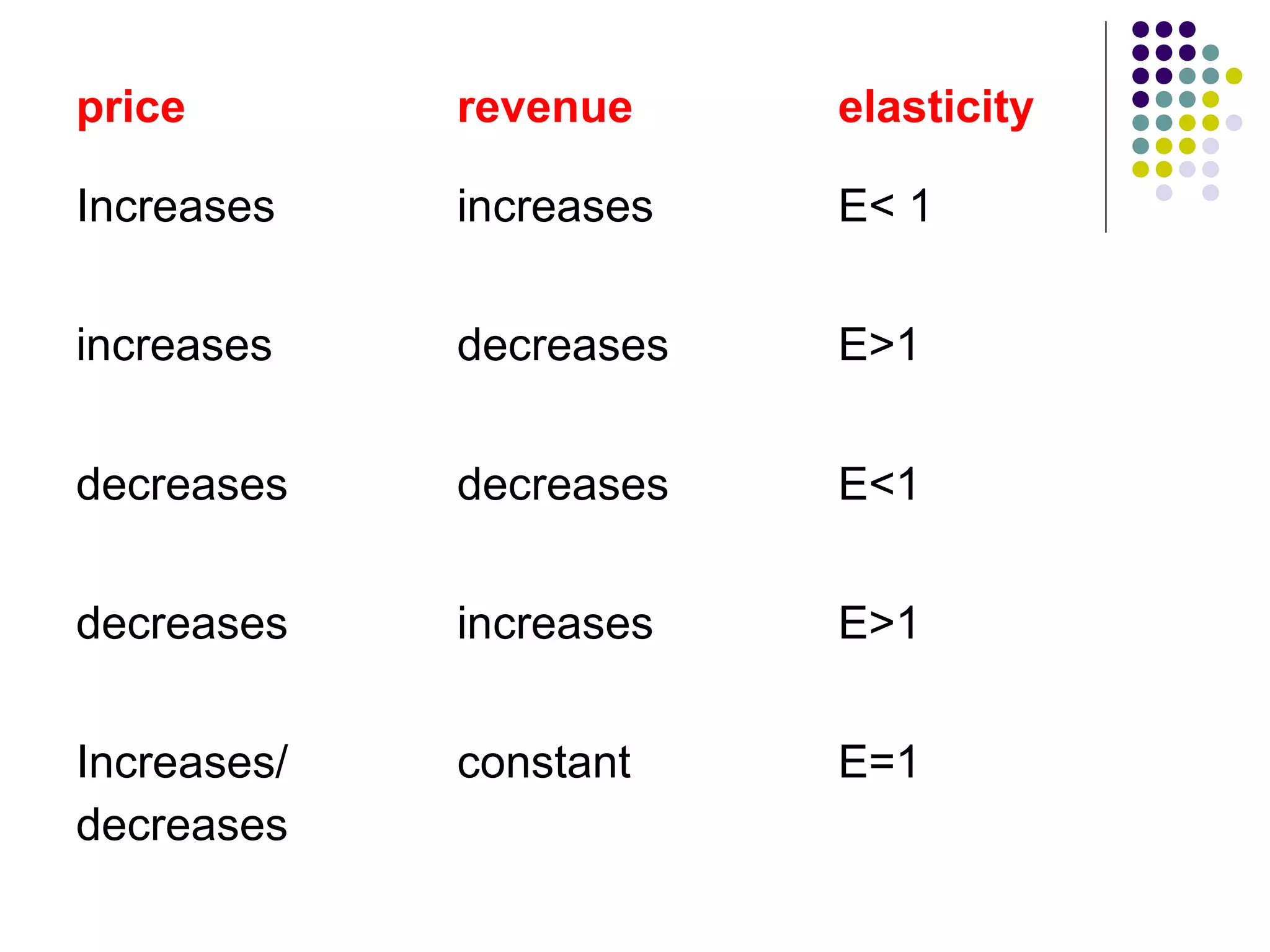
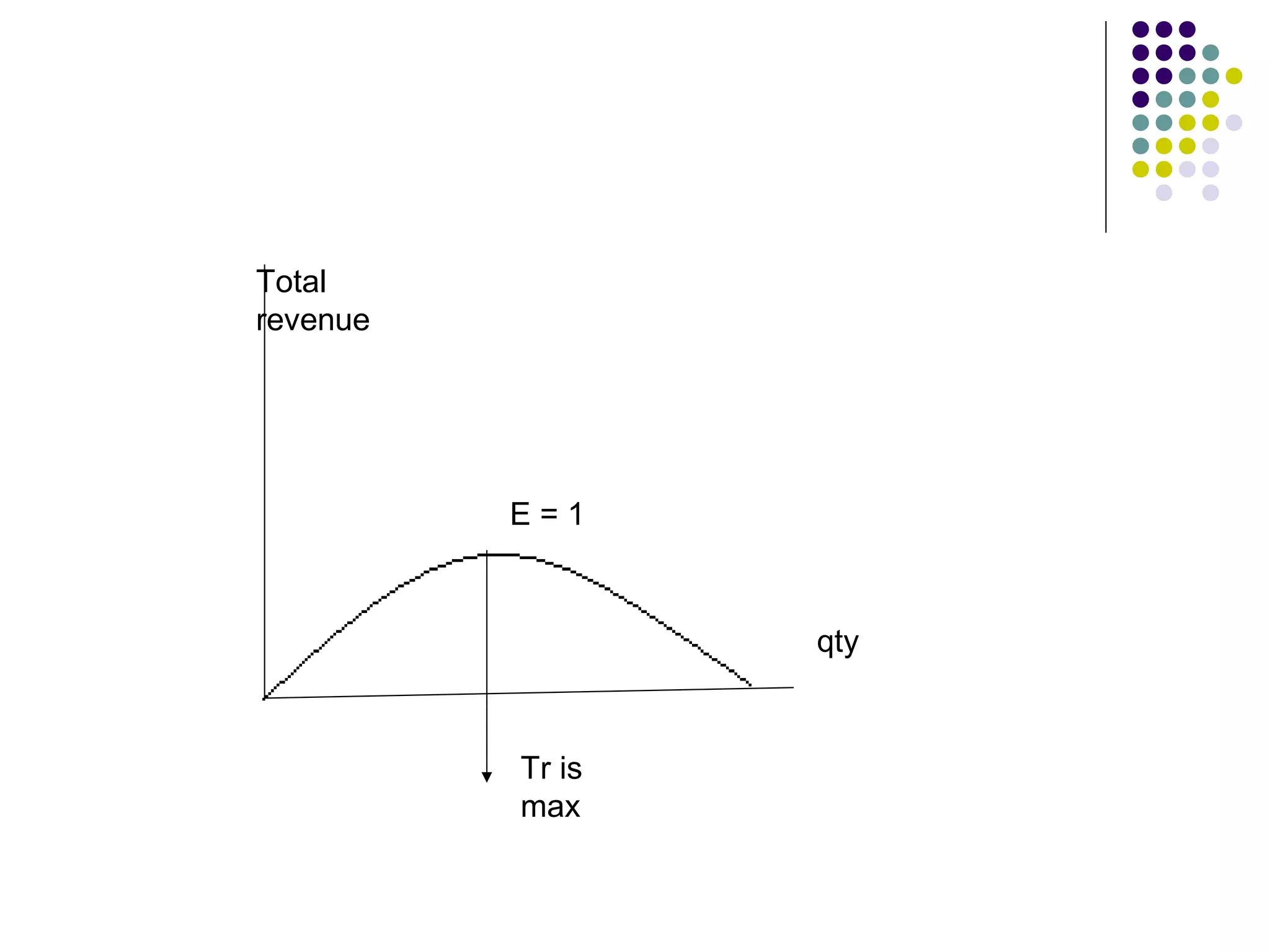
 Total revenue is maximized at the point 
where demand is unitary elastic.
price revenue elasticity 
Increases increases E< 1 
increases decreases E>1 
decreases decreases E<1 
decreases increases E>1 
Increases/ 
decreases 
constant E=1
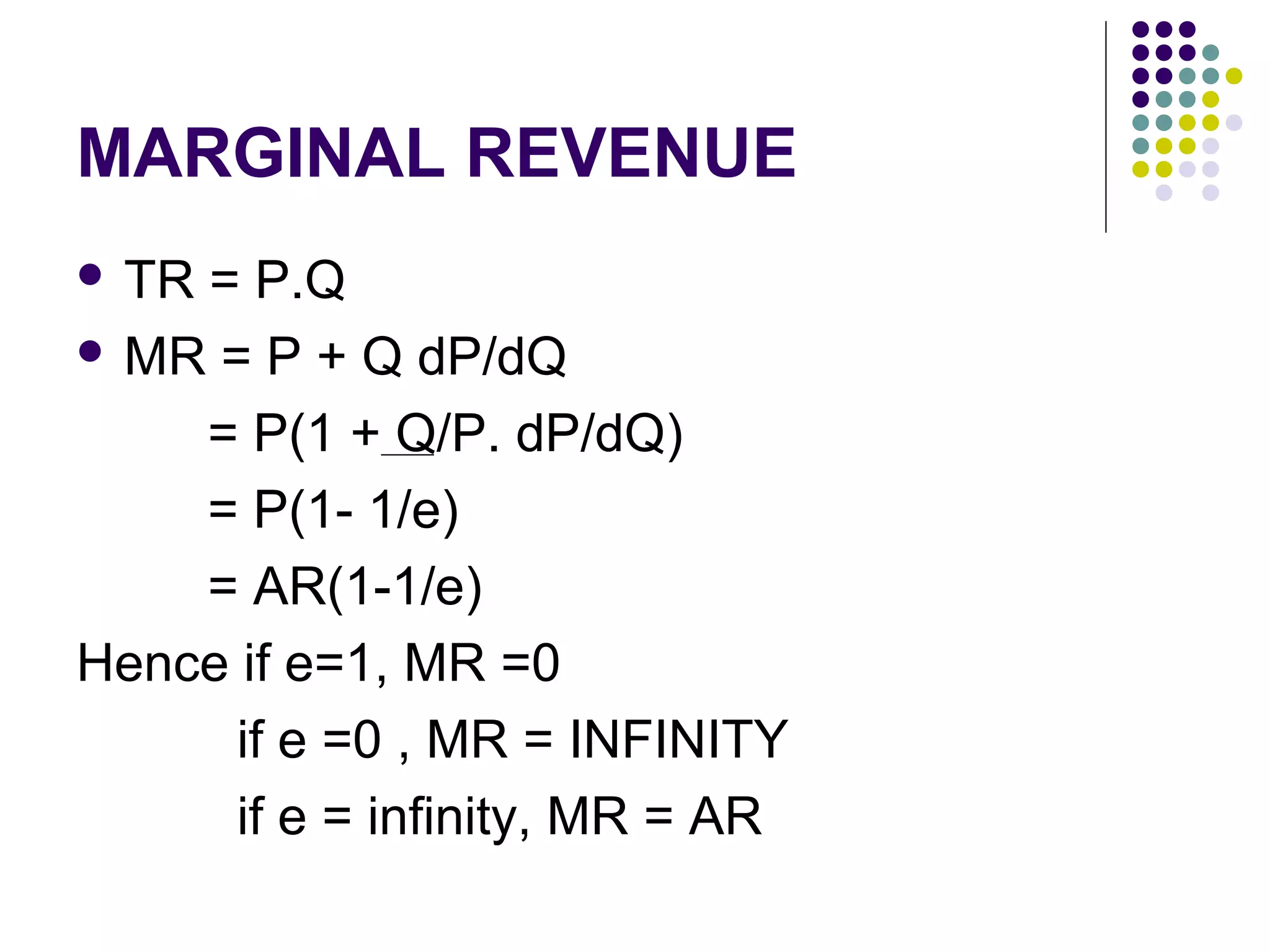
MARGINAL REVENUE 
 TR = P.Q 
MR = P + Q dP/dQ 
= P(1 + Q/P. dP/dQ) 
= P(1- 1/e) 
= AR(1-1/e) 
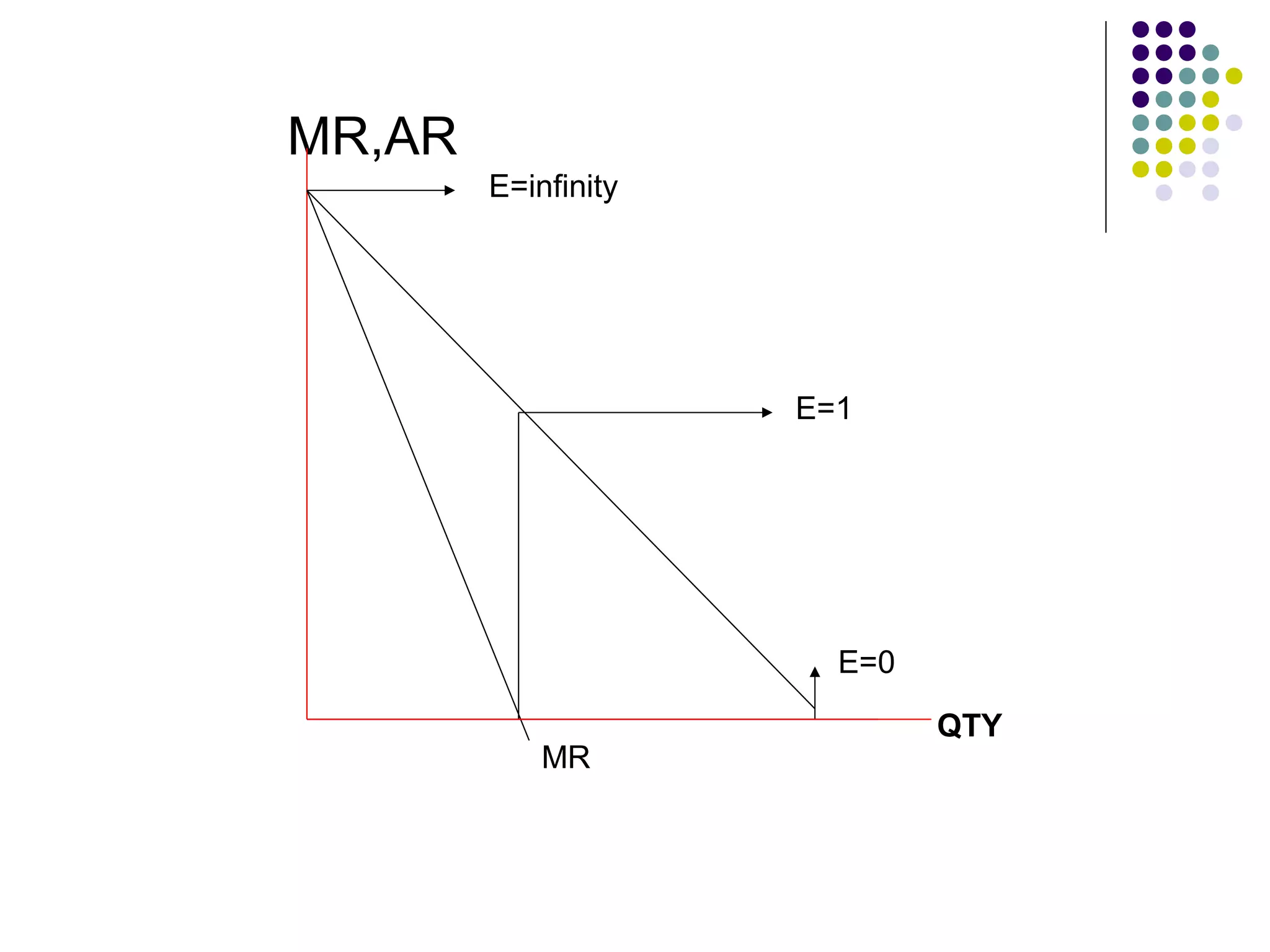
Hence if e=1, MR =0 
if e =0 , MR = INFINITY 
if e = infinity, MR = AR
MR,AR 
QTY 
E=1 
E=infinity 
MR 
E=0
Total 
revenue 
qty 
E = 1 
Tr is 
max
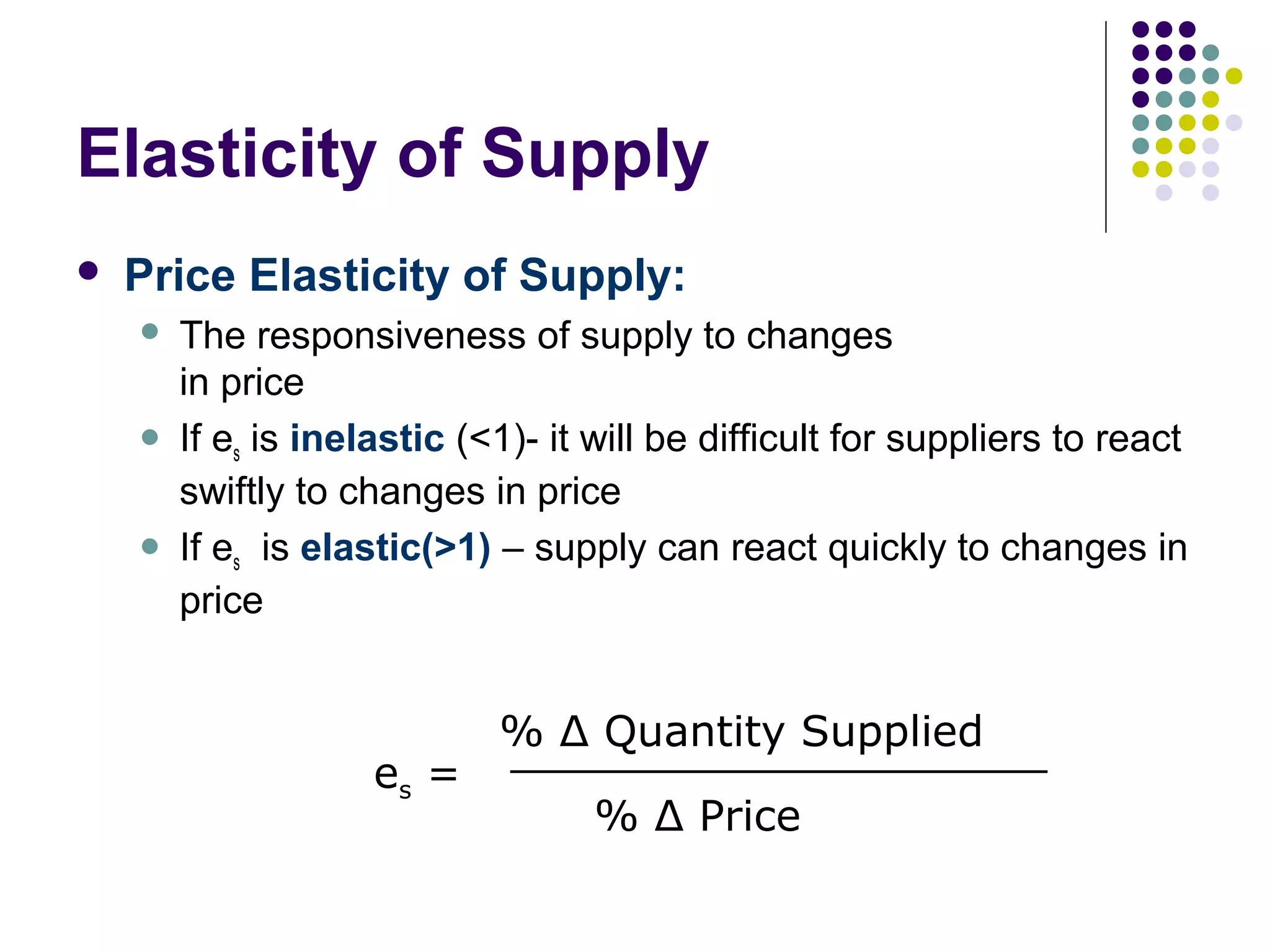
Elasticity of Supply 
 Price Elasticity of Supply: 
 The responsiveness of supply to changes 
in price 
 If es is inelastic (<1)- it will be difficult for suppliers to react 
swiftly to changes in price 
 If es is elastic(>1) – supply can react quickly to changes in 
price 
es = 
%__ Δ_ _Q_u_a_n_t_it_y_ S_u_p_p_l_ie_d___ 
% Δ Price
Paradox of the Bumper harvest 
When prices of food crops increase, the 
demand does not increase proportionally. 
 Hence the revenue earned by farmers fall. 
 The Govt announces a floor price for the 
farmers- agricultural price subsidy. 
 This interference with prices comes at a cost 
to the Govt in form of storage costs of Govt 
granaries.
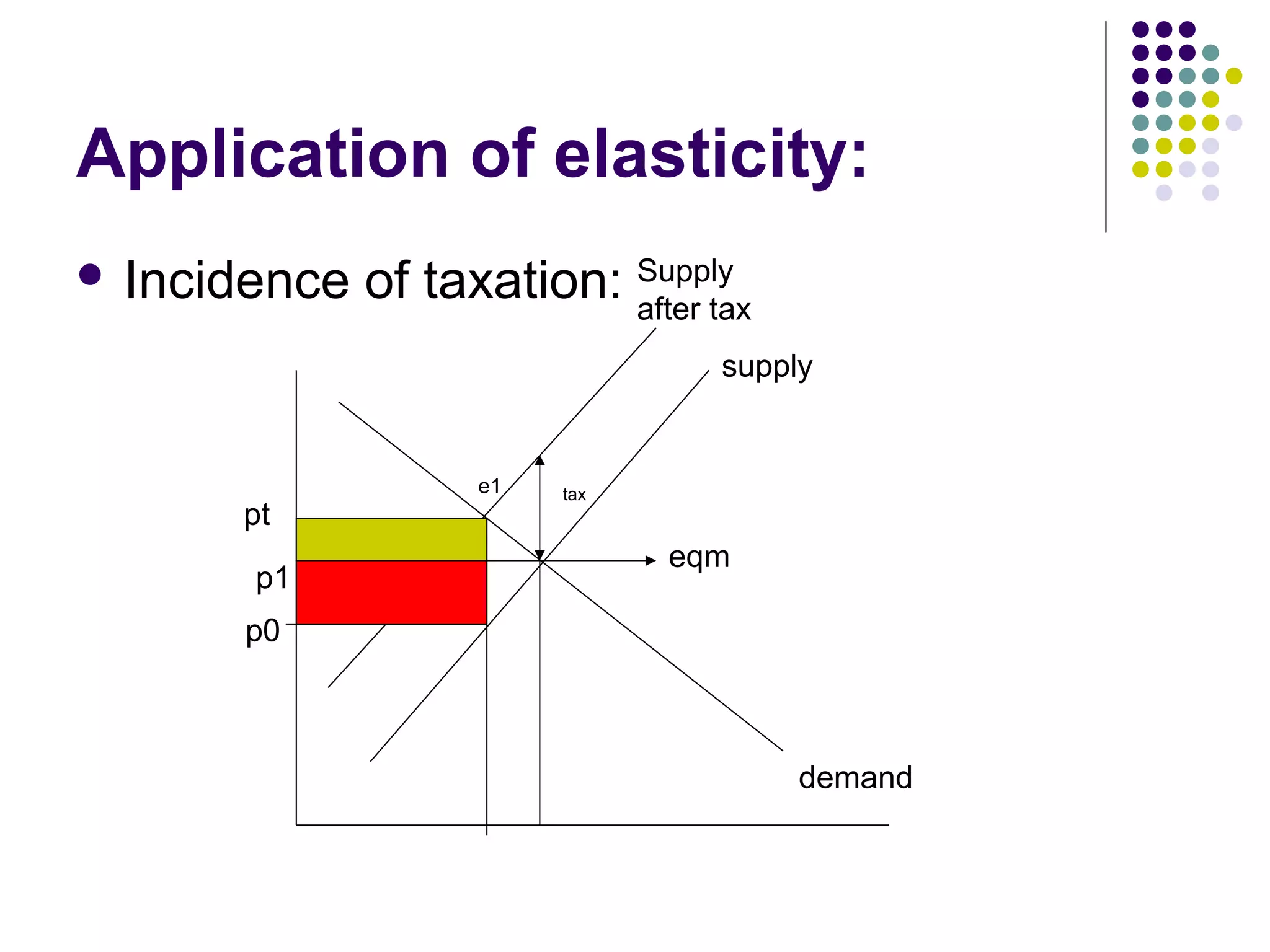
Application of elasticity: 
 Incidence of taxation: Supply 
after tax 
supply 
demand 
e1 tax 
eqm 
pt 
p1 
p0

Demand,supply,Demand and supply,equilibrium between demand and supply

  • 1.
    Demand and Supply 1. Demand Schedule and Demand Curve 2. Supply Schedule and the Supply Curve 3. Elasticity of demand and supply
  • 2.
     Demand -Total quantity customers are willing and able to purchase.  A demand function is a behavior function for consumers.  A supply function is a behavior function for producers. We describe market behavior using these two functions.
  • 3.
    Direct Demand andDerived Demand  Direct Demand-for consumption goods Goods and services that satisfy consumer desires.  Derived Demand-These are sometimes called intermediate goods. For example, demand for steel (an intermediate good) is derived from the demand for final goods (e.g., automobiles).
  • 4.
     Quantity Demanded– amount of a good that the consumer is willing to buy and able to buy at a given price over a period of time.  Law of Demand :All other things remaining unchanged, the quantity demanded of a good increases when its price decreases and vice versa.  This relationship can be shown by a demand schedule, a demand curve or a demand function.
  • 5.
    Demand Schedule Demand Schedule shows the different quantities of goods that a consumer is willing to buy at various prices.  Prices and quantities normally move in opposite directions Prices Quantity 4 28 8 15 12 5 16 1 20 0
  • 6.
    Demand Curve :A curve showing the relationship between the price of a good and the quantity demanded. price quantity
  • 7.
    Demand Function: A demand function is a causal relationship between a dependent variable (i.e., quantity demanded) and various independent variables (i.e., factors which are believed to influence quantity demanded)  Q = f(P) Where Q= quantity and P = price of a good. Example Q = 2 – 4P
  • 8.
    Determinants of Demand  Own Price  Income of the consumer  Price of other goods- 1. complements 2. substitutes  Tastes and preferences  Expectations of future prices  Advertising  Distribution of income
  • 9.
    Types of goods  Complementary goods are a pair of goods consumed together. As the price of one goes up the demand for the other falls. Example- car and petrol  Substitute goods are alternatives to each other. As the price of one goes up the demand for the other also goes up. Example – pepsi and coke
  • 10.
     Normal goodsare those goods whose demand goes up when the consumer’s income increases.  Inferior goods are those goods whose demand falls when the consumer’s income increases. Example : autotravel, kerosene  Giffen goods are those goods whose demand moves in same direction as price  Snob or Veblen goods are those goods whose demand falls when price falls
  • 11.
    Shift of theDemand Curve  A change in demand is reflected by shift of the Demand curve and is caused by a change in any of the non price determinants of demand price qty Here, the curve shifts due to an increase in income or an increase in price of a substitute good etc
  • 12.
     A changein quantity demanded is however reflected in a movement along the demand curve and is called an extension or contraction in demand.  The movement from A to B is due to the change in price of the good all other factors remaining unchanged A B
  • 13.
    Supply  Thequantity supplied is the number of units that sellers want to sell over a specified period of time at a particular price.  Law of Supply states that all other factors remaining unchanged the supply of a good increases as its price increases. This can be shown by a supply schedule, a supply curve or a supply function.
  • 14.
     Supply schedule  There exists a positive relation between quantity and price price quantity 1 2 5 10 8 15 13 25 20 35
  • 15.
     Supply Curve: qty price • Supply function shows the relation between quantity and price. It is a positive relation. Example : q= 4+3p
  • 16.
    Determinants Of Supply  Price  Cost of production  Technological progress  Prices of related outputs  Govt policy All factors other than price cause a shift of the supply curve and is called a change in supply
  • 17.
    EQUILIBRIUM  Equilibrium- perfect balance in supply and demand  Determines market output and price eqm p q s dem p
  • 18.
    Market forces drivemarket to equilibrium  at prices < equilibrium level: excess demand (amount by which quantity demanded exceeds quantity supplied at the specified price)  at price > equilibrium level: excess supply  equilibrium price is market clearing price: no excess demand or excess supply
  • 19.
    Equilibrium in aMarket Demand Price Supply 800 $3,000 2,900 1,150 $2,500 2,550 1,500 $2,000 2,200 1,850 $1,500 1,850 2,200 $1,000 1,500 2,550 $500 1,150 2,900 $0 0
  • 20.
    Surplus and Shortage  Any price above the equilibrium causes an excess supply and any price below the equilibrium causes a shortage.  The market if uncontrolled will automatically arrive at the equilibrium price at which supply equals demand.  Any shift in demand and supply curves will result in a new equilibrium  Comparison of equilibrium is called comparative -statics
  • 21.
    Price Rationing A decrease in supply creates a shortage at P0. Quantity demanded is greater than quantity supplied. Price will begin to • TrTishheee . lloowweerr ttoottaall ssuuppppllyy iiss rraattiioonneedd ttoo tthhoossee wwhhoo aarree wwiilllliinngg aanndd aabbllee ttoo ppaayy tthhee hhiigghheerr pprriiccee..
  • 22.
    Alternative Price- Control Mechanisms • A pprriiccee cceeiilliinngg is a maximum price that sellers may charge for a good, usually set by government. • Example: rent control • AA pprriiccee fflloooorr iiss aa pprriiccee aabboovvee eeqquuiilliibbrriiuumm pprriiccee tthhaatt tthhee bbuuyyeerrss hhaavvee ttoo ppaayy.. • EExxaammppllee :: aaggrriiccuullttuurraall ssuuppppoorrtt pprriiccee,, mmiinniimmuumm wwaaggeess
  • 23.
    Elasticity  Elasticity:A measure of the responsiveness of one variable to changes in another variable; the percentage change in one variable that arises due to a given percentage change in another variable.  By converting each of these changes into percentages, the elasticity measure does not depend on the units in which we measure the variables.
  • 24.
    ELASTICITY Sensitivity ofthe quantity demanded to price is called: price elasticity of demand: E % change in quantity demanded Q / Q P % change in price / P P = = D D
  • 25.
    Arc Elasticity Toget the average elasticity between two points on a demand curve we take the average of the two end points (for both price and quantity) and use it as the initial value: q2-q1/(q2+q1)/2 p2-p1/(p2+p1)/2
  • 26.
    Own Price Elasticityof Demand  Own price elasticity: A measure of the responsiveness of the quantity demanded of a good to a change in the price of that good; the percentage change in quantity demanded divided by the percentage change in the price of the good.  Elastic demand: Demand is elastic if the absolute value of the own price elasticity is greater than 1.
  • 27.
    Types of elasticities  elastic: the quantity demanded changes more than in proportion to a change in price  inelastic: the quantity demanded changes less than in proportion to a change in price
  • 28.
    Elasticity and slope Price The demand curve can be a range of shapes each of which is associated with a different relationship between price and the quantity demanded. Quantity Demanded
  • 29.
    Slope of theDemand Curve  DP is the change in Price price. (DP<0) P D slope = D Quantity Demand DQ Q Q + DQ P P+ DP DP  DQ is the change in quantity.  slope = DP/ DQ Q
  • 30.
    Elasticity and slope slope P = D D Q 1 slope Q P = D D = 1 elasticity P Qslope
  • 31.
     Elastic demand: Demand is elastic if the absolute value of own price elasticity is greater than 1.  Inelastic demand: Demand is inelastic if the absolute value of the own price elasticity is less than 1.  Unitary elastic demand: Demand is unitary elastic if the absolute value of the own price elasticity is equal to 1.  Perfectly elastic demand : e= infinity  Perfectly inelastic demand : e = 0
  • 32.
    Linear Demand Curve: price E = infinity e=lower segment/upper segment E=0 Qty E=1
  • 33.
    Determinants of Elasticity  Number and closeness of substitutes – the greater the number of substitutes, the more elastic  The proportion of income taken up by the product – the smaller the proportion the more inelastic  Price of the product- lower the price, lower the elasticity  Luxury or Necessity - for example, addictive drugs  Time period – the longer the time under consideration the more elastic a good is likely to be
  • 34.
    Cross-Price Elasticity Cross-price elasticity: A measure of the responsiveness of the demand for a good to changes in the price of a related good; the percentage change in the quantity demanded of one good divided by the percentage change in the price of a related good.  The cross-price elasticity is positive whenever goods are substitutes.  The cross-price elasticity is negative whenever goods are complements.
  • 35.
    Cross-price elasticity of demand how quantity of one good changes as price of another good increases %change in quantity demanded %change in price of another good E Q Q Q P , = D = D D D / / o o Q P P o P o P o Q
  • 36.
    Income elasticity ofdemand % change in quantity demanded % change in income / / I E Q Q Q I Y Y Y Q = = D = D D D
  • 37.
    Income Elasticity Income elasticity: A measure of the responsiveness of the demand for a good to changes in consumer income; the percentage change in quantity demanded divided by the percentage change in income.  The income elasticity is positive whenever the good is a normal good.  The income elasticity is negative whenever the good is an inferior good.
  • 38.
    Factors affecting Incomeelasticity:  Nature of the good:  inferior goods have negative income elasticity  Normal goods have positive income elasticity  Luxury goods have income elasticity greater than one  Necessary goods have income elasticity less than one
  • 39.
    Advertising Elasticity The own advertising elasticity of demand for good X defines the percentage change in the consumption of X that results from a given percentage change in advertising spent on X.
  • 40.
    Elasticity and TotalRevenue  If demand is elastic, an increase (decrease) in price will lead to a decrease (increase) in total revenue.  If demand is inelastic, an increase (decrease) in price will lead to an increase (decrease) in total revenue.  Total revenue is maximized at the point where demand is unitary elastic.
  • 41.
    price revenue elasticity Increases increases E< 1 increases decreases E>1 decreases decreases E<1 decreases increases E>1 Increases/ decreases constant E=1
  • 42.
    MARGINAL REVENUE TR = P.Q MR = P + Q dP/dQ = P(1 + Q/P. dP/dQ) = P(1- 1/e) = AR(1-1/e) Hence if e=1, MR =0 if e =0 , MR = INFINITY if e = infinity, MR = AR
  • 43.
    MR,AR QTY E=1 E=infinity MR E=0
  • 44.
    Total revenue qty E = 1 Tr is max
  • 45.
    Elasticity of Supply  Price Elasticity of Supply:  The responsiveness of supply to changes in price  If es is inelastic (<1)- it will be difficult for suppliers to react swiftly to changes in price  If es is elastic(>1) – supply can react quickly to changes in price es = %__ Δ_ _Q_u_a_n_t_it_y_ S_u_p_p_l_ie_d___ % Δ Price
  • 46.
    Paradox of theBumper harvest When prices of food crops increase, the demand does not increase proportionally.  Hence the revenue earned by farmers fall.  The Govt announces a floor price for the farmers- agricultural price subsidy.  This interference with prices comes at a cost to the Govt in form of storage costs of Govt granaries.
  • 47.
    Application of elasticity:  Incidence of taxation: Supply after tax supply demand e1 tax eqm pt p1 p0