The Theory of
Demand and Supply
           Prepared By:
           Zehra Hasan
            Sahar Zaidi
           Vineta Dastor
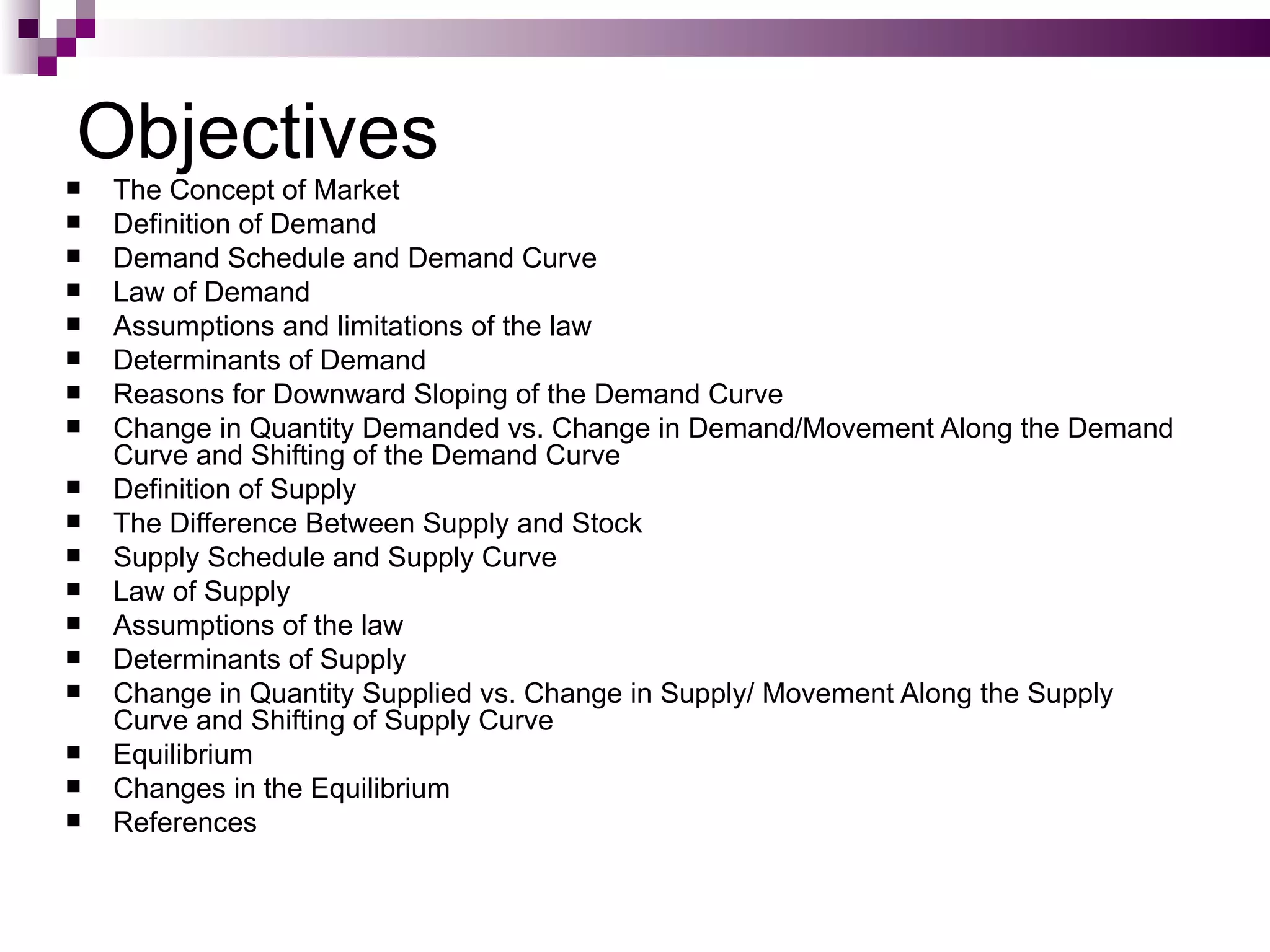
Objectives
   The Concept of Market
   Definition of Demand
   Demand Schedule and Demand Curve
   Law of Demand
   Assumptions and limitations of the law
   Determinants of Demand
   Reasons for Downward Sloping of the Demand Curve
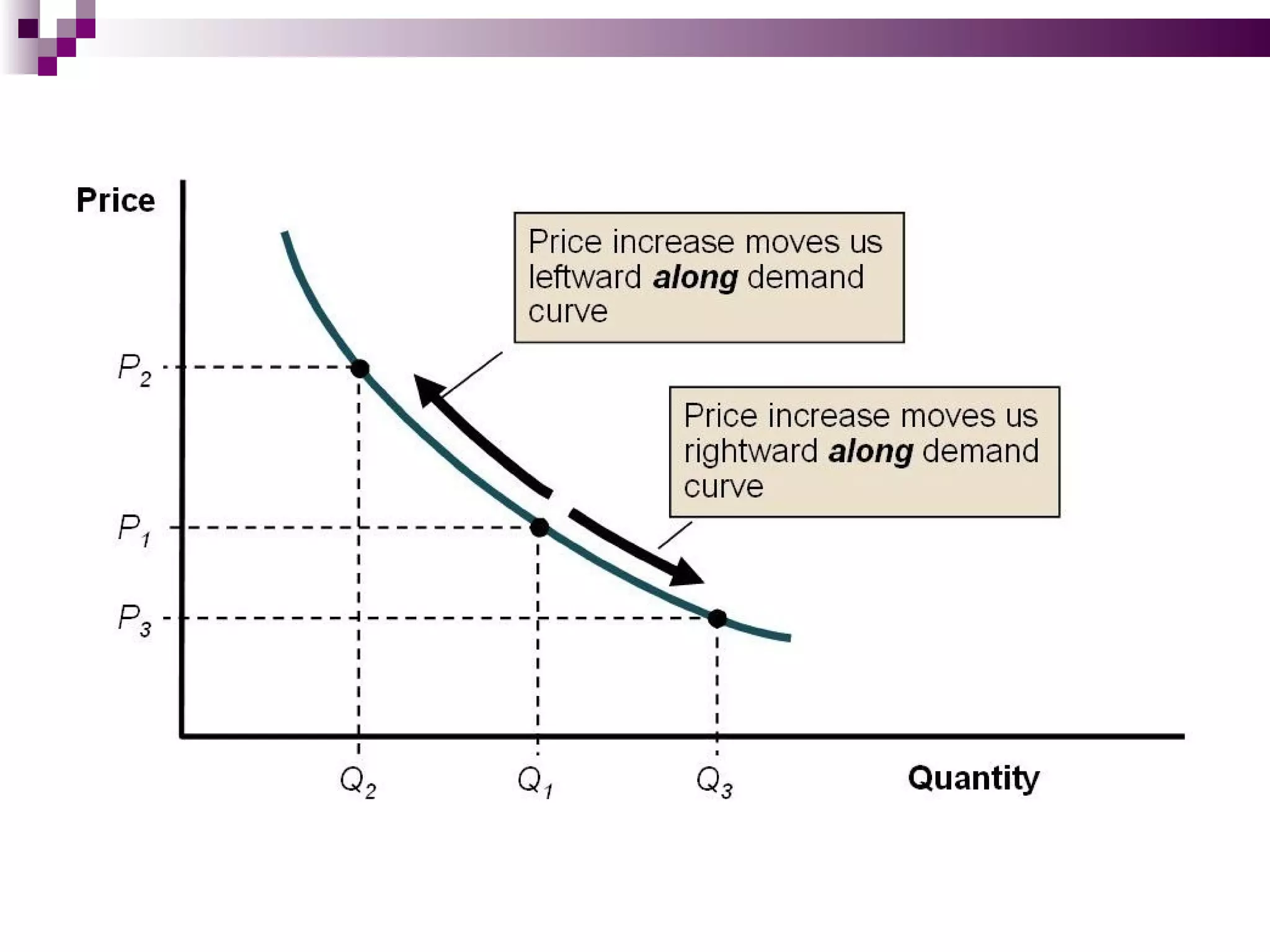
   Change in Quantity Demanded vs. Change in Demand/Movement Along the Demand
    Curve and Shifting of the Demand Curve
   Definition of Supply
   The Difference Between Supply and Stock
   Supply Schedule and Supply Curve
   Law of Supply
   Assumptions of the law
   Determinants of Supply
   Change in Quantity Supplied vs. Change in Supply/ Movement Along the Supply
    Curve and Shifting of Supply Curve
   Equilibrium
   Changes in the Equilibrium
   References
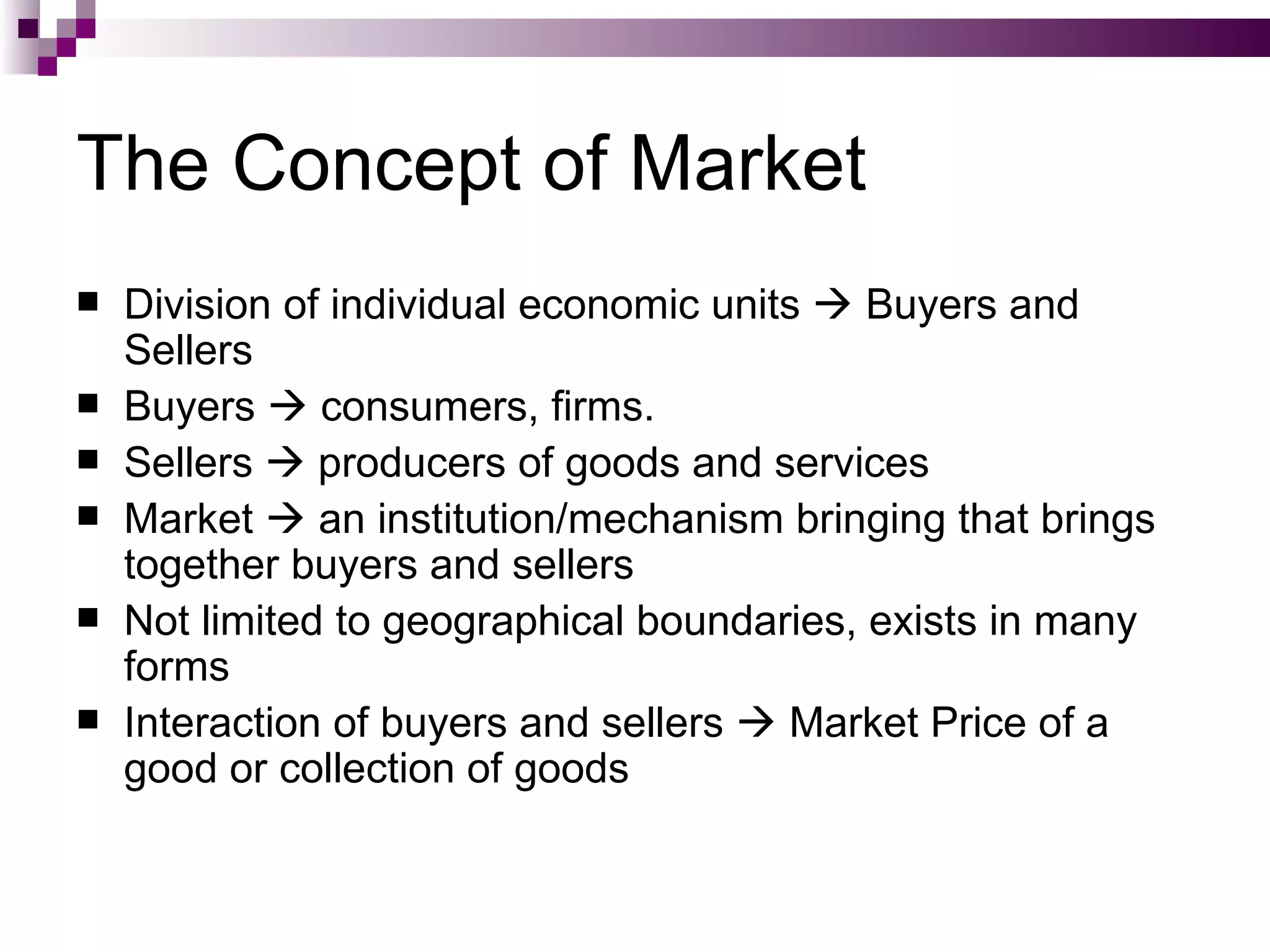
The Concept of Market
   Division of individual economic units  Buyers and
    Sellers
   Buyers  consumers, firms.
   Sellers  producers of goods and services
   Market  an institution/mechanism bringing that brings
    together buyers and sellers
   Not limited to geographical boundaries, exists in many
    forms
   Interaction of buyers and sellers  Market Price of a
    good or collection of goods
The Concept of
Demand
        By: Vineta Dastor
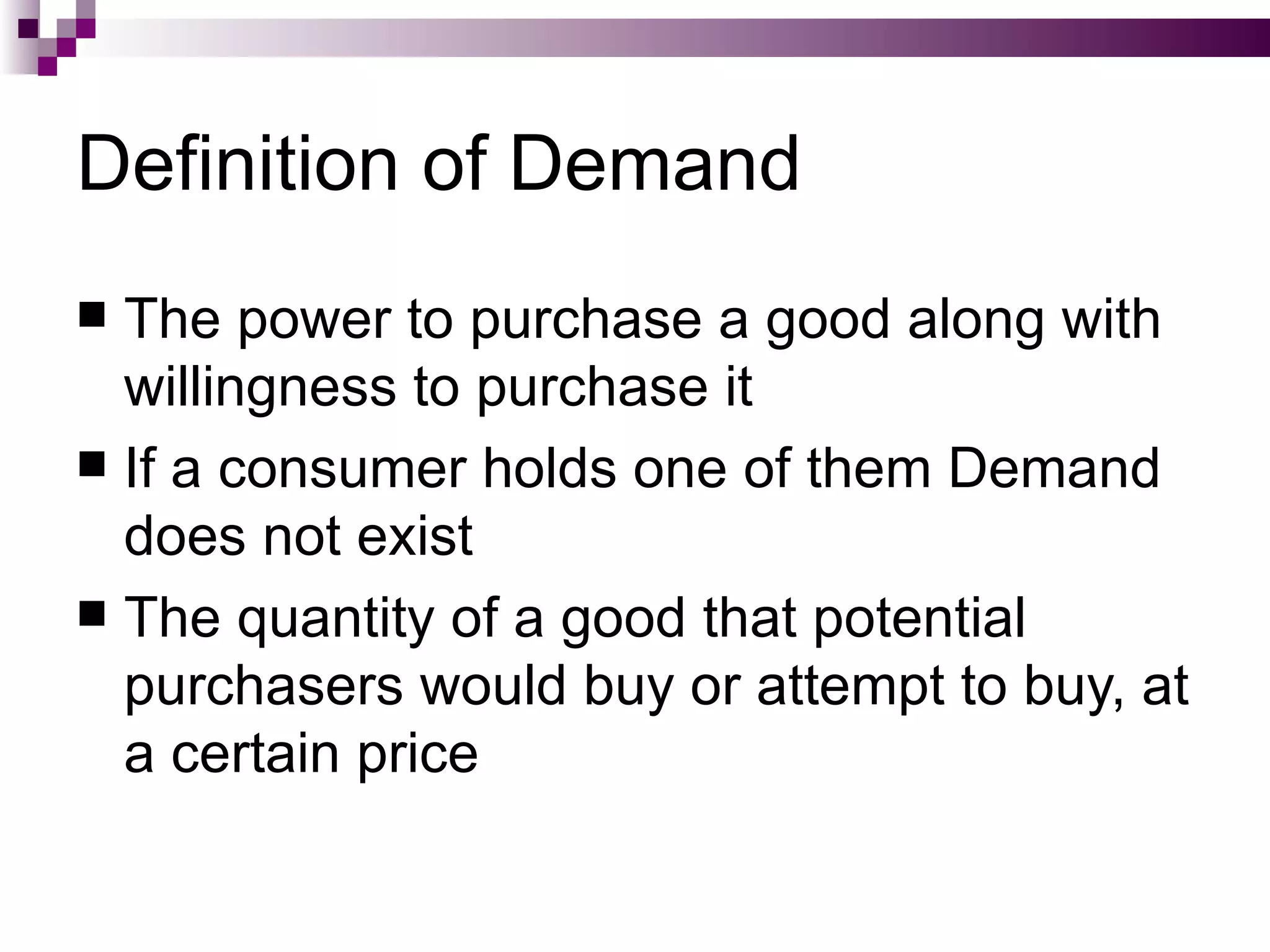
Definition of Demand
 The power to purchase a good along with
  willingness to purchase it
 If a consumer holds one of them Demand
  does not exist
 The quantity of a good that potential
  purchasers would buy or attempt to buy, at
  a certain price
“Demand is the representation of the various
  amounts of a product that consumers are
   willing and able to purchase at each of a
  series of possible prices during a specific
                period of time”
Demand Schedule and Demand
Curve
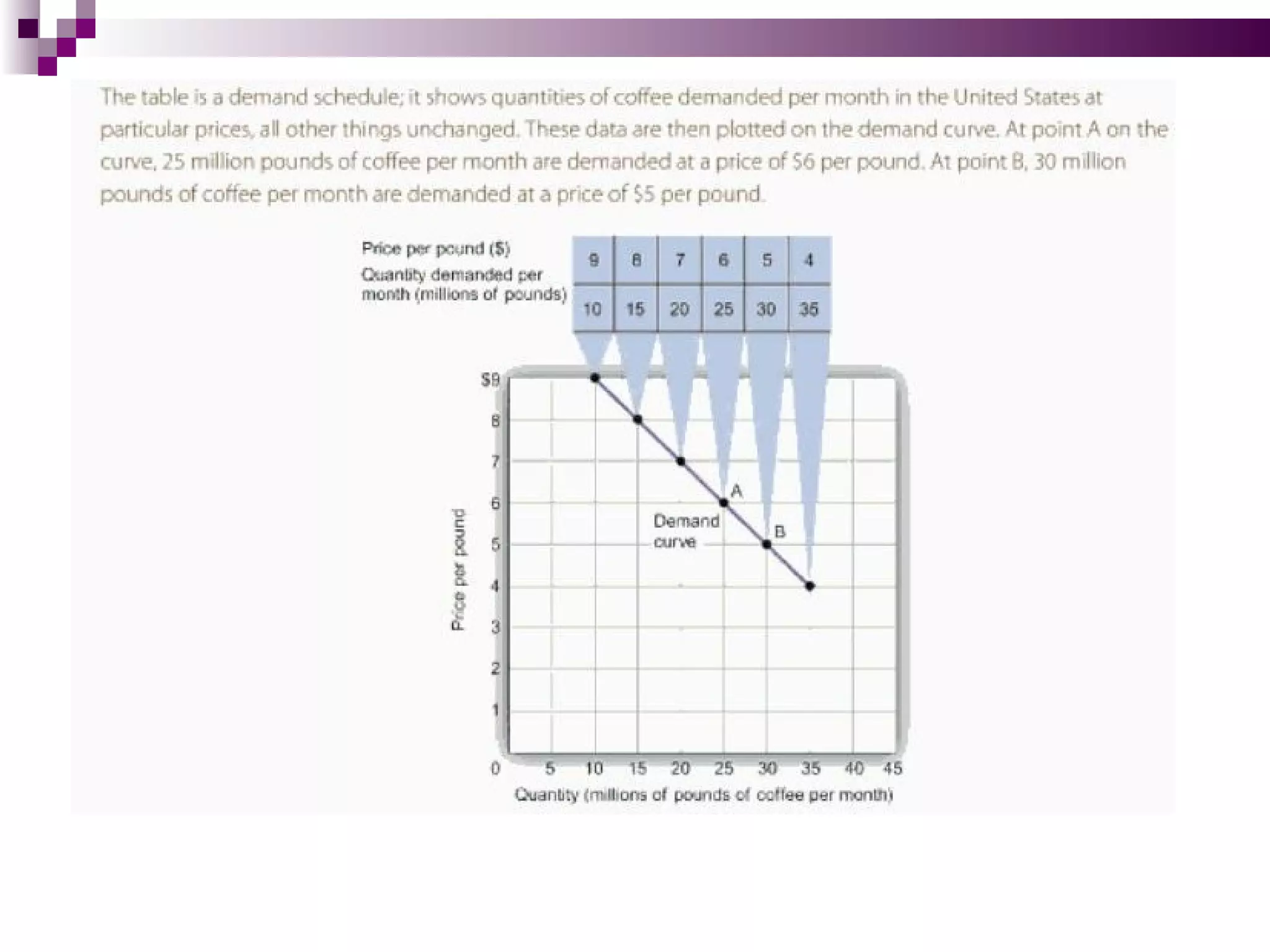
   Demand Schedule:
        -A list showing the quantity of a good that
         consumers would choose to purchase at
       different prices, with all other variables held
                          constant
   Demand Curve:
    -graphically shows the relationship between the
       price of a good and the quantity demanded ,
          holding constant all other variables that
                     influence demand
Law of Demand
 Fundamental characteristic of demand:
    “All else equal, as the price falls, the
    quantity demanded rises, and as price
      rises, the quantity demanded falls.”
 Negative relationship between price and
  quantity demanded  Law of Demand
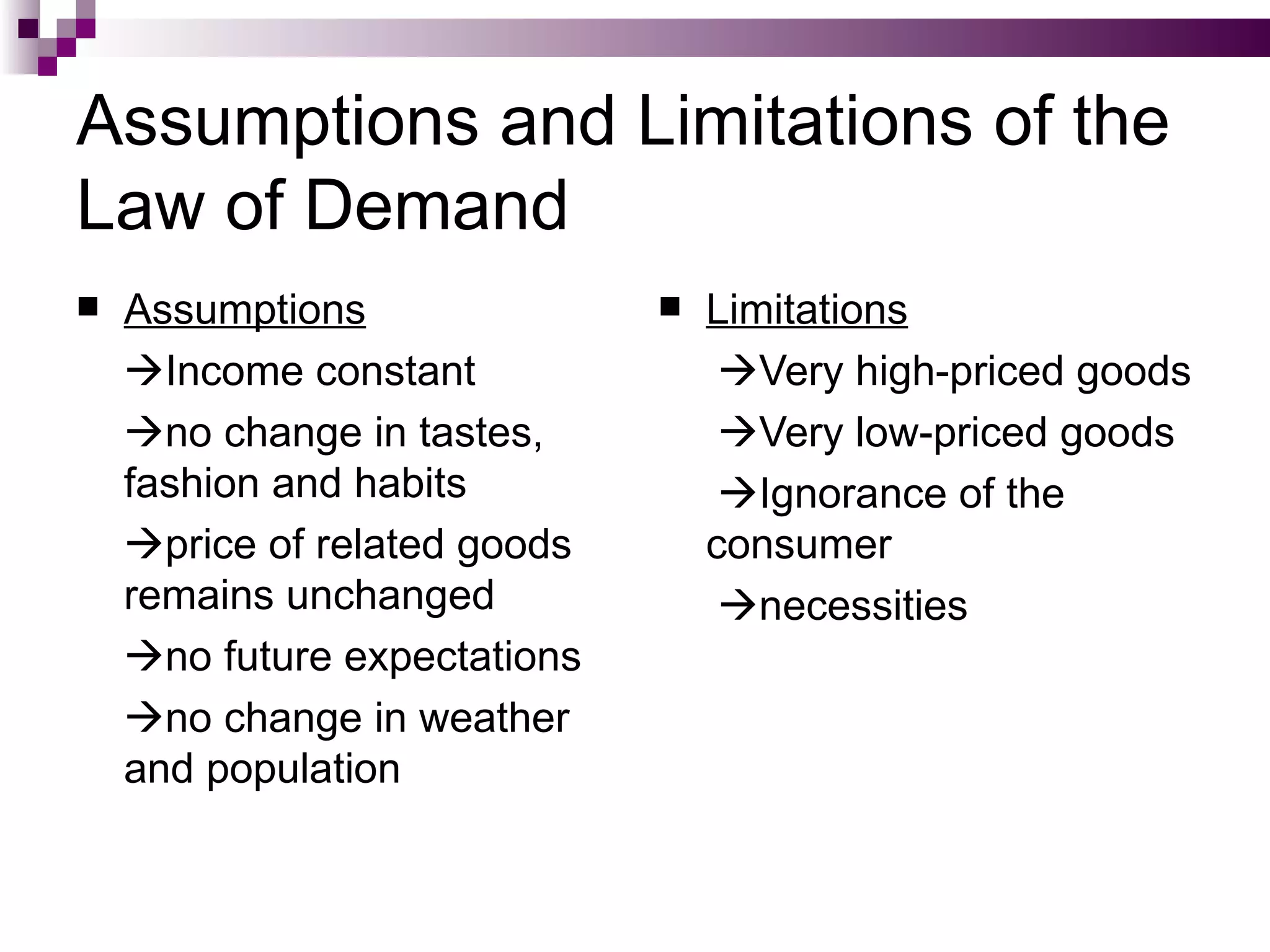
Assumptions and Limitations of the
Law of Demand
   Assumptions                  Limitations
    Income constant               Very high-priced goods
    no change in tastes,          Very low-priced goods
    fashion and habits             Ignorance of the
    price of related goods       consumer
    remains unchanged              necessities
    no future expectations
    no change in weather
    and population
Determinants of Demand
   Price of the good
   Price of related goods [substitutes and
    complements]
   The size of household income
   Taste and fashion
   Expectation
   The distribution of income among households
   Number of Buyers
Reasons for Downward Sloping of
the Demand Curve

          Customer effect
          Income effect
          Substitution effect
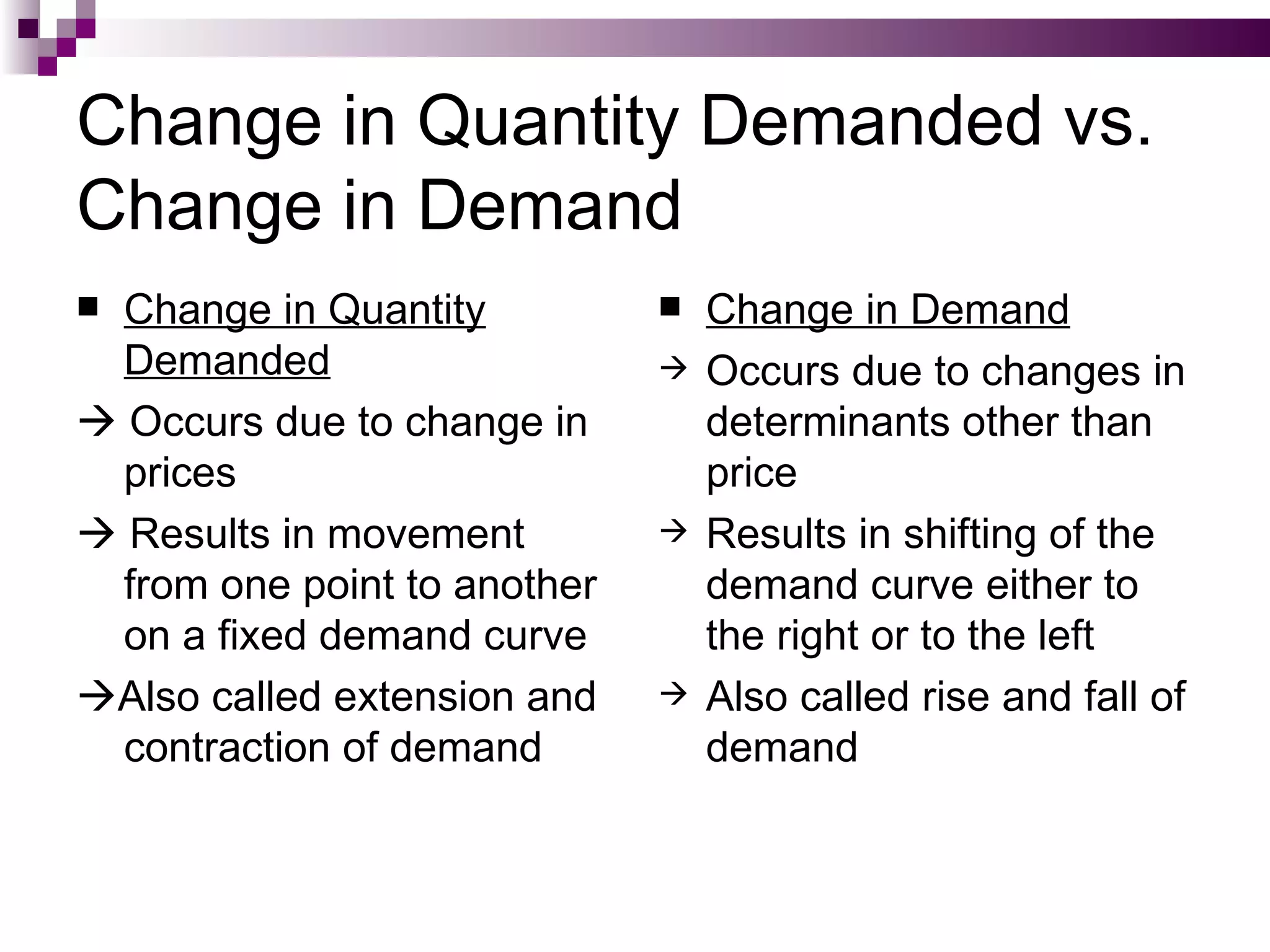
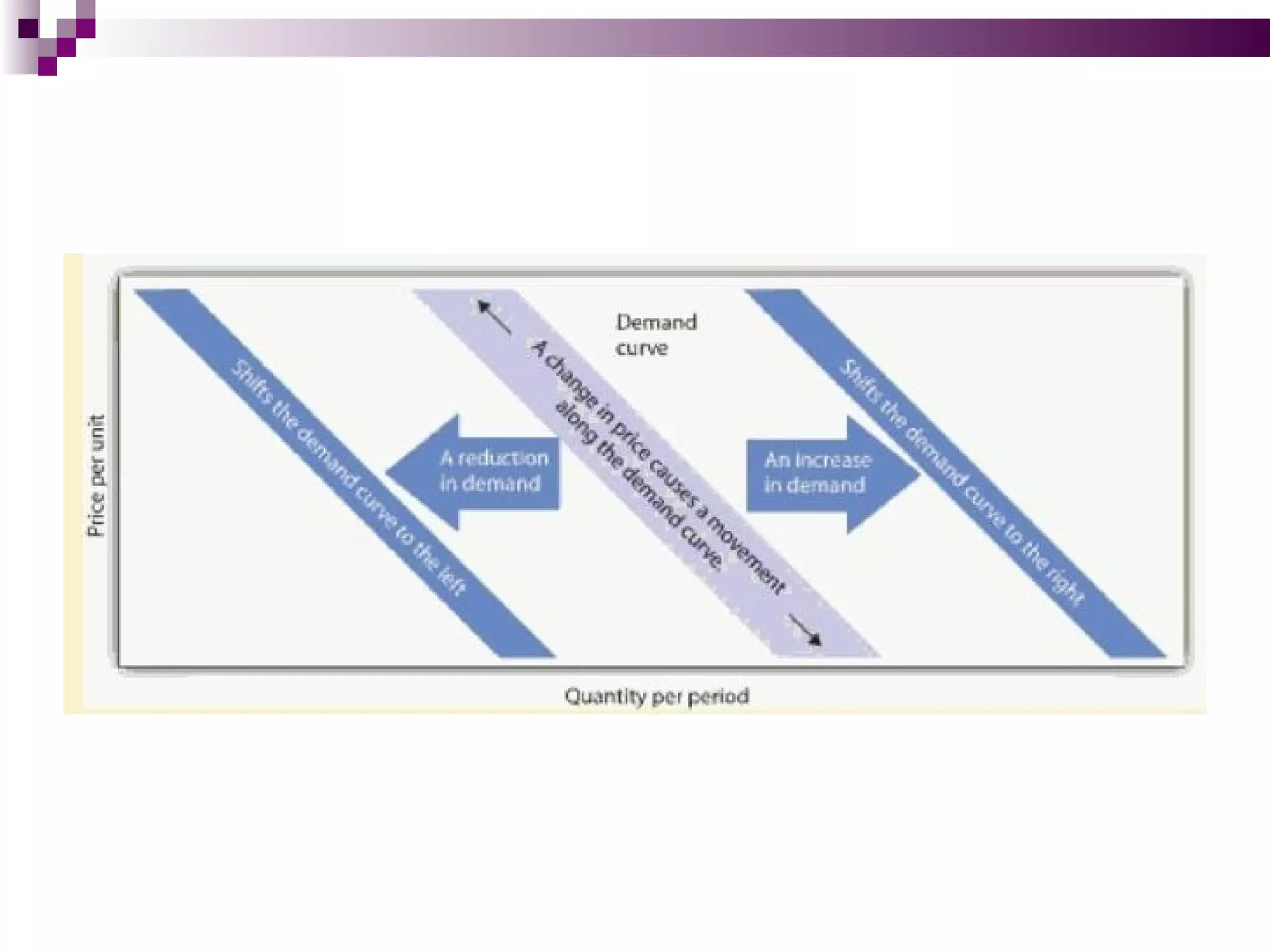
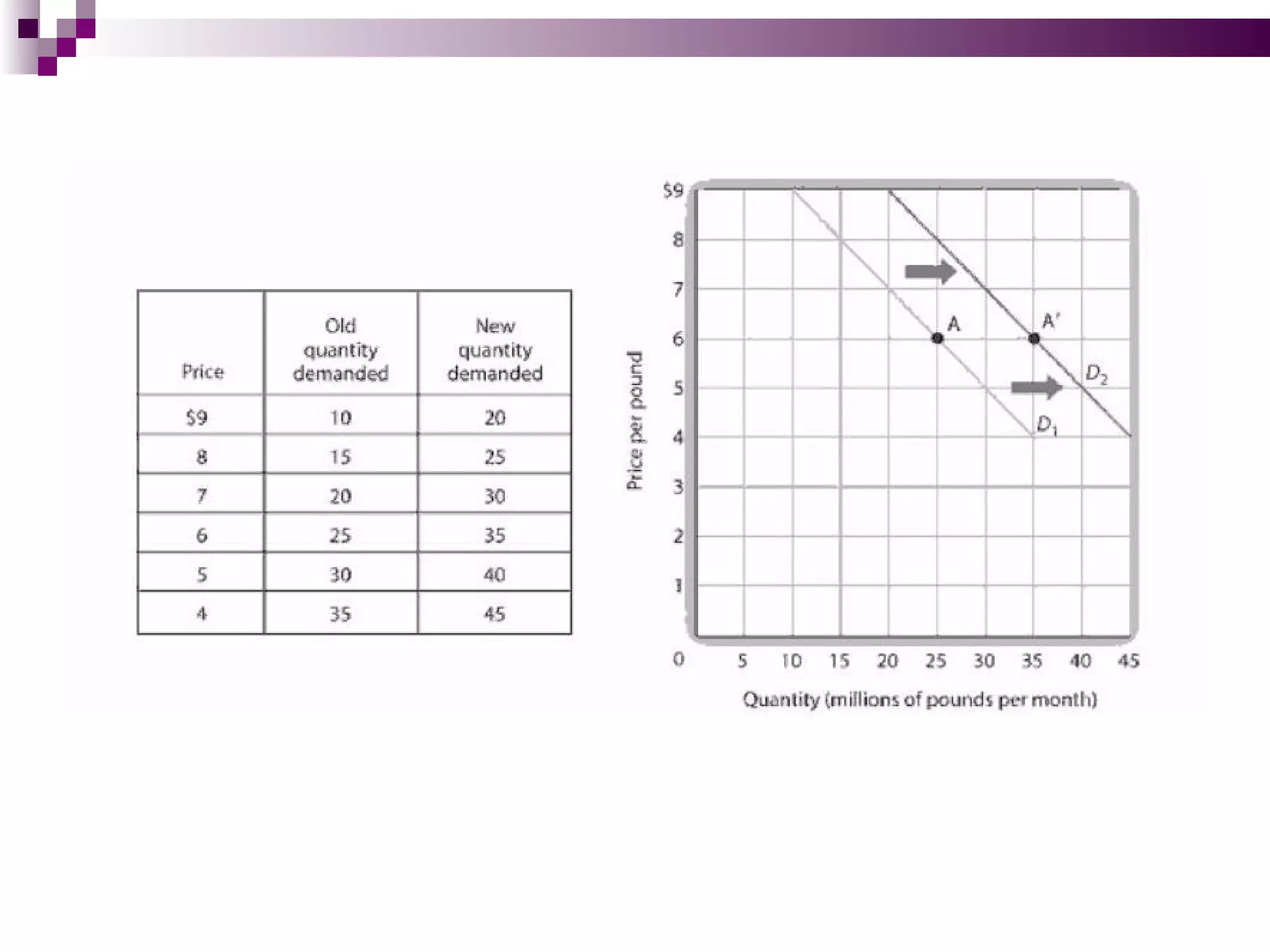
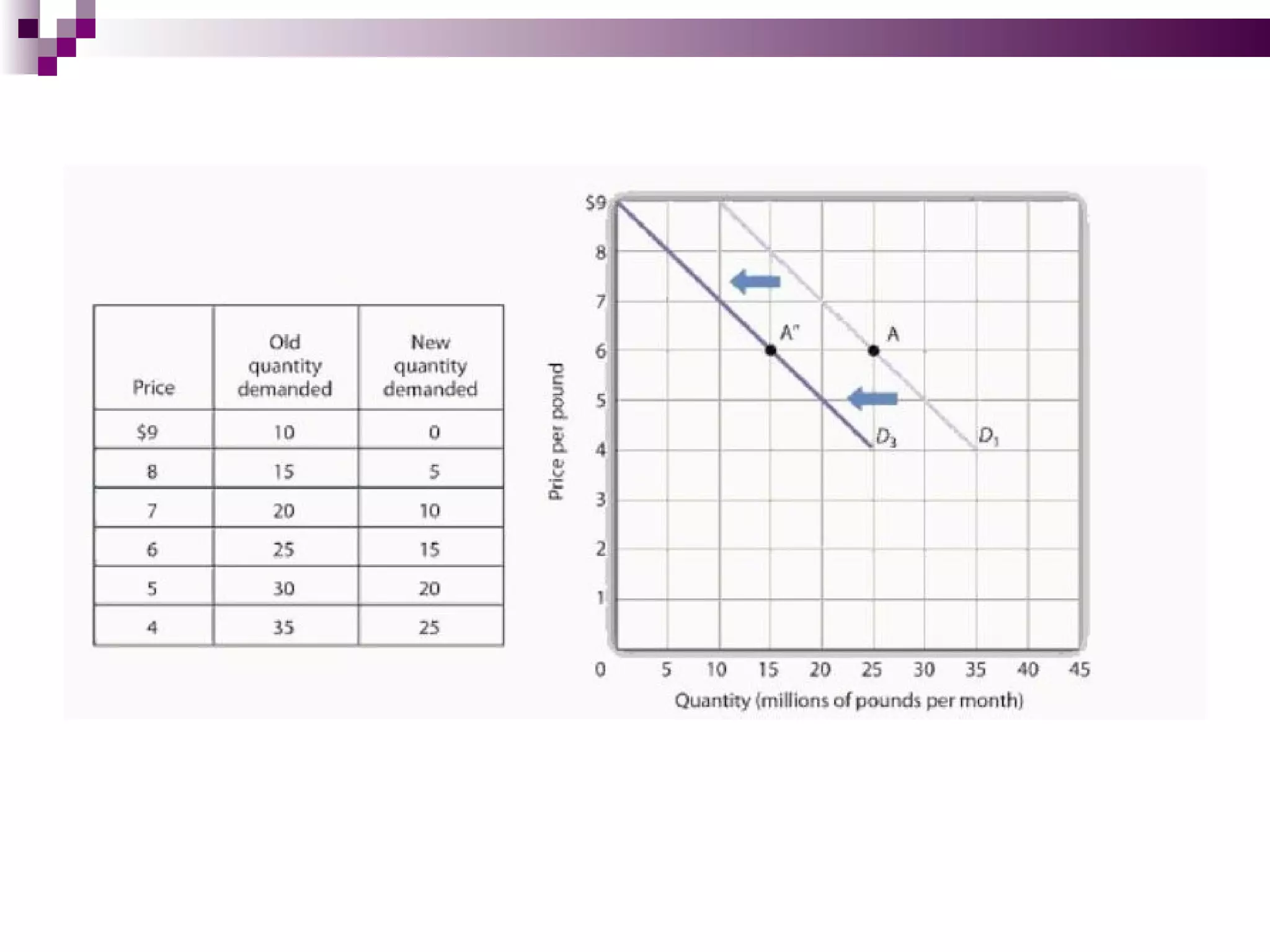
Change in Quantity Demanded vs.
Change in Demand
 Change in Quantity             Change in Demand
  Demanded                       Occurs due to changes in
 Occurs due to change in         determinants other than
  prices                          price
 Results in movement            Results in shifting of the
  from one point to another       demand curve either to
  on a fixed demand curve         the right or to the left
Also called extension and       Also called rise and fall of
  contraction of demand           demand
The Concept of
Supply
        By: Zehra Hasan
Definition of Supply
 Quantity of output brought for sale in the
  market at a certain price
 The amount of a good producers would
  want to produce and sell at a specific price
“ The amounts of a product that producers
  are willing and able to make available for
  sale at each of a series of prices during a
                specific period”
The Difference Between Supply
and Stock
Stock is the quantity of output which a seller
 has with him and has not yet brought for
 sale; whereas supply is the quantity of
 output brought from existing stock for sale
 at a certain price in the market
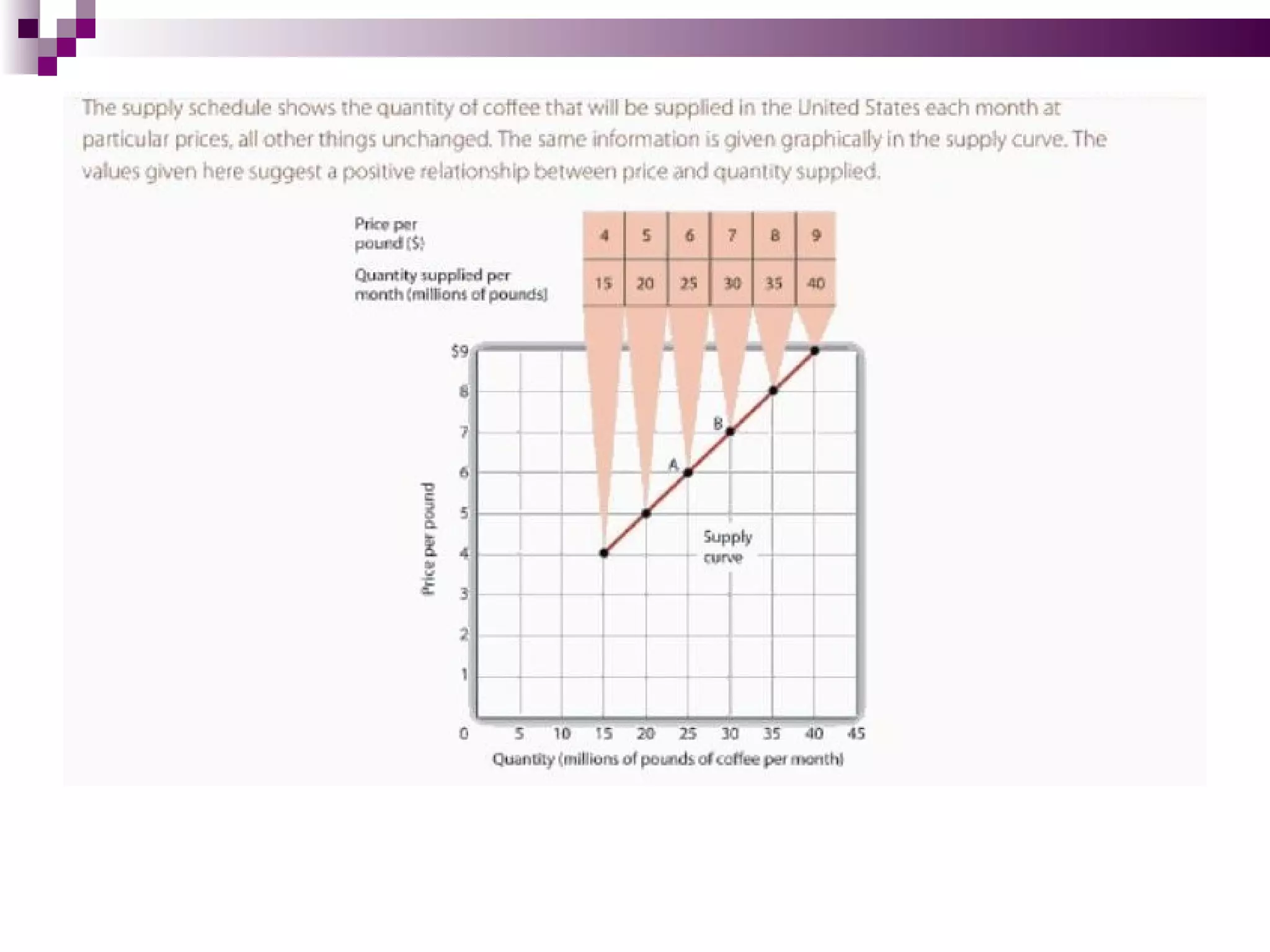
Supply Schedule and Supply Curve
   Supply Schedule:
      - A list showing the amount of a product that
     producers would produce and sell at a series of
    varying prices, during a certain time, with all the
                 other factors held constant
   Supply Curve:
      -The graphical representation of the relation
       between the quantity supplied of a good that
       producers are willing and able to sell and the
                      price of the good
The Law of Supply
 Explains the fundamental characteristic of
  supply
 “All else equal, as price rises, the quantity
    supplied rises, as price fall the quantity
                  supplied falls”
 Positive or direct relationship between the
  quantity supplied and the price Law of
  Supply
Assumptions of the Law
     Constant cost of production
     Constant price of capital goods
     Constant technology
Determinants of Supply
 Price of the good
 Resource Prices
 Technology
 Taxes and subsidies
 Price of Other Goods
 Expectations
 Number of Sellers
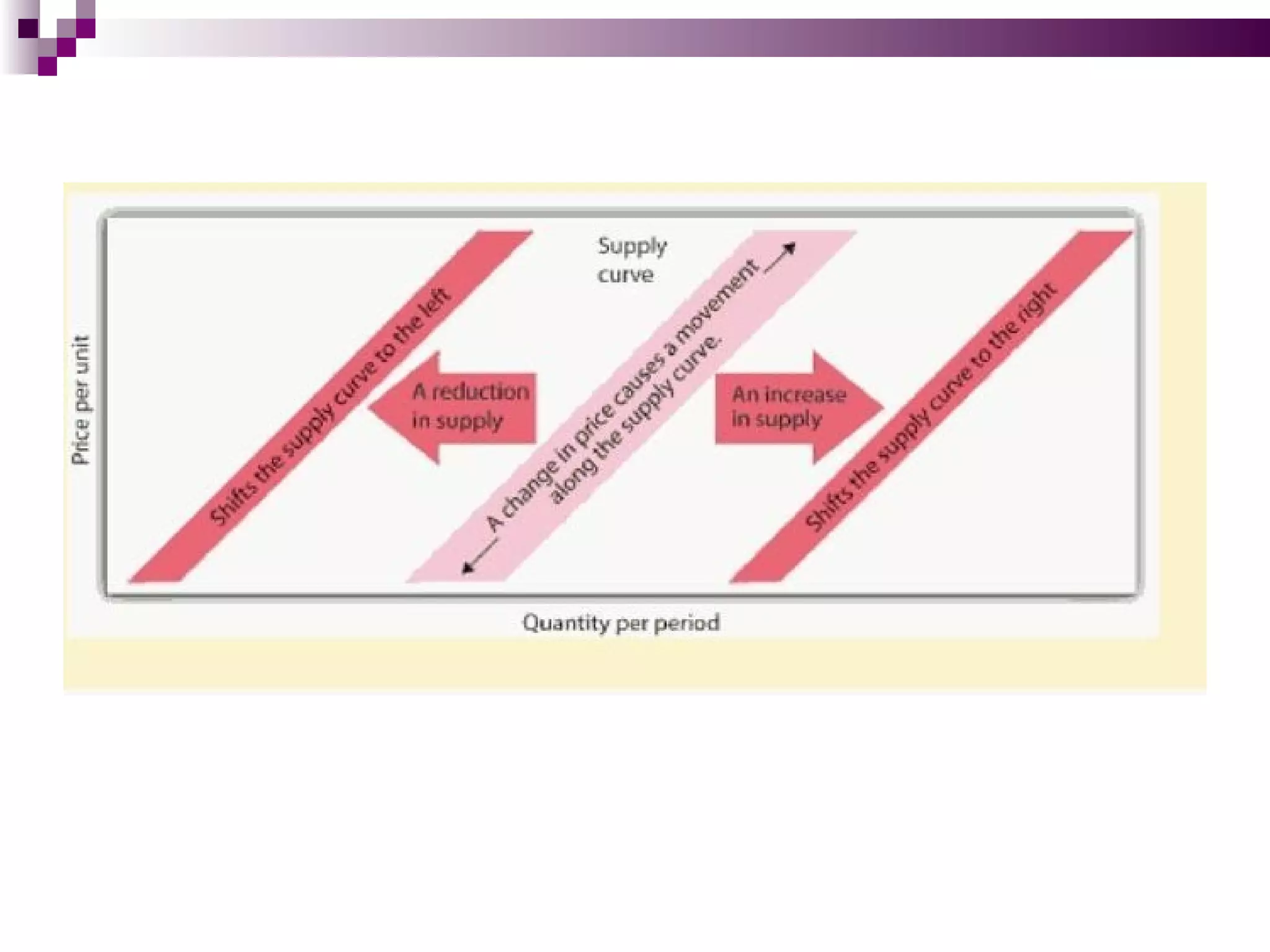
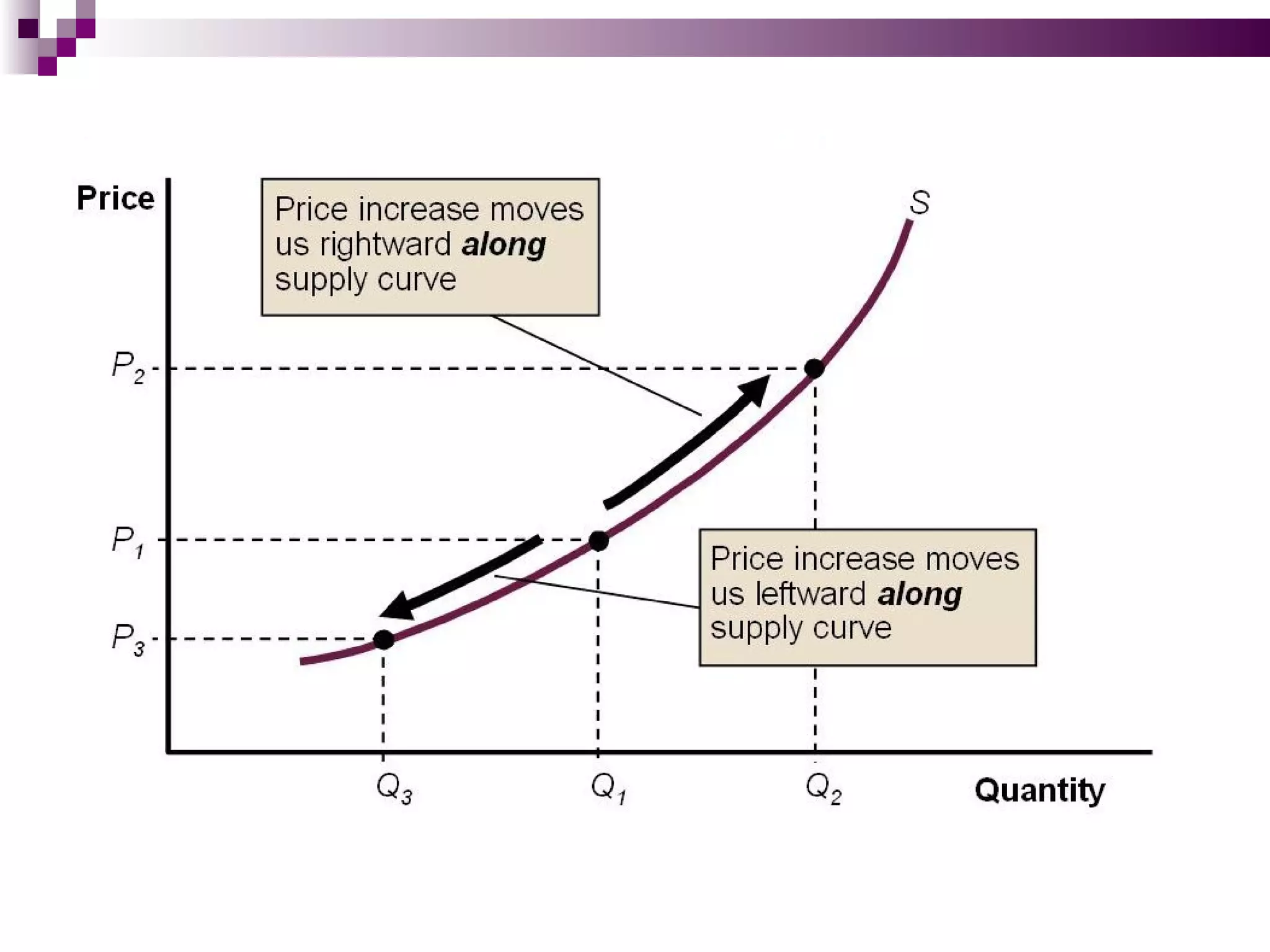
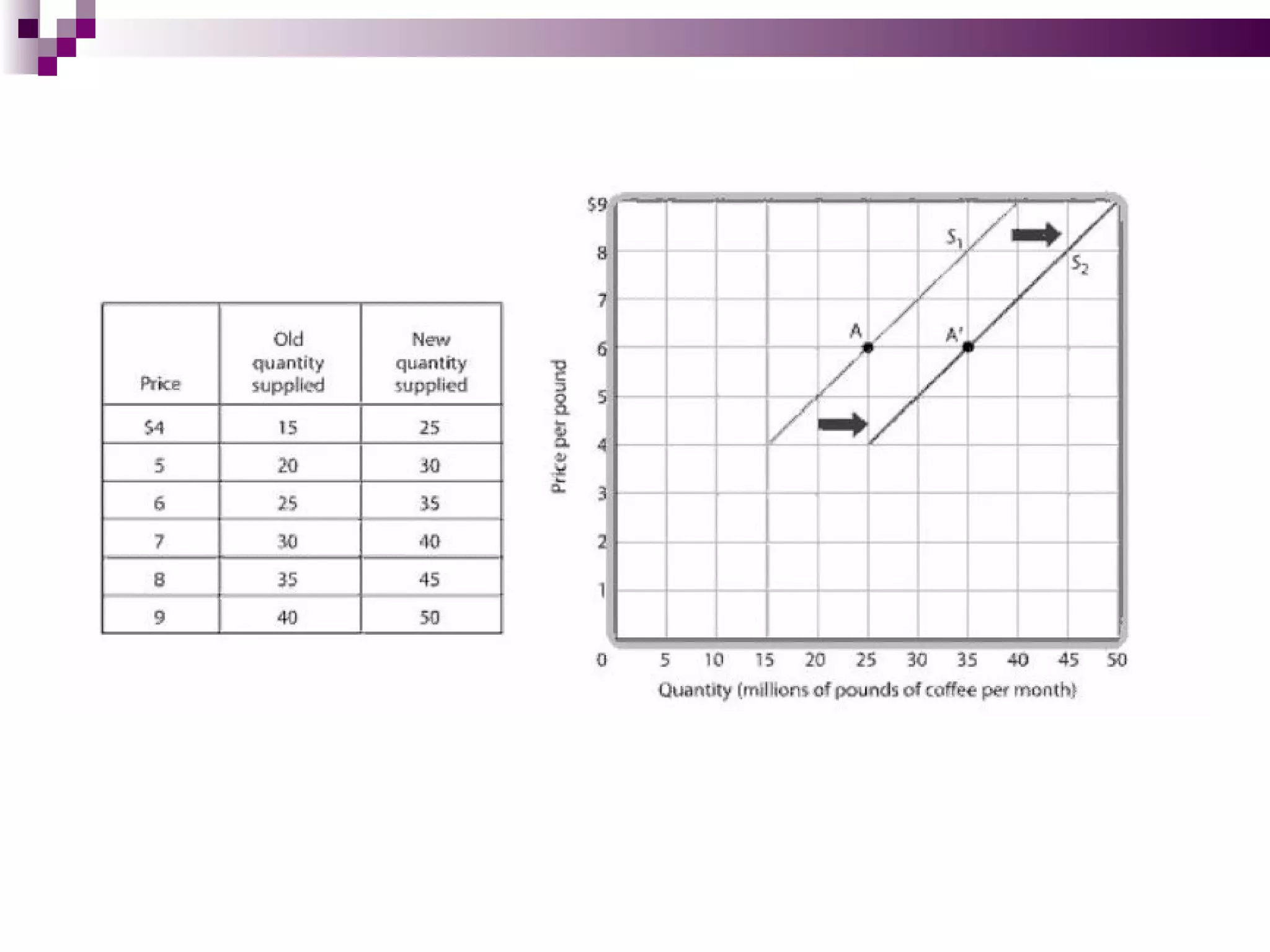
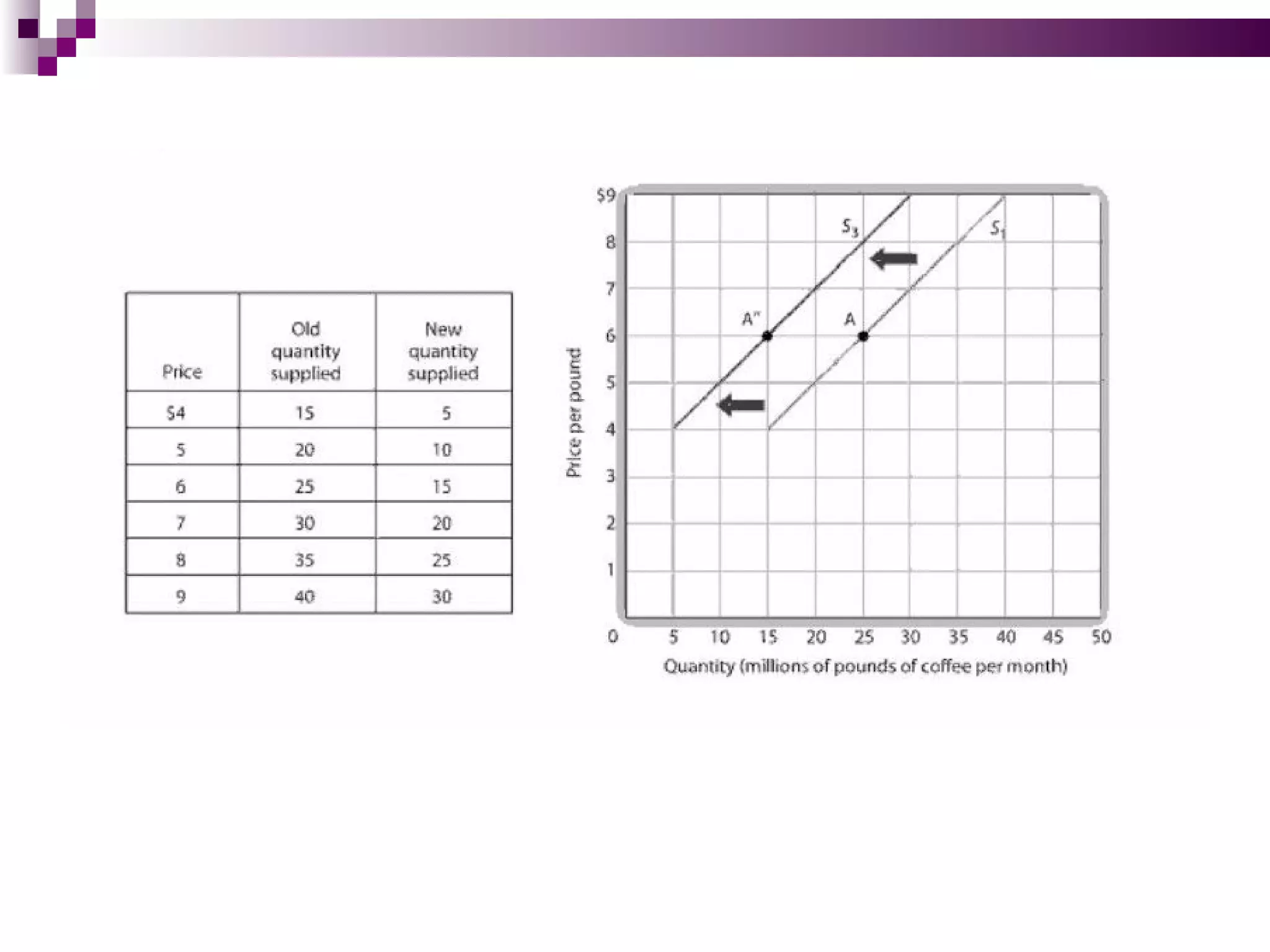
Change in Quantity Supplied vs.
Change in Supply
   Change in Quantity             Change in Supply
    Supplied                       Occurs due to change in
   Occurs due to change in         determinants of supply
    the market price                other than price
   Is represented by              Is represented by a shift
    movement from one point         in the supply curve either
    to another on the same          to the right or to the left
    supply curve                   Also called rise and fall in
   Also called extension and       supply
    contraction of supply
Equilibrium

          By: Sahar Zaidi
Equilibrium – Putting Demand and
Supply Together
   When a market is in equilibrium
    Both price of good and quantity bought and sold have settled into
     a state of rest
    The equilibrium price and equilibrium quantity are values for
     price and quantity in the market but, once achieved, will remain
     constant
           Unless and until supply curve or demand curve shifts
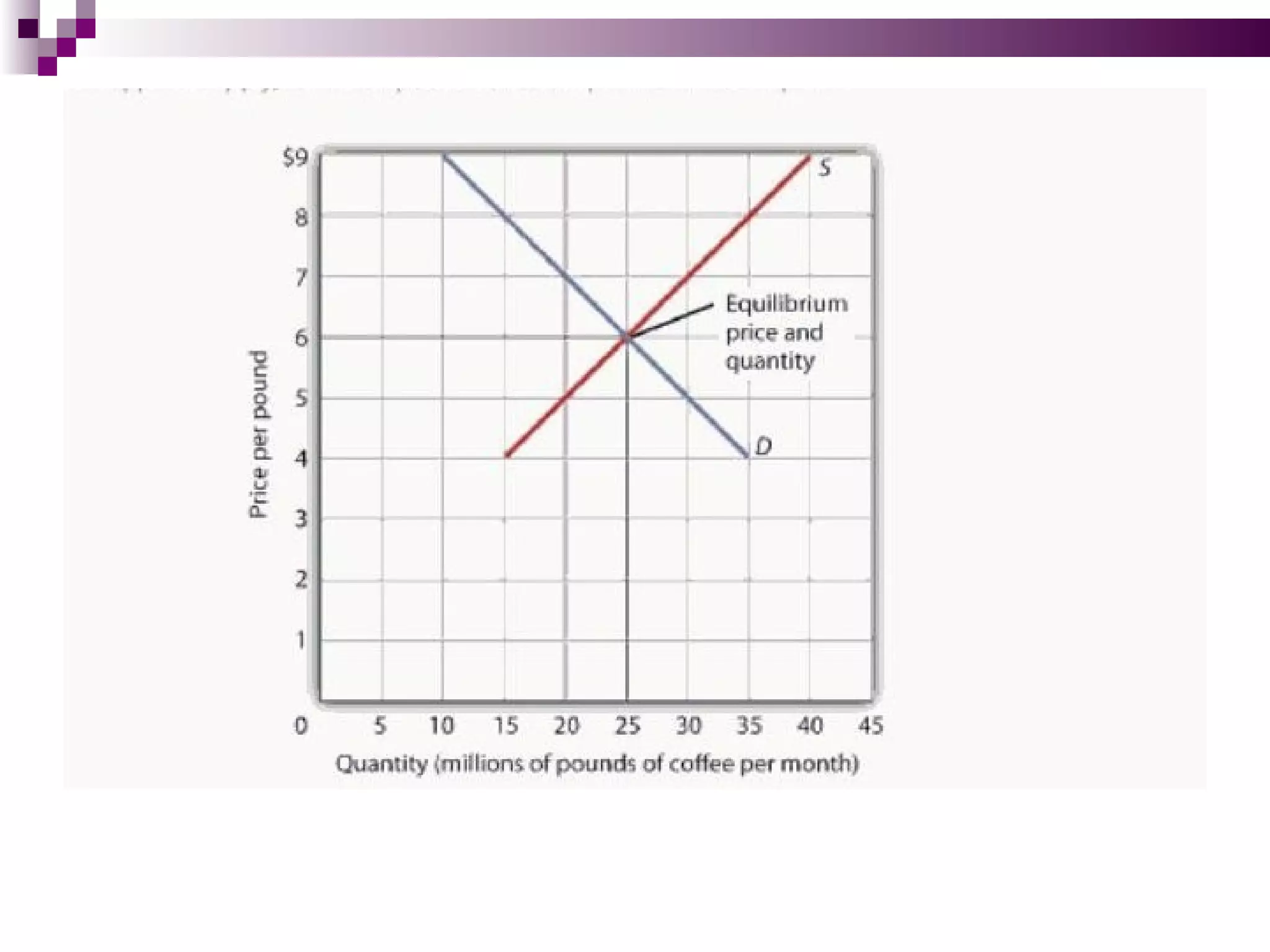
   The equilibrium price and equilibrium quantity can be
    found on the vertical and horizontal axes, respectively
     At point where supply and demand curves cross
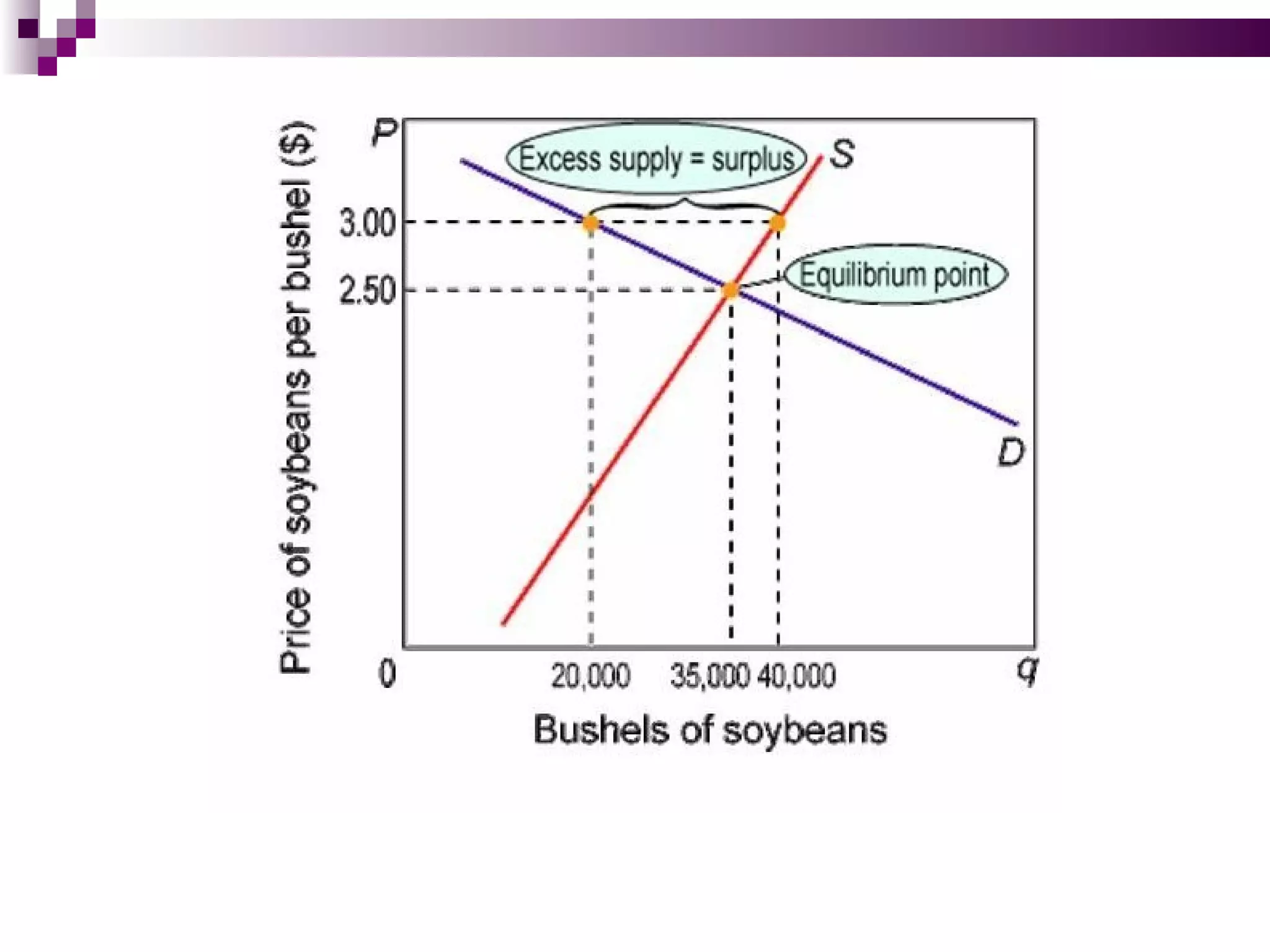
Excess Supply or Surplus
   Excess Supply
    At a given price, the excess of quantity
     supplied over quantity demanded
   Price of the good will fall as sellers
    compete with each other to sell more of
    the good than buyers want
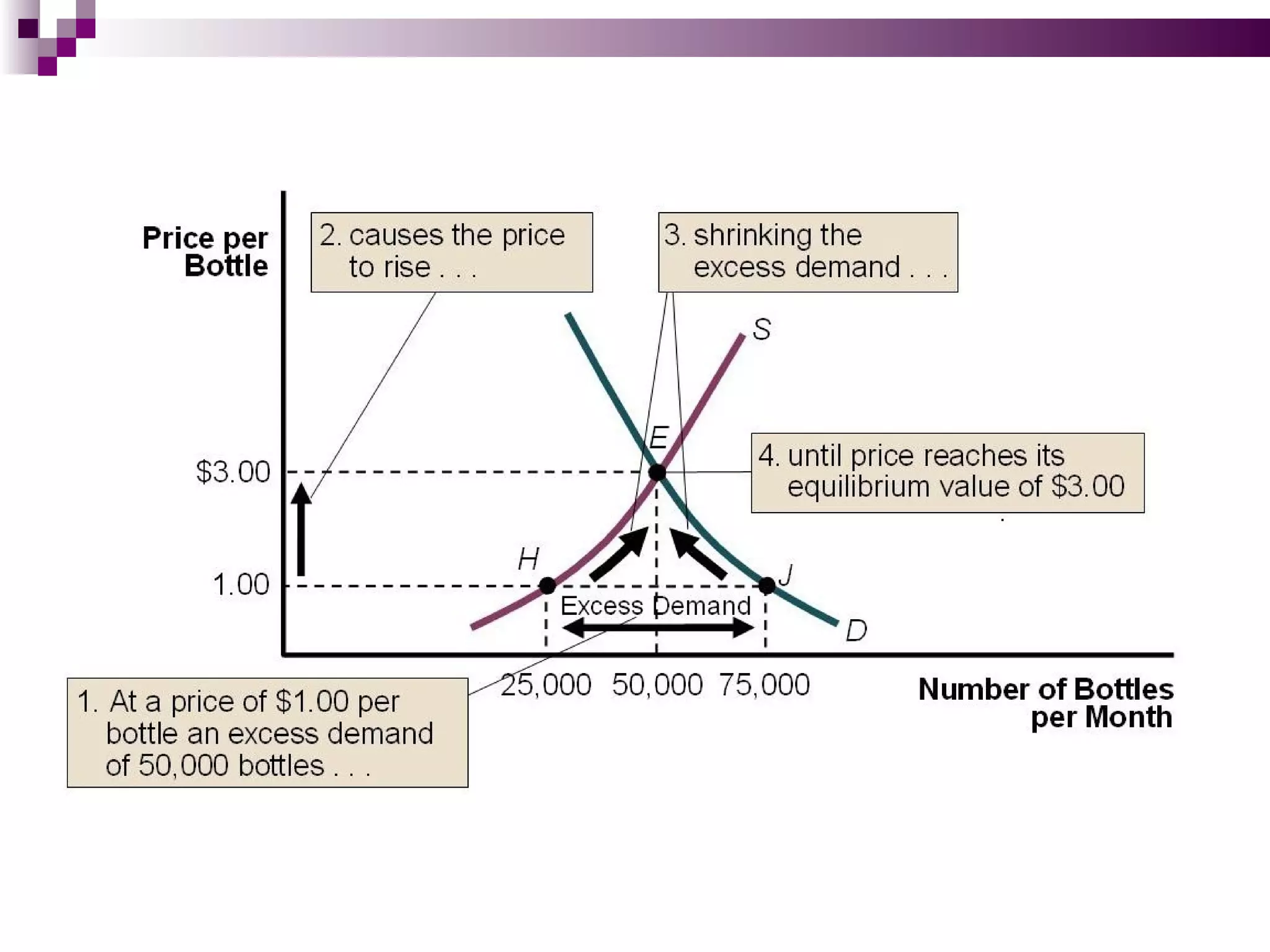
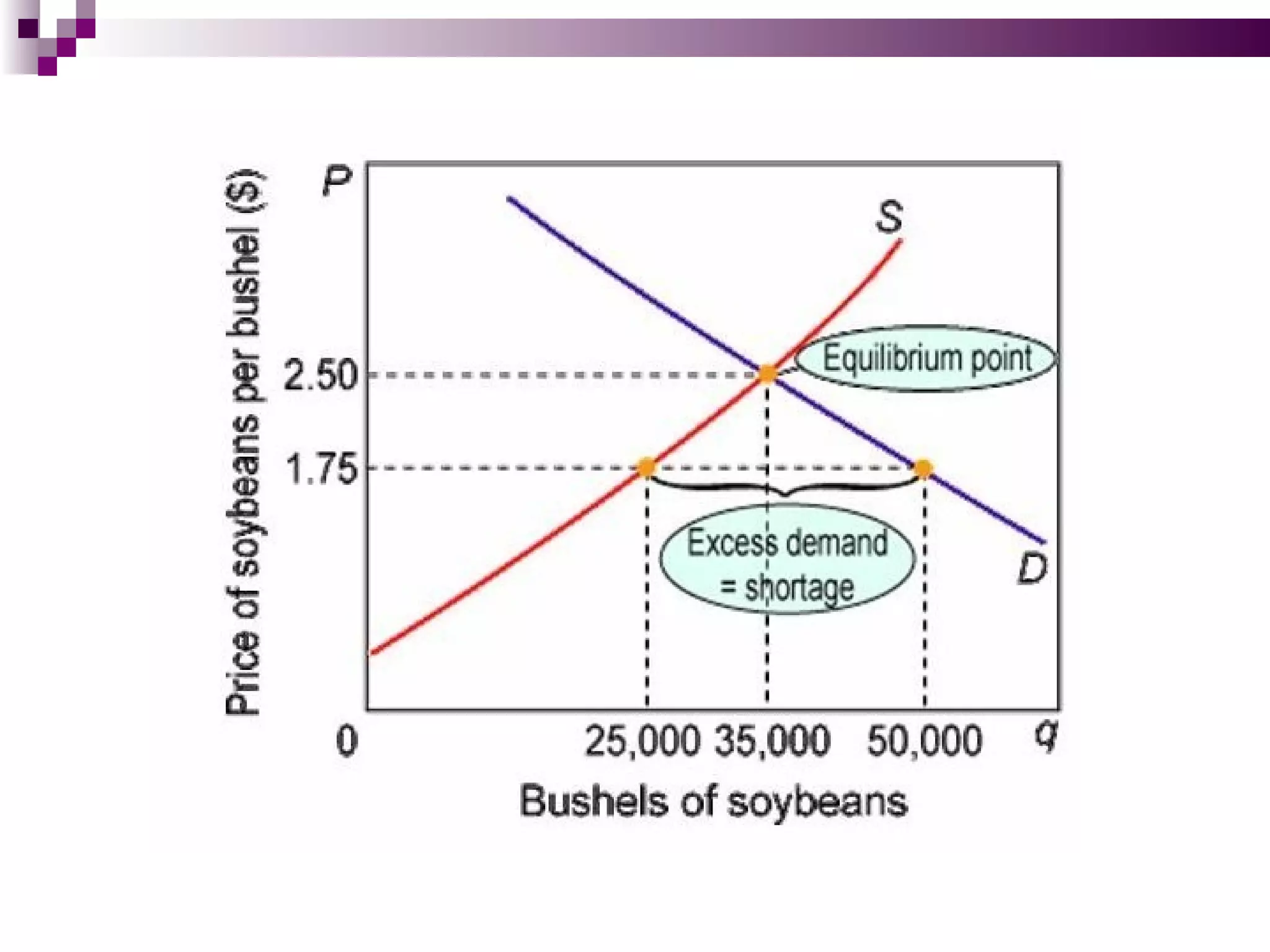
Excess Demand or Shortage
   Excess demand
    At a given price, the excess of quantity
     demanded over quantity supplied
   Price of the good will rise as buyers
    compete with each other to get more of
    the good than is available
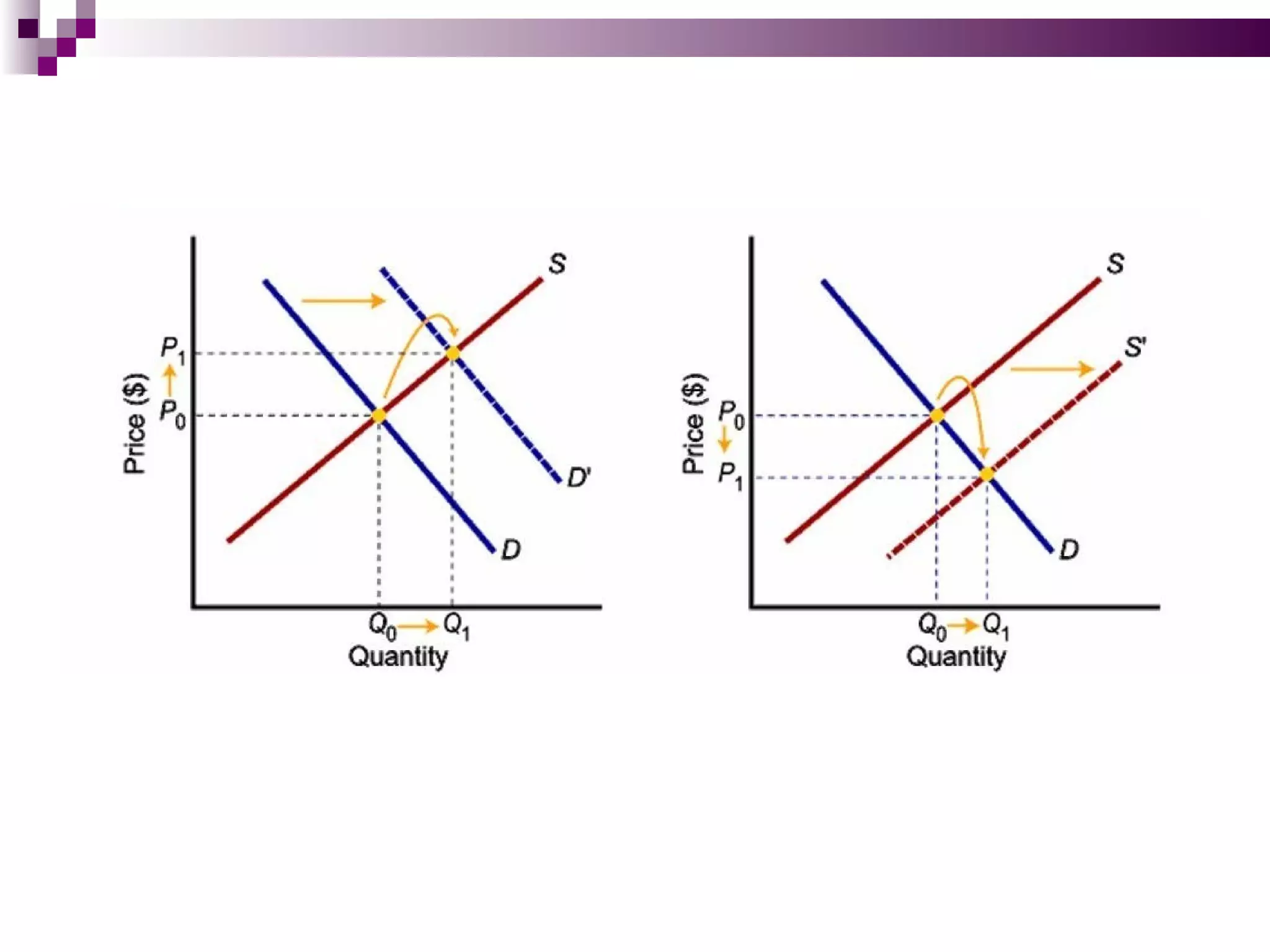
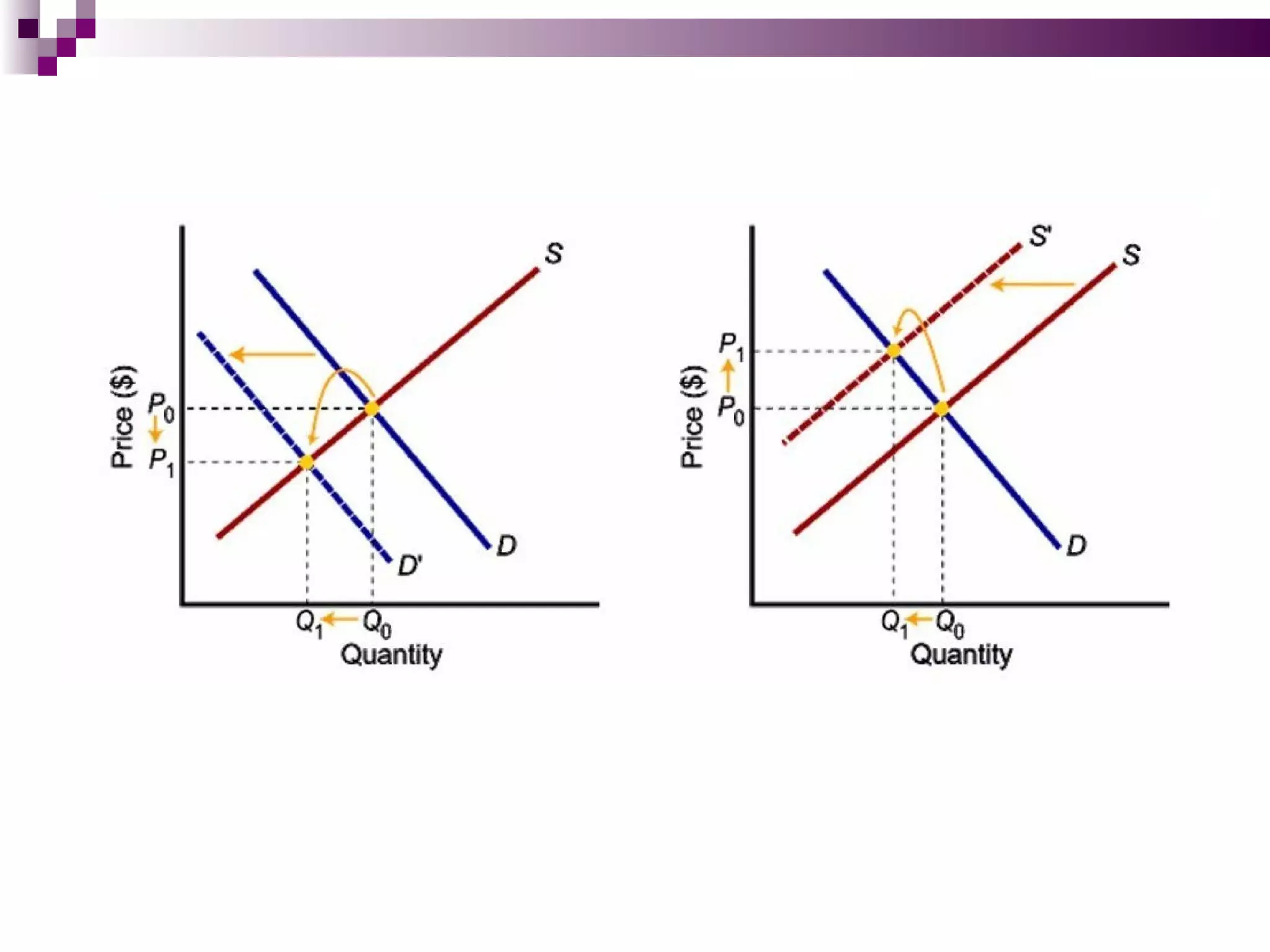
Changes in Equilibrium
                  Increase in    No Change in     Decrease in 
   Situation 
                  Demand         Demand           Demand
  Increase in     Price  ?      Price            Price  
  Supply                         Decrease        Decrease
                  Quantity  
                  Increase       Quantity         Quantity  ?
                                 Increase
  No change in    Price         Price  No       Price  
  Supply          Increase       Change           Decrease

                  Quantity      Quantity  No    Quantity  
                  Increase       Change           Decrease
  Decrease in     Price         Price Increase Price ?
  Supply          Increase
                                 Quantity         Quantity  
                  Quantity  ?   Decrease        Decrease
Conclusion
The importance of the concept of demand of
  supply is evident from the following quote:

 “ Teach a parrot the terms “Demand and Supply”
           and you’ve got an Economist.”
                                   -Thomas Carlyle
                     [Scottish Historian & Essayist
                               of the Victorian Era]
References
   Microeconomics – Robert S.Pindyck, Daniel L.
    Rubinfeld
   Introduction to Economics and Finance - (Study
    Text, C.A. Paper B3)
   Economics – McConnell Brue
   Introduction to Economics and Finance – Abdul
    Haleem Khwaja
   The Internet

The theory of demand and supply

  • 1.
    The Theory of Demandand Supply Prepared By: Zehra Hasan Sahar Zaidi Vineta Dastor
  • 2.
    Objectives  The Concept of Market  Definition of Demand  Demand Schedule and Demand Curve  Law of Demand  Assumptions and limitations of the law  Determinants of Demand  Reasons for Downward Sloping of the Demand Curve  Change in Quantity Demanded vs. Change in Demand/Movement Along the Demand Curve and Shifting of the Demand Curve  Definition of Supply  The Difference Between Supply and Stock  Supply Schedule and Supply Curve  Law of Supply  Assumptions of the law  Determinants of Supply  Change in Quantity Supplied vs. Change in Supply/ Movement Along the Supply Curve and Shifting of Supply Curve  Equilibrium  Changes in the Equilibrium  References
  • 3.
    The Concept ofMarket  Division of individual economic units  Buyers and Sellers  Buyers  consumers, firms.  Sellers  producers of goods and services  Market  an institution/mechanism bringing that brings together buyers and sellers  Not limited to geographical boundaries, exists in many forms  Interaction of buyers and sellers  Market Price of a good or collection of goods
  • 4.
    The Concept of Demand By: Vineta Dastor
  • 5.
    Definition of Demand The power to purchase a good along with willingness to purchase it  If a consumer holds one of them Demand does not exist  The quantity of a good that potential purchasers would buy or attempt to buy, at a certain price
  • 6.
    “Demand is therepresentation of the various amounts of a product that consumers are willing and able to purchase at each of a series of possible prices during a specific period of time”
  • 7.
    Demand Schedule andDemand Curve  Demand Schedule: -A list showing the quantity of a good that consumers would choose to purchase at different prices, with all other variables held constant  Demand Curve: -graphically shows the relationship between the price of a good and the quantity demanded , holding constant all other variables that influence demand
  • 9.
    Law of Demand Fundamental characteristic of demand: “All else equal, as the price falls, the quantity demanded rises, and as price rises, the quantity demanded falls.”  Negative relationship between price and quantity demanded  Law of Demand
  • 10.
    Assumptions and Limitationsof the Law of Demand  Assumptions  Limitations Income constant Very high-priced goods no change in tastes, Very low-priced goods fashion and habits Ignorance of the price of related goods consumer remains unchanged necessities no future expectations no change in weather and population
  • 11.
    Determinants of Demand  Price of the good  Price of related goods [substitutes and complements]  The size of household income  Taste and fashion  Expectation  The distribution of income among households  Number of Buyers
  • 12.
    Reasons for DownwardSloping of the Demand Curve  Customer effect  Income effect  Substitution effect
  • 13.
    Change in QuantityDemanded vs. Change in Demand  Change in Quantity  Change in Demand Demanded  Occurs due to changes in  Occurs due to change in determinants other than prices price  Results in movement  Results in shifting of the from one point to another demand curve either to on a fixed demand curve the right or to the left Also called extension and  Also called rise and fall of contraction of demand demand
  • 18.
    The Concept of Supply By: Zehra Hasan
  • 19.
    Definition of Supply Quantity of output brought for sale in the market at a certain price  The amount of a good producers would want to produce and sell at a specific price
  • 20.
    “ The amountsof a product that producers are willing and able to make available for sale at each of a series of prices during a specific period”
  • 21.
    The Difference BetweenSupply and Stock Stock is the quantity of output which a seller has with him and has not yet brought for sale; whereas supply is the quantity of output brought from existing stock for sale at a certain price in the market
  • 22.
    Supply Schedule andSupply Curve  Supply Schedule: - A list showing the amount of a product that producers would produce and sell at a series of varying prices, during a certain time, with all the other factors held constant  Supply Curve: -The graphical representation of the relation between the quantity supplied of a good that producers are willing and able to sell and the price of the good
  • 24.
    The Law ofSupply  Explains the fundamental characteristic of supply “All else equal, as price rises, the quantity supplied rises, as price fall the quantity supplied falls”  Positive or direct relationship between the quantity supplied and the price Law of Supply
  • 25.
    Assumptions of theLaw  Constant cost of production  Constant price of capital goods  Constant technology
  • 26.
    Determinants of Supply Price of the good  Resource Prices  Technology  Taxes and subsidies  Price of Other Goods  Expectations  Number of Sellers
  • 27.
    Change in QuantitySupplied vs. Change in Supply  Change in Quantity  Change in Supply Supplied  Occurs due to change in  Occurs due to change in determinants of supply the market price other than price  Is represented by  Is represented by a shift movement from one point in the supply curve either to another on the same to the right or to the left supply curve  Also called rise and fall in  Also called extension and supply contraction of supply
  • 32.
    Equilibrium By: Sahar Zaidi
  • 33.
    Equilibrium – PuttingDemand and Supply Together  When a market is in equilibrium Both price of good and quantity bought and sold have settled into a state of rest The equilibrium price and equilibrium quantity are values for price and quantity in the market but, once achieved, will remain constant  Unless and until supply curve or demand curve shifts  The equilibrium price and equilibrium quantity can be found on the vertical and horizontal axes, respectively At point where supply and demand curves cross
  • 36.
    Excess Supply orSurplus  Excess Supply At a given price, the excess of quantity supplied over quantity demanded  Price of the good will fall as sellers compete with each other to sell more of the good than buyers want
  • 38.
    Excess Demand orShortage  Excess demand At a given price, the excess of quantity demanded over quantity supplied  Price of the good will rise as buyers compete with each other to get more of the good than is available
  • 40.
    Changes in Equilibrium Increase in  No Change in  Decrease in   Situation  Demand Demand Demand Increase in  Price  ? Price  Price   Supply Decrease Decrease Quantity   Increase Quantity  Quantity  ? Increase No change in  Price   Price  No  Price   Supply Increase Change Decrease Quantity   Quantity  No  Quantity   Increase Change Decrease Decrease in  Price   Price Increase Price ? Supply Increase Quantity  Quantity   Quantity  ? Decrease Decrease
  • 43.
    Conclusion The importance ofthe concept of demand of supply is evident from the following quote: “ Teach a parrot the terms “Demand and Supply” and you’ve got an Economist.” -Thomas Carlyle [Scottish Historian & Essayist of the Victorian Era]
  • 44.
    References  Microeconomics – Robert S.Pindyck, Daniel L. Rubinfeld  Introduction to Economics and Finance - (Study Text, C.A. Paper B3)  Economics – McConnell Brue  Introduction to Economics and Finance – Abdul Haleem Khwaja  The Internet