Copyright © 2004 South-Western
55Elasticity and Its
Applications
Copyright © 2004 South-Western/Thomson Learning
Elasticity . . .
• … allows us to analyze supply and demand
with greater precision.
• … is a measure of how much buyers and sellers
respond to changes in market conditions
Copyright © 2004 South-Western/Thomson Learning
THE ELASTICITY OF DEMAND
• Price elasticity of demand is a measure of how
much the quantity demanded of a good
responds to a change in the price of that good.
• Price elasticity of demand is the percentage
change in quantity demanded given a percent
change in the price.
Copyright © 2004 South-Western/Thomson Learning
The Price Elasticity of Demand and Its
Determinants
• Availability of Close Substitutes
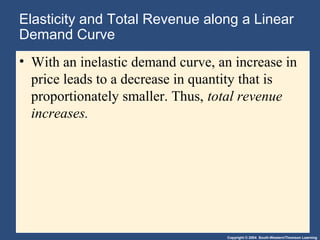
• Necessities versus Luxuries
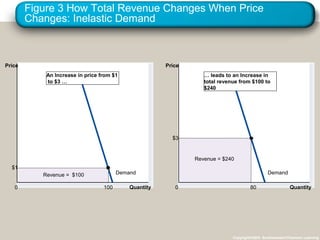
• Definition of the Market
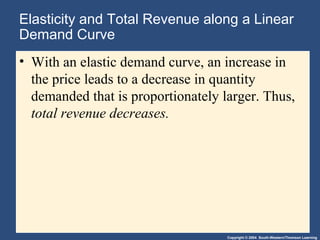
• Time Horizon
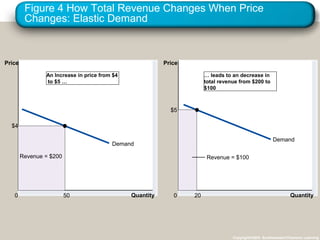
Copyright © 2004 South-Western/Thomson Learning
The Price Elasticity of Demand and Its
Determinants
• Demand tends to be more elastic :
• the larger the number of close substitutes.
• if the good is a luxury.
• the more narrowly defined the market.
• the longer the time period.
Copyright © 2004 South-Western/Thomson Learning
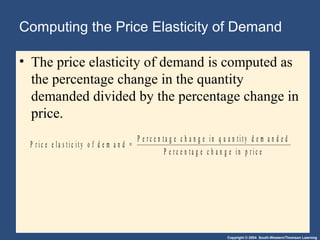
Computing the Price Elasticity of Demand
• The price elasticity of demand is computed as
the percentage change in the quantity
demanded divided by the percentage change in
price.
P r i c e e l a s t i c i t y o f d e m a n d =
P e r c e n t a g e c h a n g e i n q u a n t i t y d e m a n d e d
P e r c e n t a g e c h a n g e i n p r i c e
Copyright © 2004 South-Western/Thomson Learning
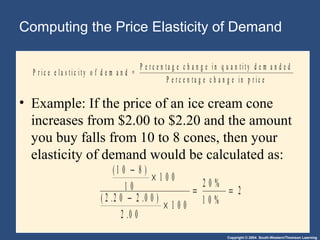
• Example: If the price of an ice cream cone
increases from $2.00 to $2.20 and the amount
you buy falls from 10 to 8 cones, then your
elasticity of demand would be calculated as:
Computing the Price Elasticity of Demand
P r i c e e l a s t i c i t y o f d e m a n d =
P e r c e n t a g e c h a n g e i n q u a n t i t y d e m a n d e d
P e r c e n t a g e c h a n g e i n p r i c e
( )
( . . )
.
1 0 8
1 0
1 0 0
2 2 0 2 0 0
2 0 0
1 0 0
2 0 %
1 0 %
2
−
×
−
×
= =
Copyright © 2004 South-Western/Thomson Learning
The Midpoint Method: A Better Way to
Calculate Percentage Changes and
Elasticities
• The midpoint formula is preferable when
calculating the price elasticity of demand
because it gives the same answer regardless of
the direction of the change.
P r i c e e l a s t i c i t y o f d e m a n d =
( ) / [ ( ) / ]
( ) / [ ( ) / ]
Q Q Q Q
P P P P
2 1 2 1
2 1 2 1
2
2
− +
− +
Copyright © 2004 South-Western/Thomson Learning
The Midpoint Method: A Better Way to
Calculate Percentage Changes and
Elasticities
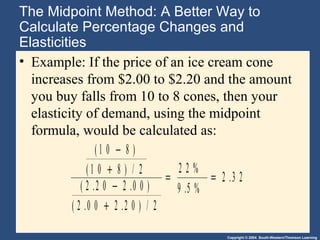
• Example: If the price of an ice cream cone
increases from $2.00 to $2.20 and the amount
you buy falls from 10 to 8 cones, then your
elasticity of demand, using the midpoint
formula, would be calculated as:
( )
( ) /
( . . )
( . . ) /
.
.
1 0 8
1 0 8 2
2 2 0 2 0 0
2 0 0 2 2 0 2
2 2 %
9 5 %
2 3 2
−
+
−
+
= =
Copyright © 2004 South-Western/Thomson Learning
The Variety of Demand Curves
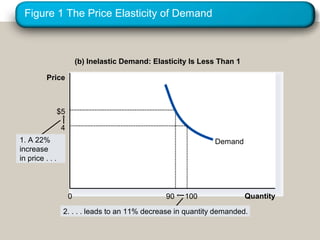
• Inelastic Demand
• Quantity demanded does not respond strongly to
price changes.
• Price elasticity of demand is less than one.
• Elastic Demand
• Quantity demanded responds strongly to changes in
price.
• Price elasticity of demand is greater than one.
Copyright © 2004 South-Western/Thomson Learning
Computing the Price Elasticity of Demand
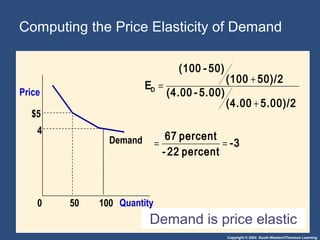
Demand is price elastic
$5
4
Demand
Quantity1000 50
-3
percent22-
percent67
5.00)/2(4.00
5.00)-(4.00
50)/2(100
50)-(100
ED
==
+
+
=
Price
Copyright © 2004 South-Western/Thomson Learning
The Variety of Demand Curves
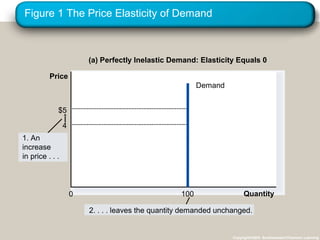
• Perfectly Inelastic
• Quantity demanded does not respond to price
changes.
• Perfectly Elastic
• Quantity demanded changes infinitely with any
change in price.
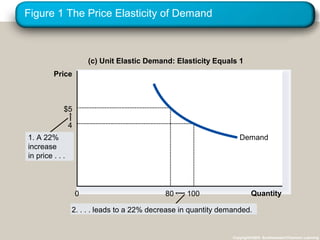
• Unit Elastic
• Quantity demanded changes by the same percentage
as the price.
Copyright © 2004 South-Western/Thomson Learning
The Variety of Demand Curves
• Because the price elasticity of demand
measures how much quantity demanded
responds to the price, it is closely related to the
slope of the demand curve.
Figure 1 The Price Elasticity of Demand
Copyright©2003 Southwestern/Thomson Learning
(a) Perfectly Inelastic Demand: Elasticity Equals 0
$5
4
Quantity
Demand
1000
1. An
increase
in price . . .
2. . . . leaves the quantity demanded unchanged.
Price
Figure 1 The Price Elasticity of Demand
(b) Inelastic Demand: Elasticity Is Less Than 1
Quantity0
$5
90
Demand1. A 22%
increase
in price . . .
Price
2. . . . leads to an 11% decrease in quantity demanded.
4
100
Figure 1 The Price Elasticity of Demand
Copyright©2003 Southwestern/Thomson Learning
2. . . . leads to a 22% decrease in quantity demanded.
(c) Unit Elastic Demand: Elasticity Equals 1
Quantity
4
1000
Price
$5
80
1. A 22%
increase
in price . . .
Demand
Figure 1 The Price Elasticity of Demand
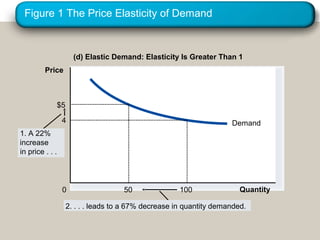
(d) Elastic Demand: Elasticity Is Greater Than 1
Demand
Quantity
4
1000
Price
$5
50
1. A 22%
increase
in price . . .
2. . . . leads to a 67% decrease in quantity demanded.
Figure 1 The Price Elasticity of Demand
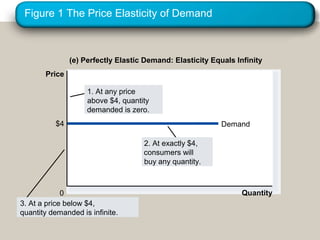
(e) Perfectly Elastic Demand: Elasticity Equals Infinity
Quantity0
Price
$4 Demand
2. At exactly $4,
consumers will
buy any quantity.
1. At any price
above $4, quantity
demanded is zero.
3. At a price below $4,
quantity demanded is infinite.
Copyright © 2004 South-Western/Thomson Learning
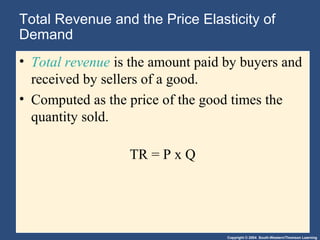
Total Revenue and the Price Elasticity of
Demand
• Total revenue is the amount paid by buyers and
received by sellers of a good.
• Computed as the price of the good times the
quantity sold.
TR = P x Q
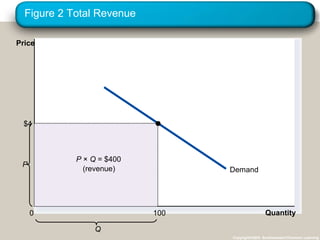
Figure 2 Total Revenue
Copyright©2003 Southwestern/Thomson Learning
Demand
Quantity
Q
P
0
Price
P × Q = $400
(revenue)
$4
100
Copyright © 2004 South-Western/Thomson Learning
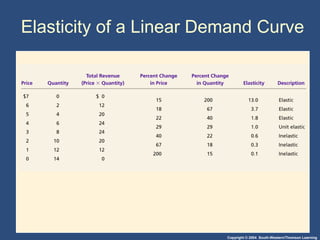
Elasticity and Total Revenue along a Linear
Demand Curve
• With an inelastic demand curve, an increase in
price leads to a decrease in quantity that is
proportionately smaller. Thus, total revenue
increases.
Figure 3 How Total Revenue Changes When Price
Changes: Inelastic Demand
Copyright©2003 Southwestern/Thomson Learning
Demand
Quantity0
Price
Revenue = $100
Quantity0
Price
Revenue = $240
Demand
$1
100
$3
80
An Increase in price from $1
to $3 …
… leads to an Increase in
total revenue from $100 to
$240
Copyright © 2004 South-Western/Thomson Learning
Elasticity and Total Revenue along a Linear
Demand Curve
• With an elastic demand curve, an increase in
the price leads to a decrease in quantity
demanded that is proportionately larger. Thus,
total revenue decreases.
Figure 4 How Total Revenue Changes When Price
Changes: Elastic Demand
Copyright©2003 Southwestern/Thomson Learning
Demand
Quantity0
Price
Revenue = $200
$4
50
Demand
Quantity0
Price
Revenue = $100
$5
20
An Increase in price from $4
to $5 …
… leads to an decrease in
total revenue from $200 to
$100
Copyright © 2004 South-Western/Thomson Learning
Elasticity of a Linear Demand Curve
Copyright © 2004 South-Western/Thomson Learning
Income Elasticity of Demand
• Income elasticity of demand measures how
much the quantity demanded of a good
responds to a change in consumers’ income.
• It is computed as the percentage change in the
quantity demanded divided by the percentage
change in income.
Copyright © 2004 South-Western/Thomson Learning
Computing Income Elasticity
I n c o m e e l a s t i c i t y o f d e m a n d =
P e r c e n t a g e c h a n g e
i n q u a n t i t y d e m a n d e d
P e r c e n t a g e c h a n g e
i n i n c o m e
Copyright © 2004 South-Western/Thomson Learning
Income Elasticity
• Types of Goods
• Normal Goods
• Inferior Goods
• Higher income raises the quantity demanded for
normal goods but lowers the quantity demanded
for inferior goods.
Copyright © 2004 South-Western/Thomson Learning
Income Elasticity
• Goods consumers regard as necessities tend to
be income inelastic
• Examples include food, fuel, clothing, utilities, and
medical services.
• Goods consumers regard as luxuries tend to be
income elastic.
• Examples include sports cars, furs, and expensive
foods.
Copyright © 2004 South-Western/Thomson Learning
THE ELASTICITY OF SUPPLY
• Price elasticity of supply is a measure of how
much the quantity supplied of a good responds
to a change in the price of that good.
• Price elasticity of supply is the percentage
change in quantity supplied resulting from a
percent change in price.
Figure 6 The Price Elasticity of Supply
Copyright©2003 Southwestern/Thomson Learning
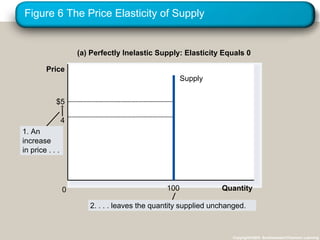
(a) Perfectly Inelastic Supply: Elasticity Equals 0
$5
4
Supply
Quantity1000
1. An
increase
in price . . .
2. . . . leaves the quantity supplied unchanged.
Price
Figure 6 The Price Elasticity of Supply
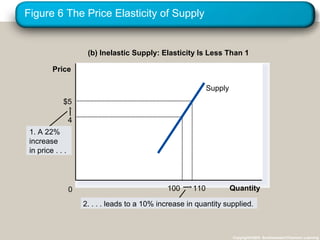
Copyright©2003 Southwestern/Thomson Learning
(b) Inelastic Supply: Elasticity Is Less Than 1
110
$5
100
4
Quantity0
1. A 22%
increase
in price . . .
Price
2. . . . leads to a 10% increase in quantity supplied.
Supply
Figure 6 The Price Elasticity of Supply
Copyright©2003 Southwestern/Thomson Learning
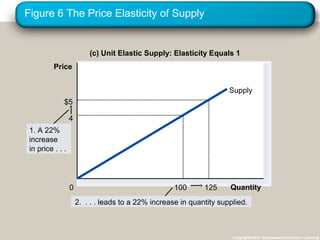
(c) Unit Elastic Supply: Elasticity Equals 1
125
$5
100
4
Quantity0
Price
2. . . . leads to a 22% increase in quantity supplied.
1. A 22%
increase
in price . . .
Supply
Figure 6 The Price Elasticity of Supply
Copyright©2003 Southwestern/Thomson Learning
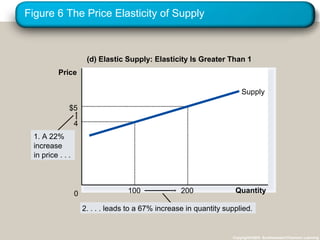
(d) Elastic Supply: Elasticity Is Greater Than 1
Quantity0
Price
1. A 22%
increase
in price . . .
2. . . . leads to a 67% increase in quantity supplied.
4
100
$5
200
Supply
Figure 6 The Price Elasticity of Supply
Copyright©2003 Southwestern/Thomson Learning
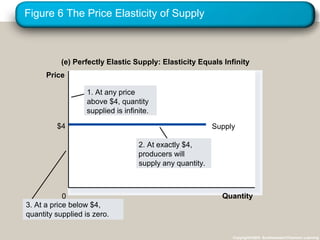
(e) Perfectly Elastic Supply: Elasticity Equals Infinity
Quantity0
Price
$4 Supply
3. At a price below $4,
quantity supplied is zero.
2. At exactly $4,
producers will
supply any quantity.
1. At any price
above $4, quantity
supplied is infinite.
Copyright © 2004 South-Western/Thomson Learning
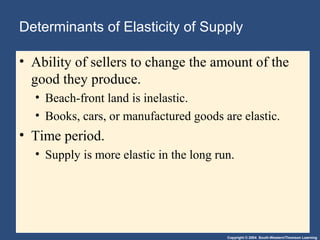
Determinants of Elasticity of Supply
• Ability of sellers to change the amount of the
good they produce.
• Beach-front land is inelastic.
• Books, cars, or manufactured goods are elastic.
• Time period.
• Supply is more elastic in the long run.
Copyright © 2004 South-Western/Thomson Learning
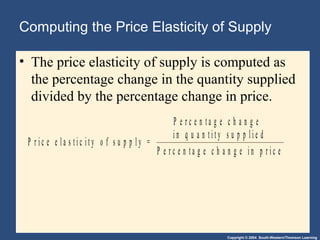
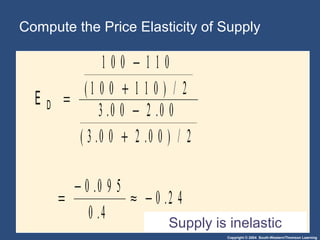
Computing the Price Elasticity of Supply
• The price elasticity of supply is computed as
the percentage change in the quantity supplied
divided by the percentage change in price.
P r i c e e l a s t i c i t y o f s u p p l y =
P e r c e n t a g e c h a n g e
i n q u a n t i t y s u p p l i e d
P e r c e n t a g e c h a n g e i n p r i c e
Copyright © 2004 South-Western/Thomson Learning
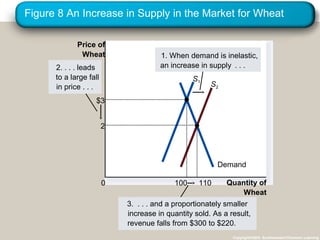
APPLICATION of ELASTICITY
• Can good news for farming be bad news for
farmers?
• What happens to wheat farmers and the market
for wheat when university agronomists discover
a new wheat hybrid that is more productive
than existing varieties?
Copyright © 2004 South-Western/Thomson Learning
THE APPLICATION OF SUPPLY,
DEMAND, AND ELASTICITY
• Examine whether the supply or demand curve
shifts.
• Determine the direction of the shift of the
curve.
• Use the supply-and-demand diagram to see how
the market equilibrium changes.
Figure 8 An Increase in Supply in the Market for Wheat
Copyright©2003 Southwestern/Thomson Learning
Quantity of
Wheat
0
Price of
Wheat
3. . . . and a proportionately smaller
increase in quantity sold. As a result,
revenue falls from $300 to $220.
Demand
S1
S2
2. . . . leads
to a large fall
in price . . .
1. When demand is inelastic,
an increase in supply . . .
2
110
$3
100
Copyright © 2004 South-Western/Thomson Learning
Compute the Price Elasticity of Supply
E D =
−
+
−
+
=
−
≈ −
1 0 0 1 1 0
1 0 0 1 1 0 2
3 0 0 2 0 0
3 0 0 2 0 0 2
0 0 9 5
0 4
0 2 4
( ) /
. .
( . . ) /
.
.
.
Supply is inelastic
Copyright © 2004 South-Western/Thomson Learning
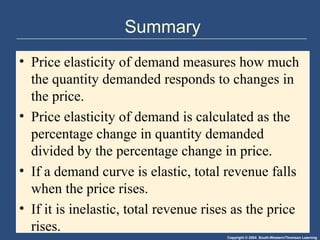
Summary
• Price elasticity of demand measures how much
the quantity demanded responds to changes in
the price.
• Price elasticity of demand is calculated as the
percentage change in quantity demanded
divided by the percentage change in price.
• If a demand curve is elastic, total revenue falls
when the price rises.
• If it is inelastic, total revenue rises as the price
rises.
Copyright © 2004 South-Western/Thomson Learning
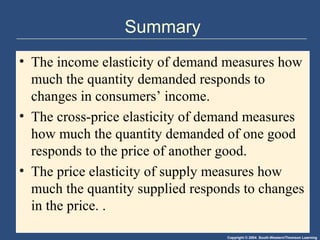
Summary
• The income elasticity of demand measures how
much the quantity demanded responds to
changes in consumers’ income.
• The cross-price elasticity of demand measures
how much the quantity demanded of one good
responds to the price of another good.
• The price elasticity of supply measures how
much the quantity supplied responds to changes
in the price. .
Copyright © 2004 South-Western/Thomson Learning
Summary
• In most markets, supply is more elastic in the
long run than in the short run.
• The price elasticity of supply is calculated as
the percentage change in quantity supplied
divided by the percentage change in price.
• The tools of supply and demand can be applied
in many different types of markets.

Elasticity and Its Application

  • 1.
    Copyright © 2004South-Western 55Elasticity and Its Applications
  • 2.
    Copyright © 2004South-Western/Thomson Learning Elasticity . . . • … allows us to analyze supply and demand with greater precision. • … is a measure of how much buyers and sellers respond to changes in market conditions
  • 3.
    Copyright © 2004South-Western/Thomson Learning THE ELASTICITY OF DEMAND • Price elasticity of demand is a measure of how much the quantity demanded of a good responds to a change in the price of that good. • Price elasticity of demand is the percentage change in quantity demanded given a percent change in the price.
  • 4.
    Copyright © 2004South-Western/Thomson Learning The Price Elasticity of Demand and Its Determinants • Availability of Close Substitutes • Necessities versus Luxuries • Definition of the Market • Time Horizon
  • 5.
    Copyright © 2004South-Western/Thomson Learning The Price Elasticity of Demand and Its Determinants • Demand tends to be more elastic : • the larger the number of close substitutes. • if the good is a luxury. • the more narrowly defined the market. • the longer the time period.
  • 6.
    Copyright © 2004South-Western/Thomson Learning Computing the Price Elasticity of Demand • The price elasticity of demand is computed as the percentage change in the quantity demanded divided by the percentage change in price. P r i c e e l a s t i c i t y o f d e m a n d = P e r c e n t a g e c h a n g e i n q u a n t i t y d e m a n d e d P e r c e n t a g e c h a n g e i n p r i c e
  • 7.
    Copyright © 2004South-Western/Thomson Learning • Example: If the price of an ice cream cone increases from $2.00 to $2.20 and the amount you buy falls from 10 to 8 cones, then your elasticity of demand would be calculated as: Computing the Price Elasticity of Demand P r i c e e l a s t i c i t y o f d e m a n d = P e r c e n t a g e c h a n g e i n q u a n t i t y d e m a n d e d P e r c e n t a g e c h a n g e i n p r i c e ( ) ( . . ) . 1 0 8 1 0 1 0 0 2 2 0 2 0 0 2 0 0 1 0 0 2 0 % 1 0 % 2 − × − × = =
  • 8.
    Copyright © 2004South-Western/Thomson Learning The Midpoint Method: A Better Way to Calculate Percentage Changes and Elasticities • The midpoint formula is preferable when calculating the price elasticity of demand because it gives the same answer regardless of the direction of the change. P r i c e e l a s t i c i t y o f d e m a n d = ( ) / [ ( ) / ] ( ) / [ ( ) / ] Q Q Q Q P P P P 2 1 2 1 2 1 2 1 2 2 − + − +
  • 9.
    Copyright © 2004South-Western/Thomson Learning The Midpoint Method: A Better Way to Calculate Percentage Changes and Elasticities • Example: If the price of an ice cream cone increases from $2.00 to $2.20 and the amount you buy falls from 10 to 8 cones, then your elasticity of demand, using the midpoint formula, would be calculated as: ( ) ( ) / ( . . ) ( . . ) / . . 1 0 8 1 0 8 2 2 2 0 2 0 0 2 0 0 2 2 0 2 2 2 % 9 5 % 2 3 2 − + − + = =
  • 10.
    Copyright © 2004South-Western/Thomson Learning The Variety of Demand Curves • Inelastic Demand • Quantity demanded does not respond strongly to price changes. • Price elasticity of demand is less than one. • Elastic Demand • Quantity demanded responds strongly to changes in price. • Price elasticity of demand is greater than one.
  • 11.
    Copyright © 2004South-Western/Thomson Learning Computing the Price Elasticity of Demand Demand is price elastic $5 4 Demand Quantity1000 50 -3 percent22- percent67 5.00)/2(4.00 5.00)-(4.00 50)/2(100 50)-(100 ED == + + = Price
  • 12.
    Copyright © 2004South-Western/Thomson Learning The Variety of Demand Curves • Perfectly Inelastic • Quantity demanded does not respond to price changes. • Perfectly Elastic • Quantity demanded changes infinitely with any change in price. • Unit Elastic • Quantity demanded changes by the same percentage as the price.
  • 13.
    Copyright © 2004South-Western/Thomson Learning The Variety of Demand Curves • Because the price elasticity of demand measures how much quantity demanded responds to the price, it is closely related to the slope of the demand curve.
  • 14.
    Figure 1 ThePrice Elasticity of Demand Copyright©2003 Southwestern/Thomson Learning (a) Perfectly Inelastic Demand: Elasticity Equals 0 $5 4 Quantity Demand 1000 1. An increase in price . . . 2. . . . leaves the quantity demanded unchanged. Price
  • 15.
    Figure 1 ThePrice Elasticity of Demand (b) Inelastic Demand: Elasticity Is Less Than 1 Quantity0 $5 90 Demand1. A 22% increase in price . . . Price 2. . . . leads to an 11% decrease in quantity demanded. 4 100
  • 16.
    Figure 1 ThePrice Elasticity of Demand Copyright©2003 Southwestern/Thomson Learning 2. . . . leads to a 22% decrease in quantity demanded. (c) Unit Elastic Demand: Elasticity Equals 1 Quantity 4 1000 Price $5 80 1. A 22% increase in price . . . Demand
  • 17.
    Figure 1 ThePrice Elasticity of Demand (d) Elastic Demand: Elasticity Is Greater Than 1 Demand Quantity 4 1000 Price $5 50 1. A 22% increase in price . . . 2. . . . leads to a 67% decrease in quantity demanded.
  • 18.
    Figure 1 ThePrice Elasticity of Demand (e) Perfectly Elastic Demand: Elasticity Equals Infinity Quantity0 Price $4 Demand 2. At exactly $4, consumers will buy any quantity. 1. At any price above $4, quantity demanded is zero. 3. At a price below $4, quantity demanded is infinite.
  • 19.
    Copyright © 2004South-Western/Thomson Learning Total Revenue and the Price Elasticity of Demand • Total revenue is the amount paid by buyers and received by sellers of a good. • Computed as the price of the good times the quantity sold. TR = P x Q
  • 20.
    Figure 2 TotalRevenue Copyright©2003 Southwestern/Thomson Learning Demand Quantity Q P 0 Price P × Q = $400 (revenue) $4 100
  • 21.
    Copyright © 2004South-Western/Thomson Learning Elasticity and Total Revenue along a Linear Demand Curve • With an inelastic demand curve, an increase in price leads to a decrease in quantity that is proportionately smaller. Thus, total revenue increases.
  • 22.
    Figure 3 HowTotal Revenue Changes When Price Changes: Inelastic Demand Copyright©2003 Southwestern/Thomson Learning Demand Quantity0 Price Revenue = $100 Quantity0 Price Revenue = $240 Demand $1 100 $3 80 An Increase in price from $1 to $3 … … leads to an Increase in total revenue from $100 to $240
  • 23.
    Copyright © 2004South-Western/Thomson Learning Elasticity and Total Revenue along a Linear Demand Curve • With an elastic demand curve, an increase in the price leads to a decrease in quantity demanded that is proportionately larger. Thus, total revenue decreases.
  • 24.
    Figure 4 HowTotal Revenue Changes When Price Changes: Elastic Demand Copyright©2003 Southwestern/Thomson Learning Demand Quantity0 Price Revenue = $200 $4 50 Demand Quantity0 Price Revenue = $100 $5 20 An Increase in price from $4 to $5 … … leads to an decrease in total revenue from $200 to $100
  • 25.
    Copyright © 2004South-Western/Thomson Learning Elasticity of a Linear Demand Curve
  • 26.
    Copyright © 2004South-Western/Thomson Learning Income Elasticity of Demand • Income elasticity of demand measures how much the quantity demanded of a good responds to a change in consumers’ income. • It is computed as the percentage change in the quantity demanded divided by the percentage change in income.
  • 27.
    Copyright © 2004South-Western/Thomson Learning Computing Income Elasticity I n c o m e e l a s t i c i t y o f d e m a n d = P e r c e n t a g e c h a n g e i n q u a n t i t y d e m a n d e d P e r c e n t a g e c h a n g e i n i n c o m e
  • 28.
    Copyright © 2004South-Western/Thomson Learning Income Elasticity • Types of Goods • Normal Goods • Inferior Goods • Higher income raises the quantity demanded for normal goods but lowers the quantity demanded for inferior goods.
  • 29.
    Copyright © 2004South-Western/Thomson Learning Income Elasticity • Goods consumers regard as necessities tend to be income inelastic • Examples include food, fuel, clothing, utilities, and medical services. • Goods consumers regard as luxuries tend to be income elastic. • Examples include sports cars, furs, and expensive foods.
  • 30.
    Copyright © 2004South-Western/Thomson Learning THE ELASTICITY OF SUPPLY • Price elasticity of supply is a measure of how much the quantity supplied of a good responds to a change in the price of that good. • Price elasticity of supply is the percentage change in quantity supplied resulting from a percent change in price.
  • 31.
    Figure 6 ThePrice Elasticity of Supply Copyright©2003 Southwestern/Thomson Learning (a) Perfectly Inelastic Supply: Elasticity Equals 0 $5 4 Supply Quantity1000 1. An increase in price . . . 2. . . . leaves the quantity supplied unchanged. Price
  • 32.
    Figure 6 ThePrice Elasticity of Supply Copyright©2003 Southwestern/Thomson Learning (b) Inelastic Supply: Elasticity Is Less Than 1 110 $5 100 4 Quantity0 1. A 22% increase in price . . . Price 2. . . . leads to a 10% increase in quantity supplied. Supply
  • 33.
    Figure 6 ThePrice Elasticity of Supply Copyright©2003 Southwestern/Thomson Learning (c) Unit Elastic Supply: Elasticity Equals 1 125 $5 100 4 Quantity0 Price 2. . . . leads to a 22% increase in quantity supplied. 1. A 22% increase in price . . . Supply
  • 34.
    Figure 6 ThePrice Elasticity of Supply Copyright©2003 Southwestern/Thomson Learning (d) Elastic Supply: Elasticity Is Greater Than 1 Quantity0 Price 1. A 22% increase in price . . . 2. . . . leads to a 67% increase in quantity supplied. 4 100 $5 200 Supply
  • 35.
    Figure 6 ThePrice Elasticity of Supply Copyright©2003 Southwestern/Thomson Learning (e) Perfectly Elastic Supply: Elasticity Equals Infinity Quantity0 Price $4 Supply 3. At a price below $4, quantity supplied is zero. 2. At exactly $4, producers will supply any quantity. 1. At any price above $4, quantity supplied is infinite.
  • 36.
    Copyright © 2004South-Western/Thomson Learning Determinants of Elasticity of Supply • Ability of sellers to change the amount of the good they produce. • Beach-front land is inelastic. • Books, cars, or manufactured goods are elastic. • Time period. • Supply is more elastic in the long run.
  • 37.
    Copyright © 2004South-Western/Thomson Learning Computing the Price Elasticity of Supply • The price elasticity of supply is computed as the percentage change in the quantity supplied divided by the percentage change in price. P r i c e e l a s t i c i t y o f s u p p l y = P e r c e n t a g e c h a n g e i n q u a n t i t y s u p p l i e d P e r c e n t a g e c h a n g e i n p r i c e
  • 38.
    Copyright © 2004South-Western/Thomson Learning APPLICATION of ELASTICITY • Can good news for farming be bad news for farmers? • What happens to wheat farmers and the market for wheat when university agronomists discover a new wheat hybrid that is more productive than existing varieties?
  • 39.
    Copyright © 2004South-Western/Thomson Learning THE APPLICATION OF SUPPLY, DEMAND, AND ELASTICITY • Examine whether the supply or demand curve shifts. • Determine the direction of the shift of the curve. • Use the supply-and-demand diagram to see how the market equilibrium changes.
  • 40.
    Figure 8 AnIncrease in Supply in the Market for Wheat Copyright©2003 Southwestern/Thomson Learning Quantity of Wheat 0 Price of Wheat 3. . . . and a proportionately smaller increase in quantity sold. As a result, revenue falls from $300 to $220. Demand S1 S2 2. . . . leads to a large fall in price . . . 1. When demand is inelastic, an increase in supply . . . 2 110 $3 100
  • 41.
    Copyright © 2004South-Western/Thomson Learning Compute the Price Elasticity of Supply E D = − + − + = − ≈ − 1 0 0 1 1 0 1 0 0 1 1 0 2 3 0 0 2 0 0 3 0 0 2 0 0 2 0 0 9 5 0 4 0 2 4 ( ) / . . ( . . ) / . . . Supply is inelastic
  • 42.
    Copyright © 2004South-Western/Thomson Learning Summary • Price elasticity of demand measures how much the quantity demanded responds to changes in the price. • Price elasticity of demand is calculated as the percentage change in quantity demanded divided by the percentage change in price. • If a demand curve is elastic, total revenue falls when the price rises. • If it is inelastic, total revenue rises as the price rises.
  • 43.
    Copyright © 2004South-Western/Thomson Learning Summary • The income elasticity of demand measures how much the quantity demanded responds to changes in consumers’ income. • The cross-price elasticity of demand measures how much the quantity demanded of one good responds to the price of another good. • The price elasticity of supply measures how much the quantity supplied responds to changes in the price. .
  • 44.
    Copyright © 2004South-Western/Thomson Learning Summary • In most markets, supply is more elastic in the long run than in the short run. • The price elasticity of supply is calculated as the percentage change in quantity supplied divided by the percentage change in price. • The tools of supply and demand can be applied in many different types of markets.