Supply and
Demand
How MarketsHow Markets
Work?Work?
Learning objectives..
Examine what determines the demandExamine what determines the demand
for a good in a competitive market.for a good in a competitive market.
Examine what determines the supplyExamine what determines the supply
of a good in a competitive market.of a good in a competitive market.
See how supply and demand togetherSee how supply and demand together
set the price of a good and theset the price of a good and the
quantity sold.quantity sold.
Consider the key role of prices inConsider the key role of prices in
allocating scarce resources.allocating scarce resources.
DEMAND
• Quantity Demanded refers to the amount
(quantity) of a good that buyers are
willing to purchase at alternative
prices for a given period.
Determinants of Demand
• What factors determine how
much ice cream / or which ice
cream you will buy?
Product’s Own Price
Consumer Income
Prices of Related Goods
Tastes
Consumer Expectations
Population
Advertising
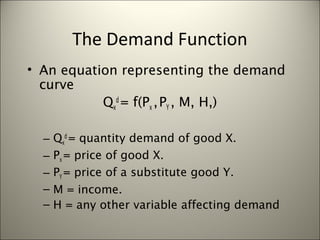
The Demand Function
• An equation representing the demand
curve
Qx
d
= f(Px ,PY , M, H,)
– Qx
d
= quantity demand of good X.
– Px = price of good X.
– PY = price of a substitute good Y.
– M = income.
– H = any other variable affecting demand
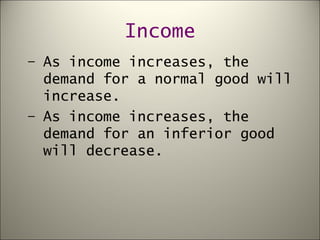
Income
– As income increases, the
demand for a normal good will
increase.
– As income increases, the
demand for an inferior good
will decrease.
Prices of Related Goods
– When a fall in the price of one
good reduces the demand for
another good, the two goods are
called substitutes.
– When a fall in the price of one
good increases the demand for
another good, the two goods are
called complements.
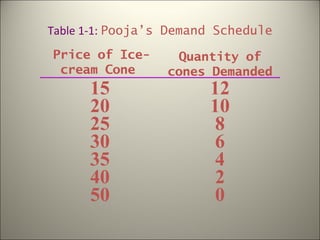
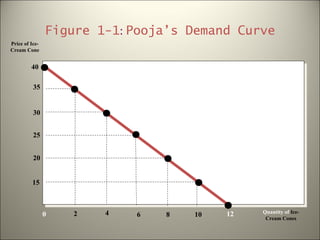
The Demand Schedule and the
Demand Curve
– The demand schedule is a table
that shows the relationship
between the price of the good and
the quantity demanded.
– The demand curve is a graph of
the relationship between the
price of a good and the quantity
demanded.
Table 1-1: Pooja’s Demand Schedule
050
240
435
630
825
1020
1215
Quantity of
cones Demanded
Price of Ice-
cream Cone
Figure 1-1: Pooja’s Demand Curve
Price of Ice-
Cream Cone
Quantity of Ice-
Cream Cones
2 4 6 8 10 120
40
35
30
25
20
15
Market Demand Schedule
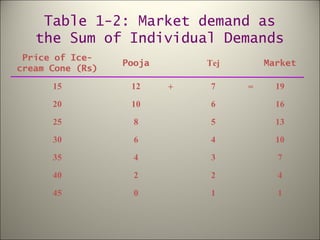
• Market demand is the sum of all
individual demands at each
possible price.
• Graphically, individual demand
curves are summed horizontally to
obtain the market demand curve.
• Assume the ice cream market has
two buyers as follows…
Table 1-2: Market demand as
the Sum of Individual Demands
045
1020
1215
Pooja
Price of Ice-
cream Cone (Rs)
+
1
6
7
Tej
1
240
435
630
825
2
3
4
5
4
7
10
13
16
19
Market
=
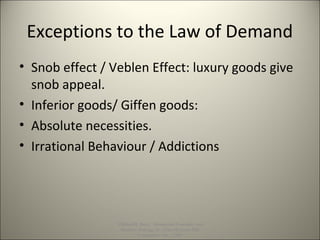
Exceptions to the Law of Demand
• Snob effect / Veblen Effect: luxury goods give
snob appeal.
• Inferior goods/ Giffen goods:
• Absolute necessities.
• Irrational Behaviour / Addictions
Michael R. Baye, Managerial Economics and
Business Strategy, 3e. ©The McGraw-Hill
Companies, Inc. , 1999
The linear Demand equation
• Qd = a – bP.
• Dependant variable = Qd
• Independent variable = P
• a, b are constants
• b= slope , measures the change in demand
due to a change in price.
• a = x-intercept , or the quantity demanded
when P=0.
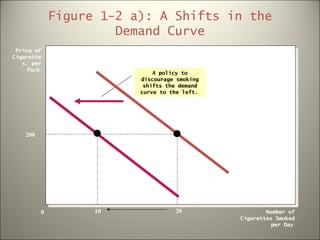
Shifts in the Demand Curve versus
Movements Along the Demand Curve
Figure 1-2 a): A Shifts in the
Demand Curve
Price of
Cigarette
s, per
Pack.
Number of
Cigarettes Smoked
per Day
D2
A policy to
discourage smoking
shifts the demand
curve to the left.
0 20
200
D1
A
10
B
Figure 1-2 b): A Movement Along the
Demand Curve
Price of
Cigarettes,
per Pack.
Number of
Cigarettes Smoked
per Day
0 20
Rs200
D1
A
A tax that raises
the price of
cigarettes results
in a movements along
the demand curve.
C
12
Rs400
I got a great deal!= Consumer
Surplus
• Barbeque Nation offers a
lot of bang for the buck!
• The Shopper’s stop sale
provides good value.
• Total value greatly
exceeds total amount
paid.
• Consumer surplus is large.
I got a lousy deal!
• That car dealer drives a
hard bargain!
• I almost decided not to
buy it!
• They tried to squeeze
the very last cent from
me!
• Total amount paid is
close to total value.
• Consumer surplus is low.
Consumer Surplus:
The Discrete Case
Price
Quantity
D
10
8
6
4
2
1 2 3 4 5
Consumer Surplus:
The value received but not
paid for
SUPPLY
• Quantity Supplied refers to
the amount (quantity) of a
good that sellers are willing
to make available for sale at
alternative prices for a
given period.
Determinants of Supply
• What factors determine how much ice
cream you are willing to offer or
produce?
Product’s Own Price
Prices of Related goods in Production
Input prices
Technology
Expectations
Number of sellers
Taxes and subsidies
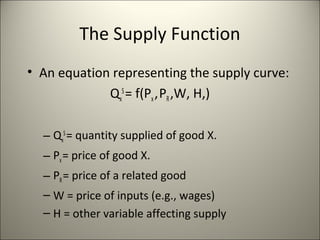
The Supply Function
• An equation representing the supply curve:
Qx
S
= f(Px,PR,W, H,)
– Qx
S
= quantity supplied of good X.
– Px= price of good X.
– PR= price of a related good
– W = price of inputs (e.g., wages)
– H = other variable affecting supply
Price
Law of Supply
– The law of supply states that,
other things equal, the
quantity supplied of a good
rises when the price of the
good rises.
Table 4-4: Ben’s Supply Schedule
545
440
335
230
125
020
015
Quantity of
cones Supplied
Price of Ice-
cream Cone (Rs)
Supply Shifters
• Input prices
• Technology or
government
regulations
• Number of firms
• Substitutes in
production
• Taxes
• Producer expectations
The linear supply equation
• Supply might be represented by a linear supply function such
as
• Q(s) = a + bP
• Q(s) represents the supply for a good
• In-class Activity: Use the linear supply equation for haircuts in
your town,
• Qs=-100+20P to answer the questions that follow:
• Create a schedule showing the supply of haircuts in your town
at prices of Rs10, Rs20, Rs30, Rs40, and Rs50.
• Calculate the price-intercept of your supply curve, then use
the data from your supply schedule to plot a supply curve for
haircuts.
Change in Quantity Supplied
Price
Quantity
S0
20
10
B
A
5 10
A to B: Increase in quantity supplied
Change in Supply
Price
Quantity
S0
S1
8
5 7
S0 to S1: Increase in supply
6
Market Supply Schedule
• Market supply is the sum of all
individual supplies at each possible
price.
• Graphically, individual supply curves
are summed horizontally to obtain the
market demand curve.
• Assume the ice cream market has two
suppliers as follows…
Table 4-5: Market supply as the Sum of
Individual Supplies
545
020
015
Ben
Price of Ice-
cream Cone (Rs)
+
8
0
0
Nicholas
13
440
335
230
125
6
4
2
0
10
7
4
1
0
0
Market
=
Table 4-6: The Determinants of
Quantity Supplied
Figure 4-7: Shifts in the Supply Curve
Price of
Ice-Cream
Cone
Quantity of
Ice-Cream
Cones
S3
S2
S1
Decrease in
supply
Increase in
supply
Market Equilibrium
• Balancing supply and
demand
– Qx
S
= Qx
d
• Steady-state
If price is too low…
Price
Quantity
S
D
5
6 12
Shortage
12 - 6 = 6
6
7
If price is too high…
Price
Quantity
S
D
9
14
Surplus
14 - 6 = 8
6
8
8
7
Market equilibrium using
equations:
• If we are looking at the market for cans of
paint, for instance, and we know that the
supply equation is as follows:
• QS = -5 + 2P And the demand equation is:
• QD = 10 – P
• Find the equilibrium demand, supply, price.

Demand supply analysis

  • 1.
  • 2.
    Learning objectives.. Examine whatdetermines the demandExamine what determines the demand for a good in a competitive market.for a good in a competitive market. Examine what determines the supplyExamine what determines the supply of a good in a competitive market.of a good in a competitive market. See how supply and demand togetherSee how supply and demand together set the price of a good and theset the price of a good and the quantity sold.quantity sold. Consider the key role of prices inConsider the key role of prices in allocating scarce resources.allocating scarce resources.
  • 3.
    DEMAND • Quantity Demandedrefers to the amount (quantity) of a good that buyers are willing to purchase at alternative prices for a given period.
  • 4.
    Determinants of Demand •What factors determine how much ice cream / or which ice cream you will buy? Product’s Own Price Consumer Income Prices of Related Goods Tastes Consumer Expectations Population Advertising
  • 5.
    The Demand Function •An equation representing the demand curve Qx d = f(Px ,PY , M, H,) – Qx d = quantity demand of good X. – Px = price of good X. – PY = price of a substitute good Y. – M = income. – H = any other variable affecting demand
  • 6.
    Income – As incomeincreases, the demand for a normal good will increase. – As income increases, the demand for an inferior good will decrease.
  • 7.
    Prices of RelatedGoods – When a fall in the price of one good reduces the demand for another good, the two goods are called substitutes. – When a fall in the price of one good increases the demand for another good, the two goods are called complements.
  • 8.
    The Demand Scheduleand the Demand Curve – The demand schedule is a table that shows the relationship between the price of the good and the quantity demanded. – The demand curve is a graph of the relationship between the price of a good and the quantity demanded.
  • 9.
    Table 1-1: Pooja’sDemand Schedule 050 240 435 630 825 1020 1215 Quantity of cones Demanded Price of Ice- cream Cone
  • 10.
    Figure 1-1: Pooja’sDemand Curve Price of Ice- Cream Cone Quantity of Ice- Cream Cones 2 4 6 8 10 120 40 35 30 25 20 15
  • 11.
    Market Demand Schedule •Market demand is the sum of all individual demands at each possible price. • Graphically, individual demand curves are summed horizontally to obtain the market demand curve. • Assume the ice cream market has two buyers as follows…
  • 12.
    Table 1-2: Marketdemand as the Sum of Individual Demands 045 1020 1215 Pooja Price of Ice- cream Cone (Rs) + 1 6 7 Tej 1 240 435 630 825 2 3 4 5 4 7 10 13 16 19 Market =
  • 13.
    Exceptions to theLaw of Demand • Snob effect / Veblen Effect: luxury goods give snob appeal. • Inferior goods/ Giffen goods: • Absolute necessities. • Irrational Behaviour / Addictions Michael R. Baye, Managerial Economics and Business Strategy, 3e. ©The McGraw-Hill Companies, Inc. , 1999
  • 14.
    The linear Demandequation • Qd = a – bP. • Dependant variable = Qd • Independent variable = P • a, b are constants • b= slope , measures the change in demand due to a change in price. • a = x-intercept , or the quantity demanded when P=0.
  • 15.
    Shifts in theDemand Curve versus Movements Along the Demand Curve
  • 16.
    Figure 1-2 a):A Shifts in the Demand Curve Price of Cigarette s, per Pack. Number of Cigarettes Smoked per Day D2 A policy to discourage smoking shifts the demand curve to the left. 0 20 200 D1 A 10 B
  • 17.
    Figure 1-2 b):A Movement Along the Demand Curve Price of Cigarettes, per Pack. Number of Cigarettes Smoked per Day 0 20 Rs200 D1 A A tax that raises the price of cigarettes results in a movements along the demand curve. C 12 Rs400
  • 18.
    I got agreat deal!= Consumer Surplus • Barbeque Nation offers a lot of bang for the buck! • The Shopper’s stop sale provides good value. • Total value greatly exceeds total amount paid. • Consumer surplus is large.
  • 19.
    I got alousy deal! • That car dealer drives a hard bargain! • I almost decided not to buy it! • They tried to squeeze the very last cent from me! • Total amount paid is close to total value. • Consumer surplus is low.
  • 20.
    Consumer Surplus: The DiscreteCase Price Quantity D 10 8 6 4 2 1 2 3 4 5 Consumer Surplus: The value received but not paid for
  • 21.
    SUPPLY • Quantity Suppliedrefers to the amount (quantity) of a good that sellers are willing to make available for sale at alternative prices for a given period.
  • 22.
    Determinants of Supply •What factors determine how much ice cream you are willing to offer or produce? Product’s Own Price Prices of Related goods in Production Input prices Technology Expectations Number of sellers Taxes and subsidies
  • 23.
    The Supply Function •An equation representing the supply curve: Qx S = f(Px,PR,W, H,) – Qx S = quantity supplied of good X. – Px= price of good X. – PR= price of a related good – W = price of inputs (e.g., wages) – H = other variable affecting supply
  • 24.
    Price Law of Supply –The law of supply states that, other things equal, the quantity supplied of a good rises when the price of the good rises.
  • 25.
    Table 4-4: Ben’sSupply Schedule 545 440 335 230 125 020 015 Quantity of cones Supplied Price of Ice- cream Cone (Rs)
  • 26.
    Supply Shifters • Inputprices • Technology or government regulations • Number of firms • Substitutes in production • Taxes • Producer expectations
  • 27.
    The linear supplyequation • Supply might be represented by a linear supply function such as • Q(s) = a + bP • Q(s) represents the supply for a good • In-class Activity: Use the linear supply equation for haircuts in your town, • Qs=-100+20P to answer the questions that follow: • Create a schedule showing the supply of haircuts in your town at prices of Rs10, Rs20, Rs30, Rs40, and Rs50. • Calculate the price-intercept of your supply curve, then use the data from your supply schedule to plot a supply curve for haircuts.
  • 28.
    Change in QuantitySupplied Price Quantity S0 20 10 B A 5 10 A to B: Increase in quantity supplied
  • 29.
    Change in Supply Price Quantity S0 S1 8 57 S0 to S1: Increase in supply 6
  • 30.
    Market Supply Schedule •Market supply is the sum of all individual supplies at each possible price. • Graphically, individual supply curves are summed horizontally to obtain the market demand curve. • Assume the ice cream market has two suppliers as follows…
  • 31.
    Table 4-5: Marketsupply as the Sum of Individual Supplies 545 020 015 Ben Price of Ice- cream Cone (Rs) + 8 0 0 Nicholas 13 440 335 230 125 6 4 2 0 10 7 4 1 0 0 Market =
  • 32.
    Table 4-6: TheDeterminants of Quantity Supplied
  • 33.
    Figure 4-7: Shiftsin the Supply Curve Price of Ice-Cream Cone Quantity of Ice-Cream Cones S3 S2 S1 Decrease in supply Increase in supply
  • 34.
    Market Equilibrium • Balancingsupply and demand – Qx S = Qx d • Steady-state
  • 35.
    If price istoo low… Price Quantity S D 5 6 12 Shortage 12 - 6 = 6 6 7
  • 36.
    If price istoo high… Price Quantity S D 9 14 Surplus 14 - 6 = 8 6 8 8 7
  • 37.
    Market equilibrium using equations: •If we are looking at the market for cans of paint, for instance, and we know that the supply equation is as follows: • QS = -5 + 2P And the demand equation is: • QD = 10 – P • Find the equilibrium demand, supply, price.