T- 1-855-694-8886
Email- info@iTutor.com
By iTutor.com
Elasticity
 Elasticity is a measure of how much buyers and sellers respond to
changes in market conditions.
 Elasticity allows us to analyze supply and demand with greater
precision.
 If something is elastic it is responsive, flexible, or readily changed.
A rubber band is elastic and with little force it easily stretches. A
chain on the other hand is rigid and changes very little when
pulled.
 In the context of price elasticity of demand, the price change is
comparable to the force applied to a rubber band or chain and the
change in quantity demanded is comparable to the stretch.
 When consumers are relatively responsive to a price change, we
say that demand is elastic.
 When the change in quantity demanded by consumers is relatively
small in response to a price change, we say that demand is
inelastic.
© iTutor. 2000-2013. All Rights Reserved
Price Elasticity of Demand
 According to the law of demand, when price goes up, consumers
demand fewer quantities of a product. If the price of a product
falls, quantity demanded will rise.
 But when the price of a product changes, by how much more (or
less) will consumers buy?
 To help answer this question, we will use a measurement called
the Price Elasticity of Demand.
 Price elasticity of demand is the percentage change in
quantity demanded given a percent change in the
price.
 It is a measure of how much the quantity demanded
of a good responds to a change in the price of that
good.
© iTutor. 2000-2013. All Rights Reserved
Computing the Price Elasticity of
Demand
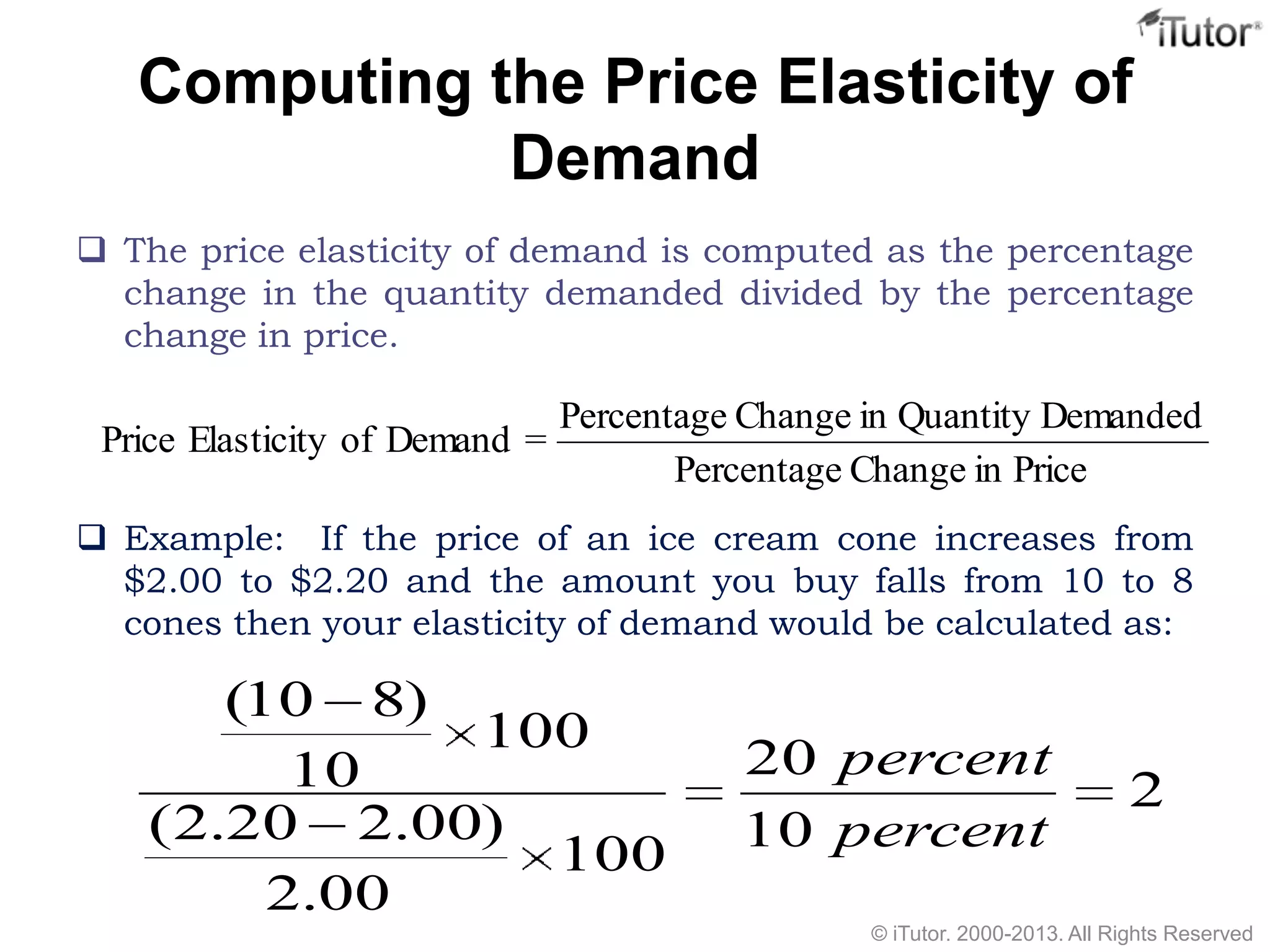
 The price elasticity of demand is computed as the percentage
change in the quantity demanded divided by the percentage
change in price.
 Example: If the price of an ice cream cone increases from
$2.00 to $2.20 and the amount you buy falls from 10 to 8
cones then your elasticity of demand would be calculated as:
PriceinChangePercentage
DemandedQuantityinChangePercentage
=DemandofElasticityPrice
2
10
20
100
00.2
)00.220.2(
100
10
)810(
percent
percent
© iTutor. 2000-2013. All Rights Reserved
Ranges of Elasticity
Inelastic Demand
 Quantity demanded does not respond strongly to price changes.
 Price elasticity of demand is less than one.
Elastic Demand
 Quantity demanded responds strongly to changes in price.
 Price elasticity of demand is greater than one.
Perfectly Inelastic
 Quantity demanded does not respond to price changes.
Perfectly Elastic
 Quantity demanded changes infinitely with any change in price.
Unit Elastic
 Quantity demanded changes by the same percentage as the
price.
© iTutor. 2000-2013. All Rights Reserved
A Variety of Demand Curves
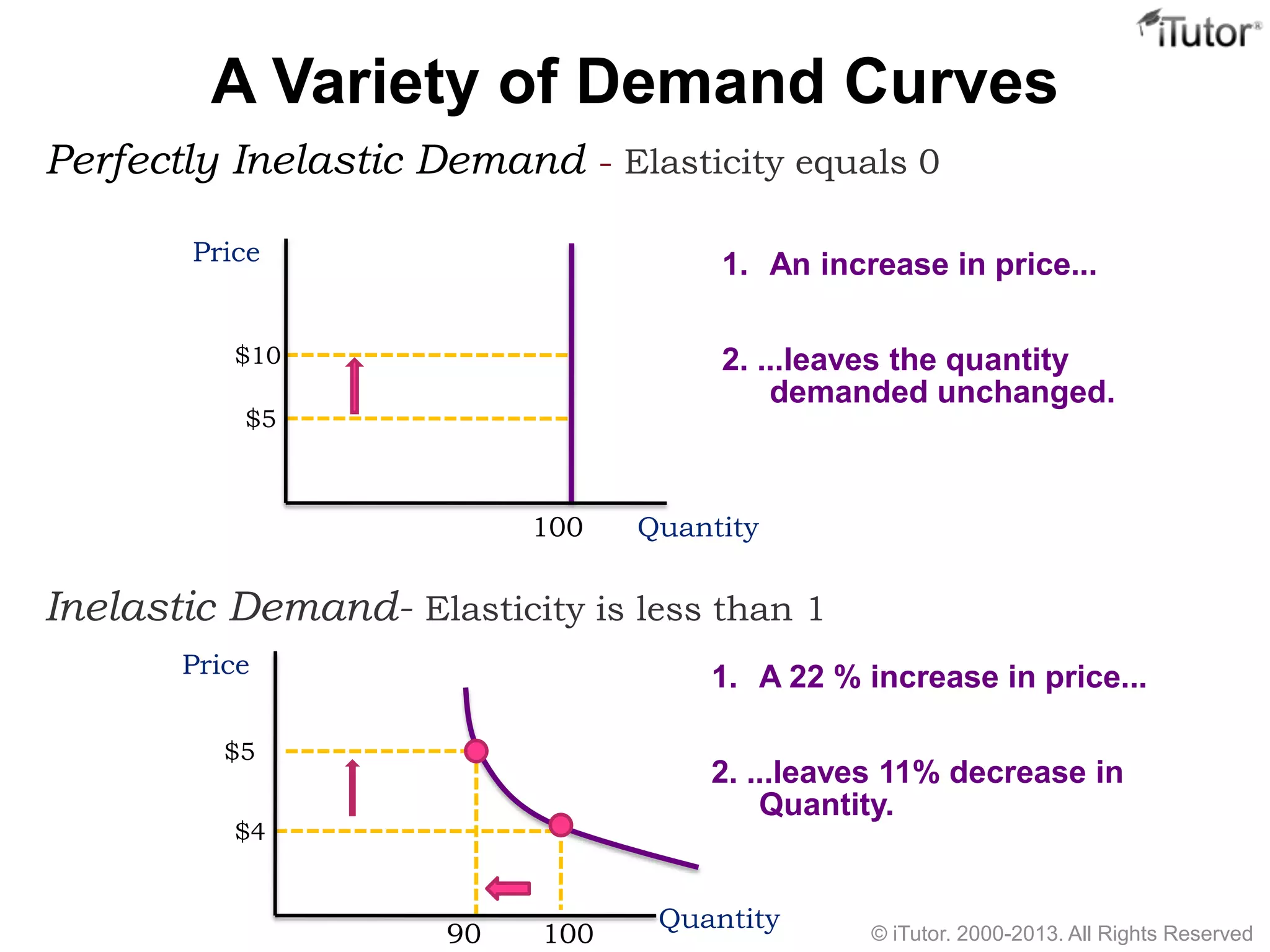
Perfectly Inelastic Demand - Elasticity equals 0
Inelastic Demand- Elasticity is less than 1
Price
Quantity100
$10
$5
1. An increase in price...
2. ...leaves the quantity
demanded unchanged.
Price
Quantity
90
$5
$4
1. A 22 % increase in price...
2. ...leaves 11% decrease in
Quantity.
100 © iTutor. 2000-2013. All Rights Reserved
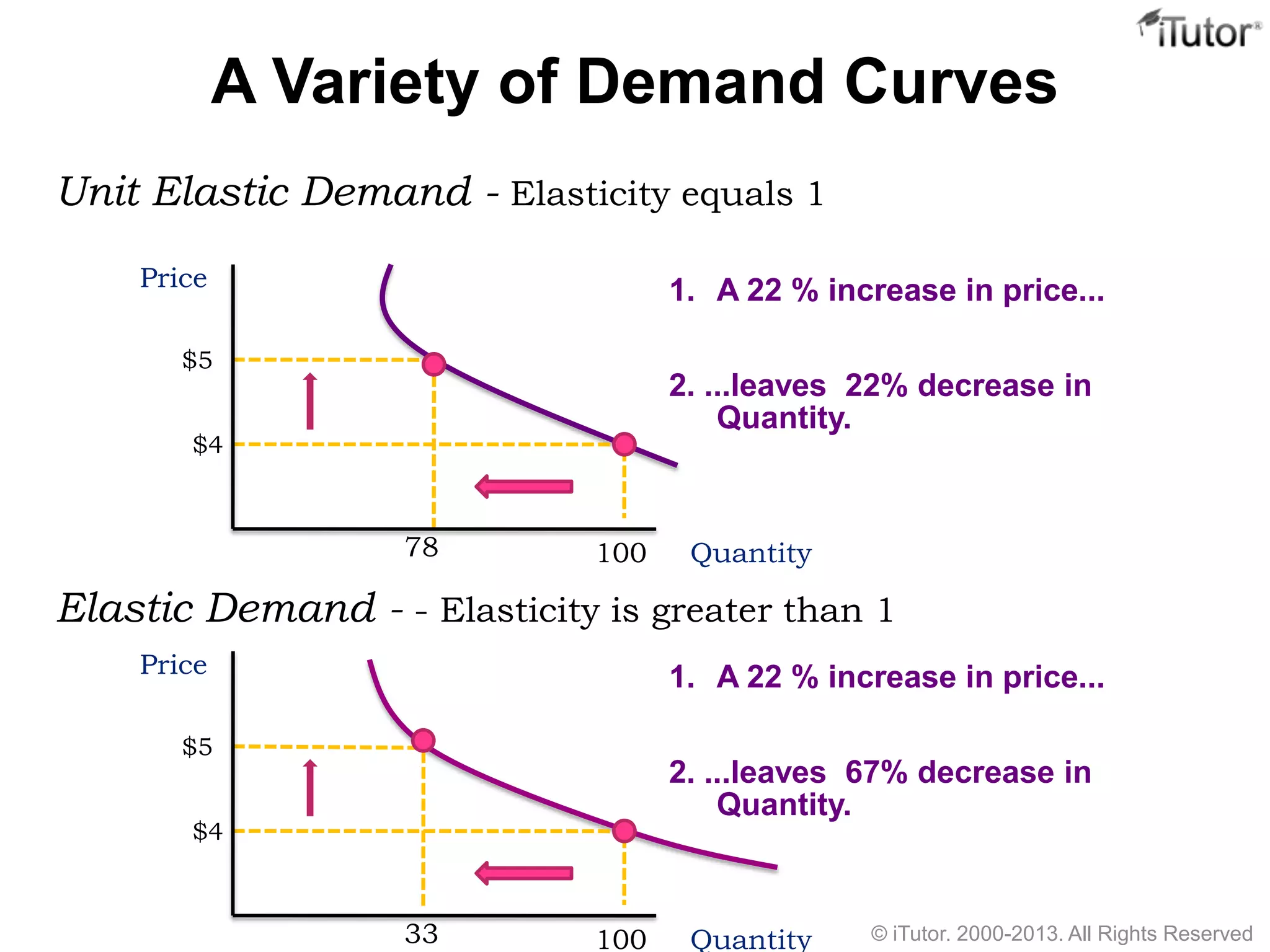
Unit Elastic Demand - Elasticity equals 1
Elastic Demand - - Elasticity is greater than 1
A Variety of Demand Curves
Price
Quantity78
$5
$4
1. A 22 % increase in price...
2. ...leaves 22% decrease in
Quantity.
100
Price
Quantity33
$5
$4
1. A 22 % increase in price...
2. ...leaves 67% decrease in
Quantity.
100 © iTutor. 2000-2013. All Rights Reserved
Quantity
Price
Demand$4
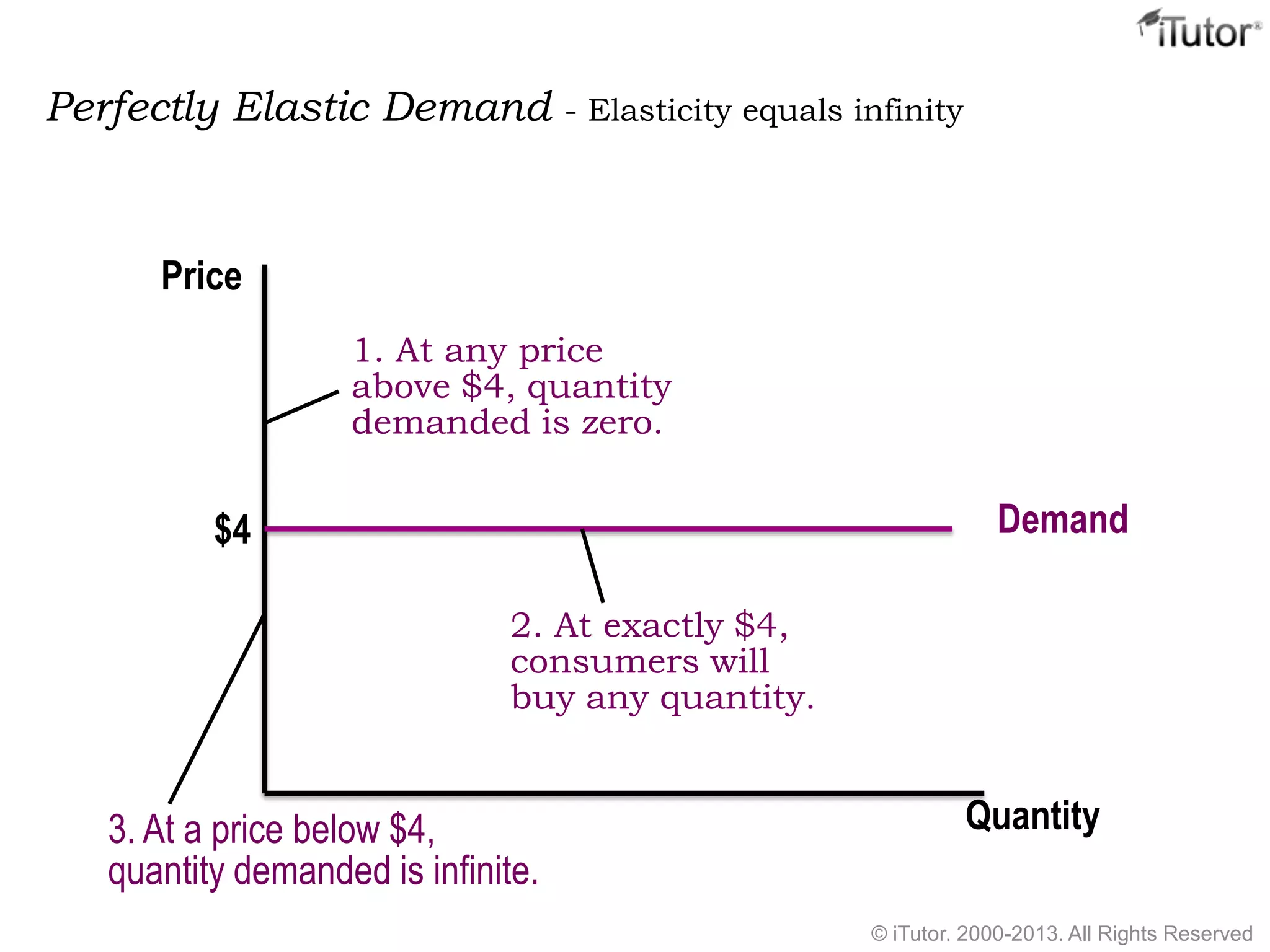
1. At any price
above $4, quantity
demanded is zero.
2. At exactly $4,
consumers will
buy any quantity.
3. At a price below $4,
quantity demanded is infinite.
Perfectly Elastic Demand - Elasticity equals infinity
© iTutor. 2000-2013. All Rights Reserved
Total Revenue
Total Revenue
 A firm’s profit is determined by
taking the total revenue minus the
total cost.
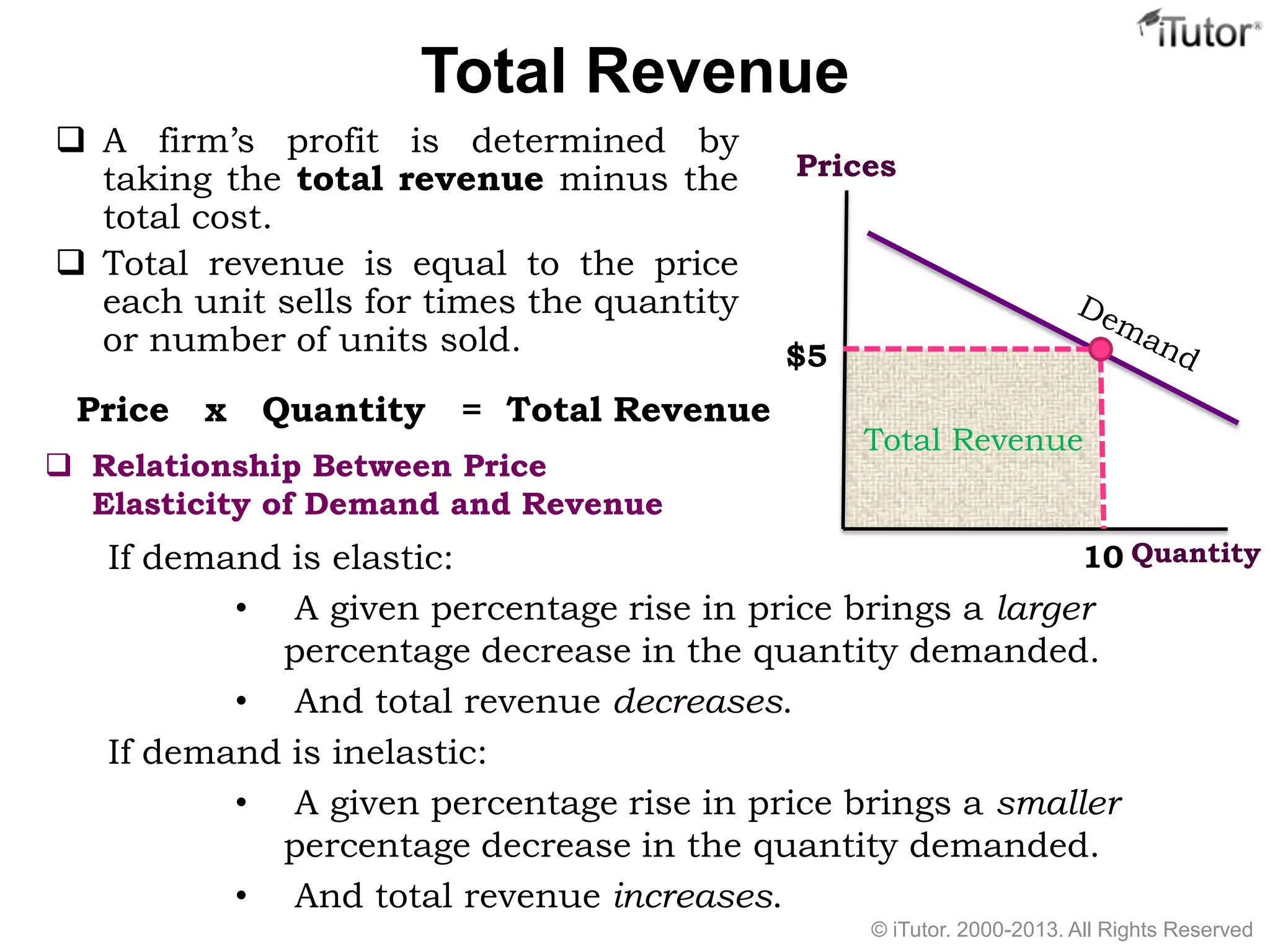
 Total revenue is equal to the price
each unit sells for times the quantity
or number of units sold.
Quantity
Prices
$5
10
Price x Quantity = Total Revenue
If demand is elastic:
• A given percentage rise in price brings a larger
percentage decrease in the quantity demanded.
• And total revenue decreases.
If demand is inelastic:
• A given percentage rise in price brings a smaller
percentage decrease in the quantity demanded.
• And total revenue increases.
 Relationship Between Price
Elasticity of Demand and Revenue
© iTutor. 2000-2013. All Rights Reserved
Determinants of the Elasticity of Demand
 Available close substitutes
 The greater the number of close substitutes that are available
for a good, the more elastic it becomes.
 If there are many bread stores in the city and one bread store
raises its price, the quantity demanded decreases since there
are many other stores producing a similar product.
 Percent of Income
 The percent of income spent on the good influences the
elasticity of demand.
 The greater percent of income spent on the good the more
elastic it becomes, all else held constant.
 Luxury or necessity?
 Those items that are a necessities in life are more inelastic
than items that are a luxury.
 Food in general, salt, and life saving medical care are
examples of necessities and have lower price elasticity than
luxury items such as: jewelry, yachts, or vacation travel.
© iTutor. 2000-2013. All Rights Reserved
 Time period
 The longer the time period, the more elastic a good becomes
as more substitutes become available.
 If the price of gas doubled, car owners would still need to buy
gas.
 But in time, they may choose to trade their larger vehicle in
for one that is more fuel efficient or uses an alternative
fuel, or even choose to move to a different apartment so that
they are closer to work or able to use an alternative methods
of public transportation such as a subway, train or bus line.
 Market definition
 The last determinant of own price elasticity is the market
definition. The broader the definition the fewer number of
close available substitutes exist.
 f a single gas station in town raises its price, there are several
other gas stations in town that sell a very similar product,
thus the gas at a particular station tends to be elastic.
 However, if we look at the entire market for gas, there are few
substitutes and the own price elasticity is inelastic.
© iTutor. 2000-2013. All Rights Reserved
Income Elasticity of Demand
 Income elasticity of demand measures how much the quantity
demanded of a good responds to a change in consumers’ income.
 It is computed as the percentage change in the quantity
demanded divided by the percentage change in income.
 Goods consumers regard as necessities tend to be income inelastic.
 Examples include food, fuel, clothing, utilities, and medical
services.
 Goods consumers regard as luxuries tend to be income elastic.
Examples include sports cars, furs, and expensive foods.
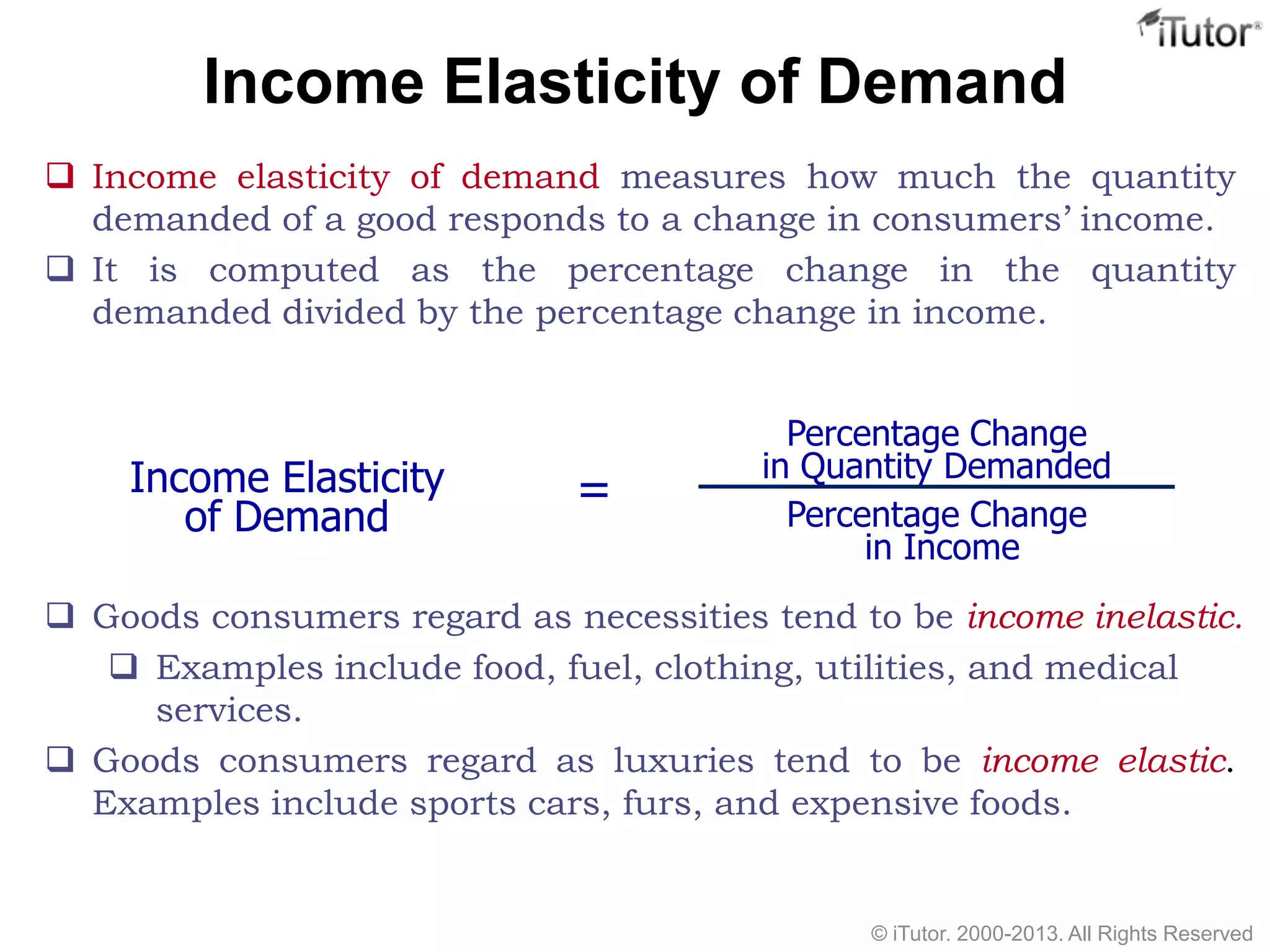
Income Elasticity
of Demand
Percentage Change
in Quantity Demanded
Percentage Change
in Income
=
© iTutor. 2000-2013. All Rights Reserved
The End
Visit www.iTutor.com
For more information call us
1-855-488-8867

Elasticity of Demand

  • 1.
  • 2.
    Elasticity  Elasticity isa measure of how much buyers and sellers respond to changes in market conditions.  Elasticity allows us to analyze supply and demand with greater precision.  If something is elastic it is responsive, flexible, or readily changed. A rubber band is elastic and with little force it easily stretches. A chain on the other hand is rigid and changes very little when pulled.  In the context of price elasticity of demand, the price change is comparable to the force applied to a rubber band or chain and the change in quantity demanded is comparable to the stretch.  When consumers are relatively responsive to a price change, we say that demand is elastic.  When the change in quantity demanded by consumers is relatively small in response to a price change, we say that demand is inelastic. © iTutor. 2000-2013. All Rights Reserved
  • 3.
    Price Elasticity ofDemand  According to the law of demand, when price goes up, consumers demand fewer quantities of a product. If the price of a product falls, quantity demanded will rise.  But when the price of a product changes, by how much more (or less) will consumers buy?  To help answer this question, we will use a measurement called the Price Elasticity of Demand.  Price elasticity of demand is the percentage change in quantity demanded given a percent change in the price.  It is a measure of how much the quantity demanded of a good responds to a change in the price of that good. © iTutor. 2000-2013. All Rights Reserved
  • 4.
    Computing the PriceElasticity of Demand  The price elasticity of demand is computed as the percentage change in the quantity demanded divided by the percentage change in price.  Example: If the price of an ice cream cone increases from $2.00 to $2.20 and the amount you buy falls from 10 to 8 cones then your elasticity of demand would be calculated as: PriceinChangePercentage DemandedQuantityinChangePercentage =DemandofElasticityPrice 2 10 20 100 00.2 )00.220.2( 100 10 )810( percent percent © iTutor. 2000-2013. All Rights Reserved
  • 5.
    Ranges of Elasticity InelasticDemand  Quantity demanded does not respond strongly to price changes.  Price elasticity of demand is less than one. Elastic Demand  Quantity demanded responds strongly to changes in price.  Price elasticity of demand is greater than one. Perfectly Inelastic  Quantity demanded does not respond to price changes. Perfectly Elastic  Quantity demanded changes infinitely with any change in price. Unit Elastic  Quantity demanded changes by the same percentage as the price. © iTutor. 2000-2013. All Rights Reserved
  • 6.
    A Variety ofDemand Curves Perfectly Inelastic Demand - Elasticity equals 0 Inelastic Demand- Elasticity is less than 1 Price Quantity100 $10 $5 1. An increase in price... 2. ...leaves the quantity demanded unchanged. Price Quantity 90 $5 $4 1. A 22 % increase in price... 2. ...leaves 11% decrease in Quantity. 100 © iTutor. 2000-2013. All Rights Reserved
  • 7.
    Unit Elastic Demand- Elasticity equals 1 Elastic Demand - - Elasticity is greater than 1 A Variety of Demand Curves Price Quantity78 $5 $4 1. A 22 % increase in price... 2. ...leaves 22% decrease in Quantity. 100 Price Quantity33 $5 $4 1. A 22 % increase in price... 2. ...leaves 67% decrease in Quantity. 100 © iTutor. 2000-2013. All Rights Reserved
  • 8.
    Quantity Price Demand$4 1. At anyprice above $4, quantity demanded is zero. 2. At exactly $4, consumers will buy any quantity. 3. At a price below $4, quantity demanded is infinite. Perfectly Elastic Demand - Elasticity equals infinity © iTutor. 2000-2013. All Rights Reserved
  • 9.
    Total Revenue Total Revenue A firm’s profit is determined by taking the total revenue minus the total cost.  Total revenue is equal to the price each unit sells for times the quantity or number of units sold. Quantity Prices $5 10 Price x Quantity = Total Revenue If demand is elastic: • A given percentage rise in price brings a larger percentage decrease in the quantity demanded. • And total revenue decreases. If demand is inelastic: • A given percentage rise in price brings a smaller percentage decrease in the quantity demanded. • And total revenue increases.  Relationship Between Price Elasticity of Demand and Revenue © iTutor. 2000-2013. All Rights Reserved
  • 10.
    Determinants of theElasticity of Demand  Available close substitutes  The greater the number of close substitutes that are available for a good, the more elastic it becomes.  If there are many bread stores in the city and one bread store raises its price, the quantity demanded decreases since there are many other stores producing a similar product.  Percent of Income  The percent of income spent on the good influences the elasticity of demand.  The greater percent of income spent on the good the more elastic it becomes, all else held constant.  Luxury or necessity?  Those items that are a necessities in life are more inelastic than items that are a luxury.  Food in general, salt, and life saving medical care are examples of necessities and have lower price elasticity than luxury items such as: jewelry, yachts, or vacation travel. © iTutor. 2000-2013. All Rights Reserved
  • 11.
     Time period The longer the time period, the more elastic a good becomes as more substitutes become available.  If the price of gas doubled, car owners would still need to buy gas.  But in time, they may choose to trade their larger vehicle in for one that is more fuel efficient or uses an alternative fuel, or even choose to move to a different apartment so that they are closer to work or able to use an alternative methods of public transportation such as a subway, train or bus line.  Market definition  The last determinant of own price elasticity is the market definition. The broader the definition the fewer number of close available substitutes exist.  f a single gas station in town raises its price, there are several other gas stations in town that sell a very similar product, thus the gas at a particular station tends to be elastic.  However, if we look at the entire market for gas, there are few substitutes and the own price elasticity is inelastic. © iTutor. 2000-2013. All Rights Reserved
  • 12.
    Income Elasticity ofDemand  Income elasticity of demand measures how much the quantity demanded of a good responds to a change in consumers’ income.  It is computed as the percentage change in the quantity demanded divided by the percentage change in income.  Goods consumers regard as necessities tend to be income inelastic.  Examples include food, fuel, clothing, utilities, and medical services.  Goods consumers regard as luxuries tend to be income elastic. Examples include sports cars, furs, and expensive foods. Income Elasticity of Demand Percentage Change in Quantity Demanded Percentage Change in Income = © iTutor. 2000-2013. All Rights Reserved
  • 13.
    The End Visit www.iTutor.com Formore information call us 1-855-488-8867