


SEMINAR PRESENTATION

Topic : Price Elasticity Of Demand

    Name : Raghav Kapahi

    Class : B.Com. ( Hons.)

    Roll No. : 29-HBCM-11
    E-Mail Id : raghavkapahi@gmail.com

                                         1
LAW OF DEMAND states that there is a inverse relation
 between PRICE of product and its DEMAND , i.e. when
 price of a product rises its demand falls & vice versa .


Ques. When price rises, what happens to demand?
 Ans : Demand falls.


                   BUT ..! BUT..! BUT..!
The next question which arises is :
          How much does demand falls.
          And answer to this question is :
PRICE
ELASTICITY
    Of
 DEMAND
             3
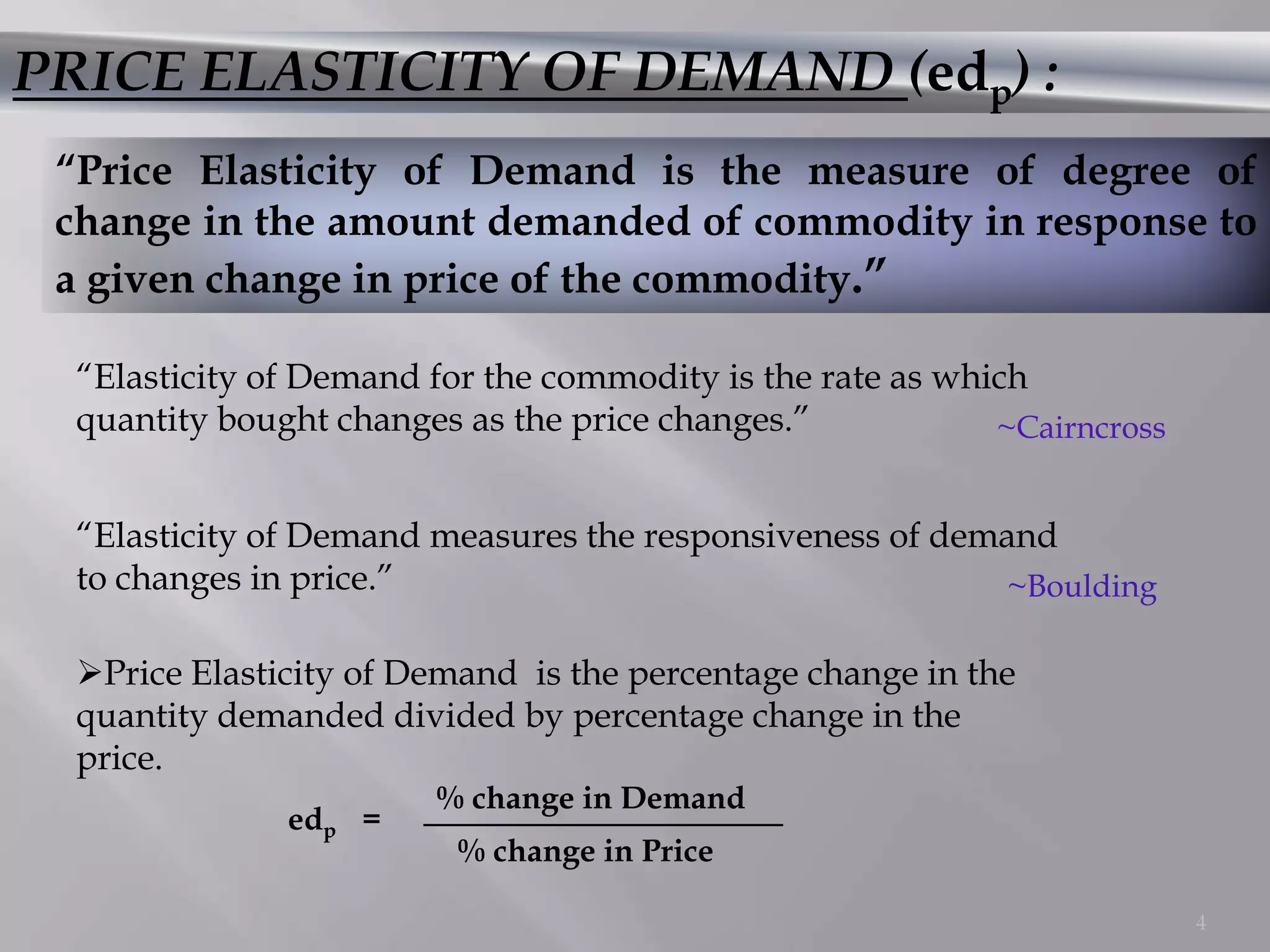
PRICE ELASTICITY OF DEMAND (edp) :
 “Price Elasticity of Demand is the measure of degree of
 change in the amount demanded of commodity in response to
 a given change in price of the commodity.”

  “Elasticity of Demand for the commodity is the rate as which
  quantity bought changes as the price changes.”            ~Cairncross


  “Elasticity of Demand measures the responsiveness of demand
  to changes in price.”                                    ~Boulding

  Price Elasticity of Demand is the percentage change in the
  quantity demanded divided by percentage change in the
  price.
                        % change in Demand
               edp =
                          % change in Price

                                                                          4
• Law of Demand indicates only the direction of change in quantity
demanded in response to change in price,
But Elasticity of Demand states that how much or to what extent the
quantity demanded will change in response to change in its price.


     If price rises by 10% - what happens to demand?
     We know demand will fall
     By more than 10%?
     By less than 10%?
     Elasticity measures the extent to which demand will
      change.

      And this, gives us five different Degrees Of
      Price Elasticity Of Demand:
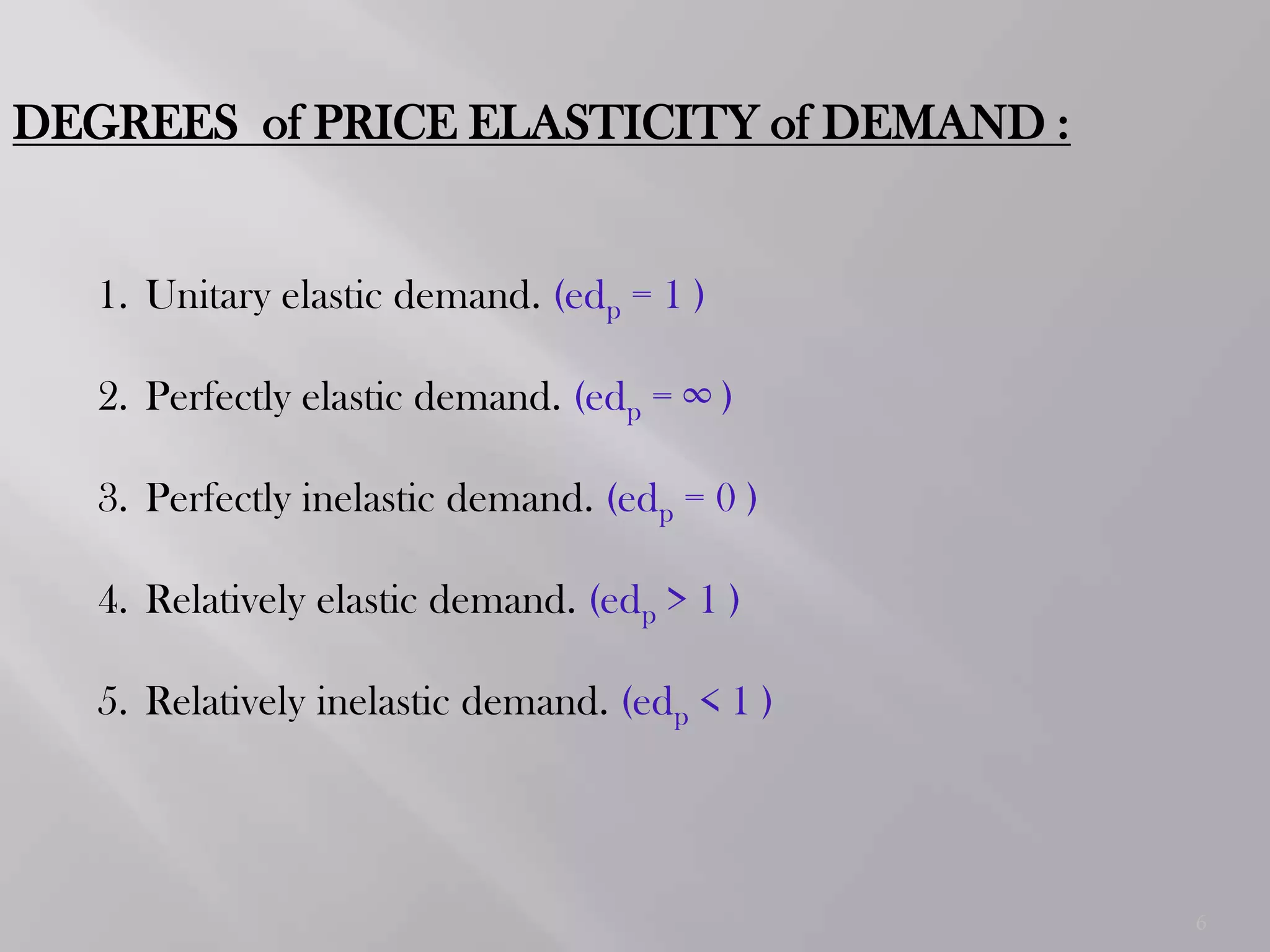
DEGREES of PRICE ELASTICITY of DEMAND :


   1. Unitary elastic demand. (edp = 1 )

   2. Perfectly elastic demand. (edp = ∞ )

   3. Perfectly inelastic demand. (edp = 0 )

   4. Relatively elastic demand. (edp > 1 )

   5. Relatively inelastic demand. (edp < 1 )


                                                6
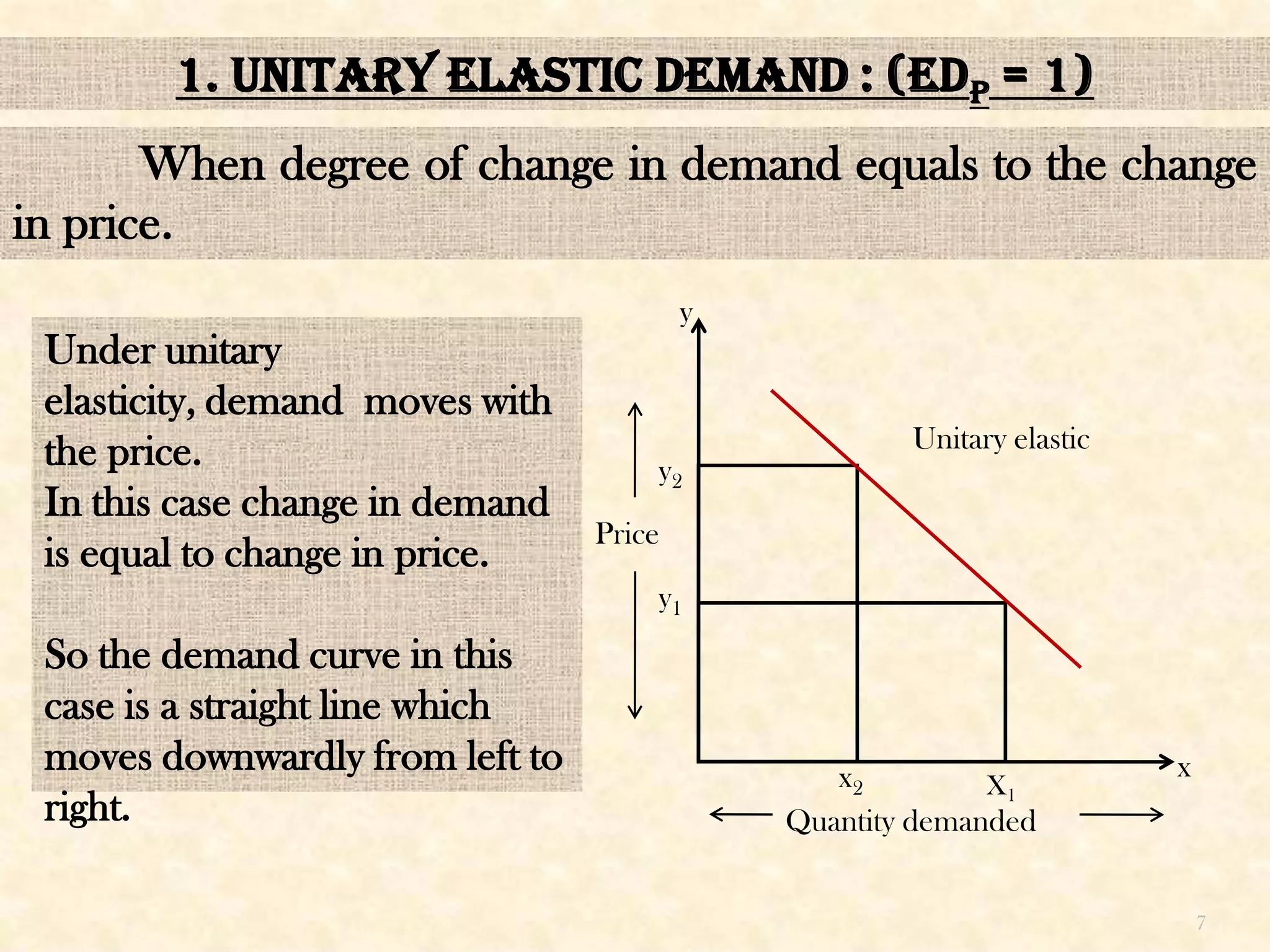
1. Unitary Elastic Demand : (edp = 1)
       When degree of change in demand equals to the change
in price.
                                         y
 Under unitary
 elasticity, demand moves with
                                                     Unitary elastic
 the price.                          y2
 In this case change in demand
                                 Price
 is equal to change in price.
                                     y1
 So the demand curve in this
 case is a straight line which
 moves downwardly from left to                  x2                     x
                                                           X1
 right.                                      Quantity demanded


                                                                           7
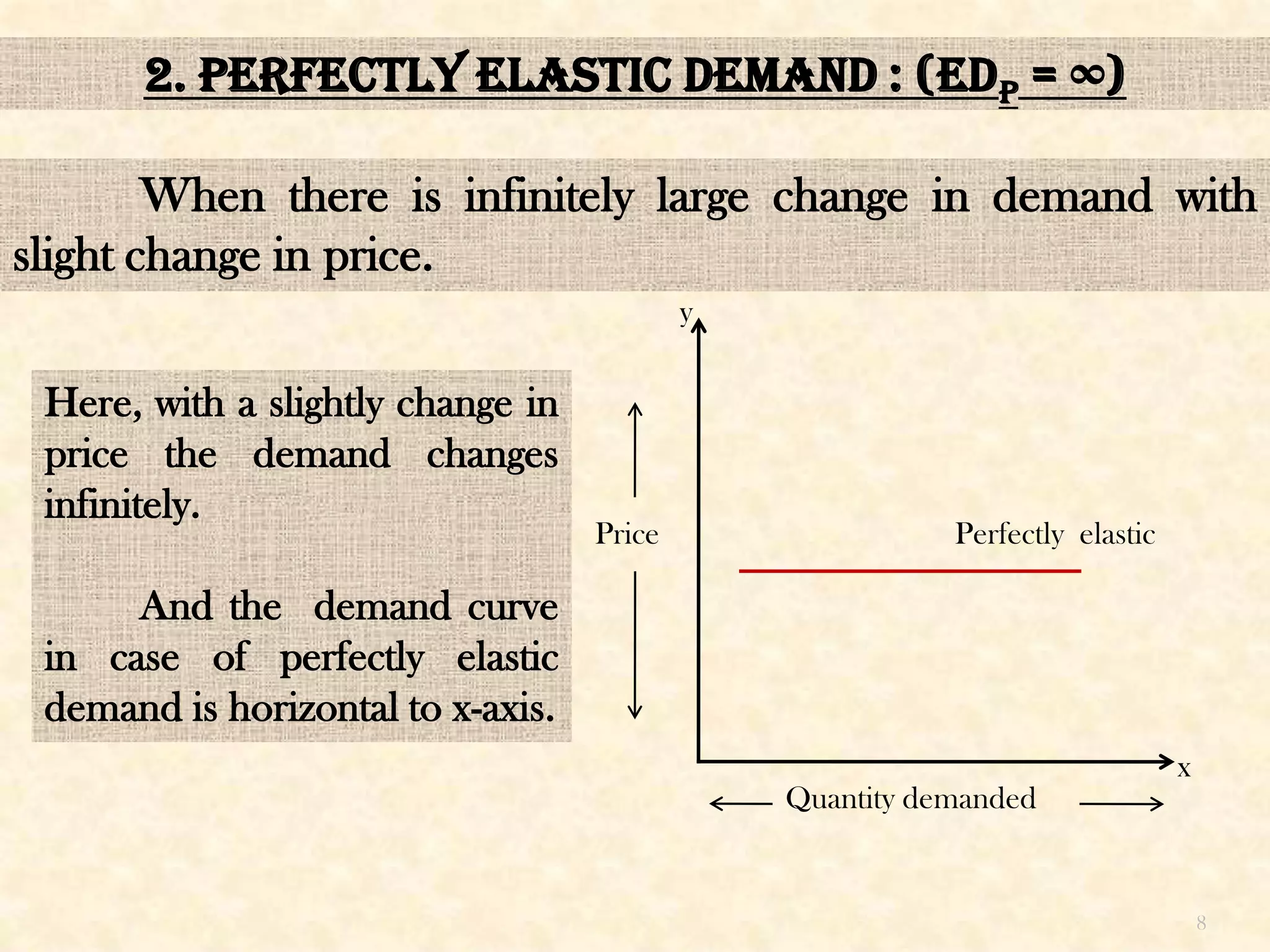
2. PERFECTLY ELASTIC DEMAND : (edp = ∞)

        When there is infinitely large change in demand with
slight change in price.
                                           y

 Here, with a slightly change in
 price the demand changes
 infinitely.
                                   Price                  Perfectly elastic

      And the demand curve
 in case of perfectly elastic
 demand is horizontal to x-axis.
                                                                              x
                                               Quantity demanded


                                                                                  8
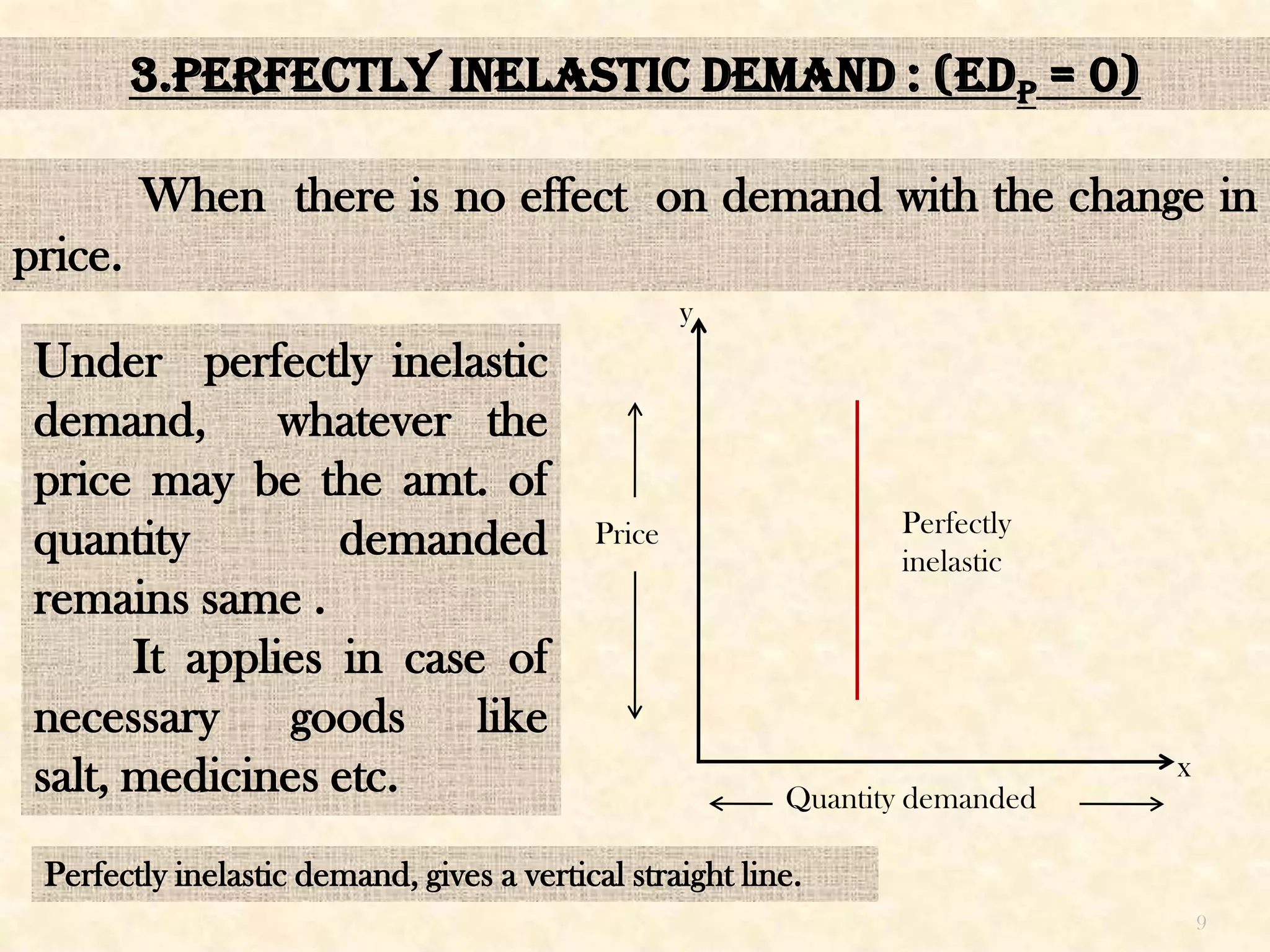
3.PERFECTLY INELASTIC DEMAND : (edp = 0)

         When there is no effect on demand with the change in
price.
                                                   y
 Under perfectly inelastic
 demand, whatever the
 price may be the amt. of
                                                                 Perfectly
 quantity         demanded                 Price
                                                                 inelastic
 remains same .
       It applies in case of
 necessary goods like
 salt, medicines etc.                                                         x
                                                          Quantity demanded

 Perfectly inelastic demand, gives a vertical straight line.
                                                                                  9
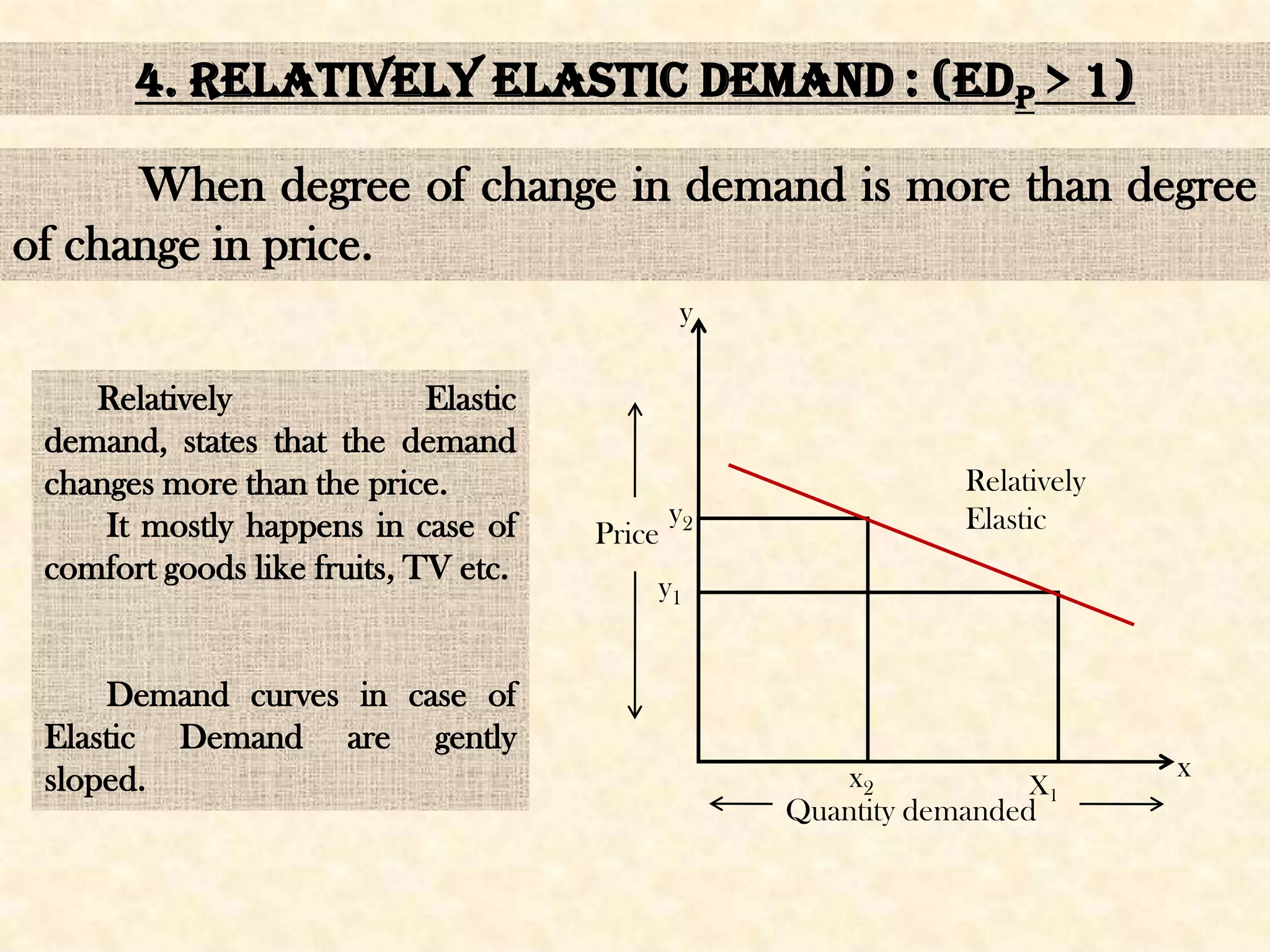
4. RELATIVELY ELASTIC DEMAND : (edp > 1)

      When degree of change in demand is more than degree
of change in price.
                                               y

    Relatively               Elastic
 demand, states that the demand
 changes more than the price.                                   Relatively
     It mostly happens in case of              y2               Elastic
                                       Price
 comfort goods like fruits, TV etc.
                                           y1


     Demand curves in case of
 Elastic Demand are gently
 sloped.                                               x2                    x
                                                                     X1
                                                    Quantity demanded
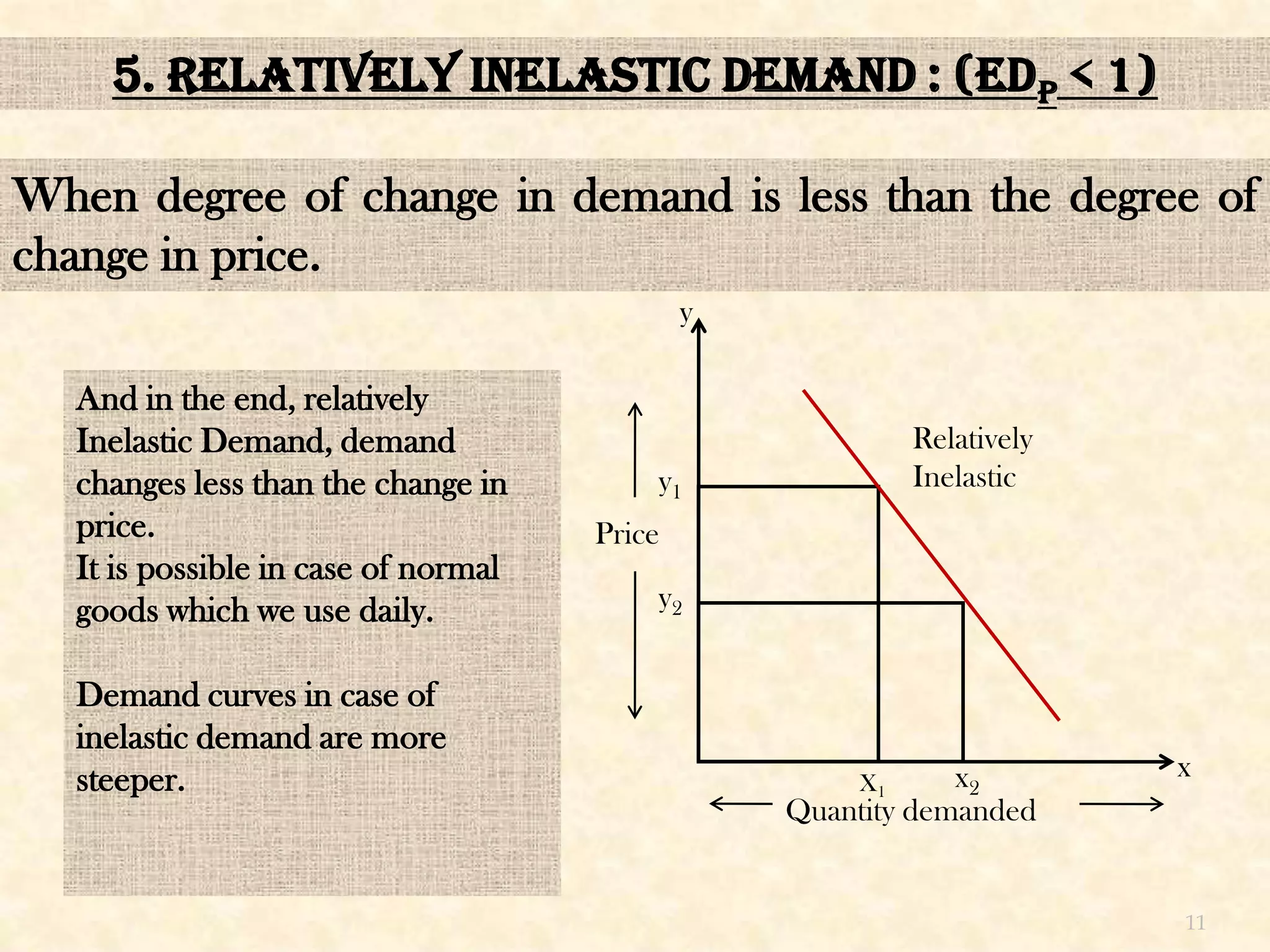
5. RELATIVELY INELASTIC DEMAND : (edp < 1)

When degree of change in demand is less than the degree of
change in price.
                                             y

  And in the end, relatively
  Inelastic Demand, demand                                 Relatively
  changes less than the change in        y1                Inelastic
  price.                             Price
  It is possible in case of normal
  goods which we use daily.              y2


  Demand curves in case of
  inelastic demand are more
  steeper.                                            X1     x2         x
                                                 Quantity demanded


                                                                        11
12

Price elasticity of demand

  • 1.
    SEMINAR PRESENTATION Topic :Price Elasticity Of Demand Name : Raghav Kapahi Class : B.Com. ( Hons.) Roll No. : 29-HBCM-11 E-Mail Id : raghavkapahi@gmail.com 1
  • 2.
    LAW OF DEMANDstates that there is a inverse relation between PRICE of product and its DEMAND , i.e. when price of a product rises its demand falls & vice versa . Ques. When price rises, what happens to demand? Ans : Demand falls. BUT ..! BUT..! BUT..! The next question which arises is : How much does demand falls. And answer to this question is :
  • 3.
    PRICE ELASTICITY Of DEMAND 3
  • 4.
    PRICE ELASTICITY OFDEMAND (edp) : “Price Elasticity of Demand is the measure of degree of change in the amount demanded of commodity in response to a given change in price of the commodity.” “Elasticity of Demand for the commodity is the rate as which quantity bought changes as the price changes.” ~Cairncross “Elasticity of Demand measures the responsiveness of demand to changes in price.” ~Boulding Price Elasticity of Demand is the percentage change in the quantity demanded divided by percentage change in the price. % change in Demand edp = % change in Price 4
  • 5.
    • Law ofDemand indicates only the direction of change in quantity demanded in response to change in price, But Elasticity of Demand states that how much or to what extent the quantity demanded will change in response to change in its price.  If price rises by 10% - what happens to demand?  We know demand will fall  By more than 10%?  By less than 10%?  Elasticity measures the extent to which demand will change. And this, gives us five different Degrees Of Price Elasticity Of Demand:
  • 6.
    DEGREES of PRICEELASTICITY of DEMAND : 1. Unitary elastic demand. (edp = 1 ) 2. Perfectly elastic demand. (edp = ∞ ) 3. Perfectly inelastic demand. (edp = 0 ) 4. Relatively elastic demand. (edp > 1 ) 5. Relatively inelastic demand. (edp < 1 ) 6
  • 7.
    1. Unitary ElasticDemand : (edp = 1) When degree of change in demand equals to the change in price. y Under unitary elasticity, demand moves with Unitary elastic the price. y2 In this case change in demand Price is equal to change in price. y1 So the demand curve in this case is a straight line which moves downwardly from left to x2 x X1 right. Quantity demanded 7
  • 8.
    2. PERFECTLY ELASTICDEMAND : (edp = ∞) When there is infinitely large change in demand with slight change in price. y Here, with a slightly change in price the demand changes infinitely. Price Perfectly elastic And the demand curve in case of perfectly elastic demand is horizontal to x-axis. x Quantity demanded 8
  • 9.
    3.PERFECTLY INELASTIC DEMAND: (edp = 0) When there is no effect on demand with the change in price. y Under perfectly inelastic demand, whatever the price may be the amt. of Perfectly quantity demanded Price inelastic remains same . It applies in case of necessary goods like salt, medicines etc. x Quantity demanded Perfectly inelastic demand, gives a vertical straight line. 9
  • 10.
    4. RELATIVELY ELASTICDEMAND : (edp > 1) When degree of change in demand is more than degree of change in price. y Relatively Elastic demand, states that the demand changes more than the price. Relatively It mostly happens in case of y2 Elastic Price comfort goods like fruits, TV etc. y1 Demand curves in case of Elastic Demand are gently sloped. x2 x X1 Quantity demanded
  • 11.
    5. RELATIVELY INELASTICDEMAND : (edp < 1) When degree of change in demand is less than the degree of change in price. y And in the end, relatively Inelastic Demand, demand Relatively changes less than the change in y1 Inelastic price. Price It is possible in case of normal goods which we use daily. y2 Demand curves in case of inelastic demand are more steeper. X1 x2 x Quantity demanded 11
  • 12.