Supply, Demand 
& 
Equilibrium 
By: Abdullah Karim 
abdullahkarim22@gmail.com
Market Exchange 
• For any market transaction to take place 
there has to be both a buyer and a seller. 
• Actually each wants what the other has. 
• The focus here is on the market for a 
particular good—cheese, chalk, chairs, 
widgets.
Law of Supply 
• Law of supply states that there is a 
positive relation between price and 
quantity supplied. 
• If price goes up, quantity supplied goes 
up; if price goes down, quantity supplied 
goes down.
Law of Demand 
• The law of demand states that there is a 
negative or inverse relation between price 
and quantity demanded. 
• If price goes up, quantity demanded goes 
down; if price goes down, quantity 
demanded goes up.
Laws of supply and demand versus 
the “theory of supply and demand” 
• Theory of supply and demand includes the 
laws of supply and demand, but the theory 
of supply and demand claims more than 
the laws do. 
• The theory of supply and demand states 
that price itself is determined by supply 
and demand forces.
Laws can be in effect without 
theory—e.g., a command system 
• In a Soviet-style command system, the 
central planning board announces one 
week that oranges are $.25 a pound. 
• The next week they announce oranges 
are $2 a pound. 
• What will happen to the demand for 
oranges?
Laws vs. Theory of Supply and 
Demand 
• It will probably fall. 
• So the law of demand is in effect. 
• But how was price determined in the 
example? 
• Not by the theory of supply and demand— 
price was determined by the central 
planning board, by command. 
• So we have the laws without the theory.
Different types of demand 
• Aggregate demand, aggregate 
consumption demand, aggregate 
investment demand—we will see these 
and others later. 
• We can speak of one individual’s demand 
for a particular good, or individual 
demand. 
• And all individuals’ demand for a particular 
good, or market demand.
market demand 
• Demand is willingness and ability to buy 
specific quantities of a good at alternative 
prices in a given time period (ceteris 
paribus).
market demand 
• If we don't include ability then it's not real 
demand, it's called… 
…wishing for something. 
• And it is not enough to be able to afford 
something, you have to want it as well— 
willingness.
Market demand 
• I wish I had a Lamborghini, but if I can’t 
afford it, it is not demand. 
• I can afford a set of teenage mutant ninja 
turtle pillowcases, but if I don’t want them, 
it is not demand.
Market demand 
• It has to be in a given time period, 
otherwise it is not clear what we are 
talking about—demand for something 
forever into the future?
market demand 
• We say ceteris paribus because the 
willingness and ability may change 
depending on other factors, but for now 
we just want to focus on what happens to 
demand when price changes, so we have 
to hold these other things constant.
market demand 
• Otherwise, if we don’t make the ceteris 
paribus assumption, and price changes, 
and quantity demanded changes, we 
won’t know if the change in demand is due 
to the price change or if it is due to one of 
the other factors that affect willingness or 
ability.
assumptions behind the market 
demand curve 
• In particular, we want to hold constant 
these factors that affect willingness or 
ability to buy:
assumptions behind the market 
demand curve 
• In particular, we want to hold constant 
these factors that affect willingness or 
ability to buy: 
– Income (affects ability to buy)
assumptions behind the market 
demand curve 
• In particular, we want to hold constant 
these factors that affect willingness or 
ability to buy: 
– Income (affects ability to buy) 
– Tastes or preferences (affects willingness to 
buy)
assumptions behind the market 
demand curve 
• In particular, we want to hold constant 
these factors that affect willingness or 
ability to buy: 
– Income (affects ability to buy) 
– Tastes or preferences (affects willingness to 
buy) 
– availability and price of related goods
Related goods 
•
Related goods 
• substitutes
Related goods 
• substitutes (coffee and tea)
Related goods 
• substitutes (coffee and tea) 
• complements
Related goods 
• substitutes (coffee and tea) 
• complements (coffee and cream)
assumptions behind the market 
demand curve 
• expectations of price, income and tastes
assumptions behind the market 
demand curve 
• expectations of price, income and tastes 
• number of buyers in the market
individual and market demand 
• Market demand is the total quantities of a 
good or service that people are willing and 
able to buy at alternative prices in a given 
time period, ceteris paribus (or simply the 
sum of individual demands).
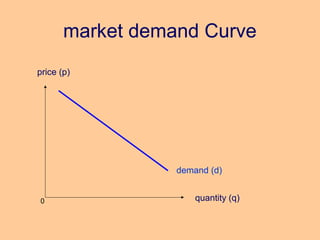
market demand Curve 
price (p) 
demand (d) 
quantity (q) 
0
market supply 
• everything we said about market demand 
is also applies to market supply (except 
the relation between price and quantity 
supplied and the factors that affect 
willingness and ability)
market supply 
• Market supply is the total quantities of a 
good that sellers are willing and able to 
sell at alternative prices in a given time 
period (ceteris paribus), or simply the 
combined willingness and ability of all 
market suppliers to sell.
market supply 
• must be both willingness and ability to sell 
• not a statement of actual sales, that will 
depend on the actual price 
• given time period 
• ceteris paribus
Assumptions behind the market 
supply curve
Assumptions behind the market 
supply curve 
• cost of production
Assumptions behind the market 
supply curve 
• cost of production 
– input prices
Assumptions behind the market 
supply curve 
• cost of production 
– input prices 
– technology
Assumptions behind the market 
supply curve 
• cost of production 
– input prices 
– Technology 
• expectations (of future price)
Assumptions behind the market 
supply curve 
• cost of production 
– input prices 
– Technology 
• expectations (of future price) 
• number of sellers in the market
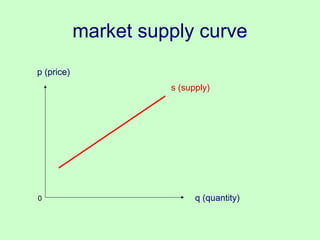
market supply curve 
p (price) 
s (supply) 
q (quantity) 
0
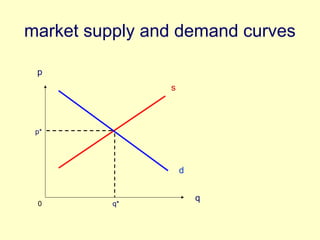
market supply and demand curves 
p 
q 
s 
d 
p* 
0 q*
market equilibrium
market equilibrium 
• unique equilibrium of market supply and 
demand
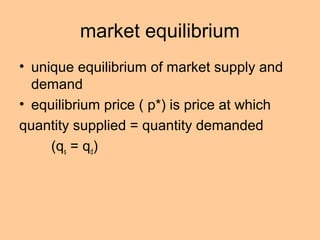
market equilibrium 
• unique equilibrium of market supply and 
demand 
• equilibrium price ( p*) is price at which 
quantity supplied = quantity demanded 
(qs = qd)
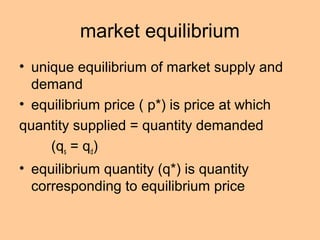
market equilibrium 
• unique equilibrium of market supply and 
demand 
• equilibrium price ( p*) is price at which 
quantity supplied = quantity demanded 
(qs = qd) 
• equilibrium quantity (q*) is quantity 
corresponding to equilibrium price
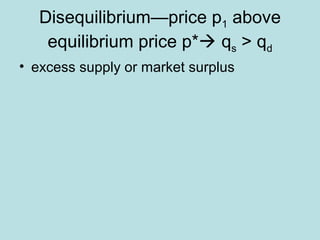
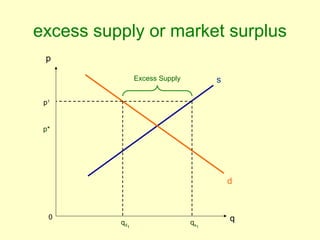
Disequilibrium—price p1 above 
equilibrium price p* qs > qd 
• excess supply or market surplus
excess supply or market surplus 
p 
q 
s 
d 
p* 
qd1 qs1 
p1 
0 
Excess Supply
equilibrating process
equilibrating process 
• competition between and among buyers 
and sellers sets off equilibrium process
equilibrating process 
• competition between and among buyers 
and sellers sets off equilibrium process 
• Firms with excess inventories cut prices to 
try to undersell their competition
equilibrating process 
• competition between and among buyers 
and sellers sets off equilibrium process 
• Firms with excess inventories cut prices to 
try to undersell their competition 
• As price falls, quantity demanded rises, 
and quantity supplied falls
equilibrating process 
• competition between and among buyers 
and sellers sets off equilibrium process 
• Firms with excess inventories cut prices to 
try to undersell their competition 
• As price falls, quantity demanded rises, 
and quantity supplied falls 
• Process continues until p = p* and 
(qs = qd)
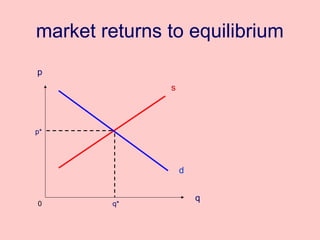
market returns to equilibrium 
p 
q 
s 
d 
p* 
0 q*
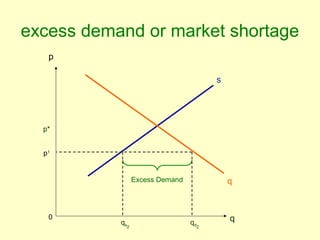
Disequilibrium—price p1 below 
equilibrium price p* qs < qd 
• excess demand or market shortage
excess demand or market shortage 
p 
q 
s 
q 
p* 
Excess Demand 
qs2 qd2 
p1 
0
equilibrating process
equilibrating process 
• competition between and among buyers 
and sellers sets off equilibrium process
equilibrating process 
• competition between and among buyers 
and sellers sets off equilibrium process 
• buyers competing with one another for 
goods in short supply bid up price to try to 
capture some of the good
equilibrating process 
• competition between and among buyers 
and sellers sets off equilibrium process 
• buyers competing with one another for 
goods in short supply bid up price to try to 
capture some of the good 
• as price goes up, demand falls and supply 
rises
equilibrating process 
• competition between and among buyers 
and sellers sets off equilibrium process 
• buyers competing with one another for 
goods in short supply bid up price to try to 
capture some of the good 
• as price goes up, demand falls and supply 
rises 
• Process continues until p = p* and qs = qd
the role of competition in 
a market economy
the role of competition in 
a market economy 
two necessary aspects for competition:
the role of competition in 
a market economy 
two necessary aspects for competition: 
1) competition between buyers and sellers
the role of competition in 
a market economy 
two necessary aspects for competition: 
1) competition between buyers and sellers 
buyers and sellers have conflicting interests. 
One side wants the price up, the other 
side wants the price down, and a 
competitive bargaining process must 
occur to determine an agreement.
the role of competition in 
a market economy 
two necessary aspects for competition: 
2) competition among buyers and among 
sellers.
the role of competition in 
a market economy 
two necessary aspects for competition: 
2) competition among buyers and among 
sellers. 
Sellers compete with other sellers to gain 
market share and profit. And buyers may 
try to outbid one another for goods that 
they want to purchase.
competition 
competition forces buyers and sellers to do 
just the opposite of what they seem to 
want—it forces sellers to cut price and it 
forces buyers to bid up the price. This 
dual struggle—between and among 
buyers and sellers—is the competitive 
market mechanism that pushes and pulls 
the market back to equilibrium price and 
quantity from any disequilibrium position.
movement from: 
disequilibrium to equilibrium 
versus 
movement from: 
old equilibrium to a new equilibrium
disequilibrium vs. new equilibrium 
• movement along the curves from changes 
in variables measured along the axes 
• shift in curves from changes in 
assumptions behind the curves
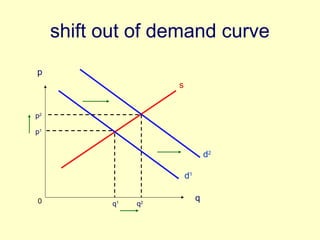
shift out of demand curve 
p 
q 
s 
d1 
p1 
q1 
p2 
q2 
d2 
0
shift of demand curve 
• shifts out from:
shift of demand curve 
• shifts out from: 
– increased income
shift of demand curve 
• shifts out from: 
– increased income 
– stronger tastes or preferences
shift of demand curve 
• shifts out from: 
– increased income 
– stronger tastes or preferences 
– increased price of substitutes
shift of demand curve 
• shifts out from: 
– increased income 
– stronger tastes or preferences 
– increased price of substitutes 
– decreased price of complements
shift of demand curve 
• shifts out from: 
– increased income 
– stronger tastes or preferences 
– increased price of substitutes 
– decreased price of complements 
– expectations of above
shift of demand curve 
• shifts out from: 
– increased income 
– stronger tastes or preferences 
– increased price of substitutes 
– decreased price of complements 
– expectations of above 
– more buyers in market
shift of demand curve 
• shifts in from:
shift of demand curve 
• shifts in from: 
– decreased income
shift of demand curve 
• shifts in from: 
– decreased income 
– weaker tastes or preferences
shift of demand curve 
• shifts in from: 
– decreased income 
– weaker tastes or preferences 
– decreased price of substitutes
shift of demand curve 
• shifts in from: 
– decreased income 
– weaker tastes or preferences 
– decreased price of substitutes 
– increased price of complements
shift of demand curve 
• shifts in from: 
– decreased income 
– weaker tastes or preferences 
– decreased price of substitutes 
– increased price of complements 
– expectations of above
shift of demand curve 
• shifts in from: 
– decreased income 
– weaker tastes or preferences 
– decreased price of substitutes 
– increased price of complements 
– expectations of above 
– fewer buyers in market
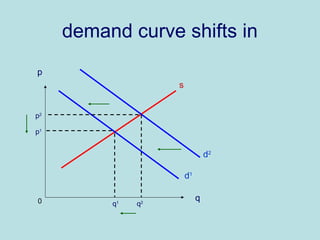
demand curve shifts in 
p 
q 
s 
d1 
p1 
q1 
p2 
q2 
d2 
0
shift of supply curve
shift of supply curve 
• shifts in from:
shift of supply curve 
• shifts in from: 
– higher costs of production
shift of supply curve 
• shifts in from: 
– higher costs of production 
• higher input prices
shift of supply curve 
• shifts in from: 
– higher costs of production 
• higher input prices 
• technological decline
shift of supply curve 
• shifts in from: 
– higher costs of production 
• higher input prices 
• technological decline 
– dimmer expectations
shift of supply curve 
• shifts in from: 
– higher costs of production 
• higher input prices 
• technological decline 
– dimmer expectations 
– fewer sellers in the market
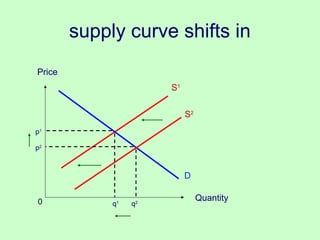
supply curve shifts in 
Price 
Quantity 
S1 
D 
p1 
q1 
S2 
p2 
0 q2
shift of supply curve 
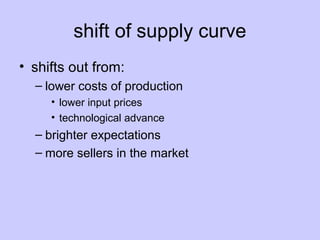
• shifts out from:
shift of supply curve 
• shifts out from: 
– lower costs of production
shift of supply curve 
• shifts out from: 
– lower costs of production 
• lower input prices
shift of supply curve 
• shifts out from: 
– lower costs of production 
• lower input prices 
• technological advance
shift of supply curve 
• shifts out from: 
– lower costs of production 
• lower input prices 
• technological advance 
– brighter expectations
shift of supply curve 
• shifts out from: 
– lower costs of production 
• lower input prices 
• technological advance 
– brighter expectations 
– more sellers in the market
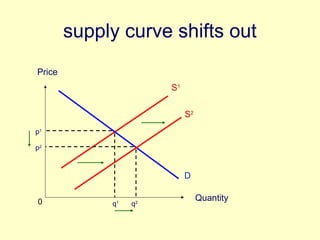
supply curve shifts out 
Price 
Quantity 
S1 
D 
p1 
q1 
S2 
p2 
0 q2
law of demand 
• the law of demand usually holds, but it can 
be violated on occasion. 
• usually if price goes up, demand goes 
down, and if price goes down demand 
goes up. 
• But there are exceptional cases where 
when price goes up, demand actually 
goes up!
“Giffen goods” 
• Case in Ireland during the potato famine, 
when price of potatoes went up, demand 
for potatoes went up. 
(hint: the average family ate potatoes for 
dinner six nights a week and one night a 
week they ate meat.)
Giffen goods 
• Reason: meat was still much more 
expensive than potatoes, so when the 
price of potatoes went up, families had to 
stop eating meat the one night and eat 
potatoes seven nights a week.
violations of law of demand 
• Also, the demand curve can be upward 
sloping in the case of goods that people 
value more when the price is higher—they 
think that price is an indicator of quality! 
Think of the situation where a price is low, 
so you think there must be something 
wrong with it.
consumer theory 
• A number of interesting tendencies along 
these lines:
consumer theory 
• A number of interesting tendencies along 
these lines: 
1) bandwagon effect: you buy something to 
be part of the crowd
consumer theory 
• A number of interesting tendencies along 
these lines: 
1) bandwagon effect: you buy something to 
be part of the crowd 
2) Snob effect: you buy something to 
distinguish yourself from the crowd (can 
be designer jeans, or ripped up jeans!)
consumer theory 
• A number of interesting tendencies along 
these lines: 
1) bandwagon effect: you buy something to 
be part of the crowd 
2) Snob effect: you buy something to 
distinguish yourself from the crowd (can 
be designer jeans, or ripped up jeans!) 
3) Veblen effect: you buy something to 
show you can afford it
law of demand 
but normally, the law of demand is said to 
hold in neoclassical economics: 
when price goes up, quantity demanded 
goes down; when price goes down, 
quantity demanded goes up. 
But how much does quantity demanded 
change when price changes?
Elasticity 
• In economics, we use the concept of 
elasticity to measure the sensitivity or 
responsiveness of one variable to another.
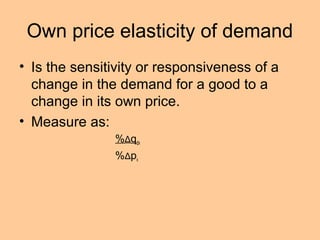
Own price elasticity of demand 
• Is the sensitivity or responsiveness of a 
change in the demand for a good to a 
change in its own price. 
• Measure as: 
%Δqdx 
%Δpx
Own price elasticity of demand 
• Factors that determine: 
1) Availability and price of close substitutes 
(many—elastic; few—inelastic) 
2) % of budget devoted to the good 
(small—inelastic; large—elastic) 
3) Time 
(short run—inelastic; long run--elastic
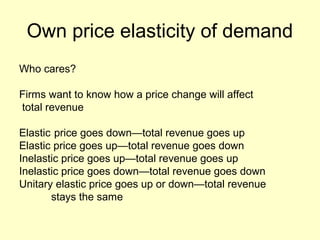
Own price elasticity of demand 
Who cares? 
Firms want to know how a price change will affect 
total revenue 
Elastic price goes down—total revenue goes up 
Elastic price goes up—total revenue goes down 
Inelastic price goes up—total revenue goes up 
Inelastic price goes down—total revenue goes down 
Unitary elastic price goes up or down—total revenue 
stays the same
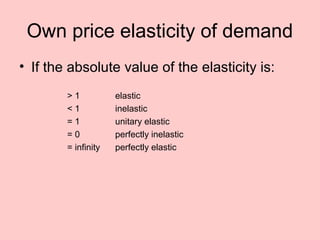
Own price elasticity of demand 
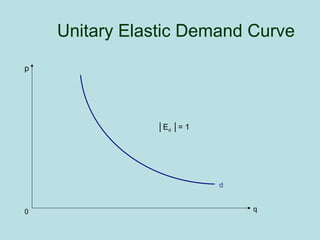
• If the absolute value of the elasticity is: 
> 1 elastic 
< 1 inelastic 
= 1 unitary elastic 
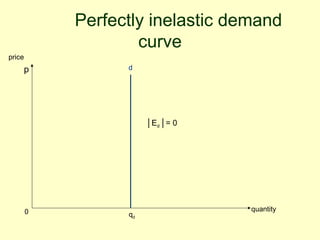
= 0 perfectly inelastic 
= infinity perfectly elastic
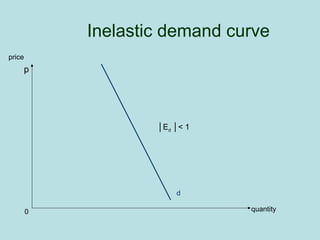
Inelastic demand curve 
d 
price 
quantity 
p 
0 
│Ed │< 1
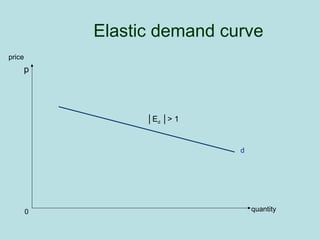
Elastic demand curve 
d 
price 
quantity 
p 
0 
│Ed │> 1
Unitary Elastic Demand Curve 
q 
d 
p 
0 
│Ed │= 1
Perfectly inelastic demand 
curve 
d 
price 
quantity 
p 
qd 
0 
│Ed │= 0
Example of perfectly inelastic 
demand? 
• What kind of good will the demand stay 
constant whether price goes up or down?
Example of perfectly inelastic 
demand? 
• What kind of good will the demand stay 
constant whether price goes up or down? 
• Insulin—diabetics cannot buy less even if 
price goes up, and if I walk into the 
pharmacy and see there is a sale on 
insulin, as a non-diabetic I don’t buy any!
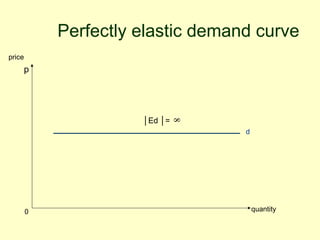
Perfectly elastic demand curve 
d 
price 
quantity 
p 
0 
│Ed │= 8
Perfectly elastic demand curve 
• Demand curve facing a firm in a perfectly 
competitive market—each firm is so small 
and there are so many firms that none can 
affect price—they are price takers.
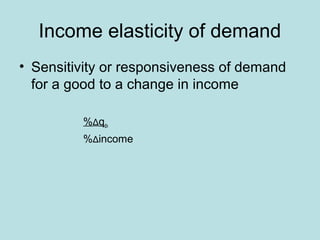
Income elasticity of demand 
• Sensitivity or responsiveness of demand 
for a good to a change in income 
%Δqdx 
%Δincome
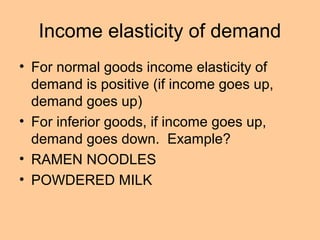
Income elasticity of demand 
• For normal goods income elasticity of 
demand is positive (if income goes up, 
demand goes up) 
• For inferior goods, if income goes up, 
demand goes down. Example?
Income elasticity of demand 
• For normal goods income elasticity of 
demand is positive (if income goes up, 
demand goes up) 
• For inferior goods, if income goes up, 
demand goes down. Example? 
• RAMEN NOODLES 
• POWDERED MILK
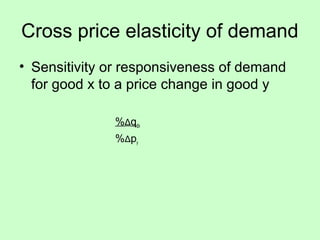
Cross price elasticity of demand 
• Sensitivity or responsiveness of demand 
for good x to a price change in good y 
%Δqdx 
%Δpy
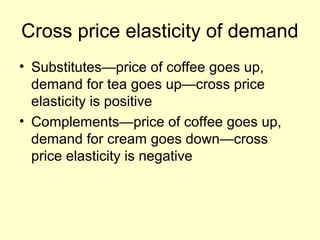
Cross price elasticity of demand 
• Substitutes—price of coffee goes up, 
demand for tea goes up—cross price 
elasticity is positive 
• Complements—price of coffee goes up, 
demand for cream goes down—cross 
price elasticity is negative
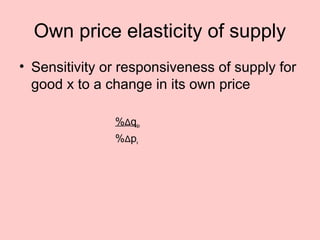
Own price elasticity of supply 
• Sensitivity or responsiveness of supply for 
good x to a change in its own price 
%Δqsx 
%Δpx
Wage elasticity of labor demand 
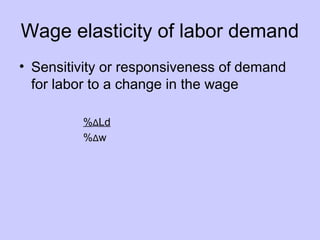
• Sensitivity or responsiveness of demand 
for labor to a change in the wage 
%ΔLd 
%Δw
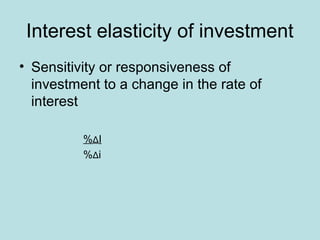
Interest elasticity of investment 
• Sensitivity or responsiveness of 
investment to a change in the rate of 
interest 
%ΔI 
%Δi
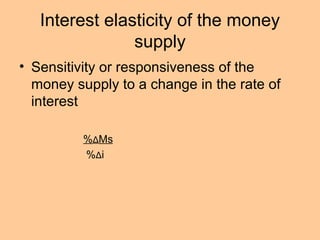
Interest elasticity of the money 
supply 
• Sensitivity or responsiveness of the 
money supply to a change in the rate of 
interest 
%ΔMs 
%Δi

Supply Demand and Equilibrium

  • 1.
    Supply, Demand & Equilibrium By: Abdullah Karim abdullahkarim22@gmail.com
  • 2.
    Market Exchange •For any market transaction to take place there has to be both a buyer and a seller. • Actually each wants what the other has. • The focus here is on the market for a particular good—cheese, chalk, chairs, widgets.
  • 3.
    Law of Supply • Law of supply states that there is a positive relation between price and quantity supplied. • If price goes up, quantity supplied goes up; if price goes down, quantity supplied goes down.
  • 4.
    Law of Demand • The law of demand states that there is a negative or inverse relation between price and quantity demanded. • If price goes up, quantity demanded goes down; if price goes down, quantity demanded goes up.
  • 5.
    Laws of supplyand demand versus the “theory of supply and demand” • Theory of supply and demand includes the laws of supply and demand, but the theory of supply and demand claims more than the laws do. • The theory of supply and demand states that price itself is determined by supply and demand forces.
  • 6.
    Laws can bein effect without theory—e.g., a command system • In a Soviet-style command system, the central planning board announces one week that oranges are $.25 a pound. • The next week they announce oranges are $2 a pound. • What will happen to the demand for oranges?
  • 7.
    Laws vs. Theoryof Supply and Demand • It will probably fall. • So the law of demand is in effect. • But how was price determined in the example? • Not by the theory of supply and demand— price was determined by the central planning board, by command. • So we have the laws without the theory.
  • 8.
    Different types ofdemand • Aggregate demand, aggregate consumption demand, aggregate investment demand—we will see these and others later. • We can speak of one individual’s demand for a particular good, or individual demand. • And all individuals’ demand for a particular good, or market demand.
  • 9.
    market demand •Demand is willingness and ability to buy specific quantities of a good at alternative prices in a given time period (ceteris paribus).
  • 10.
    market demand •If we don't include ability then it's not real demand, it's called… …wishing for something. • And it is not enough to be able to afford something, you have to want it as well— willingness.
  • 11.
    Market demand •I wish I had a Lamborghini, but if I can’t afford it, it is not demand. • I can afford a set of teenage mutant ninja turtle pillowcases, but if I don’t want them, it is not demand.
  • 12.
    Market demand •It has to be in a given time period, otherwise it is not clear what we are talking about—demand for something forever into the future?
  • 13.
    market demand •We say ceteris paribus because the willingness and ability may change depending on other factors, but for now we just want to focus on what happens to demand when price changes, so we have to hold these other things constant.
  • 14.
    market demand •Otherwise, if we don’t make the ceteris paribus assumption, and price changes, and quantity demanded changes, we won’t know if the change in demand is due to the price change or if it is due to one of the other factors that affect willingness or ability.
  • 15.
    assumptions behind themarket demand curve • In particular, we want to hold constant these factors that affect willingness or ability to buy:
  • 16.
    assumptions behind themarket demand curve • In particular, we want to hold constant these factors that affect willingness or ability to buy: – Income (affects ability to buy)
  • 17.
    assumptions behind themarket demand curve • In particular, we want to hold constant these factors that affect willingness or ability to buy: – Income (affects ability to buy) – Tastes or preferences (affects willingness to buy)
  • 18.
    assumptions behind themarket demand curve • In particular, we want to hold constant these factors that affect willingness or ability to buy: – Income (affects ability to buy) – Tastes or preferences (affects willingness to buy) – availability and price of related goods
  • 19.
  • 20.
    Related goods •substitutes
  • 21.
    Related goods •substitutes (coffee and tea)
  • 22.
    Related goods •substitutes (coffee and tea) • complements
  • 23.
    Related goods •substitutes (coffee and tea) • complements (coffee and cream)
  • 24.
    assumptions behind themarket demand curve • expectations of price, income and tastes
  • 25.
    assumptions behind themarket demand curve • expectations of price, income and tastes • number of buyers in the market
  • 26.
    individual and marketdemand • Market demand is the total quantities of a good or service that people are willing and able to buy at alternative prices in a given time period, ceteris paribus (or simply the sum of individual demands).
  • 27.
    market demand Curve price (p) demand (d) quantity (q) 0
  • 28.
    market supply •everything we said about market demand is also applies to market supply (except the relation between price and quantity supplied and the factors that affect willingness and ability)
  • 29.
    market supply •Market supply is the total quantities of a good that sellers are willing and able to sell at alternative prices in a given time period (ceteris paribus), or simply the combined willingness and ability of all market suppliers to sell.
  • 30.
    market supply •must be both willingness and ability to sell • not a statement of actual sales, that will depend on the actual price • given time period • ceteris paribus
  • 31.
    Assumptions behind themarket supply curve
  • 32.
    Assumptions behind themarket supply curve • cost of production
  • 33.
    Assumptions behind themarket supply curve • cost of production – input prices
  • 34.
    Assumptions behind themarket supply curve • cost of production – input prices – technology
  • 35.
    Assumptions behind themarket supply curve • cost of production – input prices – Technology • expectations (of future price)
  • 36.
    Assumptions behind themarket supply curve • cost of production – input prices – Technology • expectations (of future price) • number of sellers in the market
  • 37.
    market supply curve p (price) s (supply) q (quantity) 0
  • 38.
    market supply anddemand curves p q s d p* 0 q*
  • 39.
  • 40.
    market equilibrium •unique equilibrium of market supply and demand
  • 41.
    market equilibrium •unique equilibrium of market supply and demand • equilibrium price ( p*) is price at which quantity supplied = quantity demanded (qs = qd)
  • 42.
    market equilibrium •unique equilibrium of market supply and demand • equilibrium price ( p*) is price at which quantity supplied = quantity demanded (qs = qd) • equilibrium quantity (q*) is quantity corresponding to equilibrium price
  • 43.
    Disequilibrium—price p1 above equilibrium price p* qs > qd • excess supply or market surplus
  • 44.
    excess supply ormarket surplus p q s d p* qd1 qs1 p1 0 Excess Supply
  • 45.
  • 46.
    equilibrating process •competition between and among buyers and sellers sets off equilibrium process
  • 47.
    equilibrating process •competition between and among buyers and sellers sets off equilibrium process • Firms with excess inventories cut prices to try to undersell their competition
  • 48.
    equilibrating process •competition between and among buyers and sellers sets off equilibrium process • Firms with excess inventories cut prices to try to undersell their competition • As price falls, quantity demanded rises, and quantity supplied falls
  • 49.
    equilibrating process •competition between and among buyers and sellers sets off equilibrium process • Firms with excess inventories cut prices to try to undersell their competition • As price falls, quantity demanded rises, and quantity supplied falls • Process continues until p = p* and (qs = qd)
  • 50.
    market returns toequilibrium p q s d p* 0 q*
  • 51.
    Disequilibrium—price p1 below equilibrium price p* qs < qd • excess demand or market shortage
  • 52.
    excess demand ormarket shortage p q s q p* Excess Demand qs2 qd2 p1 0
  • 53.
  • 54.
    equilibrating process •competition between and among buyers and sellers sets off equilibrium process
  • 55.
    equilibrating process •competition between and among buyers and sellers sets off equilibrium process • buyers competing with one another for goods in short supply bid up price to try to capture some of the good
  • 56.
    equilibrating process •competition between and among buyers and sellers sets off equilibrium process • buyers competing with one another for goods in short supply bid up price to try to capture some of the good • as price goes up, demand falls and supply rises
  • 57.
    equilibrating process •competition between and among buyers and sellers sets off equilibrium process • buyers competing with one another for goods in short supply bid up price to try to capture some of the good • as price goes up, demand falls and supply rises • Process continues until p = p* and qs = qd
  • 58.
    the role ofcompetition in a market economy
  • 59.
    the role ofcompetition in a market economy two necessary aspects for competition:
  • 60.
    the role ofcompetition in a market economy two necessary aspects for competition: 1) competition between buyers and sellers
  • 61.
    the role ofcompetition in a market economy two necessary aspects for competition: 1) competition between buyers and sellers buyers and sellers have conflicting interests. One side wants the price up, the other side wants the price down, and a competitive bargaining process must occur to determine an agreement.
  • 62.
    the role ofcompetition in a market economy two necessary aspects for competition: 2) competition among buyers and among sellers.
  • 63.
    the role ofcompetition in a market economy two necessary aspects for competition: 2) competition among buyers and among sellers. Sellers compete with other sellers to gain market share and profit. And buyers may try to outbid one another for goods that they want to purchase.
  • 64.
    competition competition forcesbuyers and sellers to do just the opposite of what they seem to want—it forces sellers to cut price and it forces buyers to bid up the price. This dual struggle—between and among buyers and sellers—is the competitive market mechanism that pushes and pulls the market back to equilibrium price and quantity from any disequilibrium position.
  • 65.
    movement from: disequilibriumto equilibrium versus movement from: old equilibrium to a new equilibrium
  • 66.
    disequilibrium vs. newequilibrium • movement along the curves from changes in variables measured along the axes • shift in curves from changes in assumptions behind the curves
  • 67.
    shift out ofdemand curve p q s d1 p1 q1 p2 q2 d2 0
  • 68.
    shift of demandcurve • shifts out from:
  • 69.
    shift of demandcurve • shifts out from: – increased income
  • 70.
    shift of demandcurve • shifts out from: – increased income – stronger tastes or preferences
  • 71.
    shift of demandcurve • shifts out from: – increased income – stronger tastes or preferences – increased price of substitutes
  • 72.
    shift of demandcurve • shifts out from: – increased income – stronger tastes or preferences – increased price of substitutes – decreased price of complements
  • 73.
    shift of demandcurve • shifts out from: – increased income – stronger tastes or preferences – increased price of substitutes – decreased price of complements – expectations of above
  • 74.
    shift of demandcurve • shifts out from: – increased income – stronger tastes or preferences – increased price of substitutes – decreased price of complements – expectations of above – more buyers in market
  • 75.
    shift of demandcurve • shifts in from:
  • 76.
    shift of demandcurve • shifts in from: – decreased income
  • 77.
    shift of demandcurve • shifts in from: – decreased income – weaker tastes or preferences
  • 78.
    shift of demandcurve • shifts in from: – decreased income – weaker tastes or preferences – decreased price of substitutes
  • 79.
    shift of demandcurve • shifts in from: – decreased income – weaker tastes or preferences – decreased price of substitutes – increased price of complements
  • 80.
    shift of demandcurve • shifts in from: – decreased income – weaker tastes or preferences – decreased price of substitutes – increased price of complements – expectations of above
  • 81.
    shift of demandcurve • shifts in from: – decreased income – weaker tastes or preferences – decreased price of substitutes – increased price of complements – expectations of above – fewer buyers in market
  • 82.
    demand curve shiftsin p q s d1 p1 q1 p2 q2 d2 0
  • 83.
  • 84.
    shift of supplycurve • shifts in from:
  • 85.
    shift of supplycurve • shifts in from: – higher costs of production
  • 86.
    shift of supplycurve • shifts in from: – higher costs of production • higher input prices
  • 87.
    shift of supplycurve • shifts in from: – higher costs of production • higher input prices • technological decline
  • 88.
    shift of supplycurve • shifts in from: – higher costs of production • higher input prices • technological decline – dimmer expectations
  • 89.
    shift of supplycurve • shifts in from: – higher costs of production • higher input prices • technological decline – dimmer expectations – fewer sellers in the market
  • 90.
    supply curve shiftsin Price Quantity S1 D p1 q1 S2 p2 0 q2
  • 91.
    shift of supplycurve • shifts out from:
  • 92.
    shift of supplycurve • shifts out from: – lower costs of production
  • 93.
    shift of supplycurve • shifts out from: – lower costs of production • lower input prices
  • 94.
    shift of supplycurve • shifts out from: – lower costs of production • lower input prices • technological advance
  • 95.
    shift of supplycurve • shifts out from: – lower costs of production • lower input prices • technological advance – brighter expectations
  • 96.
    shift of supplycurve • shifts out from: – lower costs of production • lower input prices • technological advance – brighter expectations – more sellers in the market
  • 97.
    supply curve shiftsout Price Quantity S1 D p1 q1 S2 p2 0 q2
  • 98.
    law of demand • the law of demand usually holds, but it can be violated on occasion. • usually if price goes up, demand goes down, and if price goes down demand goes up. • But there are exceptional cases where when price goes up, demand actually goes up!
  • 99.
    “Giffen goods” •Case in Ireland during the potato famine, when price of potatoes went up, demand for potatoes went up. (hint: the average family ate potatoes for dinner six nights a week and one night a week they ate meat.)
  • 100.
    Giffen goods •Reason: meat was still much more expensive than potatoes, so when the price of potatoes went up, families had to stop eating meat the one night and eat potatoes seven nights a week.
  • 101.
    violations of lawof demand • Also, the demand curve can be upward sloping in the case of goods that people value more when the price is higher—they think that price is an indicator of quality! Think of the situation where a price is low, so you think there must be something wrong with it.
  • 102.
    consumer theory •A number of interesting tendencies along these lines:
  • 103.
    consumer theory •A number of interesting tendencies along these lines: 1) bandwagon effect: you buy something to be part of the crowd
  • 104.
    consumer theory •A number of interesting tendencies along these lines: 1) bandwagon effect: you buy something to be part of the crowd 2) Snob effect: you buy something to distinguish yourself from the crowd (can be designer jeans, or ripped up jeans!)
  • 105.
    consumer theory •A number of interesting tendencies along these lines: 1) bandwagon effect: you buy something to be part of the crowd 2) Snob effect: you buy something to distinguish yourself from the crowd (can be designer jeans, or ripped up jeans!) 3) Veblen effect: you buy something to show you can afford it
  • 106.
    law of demand but normally, the law of demand is said to hold in neoclassical economics: when price goes up, quantity demanded goes down; when price goes down, quantity demanded goes up. But how much does quantity demanded change when price changes?
  • 107.
    Elasticity • Ineconomics, we use the concept of elasticity to measure the sensitivity or responsiveness of one variable to another.
  • 108.
    Own price elasticityof demand • Is the sensitivity or responsiveness of a change in the demand for a good to a change in its own price. • Measure as: %Δqdx %Δpx
  • 109.
    Own price elasticityof demand • Factors that determine: 1) Availability and price of close substitutes (many—elastic; few—inelastic) 2) % of budget devoted to the good (small—inelastic; large—elastic) 3) Time (short run—inelastic; long run--elastic
  • 110.
    Own price elasticityof demand Who cares? Firms want to know how a price change will affect total revenue Elastic price goes down—total revenue goes up Elastic price goes up—total revenue goes down Inelastic price goes up—total revenue goes up Inelastic price goes down—total revenue goes down Unitary elastic price goes up or down—total revenue stays the same
  • 111.
    Own price elasticityof demand • If the absolute value of the elasticity is: > 1 elastic < 1 inelastic = 1 unitary elastic = 0 perfectly inelastic = infinity perfectly elastic
  • 112.
    Inelastic demand curve d price quantity p 0 │Ed │< 1
  • 113.
    Elastic demand curve d price quantity p 0 │Ed │> 1
  • 114.
    Unitary Elastic DemandCurve q d p 0 │Ed │= 1
  • 115.
    Perfectly inelastic demand curve d price quantity p qd 0 │Ed │= 0
  • 116.
    Example of perfectlyinelastic demand? • What kind of good will the demand stay constant whether price goes up or down?
  • 117.
    Example of perfectlyinelastic demand? • What kind of good will the demand stay constant whether price goes up or down? • Insulin—diabetics cannot buy less even if price goes up, and if I walk into the pharmacy and see there is a sale on insulin, as a non-diabetic I don’t buy any!
  • 118.
    Perfectly elastic demandcurve d price quantity p 0 │Ed │= 8
  • 119.
    Perfectly elastic demandcurve • Demand curve facing a firm in a perfectly competitive market—each firm is so small and there are so many firms that none can affect price—they are price takers.
  • 120.
    Income elasticity ofdemand • Sensitivity or responsiveness of demand for a good to a change in income %Δqdx %Δincome
  • 121.
    Income elasticity ofdemand • For normal goods income elasticity of demand is positive (if income goes up, demand goes up) • For inferior goods, if income goes up, demand goes down. Example?
  • 122.
    Income elasticity ofdemand • For normal goods income elasticity of demand is positive (if income goes up, demand goes up) • For inferior goods, if income goes up, demand goes down. Example? • RAMEN NOODLES • POWDERED MILK
  • 123.
    Cross price elasticityof demand • Sensitivity or responsiveness of demand for good x to a price change in good y %Δqdx %Δpy
  • 124.
    Cross price elasticityof demand • Substitutes—price of coffee goes up, demand for tea goes up—cross price elasticity is positive • Complements—price of coffee goes up, demand for cream goes down—cross price elasticity is negative
  • 125.
    Own price elasticityof supply • Sensitivity or responsiveness of supply for good x to a change in its own price %Δqsx %Δpx
  • 126.
    Wage elasticity oflabor demand • Sensitivity or responsiveness of demand for labor to a change in the wage %ΔLd %Δw
  • 127.
    Interest elasticity ofinvestment • Sensitivity or responsiveness of investment to a change in the rate of interest %ΔI %Δi
  • 128.
    Interest elasticity ofthe money supply • Sensitivity or responsiveness of the money supply to a change in the rate of interest %ΔMs %Δi