MANUFACTURING
Processes and Techniques
by prof. naman m. dave
OUTLINE
 THEORY OF METAL CUTTING
 TRADITIONAL AND NON-TRADITIONAL MACHINING
PROCESSES.
 WELDING & CASTING.
 TOLERANCE AND FITS
 METAL FORMING
THEORY OF METAL CUTTING
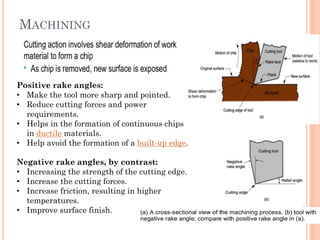
MACHINING
Positive rake angles:
• Make the tool more sharp and pointed.
• Reduce cutting forces and power
requirements.
• Helps in the formation of continuous chips
in ductile materials.
• Help avoid the formation of a built-up edge.
Negative rake angles, by contrast:
• Increasing the strength of the cutting edge.
• Increase the cutting forces.
• Increase friction, resulting in higher
temperatures.
• Improve surface finish.
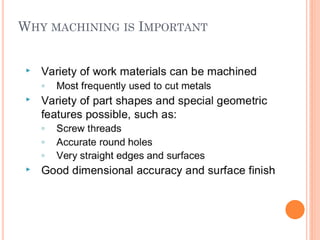
WHY MACHINING IS IMPORTANT
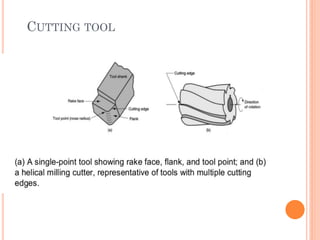
CUTTING TOOL
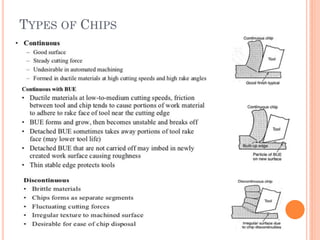
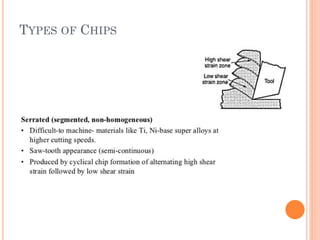
TYPES OF CHIPS
TYPES OF CHIPS
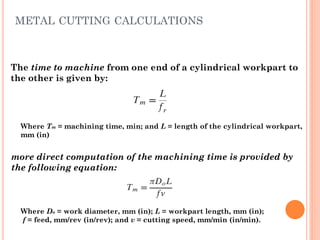
The time to machine from one end of a cylindrical workpart to
the other is given by:
Where Tm = machining time, min; and L = length of the cylindrical workpart,
mm (in)
more direct computation of the machining time is provided by
the following equation:
Where Do = work diameter, mm (in); L = workpart length, mm (in);
f = feed, mm/rev (in/rev); and v = cutting speed, mm/min (in/min).
METAL CUTTING CALCULATIONS
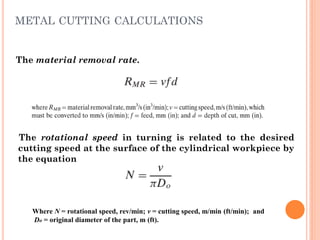
The rotational speed in turning is related to the desired
cutting speed at the surface of the cylindrical workpiece by
the equation
Where N = rotational speed, rev/min; v = cutting speed, m/min (ft/min); and
Do = original diameter of the part, m (ft).
The material removal rate.
METAL CUTTING CALCULATIONS
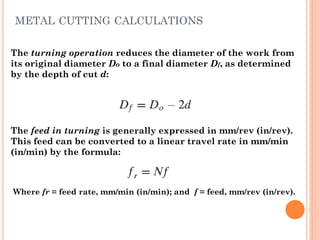
The turning operation reduces the diameter of the work from
its original diameter Do to a final diameter Df, as determined
by the depth of cut d:
The feed in turning is generally expressed in mm/rev (in/rev).
This feed can be converted to a linear travel rate in mm/min
(in/min) by the formula:
Where fr = feed rate, mm/min (in/min); and f = feed, mm/rev (in/rev).
METAL CUTTING CALCULATIONS
TRADITIONAL AND NON-TRADITIONAL
MACHINING PROCESSES
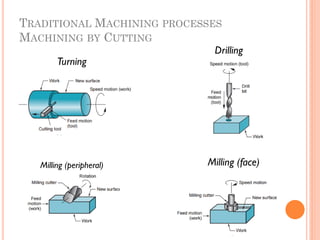
TRADITIONAL MACHINING PROCESSES
MACHINING BY CUTTING
Turning
Drilling
Milling (face)Milling (peripheral)
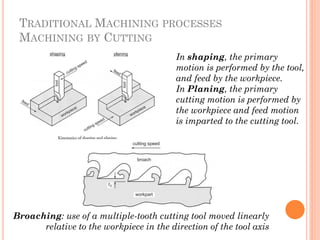
TRADITIONAL MACHINING PROCESSES
MACHINING BY CUTTING
In shaping, the primary
motion is performed by the tool,
and feed by the workpiece.
In Planing, the primary
cutting motion is performed by
the workpiece and feed motion
is imparted to the cutting tool.
Broaching: use of a multiple-tooth cutting tool moved linearly
relative to the workpiece in the direction of the tool axis
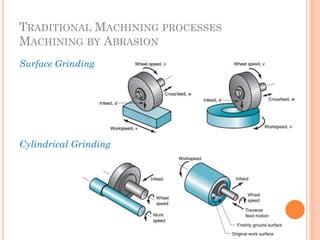
TRADITIONAL MACHINING PROCESSES
MACHINING BY ABRASION
Surface Grinding
Cylindrical Grinding
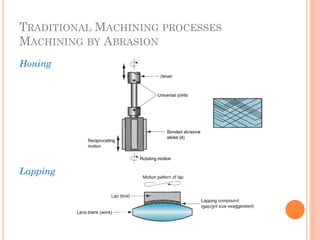
TRADITIONAL MACHINING PROCESSES
MACHINING BY ABRASION
Honing
Lapping
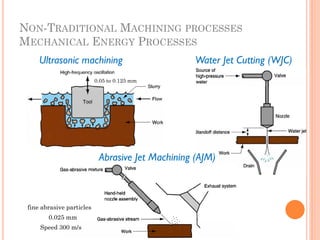
NON-TRADITIONAL MACHINING PROCESSES
MECHANICAL ENERGY PROCESSES
Ultrasonic machining Water Jet Cutting (WJC)
Abrasive Jet Machining (AJM)
Speed 300 m/s
0.025 mm
fine abrasive particles
0.05 to 0.125 mm
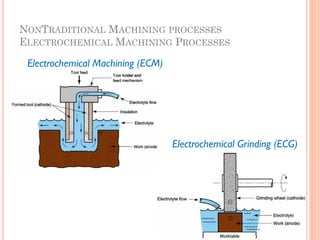
NONTRADITIONAL MACHINING PROCESSES
ELECTROCHEMICAL MACHINING PROCESSES
Electrochemical Machining (ECM)
Electrochemical Grinding (ECG)
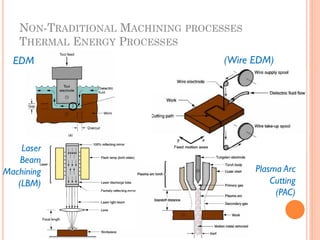
NON-TRADITIONAL MACHINING PROCESSES
THERMAL ENERGY PROCESSES
(Wire EDM)
Plasma Arc
Cutting
(PAC)
EDM
Laser
Beam
Machining
(LBM)
MULTIPLE CHOICE QUESTIONS
(MCQ)
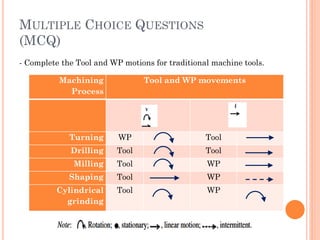
- Complete the Tool and WP motions for traditional machine tools.
Machining
Process
Tool and WP movements
Turning WP Tool
Drilling Tool Tool
Milling Tool WP
Shaping Tool WP
Cylindrical
grinding
Tool WP
MULTIPLE CHOICE QUESTIONS
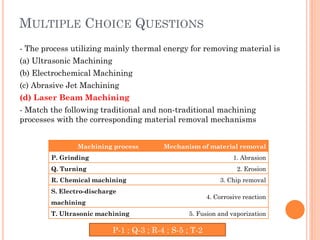
- The process utilizing mainly thermal energy for removing material is
(a) Ultrasonic Machining
(b) Electrochemical Machining
(c) Abrasive Jet Machining
(d) Laser Beam Machining
- Match the following traditional and non-traditional machining
processes with the corresponding material removal mechanisms
Machining process Mechanism of material removal
P. Grinding 1. Abrasion
Q. Turning 2. Erosion
R. Chemical machining 3. Chip removal
S. Electro-discharge
machining
4. Corrosive reaction
T. Ultrasonic machining 5. Fusion and vaporization
P-1 ; Q-3 ; R-4 ; S-5 ; T-2
WELDING & CASTING
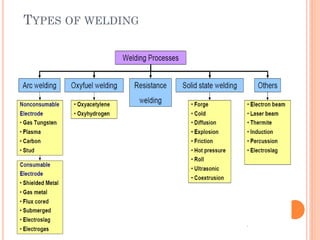
TYPES OF WELDING
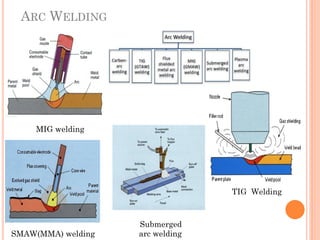
ARC WELDING
MIG welding
Submerged
arc welding
TIG Welding
SMAW(MMA) welding
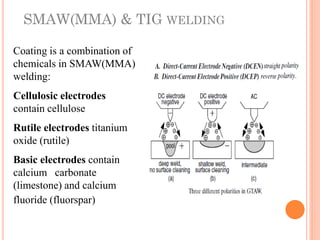
Coating is a combination of
chemicals in SMAW(MMA)
welding:
Cellulosic electrodes
contain cellulose
Rutile electrodes titanium
oxide (rutile)
Basic electrodes contain
calcium carbonate
(limestone) and calcium
fluoride (fluorspar)
SMAW(MMA) & TIG WELDING
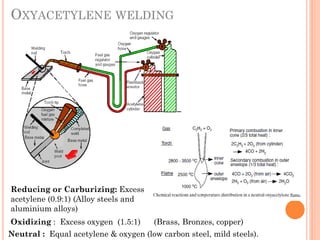
OXYACETYLENE WELDING
Reducing or Carburizing: Excess
acetylene (0.9:1) (Alloy steels and
aluminium alloys)
Oxidizing : Excess oxygen (1.5:1) (Brass, Bronzes, copper)
Neutral : Equal acetylene & oxygen (low carbon steel, mild steels).
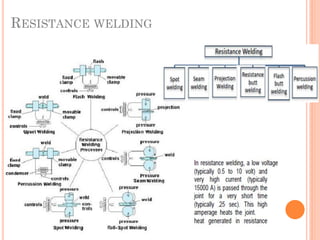
RESISTANCE WELDING
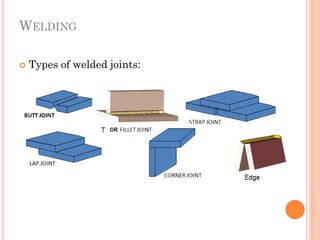
WELDING
 Types of welded joints:
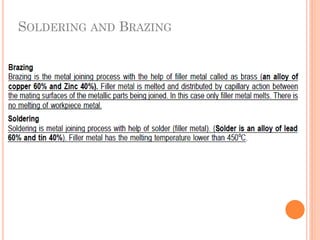
SOLDERING AND BRAZING
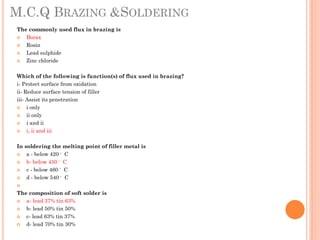
SOLDERING&M.C.Q BRAZING
The commonly used flux in brazing is
 Borax
 Rosin
 Lead sulphide
 Zinc chloride
Which of the following is function(s) of flux used in brazing?
i- Protect surface from oxidation
ii- Reduce surface tension of filler
iii- Assist its penetration
 i only
 ii only
 i and ii
 i, ii and iii
In soldering the melting point of filler metal is
 a - below 420 ◦ C
 b- below 450 ◦ C
 c - below 460 ◦ C
 d - below 540 ◦ C

The composition of soft solder is
 a- lead 37% tin 63%
 b- lead 50% tin 50%
 c- lead 63% tin 37%
 d- lead 70% tin 30%
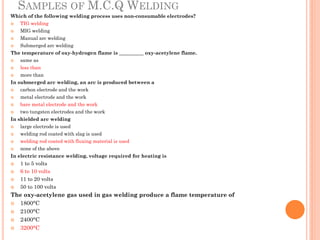
SAMPLES OF M.C.Q WELDING
Which of the following welding process uses non-consumable electrodes?
 TIG welding
 MIG welding
 Manual arc welding
 Submerged arc welding
The temperature of oxy-hydrogen flame is __________ oxy-acetylene flame.
 same as
 less than
 more than
In submerged arc welding, an arc is produced between a
 carbon electrode and the work
 metal electrode and the work
 bare metal electrode and the work
 two tungsten electrodes and the work
In shielded arc welding
 large electrode is used
 welding rod coated with slag is used
 welding rod coated with fluxing material is used
 none of the above
In electric resistance welding, voltage required for heating is
 1 to 5 volts
 6 to 10 volts
 11 to 20 volts
 50 to 100 volts
The oxy-acetylene gas used in gas welding produce a flame temperature of
 1800°C
 2100°C
 2400°C
 3200°C
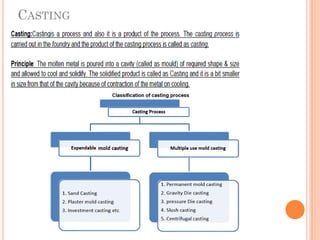
CASTING
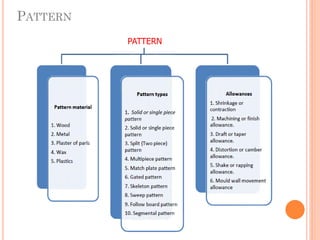
PATTERN
PATTERN
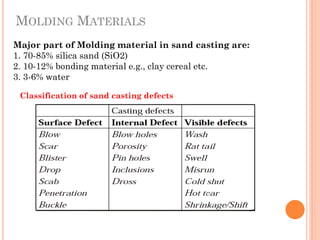
MOLDING MATERIALS
Major part of Molding material in sand casting are:
1. 70-85% silica sand (SiO2)
2. 10-12% bonding material e.g., clay cereal etc.
3. 3-6% water
Classification of sand casting defects
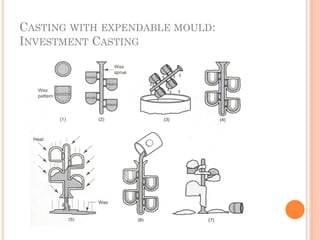
CASTING WITH EXPENDABLE MOULD:
INVESTMENT CASTING
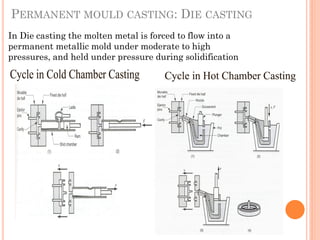
PERMANENT MOULD CASTING: DIE CASTING
In Die casting the molten metal is forced to flow into a
permanent metallic mold under moderate to high
pressures, and held under pressure during solidification
DIE CASTING
This uses pressures up to 35 MPa and is used for zinc, tin, lead, and
their alloys
In this process, pressures as high as 150 MPa are used. The storing
chamber is not heated. This process is used mainly for metals and alloys
having relatively higher melting point e.g., aluminium, magnesium and
their alloys.
CENTRIFUGAL CASTING
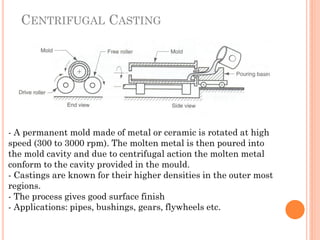
- A permanent mold made of metal or ceramic is rotated at high
speed (300 to 3000 rpm). The molten metal is then poured into
the mold cavity and due to centrifugal action the molten metal
conform to the cavity provided in the mould.
- Castings are known for their higher densities in the outer most
regions.
- The process gives good surface finish
- Applications: pipes, bushings, gears, flywheels etc.
SAMPLES OF M.C.Q CASTING
 Sand casting is which of the following types?
(a) expendable mold, or (b) permanent mold.
 The upper half of a sand casting mold is called
which of the following?
(a) cope, or (b) drag.
 In casting, a flask is which one of the following?
(a) beverage bottle for foundry men,
(b) box which holds the cope and drag,
(c) container for holding liquid metal,
(d) metal which extrudes
SAMPLES OF M.C.Q CASTING
In foundry work, a runner is which one of the following?
(a) channel in the mold leading from the Down sprue to the main mold
cavity,
(b) foundry man who moves the molten metal to the mold, or
(c) vertical channel into which molten metal is poured into the mold.
Total solidification time is defined as which one of the following?
(a) time between pouring and complete solidification,
(b) time between pouring and cooling to room temperature,
(c) time between solidification and cooling to room temperature, or (d) time
to give up the heat of fusion.
In a cold chamber die casting machine
 melting pot is separate from the machine
 melting pot is an integral part of the machine
 melting pot may have any location
 low temperature and pressure is used
TOLERANCE AND FITS
TOLERANCE AND FITS
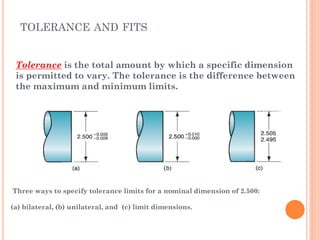
Three ways to specify tolerance limits for a nominal dimension of 2.500:
(a) bilateral, (b) unilateral, and (c) limit dimensions.
Tolerance is the total amount by which a specific dimension
is permitted to vary. The tolerance is the difference between
the maximum and minimum limits.
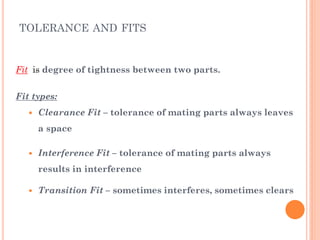
Fit is degree of tightness between two parts.
Fit types:
 Clearance Fit – tolerance of mating parts always leaves
a space
 Interference Fit – tolerance of mating parts always
results in interference
 Transition Fit – sometimes interferes, sometimes clears
TOLERANCE AND FITS
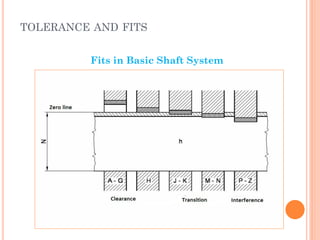
Fits in Basic Shaft System
TOLERANCE AND FITS
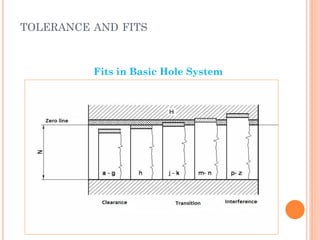
Fits in Basic Hole System
TOLERANCE AND FITS
METAL FORMING
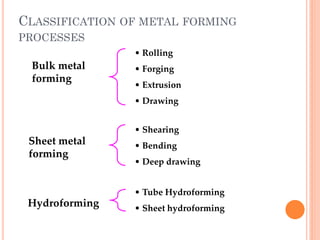
Bulk metal
forming
Sheet metal
forming
• Rolling
• Forging
• Extrusion
• Drawing
• Shearing
• Bending
• Deep drawing
Hydroforming
• Tube Hydroforming
• Sheet hydroforming
CLASSIFICATION OF METAL FORMING
PROCESSES
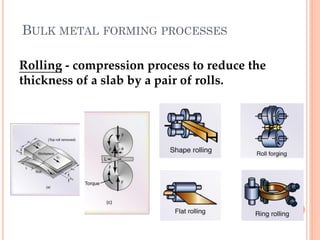
compression process to reduce the-Rolling
thickness of a slab by a pair of rolls.
BULK METAL FORMING PROCESSES
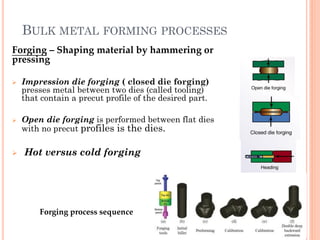
Shaping material by hammering or–Forging
pressing
 Impression die forging ( closed die forging)
presses metal between two dies (called tooling)
that contain a precut profile of the desired part.
 Open die forging is performed between flat dies
with no precut profiles is the dies.
 Hot versus cold forging
Forging process sequence
BULK METAL FORMING PROCESSES
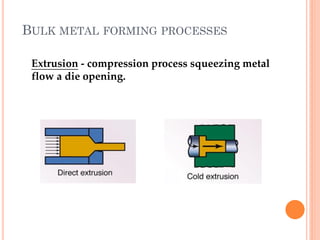
compression process squeezing metal-Extrusion
flow a die opening.
BULK METAL FORMING PROCESSES
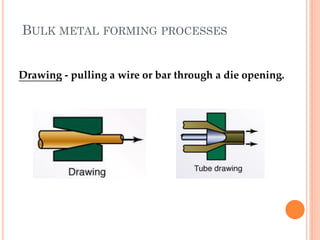
Drawing - pulling a wire or bar through a die opening.
BULK METAL FORMING PROCESSES
SHEET METAL FORMING PROCESSES
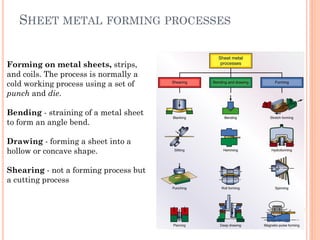
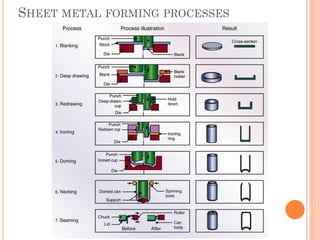
Forming on metal sheets, strips,
and coils. The process is normally a
cold working process using a set of
punch and die.
Bending - straining of a metal sheet
to form an angle bend.
Drawing - forming a sheet into a
hollow or concave shape.
Shearing - not a forming process but
a cutting process
SHEET METAL FORMING PROCESSES
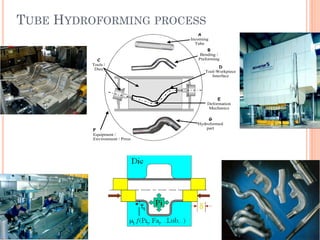
TUBE HYDROFORMING PROCESS
C
Tools /
Dies
A
Incoming
Tube
D
Tool-Workpiece
Interface
E
Deformation
Mechanics
F
Equipment /
Environment / Press
G
Hydroformed
part
B
Bending /
Preforming
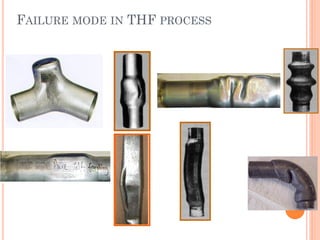
FAILURE MODE IN THF PROCESS
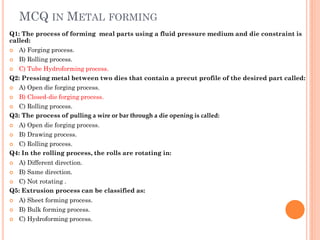
MCQ IN METAL FORMING
Q1: The process of forming metal parts using a fluid pressure medium and die constraint is
called:
 A) Forging process.
 B) Rolling process.
 C) Tube Hydroforming process.
Q2: Pressing metal between two dies that contain a precut profile of the desired part called:
 A) Open die forging process.
 B) Closed-die forging process.
 C) Rolling process.
Q3: The process of pulling a wire or bar through a die opening is called:
 A) Open die forging process.
 B) Drawing process.
 C) Rolling process.
Q4: In the rolling process, the rolls are rotating in:
 A) Different direction.
 B) Same direction.
 C) Not rotating .
Q5: Extrusion process can be classified as:
 A) Sheet forming process.
 B) Bulk forming process.
 C) Hydroforming process.
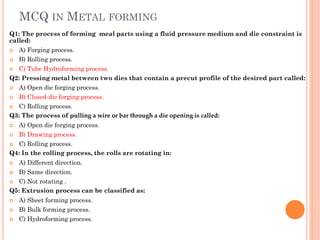
MCQ IN METAL FORMING
Q1: The process of forming meal parts using a fluid pressure medium and die constraint is
called:
 A) Forging process.
 B) Rolling process.
 C) Tube Hydroforming process.
Q2: Pressing metal between two dies that contain a precut profile of the desired part called:
 A) Open die forging process.
 B) Closed-die forging process.
 C) Rolling process.
Q3: The process of pulling a wire or bar through a die opening is called:
 A) Open die forging process.
 B) Drawing process.
 C) Rolling process.
Q4: In the rolling process, the rolls are rotating in:
 A) Different direction.
 B) Same direction.
 C) Not rotating .
Q5: Extrusion process can be classified as:
 A) Sheet forming process.
 B) Bulk forming process.
 C) Hydroforming process.
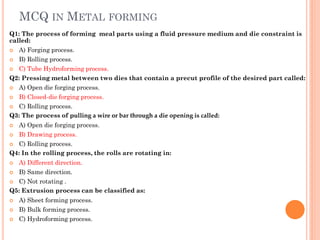
MCQ IN METAL FORMING
Q1: The process of forming meal parts using a fluid pressure medium and die constraint is
called:
 A) Forging process.
 B) Rolling process.
 C) Tube Hydroforming process.
Q2: Pressing metal between two dies that contain a precut profile of the desired part called:
 A) Open die forging process.
 B) Closed-die forging process.
 C) Rolling process.
Q3: The process of pulling a wire or bar through a die opening is called:
 A) Open die forging process.
 B) Drawing process.
 C) Rolling process.
Q4: In the rolling process, the rolls are rotating in:
 A) Different direction.
 B) Same direction.
 C) Not rotating .
Q5: Extrusion process can be classified as:
 A) Sheet forming process.
 B) Bulk forming process.
 C) Hydroforming process.
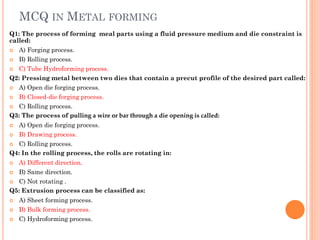
MCQ IN METAL FORMING
Q1: The process of forming meal parts using a fluid pressure medium and die constraint is
called:
 A) Forging process.
 B) Rolling process.
 C) Tube Hydroforming process.
Q2: Pressing metal between two dies that contain a precut profile of the desired part called:
 A) Open die forging process.
 B) Closed-die forging process.
 C) Rolling process.
Q3: The process of pulling a wire or bar through a die opening is called:
 A) Open die forging process.
 B) Drawing process.
 C) Rolling process.
Q4: In the rolling process, the rolls are rotating in:
 A) Different direction.
 B) Same direction.
 C) Not rotating .
Q5: Extrusion process can be classified as:
 A) Sheet forming process.
 B) Bulk forming process.
 C) Hydroforming process.
MCQ IN METAL FORMING
Q1: The process of forming meal parts using a fluid pressure medium and die constraint is
called:
 A) Forging process.
 B) Rolling process.
 C) Tube Hydroforming process.
Q2: Pressing metal between two dies that contain a precut profile of the desired part called:
 A) Open die forging process.
 B) Closed-die forging process.
 C) Rolling process.
Q3: The process of pulling a wire or bar through a die opening is called:
 A) Open die forging process.
 B) Drawing process.
 C) Rolling process.
Q4: In the rolling process, the rolls are rotating in:
 A) Different direction.
 B) Same direction.
 C) Not rotating .
Q5: Extrusion process can be classified as:
 A) Sheet forming process.
 B) Bulk forming process.
 C) Hydroforming process.
MCQ IN METAL FORMING
Q1: The process of forming meal parts using a fluid pressure medium and die constraint is
called:
 A) Forging process.
 B) Rolling process.
 C) Tube Hydroforming process.
Q2: Pressing metal between two dies that contain a precut profile of the desired part called:
 A) Open die forging process.
 B) Closed-die forging process.
 C) Rolling process.
Q3: The process of pulling a wire or bar through a die opening is called:
 A) Open die forging process.
 B) Drawing process.
 C) Rolling process.
Q4: In the rolling process, the rolls are rotating in:
 A) Different direction.
 B) Same direction.
 C) Not rotating .
Q5: Extrusion process can be classified as:
 A) Sheet forming process.
 B) Bulk forming process.
 C) Hydroforming process.
THANKS AND GOOD LUCK 

Manufacturing processes presentation

  • 1.
  • 2.
    OUTLINE  THEORY OFMETAL CUTTING  TRADITIONAL AND NON-TRADITIONAL MACHINING PROCESSES.  WELDING & CASTING.  TOLERANCE AND FITS  METAL FORMING
  • 3.
  • 4.
    MACHINING Positive rake angles: •Make the tool more sharp and pointed. • Reduce cutting forces and power requirements. • Helps in the formation of continuous chips in ductile materials. • Help avoid the formation of a built-up edge. Negative rake angles, by contrast: • Increasing the strength of the cutting edge. • Increase the cutting forces. • Increase friction, resulting in higher temperatures. • Improve surface finish.
  • 5.
  • 6.
  • 7.
  • 8.
  • 9.
    The time tomachine from one end of a cylindrical workpart to the other is given by: Where Tm = machining time, min; and L = length of the cylindrical workpart, mm (in) more direct computation of the machining time is provided by the following equation: Where Do = work diameter, mm (in); L = workpart length, mm (in); f = feed, mm/rev (in/rev); and v = cutting speed, mm/min (in/min). METAL CUTTING CALCULATIONS
  • 10.
    The rotational speedin turning is related to the desired cutting speed at the surface of the cylindrical workpiece by the equation Where N = rotational speed, rev/min; v = cutting speed, m/min (ft/min); and Do = original diameter of the part, m (ft). The material removal rate. METAL CUTTING CALCULATIONS
  • 11.
    The turning operationreduces the diameter of the work from its original diameter Do to a final diameter Df, as determined by the depth of cut d: The feed in turning is generally expressed in mm/rev (in/rev). This feed can be converted to a linear travel rate in mm/min (in/min) by the formula: Where fr = feed rate, mm/min (in/min); and f = feed, mm/rev (in/rev). METAL CUTTING CALCULATIONS
  • 12.
  • 13.
    TRADITIONAL MACHINING PROCESSES MACHININGBY CUTTING Turning Drilling Milling (face)Milling (peripheral)
  • 14.
    TRADITIONAL MACHINING PROCESSES MACHININGBY CUTTING In shaping, the primary motion is performed by the tool, and feed by the workpiece. In Planing, the primary cutting motion is performed by the workpiece and feed motion is imparted to the cutting tool. Broaching: use of a multiple-tooth cutting tool moved linearly relative to the workpiece in the direction of the tool axis
  • 15.
    TRADITIONAL MACHINING PROCESSES MACHININGBY ABRASION Surface Grinding Cylindrical Grinding
  • 16.
  • 17.
    NON-TRADITIONAL MACHINING PROCESSES MECHANICALENERGY PROCESSES Ultrasonic machining Water Jet Cutting (WJC) Abrasive Jet Machining (AJM) Speed 300 m/s 0.025 mm fine abrasive particles 0.05 to 0.125 mm
  • 18.
    NONTRADITIONAL MACHINING PROCESSES ELECTROCHEMICALMACHINING PROCESSES Electrochemical Machining (ECM) Electrochemical Grinding (ECG)
  • 19.
    NON-TRADITIONAL MACHINING PROCESSES THERMALENERGY PROCESSES (Wire EDM) Plasma Arc Cutting (PAC) EDM Laser Beam Machining (LBM)
  • 20.
    MULTIPLE CHOICE QUESTIONS (MCQ) -Complete the Tool and WP motions for traditional machine tools. Machining Process Tool and WP movements Turning WP Tool Drilling Tool Tool Milling Tool WP Shaping Tool WP Cylindrical grinding Tool WP
  • 21.
    MULTIPLE CHOICE QUESTIONS -The process utilizing mainly thermal energy for removing material is (a) Ultrasonic Machining (b) Electrochemical Machining (c) Abrasive Jet Machining (d) Laser Beam Machining - Match the following traditional and non-traditional machining processes with the corresponding material removal mechanisms Machining process Mechanism of material removal P. Grinding 1. Abrasion Q. Turning 2. Erosion R. Chemical machining 3. Chip removal S. Electro-discharge machining 4. Corrosive reaction T. Ultrasonic machining 5. Fusion and vaporization P-1 ; Q-3 ; R-4 ; S-5 ; T-2
  • 22.
  • 23.
  • 24.
    ARC WELDING MIG welding Submerged arcwelding TIG Welding SMAW(MMA) welding
  • 25.
    Coating is acombination of chemicals in SMAW(MMA) welding: Cellulosic electrodes contain cellulose Rutile electrodes titanium oxide (rutile) Basic electrodes contain calcium carbonate (limestone) and calcium fluoride (fluorspar) SMAW(MMA) & TIG WELDING
  • 26.
    OXYACETYLENE WELDING Reducing orCarburizing: Excess acetylene (0.9:1) (Alloy steels and aluminium alloys) Oxidizing : Excess oxygen (1.5:1) (Brass, Bronzes, copper) Neutral : Equal acetylene & oxygen (low carbon steel, mild steels).
  • 27.
  • 28.
    WELDING  Types ofwelded joints:
  • 29.
  • 30.
    SOLDERING&M.C.Q BRAZING The commonlyused flux in brazing is  Borax  Rosin  Lead sulphide  Zinc chloride Which of the following is function(s) of flux used in brazing? i- Protect surface from oxidation ii- Reduce surface tension of filler iii- Assist its penetration  i only  ii only  i and ii  i, ii and iii In soldering the melting point of filler metal is  a - below 420 ◦ C  b- below 450 ◦ C  c - below 460 ◦ C  d - below 540 ◦ C  The composition of soft solder is  a- lead 37% tin 63%  b- lead 50% tin 50%  c- lead 63% tin 37%  d- lead 70% tin 30%
  • 31.
    SAMPLES OF M.C.QWELDING Which of the following welding process uses non-consumable electrodes?  TIG welding  MIG welding  Manual arc welding  Submerged arc welding The temperature of oxy-hydrogen flame is __________ oxy-acetylene flame.  same as  less than  more than In submerged arc welding, an arc is produced between a  carbon electrode and the work  metal electrode and the work  bare metal electrode and the work  two tungsten electrodes and the work In shielded arc welding  large electrode is used  welding rod coated with slag is used  welding rod coated with fluxing material is used  none of the above In electric resistance welding, voltage required for heating is  1 to 5 volts  6 to 10 volts  11 to 20 volts  50 to 100 volts The oxy-acetylene gas used in gas welding produce a flame temperature of  1800°C  2100°C  2400°C  3200°C
  • 32.
  • 33.
  • 34.
    MOLDING MATERIALS Major partof Molding material in sand casting are: 1. 70-85% silica sand (SiO2) 2. 10-12% bonding material e.g., clay cereal etc. 3. 3-6% water Classification of sand casting defects
  • 35.
    CASTING WITH EXPENDABLEMOULD: INVESTMENT CASTING
  • 36.
    PERMANENT MOULD CASTING:DIE CASTING In Die casting the molten metal is forced to flow into a permanent metallic mold under moderate to high pressures, and held under pressure during solidification
  • 37.
    DIE CASTING This usespressures up to 35 MPa and is used for zinc, tin, lead, and their alloys In this process, pressures as high as 150 MPa are used. The storing chamber is not heated. This process is used mainly for metals and alloys having relatively higher melting point e.g., aluminium, magnesium and their alloys.
  • 38.
    CENTRIFUGAL CASTING - Apermanent mold made of metal or ceramic is rotated at high speed (300 to 3000 rpm). The molten metal is then poured into the mold cavity and due to centrifugal action the molten metal conform to the cavity provided in the mould. - Castings are known for their higher densities in the outer most regions. - The process gives good surface finish - Applications: pipes, bushings, gears, flywheels etc.
  • 39.
    SAMPLES OF M.C.QCASTING  Sand casting is which of the following types? (a) expendable mold, or (b) permanent mold.  The upper half of a sand casting mold is called which of the following? (a) cope, or (b) drag.  In casting, a flask is which one of the following? (a) beverage bottle for foundry men, (b) box which holds the cope and drag, (c) container for holding liquid metal, (d) metal which extrudes
  • 40.
    SAMPLES OF M.C.QCASTING In foundry work, a runner is which one of the following? (a) channel in the mold leading from the Down sprue to the main mold cavity, (b) foundry man who moves the molten metal to the mold, or (c) vertical channel into which molten metal is poured into the mold. Total solidification time is defined as which one of the following? (a) time between pouring and complete solidification, (b) time between pouring and cooling to room temperature, (c) time between solidification and cooling to room temperature, or (d) time to give up the heat of fusion. In a cold chamber die casting machine  melting pot is separate from the machine  melting pot is an integral part of the machine  melting pot may have any location  low temperature and pressure is used
  • 41.
  • 42.
    TOLERANCE AND FITS Threeways to specify tolerance limits for a nominal dimension of 2.500: (a) bilateral, (b) unilateral, and (c) limit dimensions. Tolerance is the total amount by which a specific dimension is permitted to vary. The tolerance is the difference between the maximum and minimum limits.
  • 43.
    Fit is degreeof tightness between two parts. Fit types:  Clearance Fit – tolerance of mating parts always leaves a space  Interference Fit – tolerance of mating parts always results in interference  Transition Fit – sometimes interferes, sometimes clears TOLERANCE AND FITS
  • 44.
    Fits in BasicShaft System TOLERANCE AND FITS
  • 45.
    Fits in BasicHole System TOLERANCE AND FITS
  • 46.
  • 47.
    Bulk metal forming Sheet metal forming •Rolling • Forging • Extrusion • Drawing • Shearing • Bending • Deep drawing Hydroforming • Tube Hydroforming • Sheet hydroforming CLASSIFICATION OF METAL FORMING PROCESSES
  • 48.
    compression process toreduce the-Rolling thickness of a slab by a pair of rolls. BULK METAL FORMING PROCESSES
  • 49.
    Shaping material byhammering or–Forging pressing  Impression die forging ( closed die forging) presses metal between two dies (called tooling) that contain a precut profile of the desired part.  Open die forging is performed between flat dies with no precut profiles is the dies.  Hot versus cold forging Forging process sequence BULK METAL FORMING PROCESSES
  • 50.
    compression process squeezingmetal-Extrusion flow a die opening. BULK METAL FORMING PROCESSES
  • 51.
    Drawing - pullinga wire or bar through a die opening. BULK METAL FORMING PROCESSES
  • 52.
    SHEET METAL FORMINGPROCESSES Forming on metal sheets, strips, and coils. The process is normally a cold working process using a set of punch and die. Bending - straining of a metal sheet to form an angle bend. Drawing - forming a sheet into a hollow or concave shape. Shearing - not a forming process but a cutting process
  • 53.
  • 54.
    TUBE HYDROFORMING PROCESS C Tools/ Dies A Incoming Tube D Tool-Workpiece Interface E Deformation Mechanics F Equipment / Environment / Press G Hydroformed part B Bending / Preforming
  • 55.
    FAILURE MODE INTHF PROCESS
  • 56.
    MCQ IN METALFORMING Q1: The process of forming metal parts using a fluid pressure medium and die constraint is called:  A) Forging process.  B) Rolling process.  C) Tube Hydroforming process. Q2: Pressing metal between two dies that contain a precut profile of the desired part called:  A) Open die forging process.  B) Closed-die forging process.  C) Rolling process. Q3: The process of pulling a wire or bar through a die opening is called:  A) Open die forging process.  B) Drawing process.  C) Rolling process. Q4: In the rolling process, the rolls are rotating in:  A) Different direction.  B) Same direction.  C) Not rotating . Q5: Extrusion process can be classified as:  A) Sheet forming process.  B) Bulk forming process.  C) Hydroforming process.
  • 57.
    MCQ IN METALFORMING Q1: The process of forming meal parts using a fluid pressure medium and die constraint is called:  A) Forging process.  B) Rolling process.  C) Tube Hydroforming process. Q2: Pressing metal between two dies that contain a precut profile of the desired part called:  A) Open die forging process.  B) Closed-die forging process.  C) Rolling process. Q3: The process of pulling a wire or bar through a die opening is called:  A) Open die forging process.  B) Drawing process.  C) Rolling process. Q4: In the rolling process, the rolls are rotating in:  A) Different direction.  B) Same direction.  C) Not rotating . Q5: Extrusion process can be classified as:  A) Sheet forming process.  B) Bulk forming process.  C) Hydroforming process.
  • 58.
    MCQ IN METALFORMING Q1: The process of forming meal parts using a fluid pressure medium and die constraint is called:  A) Forging process.  B) Rolling process.  C) Tube Hydroforming process. Q2: Pressing metal between two dies that contain a precut profile of the desired part called:  A) Open die forging process.  B) Closed-die forging process.  C) Rolling process. Q3: The process of pulling a wire or bar through a die opening is called:  A) Open die forging process.  B) Drawing process.  C) Rolling process. Q4: In the rolling process, the rolls are rotating in:  A) Different direction.  B) Same direction.  C) Not rotating . Q5: Extrusion process can be classified as:  A) Sheet forming process.  B) Bulk forming process.  C) Hydroforming process.
  • 59.
    MCQ IN METALFORMING Q1: The process of forming meal parts using a fluid pressure medium and die constraint is called:  A) Forging process.  B) Rolling process.  C) Tube Hydroforming process. Q2: Pressing metal between two dies that contain a precut profile of the desired part called:  A) Open die forging process.  B) Closed-die forging process.  C) Rolling process. Q3: The process of pulling a wire or bar through a die opening is called:  A) Open die forging process.  B) Drawing process.  C) Rolling process. Q4: In the rolling process, the rolls are rotating in:  A) Different direction.  B) Same direction.  C) Not rotating . Q5: Extrusion process can be classified as:  A) Sheet forming process.  B) Bulk forming process.  C) Hydroforming process.
  • 60.
    MCQ IN METALFORMING Q1: The process of forming meal parts using a fluid pressure medium and die constraint is called:  A) Forging process.  B) Rolling process.  C) Tube Hydroforming process. Q2: Pressing metal between two dies that contain a precut profile of the desired part called:  A) Open die forging process.  B) Closed-die forging process.  C) Rolling process. Q3: The process of pulling a wire or bar through a die opening is called:  A) Open die forging process.  B) Drawing process.  C) Rolling process. Q4: In the rolling process, the rolls are rotating in:  A) Different direction.  B) Same direction.  C) Not rotating . Q5: Extrusion process can be classified as:  A) Sheet forming process.  B) Bulk forming process.  C) Hydroforming process.
  • 61.
    MCQ IN METALFORMING Q1: The process of forming meal parts using a fluid pressure medium and die constraint is called:  A) Forging process.  B) Rolling process.  C) Tube Hydroforming process. Q2: Pressing metal between two dies that contain a precut profile of the desired part called:  A) Open die forging process.  B) Closed-die forging process.  C) Rolling process. Q3: The process of pulling a wire or bar through a die opening is called:  A) Open die forging process.  B) Drawing process.  C) Rolling process. Q4: In the rolling process, the rolls are rotating in:  A) Different direction.  B) Same direction.  C) Not rotating . Q5: Extrusion process can be classified as:  A) Sheet forming process.  B) Bulk forming process.  C) Hydroforming process.
  • 62.