1
REVIEW OF TOPICS
• Fitting And Assembling
• Welding
• Forging
• Casting
• Machining Processes
• Gear Making
• Electric Circuits
• Electroplating
• Wood Working
• Workshop Safety2
JUST TO REMIND YOU ABOUT
EXAMS,QUIZES,ASSIGNMENT AND FINAL VIVA
• Your Two Sessional Exams (40 Marks each)will be held
during 6th and 12th week of Course
• Two Quiz tests (10 Marks each) will also held
• Assignments will also be given
• You are required to submit a Note Book (100 Marks)
before final viva
• Final Exam
• Final Viva and Project
• Warning: Min 75 % attendance is required to appear in
the Exam. Check and confirm your attendance
regularly from ERP System.
4
Introduction
To
Machining
OBJECTIVE
1.Knowledge about various machining
processes and lathe machine components
2.Operational study of functions
performed by lathe
Machine Shop Safety Rules
• 1. Safety glasses, or appropriate goggles / face shields are
required in the shop, whether working or not!!
• 2. Shoes must be worn in any shop area. No one wearing
sandals will be allowed to enter any shop area. The
• minimum footwear must cover the entire foot.
• 3. Do not operate any item of equipment unless you are
familiar with its operation and have been authorized to
• operate it. If you have any questions regarding the use of
equipment ask the Shop Manager.
• 4. Avoid excessive use of compressed air to blow dirt or chips
from machinery to avoid scattering chips. Never
• use compressed air guns to clean clothing, hair, or aim at
another person.
• 5. In case of injury, no matter how slight, you must report it to
the Shop Manager.
Safety (Contd)
• 6.Do not attempt your self to remove foreign objects from
the eye or body. If chemicals get in the eye(s), wash eye(s)
for15 minutes in an open flow of water before proceeding
for medical treatment. Inform the Shop Manager
• 7. Machines must be shut off when cleaning, repairing, or
oiling.
• 8. Do not wear ties, loose clothing, long sleeves, jewelry,
gloves, etc. around moving or rotating machinery.
• 9.Long hair must be tied back or covered to keep it away
from moving machinery.
• 10.Hand protection in the form of suitable gloves should
be used for handling hot objects, glass or sharp-edged
items.
Safety (Contd)
• 11. Wear appropriate clothing for the job.
• 12. Do not work in the shop if tired, or in a hurry.
• 13.Practice cleanliness and orderliness in the
shop areas. Never leave a dirty piece of
equipment.
• 14. Keep the floor around machines clean, dry
and free from trip hazards. Do not allow chips to
accumulate.
• 15. Think through the entire job before starting.
Ask the Shop Manager if you are ever unsure for
any reason.
MACHINING
 Machining is a processes in which a piece of
raw material is cut into a desired final shape
and size by a controlled material-removal
process.
Assignment-1
Difference between Manufacturing & Fabrication
MACHINE TOOL
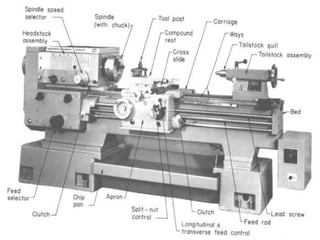
• A lathe is a machine tool which rotates the
work piece on its axis to perform various
operations such as cutting, sanding, knurling,
drilling, or deformation with tools that are
applied to the work piece to create an object
which has symmetry about an axis of
rotation.
13
14
Machining Processes
Include the following:
 Safety Equipment
 Metal removing process
 Unwanted material -- chips or swarfs
 Raw Work piece
 Machine Tool
 Machine Shop
 Machinist + ?
Material Removal Processes
A combination of shaping operations, the common feature of which
is removal of material from a work piece so the remaining part
acquires the desired shape
•Categories: Traditional and non traditional processes
Machining
– It’s a traditional material removal by a Mechanical Equipment and
sharp cutting tool, e.g., turning, milling, drilling
Abrasive processes
–material removal by hard, abrasive particles, e.g., grinding
,sand blasting
Non traditional processes
- Non traditional processes-various energy forms other than sharp
cutting tool to remove material, like chemicals ,laser water jet etc.
16
Material Removal Processes(Contd)
Mechanical
 Single-point cutting
Turning
Planning and shaping
 Multi-point cutting
Milling
Drilling
Broaching
Sawing
17
 Abrasive machining
Grinding
Honing
Lapping
Abrasive jet machining
Sand blasting
Material Removal Processes(Contd)
18
Chemical
 Chemical machining
 Electrochemical machining (ECM)
Thermal
 Torch cutting
 Electrical discharge machining (EDM)
 High energy beam machining
Others
 Laser Cutting and CNC
 Water Jet Cutting
 Ultrasonic machining
Non Traditional Material Removal Processes
19
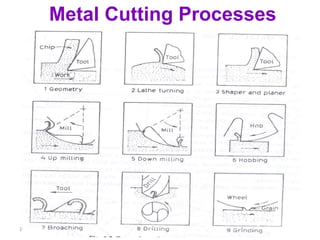
Metal Cutting Processes
BREAK
Machining
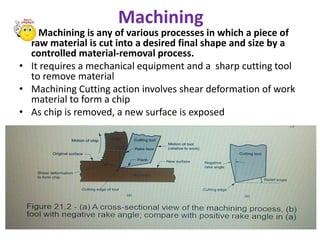
• Machining is any of various processes in which a piece of
raw material is cut into a desired final shape and size by a
controlled material-removal process.
• It requires a mechanical equipment and a sharp cutting tool
to remove material
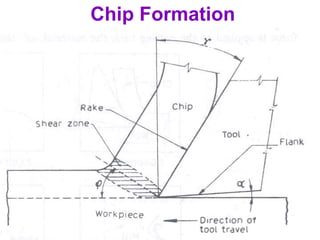
• Machining Cutting action involves shear deformation of work
material to form a chip
• As chip is removed, a new surface is exposed
• Figure 21.2 -(a) A cross-sectional view of the machining process, (b) tool with negative rake angle; compare with
positive rake angle in (a)
Machining in the Manufacturing
Sequence
•Generally performed after other manufacturing
processes, such as casting, forging, and bar
drawing –Other processes create the general
shape of the starting a work piece
• Machining provides the final shape,
dimensions, finish, and special geometric
details that other processes cannot create
Machining Operations
Some important machining operations:
• Turning
• Drilling Lathe machine
• Milling
Other machining operations:
• Shaping and planing
• Broaching and hobbing
• Sawing and engraving
Machining Operations(Contd)
Turning
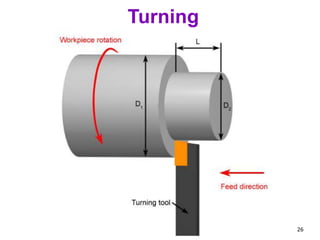
Turning is a machining process in which a cutting
tool, typically a non-rotary tool bit, describes a
helical tool path by moving more or less linearly
while the work piece rotates. The tool's axes of
movement may be literally a straight line, or
they may be along some set of curves or angles,
but they are essentially linear.
• Taper Angle in taper turning = D-d/L * 144/5
Turning
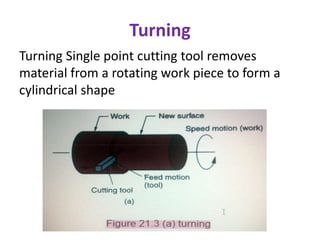
Turning Single point cutting tool removes
material from a rotating work piece to form a
cylindrical shape
26
Turning
Machining Operations (Contd)
Boring
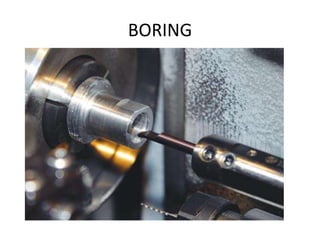
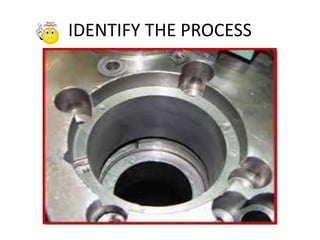
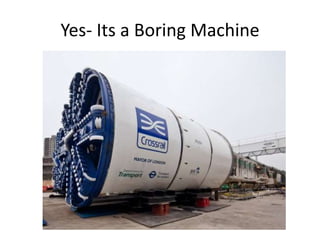
• Boring is the process of enlarging a hole that has already been
drilled (or cast), by means of a single-point cutting tool.
Drilling
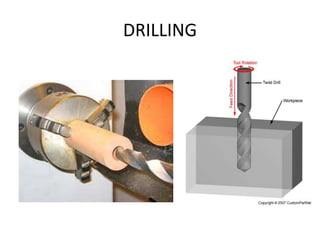
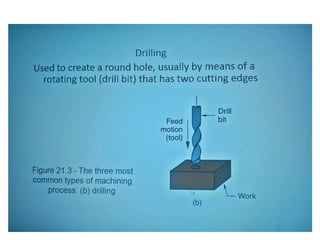
• Drilling is a cutting process that uses a drill bit to cut or enlarge a
hole of circular cross-section in solid materials. The drill bit is a
rotary cutting tool, often multipoint.
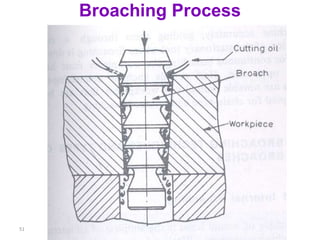
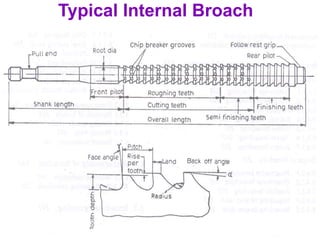
Broaching
• Broaching is a machining process that uses a toothed tool, called a
broach, to remove material. There are two main types of broaching:
linear and rotary.
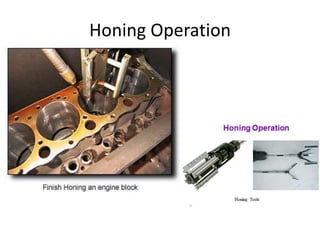
Honning
• The honing process is used to obtain precise dimensions and
surfaces in cylindrical shapes
BORING
IDENTIFY THE PROCESS
Yes- Its a Boring Machine
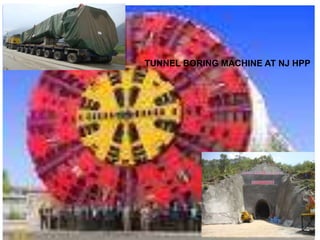
TUNNEL BORING MACHINE AT NJ HPP
TBM
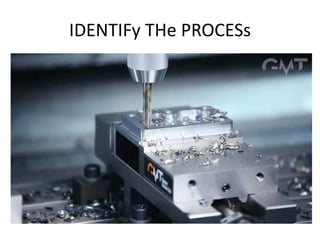
DRILLING
IDENTIFy THe PROCESs
36
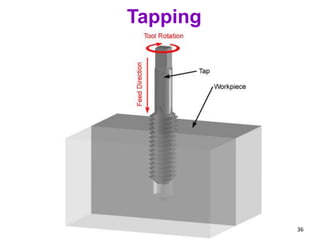
Tapping
Machining Operations (Contd)
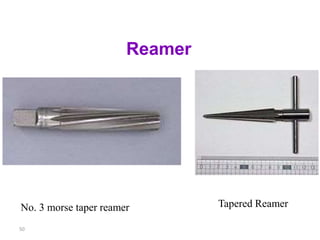
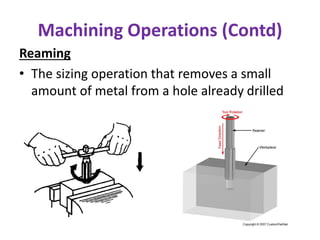
Reaming
• The sizing operation that removes a small
amount of metal from a hole already drilled
Threading
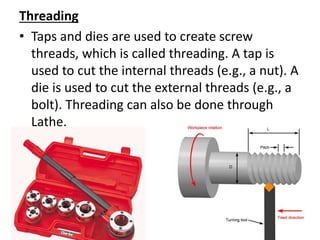
• Taps and dies are used to create screw
threads, which is called threading. A tap is
used to cut the internal threads (e.g., a nut). A
die is used to cut the external threads (e.g., a
bolt). Threading can also be done through
Lathe.
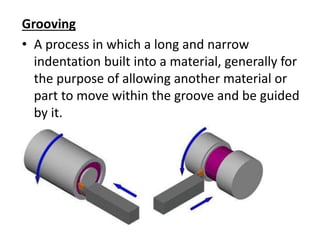
Grooving
• A process in which a long and narrow
indentation built into a material, generally for
the purpose of allowing another material or
part to move within the groove and be guided
by it.
Machining Operations (Contd)
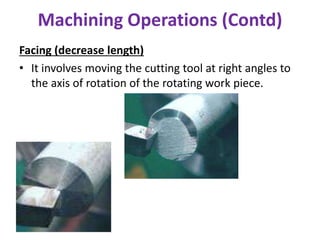
Facing (decrease length)
• It involves moving the cutting tool at right angles to
the axis of rotation of the rotating work piece.
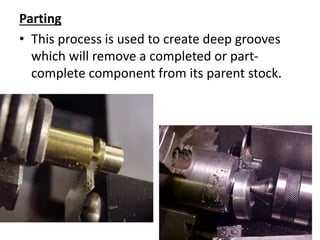
Parting
• This process is used to create deep grooves
which will remove a completed or part-
complete component from its parent stock.
Working on Lathe
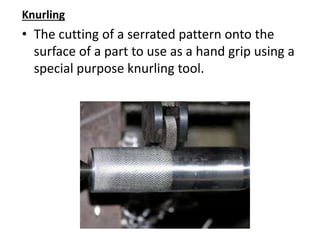
Knurling
• The cutting of a serrated pattern onto the
surface of a part to use as a hand grip using a
special purpose knurling tool.
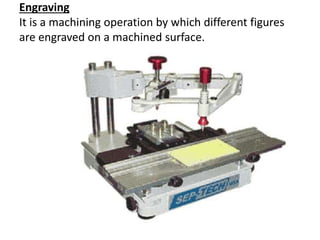
Engraving
It is a machining operation by which different figures
are engraved on a machined surface.
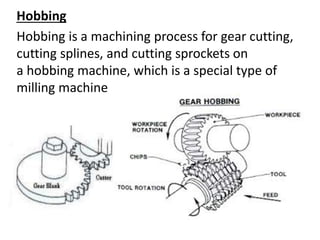
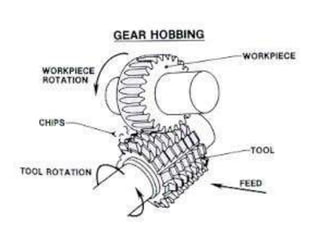
Hobbing
Hobbing is a machining process for gear cutting,
cutting splines, and cutting sprockets on
a hobbing machine, which is a special type of
milling machine
47
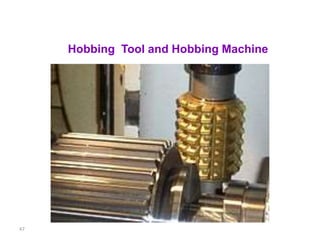
Hobbing Tool and Hobbing Machine
48
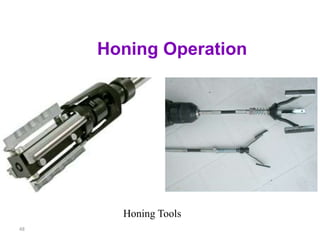
Honing Operation
Honing Tools
Honing Operation
50
Reamer
Tapered ReamerNo. 3 morse taper reamer
51
Broaching Process
52
Typical Internal Broach
53
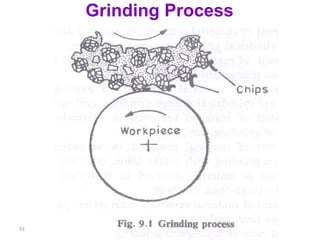
Grinding Process
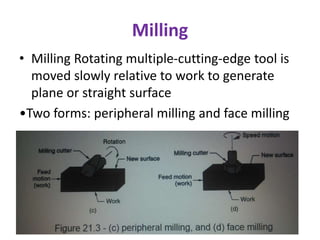
Milling
• Milling Rotating multiple-cutting-edge tool is
moved slowly relative to work to generate
plane or straight surface
•Two forms: peripheral milling and face milling
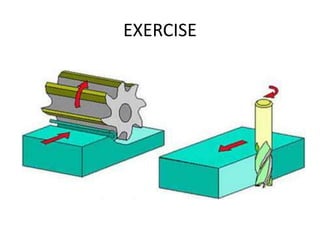
EXERCISE
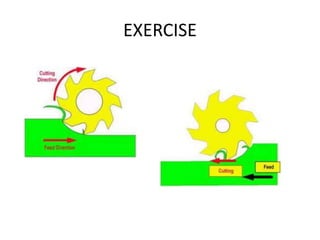
EXERCISE
57
Chip Formation
58
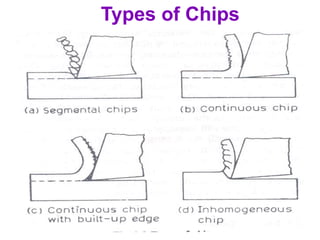
Types of Chips
Four Basic Types of Chip in Machining
1.Discontinuous chip
2.Continuous chip
3.Continuous chip with Built-up Edge (BUE)
4.Serrated chip
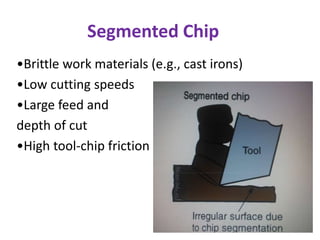
Segmented Chip
•Brittle work materials (e.g., cast irons)
•Low cutting speeds
•Large feed and
depth of cut
•High tool-chip friction
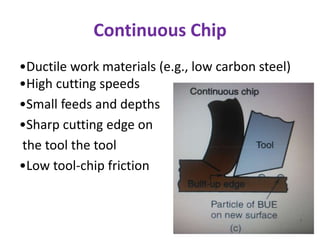
Continuous Chip
•Ductile work materials (e.g., low carbon steel)
•High cutting speeds
•Small feeds and depths
•Sharp cutting edge on
the tool the tool
•Low tool-chip friction
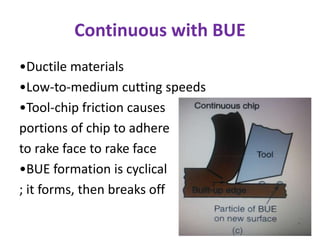
Continuous with BUE
•Ductile materials
•Low-to-medium cutting speeds
•Tool-chip friction causes
portions of chip to adhere
to rake face to rake face
•BUE formation is cyclical
; it forms, then breaks off
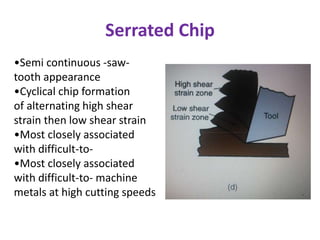
Serrated Chip
•Semi continuous -saw-
tooth appearance
•Cyclical chip formation
of alternating high shear
strain then low shear strain
•Most closely associated
with difficult-to-
•Most closely associated
with difficult-to- machine
metals at high cutting speeds
WAKE UP FOR A BREAK
BREAK

Machining processes and types

  • 1.
  • 2.
    REVIEW OF TOPICS •Fitting And Assembling • Welding • Forging • Casting • Machining Processes • Gear Making • Electric Circuits • Electroplating • Wood Working • Workshop Safety2
  • 3.
    JUST TO REMINDYOU ABOUT EXAMS,QUIZES,ASSIGNMENT AND FINAL VIVA • Your Two Sessional Exams (40 Marks each)will be held during 6th and 12th week of Course • Two Quiz tests (10 Marks each) will also held • Assignments will also be given • You are required to submit a Note Book (100 Marks) before final viva • Final Exam • Final Viva and Project • Warning: Min 75 % attendance is required to appear in the Exam. Check and confirm your attendance regularly from ERP System.
  • 4.
  • 5.
  • 6.
    OBJECTIVE 1.Knowledge about variousmachining processes and lathe machine components 2.Operational study of functions performed by lathe
  • 7.
    Machine Shop SafetyRules • 1. Safety glasses, or appropriate goggles / face shields are required in the shop, whether working or not!! • 2. Shoes must be worn in any shop area. No one wearing sandals will be allowed to enter any shop area. The • minimum footwear must cover the entire foot. • 3. Do not operate any item of equipment unless you are familiar with its operation and have been authorized to • operate it. If you have any questions regarding the use of equipment ask the Shop Manager. • 4. Avoid excessive use of compressed air to blow dirt or chips from machinery to avoid scattering chips. Never • use compressed air guns to clean clothing, hair, or aim at another person. • 5. In case of injury, no matter how slight, you must report it to the Shop Manager.
  • 8.
    Safety (Contd) • 6.Donot attempt your self to remove foreign objects from the eye or body. If chemicals get in the eye(s), wash eye(s) for15 minutes in an open flow of water before proceeding for medical treatment. Inform the Shop Manager • 7. Machines must be shut off when cleaning, repairing, or oiling. • 8. Do not wear ties, loose clothing, long sleeves, jewelry, gloves, etc. around moving or rotating machinery. • 9.Long hair must be tied back or covered to keep it away from moving machinery. • 10.Hand protection in the form of suitable gloves should be used for handling hot objects, glass or sharp-edged items.
  • 9.
    Safety (Contd) • 11.Wear appropriate clothing for the job. • 12. Do not work in the shop if tired, or in a hurry. • 13.Practice cleanliness and orderliness in the shop areas. Never leave a dirty piece of equipment. • 14. Keep the floor around machines clean, dry and free from trip hazards. Do not allow chips to accumulate. • 15. Think through the entire job before starting. Ask the Shop Manager if you are ever unsure for any reason.
  • 10.
    MACHINING  Machining isa processes in which a piece of raw material is cut into a desired final shape and size by a controlled material-removal process.
  • 11.
  • 12.
    MACHINE TOOL • Alathe is a machine tool which rotates the work piece on its axis to perform various operations such as cutting, sanding, knurling, drilling, or deformation with tools that are applied to the work piece to create an object which has symmetry about an axis of rotation.
  • 13.
  • 14.
    14 Machining Processes Include thefollowing:  Safety Equipment  Metal removing process  Unwanted material -- chips or swarfs  Raw Work piece  Machine Tool  Machine Shop  Machinist + ?
  • 15.
    Material Removal Processes Acombination of shaping operations, the common feature of which is removal of material from a work piece so the remaining part acquires the desired shape •Categories: Traditional and non traditional processes Machining – It’s a traditional material removal by a Mechanical Equipment and sharp cutting tool, e.g., turning, milling, drilling Abrasive processes –material removal by hard, abrasive particles, e.g., grinding ,sand blasting Non traditional processes - Non traditional processes-various energy forms other than sharp cutting tool to remove material, like chemicals ,laser water jet etc.
  • 16.
    16 Material Removal Processes(Contd) Mechanical Single-point cutting Turning Planning and shaping  Multi-point cutting Milling Drilling Broaching Sawing
  • 17.
    17  Abrasive machining Grinding Honing Lapping Abrasivejet machining Sand blasting Material Removal Processes(Contd)
  • 18.
    18 Chemical  Chemical machining Electrochemical machining (ECM) Thermal  Torch cutting  Electrical discharge machining (EDM)  High energy beam machining Others  Laser Cutting and CNC  Water Jet Cutting  Ultrasonic machining Non Traditional Material Removal Processes
  • 19.
  • 20.
  • 21.
    Machining • Machining isany of various processes in which a piece of raw material is cut into a desired final shape and size by a controlled material-removal process. • It requires a mechanical equipment and a sharp cutting tool to remove material • Machining Cutting action involves shear deformation of work material to form a chip • As chip is removed, a new surface is exposed • Figure 21.2 -(a) A cross-sectional view of the machining process, (b) tool with negative rake angle; compare with positive rake angle in (a)
  • 22.
    Machining in theManufacturing Sequence •Generally performed after other manufacturing processes, such as casting, forging, and bar drawing –Other processes create the general shape of the starting a work piece • Machining provides the final shape, dimensions, finish, and special geometric details that other processes cannot create
  • 23.
    Machining Operations Some importantmachining operations: • Turning • Drilling Lathe machine • Milling Other machining operations: • Shaping and planing • Broaching and hobbing • Sawing and engraving
  • 24.
    Machining Operations(Contd) Turning Turning isa machining process in which a cutting tool, typically a non-rotary tool bit, describes a helical tool path by moving more or less linearly while the work piece rotates. The tool's axes of movement may be literally a straight line, or they may be along some set of curves or angles, but they are essentially linear. • Taper Angle in taper turning = D-d/L * 144/5
  • 25.
    Turning Turning Single pointcutting tool removes material from a rotating work piece to form a cylindrical shape
  • 26.
  • 27.
    Machining Operations (Contd) Boring •Boring is the process of enlarging a hole that has already been drilled (or cast), by means of a single-point cutting tool. Drilling • Drilling is a cutting process that uses a drill bit to cut or enlarge a hole of circular cross-section in solid materials. The drill bit is a rotary cutting tool, often multipoint. Broaching • Broaching is a machining process that uses a toothed tool, called a broach, to remove material. There are two main types of broaching: linear and rotary. Honning • The honing process is used to obtain precise dimensions and surfaces in cylindrical shapes
  • 28.
  • 29.
  • 30.
    Yes- Its aBoring Machine
  • 31.
  • 32.
  • 33.
  • 35.
  • 36.
  • 37.
    Machining Operations (Contd) Reaming •The sizing operation that removes a small amount of metal from a hole already drilled
  • 38.
    Threading • Taps anddies are used to create screw threads, which is called threading. A tap is used to cut the internal threads (e.g., a nut). A die is used to cut the external threads (e.g., a bolt). Threading can also be done through Lathe.
  • 39.
    Grooving • A processin which a long and narrow indentation built into a material, generally for the purpose of allowing another material or part to move within the groove and be guided by it.
  • 40.
    Machining Operations (Contd) Facing(decrease length) • It involves moving the cutting tool at right angles to the axis of rotation of the rotating work piece.
  • 41.
    Parting • This processis used to create deep grooves which will remove a completed or part- complete component from its parent stock.
  • 42.
  • 43.
    Knurling • The cuttingof a serrated pattern onto the surface of a part to use as a hand grip using a special purpose knurling tool.
  • 44.
    Engraving It is amachining operation by which different figures are engraved on a machined surface.
  • 45.
    Hobbing Hobbing is amachining process for gear cutting, cutting splines, and cutting sprockets on a hobbing machine, which is a special type of milling machine
  • 47.
    47 Hobbing Tool andHobbing Machine
  • 48.
  • 49.
  • 50.
  • 51.
  • 52.
  • 53.
  • 54.
    Milling • Milling Rotatingmultiple-cutting-edge tool is moved slowly relative to work to generate plane or straight surface •Two forms: peripheral milling and face milling
  • 55.
  • 56.
  • 57.
  • 58.
  • 59.
    Four Basic Typesof Chip in Machining 1.Discontinuous chip 2.Continuous chip 3.Continuous chip with Built-up Edge (BUE) 4.Serrated chip
  • 60.
    Segmented Chip •Brittle workmaterials (e.g., cast irons) •Low cutting speeds •Large feed and depth of cut •High tool-chip friction
  • 61.
    Continuous Chip •Ductile workmaterials (e.g., low carbon steel) •High cutting speeds •Small feeds and depths •Sharp cutting edge on the tool the tool •Low tool-chip friction
  • 62.
    Continuous with BUE •Ductilematerials •Low-to-medium cutting speeds •Tool-chip friction causes portions of chip to adhere to rake face to rake face •BUE formation is cyclical ; it forms, then breaks off
  • 63.
    Serrated Chip •Semi continuous-saw- tooth appearance •Cyclical chip formation of alternating high shear strain then low shear strain •Most closely associated with difficult-to- •Most closely associated with difficult-to- machine metals at high cutting speeds
  • 64.
    WAKE UP FORA BREAK
  • 66.