CHAPTER
METAL CUTTING
Presentation Prepared by
Prof. Naman M. Dave
Assistant Prof. (Mechanical Dept.)
Gandhinagar Institute of Technology
• Definition of Manufacturing
• The word manufacturing is derived from Latin:
manus = hand, factus = made
• Manufacturing is the economic term for making goods and
services available to satisfy human wants.
• Manufacturing implies creating value to a raw material by
applying useful mental and physical labour. Manufacturing
converts the raw materials to finished products to be used for
some purpose.
• Whether from nature or industry materials cannot be used in their
raw forms for any useful purpose.
• The materials are then shaped and formed into different useful
components through different manufacturing processes to fulfil the
needs of day-to-day work.
INTRODUCTION
MANUFACTURING SYSTEM AND
PRODUCTION SYSTEM
Manufacturing system:
• A collection of operations and processes used to obtain a
desired product(s) or component(s) is called a manufacturing
system.
• The manufacturing system is therefore the design or
arrangement of the manufacturing processes..
Production system:
• A production system includes people, money, equipment,
materials and supplies, markets, management and the
manufacturing system.
Production System - The Big Picture
Raw materials Manufacturing
Process
Manufacturing
Process
Finished
product
Manufacturing System
People, Money, Equipment, Materials and Supplies, Markets, Management
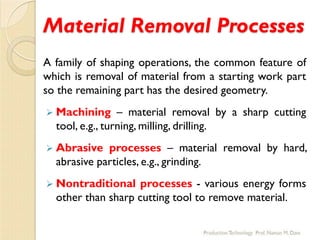
Material Removal Processes
A family of shaping operations, the common feature of
which is removal of material from a starting work part
so the remaining part has the desired geometry.
 Machining – material removal by a sharp cutting
tool, e.g., turning, milling, drilling.
 Abrasive processes – material removal by hard,
abrasive particles, e.g., grinding.
 Nontraditional processes - various energy forms
other than sharp cutting tool to remove material.
MACHINING
Machining is a semi-finishing or finishing process
essentially done to impart required or stipulated
dimensional and form accuracy and surface finish to
enable the product to
 fulfill its basic functional requirements
 provide better or improved performance
 render long service life.
Machining is a process of gradual removal of excess
material from the preformed blanks in the form of
chips.
Why Machining is Important
 Variety of work materials can be machined
◦ Most frequently used to cut metals
 Variety of part shapes and special geometric
features possible, such as:
◦ Screw threads
◦ Accurate round holes
◦ Very straight edges and surfaces
 Good dimensional accuracy and surface finish
Examples of Cutting Processes
Disadvantages with Machining
 Wasteful of material
◦ Chips generated in machining are wasted material, at
least in the unit operation
 Time consuming
◦ A machining operation generally takes more time to
shape a given part than alternative shaping processes,
such as casting, powder metallurgy, or forming
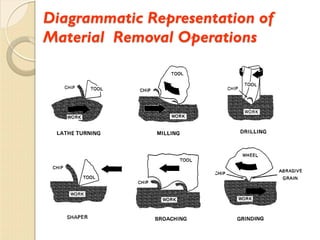
Diagrammatic Representation of
Material Removal Operations
Mechanism of Chip formation
The form of the chips is an important index of
machining because it directly or indirectly indicates :
 Nature and behavior of the work material under
machining condition
 Specific energy requirement (amount of energy
required to remove unit volume of work material)
in machining work
 Nature and degree of interaction at the chip-tool
interfaces.
Mechanism of Chip
formation
The form of machined chips depend mainly upon :
 Work material
 Material and geometry of the cutting tool
 Levels of cutting velocity and feed and also to some extent
on depth of cut
 Machining environment or cutting fluid that affects
temperature and friction at the chip-tool and work-tool
interfaces.
Knowledge of basic mechanisms of chip formation helps to
understand the characteristics of chips and to attain
favourable chip forms.
A chip has two surfaces:
1. One that is in contact with the tool face (rake
face). This surface is shiny, or burnished.
2. The other from the original surface of the work
piece.
This surface does not come into contact with any
solid body. It has a jagged, rough appearance,
which is caused by the shearing mechanism.
Chip Formation
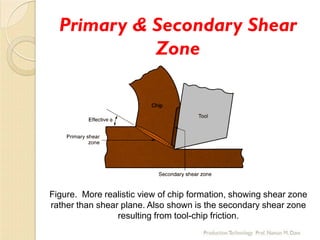
Figure. More realistic view of chip formation, showing shear zone
rather than shear plane. Also shown is the secondary shear zone
resulting from tool-chip friction.
Primary & Secondary Shear
Zone
Piispanen model of Card
Analogy
Piispanen model of Card Analogy
Four BasicTypes of Chip in
Machining
1. Discontinuous chip
2. Continuous chip
3. Continuous chip with Built-up Edge (BUE)
4. Serrated chip
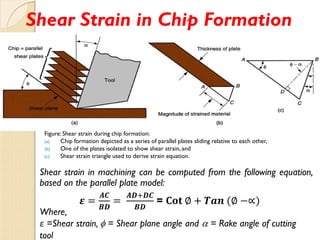
Figure: Shear strain during chip formation:
(a) Chip formation depicted as a series of parallel plates sliding relative to each other,
(b) One of the plates isolated to show shear strain, and
(c) Shear strain triangle used to derive strain equation.
Shear Strain in Chip Formation
𝜺𝜺 =
𝑨𝑨𝑨𝑨
𝑩𝑩𝑩𝑩
=
𝑨𝑨𝑨𝑨+𝑫𝑫𝑫𝑫
𝑩𝑩𝑩𝑩
= 𝐂𝐂𝐂𝐂𝐂𝐂 ∅ + 𝑻𝑻𝑻𝑻𝑻𝑻 (∅ −∝)
Shear strain in machining can be computed from the following equation,
based on the parallel plate model:
Where,
ε =Shear strain, φ = Shear plane angle and α = Rake angle of cutting
tool
Large shear strains are associated with low shear angles, or
low or negative rake angles.
Shear strains of 5 or higher in actual cutting operations.
Deformation in cutting generally takes place within a very
narrow deformation zone; that is, d = BD in Fig is very small.
Therefore, the rate at which shearing takes place is high.
Shear angle influences force and power requirements, chip
thickness, and temperature.
Consequently, much attention has been focused on
determining the relationships between the shear angle and
work piece material properties and cutting process variables.
Shear Strain in Chip Formation
Velocity Relationship in Orthogonal
Cutting
Figure (a) Schematic illustration of the basic mechanism of chip formation by
shearing. (b) Velocity diagram showing angular relationships among the three
speeds in the cutting zone.
The tool has a rake angle of α, and relief (clearance) angle. The shearing
process in chip formation is similar to the motion of cards in a deck sliding
against each other.
Velocity Relationship
Using sine rule,
)90sin(sin))(90sin( αφαφ −
==
−−
sc vvv
αφαφ cossin)cos(
sc vvv
==
−
)cos(
sin
αφ
φ
−
=
v
vc
rvvc ×=






=
)-(Cos
Sin
r
αφ
φ
)cos(
cos
αφ
α
−
=
v
vs
c
c
cc
t
t
rvv
tvt
0
0
rAs,
v
chiptheupflowingmaterialofVolumeunit timepermaterialofVolume
=×=⇒
×=×⇒
=
Velocity Relationship
Forces Acting on Chip
F, N, Fs, and Fn cannot be directly measured
Forces acting on the tool that can be measured:
– Cutting force Fc andThrust force Ft
Fs = Shear Force, which acts along the shear plane, is the resistance to
shear of the metal in forming the chip.
Fn = Force acting normal to the shear plane, is the backing up force on
the chip provided by the work piece.
F = Frictional resistance of the tool acting against the motion of the chip
as it moves upward along the tool
N = Normal to the chip force, is provided by the tool.
NS
/
FFR
FNR


+=
+=
It is assumed that the resultant forces R & R’ are equal and opposite in
magnitude and direction. Also they are Collinear. Therefore for the
purpose of analysis the chip is regarded as an independent body held in
mechanical equilibrium by the action of two equal and opposite forces R,
which the workpiece exerts upon the chip and R’ which the tool exerts
upon the chip.
Forces acting on chip in Orthogonal
cutting
Resultant Forces
 Vector addition of F and N = resultant R
 Vector addition of Fs and Fn = resultant R '
 Forces acting on the chip must be in balance:
◦ R ' must be equal in magnitude to R
◦ R’ must be opposite in direction to R
◦ R’ must be collinear with R
Cutting Forces
Fig: (a) Forces acting on a cutting tool during 2-dimensional cutting. Note that the resultant force, R must
be collinear to balance the forces. (b) Force circle to determine various forces acting in the cutting
zone.
The following is a circle
diagram. Known as Merchant’s
circle diagram, which is
convenient to determine the
relation between the various
forces and angles.
In the diagram two force
triangles have been combined
and R and R’ together have
been replaced by R. the force
R can be resolved into two
components Fc and Ft.
Fc and Ft can be determined
by force dynamometers.
tc FFR

+=
The rake angle (α) can be measured from the tool, and forces F and N can then
be determined. The shear angle (φ) can be obtained from it’s relation with chip
reduction coefficient. Now Fs & Fn can also be determined.
Merchant’s Circle Diagram
∅
Work
Tool
Chip
Clearance Angle
Ft
Fc
F
N
Fn
Fs
α
α
β
(β - α)
R
Merchant’s Circle Diagram
Work
Tool
Chip
Clearance Angle
Ft
Fc
F
N
Fn
Fs
α
α
β
∅
(β - α)
R
Clearance Angle
The procedure to construct a
Merchant’s circle diagram
Work
Tool
Chip
Ft
Fc
F
N
Fn
Fs
α
α
β
∅
R
 Set up x-y axis labeled with forces, and the origin in the
centre of the page. The cutting force (Fc) is drawn
horizontally, and the tangential force (Ft) is drawn
vertically. (Draw in the resultant (R) of Fc and Ft.
 Locate the centre of R, and draw a circle that encloses
vector R. If done correctly, the heads and tails of all 3
vectors will lie on this circle.
 Draw in the cutting tool in the upper right hand
quadrant, taking care to draw the correct rake angle (α)
from the vertical axis.
 Extend the line that is the cutting face of the tool (at the
same rake angle) through the circle. This now gives the
friction vector (F).
The procedure to construct a
Merchant’s circle diagram
The procedure to construct a
Merchant’s circle diagram
 A line can now be drawn from the head of the friction
vector, to the head of the resultant vector (R). This gives the
normal vector (N). Also add a friction angle (β) between
vectors R and N. Therefore, mathematically, R = Fc+Ft = F +
N.
 Draw a feed thickness line parallel to the horizontal axis.
Next draw a chip thickness line parallel to the tool cutting
face.
 Draw a vector from the origin (tool point) towards the
intersection of the two chip lines, stopping at the circle. The
result will be a shear force vector (Fs). Also measure the
shear force angle between Fs and Fc.
 Finally add the shear force normal (Fn) from the head of Fs
to the head of R.
 Use a scale and protractor to measure off all distances
(forces) and angles.
αα
αα
sincos
cossin
tC
tC
FFN
GEODCDODABN
FFF
GBEDGBCGCBOAF
−=⇒
−=−==
+=⇒
+=+===
Frictional Force System
angleFrictionWhere
N
F
tan
frictionoftcoefficienThe
=
==
β
βµ
Relationship of various forces acting on the chip with the horizontal and
vertical cutting force from Merchant circle diagram
Ft
Fc
F
N
α
α
β
(β - α)
R
α
α
α
(90-α)
(90-α)
O
A
C
B
G
E
D
∅
Work
Tool
Chip
Clearance Angle
Ft
Fc
F
N
Fn
Fs
α
α
β
(β - α)
R
Shear Force System
φφ
φαβ
φφ
cossin
(
sincos
tCN
N
S
tCS
S
FFF
DEBCDEADAEF
RCosF
FFF
CDOBABOBOAF
+=⇒
+=+==
)+−=
−=⇒
−=−== Also:
)tan( αβφ −+= SN FF
Relationship of various forces acting on the chip with the horizontal and
vertical cutting force from Merchant circle diagram
∅
Work
Tool
Chip
Clearance Angle
Ft
Fc
F
N
Fn
Fs
α
α
β
(β - α)
R
∅
Ft
Fc
A
O
Fn
Fs
α
α
(β - α)
R
B
C
D
E
∅
∅
(90-∅)
(90-∅)
)tan(
cossin
sincos
sincos
cossin
αβφ
φφ
φφ
αα
αα
−+=
+=
−=
−=
+=
SN
tCN
tCS
tC
tC
FF
FFF
FFF
FFN
FFF
Relationship of various forces acting on the chip with the horizontal and
vertical cutting force from Merchant circle diagram
∅
Work
Tool
Chip
Clearance Angle
Ft
Fc
F
N
Fn
Fs
α
α
β
(β - α)
R
Ft = R Sin (β-α)
Fc = R Cos (β –α)
Knowledge of the cutting forces and power involved in
machining operations is important for the following
reasons:
a. Machine tools can be properly designed to minimize
distortion of the machine components, maintain the
desired dimensional accuracy of the machined part,
and help select appropriate tool holders and work-
holding devices.
b. The work piece is capable of withstanding these
forces without excessive distortion.
c. Power requirements must be known in order to
enable the selection of a machine tool with adequate
electric power.
CUTTING FORCES and POWER
Cutting force, Fc, acts in the direction of cutting speed, V, and
supplies energy required for cutting.
Thrust force, Ft , acts in a direction normal to cutting velocity,
perpendicular to WP. The resultant force, R can be resolved
into two components :
 Friction force: F, along the tool-chip interface
 Normal force: N, perpendicular to it.
F = R sin β
N = R cos β
R is balanced by an equal and opposite force along the shear
plane and is resolved into a shear force, Fs, and a normal
force, Fn
Fs = Fc cos Ø – Ft sin Ø
Fn = Fc sin Ø + Ft cos Ø
Coefficient of Friction
Coefficient of friction between tool and chip:
Friction angle related to coefficient of friction as follows:
N
F
=µ
βµ tan=
The ratio of F to N is the coefficient of friction, μ, at the tool-chip
interface, and the angle β is the friction angle.
The coefficient of friction in metal cutting generally ranges from about
0.5 to 2.
α
α
µ
tan
tan
friction,oftCoefficien
tc
ct
FF
FF
N
F
−
+
==
Shear Stress
Shear stress acting along the shear plane:
φsin
wt
A o
s =
where As = area of the shear plane,
Shear stress = shear strength of work material during
cutting
s
A
s
F
=τ
References
1. Kalpakjian, Schmid, Manufacturing Processes for Engineering Materials, 4th
edition,, Prentice Hall 2003
2. DeGarmo, E. P., J. T. Black, and R. A. Kohser, Materials and processes in
Manufacturing, PHI.
3. P.N. Rao, Manufacturing Technology – Metal Cutting and Machine Tools,TMH.
4. George Schneider,Jr. CMfgE, Cutting Tool Applications
5. Amstead, B. H., P. F. Ostwald, and M. L. Begeman, Manufacturing
Processes, 8th ed.,Wiley, New York, 1988.
6. Amitabha Battacharya , Metal Cutting Theory and Practice
7. Shaw, M. C., Metal Cutting Principles, Oxford University Press, Oxford, 1984.
8. Schey, J.A., Introduction to Manufacturing Processes, McGraw-Hill, NewYork,
1977.
9. Lindberg, R.A., Processes and Materials of Manufacture,
10.William J Patton, Machine tool Operations, Reston publishing company
11.OW Boston, Metal Processing, 2nd edition 1951, JohnWiley and Sons
12.B.S.Raghuwanshi, A course in WorkshopTechnology-Dhanpat Rai & Sons.
13.Hajra Choudhury, Elements of Workshop Technology–Vol.-II, Media
Promoters and Publishers.
14.O P Khanna, ProductionTechnology-(Vol. II)
15.R K Jain, Production Technology
16.HMT, ProductionTechnology, HMT

Metal cutting 2

  • 1.
    CHAPTER METAL CUTTING Presentation Preparedby Prof. Naman M. Dave Assistant Prof. (Mechanical Dept.) Gandhinagar Institute of Technology
  • 2.
    • Definition ofManufacturing • The word manufacturing is derived from Latin: manus = hand, factus = made • Manufacturing is the economic term for making goods and services available to satisfy human wants. • Manufacturing implies creating value to a raw material by applying useful mental and physical labour. Manufacturing converts the raw materials to finished products to be used for some purpose. • Whether from nature or industry materials cannot be used in their raw forms for any useful purpose. • The materials are then shaped and formed into different useful components through different manufacturing processes to fulfil the needs of day-to-day work. INTRODUCTION
  • 3.
    MANUFACTURING SYSTEM AND PRODUCTIONSYSTEM Manufacturing system: • A collection of operations and processes used to obtain a desired product(s) or component(s) is called a manufacturing system. • The manufacturing system is therefore the design or arrangement of the manufacturing processes.. Production system: • A production system includes people, money, equipment, materials and supplies, markets, management and the manufacturing system.
  • 4.
    Production System -The Big Picture Raw materials Manufacturing Process Manufacturing Process Finished product Manufacturing System People, Money, Equipment, Materials and Supplies, Markets, Management
  • 5.
    Material Removal Processes Afamily of shaping operations, the common feature of which is removal of material from a starting work part so the remaining part has the desired geometry.  Machining – material removal by a sharp cutting tool, e.g., turning, milling, drilling.  Abrasive processes – material removal by hard, abrasive particles, e.g., grinding.  Nontraditional processes - various energy forms other than sharp cutting tool to remove material.
  • 6.
    MACHINING Machining is asemi-finishing or finishing process essentially done to impart required or stipulated dimensional and form accuracy and surface finish to enable the product to  fulfill its basic functional requirements  provide better or improved performance  render long service life. Machining is a process of gradual removal of excess material from the preformed blanks in the form of chips.
  • 7.
    Why Machining isImportant  Variety of work materials can be machined ◦ Most frequently used to cut metals  Variety of part shapes and special geometric features possible, such as: ◦ Screw threads ◦ Accurate round holes ◦ Very straight edges and surfaces  Good dimensional accuracy and surface finish
  • 8.
  • 9.
    Disadvantages with Machining Wasteful of material ◦ Chips generated in machining are wasted material, at least in the unit operation  Time consuming ◦ A machining operation generally takes more time to shape a given part than alternative shaping processes, such as casting, powder metallurgy, or forming
  • 10.
  • 11.
    Mechanism of Chipformation The form of the chips is an important index of machining because it directly or indirectly indicates :  Nature and behavior of the work material under machining condition  Specific energy requirement (amount of energy required to remove unit volume of work material) in machining work  Nature and degree of interaction at the chip-tool interfaces.
  • 12.
    Mechanism of Chip formation Theform of machined chips depend mainly upon :  Work material  Material and geometry of the cutting tool  Levels of cutting velocity and feed and also to some extent on depth of cut  Machining environment or cutting fluid that affects temperature and friction at the chip-tool and work-tool interfaces. Knowledge of basic mechanisms of chip formation helps to understand the characteristics of chips and to attain favourable chip forms.
  • 13.
    A chip hastwo surfaces: 1. One that is in contact with the tool face (rake face). This surface is shiny, or burnished. 2. The other from the original surface of the work piece. This surface does not come into contact with any solid body. It has a jagged, rough appearance, which is caused by the shearing mechanism. Chip Formation
  • 14.
    Figure. More realisticview of chip formation, showing shear zone rather than shear plane. Also shown is the secondary shear zone resulting from tool-chip friction. Primary & Secondary Shear Zone
  • 15.
    Piispanen model ofCard Analogy
  • 16.
    Piispanen model ofCard Analogy
  • 17.
    Four BasicTypes ofChip in Machining 1. Discontinuous chip 2. Continuous chip 3. Continuous chip with Built-up Edge (BUE) 4. Serrated chip
  • 18.
    Figure: Shear strainduring chip formation: (a) Chip formation depicted as a series of parallel plates sliding relative to each other, (b) One of the plates isolated to show shear strain, and (c) Shear strain triangle used to derive strain equation. Shear Strain in Chip Formation 𝜺𝜺 = 𝑨𝑨𝑨𝑨 𝑩𝑩𝑩𝑩 = 𝑨𝑨𝑨𝑨+𝑫𝑫𝑫𝑫 𝑩𝑩𝑩𝑩 = 𝐂𝐂𝐂𝐂𝐂𝐂 ∅ + 𝑻𝑻𝑻𝑻𝑻𝑻 (∅ −∝) Shear strain in machining can be computed from the following equation, based on the parallel plate model: Where, ε =Shear strain, φ = Shear plane angle and α = Rake angle of cutting tool
  • 19.
    Large shear strainsare associated with low shear angles, or low or negative rake angles. Shear strains of 5 or higher in actual cutting operations. Deformation in cutting generally takes place within a very narrow deformation zone; that is, d = BD in Fig is very small. Therefore, the rate at which shearing takes place is high. Shear angle influences force and power requirements, chip thickness, and temperature. Consequently, much attention has been focused on determining the relationships between the shear angle and work piece material properties and cutting process variables. Shear Strain in Chip Formation
  • 20.
    Velocity Relationship inOrthogonal Cutting Figure (a) Schematic illustration of the basic mechanism of chip formation by shearing. (b) Velocity diagram showing angular relationships among the three speeds in the cutting zone. The tool has a rake angle of α, and relief (clearance) angle. The shearing process in chip formation is similar to the motion of cards in a deck sliding against each other.
  • 21.
  • 22.
    Using sine rule, )90sin(sin))(90sin(αφαφ − == −− sc vvv αφαφ cossin)cos( sc vvv == − )cos( sin αφ φ − = v vc rvvc ×=       = )-(Cos Sin r αφ φ )cos( cos αφ α − = v vs c c cc t t rvv tvt 0 0 rAs, v chiptheupflowingmaterialofVolumeunit timepermaterialofVolume =×=⇒ ×=×⇒ = Velocity Relationship
  • 23.
    Forces Acting onChip F, N, Fs, and Fn cannot be directly measured Forces acting on the tool that can be measured: – Cutting force Fc andThrust force Ft
  • 24.
    Fs = ShearForce, which acts along the shear plane, is the resistance to shear of the metal in forming the chip. Fn = Force acting normal to the shear plane, is the backing up force on the chip provided by the work piece. F = Frictional resistance of the tool acting against the motion of the chip as it moves upward along the tool N = Normal to the chip force, is provided by the tool. NS / FFR FNR   += += It is assumed that the resultant forces R & R’ are equal and opposite in magnitude and direction. Also they are Collinear. Therefore for the purpose of analysis the chip is regarded as an independent body held in mechanical equilibrium by the action of two equal and opposite forces R, which the workpiece exerts upon the chip and R’ which the tool exerts upon the chip. Forces acting on chip in Orthogonal cutting
  • 25.
    Resultant Forces  Vectoraddition of F and N = resultant R  Vector addition of Fs and Fn = resultant R '  Forces acting on the chip must be in balance: ◦ R ' must be equal in magnitude to R ◦ R’ must be opposite in direction to R ◦ R’ must be collinear with R
  • 26.
    Cutting Forces Fig: (a)Forces acting on a cutting tool during 2-dimensional cutting. Note that the resultant force, R must be collinear to balance the forces. (b) Force circle to determine various forces acting in the cutting zone.
  • 27.
    The following isa circle diagram. Known as Merchant’s circle diagram, which is convenient to determine the relation between the various forces and angles. In the diagram two force triangles have been combined and R and R’ together have been replaced by R. the force R can be resolved into two components Fc and Ft. Fc and Ft can be determined by force dynamometers. tc FFR  += The rake angle (α) can be measured from the tool, and forces F and N can then be determined. The shear angle (φ) can be obtained from it’s relation with chip reduction coefficient. Now Fs & Fn can also be determined. Merchant’s Circle Diagram ∅ Work Tool Chip Clearance Angle Ft Fc F N Fn Fs α α β (β - α) R
  • 28.
    Merchant’s Circle Diagram Work Tool Chip ClearanceAngle Ft Fc F N Fn Fs α α β ∅ (β - α) R
  • 29.
    Clearance Angle The procedureto construct a Merchant’s circle diagram Work Tool Chip Ft Fc F N Fn Fs α α β ∅ R
  • 30.
     Set upx-y axis labeled with forces, and the origin in the centre of the page. The cutting force (Fc) is drawn horizontally, and the tangential force (Ft) is drawn vertically. (Draw in the resultant (R) of Fc and Ft.  Locate the centre of R, and draw a circle that encloses vector R. If done correctly, the heads and tails of all 3 vectors will lie on this circle.  Draw in the cutting tool in the upper right hand quadrant, taking care to draw the correct rake angle (α) from the vertical axis.  Extend the line that is the cutting face of the tool (at the same rake angle) through the circle. This now gives the friction vector (F). The procedure to construct a Merchant’s circle diagram
  • 31.
    The procedure toconstruct a Merchant’s circle diagram  A line can now be drawn from the head of the friction vector, to the head of the resultant vector (R). This gives the normal vector (N). Also add a friction angle (β) between vectors R and N. Therefore, mathematically, R = Fc+Ft = F + N.  Draw a feed thickness line parallel to the horizontal axis. Next draw a chip thickness line parallel to the tool cutting face.  Draw a vector from the origin (tool point) towards the intersection of the two chip lines, stopping at the circle. The result will be a shear force vector (Fs). Also measure the shear force angle between Fs and Fc.  Finally add the shear force normal (Fn) from the head of Fs to the head of R.  Use a scale and protractor to measure off all distances (forces) and angles.
  • 32.
    αα αα sincos cossin tC tC FFN GEODCDODABN FFF GBEDGBCGCBOAF −=⇒ −=−== +=⇒ +=+=== Frictional Force System angleFrictionWhere N F tan frictionoftcoefficienThe = == β βµ Relationshipof various forces acting on the chip with the horizontal and vertical cutting force from Merchant circle diagram Ft Fc F N α α β (β - α) R α α α (90-α) (90-α) O A C B G E D ∅ Work Tool Chip Clearance Angle Ft Fc F N Fn Fs α α β (β - α) R
  • 33.
    Shear Force System φφ φαβ φφ cossin ( sincos tCN N S tCS S FFF DEBCDEADAEF RCosF FFF CDOBABOBOAF +=⇒ +=+== )+−= −=⇒ −=−==Also: )tan( αβφ −+= SN FF Relationship of various forces acting on the chip with the horizontal and vertical cutting force from Merchant circle diagram ∅ Work Tool Chip Clearance Angle Ft Fc F N Fn Fs α α β (β - α) R ∅ Ft Fc A O Fn Fs α α (β - α) R B C D E ∅ ∅ (90-∅) (90-∅)
  • 34.
    )tan( cossin sincos sincos cossin αβφ φφ φφ αα αα −+= += −= −= += SN tCN tCS tC tC FF FFF FFF FFN FFF Relationship of variousforces acting on the chip with the horizontal and vertical cutting force from Merchant circle diagram ∅ Work Tool Chip Clearance Angle Ft Fc F N Fn Fs α α β (β - α) R Ft = R Sin (β-α) Fc = R Cos (β –α)
  • 35.
    Knowledge of thecutting forces and power involved in machining operations is important for the following reasons: a. Machine tools can be properly designed to minimize distortion of the machine components, maintain the desired dimensional accuracy of the machined part, and help select appropriate tool holders and work- holding devices. b. The work piece is capable of withstanding these forces without excessive distortion. c. Power requirements must be known in order to enable the selection of a machine tool with adequate electric power. CUTTING FORCES and POWER
  • 36.
    CUTTING FORCES andPOWER Cutting force, Fc, acts in the direction of cutting speed, V, and supplies energy required for cutting. Thrust force, Ft , acts in a direction normal to cutting velocity, perpendicular to WP. The resultant force, R can be resolved into two components :  Friction force: F, along the tool-chip interface  Normal force: N, perpendicular to it. F = R sin β N = R cos β R is balanced by an equal and opposite force along the shear plane and is resolved into a shear force, Fs, and a normal force, Fn Fs = Fc cos Ø – Ft sin Ø Fn = Fc sin Ø + Ft cos Ø
  • 37.
    Coefficient of Friction Coefficientof friction between tool and chip: Friction angle related to coefficient of friction as follows: N F =µ βµ tan= The ratio of F to N is the coefficient of friction, μ, at the tool-chip interface, and the angle β is the friction angle. The coefficient of friction in metal cutting generally ranges from about 0.5 to 2. α α µ tan tan friction,oftCoefficien tc ct FF FF N F − + ==
  • 38.
    Shear Stress Shear stressacting along the shear plane: φsin wt A o s = where As = area of the shear plane, Shear stress = shear strength of work material during cutting s A s F =τ
  • 39.
    References 1. Kalpakjian, Schmid,Manufacturing Processes for Engineering Materials, 4th edition,, Prentice Hall 2003 2. DeGarmo, E. P., J. T. Black, and R. A. Kohser, Materials and processes in Manufacturing, PHI. 3. P.N. Rao, Manufacturing Technology – Metal Cutting and Machine Tools,TMH. 4. George Schneider,Jr. CMfgE, Cutting Tool Applications 5. Amstead, B. H., P. F. Ostwald, and M. L. Begeman, Manufacturing Processes, 8th ed.,Wiley, New York, 1988. 6. Amitabha Battacharya , Metal Cutting Theory and Practice 7. Shaw, M. C., Metal Cutting Principles, Oxford University Press, Oxford, 1984. 8. Schey, J.A., Introduction to Manufacturing Processes, McGraw-Hill, NewYork, 1977. 9. Lindberg, R.A., Processes and Materials of Manufacture, 10.William J Patton, Machine tool Operations, Reston publishing company 11.OW Boston, Metal Processing, 2nd edition 1951, JohnWiley and Sons 12.B.S.Raghuwanshi, A course in WorkshopTechnology-Dhanpat Rai & Sons. 13.Hajra Choudhury, Elements of Workshop Technology–Vol.-II, Media Promoters and Publishers. 14.O P Khanna, ProductionTechnology-(Vol. II) 15.R K Jain, Production Technology 16.HMT, ProductionTechnology, HMT