MANUFACTURING PROCESS
 Raw material finished product
Classification
1. Shaping process
2. Machining process
3. Joining process
4. Finishing process
5. Property changing process
Process
1. Shaping process
 Process in which shape and size of material is
changed without removal of material.
Common process :-
Casting
Forging
Drawing
Rolling
Extruding
2. Machining process
 Process in which shape and size of material is
changed by removing material from unwanted
portions of the work piece.
Common process:-
Surfacing
Turning
Shaping
Drilling
Grinding
Milling
3. Joining process
 Process in which two or more parts are joined
together.
Common process :-
Welding
Brazing
Soldering
Bolting
Riveting
Shrink fitting
Moulding and Casting
 Casting : Process of producing metallic parts of
desired shape and size by pouring molten metal into
a mould having a cavity and allowing the molten
metal to solidify.
 Moulding: Process of making mould using a pattern.
 Pattern : Replica or model of the final product.
 Mould materials : sand, plaster of Paris, metal etc
 Pattern material : wood, metal, wax, plastic, cement
etc
Moulding box
Classification of Moulding
1. Bench moulding
 done on a bench
 Used for small castings
2. Floor moulding
 moulding done on foundry floor
 Used for medium and large moldings
3. Pit moulding
 Moulding done on pits dug on foundry floor.
 Drag part in pit & separate cope
 Used for extremely large castings
4. Machine moulding
 operations such as ramming, pattern removal are done by
machines.
 Faster method used for mass production.
 Better quality and cost of production less due to mass
production.
Properties of moulding sand
1. Porosity or permeability
2. Cohesiveness or strength
3. Adhesiveness
4. Plasticity
5. Refractoriness
6. Flowability
7. Chemical stability
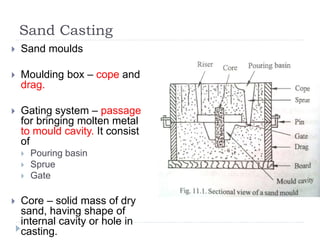
Sand Casting
 Sand moulds
 Moulding box – cope and
drag.
 Gating system – passage
for bringing molten metal
to mould cavity. It consist
of
 Pouring basin
 Sprue
 Gate
 Core – solid mass of dry
sand, having shape of
internal cavity or hole in
casting.
Permanent mould casting
 Moulds are made of metals (cast iron and alloy steel).
 Pouring molten metal into the cavity without applying
external pressure (gravitational force only).
 Mould halves are hinged for easy removal of casting.
Advantages :
 Closer dimensional tolerances.
 Better surface finish.
 Greater mechanical strength
 Lower percentage of rejection.
Disadvantages :
 Not suitable for large castings.
 Cost high
 Used for mass production only.
Die Casting
 External pressure (pneumatic, hydraulic,
mechanical) is employed (pressure die casting) for
casting.
 Fast casting process
 Metallic mould called Die.
 Used for lead, Mg, tin, Zinc alloys, Al, copper etc.
 Types of Die casting
1. Hot chamber Die casting.
2. Cold chamber die casting.
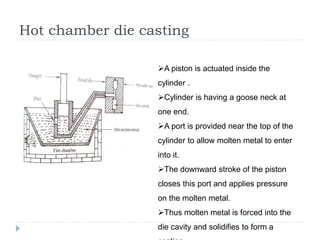
Hot chamber die casting
A piston is actuated inside the
cylinder .
Cylinder is having a goose neck at
one end.
A port is provided near the top of the
cylinder to allow molten metal to enter
into it.
The downward stroke of the piston
closes this port and applies pressure
on the molten metal.
Thus molten metal is forced into the
die cavity and solidifies to form a
Cold chamber die casting
Metal is melted separately and
transferred to the cylinder using a
hand ladle.
After closing the die, the molten
metal in the cylinder is forced into
the die cavity by applying
pressure on the piston.
After solidification the die is
opened and casting is ejected
 Advantages of die casting:
 Very high rate of production
 Very close dimensional tolerances
 High surface finish
 Economical for mass production
 Intricate shape can be easily cast
 Thin sections can be casted easily.
 Disadvantages of die casting
 All types of alloy cannot be cast
 Not suitable for large casting
 High cost of die and die casting equipments.
 Advantages and disadvantages of die casting
equipments
 No limit of size of parts that can be produced by casting
 Wide range of materials can be easily cast.
 Cheapest method for mass production.
 Intricate shape can be cast.
 Not economical for few number of castings.
Forging
 Definition : process of changing shape of metals
when it is in plastic state, by applying compressive
force, is called hot forging or simply forging.
 Hand Forging
 Drop Forging
 Press Forging
 Machine Forging
Upsetting Drawing Down
Bending Punching
ROLLING
 Rolling is the process of forming metals into desired
shape by passing the metal in between a pair of
roller . The two rolls rotated in opposite direction at
same speed. The arrangement of rolling for rolling
operation is called rolling mill. Example ;bars, plates,
sheets, rails
 Hot rolling ;metal heated above recrystallizition
temp
 Cold rolling ; metal heated below the
recrystallizition temp
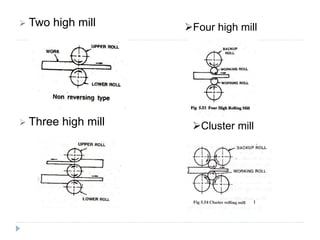
 Basis of no: of roller and their arrangements rolling
can be classified into ,
 Two high mill
 Three high mill
Four high mill
Cluster mill
EXTRUSION
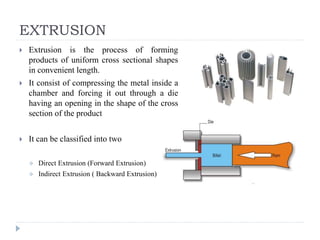
 Extrusion is the process of forming
products of uniform cross sectional shapes
in convenient length.
 It consist of compressing the metal inside a
chamber and forcing it out through a die
having an opening in the shape of the cross
section of the product
 It can be classified into two
 Direct Extrusion (Forward Extrusion)
 Indirect Extrusion ( Backward Extrusion)
Direct Extrusion (Forward Extrusion)
 In this process the metal is placed in the die
chamber and it is forced through the die opening
by applying pressure on the ram.
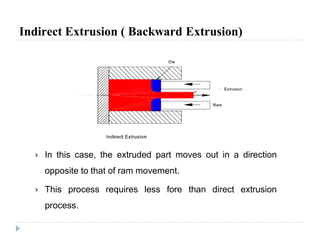
Indirect Extrusion ( Backward Extrusion)
 In this case, the extruded part moves out in a direction
opposite to that of ram movement.
 This process requires less fore than direct extrusion
process.
Welding
 Welding is the process of joining two metals by the
application of heat . Welding is done with the help of
a welding machine . Welding are classified into
 Electrical resistance welding
 Arc welding
 Gas welding
 Thermit welding
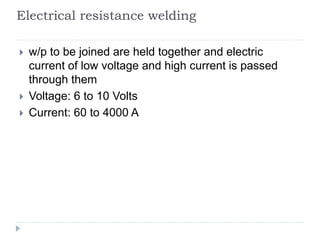
Electrical resistance welding
 w/p to be joined are held together and electric
current of low voltage and high current is passed
through them
 Voltage: 6 to 10 Volts
 Current: 60 to 4000 A
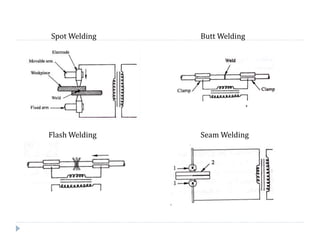
Seam WeldingFlash Welding
Butt WeldingSpot Welding
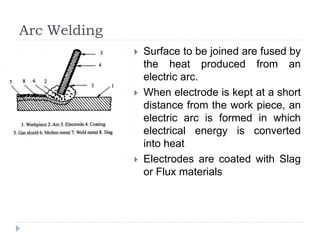
Arc Welding
 Surface to be joined are fused by
the heat produced from an
electric arc.
 When electrode is kept at a short
distance from the work piece, an
electric arc is formed in which
electrical energy is converted
into heat
 Electrodes are coated with Slag
or Flux materials
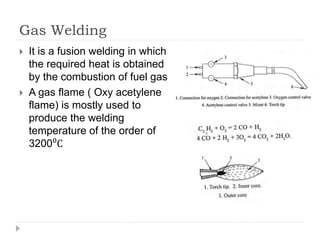
Gas Welding
 It is a fusion welding in which
the required heat is obtained
by the combustion of fuel gas
 A gas flame ( Oxy acetylene
flame) is mostly used to
produce the welding
temperature of the order of
3200⁰C
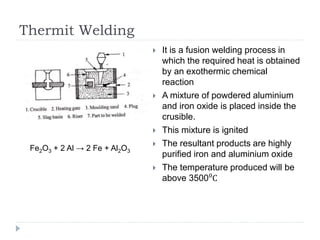
Thermit Welding
 It is a fusion welding process in
which the required heat is obtained
by an exothermic chemical
reaction
 A mixture of powdered aluminium
and iron oxide is placed inside the
crusible.
 This mixture is ignited
 The resultant products are highly
purified iron and aluminium oxide
 The temperature produced will be
above 3500⁰C
Fe2O3 + 2 Al → 2 Fe + Al2O3
BRAZING SOLDERING
 In case of brazing joining of
metal pieces is done with the
help of filler metal.
 Filler metal is melted and
distributed by capillary action
between the surfaces of the
metallic parts being joined.
 In this case only filler metal
melts.
 There is no melting of
workpiece metal.
 The filler metal (brazing
metal) should have the melting
point more than 450⁰C.
 Its melting point should be
lesser than the melting point of
workpiece metal.
Soldering is very much similar
to brazing
Its principle is same as that of
brazing.
The major difference lies with
the filler metal.
The filler metal used in case of
soldering should have the melting
temperature lower than 450⁰C
Strength of soldered joint is
much lesser than welded joint
and less than a brazed joint.
Powder Metallurgy
 It is the process of pressing fine powdered materials into
desired shape and size and heating it in a controlled
atmosphere to bond the material.
 Powder Metallurgy consist of 4 processes
 Powder Manufacturing
 Blending
 Compacting
 Sintering
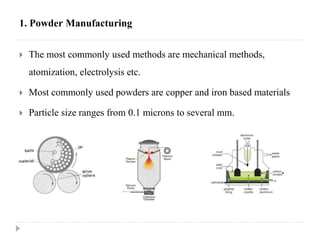
1. Powder Manufacturing
 The most commonly used methods are mechanical methods,
atomization, electrolysis etc.
 Most commonly used powders are copper and iron based materials
 Particle size ranges from 0.1 microns to several mm.
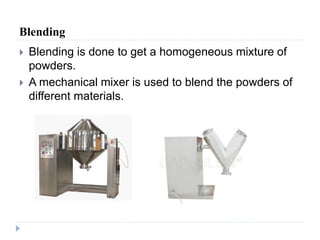
Blending
 Blending is done to get a homogeneous mixture of
powders.
 A mechanical mixer is used to blend the powders of
different materials.
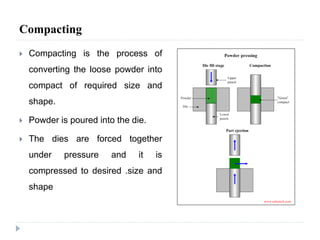
Compacting
 Compacting is the process of
converting the loose powder into
compact of required size and
shape.
 Powder is poured into the die.
 The dies are forced together
under pressure and it is
compressed to desired .size and
shape
Sintering
 After compacting the product is heated in a furnaceto a temperature
close to the melting point of the base metal.
 Heating causes the metal particles to sinter.
 Sintering is done to achieve strength and hardness to the final
product.

Manufacturing process

  • 1.
  • 2.
    MANUFACTURING PROCESS  Rawmaterial finished product Classification 1. Shaping process 2. Machining process 3. Joining process 4. Finishing process 5. Property changing process Process
  • 3.
    1. Shaping process Process in which shape and size of material is changed without removal of material. Common process :- Casting Forging Drawing Rolling Extruding
  • 4.
    2. Machining process Process in which shape and size of material is changed by removing material from unwanted portions of the work piece. Common process:- Surfacing Turning Shaping Drilling Grinding Milling
  • 5.
    3. Joining process Process in which two or more parts are joined together. Common process :- Welding Brazing Soldering Bolting Riveting Shrink fitting
  • 6.
    Moulding and Casting Casting : Process of producing metallic parts of desired shape and size by pouring molten metal into a mould having a cavity and allowing the molten metal to solidify.  Moulding: Process of making mould using a pattern.  Pattern : Replica or model of the final product.  Mould materials : sand, plaster of Paris, metal etc  Pattern material : wood, metal, wax, plastic, cement etc
  • 7.
  • 8.
    Classification of Moulding 1.Bench moulding  done on a bench  Used for small castings 2. Floor moulding  moulding done on foundry floor  Used for medium and large moldings 3. Pit moulding  Moulding done on pits dug on foundry floor.  Drag part in pit & separate cope  Used for extremely large castings 4. Machine moulding  operations such as ramming, pattern removal are done by machines.  Faster method used for mass production.  Better quality and cost of production less due to mass production.
  • 9.
    Properties of mouldingsand 1. Porosity or permeability 2. Cohesiveness or strength 3. Adhesiveness 4. Plasticity 5. Refractoriness 6. Flowability 7. Chemical stability
  • 10.
    Sand Casting  Sandmoulds  Moulding box – cope and drag.  Gating system – passage for bringing molten metal to mould cavity. It consist of  Pouring basin  Sprue  Gate  Core – solid mass of dry sand, having shape of internal cavity or hole in casting.
  • 11.
    Permanent mould casting Moulds are made of metals (cast iron and alloy steel).  Pouring molten metal into the cavity without applying external pressure (gravitational force only).  Mould halves are hinged for easy removal of casting. Advantages :  Closer dimensional tolerances.  Better surface finish.  Greater mechanical strength  Lower percentage of rejection. Disadvantages :  Not suitable for large castings.  Cost high  Used for mass production only.
  • 12.
    Die Casting  Externalpressure (pneumatic, hydraulic, mechanical) is employed (pressure die casting) for casting.  Fast casting process  Metallic mould called Die.  Used for lead, Mg, tin, Zinc alloys, Al, copper etc.  Types of Die casting 1. Hot chamber Die casting. 2. Cold chamber die casting.
  • 13.
    Hot chamber diecasting A piston is actuated inside the cylinder . Cylinder is having a goose neck at one end. A port is provided near the top of the cylinder to allow molten metal to enter into it. The downward stroke of the piston closes this port and applies pressure on the molten metal. Thus molten metal is forced into the die cavity and solidifies to form a
  • 14.
    Cold chamber diecasting Metal is melted separately and transferred to the cylinder using a hand ladle. After closing the die, the molten metal in the cylinder is forced into the die cavity by applying pressure on the piston. After solidification the die is opened and casting is ejected
  • 15.
     Advantages ofdie casting:  Very high rate of production  Very close dimensional tolerances  High surface finish  Economical for mass production  Intricate shape can be easily cast  Thin sections can be casted easily.
  • 16.
     Disadvantages ofdie casting  All types of alloy cannot be cast  Not suitable for large casting  High cost of die and die casting equipments.  Advantages and disadvantages of die casting equipments  No limit of size of parts that can be produced by casting  Wide range of materials can be easily cast.  Cheapest method for mass production.  Intricate shape can be cast.  Not economical for few number of castings.
  • 17.
    Forging  Definition :process of changing shape of metals when it is in plastic state, by applying compressive force, is called hot forging or simply forging.  Hand Forging  Drop Forging  Press Forging  Machine Forging
  • 18.
  • 19.
    ROLLING  Rolling isthe process of forming metals into desired shape by passing the metal in between a pair of roller . The two rolls rotated in opposite direction at same speed. The arrangement of rolling for rolling operation is called rolling mill. Example ;bars, plates, sheets, rails  Hot rolling ;metal heated above recrystallizition temp  Cold rolling ; metal heated below the recrystallizition temp  Basis of no: of roller and their arrangements rolling can be classified into ,
  • 20.
     Two highmill  Three high mill Four high mill Cluster mill
  • 21.
    EXTRUSION  Extrusion isthe process of forming products of uniform cross sectional shapes in convenient length.  It consist of compressing the metal inside a chamber and forcing it out through a die having an opening in the shape of the cross section of the product  It can be classified into two  Direct Extrusion (Forward Extrusion)  Indirect Extrusion ( Backward Extrusion)
  • 22.
    Direct Extrusion (ForwardExtrusion)  In this process the metal is placed in the die chamber and it is forced through the die opening by applying pressure on the ram.
  • 23.
    Indirect Extrusion (Backward Extrusion)  In this case, the extruded part moves out in a direction opposite to that of ram movement.  This process requires less fore than direct extrusion process.
  • 24.
    Welding  Welding isthe process of joining two metals by the application of heat . Welding is done with the help of a welding machine . Welding are classified into  Electrical resistance welding  Arc welding  Gas welding  Thermit welding
  • 25.
    Electrical resistance welding w/p to be joined are held together and electric current of low voltage and high current is passed through them  Voltage: 6 to 10 Volts  Current: 60 to 4000 A
  • 26.
    Seam WeldingFlash Welding ButtWeldingSpot Welding
  • 27.
    Arc Welding  Surfaceto be joined are fused by the heat produced from an electric arc.  When electrode is kept at a short distance from the work piece, an electric arc is formed in which electrical energy is converted into heat  Electrodes are coated with Slag or Flux materials
  • 28.
    Gas Welding  Itis a fusion welding in which the required heat is obtained by the combustion of fuel gas  A gas flame ( Oxy acetylene flame) is mostly used to produce the welding temperature of the order of 3200⁰C
  • 29.
    Thermit Welding  Itis a fusion welding process in which the required heat is obtained by an exothermic chemical reaction  A mixture of powdered aluminium and iron oxide is placed inside the crusible.  This mixture is ignited  The resultant products are highly purified iron and aluminium oxide  The temperature produced will be above 3500⁰C Fe2O3 + 2 Al → 2 Fe + Al2O3
  • 30.
    BRAZING SOLDERING  Incase of brazing joining of metal pieces is done with the help of filler metal.  Filler metal is melted and distributed by capillary action between the surfaces of the metallic parts being joined.  In this case only filler metal melts.  There is no melting of workpiece metal.  The filler metal (brazing metal) should have the melting point more than 450⁰C.  Its melting point should be lesser than the melting point of workpiece metal. Soldering is very much similar to brazing Its principle is same as that of brazing. The major difference lies with the filler metal. The filler metal used in case of soldering should have the melting temperature lower than 450⁰C Strength of soldered joint is much lesser than welded joint and less than a brazed joint.
  • 31.
    Powder Metallurgy  Itis the process of pressing fine powdered materials into desired shape and size and heating it in a controlled atmosphere to bond the material.  Powder Metallurgy consist of 4 processes  Powder Manufacturing  Blending  Compacting  Sintering
  • 32.
    1. Powder Manufacturing The most commonly used methods are mechanical methods, atomization, electrolysis etc.  Most commonly used powders are copper and iron based materials  Particle size ranges from 0.1 microns to several mm.
  • 33.
    Blending  Blending isdone to get a homogeneous mixture of powders.  A mechanical mixer is used to blend the powders of different materials.
  • 34.
    Compacting  Compacting isthe process of converting the loose powder into compact of required size and shape.  Powder is poured into the die.  The dies are forced together under pressure and it is compressed to desired .size and shape
  • 35.
    Sintering  After compactingthe product is heated in a furnaceto a temperature close to the melting point of the base metal.  Heating causes the metal particles to sinter.  Sintering is done to achieve strength and hardness to the final product.