FACTORS AFFECTING SURFACE
FINISH
Material of the work piece
Type of machining
Vibrations
Cutting tool
Rigidity of the system
Cutting conditions like speed ,feed
and depth of cut.
Type of coolant used. 1
MEASUREMENT OF SURFACE
FINISH
Properties influenced by surface
finish.
Appearance
Corrosion resistance
Wear resistance
Fatigue resistance
Lubrication
Noise reduction 2
SURFACE TEXTURE
 The characteristics quality of an actual surface
due to small departure from its general
geometrical form which occurring at regular or
irregular intervals, tend to form a pattern or
texture on the surface.
3
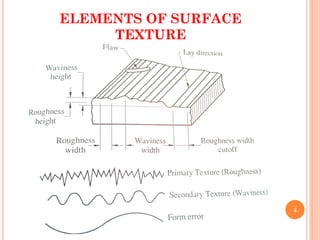
ELEMENTS OF SURFACE
TEXTURE
4
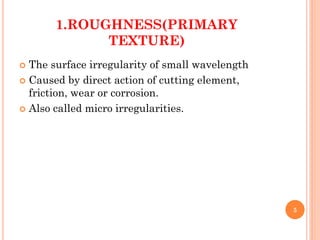
1.ROUGHNESS(PRIMARY
TEXTURE)
 The surface irregularity of small wavelength
 Caused by direct action of cutting element,
friction, wear or corrosion.
 Also called micro irregularities.
5
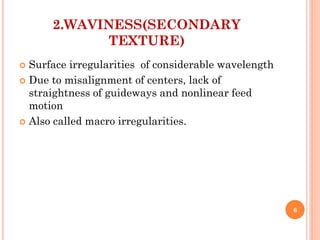
2.WAVINESS(SECONDARY
TEXTURE)
 Surface irregularities of considerable wavelength
 Due to misalignment of centers, lack of
straightness of guideways and nonlinear feed
motion
 Also called macro irregularities.
6
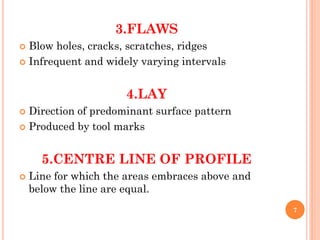
3.FLAWS
 Blow holes, cracks, scratches, ridges
 Infrequent and widely varying intervals
4.LAY
 Direction of predominant surface pattern
 Produced by tool marks
5.CENTRE LINE OF PROFILE
 Line for which the areas embraces above and
below the line are equal.
7
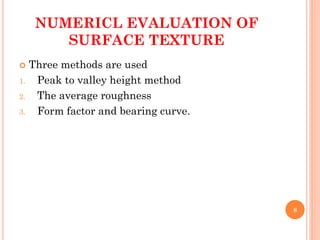
NUMERICL EVALUATION OF
SURFACE TEXTURE
 Three methods are used
1. Peak to valley height method
2. The average roughness
3. Form factor and bearing curve.
8
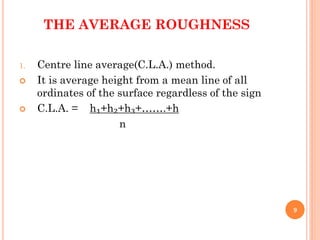
THE AVERAGE ROUGHNESS
1. Centre line average(C.L.A.) method.
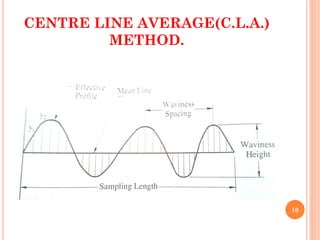
 It is average height from a mean line of all
ordinates of the surface regardless of the sign
 C.L.A. = h₁+h₂+h₃+…….+h
n
9
CENTRE LINE AVERAGE(C.L.A.)
METHOD.
10
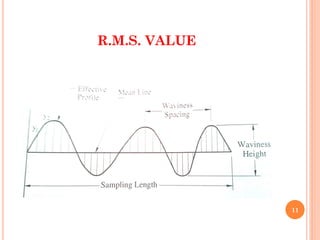
R.M.S. VALUE
11
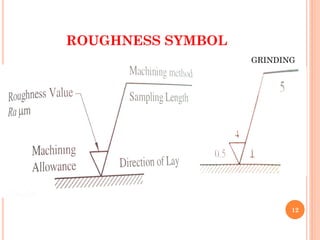
ROUGHNESS SYMBOL
12
GRINDING
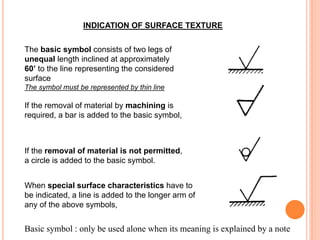
INDICATION OF SURFACE TEXTURE
The basic symbol consists of two legs of
unequal length inclined at approximately
60’ to the line representing the considered
surface
The symbol must be represented by thin line
If the removal of material by machining is
required, a bar is added to the basic symbol,
If the removal of material is not permitted,
a circle is added to the basic symbol.
When special surface characteristics have to
be indicated, a line is added to the longer arm of
any of the above symbols,
Basic symbol : only be used alone when its meaning is explained by a note
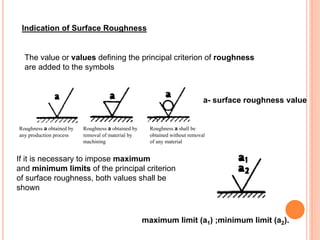
Indication of Surface Roughness
The value or values defining the principal criterion of roughness
are added to the symbols
a- surface roughness value
If it is necessary to impose maximum
and minimum limits of the principal criterion
of surface roughness, both values shall be
shown
maximum limit (a1) ;minimum limit (a2).
Roughness a obtained by
any production process
Roughness a obtained by
removal of material by
machining
Roughness a shall be
obtained without removal
of any material
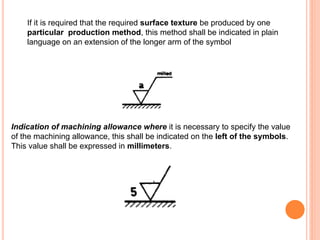
If it is required that the required surface texture be produced by one
particular production method, this method shall be indicated in plain
language on an extension of the longer arm of the symbol
Indication of machining allowance where it is necessary to specify the value
of the machining allowance, this shall be indicated on the left of the symbols.
This value shall be expressed in millimeters.
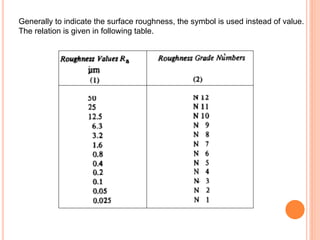
Generally to indicate the surface roughness, the symbol is used instead of value.
The relation is given in following table.
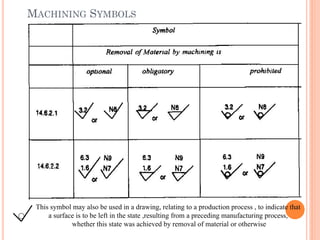
MACHINING SYMBOLS
This symbol may also be used in a drawing, relating to a production process , to indicate that
a surface is to be left in the state ,resulting from a preceding manufacturing process,
whether this state was achieved by removal of material or otherwise
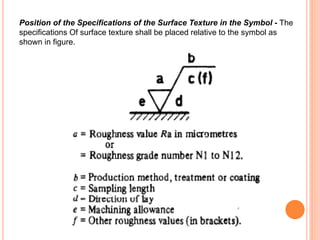
Position of the Specifications of the Surface Texture in the Symbol - The
specifications Of surface texture shall be placed relative to the symbol as
shown in figure.
symbol Interpretation
Parallel to the plane of projection
of the view in which the symbol is used
Perpendicular to the plane of projection
of the
view in which the symbol is used
Crossed in two slant direction relative to
the plane of projection of the view in
which the
symbol is used
Multidirectional
Approximately circular relative to the
centre of the surface to which the symbol
is applied
Approximately radial relative to the
centre of the surface to which the symbol
is applied
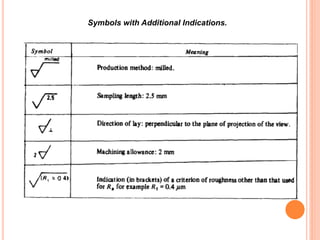
Symbols with Additional Indications.
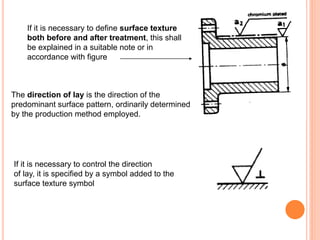
If it is necessary to define surface texture
both before and after treatment, this shall
be explained in a suitable note or in
accordance with figure
The direction of lay is the direction of the
predominant surface pattern, ordinarily determined
by the production method employed.
If it is necessary to control the direction
of lay, it is specified by a symbol added to the
surface texture symbol
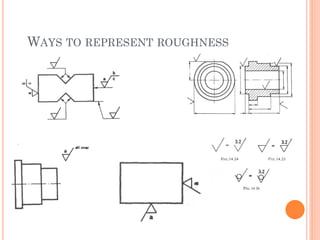
WAYS TO REPRESENT ROUGHNESS
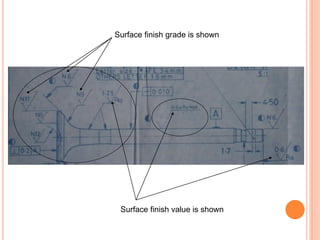
Surface finish grade is shown
Surface finish value is shown
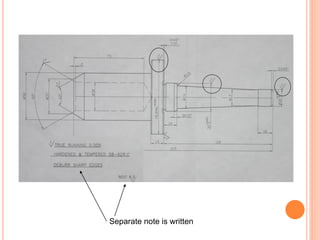
Separate note is written
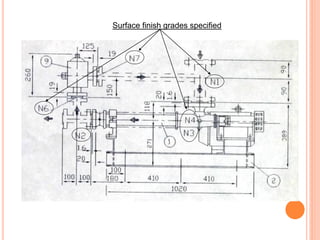
Surface finish grades specified
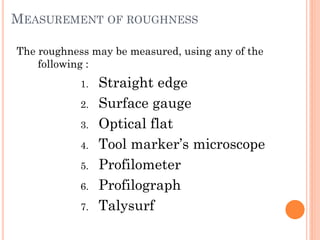
MEASUREMENT OF ROUGHNESS
The roughness may be measured, using any of the
following :
1. Straight edge
2. Surface gauge
3. Optical flat
4. Tool marker’s microscope
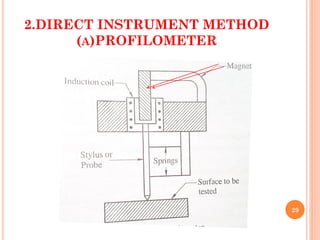
5. Profilometer
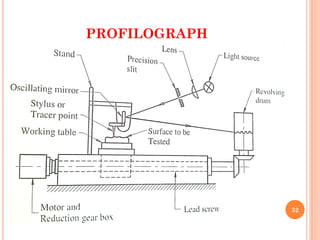
6. Profilograph
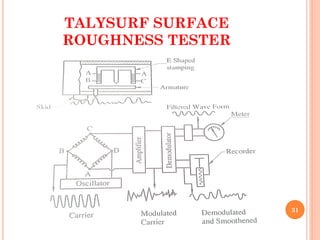
7. Talysurf
METHODS OF MEASURING
SURFACE FINISH
1. Surface inspection by comparison method
2. Direct instrument measurement
27
1. COMPARISION METHOD
1. Touch inspection
2. Visual inspection
3. Scratch inspection
4. Microscopic inspection
5. Surface photograph
6. Reflected light intensity.
28
2.DIRECT INSTRUMENT METHOD
(A)PROFILOMETER
29
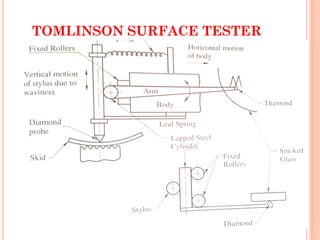
TOMLINSON SURFACE TESTER
30
TALYSURF SURFACE
ROUGHNESS TESTER
31
PROFILOGRAPH
32
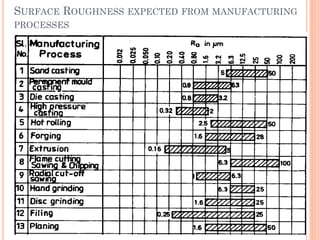
SURFACE ROUGHNESS EXPECTED FROM MANUFACTURING
PROCESSES
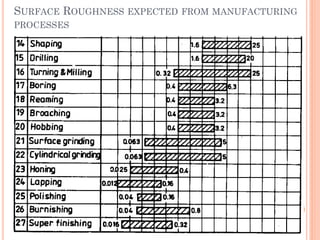
SURFACE ROUGHNESS EXPECTED FROM MANUFACTURING
PROCESSES

Surface finish measurement naman m dave

  • 1.
    FACTORS AFFECTING SURFACE FINISH Materialof the work piece Type of machining Vibrations Cutting tool Rigidity of the system Cutting conditions like speed ,feed and depth of cut. Type of coolant used. 1
  • 2.
    MEASUREMENT OF SURFACE FINISH Propertiesinfluenced by surface finish. Appearance Corrosion resistance Wear resistance Fatigue resistance Lubrication Noise reduction 2
  • 3.
    SURFACE TEXTURE  Thecharacteristics quality of an actual surface due to small departure from its general geometrical form which occurring at regular or irregular intervals, tend to form a pattern or texture on the surface. 3
  • 4.
  • 5.
    1.ROUGHNESS(PRIMARY TEXTURE)  The surfaceirregularity of small wavelength  Caused by direct action of cutting element, friction, wear or corrosion.  Also called micro irregularities. 5
  • 6.
    2.WAVINESS(SECONDARY TEXTURE)  Surface irregularitiesof considerable wavelength  Due to misalignment of centers, lack of straightness of guideways and nonlinear feed motion  Also called macro irregularities. 6
  • 7.
    3.FLAWS  Blow holes,cracks, scratches, ridges  Infrequent and widely varying intervals 4.LAY  Direction of predominant surface pattern  Produced by tool marks 5.CENTRE LINE OF PROFILE  Line for which the areas embraces above and below the line are equal. 7
  • 8.
    NUMERICL EVALUATION OF SURFACETEXTURE  Three methods are used 1. Peak to valley height method 2. The average roughness 3. Form factor and bearing curve. 8
  • 9.
    THE AVERAGE ROUGHNESS 1.Centre line average(C.L.A.) method.  It is average height from a mean line of all ordinates of the surface regardless of the sign  C.L.A. = h₁+h₂+h₃+…….+h n 9
  • 10.
  • 11.
  • 12.
  • 13.
    INDICATION OF SURFACETEXTURE The basic symbol consists of two legs of unequal length inclined at approximately 60’ to the line representing the considered surface The symbol must be represented by thin line If the removal of material by machining is required, a bar is added to the basic symbol, If the removal of material is not permitted, a circle is added to the basic symbol. When special surface characteristics have to be indicated, a line is added to the longer arm of any of the above symbols, Basic symbol : only be used alone when its meaning is explained by a note
  • 14.
    Indication of SurfaceRoughness The value or values defining the principal criterion of roughness are added to the symbols a- surface roughness value If it is necessary to impose maximum and minimum limits of the principal criterion of surface roughness, both values shall be shown maximum limit (a1) ;minimum limit (a2). Roughness a obtained by any production process Roughness a obtained by removal of material by machining Roughness a shall be obtained without removal of any material
  • 15.
    If it isrequired that the required surface texture be produced by one particular production method, this method shall be indicated in plain language on an extension of the longer arm of the symbol Indication of machining allowance where it is necessary to specify the value of the machining allowance, this shall be indicated on the left of the symbols. This value shall be expressed in millimeters.
  • 16.
    Generally to indicatethe surface roughness, the symbol is used instead of value. The relation is given in following table.
  • 17.
    MACHINING SYMBOLS This symbolmay also be used in a drawing, relating to a production process , to indicate that a surface is to be left in the state ,resulting from a preceding manufacturing process, whether this state was achieved by removal of material or otherwise
  • 18.
    Position of theSpecifications of the Surface Texture in the Symbol - The specifications Of surface texture shall be placed relative to the symbol as shown in figure.
  • 19.
    symbol Interpretation Parallel tothe plane of projection of the view in which the symbol is used Perpendicular to the plane of projection of the view in which the symbol is used Crossed in two slant direction relative to the plane of projection of the view in which the symbol is used Multidirectional Approximately circular relative to the centre of the surface to which the symbol is applied Approximately radial relative to the centre of the surface to which the symbol is applied
  • 20.
  • 21.
    If it isnecessary to define surface texture both before and after treatment, this shall be explained in a suitable note or in accordance with figure The direction of lay is the direction of the predominant surface pattern, ordinarily determined by the production method employed. If it is necessary to control the direction of lay, it is specified by a symbol added to the surface texture symbol
  • 22.
  • 23.
    Surface finish gradeis shown Surface finish value is shown
  • 24.
  • 25.
  • 26.
    MEASUREMENT OF ROUGHNESS Theroughness may be measured, using any of the following : 1. Straight edge 2. Surface gauge 3. Optical flat 4. Tool marker’s microscope 5. Profilometer 6. Profilograph 7. Talysurf
  • 27.
    METHODS OF MEASURING SURFACEFINISH 1. Surface inspection by comparison method 2. Direct instrument measurement 27
  • 28.
    1. COMPARISION METHOD 1.Touch inspection 2. Visual inspection 3. Scratch inspection 4. Microscopic inspection 5. Surface photograph 6. Reflected light intensity. 28
  • 29.
  • 30.
  • 31.
  • 32.
  • 33.
    SURFACE ROUGHNESS EXPECTEDFROM MANUFACTURING PROCESSES
  • 34.
    SURFACE ROUGHNESS EXPECTEDFROM MANUFACTURING PROCESSES