Metal Casting Processes
G.GOPINATH
By
AP/Mech/RVSTCC
METAL CASTING PROCESSES
Sand casting – Sand moulds - Type of patterns – Pattern
materials – Pattern allowances – Types of Moulding
sand – Properties – Core making – Methods of Sand
testing – Moulding machines – Types of moulding
machines - Melting furnaces – Working principle of
Special casting processes – Shell, investment casting –
Ceramic mould – Lost Wax process – Pressure die
casting – Centrifugal casting – CO2 process– Sand
Casting defects – Inspection methods
 1.Manufacturing
 Manufacturing in its broadest sense is the process of converting raw
materials into useful products.
 • IT Includes
 i) Design of the product
 ii) Selection of raw materials and
 iii) The sequence of processes through which the product will be
manufactured. Casting.
Any Product in the engineering industry will be manufactured in the below
methods
 1. By totally deforming the metal to the required shape. (Casting
/Forming)
 1. By joining two metals. (Welding)
 2. By removing the excess material from the raw stock.(Machining)
 Casting.
 Casting is the process of producing metal parts by
pouring molten metal into the mould cavity of the
required shape and allowing the metal to solidify. The
solidified metal piece is called as "casting".
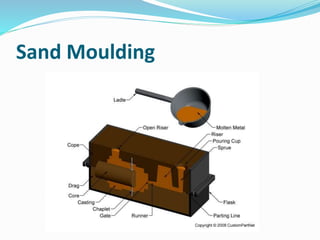
 Sand Casting /Sand Moulding.
 Sand Casting is simply melting the metal and pouring it
into a preformed cavity, called mold, allowing (the metal
to solidify and then breaking up the mold to remove
casting.
 In sand casting expandable molds are used. So for each
casting operation you have to form a new mold.
Types of sand
 a) Green-sand - mixture of sand, clay, and water,Binders
(Molases, Linseed oil); "Green” means mold contains
moisture at time of pouring.
 b) Dry-sand - organic binders rather than clay and mold
is baked to improve strength
 c) Skin-dried - drying mold cavity surface of a green-sand
 - mold to a depth of u p t o 25 mm, using torches or
heating
 d)Core Sand
 e)Baking sand
 f)Loam Sand
 g)Parting sand, Etc
Patterns
 Patterns are the replica or physical models of the final
required shape of the casting, made by wood
(teak,magony,pine), plastics, Metals, Plaster of paris etc.,
Types of patterns.
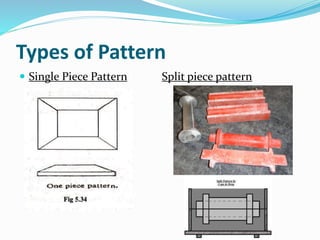
 1.Solid pattern
 2.Split piece pattern
 3.Three piece pattern
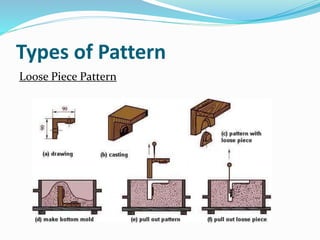
 4.Loose piece pattern
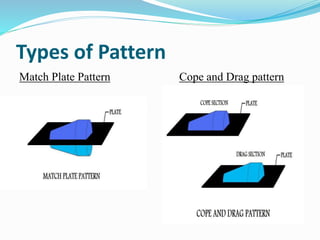
 5.Match plate pattern
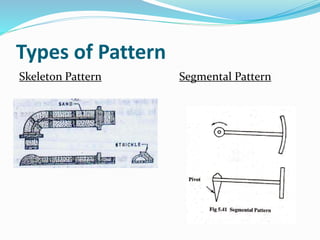
 6.Segmental pattern
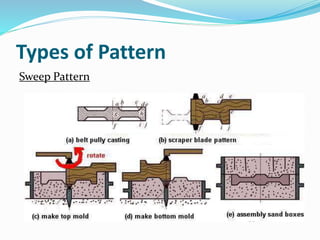
 7.Sweep patten
 8.skeleton Pattern
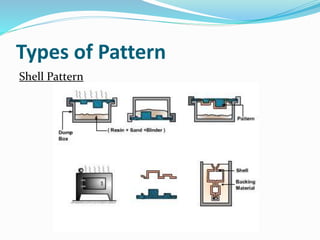
 9.shell Pattern.
 Pattern Allowance.
 Allowance are the extra dimensional compensation
give to the pattern in order to attain the correct shape
and size of the final solidified metal casting.Five types
of allowances were taken into consideration for various
reasons.
 Allowance types – refer PDF pg.no 8
Steps in Sand Casting
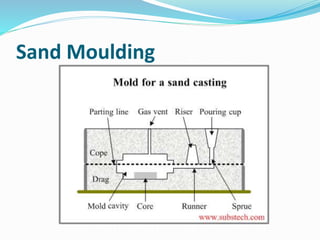
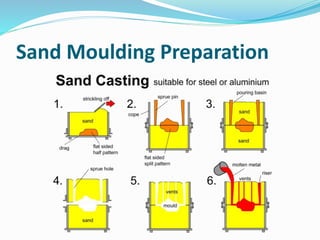
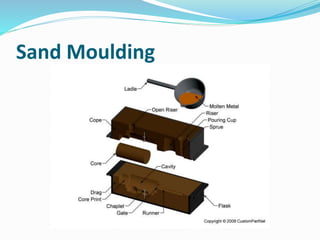
 The cavity in the sand mold is formed by packing sand
around a pattern, separating themold into two halves •
The mold must also contain gating and riser system For
internal cavity, a core must be included in mold A new
sand mold must be made for each part.
 1. Pour molten metal into sand mold
 2. Allow metal to solidify
 3. Break up the mold to remove casting
 4. Clean and inspect casting
 5. Heat treatment of casting is sometimes required to
 improve metallurgical properties.
Sand Moulding
Sand Moulding Preparation
Sand Moulding
Sand Moulding
Types of Pattern
 Single Piece Pattern Split piece pattern
Types of Pattern
Match Plate Pattern Cope and Drag pattern
Types of Pattern
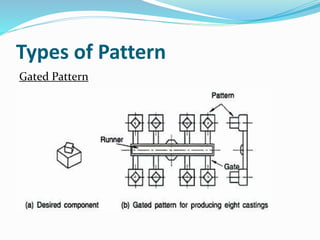
Gated Pattern
Types of Pattern
Loose Piece Pattern
Types of Pattern
Sweep Pattern
Types of Pattern
Skeleton Pattern Segmental Pattern
Types of Pattern
Shell Pattern
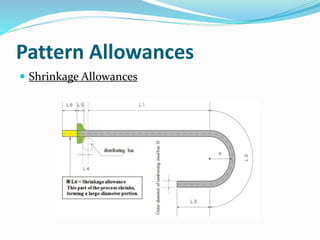
Pattern Allowances
 Shrinkage Allowances
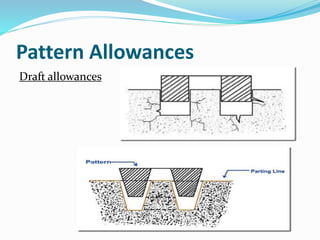
Pattern Allowances
Draft allowances
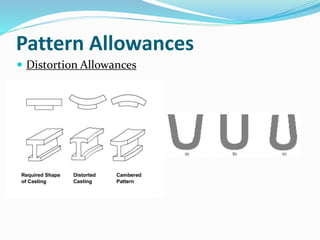
Pattern Allowances
 Distortion Allowances
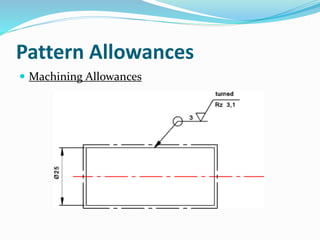
Pattern Allowances
 Machining Allowances
Pattern Allowances
Rapping Allowances or Shake Allowances
 Negative Allowance
 To rap the pattern from the sand
 It creates some space around the pattern
Moulding Sand
Constituents of Moulding Sand
 Silica sand grains
 80-90% Silicon dioxide
 Quartz rock
 Imparts refractoriness, chemical resistivity, permeability.
 Clay
 5-20%
 Bonding Strength
 Moisture
 2-8%
 Miscellaneous materials
 Limestone, magnesia, soda and potash.
Types of Moulding Sand
 Green Sand
 18-30% Silica
 6-8% water
 Soft, light and porous
 Dry Sand
 Green sand dried and baked
 Large castings
 Loam Sand
 50% of clay
 Large Castings
Types of Moulding Sand
 Facing Sand
 Face of mould
 Surface of pattern
 20-30 mm
 Backing Sand
 Back up facing sand
 System Sand
 No facing sand
 Reactivated sands
 Parting Sand
 Avoids sticking of pattern to mould sand
 Avoids sticking of cope and drag
 Core Sand
 Silica and core oil, to prepare core
Properties of Moulding Sand
 Porosity or Permeability (gas holes and pores)
 Flowability
 Collapsibility
 Adhesiveness (should cling or stick to sides of box)
 Cohesiveness or strength
 Refractoriness (withstand high temp.)
Moulding Sand Preparation
 Mixing of sand (Sand ,binders and additives)
 Sand Tempering (adding moisture)
 Sand Conditioning
 Muller Machine
 Riddles (screening sand)
 Magnetic Separators
 Aerators(sand grains)
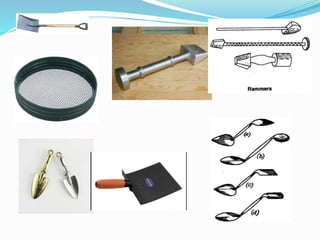
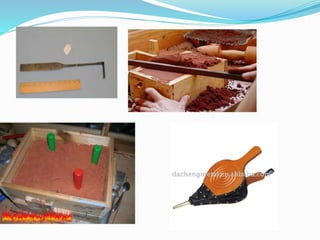
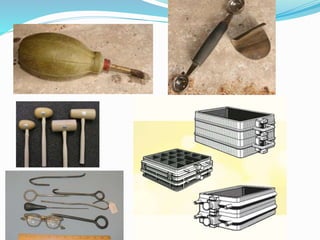
Moulding Tools
 Showel
 Riddle
 Rammer
 Trowel
 Slick
 Lifter
 Strike-off bar
 Sprue pin
•Bellow
•Swab
•Gate cutter
•Mallet
•Vent Rod
•Draw spike
•Clamps
•Moulding boxes
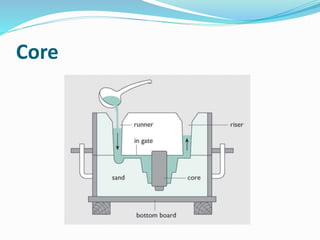
Core
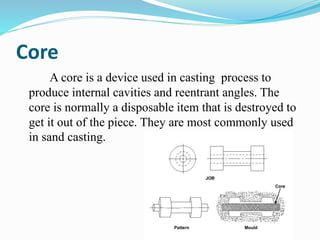
A core is a device used in casting process to
produce internal cavities and reentrant angles. The
core is normally a disposable item that is destroyed to
get it out of the piece. They are most commonly used
in sand casting.
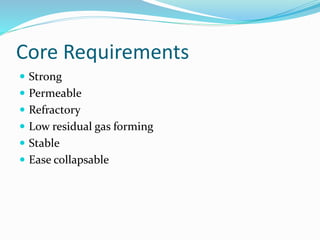
Core Requirements
 Strong
 Permeable
 Refractory
 Low residual gas forming
 Stable
 Ease collapsable
Core
Core Sand
 Sand and Binder
 Silica, zircon, olivine, carbon, chamotte
 Not have more than 5% of clay.
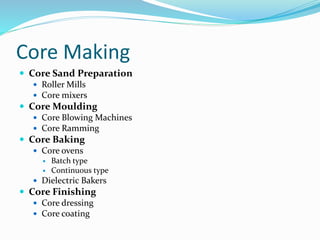
Core Making
 Core Sand Preparation
 Roller Mills
 Core mixers
 Core Moulding
 Core Blowing Machines
 Core Ramming
 Core Baking
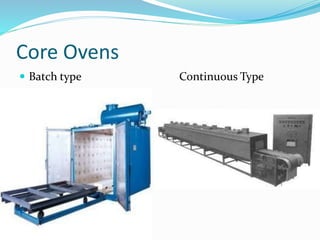
 Core ovens
 Batch type
 Continuous type
 Dielectric Bakers
 Core Finishing
 Core dressing
 Core coating
Core Ovens
 Batch type Continuous Type
Types of Core
 Horizontal Core
 Vertical Core
 Balanced Core
 Hanging Core
 Wing Core
 Ram-up Core
 Kiss Core
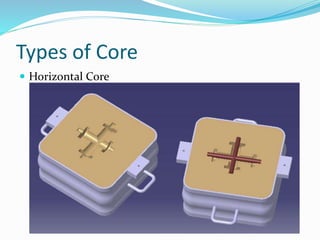
Types of Core
 Horizontal Core
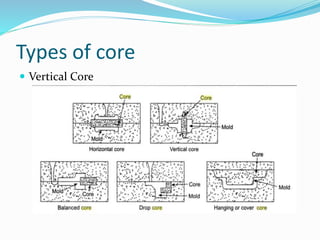
Types of core
 Vertical Core
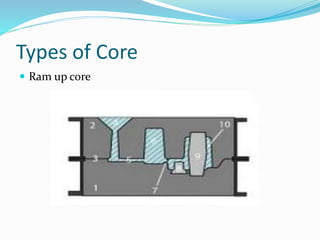
Types of Core
 Ram up core
Unit 1 manufacturing technology I Metal casting process

Unit 1 manufacturing technology I Metal casting process

  • 1.
  • 2.
    METAL CASTING PROCESSES Sandcasting – Sand moulds - Type of patterns – Pattern materials – Pattern allowances – Types of Moulding sand – Properties – Core making – Methods of Sand testing – Moulding machines – Types of moulding machines - Melting furnaces – Working principle of Special casting processes – Shell, investment casting – Ceramic mould – Lost Wax process – Pressure die casting – Centrifugal casting – CO2 process– Sand Casting defects – Inspection methods
  • 3.
     1.Manufacturing  Manufacturingin its broadest sense is the process of converting raw materials into useful products.  • IT Includes  i) Design of the product  ii) Selection of raw materials and  iii) The sequence of processes through which the product will be manufactured. Casting. Any Product in the engineering industry will be manufactured in the below methods  1. By totally deforming the metal to the required shape. (Casting /Forming)  1. By joining two metals. (Welding)  2. By removing the excess material from the raw stock.(Machining)
  • 4.
     Casting.  Castingis the process of producing metal parts by pouring molten metal into the mould cavity of the required shape and allowing the metal to solidify. The solidified metal piece is called as "casting".  Sand Casting /Sand Moulding.  Sand Casting is simply melting the metal and pouring it into a preformed cavity, called mold, allowing (the metal to solidify and then breaking up the mold to remove casting.  In sand casting expandable molds are used. So for each casting operation you have to form a new mold.
  • 5.
    Types of sand a) Green-sand - mixture of sand, clay, and water,Binders (Molases, Linseed oil); "Green” means mold contains moisture at time of pouring.  b) Dry-sand - organic binders rather than clay and mold is baked to improve strength  c) Skin-dried - drying mold cavity surface of a green-sand  - mold to a depth of u p t o 25 mm, using torches or heating  d)Core Sand  e)Baking sand  f)Loam Sand  g)Parting sand, Etc
  • 6.
    Patterns  Patterns arethe replica or physical models of the final required shape of the casting, made by wood (teak,magony,pine), plastics, Metals, Plaster of paris etc., Types of patterns.  1.Solid pattern  2.Split piece pattern  3.Three piece pattern  4.Loose piece pattern  5.Match plate pattern  6.Segmental pattern  7.Sweep patten  8.skeleton Pattern  9.shell Pattern.
  • 7.
     Pattern Allowance. Allowance are the extra dimensional compensation give to the pattern in order to attain the correct shape and size of the final solidified metal casting.Five types of allowances were taken into consideration for various reasons.  Allowance types – refer PDF pg.no 8
  • 8.
    Steps in SandCasting  The cavity in the sand mold is formed by packing sand around a pattern, separating themold into two halves • The mold must also contain gating and riser system For internal cavity, a core must be included in mold A new sand mold must be made for each part.  1. Pour molten metal into sand mold  2. Allow metal to solidify  3. Break up the mold to remove casting  4. Clean and inspect casting  5. Heat treatment of casting is sometimes required to  improve metallurgical properties.
  • 9.
  • 10.
  • 11.
  • 12.
  • 13.
    Types of Pattern Single Piece Pattern Split piece pattern
  • 14.
    Types of Pattern MatchPlate Pattern Cope and Drag pattern
  • 15.
  • 16.
  • 17.
  • 18.
    Types of Pattern SkeletonPattern Segmental Pattern
  • 19.
  • 20.
  • 21.
  • 22.
  • 23.
  • 24.
    Pattern Allowances Rapping Allowancesor Shake Allowances  Negative Allowance  To rap the pattern from the sand  It creates some space around the pattern
  • 25.
    Moulding Sand Constituents ofMoulding Sand  Silica sand grains  80-90% Silicon dioxide  Quartz rock  Imparts refractoriness, chemical resistivity, permeability.  Clay  5-20%  Bonding Strength  Moisture  2-8%  Miscellaneous materials  Limestone, magnesia, soda and potash.
  • 26.
    Types of MouldingSand  Green Sand  18-30% Silica  6-8% water  Soft, light and porous  Dry Sand  Green sand dried and baked  Large castings  Loam Sand  50% of clay  Large Castings
  • 27.
    Types of MouldingSand  Facing Sand  Face of mould  Surface of pattern  20-30 mm  Backing Sand  Back up facing sand  System Sand  No facing sand  Reactivated sands  Parting Sand  Avoids sticking of pattern to mould sand  Avoids sticking of cope and drag  Core Sand  Silica and core oil, to prepare core
  • 28.
    Properties of MouldingSand  Porosity or Permeability (gas holes and pores)  Flowability  Collapsibility  Adhesiveness (should cling or stick to sides of box)  Cohesiveness or strength  Refractoriness (withstand high temp.)
  • 29.
    Moulding Sand Preparation Mixing of sand (Sand ,binders and additives)  Sand Tempering (adding moisture)  Sand Conditioning  Muller Machine  Riddles (screening sand)  Magnetic Separators  Aerators(sand grains)
  • 30.
    Moulding Tools  Showel Riddle  Rammer  Trowel  Slick  Lifter  Strike-off bar  Sprue pin •Bellow •Swab •Gate cutter •Mallet •Vent Rod •Draw spike •Clamps •Moulding boxes
  • 34.
    Core A core isa device used in casting process to produce internal cavities and reentrant angles. The core is normally a disposable item that is destroyed to get it out of the piece. They are most commonly used in sand casting.
  • 35.
    Core Requirements  Strong Permeable  Refractory  Low residual gas forming  Stable  Ease collapsable
  • 36.
  • 37.
    Core Sand  Sandand Binder  Silica, zircon, olivine, carbon, chamotte  Not have more than 5% of clay.
  • 38.
    Core Making  CoreSand Preparation  Roller Mills  Core mixers  Core Moulding  Core Blowing Machines  Core Ramming  Core Baking  Core ovens  Batch type  Continuous type  Dielectric Bakers  Core Finishing  Core dressing  Core coating
  • 39.
    Core Ovens  Batchtype Continuous Type
  • 40.
    Types of Core Horizontal Core  Vertical Core  Balanced Core  Hanging Core  Wing Core  Ram-up Core  Kiss Core
  • 41.
    Types of Core Horizontal Core
  • 42.
    Types of core Vertical Core
  • 43.
    Types of Core Ram up core