MULTI MODE CASTING PROCESS
CONCEPT
 Casting is a manufacturing process in which a liquid material is usually poured
into a mold, which contains a hollow cavity of the desired shape, and then allowed
to solidify.
 The solidified part is also known as a casting, which is ejected or broken out of the
mold to complete the process.
 Casting materials are usually metals or various cold setting materials
that cure after mixing two or more components together; examples
are epoxy, concrete, plaster and clay. Casting is most often used for making
complex shapes that would be otherwise difficult or uneconomical to make by
other methods
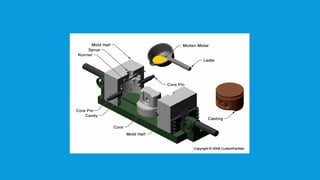
PERMANENT MOLD CASTING
 Permanent mold castings, while not as flexible as sand castings in allowing the
use of different patterns (different part designs), lower the cost of producing a
part.
 At a production run of 1000 or more parts, permanent mold castings produce a
lower piece cost part. Of course, the break-even point depends on the complexity
of the part.
 More complex parts being favored by the use of permanent molds.The usual
considerations of minimum wall thicknesses (such as 3mm for lengths under 75
mm), radius (inside radius = nominal wall thickness, outside radius = 3 x nominal
wall thickness), draft angles (1 to 3º on outside surfaces, 2 to 5º on inside surfaces)
etc. all apply.
PERMANENT MOLD CASTING
 Typical tolerances are 2 % of linear dimensions. Surface finish ranges from 2.5 µm
to 7.5 µm (100 µin to 250 µin).
 .Typical part sizes range from 50 g to 70 kg (1.5 ounces to 150 lb.).
 Typical materials used are small and medium sized parts made from aluminum,
magnesium and brass and their alloys.
 Typical parts include gears, splines, wheels, gear housings, pipefittings, fuel
injection housings, and automotive engine pistons
DIE CASTING
 Die casting is a manufacturing process for producing metal parts by forcing
molten metal under high pressure into a die cavity.
 Generally speaking, these die or mold cavities are created with hardened tool
steel that have been previously machined to the net shape or near net shape of
the die cast parts.
 This process allows products to be made with high degree of accuracy and
repeatability.
 The die casting process also produce fine details such as textured surfaces or
names without requiring further processing.
DIE CASTING
 The die casting process usually produce parts using primarily non-ferrous metals,
such as zinc, copper, aluminum and magnesium. Over the years, many different
alloys have been developed to meet certain type of needs and requirements of
each application.
 Type of die casting processes
 The die casting process can be further divided into two different categories:
 Hot Chamber Die Casting
 Cold Chamber Die Casting
HOT CHAMBER DIE CASTING
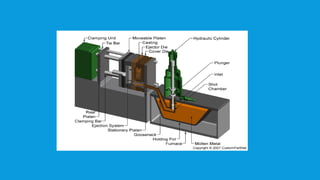
 Hot Chamber Die Casting is the process where the injection system is immersed in
pool of molten metal hence the name.
 The furnace is attached to the machine via a feeding system called a
gooseneck. As the cycle begins the piston will retracts, which allows the molten
metal to fill the “gooseneck” from a port in the injection cylinder.
 As the plunger move downwards, it seals the port and forces the molten metal
through the gooseneck and nozzle into the die. Once the metal solidifies, the
plunger will pull upwards.
COLD CHAMBER DIE CASTING
 Cold Chamber Die Casting is the process of using a ladle to transport the molten
metal from the holding furnace into the unheated shot chamber or injection
cylinder.
 This metal is then shot into the die by using a hydraulic piston.
 The main disadvantage of this process is that it is relatively slower compared to
the Hot Chamber Die Casting process.
 However, this process is primarily used for manufacturing aluminum parts as
molten aluminum alloys have a tendency to attack and erode the metal cylinders,
plungers and dies greatly shortening their tool life
SQUEEZE CASTING
 Squeeze casting, also known as liquid metal forging, is a combination of casting
and forging process.
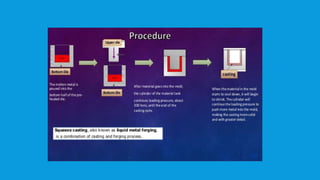
 The molten metal is poured into the bottom half of the pre-heated die. As the
metal starts solidifying, the upper half closes the die and applies pressure during
the solidification process.The amount of pressure thus applied is significantly less
than used in forging, and parts of great detail can be produced. Coring can be
used with this process to form holes and recesses.The porosity is low and the
mechanical properties are improved.
 Both ferrous and non-ferrous materials can be produced using this method.
CENTRIFUGAL CASTING
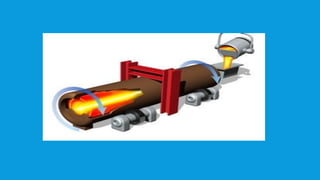
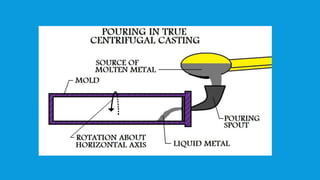
 Centrifugal casting is a process that delivers castings of very high material
soundness, and thus is the technology of choice for applications like jet engine
compressor cases, petrochemical furnace tubes, many military products, and
other high-reliability application.
 Because of the high g-forces applied to the molten metal in the spinning die, less
dense material, including impurities, “floats” to the I.D. where it is subsequently
removed by machining. Solidification is managed directionally under pressure,
from the O.D. to the I.D., avoiding any mid-wall shrinkage, leaving a defect-free
structure without cavities or gas pockets.
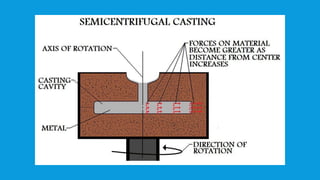
SEMI-CENTRIFUGAL CASTING
 The molds used can be permanent or expendable, can be stacked as necessary.
 The rotational speeds are lower than those used in centrifugal casting.
 The center axis of the part has inclusion defects as well as porosity and thus is
suitable only for parts where this can be machined away.
 This process is used for making wheels, nozzles and similar parts where the axis of
the part is removed by subsequent machining.
CENTRIFUGING
 Centrifuging is used for forcing metal from a central axis of the equipment into
individual mold cavities that are placed on the circumference.
 This provides a means of increasing the filling pressure within each mold and
allows for reproduction of intricate details.
 This method is often used for the pouring of investment casting pattern
CONTINUOUS CASTING
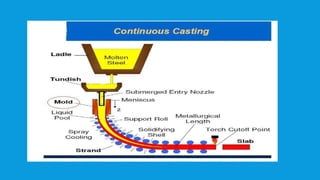
 Continuous casting, also referred to as strand casting, is a process used in
manufacturing industry to cast a continuous length of metal. Molten metal is cast
through a mold, the casting takes the two dimensional profile of the mold but its
length is indeterminate.
 The casting will keep traveling downward, its length increasing with time. New
molten metal is constantly supplied to the mold, at exactly the correct rate, to
keep up with the solidifying casting. Industrial manufacture of continuous castings
is a very precisely calculated operation.
 Continuous casting can produce long strands from aluminum and copper, also the
process has been developed for the production of steel
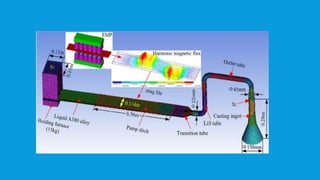
ELECTROMAGNETIC CASTING
 Electromagnetic Casting (EM forming or magneforming) is a type of high
velocity, cold casting process for electrically conductive metals, most
commonly copper and aluminum.
 The workpiece is reshaped by high intensity pulsed magnetic field that induce a
current in the workpiece and a corresponding repulsive magnetic field, rapidly
repelling portions of the workpiece.
 The workpiece can be reshaped without any contact from a tool, although in
some instances the piece may be pressed against a die or former
Multi mode Casting Process

Multi mode Casting Process

  • 1.
  • 2.
    CONCEPT  Casting isa manufacturing process in which a liquid material is usually poured into a mold, which contains a hollow cavity of the desired shape, and then allowed to solidify.  The solidified part is also known as a casting, which is ejected or broken out of the mold to complete the process.  Casting materials are usually metals or various cold setting materials that cure after mixing two or more components together; examples are epoxy, concrete, plaster and clay. Casting is most often used for making complex shapes that would be otherwise difficult or uneconomical to make by other methods
  • 3.
    PERMANENT MOLD CASTING Permanent mold castings, while not as flexible as sand castings in allowing the use of different patterns (different part designs), lower the cost of producing a part.  At a production run of 1000 or more parts, permanent mold castings produce a lower piece cost part. Of course, the break-even point depends on the complexity of the part.  More complex parts being favored by the use of permanent molds.The usual considerations of minimum wall thicknesses (such as 3mm for lengths under 75 mm), radius (inside radius = nominal wall thickness, outside radius = 3 x nominal wall thickness), draft angles (1 to 3º on outside surfaces, 2 to 5º on inside surfaces) etc. all apply.
  • 5.
    PERMANENT MOLD CASTING Typical tolerances are 2 % of linear dimensions. Surface finish ranges from 2.5 µm to 7.5 µm (100 µin to 250 µin).  .Typical part sizes range from 50 g to 70 kg (1.5 ounces to 150 lb.).  Typical materials used are small and medium sized parts made from aluminum, magnesium and brass and their alloys.  Typical parts include gears, splines, wheels, gear housings, pipefittings, fuel injection housings, and automotive engine pistons
  • 6.
    DIE CASTING  Diecasting is a manufacturing process for producing metal parts by forcing molten metal under high pressure into a die cavity.  Generally speaking, these die or mold cavities are created with hardened tool steel that have been previously machined to the net shape or near net shape of the die cast parts.  This process allows products to be made with high degree of accuracy and repeatability.  The die casting process also produce fine details such as textured surfaces or names without requiring further processing.
  • 7.
    DIE CASTING  Thedie casting process usually produce parts using primarily non-ferrous metals, such as zinc, copper, aluminum and magnesium. Over the years, many different alloys have been developed to meet certain type of needs and requirements of each application.  Type of die casting processes  The die casting process can be further divided into two different categories:  Hot Chamber Die Casting  Cold Chamber Die Casting
  • 8.
    HOT CHAMBER DIECASTING  Hot Chamber Die Casting is the process where the injection system is immersed in pool of molten metal hence the name.  The furnace is attached to the machine via a feeding system called a gooseneck. As the cycle begins the piston will retracts, which allows the molten metal to fill the “gooseneck” from a port in the injection cylinder.  As the plunger move downwards, it seals the port and forces the molten metal through the gooseneck and nozzle into the die. Once the metal solidifies, the plunger will pull upwards.
  • 10.
    COLD CHAMBER DIECASTING  Cold Chamber Die Casting is the process of using a ladle to transport the molten metal from the holding furnace into the unheated shot chamber or injection cylinder.  This metal is then shot into the die by using a hydraulic piston.  The main disadvantage of this process is that it is relatively slower compared to the Hot Chamber Die Casting process.  However, this process is primarily used for manufacturing aluminum parts as molten aluminum alloys have a tendency to attack and erode the metal cylinders, plungers and dies greatly shortening their tool life
  • 11.
    SQUEEZE CASTING  Squeezecasting, also known as liquid metal forging, is a combination of casting and forging process.  The molten metal is poured into the bottom half of the pre-heated die. As the metal starts solidifying, the upper half closes the die and applies pressure during the solidification process.The amount of pressure thus applied is significantly less than used in forging, and parts of great detail can be produced. Coring can be used with this process to form holes and recesses.The porosity is low and the mechanical properties are improved.  Both ferrous and non-ferrous materials can be produced using this method.
  • 13.
    CENTRIFUGAL CASTING  Centrifugalcasting is a process that delivers castings of very high material soundness, and thus is the technology of choice for applications like jet engine compressor cases, petrochemical furnace tubes, many military products, and other high-reliability application.  Because of the high g-forces applied to the molten metal in the spinning die, less dense material, including impurities, “floats” to the I.D. where it is subsequently removed by machining. Solidification is managed directionally under pressure, from the O.D. to the I.D., avoiding any mid-wall shrinkage, leaving a defect-free structure without cavities or gas pockets.
  • 15.
    SEMI-CENTRIFUGAL CASTING  Themolds used can be permanent or expendable, can be stacked as necessary.  The rotational speeds are lower than those used in centrifugal casting.  The center axis of the part has inclusion defects as well as porosity and thus is suitable only for parts where this can be machined away.  This process is used for making wheels, nozzles and similar parts where the axis of the part is removed by subsequent machining.
  • 17.
    CENTRIFUGING  Centrifuging isused for forcing metal from a central axis of the equipment into individual mold cavities that are placed on the circumference.  This provides a means of increasing the filling pressure within each mold and allows for reproduction of intricate details.  This method is often used for the pouring of investment casting pattern
  • 19.
    CONTINUOUS CASTING  Continuouscasting, also referred to as strand casting, is a process used in manufacturing industry to cast a continuous length of metal. Molten metal is cast through a mold, the casting takes the two dimensional profile of the mold but its length is indeterminate.  The casting will keep traveling downward, its length increasing with time. New molten metal is constantly supplied to the mold, at exactly the correct rate, to keep up with the solidifying casting. Industrial manufacture of continuous castings is a very precisely calculated operation.  Continuous casting can produce long strands from aluminum and copper, also the process has been developed for the production of steel
  • 21.
    ELECTROMAGNETIC CASTING  ElectromagneticCasting (EM forming or magneforming) is a type of high velocity, cold casting process for electrically conductive metals, most commonly copper and aluminum.  The workpiece is reshaped by high intensity pulsed magnetic field that induce a current in the workpiece and a corresponding repulsive magnetic field, rapidly repelling portions of the workpiece.  The workpiece can be reshaped without any contact from a tool, although in some instances the piece may be pressed against a die or former