CHAPTER
Temperature Measurement
Presentation Prepared by
Prof. Naman M. Dave
Assistant Prof. (Mechanical Dept.)
Gandhinagar Institute of Technology
Please refer this file just as
reference material. More
concentration should on class
room work and text book
methodology.
INTRODUCTION
• Temperature: A measure proportional to the
average translational kinetic energy associated with
the disordered microscopic motion of atoms and
molecules.
• The flow of heat is from a high temperature region
toward a lower temperature region.
• When a high temperature object is placed in
contact with a low temperature object, then energy
will flow from the high temperature object to the
lower temperature object, and they will approach
an equilibrium temperature.
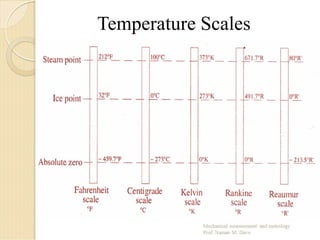
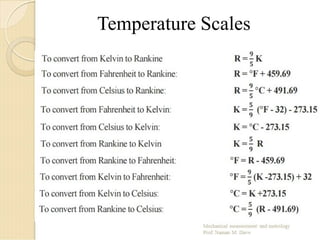
Temperature Scales
Temperature Scales
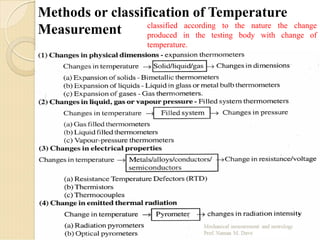
Methods or classification of Temperature
Measurement classified according to the nature the change
produced in the testing body with change of
temperature.
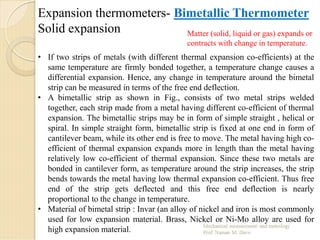
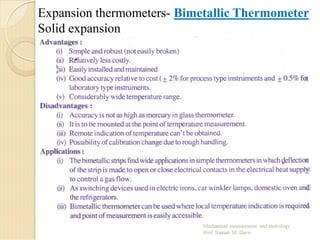
Expansion thermometers- Bimetallic Thermometer
Solid expansion Matter (solid, liquid or gas) expands or
contracts with change in temperature.
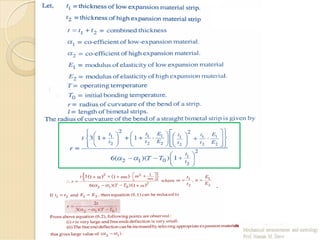
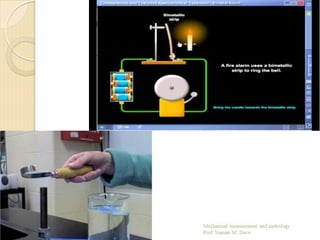
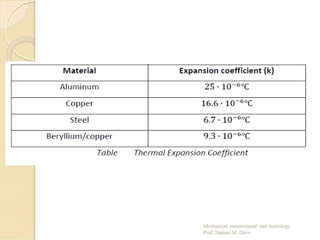
• If two strips of metals (with different thermal expansion co-efficients) at the
same temperature are firmly bonded together, a temperature change causes a
differential expansion. Hence, any change in temperature around the bimetal
strip can be measured in terms of the free end deflection.
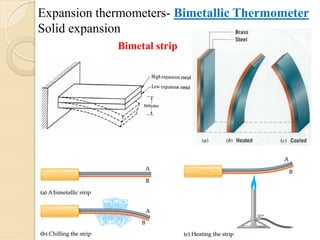
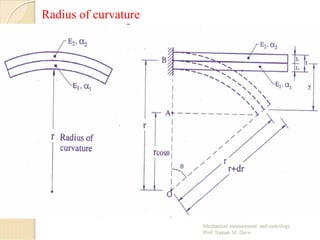
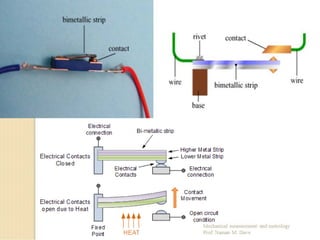
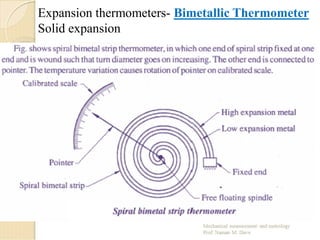
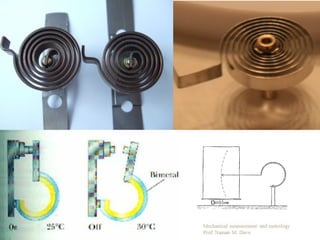
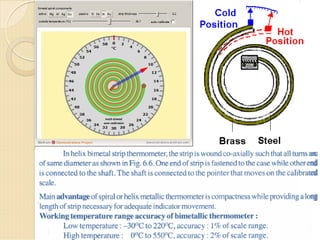
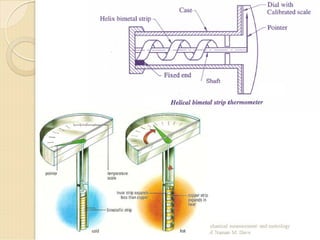
• A bimetallic strip as shown in Fig., consists of two metal strips welded
together, each strip made from a metal having different co-efficient of thermal
expansion. The bimetallic strips may be in form of simple straight , helical or
spiral. In simple straight form, bimetallic strip is fixed at one end in form of
cantilever beam, while its other end is free to move. The metal having high co-
efficient of thermal expansion expands more in length than the metal having
relatively low co-efficient of thermal expansion. Since these two metals are
bonded in cantilever form, as temperature around the strip increases, the strip
bends towards the metal having low thermal expansion co-efficient. Thus free
end of the strip gets deflected and this free end deflection is nearly
proportional to the change in temperature.
• Material of bimetal strip : Invar (an alloy of nickel and iron is most commonly
used for low expansion material. Brass, Nickel or Ni-Mo alloy are used for
high expansion material.
Expansion thermometers- Bimetallic Thermometer
Solid expansion
Bimetal strip
Radius of curvature
Expansion thermometers- Bimetallic Thermometer
Solid expansion
INTRODUCTION
Expansion thermometers- Bimetallic Thermometer
Solid expansion
Expansion thermometers- Bimetallic Thermometer
Solid expansion
Liquid in Glass Thermometers
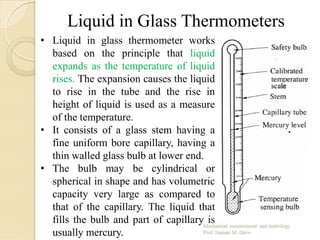
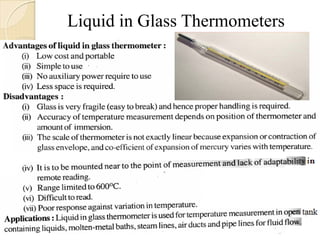
• Liquid in glass thermometer works
based on the principle that liquid
expands as the temperature of liquid
rises. The expansion causes the liquid
to rise in the tube and the rise in
height of liquid is used as a measure
of the temperature.
• It consists of a glass stem having a
fine uniform bore capillary, having a
thin walled glass bulb at lower end.
• The bulb may be cylindrical or
spherical in shape and has volumetric
capacity very large as compared to
that of the capillary. The liquid that
fills the bulb and part of capillary is
usually mercury.
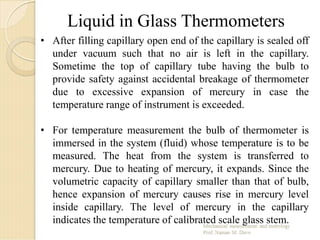
• After filling capillary open end of the capillary is sealed off
under vacuum such that no air is left in the capillary.
Sometime the top of capillary tube having the bulb to
provide safety against accidental breakage of thermometer
due to excessive expansion of mercury in case the
temperature range of instrument is exceeded.
• For temperature measurement the bulb of thermometer is
immersed in the system (fluid) whose temperature is to be
measured. The heat from the system is transferred to
mercury. Due to heating of mercury, it expands. Since the
volumetric capacity of capillary smaller than that of bulb,
hence expansion of mercury causes rise in mercury level
inside capillary. The level of mercury in the capillary
indicates the temperature of calibrated scale glass stem.
Liquid in Glass Thermometers
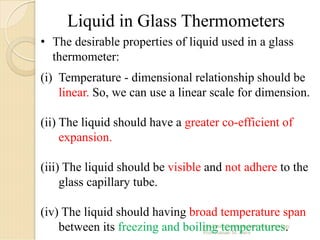
• The desirable properties of liquid used in a glass
thermometer:
(i) Temperature - dimensional relationship should be
linear. So, we can use a linear scale for dimension.
(ii) The liquid should have a greater co-efficient of
expansion.
(iii) The liquid should be visible and not adhere to the
glass capillary tube.
(iv) The liquid should having broad temperature span
between its freezing and boiling temperatures.
Liquid in Glass Thermometers
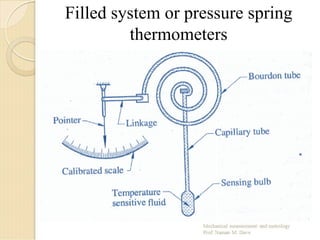
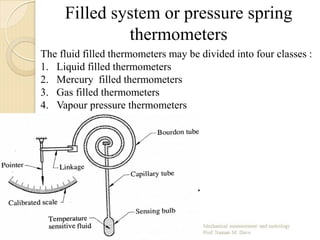
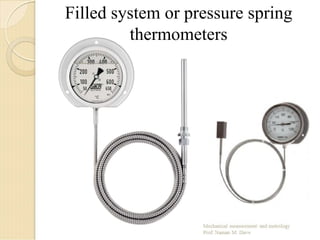
Filled system or pressure spring
thermometers
The fluid filled thermometers may be divided into four classes :
1. Liquid filled thermometers
2. Mercury filled thermometers
3. Gas filled thermometers
4. Vapour pressure thermometers
Filled system or pressure spring
thermometers
Filled system or pressure spring
thermometers
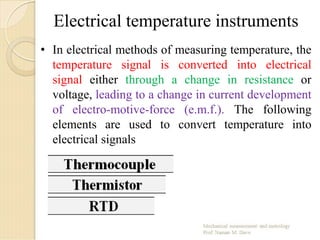
Electrical temperature instruments
• In electrical methods of measuring temperature, the
temperature signal is converted into electrical
signal either through a change in resistance or
voltage, leading to a change in current development
of electro-motive-force (e.m.f.). The following
elements are used to convert temperature into
electrical signals
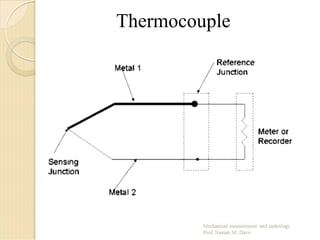
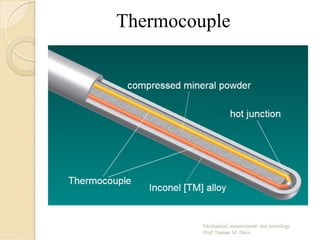
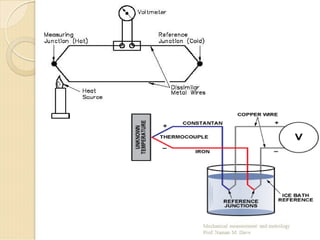
Thermocouple
Thermocouple
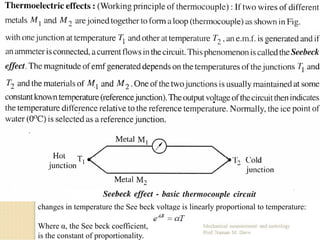
changes in temperature the See beck voltage is linearly proportional to temperature:
Where α, the See beck coefficient,
is the constant of proportionality.
Thermocouple effects
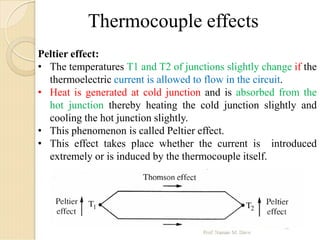
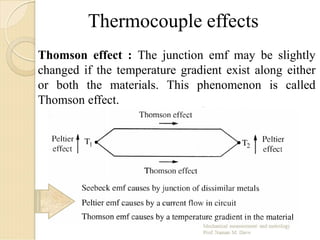
Peltier effect:
• The temperatures T1 and T2 of junctions slightly change if the
thermoelectric current is allowed to flow in the circuit.
• Heat is generated at cold junction and is absorbed from the
hot junction thereby heating the cold junction slightly and
cooling the hot junction slightly.
• This phenomenon is called Peltier effect.
• This effect takes place whether the current is introduced
extremely or is induced by the thermocouple itself.
Thomson effect : The junction emf may be slightly
changed if the temperature gradient exist along either
or both the materials. This phenomenon is called
Thomson effect.
Thermocouple effects
Thermistors
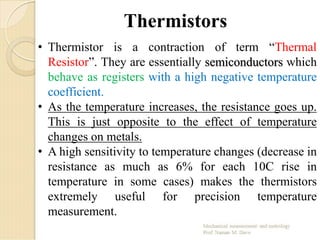
• Thermistor is a contraction of term “Thermal
Resistor”. They are essentially semiconductors which
behave as registers with a high negative temperature
coefficient.
• As the temperature increases, the resistance goes up.
This is just opposite to the effect of temperature
changes on metals.
• A high sensitivity to temperature changes (decrease in
resistance as much as 6% for each 10C rise in
temperature in some cases) makes the thermistors
extremely useful for precision temperature
measurement.
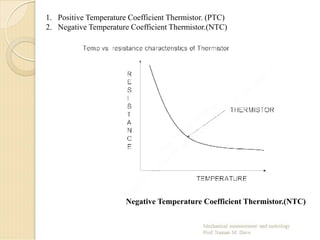
1. Positive Temperature Coefficient Thermistor. (PTC)
2. Negative Temperature Coefficient Thermistor.(NTC)
Negative Temperature Coefficient Thermistor.(NTC)
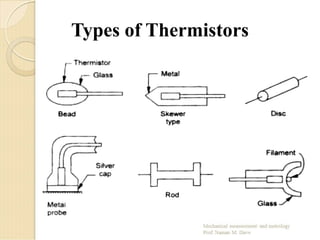
Types of Thermistors
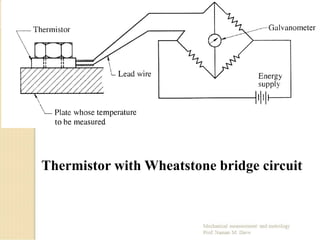
Thermistor with Wheatstone bridge circuit
Thermistors
• The thermistors are composed of metal oxides. The most
commonly used oxides are those of manganese, nickel, cobalt,
iron, copper and titanium.
• The fabrication of commercial NTC thermistors uses basic
ceramics technology and continues today much as it has for
decades.
• In the basic process, a mixture of two or more metal oxide
powders are combined with suitable binders, are formed to a
desired geometry, dried, and sintered at an elevated
temperature.
• By varying the types of oxides used, their relative proportions,
the sintering atmosphere, and the sintering temperature, a
wide range of resistivity and temperature coefficient
characteristics can be obtained.
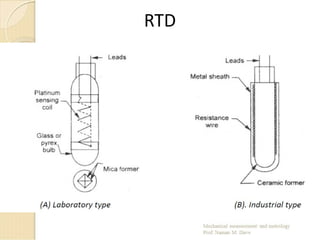
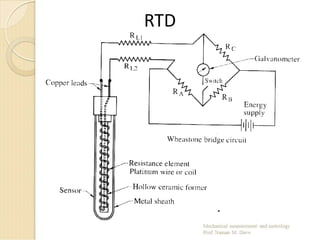
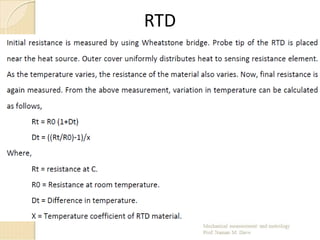
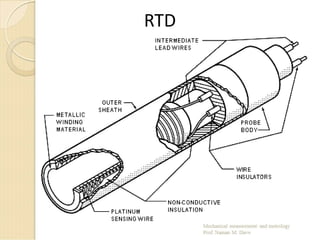
Metal resistance thermometer
• This thermometer is an instrument used to measure the
temperature variation in control room.
Working principle
• In each metallic conductor, their resistance changes when
its temperature is changed.
• By calculating the variation in resistance, the temperature
variations may be calculated.
• The thermometer which utilizes this phenomenon is called
“resistance thermometer”.
RTD
RTD
RTD
RTD
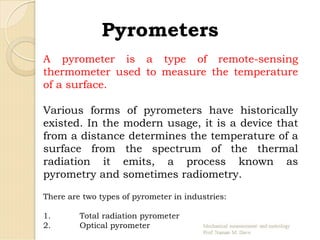
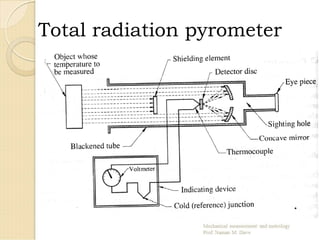
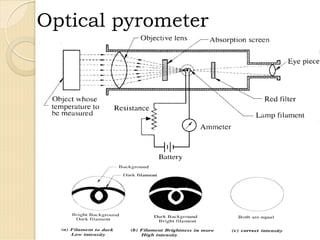
Pyrometers
A pyrometer is a type of remote-sensing
thermometer used to measure the temperature
of a surface.
Various forms of pyrometers have historically
existed. In the modern usage, it is a device that
from a distance determines the temperature of a
surface from the spectrum of the thermal
radiation it emits, a process known as
pyrometry and sometimes radiometry.
There are two types of pyrometer in industries:
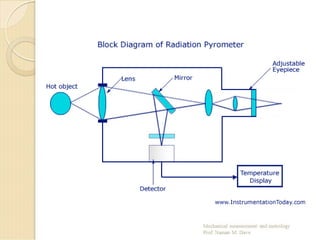
1. Total radiation pyrometer
2. Optical pyrometer
Total radiation pyrometer
Optical pyrometer
Chapter  temperature measurement

Chapter temperature measurement

  • 1.
    CHAPTER Temperature Measurement Presentation Preparedby Prof. Naman M. Dave Assistant Prof. (Mechanical Dept.) Gandhinagar Institute of Technology
  • 2.
    Please refer thisfile just as reference material. More concentration should on class room work and text book methodology.
  • 3.
    INTRODUCTION • Temperature: Ameasure proportional to the average translational kinetic energy associated with the disordered microscopic motion of atoms and molecules. • The flow of heat is from a high temperature region toward a lower temperature region. • When a high temperature object is placed in contact with a low temperature object, then energy will flow from the high temperature object to the lower temperature object, and they will approach an equilibrium temperature.
  • 4.
  • 5.
  • 6.
    Methods or classificationof Temperature Measurement classified according to the nature the change produced in the testing body with change of temperature.
  • 7.
    Expansion thermometers- BimetallicThermometer Solid expansion Matter (solid, liquid or gas) expands or contracts with change in temperature. • If two strips of metals (with different thermal expansion co-efficients) at the same temperature are firmly bonded together, a temperature change causes a differential expansion. Hence, any change in temperature around the bimetal strip can be measured in terms of the free end deflection. • A bimetallic strip as shown in Fig., consists of two metal strips welded together, each strip made from a metal having different co-efficient of thermal expansion. The bimetallic strips may be in form of simple straight , helical or spiral. In simple straight form, bimetallic strip is fixed at one end in form of cantilever beam, while its other end is free to move. The metal having high co- efficient of thermal expansion expands more in length than the metal having relatively low co-efficient of thermal expansion. Since these two metals are bonded in cantilever form, as temperature around the strip increases, the strip bends towards the metal having low thermal expansion co-efficient. Thus free end of the strip gets deflected and this free end deflection is nearly proportional to the change in temperature. • Material of bimetal strip : Invar (an alloy of nickel and iron is most commonly used for low expansion material. Brass, Nickel or Ni-Mo alloy are used for high expansion material.
  • 8.
    Expansion thermometers- BimetallicThermometer Solid expansion Bimetal strip
  • 9.
  • 13.
    Expansion thermometers- BimetallicThermometer Solid expansion
  • 14.
  • 15.
    Expansion thermometers- BimetallicThermometer Solid expansion
  • 18.
    Expansion thermometers- BimetallicThermometer Solid expansion
  • 20.
    Liquid in GlassThermometers • Liquid in glass thermometer works based on the principle that liquid expands as the temperature of liquid rises. The expansion causes the liquid to rise in the tube and the rise in height of liquid is used as a measure of the temperature. • It consists of a glass stem having a fine uniform bore capillary, having a thin walled glass bulb at lower end. • The bulb may be cylindrical or spherical in shape and has volumetric capacity very large as compared to that of the capillary. The liquid that fills the bulb and part of capillary is usually mercury.
  • 21.
    • After fillingcapillary open end of the capillary is sealed off under vacuum such that no air is left in the capillary. Sometime the top of capillary tube having the bulb to provide safety against accidental breakage of thermometer due to excessive expansion of mercury in case the temperature range of instrument is exceeded. • For temperature measurement the bulb of thermometer is immersed in the system (fluid) whose temperature is to be measured. The heat from the system is transferred to mercury. Due to heating of mercury, it expands. Since the volumetric capacity of capillary smaller than that of bulb, hence expansion of mercury causes rise in mercury level inside capillary. The level of mercury in the capillary indicates the temperature of calibrated scale glass stem. Liquid in Glass Thermometers
  • 22.
    • The desirableproperties of liquid used in a glass thermometer: (i) Temperature - dimensional relationship should be linear. So, we can use a linear scale for dimension. (ii) The liquid should have a greater co-efficient of expansion. (iii) The liquid should be visible and not adhere to the glass capillary tube. (iv) The liquid should having broad temperature span between its freezing and boiling temperatures. Liquid in Glass Thermometers
  • 23.
    Liquid in GlassThermometers
  • 25.
    Filled system orpressure spring thermometers
  • 26.
    The fluid filledthermometers may be divided into four classes : 1. Liquid filled thermometers 2. Mercury filled thermometers 3. Gas filled thermometers 4. Vapour pressure thermometers Filled system or pressure spring thermometers
  • 27.
    Filled system orpressure spring thermometers
  • 28.
    Electrical temperature instruments •In electrical methods of measuring temperature, the temperature signal is converted into electrical signal either through a change in resistance or voltage, leading to a change in current development of electro-motive-force (e.m.f.). The following elements are used to convert temperature into electrical signals
  • 29.
  • 30.
  • 31.
    changes in temperaturethe See beck voltage is linearly proportional to temperature: Where α, the See beck coefficient, is the constant of proportionality.
  • 32.
    Thermocouple effects Peltier effect: •The temperatures T1 and T2 of junctions slightly change if the thermoelectric current is allowed to flow in the circuit. • Heat is generated at cold junction and is absorbed from the hot junction thereby heating the cold junction slightly and cooling the hot junction slightly. • This phenomenon is called Peltier effect. • This effect takes place whether the current is introduced extremely or is induced by the thermocouple itself.
  • 33.
    Thomson effect :The junction emf may be slightly changed if the temperature gradient exist along either or both the materials. This phenomenon is called Thomson effect. Thermocouple effects
  • 36.
    Thermistors • Thermistor isa contraction of term “Thermal Resistor”. They are essentially semiconductors which behave as registers with a high negative temperature coefficient. • As the temperature increases, the resistance goes up. This is just opposite to the effect of temperature changes on metals. • A high sensitivity to temperature changes (decrease in resistance as much as 6% for each 10C rise in temperature in some cases) makes the thermistors extremely useful for precision temperature measurement.
  • 37.
    1. Positive TemperatureCoefficient Thermistor. (PTC) 2. Negative Temperature Coefficient Thermistor.(NTC) Negative Temperature Coefficient Thermistor.(NTC)
  • 38.
  • 39.
  • 40.
    Thermistors • The thermistorsare composed of metal oxides. The most commonly used oxides are those of manganese, nickel, cobalt, iron, copper and titanium. • The fabrication of commercial NTC thermistors uses basic ceramics technology and continues today much as it has for decades. • In the basic process, a mixture of two or more metal oxide powders are combined with suitable binders, are formed to a desired geometry, dried, and sintered at an elevated temperature. • By varying the types of oxides used, their relative proportions, the sintering atmosphere, and the sintering temperature, a wide range of resistivity and temperature coefficient characteristics can be obtained.
  • 41.
    Metal resistance thermometer •This thermometer is an instrument used to measure the temperature variation in control room. Working principle • In each metallic conductor, their resistance changes when its temperature is changed. • By calculating the variation in resistance, the temperature variations may be calculated. • The thermometer which utilizes this phenomenon is called “resistance thermometer”.
  • 42.
  • 43.
  • 44.
  • 45.
  • 46.
    Pyrometers A pyrometer isa type of remote-sensing thermometer used to measure the temperature of a surface. Various forms of pyrometers have historically existed. In the modern usage, it is a device that from a distance determines the temperature of a surface from the spectrum of the thermal radiation it emits, a process known as pyrometry and sometimes radiometry. There are two types of pyrometer in industries: 1. Total radiation pyrometer 2. Optical pyrometer
  • 48.
  • 49.