Manchester Encoding Theory and Use By Professor Tom Mavroidis January 31,2001
What is Manchester Encoding ? It is a process by which a Synchronous clock encoding technique is used by the OSI physical Layer to encode the clock and data of a synchronous bit stream.
What is the difference? In this technique the binary data to be transmitted over the cable are not sent as a sequence of logical 1 & 0’s known as non return to zero (NRZ), instead the bit are translated into a different format that has a number of advantages over using straight binary.
Where is it used? A popular technique used for encoding data on magnetic disks. Also known as phase encoding Problems include poor bit storage density
Resides in the Physical Layer Physical Layer serializes the frame (converts it to a series of bits) and send it across a circuit to the destination.
Three types of encoding discussed NRZ - Non Return to Zero RZ - Return to zero Manchester encoding
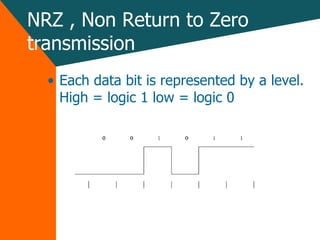
NRZ , Non Return to Zero transmission Each data bit is represented by a level.  High = logic 1 low = logic 0
Problem with NRZ Long runs of consecutive bits with the same value  make it impossible to detect bit boundaries by the inability of the receiver to detect the clocking speed.
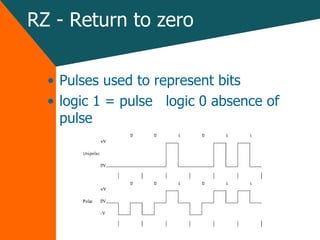
RZ - Return to zero Pulses used to represent bits logic 1 = pulse  logic 0 absence of pulse
RZ - Advantages Clock signals can be extracted from the logic 1 signals. Halves the width of the pulse Polar RZ sends pulses for both logic 0 and logic 1 Requires an extra voltage level
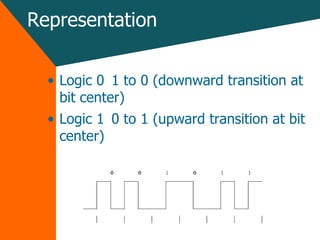
Manchester Encoding Logic 1 is represented by a transition in a particular direction in the center of each bit. Opposite direction used to represent logic 0
Representation Logic 0 1 to 0 (downward transition at bit center) Logic 1 0 to 1 (upward transition at bit center)
Manchester Encoding  Was named after its birthplace in Manchester, England Bit transitions do not always occur at the ‘bit boundaries. There is always a transition at the center of the bit
Improved clocking Allows the receiver to extract the clock signal  Correctly decodes the value and timing of each bit
Receiver Reassembles the series of bits to form a frame and forwards the frame for processing by the link layer Frame is then CRC checked and a retransmission is requested if the checksum is invalid.
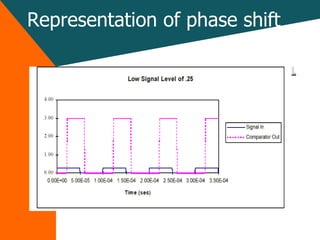
Representation of phase shift
Uses Manchester encoding is used to : Transmit data across systems Store data on magnetic media, disks etc. Communicate with Satellites
Conclusion Based on application different types of encoding can be used Manchester encoding exhibits poor bit storage density but improved reliability.
Links http://www.erg.abdn.ac.uk/users/gorry/course/phy-pages/man.html http://home.europa.com/~celiac/manch_enc.html http://csshaun.cs.ru/ac/za/netnotes/netnotes003.html http://www.pdp8.net/tu56/tu56.shtml

Manchester Encoding

  • 1.
    Manchester Encoding Theoryand Use By Professor Tom Mavroidis January 31,2001
  • 2.
    What is ManchesterEncoding ? It is a process by which a Synchronous clock encoding technique is used by the OSI physical Layer to encode the clock and data of a synchronous bit stream.
  • 3.
    What is thedifference? In this technique the binary data to be transmitted over the cable are not sent as a sequence of logical 1 & 0’s known as non return to zero (NRZ), instead the bit are translated into a different format that has a number of advantages over using straight binary.
  • 4.
    Where is itused? A popular technique used for encoding data on magnetic disks. Also known as phase encoding Problems include poor bit storage density
  • 5.
    Resides in thePhysical Layer Physical Layer serializes the frame (converts it to a series of bits) and send it across a circuit to the destination.
  • 6.
    Three types ofencoding discussed NRZ - Non Return to Zero RZ - Return to zero Manchester encoding
  • 7.
    NRZ , NonReturn to Zero transmission Each data bit is represented by a level. High = logic 1 low = logic 0
  • 8.
    Problem with NRZLong runs of consecutive bits with the same value make it impossible to detect bit boundaries by the inability of the receiver to detect the clocking speed.
  • 9.
    RZ - Returnto zero Pulses used to represent bits logic 1 = pulse logic 0 absence of pulse
  • 10.
    RZ - AdvantagesClock signals can be extracted from the logic 1 signals. Halves the width of the pulse Polar RZ sends pulses for both logic 0 and logic 1 Requires an extra voltage level
  • 11.
    Manchester Encoding Logic1 is represented by a transition in a particular direction in the center of each bit. Opposite direction used to represent logic 0
  • 12.
    Representation Logic 01 to 0 (downward transition at bit center) Logic 1 0 to 1 (upward transition at bit center)
  • 13.
    Manchester Encoding Was named after its birthplace in Manchester, England Bit transitions do not always occur at the ‘bit boundaries. There is always a transition at the center of the bit
  • 14.
    Improved clocking Allowsthe receiver to extract the clock signal Correctly decodes the value and timing of each bit
  • 15.
    Receiver Reassembles theseries of bits to form a frame and forwards the frame for processing by the link layer Frame is then CRC checked and a retransmission is requested if the checksum is invalid.
  • 16.
  • 17.
    Uses Manchester encodingis used to : Transmit data across systems Store data on magnetic media, disks etc. Communicate with Satellites
  • 18.
    Conclusion Based onapplication different types of encoding can be used Manchester encoding exhibits poor bit storage density but improved reliability.
  • 19.
    Links http://www.erg.abdn.ac.uk/users/gorry/course/phy-pages/man.html http://home.europa.com/~celiac/manch_enc.htmlhttp://csshaun.cs.ru/ac/za/netnotes/netnotes003.html http://www.pdp8.net/tu56/tu56.shtml