B Y G A U R A V S I N G H R A W A T
1 2 3 1 6 E N 0 0 9
S Y S T E M E N G I N E E R I N G
Distance Vector Routing
Algorithm
Solution of Distance vector Routing Algorithm
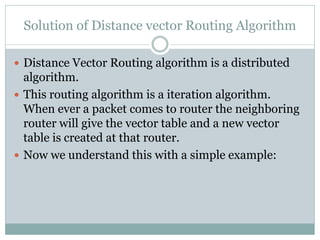
 Distance Vector Routing algorithm is a distributed
algorithm.
 This routing algorithm is a iteration algorithm.
When ever a packet comes to router the neighboring
router will give the vector table and a new vector
table is created at that router.
 Now we understand this with a simple example:
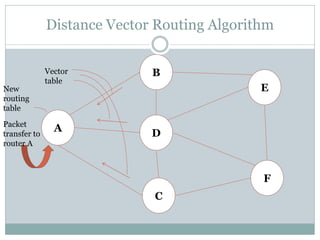
Distance Vector Routing Algorithm
A
C
B
D
F
E
Vector
table
New
routing
table
Packet
transfer to
router A
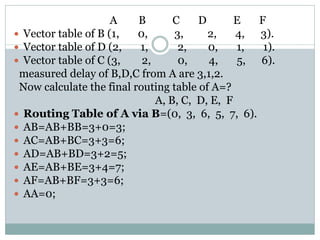
A B C D E F
 Vector table of B (1, 0, 3, 2, 4, 3).
 Vector table of D (2, 1, 2, 0, 1, 1).
 Vector table of C (3, 2, 0, 4, 5, 6).
measured delay of B,D,C from A are 3,1,2.
Now calculate the final routing table of A=?
A, B, C, D, E, F
 Routing Table of A via B=(0, 3, 6, 5, 7, 6).
 AB=AB+BB=3+0=3;
 AC=AB+BC=3+3=6;
 AD=AB+BD=3+2=5;
 AE=AB+BE=3+4=7;
 AF=AB+BF=3+3=6;
 AA=0;
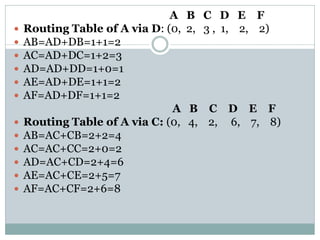
A B C D E F
 Routing Table of A via D: (0, 2, 3 , 1, 2, 2)
 AB=AD+DB=1+1=2
 AC=AD+DC=1+2=3
 AD=AD+DD=1+0=1
 AE=AD+DE=1+1=2
 AF=AD+DF=1+1=2
A B C D E F
 Routing Table of A via C: (0, 4, 2, 6, 7, 8)
 AB=AC+CB=2+2=4
 AC=AC+CC=2+0=2
 AD=AC+CD=2+4=6
 AE=AC+CE=2+5=7
 AF=AC+CF=2+6=8
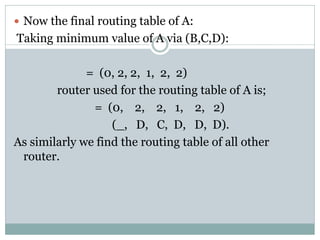
 Now the final routing table of A:
Taking minimum value of A via (B,C,D):
= (0, 2, 2, 1, 2, 2)
router used for the routing table of A is;
= (0, 2, 2, 1, 2, 2)
(_, D, C, D, D, D).
As similarly we find the routing table of all other
router.

Distance vector routing algorithm

  • 1.
    B Y GA U R A V S I N G H R A W A T 1 2 3 1 6 E N 0 0 9 S Y S T E M E N G I N E E R I N G Distance Vector Routing Algorithm
  • 2.
    Solution of Distancevector Routing Algorithm  Distance Vector Routing algorithm is a distributed algorithm.  This routing algorithm is a iteration algorithm. When ever a packet comes to router the neighboring router will give the vector table and a new vector table is created at that router.  Now we understand this with a simple example:
  • 3.
    Distance Vector RoutingAlgorithm A C B D F E Vector table New routing table Packet transfer to router A
  • 4.
    A B CD E F  Vector table of B (1, 0, 3, 2, 4, 3).  Vector table of D (2, 1, 2, 0, 1, 1).  Vector table of C (3, 2, 0, 4, 5, 6). measured delay of B,D,C from A are 3,1,2. Now calculate the final routing table of A=? A, B, C, D, E, F  Routing Table of A via B=(0, 3, 6, 5, 7, 6).  AB=AB+BB=3+0=3;  AC=AB+BC=3+3=6;  AD=AB+BD=3+2=5;  AE=AB+BE=3+4=7;  AF=AB+BF=3+3=6;  AA=0;
  • 5.
    A B CD E F  Routing Table of A via D: (0, 2, 3 , 1, 2, 2)  AB=AD+DB=1+1=2  AC=AD+DC=1+2=3  AD=AD+DD=1+0=1  AE=AD+DE=1+1=2  AF=AD+DF=1+1=2 A B C D E F  Routing Table of A via C: (0, 4, 2, 6, 7, 8)  AB=AC+CB=2+2=4  AC=AC+CC=2+0=2  AD=AC+CD=2+4=6  AE=AC+CE=2+5=7  AF=AC+CF=2+6=8
  • 6.
     Now thefinal routing table of A: Taking minimum value of A via (B,C,D): = (0, 2, 2, 1, 2, 2) router used for the routing table of A is; = (0, 2, 2, 1, 2, 2) (_, D, C, D, D, D). As similarly we find the routing table of all other router.