NAD710 Introduction to Networks Using Linux
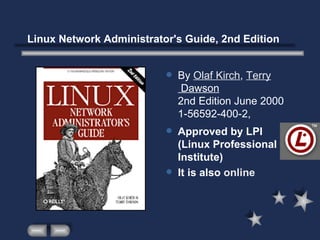
Linux Network Administrator's Guide, 2nd Edition   By  Olaf Kirch ,  Terry  Dawson 2nd Edition June 2000  1-56592-400-2, Approved by LPI (Linux Professional Institute) It is also  online
Introduction  (Chapter 1) Gain an understanding of how Linux fits into today’s networked world Discuss the strengths and weaknesses of Linux  Learn when a Linux solution the right decision Install and administer the latest in Linux applications for resource sharing
Governing  Agencies ICANN  The Internet Corporation for Assigned Names and Numbers IANA  Internet Assigned Numbers authority IEEE  The Institute of Electrical and Electronics Engineers
IAB IAB  The Internet Activities Board The origin of today's IAB lies in the Internet Configuration Control Board (ICCB), which was created in 1981 by Vint Cerf, at that time program manager at  DARPA , to advise him on technical issues. The ICCB was chaired by David Clark, MIT.  In September 1984, after the ICCB meeting held at RSRE in Malvern, UK, the ICCB was disbanded and replaced by the Internet  Advisory  Board (IAB). This change was initiated by Dave Clark and Barry Leiner, who had taken over management of the Internet research program at DARPA. The IAB consisted of the chairs of the newly-formed research task forces and Jon Postel (ISI), as RFC editor and "protocol czar". The first set of chairs of the task forces were the members of the ICCB. The IAB was chaired by Dave Clark.
TCP/IP Networking  (Chapter 2) Network Interfaces IP Addresses  192.168.1.25 - 10.0.0.15 - 198.235.216.131 Address Resolution  64.58.76.227 -> 00:04:ac:38:93:85 IP Routing  ICMP  messaging Resolving Host Names  www.yahoo.com -> 64.58.76.227
Linux Network Commands ifconfig  netstat  ping  traceroute  nslookup  route dig
Configuring Network Hardware  (Chapter 3) Kernel Configuration Linux network devices Ethernet loadable kernel modules
Configuring TCP/IP Networking  (Chapter 5) Setting the Hostname Assigning IP addresses statically Automatically receiving an address (DHCP) Subnet masks - what are they and what do they do? Dividing networks using Subnets
TCP/IP -  The need for standards Why is it so important to the Internet? Gain an understanding of: the OSI and DOD Layer models the 802.x standards Why standards play such an important role Explain the RFC (Request for comments) as maintained by the IETF (Internet Engineering Task Force) system and how the system  is used.
ARP and RARP The address resolution protocol How does a machine communicate within the subnet? When do we need to route using a Layer 3 Protocol?
DNS  (Chapter 6) Setting up name services (BINDx) How does it resolve names to addresses and vice-versa You will setup your machine with the name service running
NFS  Network File System (Chapter 14) Preparing NFS Mounting an NFS volume The NFS daemons The exports file
SAMBA Samba is an  Open Source / Free Software  suite that provides seamless file and print services to SMB/CIFS clients We will discuss and install samba on our machines
Bridges, Routers and Switches Which device should be used to address a specific design goal? What the differences are with each of these devices? Why the layered model approach helps speed up the process required to bring products to market.
Routing Protocols How information is passed between routers How they can protect networks or if incorrectly installed expose them Discuss RIP (routing information protocol) and OSPF (open shortest path first)
Bridging Protocols Operates at Layer 2 of the OSI model Smart bridges, allow some form of intelligence at Layer 3 Spanning-Tree Protocol is a link management protocol that provides path redundancy while preventing undesirable loops in the network.
Network monitoring and Discovery tools Ethereal - view the packets in real time Nmap - port scanner Npulse - front end for nmap You will install and run these applications on your machines

Introduction To Networks Using Linux

  • 1.
    NAD710 Introduction toNetworks Using Linux
  • 2.
    Linux Network Administrator'sGuide, 2nd Edition By Olaf Kirch , Terry Dawson 2nd Edition June 2000 1-56592-400-2, Approved by LPI (Linux Professional Institute) It is also online
  • 3.
    Introduction (Chapter1) Gain an understanding of how Linux fits into today’s networked world Discuss the strengths and weaknesses of Linux Learn when a Linux solution the right decision Install and administer the latest in Linux applications for resource sharing
  • 4.
    Governing AgenciesICANN The Internet Corporation for Assigned Names and Numbers IANA Internet Assigned Numbers authority IEEE The Institute of Electrical and Electronics Engineers
  • 5.
    IAB IAB The Internet Activities Board The origin of today's IAB lies in the Internet Configuration Control Board (ICCB), which was created in 1981 by Vint Cerf, at that time program manager at DARPA , to advise him on technical issues. The ICCB was chaired by David Clark, MIT. In September 1984, after the ICCB meeting held at RSRE in Malvern, UK, the ICCB was disbanded and replaced by the Internet Advisory Board (IAB). This change was initiated by Dave Clark and Barry Leiner, who had taken over management of the Internet research program at DARPA. The IAB consisted of the chairs of the newly-formed research task forces and Jon Postel (ISI), as RFC editor and "protocol czar". The first set of chairs of the task forces were the members of the ICCB. The IAB was chaired by Dave Clark.
  • 6.
    TCP/IP Networking (Chapter 2) Network Interfaces IP Addresses 192.168.1.25 - 10.0.0.15 - 198.235.216.131 Address Resolution 64.58.76.227 -> 00:04:ac:38:93:85 IP Routing ICMP messaging Resolving Host Names www.yahoo.com -> 64.58.76.227
  • 7.
    Linux Network Commandsifconfig netstat ping traceroute nslookup route dig
  • 8.
    Configuring Network Hardware (Chapter 3) Kernel Configuration Linux network devices Ethernet loadable kernel modules
  • 9.
    Configuring TCP/IP Networking (Chapter 5) Setting the Hostname Assigning IP addresses statically Automatically receiving an address (DHCP) Subnet masks - what are they and what do they do? Dividing networks using Subnets
  • 10.
    TCP/IP - The need for standards Why is it so important to the Internet? Gain an understanding of: the OSI and DOD Layer models the 802.x standards Why standards play such an important role Explain the RFC (Request for comments) as maintained by the IETF (Internet Engineering Task Force) system and how the system is used.
  • 11.
    ARP and RARPThe address resolution protocol How does a machine communicate within the subnet? When do we need to route using a Layer 3 Protocol?
  • 12.
    DNS (Chapter6) Setting up name services (BINDx) How does it resolve names to addresses and vice-versa You will setup your machine with the name service running
  • 13.
    NFS NetworkFile System (Chapter 14) Preparing NFS Mounting an NFS volume The NFS daemons The exports file
  • 14.
    SAMBA Samba isan Open Source / Free Software suite that provides seamless file and print services to SMB/CIFS clients We will discuss and install samba on our machines
  • 15.
    Bridges, Routers andSwitches Which device should be used to address a specific design goal? What the differences are with each of these devices? Why the layered model approach helps speed up the process required to bring products to market.
  • 16.
    Routing Protocols Howinformation is passed between routers How they can protect networks or if incorrectly installed expose them Discuss RIP (routing information protocol) and OSPF (open shortest path first)
  • 17.
    Bridging Protocols Operatesat Layer 2 of the OSI model Smart bridges, allow some form of intelligence at Layer 3 Spanning-Tree Protocol is a link management protocol that provides path redundancy while preventing undesirable loops in the network.
  • 18.
    Network monitoring andDiscovery tools Ethereal - view the packets in real time Nmap - port scanner Npulse - front end for nmap You will install and run these applications on your machines

Editor's Notes

  • #2 Never has there been such dramatic changes to the business world as we have seen in the 1990’s with e-business and the internet. The role played by internet has forced companies to get connected to stay relevant so they may compete in today's fast moving markets. In the 60’s and 70’s there were many different networks, protocols and implementations. Sharing of information among these dissimilar networks soon became a problem. A common protocol needed to be developed. The Defense Advanced Research Projects Agency funded the exploration of this common protocol. The TCP/IP protocol suite evolved from the ARPANET protocol suite where the fundamental concept of layering was introduced.