Wireless LAN (IEEE 802.11)Wireless LAN (IEEE 802.11)
V.Parthipan
Assistant Professor
CSE
• Links two or more devices using
a wireless distribution method.
LAN/WLAN
• LANs provide connectivity for
interconnecting computing resources
at the local levels of an organization
• Wired LANs
• Limitations because of physical,
hard-wired infrastructure
• Wireless LANs provide
• Flexibility
• Portability
• Mobility
• Ease of Installation
IEEE 802.11 Wireless LAN Standard
 Wireless LAN standard – IEEE 802.11
 IEEE published 802.11 in 1997, after seven
years of work
 Most prominent specification for WLANs
 Scope of IEEE 802.11 is limited to Physical and
Data Link Layers.
Benefits of 802.11 Standard
o Appliance Interoperability
o Fast Product Development
o Stable Future Migration
o Price Reductions
o Significant differences between wireless and
wired LANs:
oPower Management
oSecurity
oBandwidth
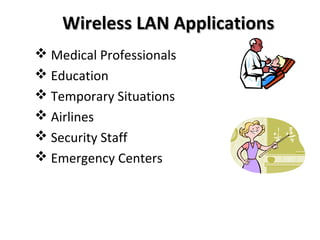
Wireless LAN ApplicationsWireless LAN Applications
 Medical Professionals
 Education
 Temporary Situations
 Airlines
 Security Staff
 Emergency Centers
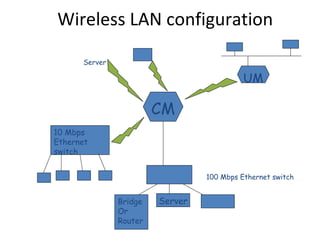
Wireless LAN configuration
CM
10 Mbps
Ethernet
switch
UM
Bridge
Or
Router
Server
100 Mbps Ethernet switch
Server
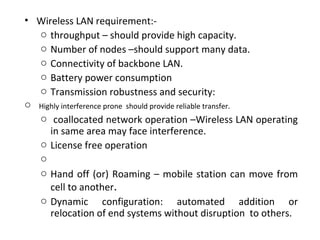
• Wireless LAN requirement:-
o throughput – should provide high capacity.
o Number of nodes –should support many data.
o Connectivity of backbone LAN.
o Battery power consumption
o Transmission robustness and security:
o Highly interference prone should provide reliable transfer.
o coallocated network operation –Wireless LAN operating
in same area may face interference.
o License free operation
o
o Hand off (or) Roaming – mobile station can move from
cell to another.
o Dynamic configuration: automated addition or
relocation of end systems without disruption to others.
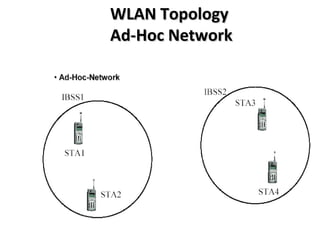
WLAN TopologyWLAN Topology
Ad-Hoc NetworkAd-Hoc Network
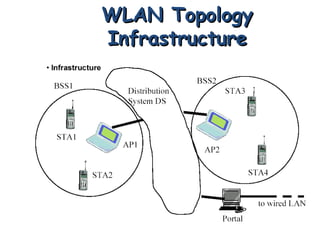
WLAN TopologyWLAN Topology
InfrastructureInfrastructure
Association Related ServicesAssociation Related Services
 Association
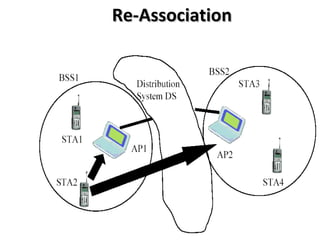
Re-association
Disassociation
Re-AssociationRe-Association
Access and Privacy ServicesAccess and Privacy Services
Authentication
Privacy
IEEE 802.11 Medium Access ControlIEEE 802.11 Medium Access Control
• MAC layer covers three functional areas:
• Reliable data delivery
• Access control
• Security
Physical Media Defined by OriginalPhysical Media Defined by Original
802.11 Standard802.11 Standard
Frequency-hopping spread spectrum
Operating in 2.4 GHz ISM band
Lower cost, power consumption
Most tolerant to signal interference
Direct-sequence spread spectrum
Operating in 2.4 GHz ISM band
Supports higher data rates
More range than FH or IR physical layers
Infrared
Lowest cost
Lowest range compared to spread spectrum
Doesn’t penetrate walls, so no eavesdropping
Future of WLANFuture of WLAN
WLANs move to maturity
• Higher Speeds
• Improved Security
• Seamless end-to-end protocols
• Better Error control
• Long distances
• New vendors
• Better interoperability
• Global networking

Ieee 802.11 wireless lan

  • 1.
    Wireless LAN (IEEE802.11)Wireless LAN (IEEE 802.11) V.Parthipan Assistant Professor CSE • Links two or more devices using a wireless distribution method.
  • 2.
    LAN/WLAN • LANs provideconnectivity for interconnecting computing resources at the local levels of an organization • Wired LANs • Limitations because of physical, hard-wired infrastructure • Wireless LANs provide • Flexibility • Portability • Mobility • Ease of Installation
  • 3.
    IEEE 802.11 WirelessLAN Standard  Wireless LAN standard – IEEE 802.11  IEEE published 802.11 in 1997, after seven years of work  Most prominent specification for WLANs  Scope of IEEE 802.11 is limited to Physical and Data Link Layers.
  • 4.
    Benefits of 802.11Standard o Appliance Interoperability o Fast Product Development o Stable Future Migration o Price Reductions o Significant differences between wireless and wired LANs: oPower Management oSecurity oBandwidth
  • 5.
    Wireless LAN ApplicationsWirelessLAN Applications  Medical Professionals  Education  Temporary Situations  Airlines  Security Staff  Emergency Centers
  • 6.
    Wireless LAN configuration CM 10Mbps Ethernet switch UM Bridge Or Router Server 100 Mbps Ethernet switch Server
  • 7.
    • Wireless LANrequirement:- o throughput – should provide high capacity. o Number of nodes –should support many data. o Connectivity of backbone LAN. o Battery power consumption o Transmission robustness and security: o Highly interference prone should provide reliable transfer. o coallocated network operation –Wireless LAN operating in same area may face interference. o License free operation o o Hand off (or) Roaming – mobile station can move from cell to another. o Dynamic configuration: automated addition or relocation of end systems without disruption to others.
  • 8.
    WLAN TopologyWLAN Topology Ad-HocNetworkAd-Hoc Network
  • 9.
  • 10.
    Association Related ServicesAssociationRelated Services  Association Re-association Disassociation
  • 11.
  • 12.
    Access and PrivacyServicesAccess and Privacy Services Authentication Privacy
  • 13.
    IEEE 802.11 MediumAccess ControlIEEE 802.11 Medium Access Control • MAC layer covers three functional areas: • Reliable data delivery • Access control • Security
  • 14.
    Physical Media Definedby OriginalPhysical Media Defined by Original 802.11 Standard802.11 Standard Frequency-hopping spread spectrum Operating in 2.4 GHz ISM band Lower cost, power consumption Most tolerant to signal interference Direct-sequence spread spectrum Operating in 2.4 GHz ISM band Supports higher data rates More range than FH or IR physical layers Infrared Lowest cost Lowest range compared to spread spectrum Doesn’t penetrate walls, so no eavesdropping
  • 15.
    Future of WLANFutureof WLAN WLANs move to maturity • Higher Speeds • Improved Security • Seamless end-to-end protocols • Better Error control • Long distances • New vendors • Better interoperability • Global networking