1
ERROR
CORRECTION
&
ERROR
DETECTION
 Data can be corrupted during transmission. For reliable communication,
errors must be detected and corrected.
 Error detection and correction are implemented either at data link layer
or the transport layer of the OSI model.
2
TYPES OF ERRORS
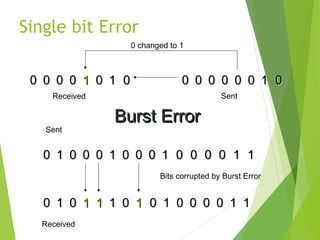
 Single bit error :-
-Only one bit in the data unit has changed.
 Burst error :-
-It means that two or more bits in the data unit has
changed.
3
Single bit Error
00 00 00 00 11 00 11 00
4
00 00 00 00 00 00 11 00
Burst ErrorBurst Error
00 11 00 00 00 11 00 00 00 11 00 00 00 00 11 11
00 11 00 11 11 11 00 11 00 11 00 00 00 00 11 11
0 changed to 1
Received Sent
Sent
Received
Bits corrupted by Burst Error
ERROR DETECTION
 Error detecting code is to include only enough redundancy to allow the
receiver to deduce that an error occurred, but not which error, and have
it request a re-transmission.
 Error detection uses the concept of redundancy, which means adding
extra bits for detecting error at the destination.
5
Redundancy
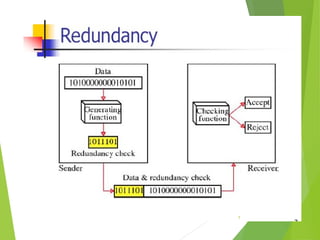
 Instead of repeating the entire data stream, a shorter group of bits may
be appended to the end of each unit. This technique is called Redundancy
because the extra bit are redundant to the information. They are
discarded as soon as the accuracy of the transmission has been
determined.
6
7
 There are basically four types of redundancy checks. They are:
1. VRC (Vertical Redundancy Check).
2. LRC (Longitudinal Redundancy Check).
3. CRC (Cyclical Redundancy Check).
8
ERROR DETECTION
 VERTICAL REDUNDUNCY CHECK
 LONGITUDINAL REDUNDANCY CHECK
 CYCLIC REDUNDANCY CHECK
9
CYCLIC REDUNDANCY CHECK
(CRC)
 In this method , a sequence of redundant bits ,
called the CRC or the CRC remainder, is appended to the end of the
unit so that the resulting data unit become exactly divisible by a
second, predetermined binary number. At its destination , the
incoming data is divided by the same number. If at this step there is
no remaunit inder ,the data unit assume to be correct and is
accepted, otherwise it indicate that data unit has been damaged in
transmission and therefore must be rejected.
The redundancy bits is used by CRC are derived by dividing the data
unit by a predetermined divisor. The remainder is the CRC.
10
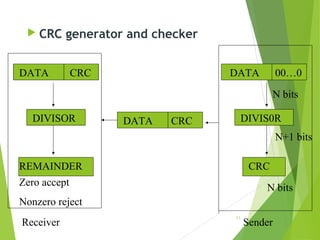
 CRC generator and checker
11
DATA CRC
DIVISOR
REMAINDER CRC
DATA CRC DIVIS0R
DATA 00…0
Zero accept
Nonzero reject
N bits
N+1 bits
N bits
Receiver Sender
Divisor
The divisor is determined according to the algebraic
polynomial.
for e.g.
A polynomial is
X^7 + x^5 + x^2 + x + 1
generation of divisor from polynomial
12
X^7 + X^5 + X^2 + X + 1
1 0 1 0 0 1 1 1
X^4 X^3X^6
A polynomial should be selected according to the following rule:-
1. It should not be divisible by x.
2. It should be divisible by x+1.
13
 Example :-
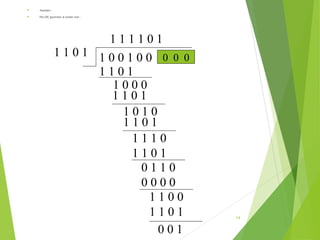
 The CRC generator at sender end :
14
1 1 0 1
1 1 1 1 0 1
1 0 0 1 0 0 0 0 0
1 1 0 1
1 0 0 0
1 1 0 1
1 0 1 0
1 1 0 1
1 1 1 0
1 1 0 1
0 1 1 0
0 0 0 0
1 1 0 0
1 1 0 1
0 0 1
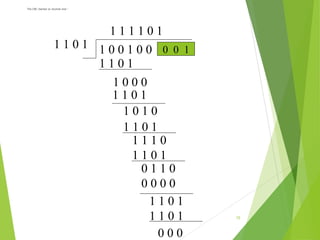
The CRC checker at receiver end :
15
1 1 0 1
1 1 1 1 0 1
1 0 0 1 0 0 0 0 1
1 1 0 1
1 0 0 0
1 1 0 1
1 0 1 0
1 1 0 1
1 1 1 0
1 1 0 1
0 1 1 0
0 0 0 0
1 1 0 1
1 1 0 1
0 0 0
ERROR CORRECTION
 Error correcting code is to include enough
redundant information along with each block of
data sent to enable the receiver to deduce
what the transmitted character must have
been.
 Error Correction must be handled in two ways :
- When an error is discovered, the receiver
can have the sender retransmit the entire data
unit.
- Receiver can use an error correcting code,
which automatically corrects certain errors.16
 There are two types of Error Correcting techniques :
1. Single bit error correction.
2. Burst error correction.
 Error Correction can be done with the help
of HAMMING CODE.
17
HAMMING CODE
 It is a technique developed by R.W.Hamming.
 Hamming code can be applied to data units of any
length and uses the relationship between data and
redundancy bits. For eg.
18
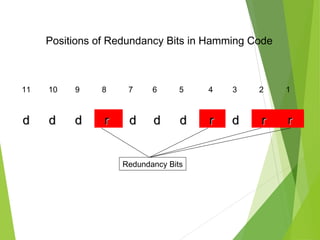
 A 7 bit ASCII code requires 4 Redundancy bits that can be added to the
end of the data unit or interspersed with the original data bits.
 These bits are placed in positions 1,2,4 and 8. We refer to these bits as
r1,r2,r4 and r8.
19
dd dd dd rr dd dd dd rr dd rr rr
20
Redundancy Bits
Positions of Redundancy Bits in Hamming Code
11 10 9 8 7 6 5 4 3 2 1
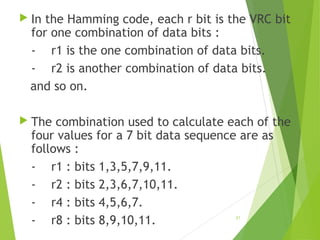
 In the Hamming code, each r bit is the VRC bit
for one combination of data bits :
- r1 is the one combination of data bits.
- r2 is another combination of data bits.
and so on.
 The combination used to calculate each of the
four values for a 7 bit data sequence are as
follows :
- r1 : bits 1,3,5,7,9,11.
- r2 : bits 2,3,6,7,10,11.
- r4 : bits 4,5,6,7.
- r8 : bits 8,9,10,11. 21
11 00 00 11 11 00 11
22
11 00 00 11 11 00 11 11
11 00 00 11 11 00 11 00 11
11 00 00 11 11 00 00 11 00 11
11 00 00 11 11 11 00 00 11 00 11
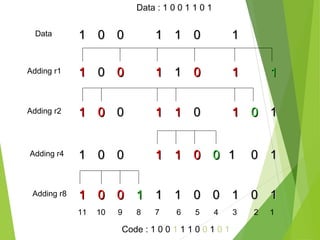
Data : 1 0 0 1 1 0 1
Data
Adding r1
Adding r2
Adding r4
Adding r8
Code : 1 0 0 1 1 1 0 0 1 0 1
11 10 9 8 7 6 5 4 3 2 1
11 00 00 11 11 11 00 00 11 00 11
23
11 00 00 11 00 11 00 00 11 00 11
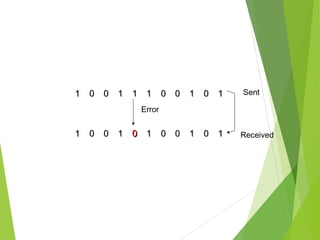
Sent
Received
Error
24
11 00 00 11 00 11 00 00 11 00 11
11 10 9 8 7 6 5 4 3 2 1
11 00 00 11 00 11 00 00 11 00 11
11 10 9 8 7 6 5 4 3 2 1
11 00 00 11 00 11 00 00 11 00 11
11 10 9 8 7 6 5 4 3 2 1
11 00 00 11 00 11 00 00 11 00 11
11 10 9 8 7 6 5 4 3 2 1
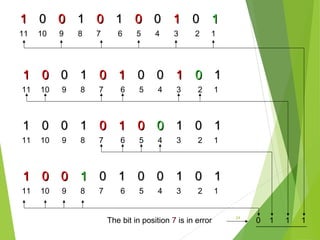
0 1 1 1The bit in position 7 is in error

Error detection correction (CRC)

  • 1.
  • 2.
     Data canbe corrupted during transmission. For reliable communication, errors must be detected and corrected.  Error detection and correction are implemented either at data link layer or the transport layer of the OSI model. 2
  • 3.
    TYPES OF ERRORS Single bit error :- -Only one bit in the data unit has changed.  Burst error :- -It means that two or more bits in the data unit has changed. 3
  • 4.
    Single bit Error 0000 00 00 11 00 11 00 4 00 00 00 00 00 00 11 00 Burst ErrorBurst Error 00 11 00 00 00 11 00 00 00 11 00 00 00 00 11 11 00 11 00 11 11 11 00 11 00 11 00 00 00 00 11 11 0 changed to 1 Received Sent Sent Received Bits corrupted by Burst Error
  • 5.
    ERROR DETECTION  Errordetecting code is to include only enough redundancy to allow the receiver to deduce that an error occurred, but not which error, and have it request a re-transmission.  Error detection uses the concept of redundancy, which means adding extra bits for detecting error at the destination. 5
  • 6.
    Redundancy  Instead ofrepeating the entire data stream, a shorter group of bits may be appended to the end of each unit. This technique is called Redundancy because the extra bit are redundant to the information. They are discarded as soon as the accuracy of the transmission has been determined. 6
  • 7.
  • 8.
     There arebasically four types of redundancy checks. They are: 1. VRC (Vertical Redundancy Check). 2. LRC (Longitudinal Redundancy Check). 3. CRC (Cyclical Redundancy Check). 8
  • 9.
    ERROR DETECTION  VERTICALREDUNDUNCY CHECK  LONGITUDINAL REDUNDANCY CHECK  CYCLIC REDUNDANCY CHECK 9
  • 10.
    CYCLIC REDUNDANCY CHECK (CRC) In this method , a sequence of redundant bits , called the CRC or the CRC remainder, is appended to the end of the unit so that the resulting data unit become exactly divisible by a second, predetermined binary number. At its destination , the incoming data is divided by the same number. If at this step there is no remaunit inder ,the data unit assume to be correct and is accepted, otherwise it indicate that data unit has been damaged in transmission and therefore must be rejected. The redundancy bits is used by CRC are derived by dividing the data unit by a predetermined divisor. The remainder is the CRC. 10
  • 11.
     CRC generatorand checker 11 DATA CRC DIVISOR REMAINDER CRC DATA CRC DIVIS0R DATA 00…0 Zero accept Nonzero reject N bits N+1 bits N bits Receiver Sender
  • 12.
    Divisor The divisor isdetermined according to the algebraic polynomial. for e.g. A polynomial is X^7 + x^5 + x^2 + x + 1 generation of divisor from polynomial 12 X^7 + X^5 + X^2 + X + 1 1 0 1 0 0 1 1 1 X^4 X^3X^6
  • 13.
    A polynomial shouldbe selected according to the following rule:- 1. It should not be divisible by x. 2. It should be divisible by x+1. 13
  • 14.
     Example :- The CRC generator at sender end : 14 1 1 0 1 1 1 1 1 0 1 1 0 0 1 0 0 0 0 0 1 1 0 1 1 0 0 0 1 1 0 1 1 0 1 0 1 1 0 1 1 1 1 0 1 1 0 1 0 1 1 0 0 0 0 0 1 1 0 0 1 1 0 1 0 0 1
  • 15.
    The CRC checkerat receiver end : 15 1 1 0 1 1 1 1 1 0 1 1 0 0 1 0 0 0 0 1 1 1 0 1 1 0 0 0 1 1 0 1 1 0 1 0 1 1 0 1 1 1 1 0 1 1 0 1 0 1 1 0 0 0 0 0 1 1 0 1 1 1 0 1 0 0 0
  • 16.
    ERROR CORRECTION  Errorcorrecting code is to include enough redundant information along with each block of data sent to enable the receiver to deduce what the transmitted character must have been.  Error Correction must be handled in two ways : - When an error is discovered, the receiver can have the sender retransmit the entire data unit. - Receiver can use an error correcting code, which automatically corrects certain errors.16
  • 17.
     There aretwo types of Error Correcting techniques : 1. Single bit error correction. 2. Burst error correction.  Error Correction can be done with the help of HAMMING CODE. 17
  • 18.
    HAMMING CODE  Itis a technique developed by R.W.Hamming.  Hamming code can be applied to data units of any length and uses the relationship between data and redundancy bits. For eg. 18
  • 19.
     A 7bit ASCII code requires 4 Redundancy bits that can be added to the end of the data unit or interspersed with the original data bits.  These bits are placed in positions 1,2,4 and 8. We refer to these bits as r1,r2,r4 and r8. 19
  • 20.
    dd dd ddrr dd dd dd rr dd rr rr 20 Redundancy Bits Positions of Redundancy Bits in Hamming Code 11 10 9 8 7 6 5 4 3 2 1
  • 21.
     In theHamming code, each r bit is the VRC bit for one combination of data bits : - r1 is the one combination of data bits. - r2 is another combination of data bits. and so on.  The combination used to calculate each of the four values for a 7 bit data sequence are as follows : - r1 : bits 1,3,5,7,9,11. - r2 : bits 2,3,6,7,10,11. - r4 : bits 4,5,6,7. - r8 : bits 8,9,10,11. 21
  • 22.
    11 00 0011 11 00 11 22 11 00 00 11 11 00 11 11 11 00 00 11 11 00 11 00 11 11 00 00 11 11 00 00 11 00 11 11 00 00 11 11 11 00 00 11 00 11 Data : 1 0 0 1 1 0 1 Data Adding r1 Adding r2 Adding r4 Adding r8 Code : 1 0 0 1 1 1 0 0 1 0 1 11 10 9 8 7 6 5 4 3 2 1
  • 23.
    11 00 0011 11 11 00 00 11 00 11 23 11 00 00 11 00 11 00 00 11 00 11 Sent Received Error
  • 24.
    24 11 00 0011 00 11 00 00 11 00 11 11 10 9 8 7 6 5 4 3 2 1 11 00 00 11 00 11 00 00 11 00 11 11 10 9 8 7 6 5 4 3 2 1 11 00 00 11 00 11 00 00 11 00 11 11 10 9 8 7 6 5 4 3 2 1 11 00 00 11 00 11 00 00 11 00 11 11 10 9 8 7 6 5 4 3 2 1 0 1 1 1The bit in position 7 is in error