Managing Workplace
Conflict
Cavelle Joseph, M.B.A., B.Sc.
HRMATT’s 9th Biennial Conference
Hilton Trinidad & Conference Center
14th May 2013
“Whycan’t wealljustgetalong?”
This is a question, as many of you may remember,
was asked in the worst of circumstances by a man
severely beaten during an arrest.
How many of us ask this on a daily basis?
In personal and family relationships, in schools and at
work, interactions among people are often fraught with
disagreements.
This presentation is intended to address managers,
supervisors and other individuals who manage
employees.
HRMATT’s 9th Biennial Conference – May 13th & 14th, 2013 2
At the close of this session, you will be able to:
Explain what workplace conflicts are, the forms
they take and cite examples.
List at least three causes of these conflicts.
State ways interpersonal conflicts may be avoided.
List steps to follow in addressing an interpersonal
conflict between two or more employees
Describe the supervisor’s responsibility during a
conflict resolution meeting.
HRMATT’s 9th Biennial Conference – May 13th & 14th, 2013 3
A condition between workers who are:
Interdependent in some way
Acting in ways that create a business problem
When one or both parties are not able to secure
what they need or want and are actively seeking
their own goals.
Conflict can build up over time or it can flare up
suddenly.
HRMATT’s 9th Biennial Conference – May 13th & 14th, 2013 4
It can be based on genuine disagreements
about the job, but it also can be fueled by many
other things:
Pressures that the individuals are feeling
Frustrations
Fears
Personal dislikes, etc.
HRMATT’s 9th Biennial Conference – May 13th & 14th, 2013 5
A conflict exists when one person’s attempt to
reach his or her goals interferes with another
person’s attempt to do the same.
Ex. Gail’s goal is to do her job well, and she see
her efforts being blocked by Frank.
His goal may be to prevent his cherished way of
doing things from changing.
Frank patronizes Gail, she threatens and calls him a
name.
HRMATT’s 9th Biennial Conference – May 13th & 14th, 2013 6
Of course, conflict doesn’t have to be so open
or obvious.
Perhaps the nastiest conflict in organizations
(and personal interactions) are the ones
papered over by smiles and hearty greetings.
If you feel that someone who pretends to like
you is really stabbing you in the back, you ARE
in conflict.
HRMATT’s 9th Biennial Conference – May 13th & 14th, 2013 7
Some signs of conflict are very visible. For ex.,
you might:
Witness a heated exchange between colleagues.
Attend a meeting between management and
employee representatives that turns into a stand-
off.
However, not all forms of conflict are so
obvious.
HRMATT’s 9th Biennial Conference – May 13th & 14th, 2013 8
Spotting conflict at an early stage gives you a
better chance of:
Identifying the underlying causes
Reaching a sustainable agreement
Resolving the conflict
HRMATT’s 9th Biennial Conference – May 13th & 14th, 2013 9
Misunderstanding
Personality clashes
Competition for resources
Authority issues
Lack of cooperation
Differences over methods or style
Low performance
Value or goal differences
HRMATT’s 9th Biennial Conference – May 13th & 14th, 2013 10
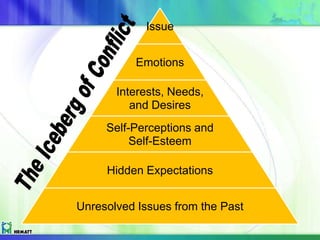
Issue
Emotions
Interests, Needs,
and Desires
Self-Perceptions and
Self-Esteem
Hidden Expectations
Unresolved Issues from the Past
You might notice the following symptoms:
Motivation drops: fewer people volunteer to take on new
tasks and there is little employee input at meetings
Behaviour changes: people start to make derogatory
remarks towards each other and there are fewer social
events organized
Productivity falls: there are likely to be more queries and
complaints if people are not cooperating with each other
Sickness absence increases: unhappiness may lead to
depression or stress
Responses to staff attitude surveys or questionnaires
indicate underlying dissatisfaction.
HRMATT’s 9th Biennial Conference – May 13th & 14th, 2013 12
Conflict is destructive when it:
Diverts energy from more important issues and
tasks
Deepens differences in values
Polarizes groups so that cooperation is reduced
Destroys morale of people or reinforces poor self
concepts
HRMATT’s 9th Biennial Conference – May 13th & 14th, 2013 13
Conflict is constructive when it:
Opens up issues of importance, resulting in issue
clarification.
Helps build cohesiveness as people learn more
about each other.
Causes reassessment by allowing for examination
of procedures or actions.
Increases individual involvement.
HRMATT’s 9th Biennial Conference – May 13th & 14th, 2013 14
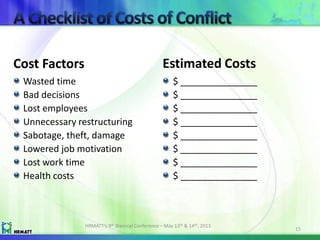
Cost Factors
Wasted time
Bad decisions
Lost employees
Unnecessary restructuring
Sabotage, theft, damage
Lowered job motivation
Lost work time
Health costs
Estimated Costs
$ _______________
$ _______________
$ _______________
$ _______________
$ _______________
$ _______________
$ _______________
$ _______________
HRMATT’s 9th Biennial Conference – May 13th & 14th, 2013
15
Avoid – Non confrontational; denies issues are a
problem.
Accommodate – agreeable, non – assertive;
cooperative even at the expense of personal goals.
Compete – uses power, position, personality, or
status to get own way.
Compromise – aggressive but cooperative; tries to
bargain, compromise, and split the difference.
Collaborate – high respect for mutual benefit.
HRMATT’s 9th Biennial Conference – May 13th & 14th, 2013 16
When presented with conflict, we may act
without thinking about the choices we have.
Consider the degree of assertiveness (“I want
my way”) and cooperation (“Whatever you
want”) in each style.
HRMATT’s 9th Biennial Conference – May 13th & 14th, 2013 17
When the following conditions are in place, the
likelihood of a positive resolution increases:
Commitment to find a resolution that is mutually
beneficial.
Trust.
Frame of mind that there is more than one way to
look at the issues.
Belief that a solution exists.
Commitment to stay in the communication process.
HRMATT’s 9th Biennial Conference – May 13th & 14th, 2013 18
1. Obtain agreement from all parties that they
will:
Work to resolve the conflict.
Treat each other with respect, dignity and fairness.
Be clear and truthful about what is really bothering
them and what they want to change.
Listen to other participants and make an effort to
understand their views.
Be willing to take responsibility for their behaviour.
Be willing to compromise.
HRMATT’s 9th Biennial Conference – May 13th & 14th, 2013 19
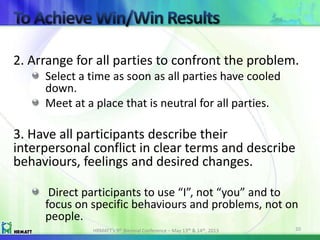
2. Arrange for all parties to confront the problem.
Select a time as soon as all parties have cooled
down.
Meet at a place that is neutral for all parties.
3. Have all participants describe their
interpersonal conflict in clear terms and describe
behaviours, feelings and desired changes.
Direct participants to use “I”, not “you” and to
focus on specific behaviours and problems, not on
people.
HRMATT’s 9th Biennial Conference – May 13th & 14th, 2013 20
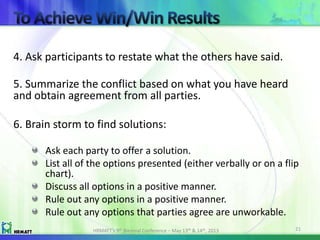
4. Ask participants to restate what the others have said.
5. Summarize the conflict based on what you have heard
and obtain agreement from all parties.
6. Brain storm to find solutions:
Ask each party to offer a solution.
List all of the options presented (either verbally or on a flip
chart).
Discuss all options in a positive manner.
Rule out any options in a positive manner.
Rule out any options that parties agree are unworkable.
HRMATT’s 9th Biennial Conference – May 13th & 14th, 2013 21
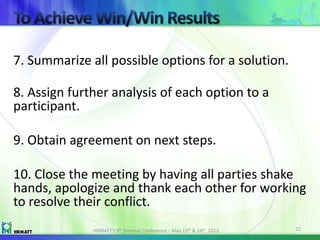
7. Summarize all possible options for a solution.
8. Assign further analysis of each option to a
participant.
9. Obtain agreement on next steps.
10. Close the meeting by having all parties shake
hands, apologize and thank each other for working
to resolve their conflict.
HRMATT’s 9th Biennial Conference – May 13th & 14th, 2013 22
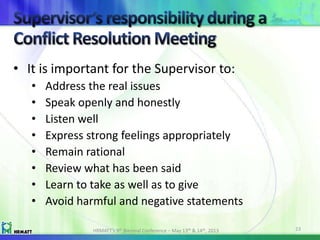
• It is important for the Supervisor to:
• Address the real issues
• Speak openly and honestly
• Listen well
• Express strong feelings appropriately
• Remain rational
• Review what has been said
• Learn to take as well as to give
• Avoid harmful and negative statements
HRMATT’s 9th Biennial Conference – May 13th & 14th, 2013 23
• Developing and implementing workplace conflict
policies and procedures.
• Creating and managing conflict – resolution
programs.
• Initiating employee communications on conflict.
• Tracking the metrics and the costs of conflict
resolution efforts.
• Becoming involved in settling workplace conflicts.
• If HR cannot resolve a conflict, an outside
specialist may be needed to work out a
settlement.
HRMATT’s 9th Biennial Conference – May 13th & 14th, 2013 24
3Thingsyou can start doingtomorrow
HRMATT’s 9th Biennial Conference – May 13th & 14th, 2013 25
1. Deal with complaints and problems
2. Realize “perception” is as important as reality
3. Remember the goal is to prevent, resolve and
avoid claims – not to “win”
HRMATT’s 9th Biennial Conference – May 13th & 14th, 2013 26
• Conflict Resolution (2001) by Daniel Dana
• People Styles at Work (1996) by Robert
Bolton & Dorothy Grover Bolton
• Resolving Conflicts at Work (2005) by
Kenneth Cloke & Joan Goldsmith
• Workplace Wars and How to End Them
(1994) by Kenneth Kaye
Speaker’s Contact Info
HRMATT’s 9th Biennial Conference – May 13th & 14th, 2013 27
Phone: 620-9193
E-mail: cavellewjoseph@gmail.com
Skype: Cavelle-Joseph
LinkedIn: Cavelle Joseph

Managing Workplace Conflict - HRMATT

  • 1.
    Managing Workplace Conflict Cavelle Joseph,M.B.A., B.Sc. HRMATT’s 9th Biennial Conference Hilton Trinidad & Conference Center 14th May 2013
  • 2.
    “Whycan’t wealljustgetalong?” This isa question, as many of you may remember, was asked in the worst of circumstances by a man severely beaten during an arrest. How many of us ask this on a daily basis? In personal and family relationships, in schools and at work, interactions among people are often fraught with disagreements. This presentation is intended to address managers, supervisors and other individuals who manage employees. HRMATT’s 9th Biennial Conference – May 13th & 14th, 2013 2
  • 3.
    At the closeof this session, you will be able to: Explain what workplace conflicts are, the forms they take and cite examples. List at least three causes of these conflicts. State ways interpersonal conflicts may be avoided. List steps to follow in addressing an interpersonal conflict between two or more employees Describe the supervisor’s responsibility during a conflict resolution meeting. HRMATT’s 9th Biennial Conference – May 13th & 14th, 2013 3
  • 4.
    A condition betweenworkers who are: Interdependent in some way Acting in ways that create a business problem When one or both parties are not able to secure what they need or want and are actively seeking their own goals. Conflict can build up over time or it can flare up suddenly. HRMATT’s 9th Biennial Conference – May 13th & 14th, 2013 4
  • 5.
    It can bebased on genuine disagreements about the job, but it also can be fueled by many other things: Pressures that the individuals are feeling Frustrations Fears Personal dislikes, etc. HRMATT’s 9th Biennial Conference – May 13th & 14th, 2013 5
  • 6.
    A conflict existswhen one person’s attempt to reach his or her goals interferes with another person’s attempt to do the same. Ex. Gail’s goal is to do her job well, and she see her efforts being blocked by Frank. His goal may be to prevent his cherished way of doing things from changing. Frank patronizes Gail, she threatens and calls him a name. HRMATT’s 9th Biennial Conference – May 13th & 14th, 2013 6
  • 7.
    Of course, conflictdoesn’t have to be so open or obvious. Perhaps the nastiest conflict in organizations (and personal interactions) are the ones papered over by smiles and hearty greetings. If you feel that someone who pretends to like you is really stabbing you in the back, you ARE in conflict. HRMATT’s 9th Biennial Conference – May 13th & 14th, 2013 7
  • 8.
    Some signs ofconflict are very visible. For ex., you might: Witness a heated exchange between colleagues. Attend a meeting between management and employee representatives that turns into a stand- off. However, not all forms of conflict are so obvious. HRMATT’s 9th Biennial Conference – May 13th & 14th, 2013 8
  • 9.
    Spotting conflict atan early stage gives you a better chance of: Identifying the underlying causes Reaching a sustainable agreement Resolving the conflict HRMATT’s 9th Biennial Conference – May 13th & 14th, 2013 9
  • 10.
    Misunderstanding Personality clashes Competition forresources Authority issues Lack of cooperation Differences over methods or style Low performance Value or goal differences HRMATT’s 9th Biennial Conference – May 13th & 14th, 2013 10
  • 11.
    Issue Emotions Interests, Needs, and Desires Self-Perceptionsand Self-Esteem Hidden Expectations Unresolved Issues from the Past
  • 12.
    You might noticethe following symptoms: Motivation drops: fewer people volunteer to take on new tasks and there is little employee input at meetings Behaviour changes: people start to make derogatory remarks towards each other and there are fewer social events organized Productivity falls: there are likely to be more queries and complaints if people are not cooperating with each other Sickness absence increases: unhappiness may lead to depression or stress Responses to staff attitude surveys or questionnaires indicate underlying dissatisfaction. HRMATT’s 9th Biennial Conference – May 13th & 14th, 2013 12
  • 13.
    Conflict is destructivewhen it: Diverts energy from more important issues and tasks Deepens differences in values Polarizes groups so that cooperation is reduced Destroys morale of people or reinforces poor self concepts HRMATT’s 9th Biennial Conference – May 13th & 14th, 2013 13
  • 14.
    Conflict is constructivewhen it: Opens up issues of importance, resulting in issue clarification. Helps build cohesiveness as people learn more about each other. Causes reassessment by allowing for examination of procedures or actions. Increases individual involvement. HRMATT’s 9th Biennial Conference – May 13th & 14th, 2013 14
  • 15.
    Cost Factors Wasted time Baddecisions Lost employees Unnecessary restructuring Sabotage, theft, damage Lowered job motivation Lost work time Health costs Estimated Costs $ _______________ $ _______________ $ _______________ $ _______________ $ _______________ $ _______________ $ _______________ $ _______________ HRMATT’s 9th Biennial Conference – May 13th & 14th, 2013 15
  • 16.
    Avoid – Nonconfrontational; denies issues are a problem. Accommodate – agreeable, non – assertive; cooperative even at the expense of personal goals. Compete – uses power, position, personality, or status to get own way. Compromise – aggressive but cooperative; tries to bargain, compromise, and split the difference. Collaborate – high respect for mutual benefit. HRMATT’s 9th Biennial Conference – May 13th & 14th, 2013 16
  • 17.
    When presented withconflict, we may act without thinking about the choices we have. Consider the degree of assertiveness (“I want my way”) and cooperation (“Whatever you want”) in each style. HRMATT’s 9th Biennial Conference – May 13th & 14th, 2013 17
  • 18.
    When the followingconditions are in place, the likelihood of a positive resolution increases: Commitment to find a resolution that is mutually beneficial. Trust. Frame of mind that there is more than one way to look at the issues. Belief that a solution exists. Commitment to stay in the communication process. HRMATT’s 9th Biennial Conference – May 13th & 14th, 2013 18
  • 19.
    1. Obtain agreementfrom all parties that they will: Work to resolve the conflict. Treat each other with respect, dignity and fairness. Be clear and truthful about what is really bothering them and what they want to change. Listen to other participants and make an effort to understand their views. Be willing to take responsibility for their behaviour. Be willing to compromise. HRMATT’s 9th Biennial Conference – May 13th & 14th, 2013 19
  • 20.
    2. Arrange forall parties to confront the problem. Select a time as soon as all parties have cooled down. Meet at a place that is neutral for all parties. 3. Have all participants describe their interpersonal conflict in clear terms and describe behaviours, feelings and desired changes. Direct participants to use “I”, not “you” and to focus on specific behaviours and problems, not on people. HRMATT’s 9th Biennial Conference – May 13th & 14th, 2013 20
  • 21.
    4. Ask participantsto restate what the others have said. 5. Summarize the conflict based on what you have heard and obtain agreement from all parties. 6. Brain storm to find solutions: Ask each party to offer a solution. List all of the options presented (either verbally or on a flip chart). Discuss all options in a positive manner. Rule out any options in a positive manner. Rule out any options that parties agree are unworkable. HRMATT’s 9th Biennial Conference – May 13th & 14th, 2013 21
  • 22.
    7. Summarize allpossible options for a solution. 8. Assign further analysis of each option to a participant. 9. Obtain agreement on next steps. 10. Close the meeting by having all parties shake hands, apologize and thank each other for working to resolve their conflict. HRMATT’s 9th Biennial Conference – May 13th & 14th, 2013 22
  • 23.
    • It isimportant for the Supervisor to: • Address the real issues • Speak openly and honestly • Listen well • Express strong feelings appropriately • Remain rational • Review what has been said • Learn to take as well as to give • Avoid harmful and negative statements HRMATT’s 9th Biennial Conference – May 13th & 14th, 2013 23
  • 24.
    • Developing andimplementing workplace conflict policies and procedures. • Creating and managing conflict – resolution programs. • Initiating employee communications on conflict. • Tracking the metrics and the costs of conflict resolution efforts. • Becoming involved in settling workplace conflicts. • If HR cannot resolve a conflict, an outside specialist may be needed to work out a settlement. HRMATT’s 9th Biennial Conference – May 13th & 14th, 2013 24
  • 25.
    3Thingsyou can startdoingtomorrow HRMATT’s 9th Biennial Conference – May 13th & 14th, 2013 25 1. Deal with complaints and problems 2. Realize “perception” is as important as reality 3. Remember the goal is to prevent, resolve and avoid claims – not to “win”
  • 26.
    HRMATT’s 9th BiennialConference – May 13th & 14th, 2013 26 • Conflict Resolution (2001) by Daniel Dana • People Styles at Work (1996) by Robert Bolton & Dorothy Grover Bolton • Resolving Conflicts at Work (2005) by Kenneth Cloke & Joan Goldsmith • Workplace Wars and How to End Them (1994) by Kenneth Kaye
  • 27.
    Speaker’s Contact Info HRMATT’s9th Biennial Conference – May 13th & 14th, 2013 27 Phone: 620-9193 E-mail: cavellewjoseph@gmail.com Skype: Cavelle-Joseph LinkedIn: Cavelle Joseph